Deborah Lince
Walden University
EDUC – 6706G-4:
The Beginning Reader, PreK-3
What is a Literate Environment?
   "Construction of a literacy program starts with the students. The
    program should be based on their interests, their abilities, and the
    nature of the community in which they live" (Gunning, 2008, pp.
    533-534).


   “The classroom community should feel safe and respectful so
    students are motivated to learn and actively involved in reading and
    writing activities. Perhaps the most striking quality is the
    partnership that the teacher and students create: They become a
    „family‟ in which all the members respect one another and support
    each other‟s learning” (Tompkins, 2010, p. 116).
Getting to Know Literacy Learners


   As kindergarteners, most of my students are developing
    as literacy learners. Unfortunately, for some, this is their
    first exposure to reading. Being able to determine the
    noncognitive aspects of each student provides critical
    additional information. Assessments are only one piece
    of the puzzle; observations, conferences, and familial
    history are all factors in what creates a literary learner.
    As each puzzle piece is placed, the big picture begins to
    form so that individualized instruction can occur and
    student success can be achieved. "By linking
    assessment and instruction, teachers improve students'
    learning and their teaching" (Tompkins, 2010, p. 75).
Key assessments include:
   Phonics (upper and lowercase letter identification and sounds)
   Phonemic awareness (rhyme, long vowels, blending, initial and
    ending sounds)
   36 high frequency words
   Concepts of print (front and back cover, holds book, title, turns
    pages, identifies a letter, word, and sentence, identifying the job of the
    author and illustrator, and directionality).
   Letter identification and sounds guide daily instruction.
   DIBELS

Connections are made in handwriting, calendar, and in letters of the
 week to help increase awareness. Coordination with the ELL
 instructor occurs to further support ELL students. This ensures that
 they are receiving proper support and instruction based on their level
 of English understanding.
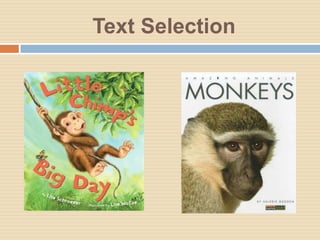
Text Selection
   "We are surrounded by text whose primary
    purpose is to convey information about the
    natural or social world. Success in
    schooling, the workplace, and society
    depends on our ability to comprehend this
    material. Yet many children and adults
    struggle to comprehend informational text"
    (Duke, 2004, p. 40).
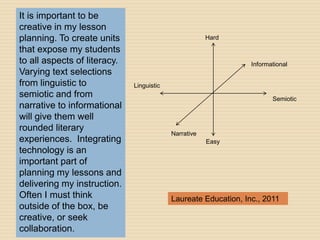
It is important to be
creative in my lesson
planning. To create units                              Hard

that expose my students
to all aspects of literacy.                                      Informational
Varying text selections
from linguistic to            Linguistic
semiotic and from                                                       Semiotic
narrative to informational
will give them well
rounded literary
                                           Narrative
experiences. Integrating                               Easy
technology is an
important part of
planning my lessons and
delivering my instruction.
Often I must think                         Laureate Education, Inc., 2011
outside of the box, be
creative, or seek
collaboration.
Interactive Perspective
   “Interactive texts teach students how to read and write” (Laureate
    Education, Inc., 2011).
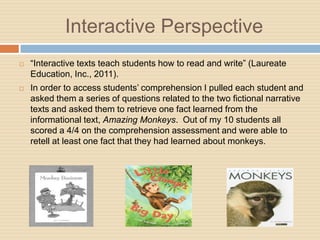
   In order to access students‟ comprehension I pulled each student and
    asked them a series of questions related to the two fictional narrative
    texts and asked them to retrieve one fact learned from the
    informational text, Amazing Monkeys. Out of my 10 students all
    scored a 4/4 on the comprehension assessment and were able to
    retell at least one fact that they had learned about monkeys.
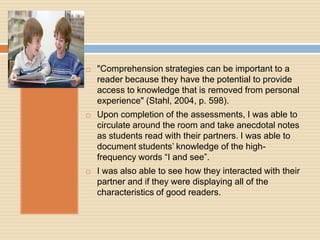
   "Comprehension strategies can be important to a
    reader because they have the potential to provide
    access to knowledge that is removed from personal
    experience" (Stahl, 2004, p. 598).
   Upon completion of the assessments, I was able to
    circulate around the room and take anecdotal notes
    as students read with their partners. I was able to
    document students‟ knowledge of the high-
    frequency words “I and see”.
   I was also able to see how they interacted with their
    partner and if they were displaying all of the
    characteristics of good readers.
Critical & Response Perspectives


   “Using critical literacy helps pull the power
      from the author and makes it an equal
 relationship between the author and the reader
      by allowing us to see the texts from all
 angles, not just believing what is written down”
               (Molden, 2007, p.51).
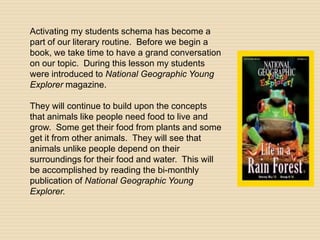
Activating my students schema has become a
part of our literary routine. Before we begin a
book, we take time to have a grand conversation
on our topic. During this lesson my students
were introduced to National Geographic Young
Explorer magazine.

They will continue to build upon the concepts
that animals like people need food to live and
grow. Some get their food from plants and some
get it from other animals. They will see that
animals unlike people depend on their
surroundings for their food and water. This will
be accomplished by reading the bi-monthly
publication of National Geographic Young
Explorer.
Conclusion

   As I continue to supplement my curriculum with
    the wonderful text selections available I am seeing
    growth in my students and my teaching practice.
    Informational text can be enjoyed just as much as
    fictional narrative if given a chance. My students
    are learning to analyze texts and to become
    critical thinkers. These are important skills that
    they will continue to hone throughout their
    academic careers. Teaching these skills at the
    beginning will enable them to become efficient in
    both critical and response perspectives leading to
    their ultimate success.
References
Bodden, V. (2010). Amazing monkeys. Mankato: Creative Paperbacks.

Duke, N. (2004). The case for informational text. Educational Leadership, 61(6), 40–44.

Gunning, T. G. (2008). Creating literacy instruction for all students (6th ed.). Boston: Pearson Education, Inc.

Laureate Education, Inc. (Producer). (2011). Analyzing and Selecting Text. [Video webcast]. In The beginning reader: PreK-3. Retrieved from

      http://www.courseur.com

Laureate Education, Inc. (Producer). (2011c). Interactive Perspective: Guided Reading. [Video webcast]. In The beginning reader: PreK-3. Retrieved from

      http://www.courseurl.com

Molden, K. (2007). Critical literacy, the right answer for the reading classroom: strategies to move beyond comprehension for reading improvement. Reading

      Improvement, 44 (1), 50-56.

National Geographic Kids. (n.d.). Chimpanzees. Retrieved from http://kids.nationalgeographic.com/kids/animals/creaturefeature/chimpanzee/


Schroeder, L. (2010). Little chimp's big day. New York: Sterling Publishing Company.

Sprick, M. (2004). Monkey Business. Longmont: Sopris West.


Stahl, K. A. D. (2004). Proof, practice, and promise: Comprehension strategy instruction in the primary grades. Reading Teacher, 57(7), 598–

      608.

Tompkins, G. E. (2010). Literacy for the 21st century: A balanced approach (5th ed.). Boston: Allyn & Bacon.

Deborah lince

  • 1.
    Deborah Lince Walden University EDUC– 6706G-4: The Beginning Reader, PreK-3
  • 2.
    What is aLiterate Environment?  "Construction of a literacy program starts with the students. The program should be based on their interests, their abilities, and the nature of the community in which they live" (Gunning, 2008, pp. 533-534).  “The classroom community should feel safe and respectful so students are motivated to learn and actively involved in reading and writing activities. Perhaps the most striking quality is the partnership that the teacher and students create: They become a „family‟ in which all the members respect one another and support each other‟s learning” (Tompkins, 2010, p. 116).
  • 3.
    Getting to KnowLiteracy Learners  As kindergarteners, most of my students are developing as literacy learners. Unfortunately, for some, this is their first exposure to reading. Being able to determine the noncognitive aspects of each student provides critical additional information. Assessments are only one piece of the puzzle; observations, conferences, and familial history are all factors in what creates a literary learner. As each puzzle piece is placed, the big picture begins to form so that individualized instruction can occur and student success can be achieved. "By linking assessment and instruction, teachers improve students' learning and their teaching" (Tompkins, 2010, p. 75).
  • 4.
    Key assessments include:  Phonics (upper and lowercase letter identification and sounds)  Phonemic awareness (rhyme, long vowels, blending, initial and ending sounds)  36 high frequency words  Concepts of print (front and back cover, holds book, title, turns pages, identifies a letter, word, and sentence, identifying the job of the author and illustrator, and directionality).  Letter identification and sounds guide daily instruction.  DIBELS Connections are made in handwriting, calendar, and in letters of the week to help increase awareness. Coordination with the ELL instructor occurs to further support ELL students. This ensures that they are receiving proper support and instruction based on their level of English understanding.
  • 5.
  • 6.
    "We are surrounded by text whose primary purpose is to convey information about the natural or social world. Success in schooling, the workplace, and society depends on our ability to comprehend this material. Yet many children and adults struggle to comprehend informational text" (Duke, 2004, p. 40).
  • 7.
    It is importantto be creative in my lesson planning. To create units Hard that expose my students to all aspects of literacy. Informational Varying text selections from linguistic to Linguistic semiotic and from Semiotic narrative to informational will give them well rounded literary Narrative experiences. Integrating Easy technology is an important part of planning my lessons and delivering my instruction. Often I must think Laureate Education, Inc., 2011 outside of the box, be creative, or seek collaboration.
  • 8.
    Interactive Perspective  “Interactive texts teach students how to read and write” (Laureate Education, Inc., 2011).  In order to access students‟ comprehension I pulled each student and asked them a series of questions related to the two fictional narrative texts and asked them to retrieve one fact learned from the informational text, Amazing Monkeys. Out of my 10 students all scored a 4/4 on the comprehension assessment and were able to retell at least one fact that they had learned about monkeys.
  • 9.
    "Comprehension strategies can be important to a reader because they have the potential to provide access to knowledge that is removed from personal experience" (Stahl, 2004, p. 598).  Upon completion of the assessments, I was able to circulate around the room and take anecdotal notes as students read with their partners. I was able to document students‟ knowledge of the high- frequency words “I and see”.  I was also able to see how they interacted with their partner and if they were displaying all of the characteristics of good readers.
  • 10.
    Critical & ResponsePerspectives  “Using critical literacy helps pull the power from the author and makes it an equal relationship between the author and the reader by allowing us to see the texts from all angles, not just believing what is written down” (Molden, 2007, p.51).
  • 11.
    Activating my studentsschema has become a part of our literary routine. Before we begin a book, we take time to have a grand conversation on our topic. During this lesson my students were introduced to National Geographic Young Explorer magazine. They will continue to build upon the concepts that animals like people need food to live and grow. Some get their food from plants and some get it from other animals. They will see that animals unlike people depend on their surroundings for their food and water. This will be accomplished by reading the bi-monthly publication of National Geographic Young Explorer.
  • 12.
    Conclusion  As I continue to supplement my curriculum with the wonderful text selections available I am seeing growth in my students and my teaching practice. Informational text can be enjoyed just as much as fictional narrative if given a chance. My students are learning to analyze texts and to become critical thinkers. These are important skills that they will continue to hone throughout their academic careers. Teaching these skills at the beginning will enable them to become efficient in both critical and response perspectives leading to their ultimate success.
  • 13.
    References Bodden, V. (2010).Amazing monkeys. Mankato: Creative Paperbacks. Duke, N. (2004). The case for informational text. Educational Leadership, 61(6), 40–44. Gunning, T. G. (2008). Creating literacy instruction for all students (6th ed.). Boston: Pearson Education, Inc. Laureate Education, Inc. (Producer). (2011). Analyzing and Selecting Text. [Video webcast]. In The beginning reader: PreK-3. Retrieved from http://www.courseur.com Laureate Education, Inc. (Producer). (2011c). Interactive Perspective: Guided Reading. [Video webcast]. In The beginning reader: PreK-3. Retrieved from http://www.courseurl.com Molden, K. (2007). Critical literacy, the right answer for the reading classroom: strategies to move beyond comprehension for reading improvement. Reading Improvement, 44 (1), 50-56. National Geographic Kids. (n.d.). Chimpanzees. Retrieved from http://kids.nationalgeographic.com/kids/animals/creaturefeature/chimpanzee/ Schroeder, L. (2010). Little chimp's big day. New York: Sterling Publishing Company. Sprick, M. (2004). Monkey Business. Longmont: Sopris West. Stahl, K. A. D. (2004). Proof, practice, and promise: Comprehension strategy instruction in the primary grades. Reading Teacher, 57(7), 598– 608. Tompkins, G. E. (2010). Literacy for the 21st century: A balanced approach (5th ed.). Boston: Allyn & Bacon.