Lesson 13
Cooperative
Learning With the
Computer
Objectives
To discuss the different elements
of cooperative learning with the use
of computer.
To compare what are the advantages
and disadvantages of cooperative
learning using computer.
Cooperative Learning/Collaborative
Learning
learning by small groups of students who work
together in a common learning task.
based on the model that knowledge can be
created within a population where members
actively interact by sharing experiences and
take on asymmetry roles.
commonly illustrated when groups of students
work together to search for understanding,
meaning, or solutions or to create an artifact
or product of their learning.
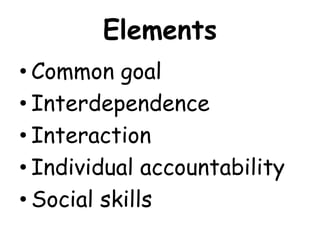
Elements
• Common goal
• Interdependence
• Interaction
• Individual accountability
• Social skills
Pros
• Encourages active learning, while
motivating students.
• Increase academic performance.
• Promotes literacy and language skills.
• Improves teacher effectiveness.
• Improves personal and social development.
Cons
• Students in the group are having conversations
that has nothing to do with the lesson.
• Students becoming impatient with others in the
group ceasing to work cooperatively.
• One bright students doing the most of the work.
• Teachers may rely on students about
lessons/resources and make it an excuse to keep
the students busy.
Cooperative Learning w/ the
Computer
Researches have made studies on the
learning interaction between the students
and the computer. The studies have great
value since it has been a long standing fear
that the computer may foster student
learning in isolation that hinders the
development of the students social skills.
Cooperative Learning w/ the
Computer
A pedagogical approach wherein learning takes place via
social interaction using a computer or through the
Internet. This kind of learning is characterized by the
sharing and construction of knowledge among
participants using technology as their primary means of
communication or as a common resource. It can be
implemented in online and classroom learning
environments and can take place synchronously or
asynchronously.
HISTORY
Though studies in collaborative learning and
technology took place throughout the 1980s and 90s,
the earliest public workshop directly addressing CSCL
was "Joint Problem Solving and Microcomputers"
which took place in San Diego in 1983. Six years later
in 1989, the term "computer-supported collaborative
learning" was used in a NATO-sponsored workshop
in Maratea, Italy. A biannual CSCL conference series
began in 1995. At the 2002 and 2003 CSCL
conferences, the International Society of the
Learning Sciences (ISLS) was established to run the
CSCL and ICLS conference series and
the International Journal of Computer-Supported
Collaborative Learning (ijCSCL) and JLS journals.
Components of Cooperative
Learning
• Assigning students to mixed ability teams.
• Establishing positive interdependence.
• Teaching cooperative teaching skills.
• Insuring individual accountability.
• Helping groups process information.
The End
By:
• Arboleda, Lalaine
• Bartolome, Jeah
• Cortez, Jorence
• Estimos, Gem Anton
• Nacion, Welina

cooperative learning with the computer

  • 1.
  • 2.
    Objectives To discuss thedifferent elements of cooperative learning with the use of computer. To compare what are the advantages and disadvantages of cooperative learning using computer.
  • 3.
    Cooperative Learning/Collaborative Learning learning bysmall groups of students who work together in a common learning task. based on the model that knowledge can be created within a population where members actively interact by sharing experiences and take on asymmetry roles. commonly illustrated when groups of students work together to search for understanding, meaning, or solutions or to create an artifact or product of their learning.
  • 4.
    Elements • Common goal •Interdependence • Interaction • Individual accountability • Social skills
  • 5.
    Pros • Encourages activelearning, while motivating students. • Increase academic performance. • Promotes literacy and language skills. • Improves teacher effectiveness. • Improves personal and social development.
  • 6.
    Cons • Students inthe group are having conversations that has nothing to do with the lesson. • Students becoming impatient with others in the group ceasing to work cooperatively. • One bright students doing the most of the work. • Teachers may rely on students about lessons/resources and make it an excuse to keep the students busy.
  • 7.
    Cooperative Learning w/the Computer Researches have made studies on the learning interaction between the students and the computer. The studies have great value since it has been a long standing fear that the computer may foster student learning in isolation that hinders the development of the students social skills.
  • 8.
    Cooperative Learning w/the Computer A pedagogical approach wherein learning takes place via social interaction using a computer or through the Internet. This kind of learning is characterized by the sharing and construction of knowledge among participants using technology as their primary means of communication or as a common resource. It can be implemented in online and classroom learning environments and can take place synchronously or asynchronously.
  • 9.
    HISTORY Though studies incollaborative learning and technology took place throughout the 1980s and 90s, the earliest public workshop directly addressing CSCL was "Joint Problem Solving and Microcomputers" which took place in San Diego in 1983. Six years later in 1989, the term "computer-supported collaborative learning" was used in a NATO-sponsored workshop in Maratea, Italy. A biannual CSCL conference series began in 1995. At the 2002 and 2003 CSCL conferences, the International Society of the Learning Sciences (ISLS) was established to run the CSCL and ICLS conference series and the International Journal of Computer-Supported Collaborative Learning (ijCSCL) and JLS journals.
  • 10.
    Components of Cooperative Learning •Assigning students to mixed ability teams. • Establishing positive interdependence. • Teaching cooperative teaching skills. • Insuring individual accountability. • Helping groups process information.
  • 11.
    The End By: • Arboleda,Lalaine • Bartolome, Jeah • Cortez, Jorence • Estimos, Gem Anton • Nacion, Welina