PRELIMINARY ACTIVITY
MEANING OF INTEGRATED CURRICULUM
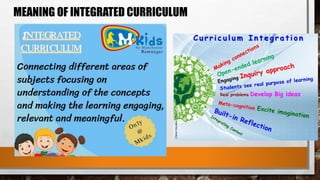
An integrated curriculum is described
as one that connects different areas of
study by cutting across subject-matter
lines and emphasizing unifying
concepts. Integration focuses on making
connections for students, allowing them to
engage in relevant, meaningful activities
that can be connected to real life
An integrated curriculum aims to connect
the theory learned in the classroom, with
practical, real-life knowledge and
experiences. The practical and experiential
learning aspect of an integrated curriculum
is facilitated through service-learning.
MEANING OF INTEGRATED CURRICULUM
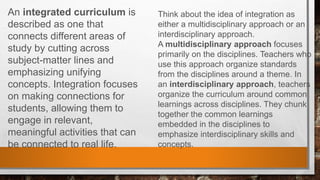
An integrated curriculum is
described as one that
connects different areas of
study by cutting across
subject-matter lines and
emphasizing unifying
concepts. Integration focuses
on making connections for
students, allowing them to
engage in relevant,
meaningful activities that can
be connected to real life.
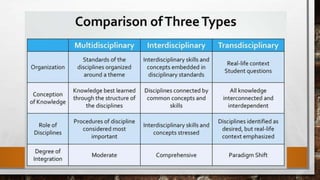
Think about the idea of integration as
either a multidisciplinary approach or an
interdisciplinary approach.
A multidisciplinary approach focuses
primarily on the disciplines. Teachers who
use this approach organize standards
from the disciplines around a theme. In
an interdisciplinary approach, teachers
organize the curriculum around common
learnings across disciplines. They chunk
together the common learnings
embedded in the disciplines to
emphasize interdisciplinary skills and
concepts.
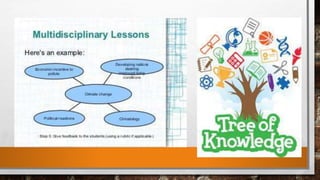
Multidisciplinary integration
Focuses primarily on the disciplines.
This approach relates different subject
around a common theme. In this
approach, teachers fuse skills,
knowledge, or even attitudes into the
regular school curriculum.
In some schools, for example,
students learn respect for the
environment in every subject area
An integrated curriculum is
described as one that connects
different areas of study by cutting
across subject-matter lines and
emphasizing unifying concepts.
Integration focuses on making
connections for students, allowing
them to engage in relevant,
meaningful activities that can be
connected to real life.
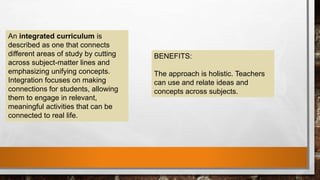
BENEFITS:
The approach is holistic. Teachers
can use and relate ideas and
concepts across subjects.
One final key benefit of an integrated curriculum is the
ability for students to see skills multiple times. Instead
of teaching comprehension strategies in just reading,
teaching those strategies across multiple disciplines
can give students an opportunity to see and
implement it more often. The repetition of the skills
being taught creates a higher level of understanding
and retention of information for students in the
classroom.
Students not only connect and create more real-
world connections in integrated classrooms, but
they are also more actively engaged. Creating an
integrated curriculum means that teachers are
charged with having to create challenging, fun,
meaningful tasks that help students connect to
information. Creating a solar system unit that also
requires oral language development and practice,
reading comprehension skills and mathematics,
can engage students far more than just a lesson
on the solar system alone. Integration helps to
achieve retention and engagement in
classrooms, which yields higher mastery of
content standards.
To create multidisciplinary integrated
curriculum, develop a central theme focused
on social studies and teach history,
geography, economics and government in
that thematic based unit. You may also
achieve this by creating a mathematics
thematic unit that teaches the relationship
between fractions, percents, decimals and
ratios.
Think about the idea of integration as
either a multidisciplinary approach or an
interdisciplinary approach.
A multidisciplinary approach focuses
primarily on the disciplines. Teachers
who use this approach organize
standards from the disciplines around a
theme. In an interdisciplinary
approach, teachers organize the
curriculum around common learnings
across disciplines. They chunk together
the common learnings embedded in the
disciplines to emphasize
interdisciplinary skills and concepts.
INTEGRATED CURRICULUM
The concept of an integrated curriculum and its significance to the learners was expounded
by educators like Beane (1992), Johnson and Johnson (1998), and Kellough (2003).
a. An integrated curriculum refers to a single course that contains one or more disciplines.
It consist of one set of objectives and assessment that covers a number of related disciplines
(Johnson and Johnson, 1998)
b. An integrated curriculum is an educational approach that cuts across and draws
multiple areas for for learning and instruction. Its purpose is to realistically link various
disciplines into the study and exploration of certain aspects of the world (Beane, 1992)
c. An integrated curriculum is a way of teaching a way of planning and organizing the
instructional program. This enables the discrete disciplines of subject matter related to one
another design that matches the developmental needs of the learners to connect to their
learning's in ways that are meaningful to their current and past experiences. This is an
antithesis of the traditional, disparate, subject-matter oriented teaching and curriculum
designation. (Kellough, 2003)
INTEGRATED CURRICULUM
1. INTEGRATION IN BASIC EDUCATION
To integrate is to make up, combine, or complete to produce a whole or a larger
unit as parts do. Integration is applied in education to facilitate the integrative and
interactive learning process in the classroom. To Johnson and Johnson (1998),
integration is the process of linking new information to prior learning, and linking
different parts of learning to each other.
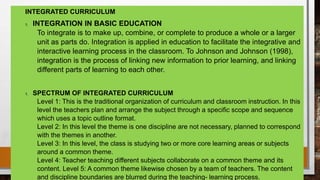
1. SPECTRUM OF INTEGRATED CURRICULUM
Level 1: This is the traditional organization of curriculum and classroom instruction. In this
level the teachers plan and arrange the subject through a specific scope and sequence
which uses a topic outline format.
Level 2: In this level the theme is one discipline are not necessary, planned to correspond
with the themes in another.
Level 3: In this level, the class is studying two or more core learning areas or subjects
around a common theme.
Level 4: Teacher teaching different subjects collaborate on a common theme and its
content. Level 5: A common theme likewise chosen by a team of teachers. The content
and discipline boundaries are blurred during the teaching- learning process.
1. THEORIES SUPPORTING CURRICULUM INTEGRATION
1. Experiential Learning. Carl Roger (2004), the proponent of this theory, believe that all
individual has a natural propensity to learn. John Dewey (1938), posits that school learning
should be experiential because students learn from what they experience.
2. Multiple Intelligences. Howard Gardner, affirms that there are more kind of
intelligence that what we thought before:
The nine categories of intelligences presented by Gardner and Associates
A. Linguistic intelligence
B. Logical-Mathematical Intelligence
C. Spatial Intelligence
D. Bodily-kinesthetic Intelligence
E. Musical Intelligence
F. Interpersonal Intelligence
G. Intrapersonal Intelligence
H. Naturalistic Intelligence
I. Existentialist Intelligence
1. Constructivism. This theory expounds that development and learning occur through constructive
process and that knowledge is constructed from experience. Constructivist like John Dewey (1938), Jean
Piaget (1960), and Lev Vygotsky 91934) maintain that children learn by actually constructing meaning
from their simultaneously embedded experiences. Teaching in a constructivist mode has a slower pace,
uses varied strategies and resource materials, and provides opportunities for the new creation of new
ideas.
1. Principles in Integrating Big Ideas and Strategies
To ensure effective instruction. Beane (1992) expounds the significance of the following
principles in integrating big ideas and strategies.
1. Integrate several ideas and strategies.
2. Match content with strategies
3. Integrate relevant concepts.
4. Integrate big ideas across multiple contents of instructions.
5. Provide opportunities to establish connections.
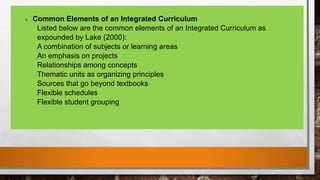
1. Common Elements of an Integrated Curriculum
Listed below are the common elements of an Integrated Curriculum as
expounded by Lake (2000):
A combination of subjects or learning areas
An emphasis on projects
Relationships among concepts
Thematic units as organizing principles
Sources that go beyond textbooks
Flexible schedules
Flexible student grouping
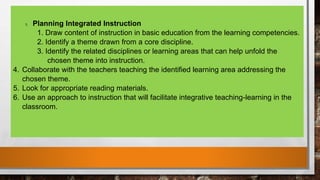
1. Planning Integrated Instruction
1. Draw content of instruction in basic education from the learning competencies.
2. Identify a theme drawn from a core discipline.
3. Identify the related disciplines or learning areas that can help unfold the
chosen theme into instruction.
4. Collaborate with the teachers teaching the identified learning area addressing the
chosen theme.
5. Look for appropriate reading materials.
6. Use an approach to instruction that will facilitate integrative teaching-learning in the
classroom.

Integrative-teaching.pptx

  • 2.
  • 3.
    MEANING OF INTEGRATEDCURRICULUM An integrated curriculum is described as one that connects different areas of study by cutting across subject-matter lines and emphasizing unifying concepts. Integration focuses on making connections for students, allowing them to engage in relevant, meaningful activities that can be connected to real life An integrated curriculum aims to connect the theory learned in the classroom, with practical, real-life knowledge and experiences. The practical and experiential learning aspect of an integrated curriculum is facilitated through service-learning.
  • 4.
  • 6.
    An integrated curriculumis described as one that connects different areas of study by cutting across subject-matter lines and emphasizing unifying concepts. Integration focuses on making connections for students, allowing them to engage in relevant, meaningful activities that can be connected to real life. Think about the idea of integration as either a multidisciplinary approach or an interdisciplinary approach. A multidisciplinary approach focuses primarily on the disciplines. Teachers who use this approach organize standards from the disciplines around a theme. In an interdisciplinary approach, teachers organize the curriculum around common learnings across disciplines. They chunk together the common learnings embedded in the disciplines to emphasize interdisciplinary skills and concepts.
  • 10.
    Multidisciplinary integration Focuses primarilyon the disciplines. This approach relates different subject around a common theme. In this approach, teachers fuse skills, knowledge, or even attitudes into the regular school curriculum. In some schools, for example, students learn respect for the environment in every subject area
  • 17.
    An integrated curriculumis described as one that connects different areas of study by cutting across subject-matter lines and emphasizing unifying concepts. Integration focuses on making connections for students, allowing them to engage in relevant, meaningful activities that can be connected to real life. BENEFITS: The approach is holistic. Teachers can use and relate ideas and concepts across subjects.
  • 18.
    One final keybenefit of an integrated curriculum is the ability for students to see skills multiple times. Instead of teaching comprehension strategies in just reading, teaching those strategies across multiple disciplines can give students an opportunity to see and implement it more often. The repetition of the skills being taught creates a higher level of understanding and retention of information for students in the classroom. Students not only connect and create more real- world connections in integrated classrooms, but they are also more actively engaged. Creating an integrated curriculum means that teachers are charged with having to create challenging, fun, meaningful tasks that help students connect to information. Creating a solar system unit that also requires oral language development and practice, reading comprehension skills and mathematics, can engage students far more than just a lesson on the solar system alone. Integration helps to achieve retention and engagement in classrooms, which yields higher mastery of content standards.
  • 19.
    To create multidisciplinaryintegrated curriculum, develop a central theme focused on social studies and teach history, geography, economics and government in that thematic based unit. You may also achieve this by creating a mathematics thematic unit that teaches the relationship between fractions, percents, decimals and ratios. Think about the idea of integration as either a multidisciplinary approach or an interdisciplinary approach. A multidisciplinary approach focuses primarily on the disciplines. Teachers who use this approach organize standards from the disciplines around a theme. In an interdisciplinary approach, teachers organize the curriculum around common learnings across disciplines. They chunk together the common learnings embedded in the disciplines to emphasize interdisciplinary skills and concepts.
  • 20.
    INTEGRATED CURRICULUM The conceptof an integrated curriculum and its significance to the learners was expounded by educators like Beane (1992), Johnson and Johnson (1998), and Kellough (2003). a. An integrated curriculum refers to a single course that contains one or more disciplines. It consist of one set of objectives and assessment that covers a number of related disciplines (Johnson and Johnson, 1998) b. An integrated curriculum is an educational approach that cuts across and draws multiple areas for for learning and instruction. Its purpose is to realistically link various disciplines into the study and exploration of certain aspects of the world (Beane, 1992) c. An integrated curriculum is a way of teaching a way of planning and organizing the instructional program. This enables the discrete disciplines of subject matter related to one another design that matches the developmental needs of the learners to connect to their learning's in ways that are meaningful to their current and past experiences. This is an antithesis of the traditional, disparate, subject-matter oriented teaching and curriculum designation. (Kellough, 2003)
  • 21.
    INTEGRATED CURRICULUM 1. INTEGRATIONIN BASIC EDUCATION To integrate is to make up, combine, or complete to produce a whole or a larger unit as parts do. Integration is applied in education to facilitate the integrative and interactive learning process in the classroom. To Johnson and Johnson (1998), integration is the process of linking new information to prior learning, and linking different parts of learning to each other. 1. SPECTRUM OF INTEGRATED CURRICULUM Level 1: This is the traditional organization of curriculum and classroom instruction. In this level the teachers plan and arrange the subject through a specific scope and sequence which uses a topic outline format. Level 2: In this level the theme is one discipline are not necessary, planned to correspond with the themes in another. Level 3: In this level, the class is studying two or more core learning areas or subjects around a common theme. Level 4: Teacher teaching different subjects collaborate on a common theme and its content. Level 5: A common theme likewise chosen by a team of teachers. The content and discipline boundaries are blurred during the teaching- learning process.
  • 22.
    1. THEORIES SUPPORTINGCURRICULUM INTEGRATION 1. Experiential Learning. Carl Roger (2004), the proponent of this theory, believe that all individual has a natural propensity to learn. John Dewey (1938), posits that school learning should be experiential because students learn from what they experience. 2. Multiple Intelligences. Howard Gardner, affirms that there are more kind of intelligence that what we thought before: The nine categories of intelligences presented by Gardner and Associates A. Linguistic intelligence B. Logical-Mathematical Intelligence C. Spatial Intelligence D. Bodily-kinesthetic Intelligence E. Musical Intelligence F. Interpersonal Intelligence G. Intrapersonal Intelligence H. Naturalistic Intelligence I. Existentialist Intelligence
  • 23.
    1. Constructivism. Thistheory expounds that development and learning occur through constructive process and that knowledge is constructed from experience. Constructivist like John Dewey (1938), Jean Piaget (1960), and Lev Vygotsky 91934) maintain that children learn by actually constructing meaning from their simultaneously embedded experiences. Teaching in a constructivist mode has a slower pace, uses varied strategies and resource materials, and provides opportunities for the new creation of new ideas. 1. Principles in Integrating Big Ideas and Strategies To ensure effective instruction. Beane (1992) expounds the significance of the following principles in integrating big ideas and strategies. 1. Integrate several ideas and strategies. 2. Match content with strategies 3. Integrate relevant concepts. 4. Integrate big ideas across multiple contents of instructions. 5. Provide opportunities to establish connections.
  • 24.
    1. Common Elementsof an Integrated Curriculum Listed below are the common elements of an Integrated Curriculum as expounded by Lake (2000): A combination of subjects or learning areas An emphasis on projects Relationships among concepts Thematic units as organizing principles Sources that go beyond textbooks Flexible schedules Flexible student grouping
  • 25.
    1. Planning IntegratedInstruction 1. Draw content of instruction in basic education from the learning competencies. 2. Identify a theme drawn from a core discipline. 3. Identify the related disciplines or learning areas that can help unfold the chosen theme into instruction. 4. Collaborate with the teachers teaching the identified learning area addressing the chosen theme. 5. Look for appropriate reading materials. 6. Use an approach to instruction that will facilitate integrative teaching-learning in the classroom.

Editor's Notes

  • #7 To create multidisciplinary integrated curriculum, develop a central theme focused on social studies and teach history, geography, economics and government in that thematic based unit. You may also achieve this by creating a mathematics thematic unit that teaches the relationship between fractions, percent, decimals and ratios. This will help students make connections to many disciplines