Cooperative 
Learning 
Franklin De Flor
Cooperative Learning 
• It is where the students work 
in group or team to help each 
other learn. 
10/20/2014 2
Characteristic Features 
• It has two important components 
–Cooperative incentive structure 
–Cooperative task structure 
• Students work in team to tackle 
academic task 
10/20/2014 3
• Reward system are group-oriented 
rather than individually-oriented. 
• The interactions within the group is 
controlled by the members 
themselves 
• Teams are made up of mixed abilities. 
High, average, and low achievers. 
10/20/2014 4
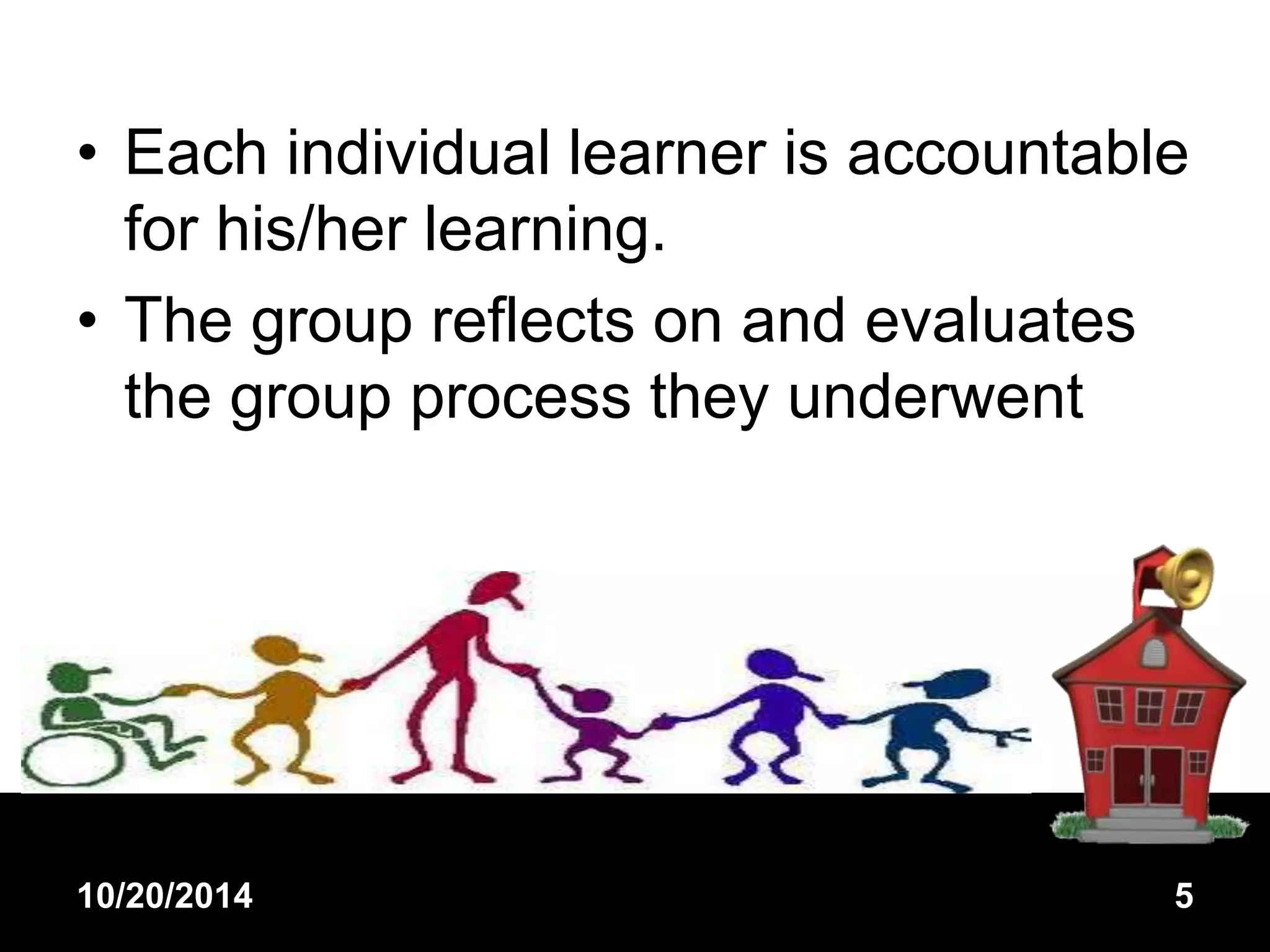
• Each individual learner is accountable 
for his/her learning. 
• The group reflects on and evaluates 
the group process they underwent 
10/20/2014 5
Guidelines for its Effective use 
• Heterogeneous grouping where in 
high, average and low. 
• Make sure that the students 
exhibits the necessary social 
skills to work cooperatively in 
group situation. 
10/20/2014 6
• Arrange the furniture so that the 
groups of students can sit facing each 
other during session. 
• Provide adequate learning tools so as 
not to make others wait at a time that 
are needed. 
• Make sure each group understands 
the goals, procedures, task and 
methods of evaluation. 
10/20/2014 7
Overview of selected structures 
in cooperative learning 
Teambuilding 
• Roundrobin 
• Each students in turn share 
something with his/her teammates. 
• Expressing ideas and opinions. 
10/20/2014 8
Class building 
• Corners 
• Each students moves to a corner of 
the room representing a teacher-determined 
alternative. 
• Seeing alternative hypotheses, 
values, problemsolving, approaches. 
10/20/2014 9
Communication Building 
• Match Mine 
• Students attempt to match the 
arrangement of object on a grid of 
another student using oral 
communication only 
• Vocabulary development, 
communication skills, role taking 
ability. 
10/20/2014 10
Mastery 
• Numbered Heads Together 
• The teacher ask a question, students 
consult to make sure everyone knows 
the answer, then one student is called 
upon to answer. 
• Review, checking for knowledge, 
comprehension. Tutoring. 
10/20/2014 11
Mastery 
• Color-coded co-op cards 
• Students memorize facts using a flash 
card game. The game is structured so 
that there is a maximum probability of 
success at each step, moving from 
short term to long term memory. 
Scoring is based on improvement. 
• Memorizing facts, helping, praising. 
10/20/2014 12
Mastery 
• Praise Check 
• Students work in pairs within the groups of 
four. Within pairs students alternate – one 
solves a problem while the other coaches. 
After every two problems the pair checks 
to see if they have the same answer as the 
other pair. 
• Practicing skills, helping, praising 
10/20/2014 13
Concept development 
• Three step interview 
• Students interview each other in pair, first 
one way, then the other. Students each 
share with the group information they 
learned in the interview 
• Sharing personal information such as 
hypothesis, reactions to a poem, 
conclusion from a unit. Participation, 
listening. 
10/20/2014 14
Concept development 
• Think-pair share 
• Students think to them selves on a topic 
provided by the teacher; they pair up with 
another student to discuss it; they then 
share their thoughts with the class. 
• Generating and revising hypothesis, 
inductive reasoning, application. 
Participation, involvement. 
10/20/2014 15
Concept Development 
• Team Word-Webbing 
• Students write simultaneously on a piece 
of chart paper, drawing main concepts, 
supporting elements, and bridges 
representing the relation of ideas in a 
concept. 
• Analysis of concepts into components, 
understanding multiple relations among 
ideas. 
10/20/2014 16
Multifunctional 
• Roundtable 
• Each student in turn writes one answer as 
a paper and a pencil are passed around 
the group. With simultaneous roundtable 
more than one pencil and paper are used 
at once. 
• Assessing prior knowledge, practising 
skills, recalling information, creating 
cooperative art. 
10/20/2014 17
Multifunctional 
• Inside-outside circle 
• Students stands in pairs in two concentric 
circles. The inside circle faces out; the 
outside circle faces in. students use flash 
cards or respond to the teacher questions 
as they rotate to each new partner. 
• Checking for understanding, review, 
processing, helping. Tutoring, sharing, 
meeting classmates. 
10/20/2014 18
Multifunctional 
• Partners 
• Students work in pairs to create or master 
content. They consult with partners from 
other teams. Then they share their 
products or understanding with the other 
partner in their team. 
• Mastery and presentation of new material, 
concept development. Presentation and 
comm. Skills. 
10/20/2014 19
Multifunctional 
• Jigsaw 
• Each student on the team becomes an 
“expert” on the topic by working with 
members from other teams assigned the 
corresponding expert topic. Upon returning 
to their teams, each one in turn teaches 
the group; and students are all assessed 
on all aspects of the topic. 
• Acquisition and presentation of new 
material, 
10/20/2014 20
Multifunctional 
• Co-op Co-op 
• Students work in groups to produce a 
particular group product to share with the 
whole class; each student makes a 
particular contribution to the group. 
• Learning and sharing complex material, 
often with multiple sources; evaluation; 
application; analysis; synthesis. Conflict 
resolution; presentation skills. 
10/20/2014 21
Advantage of Cooperative Learning 
• Interdependent relationship is 
strengthened and reinforced when group 
cooperation is rewarded. 
• Group work develops friendliness, 
willingness to assist and more worthwhile 
value of caring and sharing. 
• Cooperation in groups promotes maximum 
generations and exchange of ideas, 
tolerance and respect for other people’s 
points of view. 
10/20/2014 22
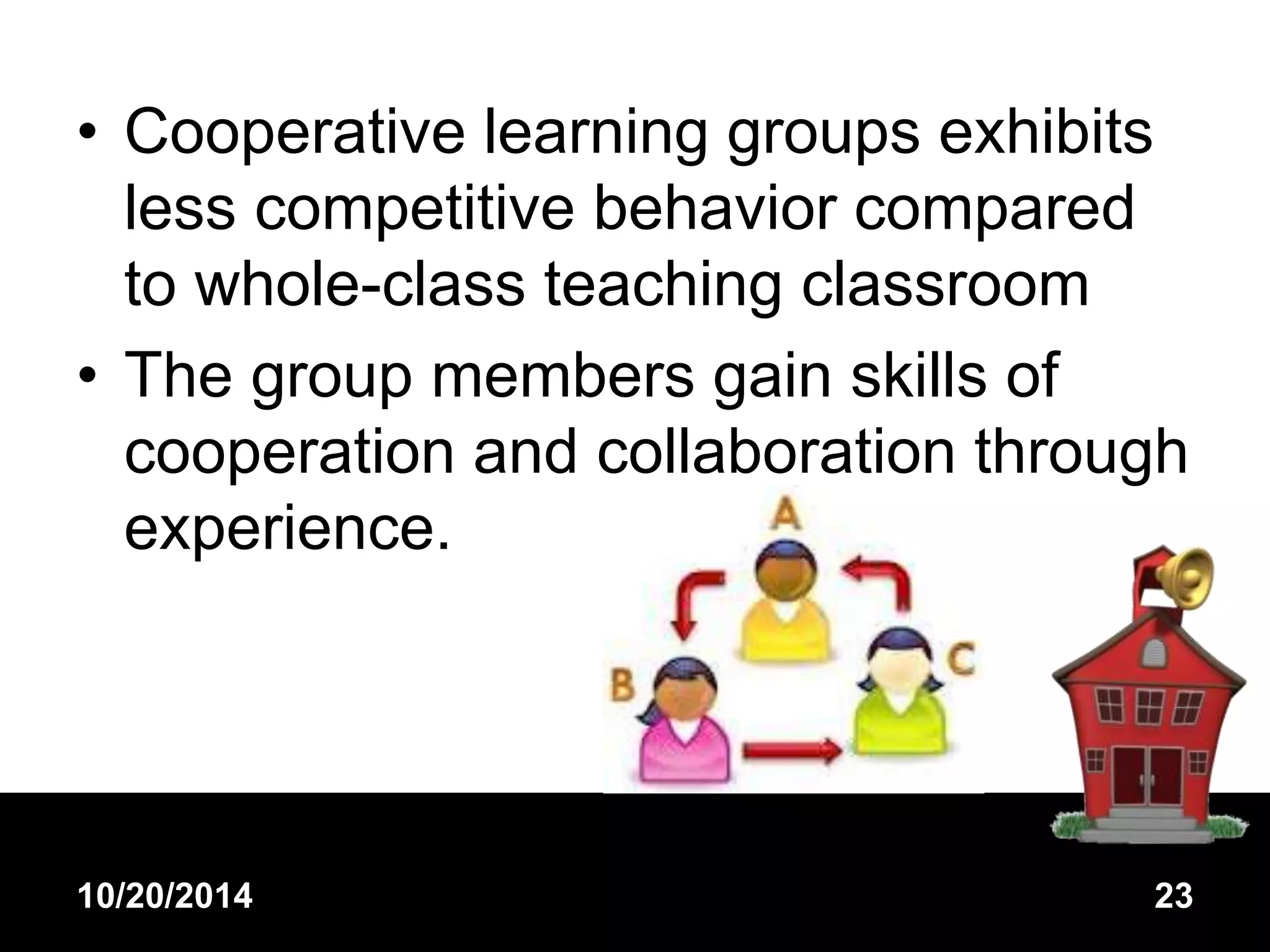
• Cooperative learning groups exhibits 
less competitive behavior compared 
to whole-class teaching classroom 
• The group members gain skills of 
cooperation and collaboration through 
experience. 
10/20/2014 23
Disadvantage Cooperative Learning 
• People need to go at different speeds. 
• Some people need to go at different 
speeds while doing the lab to fully 
understand and absorb the information. It 
seems that while working in a group, 
someone is either slowed down or forced 
to catch up faster then they would like to. 
10/20/2014 24
Someone may try to take over the group. 
• I think that one of the biggest problems of a 
group situation is the balance of power. 
Not all people are given an equal voice in a 
group. Usually there is one group leader 
that everyone defers to. Another person 
takes care of the data. Some people end 
up feeling overlooked or unappreciated. 
10/20/2014 25
Quiet people may not feel comfortable. 
• Some students are shy or reserved and 
feel awkward when working with others. 
• Often when I hear that we have to work in 
groups I get very uneasy. I do not always 
like to meet new people. I do not know how 
they will take my beliefs and values. 
10/20/2014 26
Sometimes people just don't get along. 
• Sometimes people just don't get along no matter 
how hard they try, their personalities clash. In 
these cases long time lab partners would be 
horrible, you spend more time over coming your 
differences than actually doing the work. 
• There could be arguing with group members. 
When you put a group of people that have never 
worked together . . . personalities might lead to 
arguments, this would waste time and lead to an 
unproductive group. 
10/20/2014 27
People may not pull their weight. 
• I get very angry when we all work so 
hard and then one person who did 
nothing all lab asks to get the 
answers. I realize that there could be 
multiple reasons for why this person 
did not pull their weight, other then 
that they might be lazy. However, it is 
a very frustrating situation. 
10/20/2014 28
It is not fair! 
• Often times group members will not 
equally contribute to a task in which 
the whole group receives one grade. 
So if a member does not fully 
participate they may be given a grade 
that they do not deserve. 
10/20/2014 29
A concept may not be understood as 
well if a person doesn't have to 
figure it out. 
• At times you miss things that you would 
learn by doing the project on your own. 
• Sometimes peer groups get lazy and just 
give group members answers to a certain 
problem without explaining how they 
arrived at their conclusions. Because of 
this, no real knowledge has been gained. 
10/20/2014 30
The time spent talking about 
irrelevant topics is unbelievable. 
• One last problem of group work is 
that sometimes nothing gets done 
because everyone is talking about 
everything but what they are 
supposed to be doing! 
10/20/2014 31
Sample Lesson 
10/20/2014 32
Constructive Communication 
Strategies 
• Purpose: To practice positive (as 
opposed to negative) 
communication skills. 
10/20/2014 33
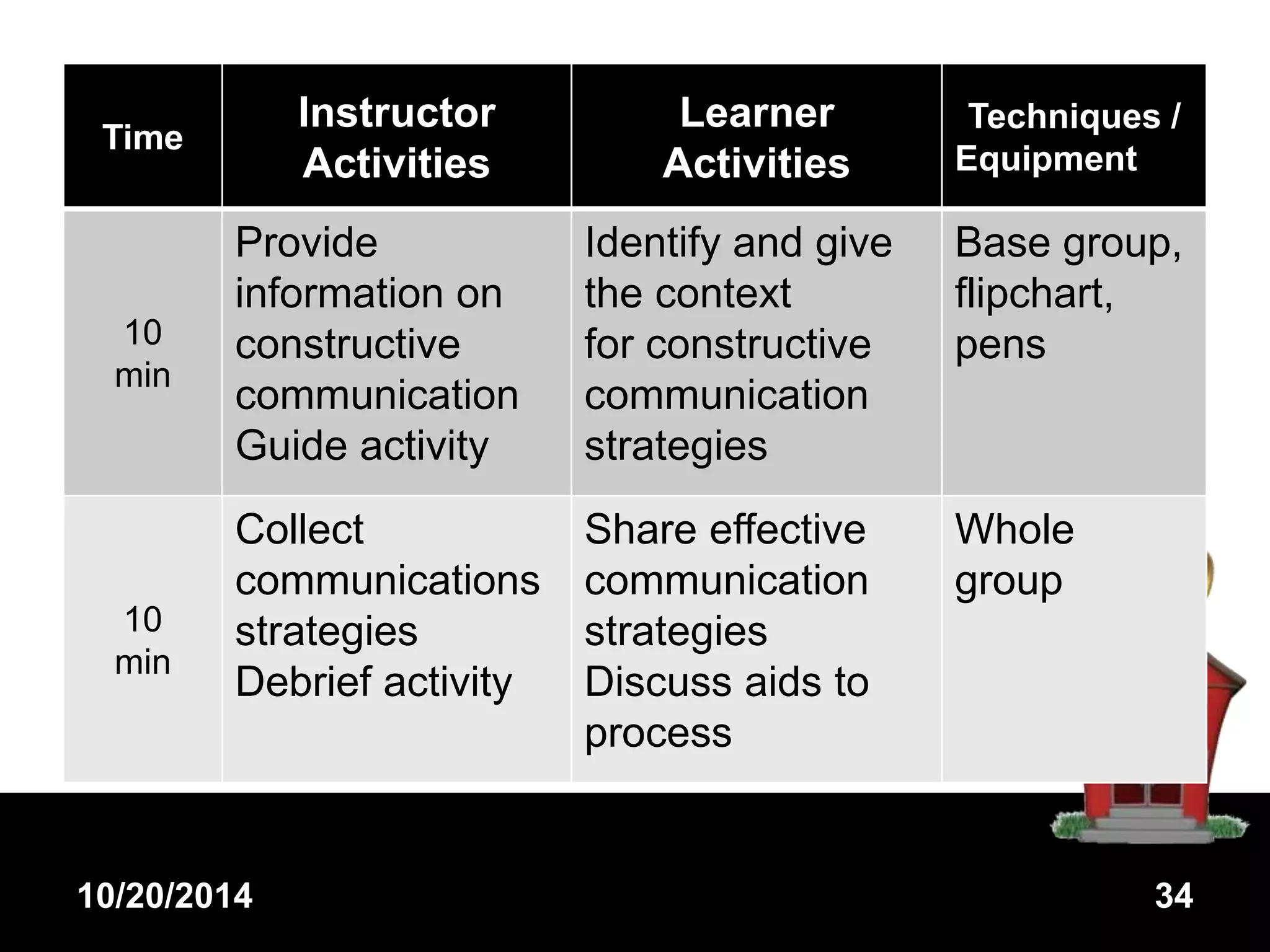
Time 
Instructor 
Activities 
Learner 
Activities 
Techniques / 
Equipment 
10 
min 
Provide 
information on 
constructive 
communication 
Guide activity 
Identify and give 
the context 
for constructive 
communication 
strategies 
Base group, 
flipchart, 
pens 
10 
min 
Collect 
communications 
strategies 
Debrief activity 
Share effective 
communication 
strategies 
Discuss aids to 
process 
Whole 
group 
10/20/2014 34
• Organizer: Constructive communication 
helps to get the job done. 
• Objective: Identify and give the context for 
constructive communication strategies to 
accomplish as particular task {for instance: 
to complete a project that culminates in a 
presentation by the group}. 
• Time: 20 minutes 
10/20/2014 35
• Techniques / Equipment: Discussion, 
information and personal experiences. 
• Process: In base groups: 
– Discuss and give examples of ways to 
encourage constructive communication. 
– Experiment with positive communication 
methods and their effectiveness in the 
individual groups. 
10/20/2014 36
• Group Success: Everyone in the group 
can identify the communication methods. 
• Accountability: Share effective 
communication strategies with the whole 
group. 
• Debrief: Identify how constructive 
communication assists in completing 
tasks. 
10/20/2014 37
Thank You 
10/20/2014 38

Cooperative Learning

  • 1.
  • 2.
    Cooperative Learning •It is where the students work in group or team to help each other learn. 10/20/2014 2
  • 3.
    Characteristic Features •It has two important components –Cooperative incentive structure –Cooperative task structure • Students work in team to tackle academic task 10/20/2014 3
  • 4.
    • Reward systemare group-oriented rather than individually-oriented. • The interactions within the group is controlled by the members themselves • Teams are made up of mixed abilities. High, average, and low achievers. 10/20/2014 4
  • 5.
    • Each individuallearner is accountable for his/her learning. • The group reflects on and evaluates the group process they underwent 10/20/2014 5
  • 6.
    Guidelines for itsEffective use • Heterogeneous grouping where in high, average and low. • Make sure that the students exhibits the necessary social skills to work cooperatively in group situation. 10/20/2014 6
  • 7.
    • Arrange thefurniture so that the groups of students can sit facing each other during session. • Provide adequate learning tools so as not to make others wait at a time that are needed. • Make sure each group understands the goals, procedures, task and methods of evaluation. 10/20/2014 7
  • 8.
    Overview of selectedstructures in cooperative learning Teambuilding • Roundrobin • Each students in turn share something with his/her teammates. • Expressing ideas and opinions. 10/20/2014 8
  • 9.
    Class building •Corners • Each students moves to a corner of the room representing a teacher-determined alternative. • Seeing alternative hypotheses, values, problemsolving, approaches. 10/20/2014 9
  • 10.
    Communication Building •Match Mine • Students attempt to match the arrangement of object on a grid of another student using oral communication only • Vocabulary development, communication skills, role taking ability. 10/20/2014 10
  • 11.
    Mastery • NumberedHeads Together • The teacher ask a question, students consult to make sure everyone knows the answer, then one student is called upon to answer. • Review, checking for knowledge, comprehension. Tutoring. 10/20/2014 11
  • 12.
    Mastery • Color-codedco-op cards • Students memorize facts using a flash card game. The game is structured so that there is a maximum probability of success at each step, moving from short term to long term memory. Scoring is based on improvement. • Memorizing facts, helping, praising. 10/20/2014 12
  • 13.
    Mastery • PraiseCheck • Students work in pairs within the groups of four. Within pairs students alternate – one solves a problem while the other coaches. After every two problems the pair checks to see if they have the same answer as the other pair. • Practicing skills, helping, praising 10/20/2014 13
  • 14.
    Concept development •Three step interview • Students interview each other in pair, first one way, then the other. Students each share with the group information they learned in the interview • Sharing personal information such as hypothesis, reactions to a poem, conclusion from a unit. Participation, listening. 10/20/2014 14
  • 15.
    Concept development •Think-pair share • Students think to them selves on a topic provided by the teacher; they pair up with another student to discuss it; they then share their thoughts with the class. • Generating and revising hypothesis, inductive reasoning, application. Participation, involvement. 10/20/2014 15
  • 16.
    Concept Development •Team Word-Webbing • Students write simultaneously on a piece of chart paper, drawing main concepts, supporting elements, and bridges representing the relation of ideas in a concept. • Analysis of concepts into components, understanding multiple relations among ideas. 10/20/2014 16
  • 17.
    Multifunctional • Roundtable • Each student in turn writes one answer as a paper and a pencil are passed around the group. With simultaneous roundtable more than one pencil and paper are used at once. • Assessing prior knowledge, practising skills, recalling information, creating cooperative art. 10/20/2014 17
  • 18.
    Multifunctional • Inside-outsidecircle • Students stands in pairs in two concentric circles. The inside circle faces out; the outside circle faces in. students use flash cards or respond to the teacher questions as they rotate to each new partner. • Checking for understanding, review, processing, helping. Tutoring, sharing, meeting classmates. 10/20/2014 18
  • 19.
    Multifunctional • Partners • Students work in pairs to create or master content. They consult with partners from other teams. Then they share their products or understanding with the other partner in their team. • Mastery and presentation of new material, concept development. Presentation and comm. Skills. 10/20/2014 19
  • 20.
    Multifunctional • Jigsaw • Each student on the team becomes an “expert” on the topic by working with members from other teams assigned the corresponding expert topic. Upon returning to their teams, each one in turn teaches the group; and students are all assessed on all aspects of the topic. • Acquisition and presentation of new material, 10/20/2014 20
  • 21.
    Multifunctional • Co-opCo-op • Students work in groups to produce a particular group product to share with the whole class; each student makes a particular contribution to the group. • Learning and sharing complex material, often with multiple sources; evaluation; application; analysis; synthesis. Conflict resolution; presentation skills. 10/20/2014 21
  • 22.
    Advantage of CooperativeLearning • Interdependent relationship is strengthened and reinforced when group cooperation is rewarded. • Group work develops friendliness, willingness to assist and more worthwhile value of caring and sharing. • Cooperation in groups promotes maximum generations and exchange of ideas, tolerance and respect for other people’s points of view. 10/20/2014 22
  • 23.
    • Cooperative learninggroups exhibits less competitive behavior compared to whole-class teaching classroom • The group members gain skills of cooperation and collaboration through experience. 10/20/2014 23
  • 24.
    Disadvantage Cooperative Learning • People need to go at different speeds. • Some people need to go at different speeds while doing the lab to fully understand and absorb the information. It seems that while working in a group, someone is either slowed down or forced to catch up faster then they would like to. 10/20/2014 24
  • 25.
    Someone may tryto take over the group. • I think that one of the biggest problems of a group situation is the balance of power. Not all people are given an equal voice in a group. Usually there is one group leader that everyone defers to. Another person takes care of the data. Some people end up feeling overlooked or unappreciated. 10/20/2014 25
  • 26.
    Quiet people maynot feel comfortable. • Some students are shy or reserved and feel awkward when working with others. • Often when I hear that we have to work in groups I get very uneasy. I do not always like to meet new people. I do not know how they will take my beliefs and values. 10/20/2014 26
  • 27.
    Sometimes people justdon't get along. • Sometimes people just don't get along no matter how hard they try, their personalities clash. In these cases long time lab partners would be horrible, you spend more time over coming your differences than actually doing the work. • There could be arguing with group members. When you put a group of people that have never worked together . . . personalities might lead to arguments, this would waste time and lead to an unproductive group. 10/20/2014 27
  • 28.
    People may notpull their weight. • I get very angry when we all work so hard and then one person who did nothing all lab asks to get the answers. I realize that there could be multiple reasons for why this person did not pull their weight, other then that they might be lazy. However, it is a very frustrating situation. 10/20/2014 28
  • 29.
    It is notfair! • Often times group members will not equally contribute to a task in which the whole group receives one grade. So if a member does not fully participate they may be given a grade that they do not deserve. 10/20/2014 29
  • 30.
    A concept maynot be understood as well if a person doesn't have to figure it out. • At times you miss things that you would learn by doing the project on your own. • Sometimes peer groups get lazy and just give group members answers to a certain problem without explaining how they arrived at their conclusions. Because of this, no real knowledge has been gained. 10/20/2014 30
  • 31.
    The time spenttalking about irrelevant topics is unbelievable. • One last problem of group work is that sometimes nothing gets done because everyone is talking about everything but what they are supposed to be doing! 10/20/2014 31
  • 32.
  • 33.
    Constructive Communication Strategies • Purpose: To practice positive (as opposed to negative) communication skills. 10/20/2014 33
  • 34.
    Time Instructor Activities Learner Activities Techniques / Equipment 10 min Provide information on constructive communication Guide activity Identify and give the context for constructive communication strategies Base group, flipchart, pens 10 min Collect communications strategies Debrief activity Share effective communication strategies Discuss aids to process Whole group 10/20/2014 34
  • 35.
    • Organizer: Constructivecommunication helps to get the job done. • Objective: Identify and give the context for constructive communication strategies to accomplish as particular task {for instance: to complete a project that culminates in a presentation by the group}. • Time: 20 minutes 10/20/2014 35
  • 36.
    • Techniques /Equipment: Discussion, information and personal experiences. • Process: In base groups: – Discuss and give examples of ways to encourage constructive communication. – Experiment with positive communication methods and their effectiveness in the individual groups. 10/20/2014 36
  • 37.
    • Group Success:Everyone in the group can identify the communication methods. • Accountability: Share effective communication strategies with the whole group. • Debrief: Identify how constructive communication assists in completing tasks. 10/20/2014 37
  • 38.