Cooperative Learning in the
   College Classroom
Workshop Objectives
 :By the end of this workshop , participants will be able to
Discuss Changing Paradigm of College Teaching-
”Define “cooperative learning-
Review research related to Cooperative learning-
Discuss reasons for using cooperative leaning in our classrooms -
Compare between cooperative and traditional teaching methods -
Identify elements of cooperative learning-
Recognize lesson format for a cooperative lesson-
Identify and practice some cooperative learning strategies-
Discuss some challenges facing the application of Cooperative -
learning approach in the college classroom
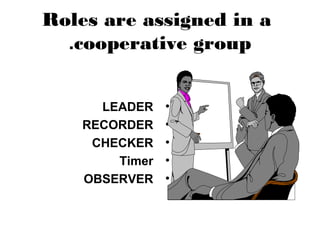
Roles are assigned in a
  .cooperative group


      LEADER    •
    RECORDER    •
     CHECKER    •
        Timer   •
    OBSERVER    •
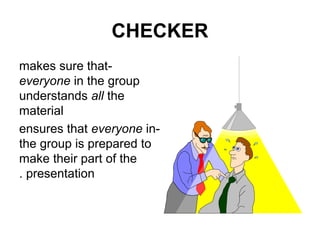
CHECKER
makes sure that-
everyone in the group
understands all the
material
ensures that everyone in-
the group is prepared to
make their part of the
. presentation
LEADER
responsible for the groups output-
keeps group ‘on track’ and focused-
assigns tasks-
controls the direction of the project-
assigns additional roles, such as ‘experimenter’ -
’or ‘equipment manager
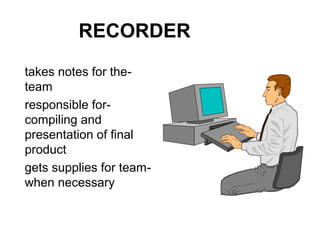
RECORDER
takes notes for the-
team
responsible for-
compiling and
presentation of final
product
gets supplies for team-
when necessary
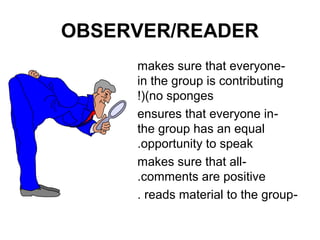
OBSERVER/READER
     makes sure that everyone-
     in the group is contributing
     !((no sponges
     ensures that everyone in-
     the group has an equal
     .opportunity to speak
     makes sure that all-
     .comments are positive
     . reads material to the group-
Activity 1
Comparison of Old and New Paradigms
        of College Teaching
Changing Paradigm of College Teaching

. A paradigm shift is taking place in college teaching
We are dropping the old paradigm of teaching and adopting a new paradigm
. based on theory and research that has clear applications to instruction

The primary means of achieving the new paradigm of teaching in the college
.classroom is to use cooperative learning

Cooperative learning provides the context within which the development of
student talent is encouraged. Carefully structured cooperative learning
ensures that students are cognitively, physically, emotionally, and
psychologically actively involved in constructing their own knowledge and is
an important step in changing the passive and impersonal character of
.many college classrooms


http://www.anderson.ucla.edu
Cooperation in the College classroom
ِ


          Activity 2
?What is Cooperative Learning
Cooperative Learning

It is instruction that involves people working in
teams to accomplish a common goal, under
conditions that involve both positive
interdependence (all members must
cooperate to complete the task) and
individual and group accountability (each
member is accountable for the complete final
).outcome
?What is Cooperative learning
Cooperative learning, is also called collaborative
learning, occurs whenever students interact in
pairs or groups to share knowledge and
experiences. All activities in which students work
together head towards a common goal, from
interacting with daily partners to completing long
term projects with learning communities, are
.cooperative learning activities
Cooperative learning is a method of teaching and learning
in which students team together to explore a significant
.question or create a meaningful project

In cooperative learning, students work together in small
groups on a structured activity. They are individually
accountable for their work, and the work of the group as
. a whole is also assessed

Cooperative learning is a successful teaching strategy in
which small teams, each with students of different levels
of ability, use a variety of learning activities to improve
their understanding of a subject. Each member of a team
is responsible not only for learning what is taught but
.also for helping teammates learn
Cooperative Learning is a relationship in a group
of students that requires positive
interdependence (a sense of sink or swim
together), individual accountability (each of us
has to contribute and learn), interpersonal skills
(communication, trust, leadership, decision
making, and conflict resolution), face-to-face
promotive interaction, and processing (reflecting
on how well the team is functioning and how to
).function even better
Activity No.3
Why use Cooperative Learning in
      ?College Classes
Review of Research
During the past 90 years nearly 600
experimental and over 100 correlational
studies have been conducted comparing
the effectiveness of cooperative,
competitive, and individualistic efforts.
These studies have been conducted by a
wide variety of researchers in different
decades with different age subjects, in
different subject areas, and in different
.settings
:The more students work in cooperative learning groups

the more they will learn-
the better they will understand what they are learning -
the easier it will be to remember what they learn-
the better they will feel about themselves, the class and-
.their classmates

:Other outcomes included
. positive relationships, and psychological health-
higher achievement and greater productivity-
 more caring, supportive, and committed relationships-
greater psychological health, social competence, and self--
 .esteem
Cooperative learning researchers and-
practitioners have shown that positive peer
relationships are essential to success in college.
).(Karl A. Smith, David & Roger Johnson 2000

Student participation, teacher encouragement, -
and student-student interaction positively relate
. to improved critical thinking

This confirms that discussions are superior to-
lectures in improving thinking and problem
    .solving
Acknowledgment of individual differences
 Interpersonal development
 Active involvement in learning
 More opportunities for personal feedback
Deeper understanding of content
Increased overall achievement in grades
 Improved self-esteem
 Higher motivation to remain on task
 Active and constructive involvement in content
 Ownership of their own learning
 Solving group conflicts
 Improvement of teamwork skills
 Increased student retention
Enhancement of student satisfaction with their learning
 experience
 Development of skills in oral communication
 Development of students' social skills
Activity 4
Traditional and Cooperative Learning Groups
        ?What Is the Difference
Five Defining Elements of
         Cooperative Learning

Positive interdependence-1
Face-to-face promotive interaction .2
Individual and group accountability.3
Interdependence and small group skills -4
Group processing.5
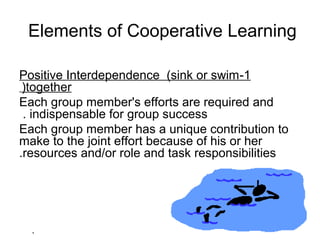
Elements of Cooperative Learning

Positive Interdependence (sink or swim -1
 (together
Each group member's efforts are required and
 . indispensable for group success
Each group member has a unique contribution to
make to the joint effort because of his or her
.resources and/or role and task responsibilities


  •
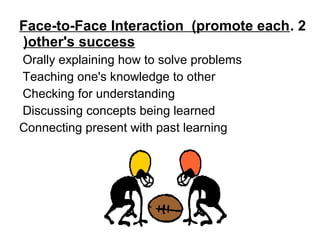
Face-to-Face Interaction (promote each . 2
(other's success
Orally explaining how to solve problems
Teaching one's knowledge to other
Checking for understanding
Discussing concepts being learned
Connecting present with past learning
Individual &Group Accountability. 3

Keeping the size of the group small. The smaller the size of the group, -
. the greater the individual accountability may be
. Giving an individual test to each student-
Randomly examining students orally by calling on one student to -
present his or her group's work to the teacher (in the presence of
. the group( or to the entire class
Observing each group and recording the frequency with which each -
. member-contributes to the group's work
Assigning one student in each group the role of checker. The checker -
asks other group members to explain the reasoning and rationale
. underlying group answers
 Having students teach what they learned to someone-
. else

                                                                            •
Interpersonal &Small-Group Skills. 4
: Social skills must be taught
 Decision-making
 Trust-building
 Leadership
 Communication
Conflict-management skills
Group Processing. 5
Group members discuss how well they are
achieving their goals and maintaining
 effective working relationships
Describe what member actions are helpful
 and not helpful
Make decisions about what behaviors to
.continue or change
Some Social Skills
LISTENING
TAKING TURNS
CONTRIBUTING
REACHING A CONCENSUS
ENCOURAGING
COOPERATING
FOLLOWING DIRECTIONS
Grouping Patterns
Grouping Patterns
:Informal cooperative learning groups.1

They are temporary groups that last for only one discussion or one class
period. Their purposes are to focus student’s attention on the material to be
learned, set a mood conducive to learning, help organize in advance the
material to be covered in a class session, ensure that students cognitively
process the material being taught, and provide closure to an instructional
session. They may be used at any time, but are especially useful during a
 .lecture or direct teaching ,Can last a few minutes or class period

:Examples
A-Summarize the answer to the question being discussed.
b. Solve a problem.
c. Give a reaction to a theory, a concept, or information being presented.
d. Elaborate (relate material to past learning so that it gets integrated into
existing conceptual frameworks( the material being presented.
e. Predict or explain.
f. Attempt to resolve the conceptual conflict the presentation has aroused.
.g. Hypothesize answers to the question being posed
(Grouping Patterns (con’t
-Formal groups
Designed for students to have enough time to -
thoroughly complete an academic assignment
.May last several days or weeks -
:Design tasks to include-
Positive interdependence
Group processing
Face to face promotive interaction
Individual and group accountability
Social and Interpersonal Skills
-Base groups
Created to provide students support throughout a semester or academic
year

Results: general sense of belonging to class

The base group functions as a support group for its members
 :that
Gives assistance, support, and encouragement for mastering the
course content and skills and provides feedback on how well the
.content and skills are being learned


Gives assistance, support, and encouragement for thinking critically
about the course content, explaining precisely what one learns,
engaging in intellectual controversy, getting the work done on
.time, and applying what is learned to one's own life


Provides a set of interpersonal relationships to personalize the course
and to try out the cooperative learning procedures and skills
.emphasized within the course

Provides a structure for managing course evaluation
Activity No.5
Class Activities that use Cooperative
              Learning
Examples of cooperative
          learning activities
Peer tutoring,         Conversation cards
Think-pair-share,           Role-plays
 Jigsaw,             Open-ended free conversations
,Information-gap activities
 ,Problem solving
Storytelling,Structured Academic Controversy
,Cooperative projects
,Paired interviews
Sharing opinions, debating, narrating, describing, and
explaining
Planning an Active Learning Activity


? What are your objectives for the activity -
?Who is interacting-
Will students pair up with someone beside them? Or perhaps-
?someone sitting behind/in front of them
Should they pair up with someone with a different background?-
? Someone they don't know yet
When does the activity occur during the class? Beginning? -
? Middle? End? How much time are you willing to spend on it
Will they write down their answers/ideas/questions or just-
? discuss them
Will they turn in the responses or not? If they are asked to turn-
? them in, should they put their names on them
?What are some challenges I might face
References
David and Roger Johnson. "Cooperative Learning." [Online] 15 October 2001.
http://www.clcrc.com/pages/cl.html
David and Roger Johnson. "An Overview of Cooperative Learning." [Online] 15
October 2001. http://www.clcrc.com/pages/overviewpaper.html
Howard Community College's Teaching Resources. "Ideas on Cooperative
Learning and the use of Small Groups." [Online] 15 October 2001.
http://www.howardcc.edu/profdev/resources/learning/groups1.htm
Kagan, Spencer. "Kagan Structures for Emotional Intelligence." [Online] 15
October 2001. "http://www.kagancooplearn.com/Newsletter/1001/index.html
College Level One — Collaborative Learning Page. On the web at:
http://www.wcer.wisc.edu/nise/cl1/CL/resource/R1.asp
Panitz, T. (1996). A Definition of Collaborative vs Cooperative Learning. On the
web at:
http://www.lgu.ac.uk/deliberations/collab.learning/panitz2.html
Useful Sites
http://www.orangeusd.k12.ca.us
Thinking and Learning-
http://www.edtech.kennesaw.edu
Cooperative Learning-
Active Learning for the College Classroom -
http://www.calstatela.edu

Cooperative2

  • 1.
    Cooperative Learning inthe College Classroom
  • 2.
    Workshop Objectives :Bythe end of this workshop , participants will be able to Discuss Changing Paradigm of College Teaching- ”Define “cooperative learning- Review research related to Cooperative learning- Discuss reasons for using cooperative leaning in our classrooms - Compare between cooperative and traditional teaching methods - Identify elements of cooperative learning- Recognize lesson format for a cooperative lesson- Identify and practice some cooperative learning strategies- Discuss some challenges facing the application of Cooperative - learning approach in the college classroom
  • 3.
    Roles are assignedin a .cooperative group LEADER • RECORDER • CHECKER • Timer • OBSERVER •
  • 4.
    CHECKER makes sure that- everyonein the group understands all the material ensures that everyone in- the group is prepared to make their part of the . presentation
  • 5.
    LEADER responsible for thegroups output- keeps group ‘on track’ and focused- assigns tasks- controls the direction of the project- assigns additional roles, such as ‘experimenter’ - ’or ‘equipment manager
  • 6.
    RECORDER takes notes forthe- team responsible for- compiling and presentation of final product gets supplies for team- when necessary
  • 7.
    OBSERVER/READER makes sure that everyone- in the group is contributing !((no sponges ensures that everyone in- the group has an equal .opportunity to speak makes sure that all- .comments are positive . reads material to the group-
  • 8.
    Activity 1 Comparison ofOld and New Paradigms of College Teaching
  • 9.
    Changing Paradigm ofCollege Teaching . A paradigm shift is taking place in college teaching We are dropping the old paradigm of teaching and adopting a new paradigm . based on theory and research that has clear applications to instruction The primary means of achieving the new paradigm of teaching in the college .classroom is to use cooperative learning Cooperative learning provides the context within which the development of student talent is encouraged. Carefully structured cooperative learning ensures that students are cognitively, physically, emotionally, and psychologically actively involved in constructing their own knowledge and is an important step in changing the passive and impersonal character of .many college classrooms http://www.anderson.ucla.edu Cooperation in the College classroom
  • 10.
    ِ Activity 2 ?What is Cooperative Learning
  • 11.
    Cooperative Learning It isinstruction that involves people working in teams to accomplish a common goal, under conditions that involve both positive interdependence (all members must cooperate to complete the task) and individual and group accountability (each member is accountable for the complete final ).outcome
  • 12.
    ?What is Cooperativelearning Cooperative learning, is also called collaborative learning, occurs whenever students interact in pairs or groups to share knowledge and experiences. All activities in which students work together head towards a common goal, from interacting with daily partners to completing long term projects with learning communities, are .cooperative learning activities
  • 13.
    Cooperative learning isa method of teaching and learning in which students team together to explore a significant .question or create a meaningful project In cooperative learning, students work together in small groups on a structured activity. They are individually accountable for their work, and the work of the group as . a whole is also assessed Cooperative learning is a successful teaching strategy in which small teams, each with students of different levels of ability, use a variety of learning activities to improve their understanding of a subject. Each member of a team is responsible not only for learning what is taught but .also for helping teammates learn
  • 14.
    Cooperative Learning isa relationship in a group of students that requires positive interdependence (a sense of sink or swim together), individual accountability (each of us has to contribute and learn), interpersonal skills (communication, trust, leadership, decision making, and conflict resolution), face-to-face promotive interaction, and processing (reflecting on how well the team is functioning and how to ).function even better
  • 15.
    Activity No.3 Why useCooperative Learning in ?College Classes
  • 16.
    Review of Research Duringthe past 90 years nearly 600 experimental and over 100 correlational studies have been conducted comparing the effectiveness of cooperative, competitive, and individualistic efforts. These studies have been conducted by a wide variety of researchers in different decades with different age subjects, in different subject areas, and in different .settings
  • 17.
    :The more studentswork in cooperative learning groups the more they will learn- the better they will understand what they are learning - the easier it will be to remember what they learn- the better they will feel about themselves, the class and- .their classmates :Other outcomes included . positive relationships, and psychological health- higher achievement and greater productivity- more caring, supportive, and committed relationships- greater psychological health, social competence, and self-- .esteem
  • 18.
    Cooperative learning researchersand- practitioners have shown that positive peer relationships are essential to success in college. ).(Karl A. Smith, David & Roger Johnson 2000 Student participation, teacher encouragement, - and student-student interaction positively relate . to improved critical thinking This confirms that discussions are superior to- lectures in improving thinking and problem .solving
  • 19.
    Acknowledgment of individualdifferences Interpersonal development Active involvement in learning More opportunities for personal feedback Deeper understanding of content Increased overall achievement in grades Improved self-esteem Higher motivation to remain on task Active and constructive involvement in content Ownership of their own learning Solving group conflicts Improvement of teamwork skills Increased student retention Enhancement of student satisfaction with their learning experience Development of skills in oral communication Development of students' social skills
  • 20.
    Activity 4 Traditional andCooperative Learning Groups ?What Is the Difference
  • 21.
    Five Defining Elementsof Cooperative Learning Positive interdependence-1 Face-to-face promotive interaction .2 Individual and group accountability.3 Interdependence and small group skills -4 Group processing.5
  • 22.
    Elements of CooperativeLearning Positive Interdependence (sink or swim -1 (together Each group member's efforts are required and . indispensable for group success Each group member has a unique contribution to make to the joint effort because of his or her .resources and/or role and task responsibilities •
  • 23.
    Face-to-Face Interaction (promoteeach . 2 (other's success Orally explaining how to solve problems Teaching one's knowledge to other Checking for understanding Discussing concepts being learned Connecting present with past learning
  • 24.
    Individual &Group Accountability.3 Keeping the size of the group small. The smaller the size of the group, - . the greater the individual accountability may be . Giving an individual test to each student- Randomly examining students orally by calling on one student to - present his or her group's work to the teacher (in the presence of . the group( or to the entire class Observing each group and recording the frequency with which each - . member-contributes to the group's work Assigning one student in each group the role of checker. The checker - asks other group members to explain the reasoning and rationale . underlying group answers Having students teach what they learned to someone- . else •
  • 25.
    Interpersonal &Small-Group Skills.4 : Social skills must be taught Decision-making Trust-building Leadership Communication Conflict-management skills
  • 26.
    Group Processing. 5 Groupmembers discuss how well they are achieving their goals and maintaining effective working relationships Describe what member actions are helpful and not helpful Make decisions about what behaviors to .continue or change
  • 27.
    Some Social Skills LISTENING TAKINGTURNS CONTRIBUTING REACHING A CONCENSUS ENCOURAGING COOPERATING FOLLOWING DIRECTIONS
  • 28.
  • 29.
    Grouping Patterns :Informal cooperativelearning groups.1 They are temporary groups that last for only one discussion or one class period. Their purposes are to focus student’s attention on the material to be learned, set a mood conducive to learning, help organize in advance the material to be covered in a class session, ensure that students cognitively process the material being taught, and provide closure to an instructional session. They may be used at any time, but are especially useful during a .lecture or direct teaching ,Can last a few minutes or class period :Examples A-Summarize the answer to the question being discussed. b. Solve a problem. c. Give a reaction to a theory, a concept, or information being presented. d. Elaborate (relate material to past learning so that it gets integrated into existing conceptual frameworks( the material being presented. e. Predict or explain. f. Attempt to resolve the conceptual conflict the presentation has aroused. .g. Hypothesize answers to the question being posed
  • 30.
    (Grouping Patterns (con’t -Formalgroups Designed for students to have enough time to - thoroughly complete an academic assignment .May last several days or weeks - :Design tasks to include- Positive interdependence Group processing Face to face promotive interaction Individual and group accountability Social and Interpersonal Skills
  • 31.
    -Base groups Created toprovide students support throughout a semester or academic year Results: general sense of belonging to class The base group functions as a support group for its members :that Gives assistance, support, and encouragement for mastering the course content and skills and provides feedback on how well the .content and skills are being learned Gives assistance, support, and encouragement for thinking critically about the course content, explaining precisely what one learns, engaging in intellectual controversy, getting the work done on .time, and applying what is learned to one's own life Provides a set of interpersonal relationships to personalize the course and to try out the cooperative learning procedures and skills .emphasized within the course Provides a structure for managing course evaluation
  • 32.
    Activity No.5 Class Activitiesthat use Cooperative Learning
  • 33.
    Examples of cooperative learning activities Peer tutoring, Conversation cards Think-pair-share, Role-plays Jigsaw, Open-ended free conversations ,Information-gap activities ,Problem solving Storytelling,Structured Academic Controversy ,Cooperative projects ,Paired interviews Sharing opinions, debating, narrating, describing, and explaining
  • 34.
    Planning an ActiveLearning Activity ? What are your objectives for the activity - ?Who is interacting- Will students pair up with someone beside them? Or perhaps- ?someone sitting behind/in front of them Should they pair up with someone with a different background?- ? Someone they don't know yet When does the activity occur during the class? Beginning? - ? Middle? End? How much time are you willing to spend on it Will they write down their answers/ideas/questions or just- ? discuss them Will they turn in the responses or not? If they are asked to turn- ? them in, should they put their names on them
  • 35.
    ?What are somechallenges I might face
  • 36.
    References David and RogerJohnson. "Cooperative Learning." [Online] 15 October 2001. http://www.clcrc.com/pages/cl.html David and Roger Johnson. "An Overview of Cooperative Learning." [Online] 15 October 2001. http://www.clcrc.com/pages/overviewpaper.html Howard Community College's Teaching Resources. "Ideas on Cooperative Learning and the use of Small Groups." [Online] 15 October 2001. http://www.howardcc.edu/profdev/resources/learning/groups1.htm Kagan, Spencer. "Kagan Structures for Emotional Intelligence." [Online] 15 October 2001. "http://www.kagancooplearn.com/Newsletter/1001/index.html College Level One — Collaborative Learning Page. On the web at: http://www.wcer.wisc.edu/nise/cl1/CL/resource/R1.asp Panitz, T. (1996). A Definition of Collaborative vs Cooperative Learning. On the web at: http://www.lgu.ac.uk/deliberations/collab.learning/panitz2.html
  • 37.
    Useful Sites http://www.orangeusd.k12.ca.us Thinking andLearning- http://www.edtech.kennesaw.edu Cooperative Learning- Active Learning for the College Classroom - http://www.calstatela.edu