COOPERATIVE LEARNING
Bethany Sult
SOE 115 Psychology of Teaching and Learning
Kendall College
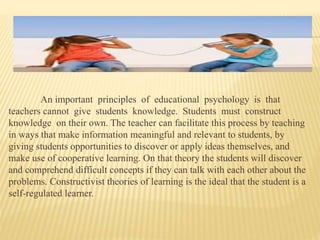
An important principles of educational psychology is that
teachers cannot give students knowledge. Students must construct
knowledge on their own. The teacher can facilitate this process by teaching
in ways that make information meaningful and relevant to students, by
giving students opportunities to discover or apply ideas themselves, and
make use of cooperative learning. On that theory the students will discover
and comprehend difficult concepts if they can talk with each other about the
problems. Constructivist theories of learning is the ideal that the student is a
self-regulated learner.
Cooperative learning activities can play many roles in the learning process
as students are assigned to cooperative groups and stay together as a group for
many weeks or months. When children work in small groups, they learn
important lessons about cooperation, compromise, and talking in a conversation.
promote student learning and academic achievement
enhance student satisfaction with their learning experience
help students develop skills in oral communication
develop social skills & promote student self-esteem
help to promote positive race relation
Cooperative learning always makes use of teamwork and cooperation.
Group (or cooperative)learning has several steps:
Decide on a group goal that everyone can agree on.
Give everyone a job.
Work together cooperatively.
Ask for adult help if needed.
Evaluate the process (look at what's working and what's not).
Stay focused till the end.
Some challenges of using cooperative learning include releasing the
control of learning, managing noise levels, resolving conflicts, and assessing
student learning
As students become familiar with cooperative group structures, have them
take more ownership of the process. Cooperative learning can be used in any class
at any level with any subject area.
Use cooperative groups during partner reading.
Use cooperative groups during the writing process
Use cooperative groups to practice problem-solving strategies.
Use cooperative groups to create and discuss hypotheses before
completing experiments.
Cooperative learning result in positive student outcomes in all domains as
a teaching method to increase student achievement. A basic element is positive
independence, equal opportunities, and individual accountability.
“Cooperative learning groups do not separate students on the basis of
class, race, or gender and the goals of middle schools are consistent with the goals
of cooperative learning theories. It is a peer-centered pedagogy that promotes
academic achievement and builds positive social relationships”(Sapon-Shevin,
1994).
REFERENCES
EBSCOhost : WORKING TOGETHER to Reach a Goal. By: Milios, Rita, Current
Health 1, 0199820X, Oct2000, Vol. 24, Issue 2
Sapon-Shevin, M. (1994). Cooperative learning and middle schools: What would it
take to really do it right? Theory Into Practice, 33, 183-190.
Cooperative Learning Structures Can Increase Student
Achievementwww.ascd.org/ASCD/pdf/journals/ed_lead/el_198810_slavin.pdf

Cooperative learning slide presentation

  • 1.
    COOPERATIVE LEARNING Bethany Sult SOE115 Psychology of Teaching and Learning Kendall College
  • 2.
    An important principlesof educational psychology is that teachers cannot give students knowledge. Students must construct knowledge on their own. The teacher can facilitate this process by teaching in ways that make information meaningful and relevant to students, by giving students opportunities to discover or apply ideas themselves, and make use of cooperative learning. On that theory the students will discover and comprehend difficult concepts if they can talk with each other about the problems. Constructivist theories of learning is the ideal that the student is a self-regulated learner.
  • 3.
    Cooperative learning activitiescan play many roles in the learning process as students are assigned to cooperative groups and stay together as a group for many weeks or months. When children work in small groups, they learn important lessons about cooperation, compromise, and talking in a conversation. promote student learning and academic achievement enhance student satisfaction with their learning experience help students develop skills in oral communication develop social skills & promote student self-esteem help to promote positive race relation
  • 4.
    Cooperative learning alwaysmakes use of teamwork and cooperation. Group (or cooperative)learning has several steps: Decide on a group goal that everyone can agree on. Give everyone a job. Work together cooperatively. Ask for adult help if needed. Evaluate the process (look at what's working and what's not). Stay focused till the end. Some challenges of using cooperative learning include releasing the control of learning, managing noise levels, resolving conflicts, and assessing student learning
  • 5.
    As students becomefamiliar with cooperative group structures, have them take more ownership of the process. Cooperative learning can be used in any class at any level with any subject area. Use cooperative groups during partner reading. Use cooperative groups during the writing process Use cooperative groups to practice problem-solving strategies. Use cooperative groups to create and discuss hypotheses before completing experiments.
  • 6.
    Cooperative learning resultin positive student outcomes in all domains as a teaching method to increase student achievement. A basic element is positive independence, equal opportunities, and individual accountability. “Cooperative learning groups do not separate students on the basis of class, race, or gender and the goals of middle schools are consistent with the goals of cooperative learning theories. It is a peer-centered pedagogy that promotes academic achievement and builds positive social relationships”(Sapon-Shevin, 1994).
  • 7.
    REFERENCES EBSCOhost : WORKINGTOGETHER to Reach a Goal. By: Milios, Rita, Current Health 1, 0199820X, Oct2000, Vol. 24, Issue 2 Sapon-Shevin, M. (1994). Cooperative learning and middle schools: What would it take to really do it right? Theory Into Practice, 33, 183-190. Cooperative Learning Structures Can Increase Student Achievementwww.ascd.org/ASCD/pdf/journals/ed_lead/el_198810_slavin.pdf