COOPERATIVE AND
COLLABORATIVE
LANGUAGE
LEARNING
COOPERATIVE
LANGUAGE LEARNING
Cooperative learning is
group learning activity organized so
that learning is dependent on the
socially structured exchange of
information between learners in
groups and in which each learner is
held accountable for his or her own
learning and is motivated to
increase the learning of others.
(Olsen and Kagan 1992:8)
COLLABORATIVE
LANGUAGE LEARNING
Collaborative vs.
Cooperative Learning
Collaborative Learning
Collaborative
learning is based on the
idea that learning is a
naturally social act in
which the participants
talk among themselves
(Gerlach,1994). It is
through the talk that
learning occurs.
Cooperative Learning
Cooperative learning
is a successful teaching
strategy in which small
teams, each with
students of different
levels of ability, use a
variety of learning
activities to improve
their understanding of a
subject. (U.S. Dept. of
Ed. Office of Research,
1992)
None or negative
Be a winner or loser.
Judge of students’
right or wrong
Passive receiver and
performer
Mainly teacher-
student interaction
Separate desks
Positive
All members contribute
to the group
Facilitator of the
communication tasks
Active participant
Intense interaction
among students
Collaborative small
groups
Traditional
Language Learning
Cooperative
and Collaborative Learning
Independence
Room
arrangement
Student
expectations
Teacher’s roles
Learner roles
Interaction
Traditional Language
Teaching
It is a teacher-centered method in which many
ingredients of Grammar-translation Method and
Audio-Lingual Method are used in the language
teaching and learning.
Language learning is viewed as memorizing rules and
facts in order to understand and manipulate the
morphology and syntax of the foreign language.
Student-student interaction is minimal.
Students are seen as acquiring knowledge of language
rather than communicative ability directly and they
simply passively acquire the new knowledge.
Dealing with
Communicative Language
Cooperative language learning
shares some characteristics with
communicative language teaching.
They both give high light to the interaction and
communication between students and students and
teachers, take teachers’ role as facilitator and stress the
autonomy and centricity of the students in classroom.
They both consider healthy relationships
with other classmates are more conductive to learning,
and respect the integrity of learners, allowing for
personal growth and responsibility, etc.
GENERAL
CHARACTERISTICS
Development of learning
and communication
strategies
Replace teacher-fronted
lessons for student-centered
Replace competition
cooperation with in
interactive pair and group
activities
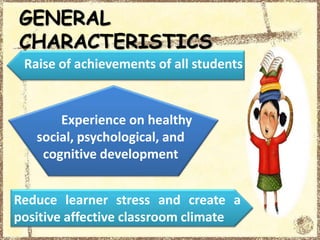
Raise of achievements of all students
Experience on healthy
social, psychological, and
cognitive development
Reduce learner stress and create a
positive affective classroom climate
GENERAL
CHARACTERISTICS
APPROACH THEORY OF LANGUAGE
Interactive and cooperative nature of language
Communication as a primary purpose of
language
Most speech is organized as conversation
Communication takes place upon certain
agreed-upon set of cooperative rules
We learn these social rules in
conversational interaction
APPROACH THEORY OF LEARNING
Role of social interaction in learning (Piaget and
Vygotsky)
Development of critical thinking skills
Learning must emphasize on
cooperation and collaboration, not on competition
Cognitive development and increased language skills
Greater variety of materials to stimulate language
and concept learning
Students act as resources of each other – a more
active role
OBJECTIVES
To give opportunities for students to
develop critical thinking skills in a shared,
non-competitive environment
Teachers must pay attention to the
development of systematic group-based
procedures
Cooperative and Collaborative in
Classroom Setting
If the language class is meant to be a place
where individuals can practice in communication
in the foreign language, it is vital to establish a
social and affective climate in which students are
not restricted, aggressive, or feared (Stern, 1992).
Cooperative learning, like other group work,
offers a relaxed climate in the classroom, while it
also increase student motivation (Brown, 1994;
Crandall, 1999).
Creating Effective Climate for
Learning
Individuals have the opportunity to
rehearse their answers before being asked to offer
them in front of the whole class so their anxiety and
fear of failure may reduce. Time to think and receive
feedback form group members, and the greater
likelihood of success reduce anxiety and can result in
increased participation in learning language
(Crandall, 1999).
Cooperative and Collaborative in
Classroom Setting
Creating Effective Climate for
Learning
The final aim of cooperative learning is to make
each student a stronger individual through doing work
cooperatively. Cooperative learning, therefore, emphasizes
individual accountability. It places responsibility for action
and progress on each of the members of the group
somewhat equally. Positive role and goal interdependence
help students become more autonomous and self-
controlled and less dependent upon outside authority, and
over time, they will gradually move from interdependence
to independence (Johnson & Johnson, 1991).
Cooperative and Collaborative in
Classroom Setting
Fostering Learner Responsibility and Independence
Cooperative Collaborative Learning
Examples
Cooperative collaborative learning
should always be:
engaging
exploratory
transforming
presentable
reflective.
TYPES OF LEARNING AND
TEACHING ACTIVITIES
Johnson Olsen & Kagan
1992
Coelho 1992
Cooperative
Learning Groups
Key Elements Cooperative/
Collaborative
Learning Tasks
 Olsen & Kagan:
Three-step
interview, Round
table, Think-pair-
share, Solve-pair-
share, Numbered
heads.
 Formal
Informal
Cooperative
Base Groups
 Positive
Interdependence
 Group
Formation
Individual
Accountability
Social Skills
Structuring and
structures
 Team practice
from common
input
Jig saw
Cooperative
projects
Johnson's Cooperative Learning Groups
Formal
= Tasks in which students work together
Informal
= Ad-hoc groups used to facilitate learning
related to direct teaching
Cooperative
= Long term, heterogeneous learning groups
allowing students to support , help and assist
each other ( combination of the two)
Key Elements (Olsen & Kagan, 1992)
Positive Interdependence (mutual support
within the group)
Group Formation (size 2-4 people, age, time
limits, groupings, roles)
Individual Accountability (group or
individually)
Social Skills (explicit instruction is necessary
for successful interaction)
Structure ( the task design, written or oral)
Cooperative Learning Tasks (Coelho, 1992)
TEAM PRACTICE FOR COMMON
INPUT
=Skills development and mastery of facts
Student work on some material
Practice to follow traditional , teacher–directed
teaching
Students coaching and helping each other to
ensure comprehension
Any person in the group can answer a teacher’s
question
Cooperative Learning Tasks (Coelho, 1992)
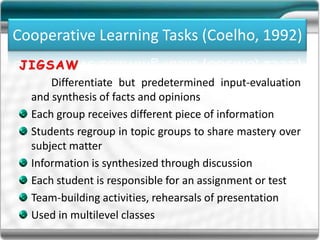
JIGSAW
Differentiate but predetermined input-evaluation
and synthesis of facts and opinions
Each group receives different piece of information
Students regroup in topic groups to share mastery over
subject matter
Information is synthesized through discussion
Each student is responsible for an assignment or test
Team-building activities, rehearsals of presentation
Used in multilevel classes
Cooperative Learning Tasks (Coelho, 1992)
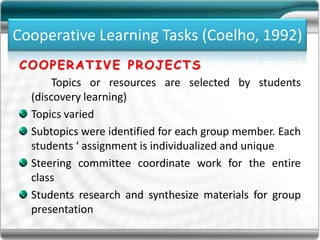
COOPERATIVE PROJECTS
Topics or resources are selected by students
(discovery learning)
Topics varied
Subtopics were identified for each group member. Each
students ‘ assignment is individualized and unique
Steering committee coordinate work for the entire
class
Students research and synthesize materials for group
presentation
Cooperative Learning Tasks (Coelho, 1992)
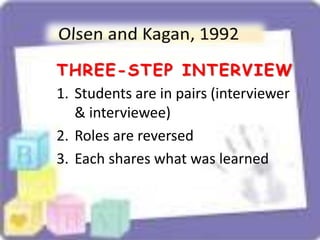
THREE-STEP INTERVIEW
1. Students are in pairs (interviewer
& interviewee)
2. Roles are reversed
3. Each shares what was learned
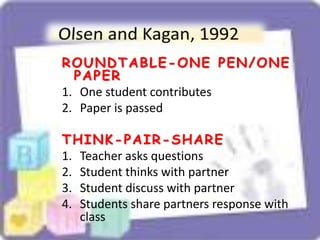
ROUNDTABLE-ONE PEN/ONE
PAPER
1. One student contributes
2. Paper is passed
THINK-PAIR-SHARE
1. Teacher asks questions
2. Student thinks with partner
3. Student discuss with partner
4. Students share partners response with
class
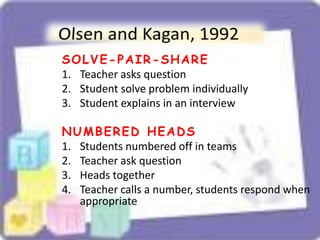
SOLVE-PAIR-SHARE
1. Teacher asks question
2. Student solve problem individually
3. Student explains in an interview
NUMBERED HEADS
1. Students numbered off in teams
2. Teacher ask question
3. Heads together
4. Teacher calls a number, students respond when
appropriate
LEARNER’S ROLES
Work collaboratively on tasks with other group
members.
Must learn teamwork skills.
Be directors of their learning (plan, monitor, and
evaluate their own learning)
Learning requires student’s direct and active
involvement and participation.
Alternate roles involve partners in the role of
tutors, checkers, recorders, and information
sharers. “Pair tasks”
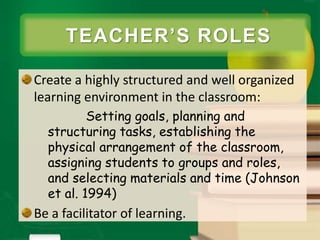
TEACHER ROLES
Create a highly structured and well organized
learning environment in the classroom:
Setting goals, planning and
structuring tasks, establishing the
physical arrangement of the classroom,
assigning students to groups and roles,
and selecting materials and time (Johnson
et al. 1994)
Be a facilitator of learning.
TEACHER’S ROLES
Move around the class and helping students and groups
as needs arise:
During this time the teacher interacts,
teaches, refocuses, questions, clarifies,
supports, expands, celebrates, and empathizes.
And facilitators are giving feedback,
redirecting the group with questions,
encouraging the group to solve its own
problems, extending activity, encouraging
thinking, managing conflict, observing students,
and supplying resources. (Harel 1992: 169)
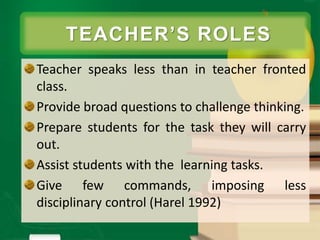
TEACHER’S ROLES
Teacher speaks less than in teacher fronted
class.
Provide broad questions to challenge thinking.
Prepare students for the task they will carry
out.
Assist students with the learning tasks.
Give few commands, imposing less
disciplinary control (Harel 1992)
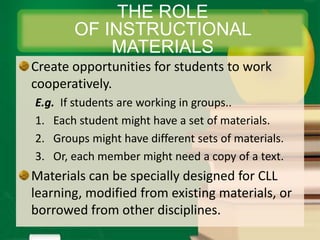
TEACHER’S ROLES
Create opportunities for students to work
cooperatively.
E.g. If students are working in groups..
1. Each student might have a set of materials.
2. Groups might have different sets of materials.
3. Or, each member might need a copy of a text.
Materials can be specially designed for CLL
learning, modified from existing materials, or
borrowed from other disciplines.
THE ROLE
OF INSTRUCTIONAL
MATERIALS
CONCLUSIONS
Using group discussions motivate
students to participate.
Maximize student’s interaction
Students contribute to each
other’s learning
Benefits of Cooperative
and Collaborative Language Learning
CONCLUSIONS
Less emphasis on language
structure
High- risk of student’s usage of
their native language
Time consuming
Disadvantages of Cooperative
and Collaborative Language Learning
CONCLUSIONS
In general, the success of
the cooperative and
collaborative learning is on the
hands of the teacher. It is on
how the teacher can formulate
effective activities that can
accommodate the students’
needs.
collaborative-lang.-learning.pptx