Dr. C.M.SEDANI
BE, MTech., PhD( Mechanical Engg.) ,PGDBM,MBA(HRM)
cmsedani@gmail.com, +918208558052
Principal @ PVGCOE Nashik@PVPIT Pune@MSSCET Jalna(MS) India
Professor@JDIET Yavatmal
(More than 30 Years Experience in Technical Education)
COLLABORATIVE LEARNING
Teaching :
• “Teaching is a complex, difficult and often subtle activity.”
• Teachers need to be directive, Influential, caring and actively engaged in the passion of
teaching and learning .
• Teacher need to be aware of what each and every student is thinking and knowing and
construct the meaning in the light of knowledge
• Teacher must understand the concept and shall develop proficient knowledge of the
subject. He may use appropriate feedback for Progressive moves of students.
• Although I will be arguing that a great deal of teaching is spontaneous, 'natural’
and effective, Since students generally learn what they practice, it is helpful for
the teacher to consider how closely related the learning tasks are to desired
learning outcomes.
09-08-2023
Dr.C.M.Sedani /Active Learning Practices /India 3
Teaching & Learning :
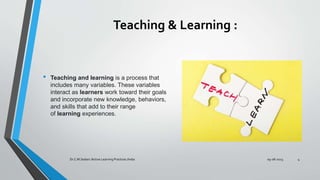
• Teaching and learning is a process that
includes many variables. These variables
interact as learners work toward their goals
and incorporate new knowledge, behaviors,
and skills that add to their range
of learning experiences.
09-08-2023
Dr.C.M.Sedani /Active Learning Practices /India 4
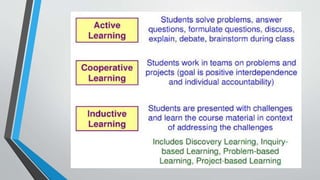
Active Learning :
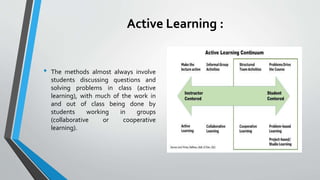
• The methods almost always involve
students discussing questions and
solving problems in class (active
learning), with much of the work in
and out of class being done by
students working in groups
(collaborative or cooperative
learning).
Teaching with Purpose:
• An important dimension is that teacher-
scholars survey creative examples or
options for teaching and learning.
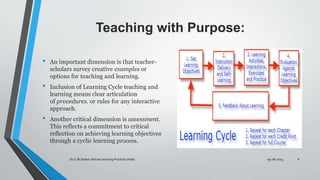
• Inclusion of Learning Cycle teaching and
learning means clear articulation
of procedures. or rules for any interactive
approach.
• Another critical dimension is assessment.
This reflects a commitment to critical
reflection on achieving learning objectives
through a cyclic learning process.
09-08-2023
Dr.C.M.Sedani /Active Learning Practices /India 6
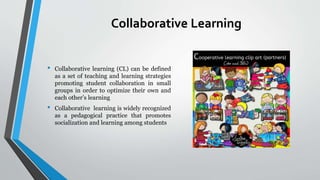
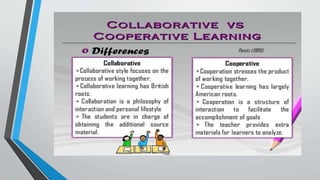
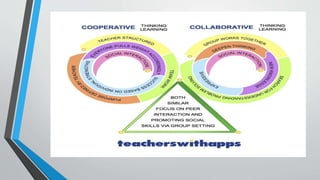
Collaborative Learning
• Collaborative learning (CL) can be defined
as a set of teaching and learning strategies
promoting student collaboration in small
groups in order to optimize their own and
each other’s learning
• Collaborative learning is widely recognized
as a pedagogical practice that promotes
socialization and learning among students
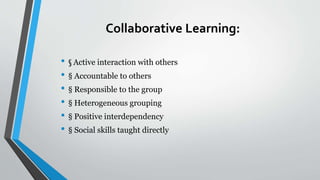
Collaborative Learning:
• § Active interaction with others
• § Accountable to others
• § Responsible to the group
• § Heterogeneous grouping
• § Positive interdependency
• § Social skills taught directly
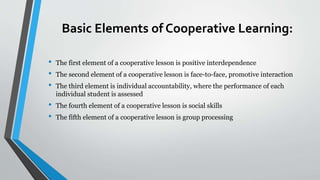
Basic Elements of Cooperative Learning:
• The first element of a cooperative lesson is positive interdependence
• The second element of a cooperative lesson is face-to-face, promotive interaction
• The third element is individual accountability, where the performance of each
individual student is assessed
• The fourth element of a cooperative lesson is social skills
• The fifth element of a cooperative lesson is group processing
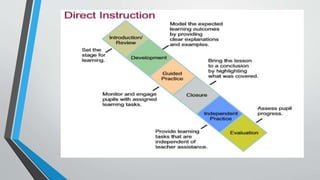
Formal Cooperative Learning Groups
• 1. Specifies the objectives for the lesson (one
academic and one social skills)
• 2. Makes a series of decisions about how to
structure the learning groups .
• 3. Teaches the academic concepts, principles,
and strategies
• 4. Monitors the functioning of the learning
groups and intervenes to teach collaborative
skills and provide assistance in academic
learning when it is needed.
• 5. Evaluates student performance against the
preset criteria for excellence and ensures that
groups process how effectively members
worked together.
• Informal Cooperative LearningGroups
• During a lecture, demonstration, or film
they can be used to focus student
attention on the materials to be learned
Problems students encounter when
collaborating in groups :
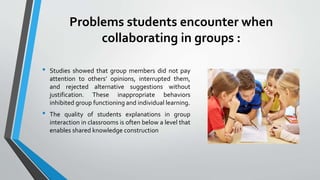
• Studies showed that group members did not pay
attention to others’ opinions, interrupted them,
and rejected alternative suggestions without
justification. These inappropriate behaviors
inhibited group functioning and individual learning.
• The quality of students explanations in group
interaction in classrooms is often below a level that
enables shared knowledge construction
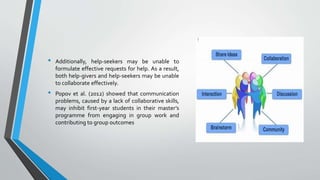
• Additionally, help-seekers may be unable to
formulate effective requests for help. As a result,
both help-givers and help-seekers may be unable
to collaborate effectively.
• Popov et al. (2012) showed that communication
problems, caused by a lack of collaborative skills,
may inhibit first-year students in their master’s
programme from engaging in group work and
contributing to group outcomes
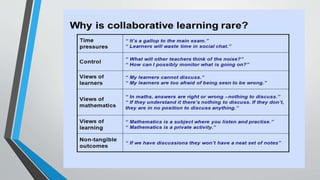
ProblemsTeachers encounter when applying
collaborative learning
Two problems affecting CL
effectiveness:
Organization of collaborative activities,
Assessment of learning
Teachers often face challenges while
structuring collaborative activities such as
monitoring students on-task behavior,
managing group-work time, providing
relevant materials, assigning individual
roles, and establishing teamwork beliefs
and behaviors
Second, teachers frequently find it
difficult to assess students’ performance
and achievements as they implement CL
in classrooms at all levels of education
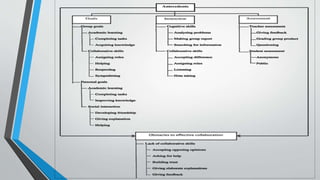
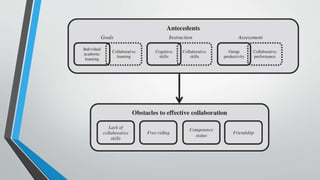
• Lack of collaborative skills All students agreed that, when they started to
work in groups, they did not know how to collaborate effectively. Their lack
of collaborative skills such as accepting opposing viewpoints, giving
elaborate explanations, providing and receiving help, and negotiating
• The second obstacle to effective collaboration was free-riding. More than
two-thirds of the students indicated that, when collaborating on group
assignments, some peers contributed most, while others worked less, and
some did not even put in effort when completing their own tasks
Competence status
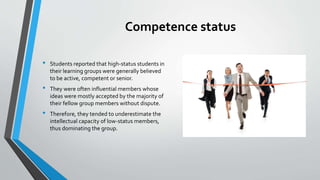
• Students reported that high-status students in
their learning groups were generally believed
to be active, competent or senior.
• They were often influential members whose
ideas were mostly accepted by the majority of
their fellow group members without dispute.
• Therefore, they tended to underestimate the
intellectual capacity of low-status members,
thus dominating the group.
Friendship Relations:
• Friendship relations in groups
were an obstacle to effective
collaboration, described that
feelings of friendship in the
group sometimes inhibited them
from working seriously and
constructing good arguments
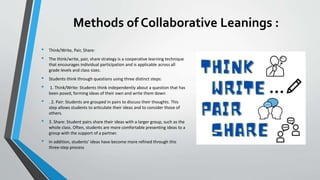
Methods of Collaborative Leanings :
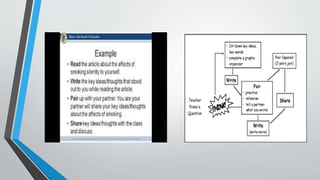
• Think/Write, Pair, Share:
• The think/write, pair, share strategy is a cooperative learning technique
that encourages individual participation and is applicable across all
grade levels and class sizes.
• Students think through questions using three distinct steps:
• 1. Think/Write: Students think independently about a question that has
been posed, forming ideas of their own and write them down
• . 2. Pair: Students are grouped in pairs to discuss their thoughts. This
step allows students to articulate their ideas and to consider those of
others.
• 3. Share: Student pairs share their ideas with a larger group, such as the
whole class. Often, students are more comfortable presenting ideas to a
group with the support of a partner.
• In addition, students' ideas have become more refined through this
three-step process
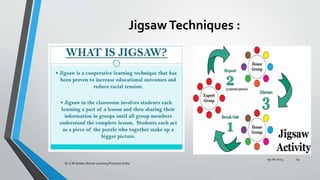
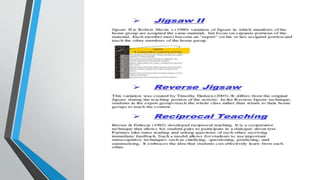
JigsawTechniques :
09-08-2023
Dr.C.M.Sedani /Active Learning Practices /India
24
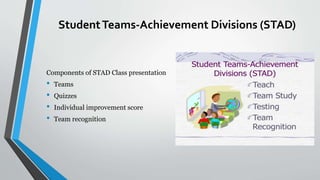
StudentTeams-Achievement Divisions (STAD)
Components of STAD Class presentation
• Teams
• Quizzes
• Individual improvement score
• Team recognition
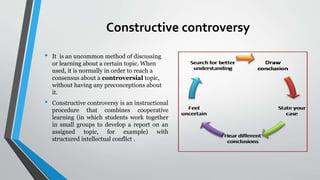
Constructive controversy
• It is an uncommon method of discussing
or learning about a certain topic. When
used, it is normally in order to reach a
consensus about a controversial topic,
without having any preconceptions about
it.
• Constructive controversy is an instructional
procedure that combines cooperative
learning (in which students work together
in small groups to develop a report on an
assigned topic, for example) with
structured intellectual conflict .
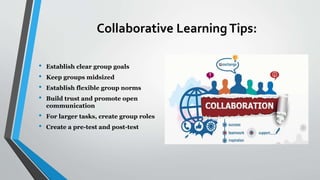
Collaborative LearningTips:
• Establish clear group goals
• Keep groups midsized
• Establish flexible group norms
• Build trust and promote open
communication
• For larger tasks, create group roles
• Create a pre-test and post-test
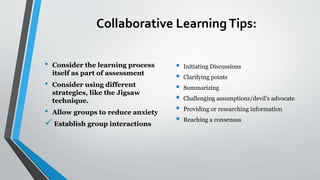
Collaborative LearningTips:
• Consider the learning process
itself as part of assessment
• Consider using different
strategies, like the Jigsaw
technique.
• Allow groups to reduce anxiety
 Establish group interactions
 Initiating Discussions
 Clarifying points
 Summarizing
 Challenging assumptions/devil’s advocate
 Providing or researching information
 Reaching a consensus
• Use Real-world problems
• Keep in mind the diversity of
groups
• Consider demographics
• Use scaffolding or diminished
responsibility as students begin
to understand concepts
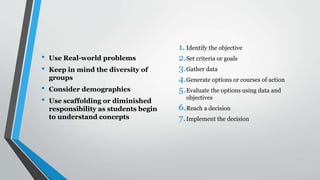
1. Identify the objective
2.Set criteria or goals
3.Gather data
4.Generate options or courses of action
5.Evaluate the options using data and
objectives
6.Reach a decision
7.Implement the decision
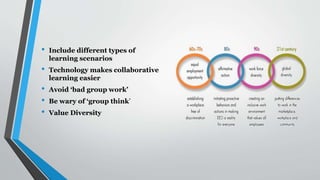
• Include different types of
learning scenarios
• Technology makes collaborative
learning easier
• Avoid ‘bad group work’
• Be wary of ‘group think’
• Value Diversity
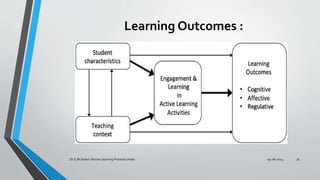
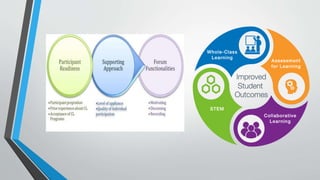
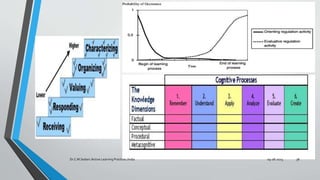
Learning Outcomes :
09-08-2023
Dr.C.M.Sedani /Active Learning Practices /India 35
09-08-2023
Dr.C.M.Sedani /Active Learning Practices /India 38
Social benefits : CL helps to develop a social support system for learners; CL
leads to build diversity understanding among students and staff; CL establishes
a positive atmosphere for modeling and practicing cooperation, and; CL
develops learning communities.
 Psychological benefits :Student-centered instruction increases students' self
esteem; Cooperation reduces anxiety, and; CL develops positive attitudes
towards teachers.
 Academic benefits :CL Promotes critical thinking skills, Involves students
actively in the learning process Classroom results are improved Models
appropriate student problem solving techniques
Alternate student and teacher assessment techniques :Collaborative teaching
techniques utilize a variety of assessments.
THANKYOUVERY MUCH !!!
09-08-2023 42
Dr.C.M.Sedani
Principal @PVGCOE & SSDIOM
Nashik@PVPIT Pune@MSSCET Jalna
cmsedani@gmail.com
+918208558052

Collabrative Learning.pptx

  • 1.
    Dr. C.M.SEDANI BE, MTech.,PhD( Mechanical Engg.) ,PGDBM,MBA(HRM) cmsedani@gmail.com, +918208558052 Principal @ PVGCOE Nashik@PVPIT Pune@MSSCET Jalna(MS) India Professor@JDIET Yavatmal (More than 30 Years Experience in Technical Education) COLLABORATIVE LEARNING
  • 3.
    Teaching : • “Teachingis a complex, difficult and often subtle activity.” • Teachers need to be directive, Influential, caring and actively engaged in the passion of teaching and learning . • Teacher need to be aware of what each and every student is thinking and knowing and construct the meaning in the light of knowledge • Teacher must understand the concept and shall develop proficient knowledge of the subject. He may use appropriate feedback for Progressive moves of students. • Although I will be arguing that a great deal of teaching is spontaneous, 'natural’ and effective, Since students generally learn what they practice, it is helpful for the teacher to consider how closely related the learning tasks are to desired learning outcomes. 09-08-2023 Dr.C.M.Sedani /Active Learning Practices /India 3
  • 4.
    Teaching & Learning: • Teaching and learning is a process that includes many variables. These variables interact as learners work toward their goals and incorporate new knowledge, behaviors, and skills that add to their range of learning experiences. 09-08-2023 Dr.C.M.Sedani /Active Learning Practices /India 4
  • 5.
    Active Learning : •The methods almost always involve students discussing questions and solving problems in class (active learning), with much of the work in and out of class being done by students working in groups (collaborative or cooperative learning).
  • 6.
    Teaching with Purpose: •An important dimension is that teacher- scholars survey creative examples or options for teaching and learning. • Inclusion of Learning Cycle teaching and learning means clear articulation of procedures. or rules for any interactive approach. • Another critical dimension is assessment. This reflects a commitment to critical reflection on achieving learning objectives through a cyclic learning process. 09-08-2023 Dr.C.M.Sedani /Active Learning Practices /India 6
  • 8.
    Collaborative Learning • Collaborativelearning (CL) can be defined as a set of teaching and learning strategies promoting student collaboration in small groups in order to optimize their own and each other’s learning • Collaborative learning is widely recognized as a pedagogical practice that promotes socialization and learning among students
  • 9.
    Collaborative Learning: • §Active interaction with others • § Accountable to others • § Responsible to the group • § Heterogeneous grouping • § Positive interdependency • § Social skills taught directly
  • 10.
    Basic Elements ofCooperative Learning: • The first element of a cooperative lesson is positive interdependence • The second element of a cooperative lesson is face-to-face, promotive interaction • The third element is individual accountability, where the performance of each individual student is assessed • The fourth element of a cooperative lesson is social skills • The fifth element of a cooperative lesson is group processing
  • 11.
    Formal Cooperative LearningGroups • 1. Specifies the objectives for the lesson (one academic and one social skills) • 2. Makes a series of decisions about how to structure the learning groups . • 3. Teaches the academic concepts, principles, and strategies • 4. Monitors the functioning of the learning groups and intervenes to teach collaborative skills and provide assistance in academic learning when it is needed. • 5. Evaluates student performance against the preset criteria for excellence and ensures that groups process how effectively members worked together. • Informal Cooperative LearningGroups • During a lecture, demonstration, or film they can be used to focus student attention on the materials to be learned
  • 12.
    Problems students encounterwhen collaborating in groups : • Studies showed that group members did not pay attention to others’ opinions, interrupted them, and rejected alternative suggestions without justification. These inappropriate behaviors inhibited group functioning and individual learning. • The quality of students explanations in group interaction in classrooms is often below a level that enables shared knowledge construction
  • 13.
    • Additionally, help-seekersmay be unable to formulate effective requests for help. As a result, both help-givers and help-seekers may be unable to collaborate effectively. • Popov et al. (2012) showed that communication problems, caused by a lack of collaborative skills, may inhibit first-year students in their master’s programme from engaging in group work and contributing to group outcomes
  • 14.
    ProblemsTeachers encounter whenapplying collaborative learning Two problems affecting CL effectiveness: Organization of collaborative activities, Assessment of learning Teachers often face challenges while structuring collaborative activities such as monitoring students on-task behavior, managing group-work time, providing relevant materials, assigning individual roles, and establishing teamwork beliefs and behaviors Second, teachers frequently find it difficult to assess students’ performance and achievements as they implement CL in classrooms at all levels of education
  • 17.
    • Lack ofcollaborative skills All students agreed that, when they started to work in groups, they did not know how to collaborate effectively. Their lack of collaborative skills such as accepting opposing viewpoints, giving elaborate explanations, providing and receiving help, and negotiating • The second obstacle to effective collaboration was free-riding. More than two-thirds of the students indicated that, when collaborating on group assignments, some peers contributed most, while others worked less, and some did not even put in effort when completing their own tasks
  • 18.
    Competence status • Studentsreported that high-status students in their learning groups were generally believed to be active, competent or senior. • They were often influential members whose ideas were mostly accepted by the majority of their fellow group members without dispute. • Therefore, they tended to underestimate the intellectual capacity of low-status members, thus dominating the group.
  • 19.
    Friendship Relations: • Friendshiprelations in groups were an obstacle to effective collaboration, described that feelings of friendship in the group sometimes inhibited them from working seriously and constructing good arguments
  • 22.
    Methods of CollaborativeLeanings : • Think/Write, Pair, Share: • The think/write, pair, share strategy is a cooperative learning technique that encourages individual participation and is applicable across all grade levels and class sizes. • Students think through questions using three distinct steps: • 1. Think/Write: Students think independently about a question that has been posed, forming ideas of their own and write them down • . 2. Pair: Students are grouped in pairs to discuss their thoughts. This step allows students to articulate their ideas and to consider those of others. • 3. Share: Student pairs share their ideas with a larger group, such as the whole class. Often, students are more comfortable presenting ideas to a group with the support of a partner. • In addition, students' ideas have become more refined through this three-step process
  • 24.
  • 27.
    StudentTeams-Achievement Divisions (STAD) Componentsof STAD Class presentation • Teams • Quizzes • Individual improvement score • Team recognition
  • 28.
    Constructive controversy • Itis an uncommon method of discussing or learning about a certain topic. When used, it is normally in order to reach a consensus about a controversial topic, without having any preconceptions about it. • Constructive controversy is an instructional procedure that combines cooperative learning (in which students work together in small groups to develop a report on an assigned topic, for example) with structured intellectual conflict .
  • 29.
    Collaborative LearningTips: • Establishclear group goals • Keep groups midsized • Establish flexible group norms • Build trust and promote open communication • For larger tasks, create group roles • Create a pre-test and post-test
  • 30.
    Collaborative LearningTips: • Considerthe learning process itself as part of assessment • Consider using different strategies, like the Jigsaw technique. • Allow groups to reduce anxiety  Establish group interactions  Initiating Discussions  Clarifying points  Summarizing  Challenging assumptions/devil’s advocate  Providing or researching information  Reaching a consensus
  • 31.
    • Use Real-worldproblems • Keep in mind the diversity of groups • Consider demographics • Use scaffolding or diminished responsibility as students begin to understand concepts 1. Identify the objective 2.Set criteria or goals 3.Gather data 4.Generate options or courses of action 5.Evaluate the options using data and objectives 6.Reach a decision 7.Implement the decision
  • 33.
    • Include differenttypes of learning scenarios • Technology makes collaborative learning easier • Avoid ‘bad group work’ • Be wary of ‘group think’ • Value Diversity
  • 35.
    Learning Outcomes : 09-08-2023 Dr.C.M.Sedani/Active Learning Practices /India 35
  • 38.
  • 39.
    Social benefits :CL helps to develop a social support system for learners; CL leads to build diversity understanding among students and staff; CL establishes a positive atmosphere for modeling and practicing cooperation, and; CL develops learning communities.  Psychological benefits :Student-centered instruction increases students' self esteem; Cooperation reduces anxiety, and; CL develops positive attitudes towards teachers.  Academic benefits :CL Promotes critical thinking skills, Involves students actively in the learning process Classroom results are improved Models appropriate student problem solving techniques Alternate student and teacher assessment techniques :Collaborative teaching techniques utilize a variety of assessments.
  • 42.
    THANKYOUVERY MUCH !!! 09-08-202342 Dr.C.M.Sedani Principal @PVGCOE & SSDIOM Nashik@PVPIT Pune@MSSCET Jalna cmsedani@gmail.com +918208558052