Organizational controlling
Controlling
One ofthemanagerial functionslike planning, organizing, staffing and
directing.
Process of gathering and feeding back information about performance so
that decision makers can compare actual results with planned results and
decide what to do about any apparent discrepancies or problems.
Helpstocheck errorsand take corrective measuresso that the deviation from
standards are minimizedand goals oftheorganization are achieved in a
desired manner.
Organizational Control
Managers monitor and regulate how efficiently and effectively an organization
and its members are performing the activities necessary to achieve
organizational goals
Organizational Control
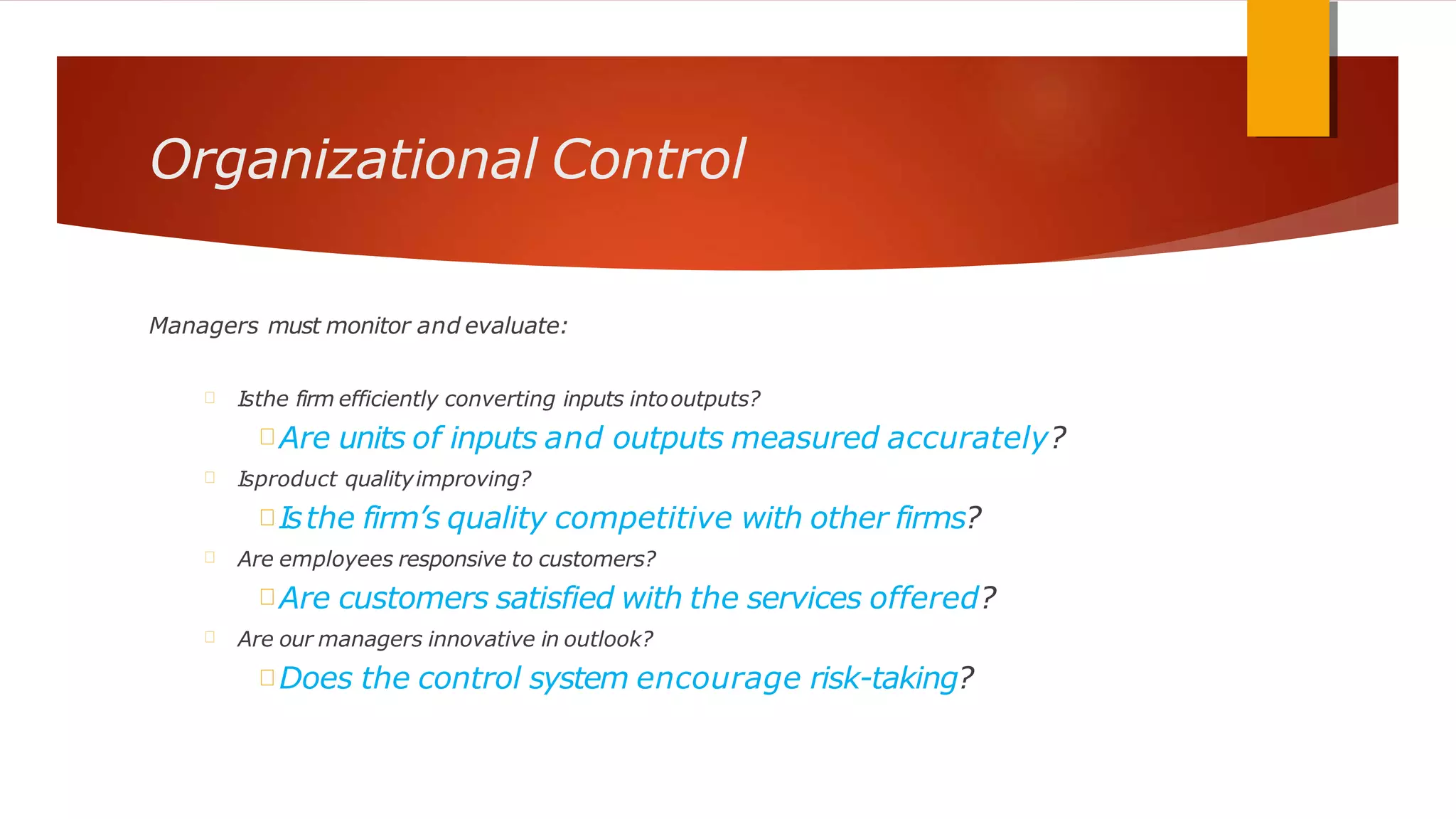
Managers must monitor and evaluate:
Isthe firm efficiently converting inputs intooutputs?
Are units of inputs and outputs measured accurately?
Isproduct qualityimproving?
Isthe firm’s quality competitive with other firms?
Are employees responsive to customers?
Are customers satisfied with the services offered?
Are our managers innovative in outlook?
Does the control system encourage risk-taking?
Control Systems
Control Systems
Formal, target-setting,monitoring, evaluation and feedback systemsthat
provide managers with information about whether the organization’s strategy
and structure are working efficiently and effectively.
Control Systems
A good control system should:
be flexible so managers can respond as needed.
provide accurate information about the organization.
provide information in a timely manner.
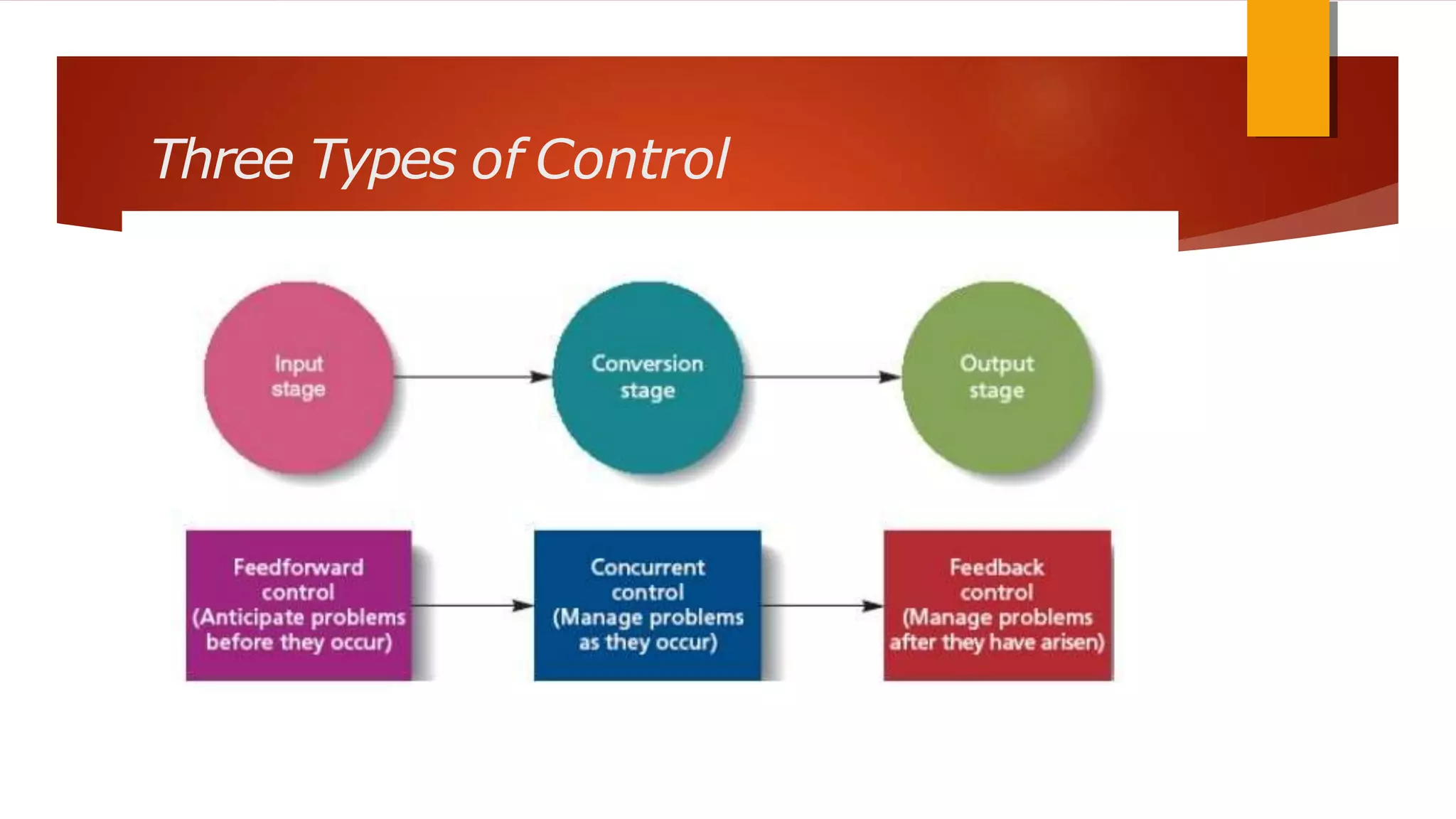
Three Types of Control
Types of Control
Feed forward Controls
Used to anticipate problems before they arise so that problems do not occur
later during the conversionprocess
Giving stringent product specifications to suppliers in advance
ITcan be used to keep in contact with suppliers and to monitor their progress
Types of Control
Concurrent Controls
Give managers immediate feedback on how efficiently inputs are being
transformed into outputs
Allows managers to correct problems as they arise
Types of Control
Feedback Controls
Used to provide information at the output stage about customers’ reactions to
goods and services so that corrective action can be taken if necessary
FEATURESOFCONTROLLING
Control isforwardlooking :
One can control future happenings and not the past.
Managers suggest corrective actions for the future period.
Control isboth an executive process and a result :
Each manager has to perform control function in the organization.
Nature, scope and limit of the control function may be different for different
managers.
The word ‘control ‘ is preceded by an adjective to designate control problem :
quality control, inventory control, production control, administrative control etc.
FEATURESOFCONTROLLING
Control isa continuousprocess :
Managerial control follows a definite pattern and time table,
month after month and year after year on a continuous basis.
A control systemisa coordinated –integrated system :
Data collected for different purposes should be reconciled with one another.
Control is a single system, but more accurate to think of it as a set of interlocking
subsystems.
STEPSINCONTROLLING
Control isreciprocally related toplanning :
Draws attention to situations where new planning is needed.
Provides data upon which plans can be based.
Various stepsincontrol process which are necessary inits
relationship toplanning :
Establishment of control standards.
Measurement of performance.
Comparison between performance and standards and the communication.
Correction of deviation from the standards.
1.ESTABLISHMENTOF CONTROL
STANDARDS
Plans-goals, objectives, targetstobe achieved. Actual
results are measured againstthem.
Precision :
Great precision –Standards are set in quantities.
E.g. Physical –Volume of products, manhour.
Monetary –Costs, revenues, investment.
Lessprecision –Standards are in qualitative terms.
E.g. Human relations.
ESTABLISHMENTOF CONTROL
STANDARDS
It is also important to decide the level of achievement which will be
regarded as good or satisfactory.
Desired level of performance -reasonable , feasible, some amount of
flexibility , stated in terms of range (maximum and minimum).
2.MEASUREMENTOFPERFORMANCE
Involves measuringtheperformance in the work in termsof
control standards.
Methods of measuring performance :
Quantitative–Physical and monetary terms, easily and precisely measurable.
E.g. Production units, sales, volume, profitsetc.
Qualitative –Intangible, cannot be measuredprecisely.
E.g. Human relations etc.
Techniques –Psychological tests, opinion surveys.
MEASUREMENTOFPERFORMANCE
Measurement must be
(i)clear, simple and rational,
(ii)relevant,
(iii)direct attention and efforts,
(iv)reliable, self announcing, and understandable
without complicated interpretation or philosophical
discussions.
3.COMPARING ACTUALAND
STANDARDPERFORMANCE
Steps :
Finding out the extentofdeviations.
Identifying the causes ofsuchdeviations.
Accurate standardsand accurate measurementofactual
performance are very important for clear revelation of variations.
Requiredstandardsachieved :
No further managerial actionisnecessary.
Control process iscomplete.
Requiredstandardsnotachieved :
Extent of variation may differ from case to case, depends upon the type of activity.
COMPARING ACTUALAND STANDARD
PERFORMANCE
Strictcompliance withstandardsorpermissible limitof variation.
E.g. Engineering products –a very minute variation may be significant.
When the deviation between standard and actual performance is
beyond the prescribed limit, an analysis is made of the causes of such
deviation.
Controllable factors –Person concerned will take necessarycorrective
action.
Uncontrollable factors –Person concerned cannot be held
responsible.
Communication of data to the person who can take corrective
action.
4.CORRECTIONOF DEVIATIONS
Organization is not a self –regulatingsystem.
Actions should be taken to maintain the desired degree of
control in the system oroperation.
Control actions :
Review of plans and goals and change therein on the basis of such review.
Change in the assignment oftasks.
Change in existingtechniques ofdirection.
Change in theorganizationstructure.
Provision for newfacilities.
Management Controlling
The Control Process
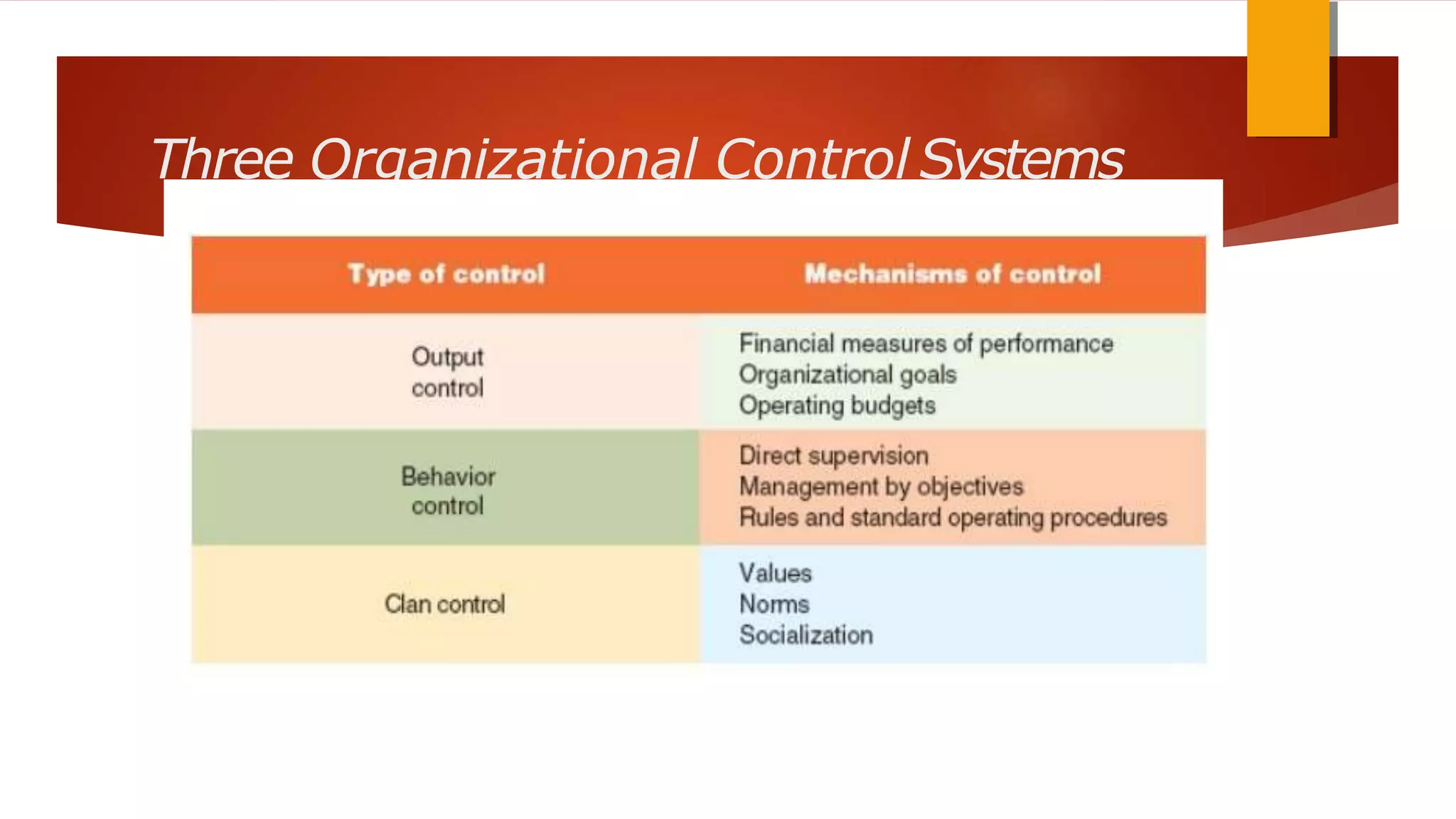
Three Organizational Control Systems
1.Output Control
Operating Budgets
Blueprint that states how managers intend to use organizational resources to
achieve organizational goalsefficiently.
Effective Output Control
1. Objective financial measures
2. Challenging goals and performance standards
3. Appropriate operating budgets
Problems with Output Control
Managers must create output standards that motivate at all levels
Should not cause managers to behave in inappropriate ways to achieve
organizational goals
2.Behavior Control
Direct supervision
managers who actively monitor and observe the behavior of their
subordinates
Teach subordinates appropriate behaviors
Intervene to take corrective action
Most immediate and potent form of behavioral control
Can be an effective way of motivating employees
Problems with DirectSupervision
Very expensive because a manager can personally manage only a
relatively small number of subordinateseffectively
Can demotivate subordinates if they feel that they are under such close
scrutiny that they are not free to make their own decisions
3.Bureaucratic Control
Bureaucratic Control
Control through a system of rules and standard operating procedures (SOPs)
that shapes and regulates the behavior of divisions, functions, and individuals.
Problems with Bureaucratic Control
Rules easier to make than discarding them, leading to bureaucratic “red tape”
and slowing organizational reaction times to problems.
Firms become too standardized and lose flexibility to learn, to create new
ideas, and solve to new problems.
Clan Control
Clan Control
The control exerted on individuals and groups in an organization by shared
values, norms, standards of behavior, and expectations.

Organizational control

  • 1.
  • 2.
    Controlling One ofthemanagerial functionslikeplanning, organizing, staffing and directing. Process of gathering and feeding back information about performance so that decision makers can compare actual results with planned results and decide what to do about any apparent discrepancies or problems. Helpstocheck errorsand take corrective measuresso that the deviation from standards are minimizedand goals oftheorganization are achieved in a desired manner.
  • 3.
    Organizational Control Organizational Control Managersmonitor and regulate how efficiently and effectively an organization and its members are performing the activities necessary to achieve organizational goals
  • 4.
    Organizational Control Managers mustmonitor and evaluate: Isthe firm efficiently converting inputs intooutputs? Are units of inputs and outputs measured accurately? Isproduct qualityimproving? Isthe firm’s quality competitive with other firms? Are employees responsive to customers? Are customers satisfied with the services offered? Are our managers innovative in outlook? Does the control system encourage risk-taking?
  • 5.
    Control Systems Control Systems Formal,target-setting,monitoring, evaluation and feedback systemsthat provide managers with information about whether the organization’s strategy and structure are working efficiently and effectively.
  • 6.
    Control Systems A goodcontrol system should: be flexible so managers can respond as needed. provide accurate information about the organization. provide information in a timely manner.
  • 7.
  • 8.
    Types of Control Feedforward Controls Used to anticipate problems before they arise so that problems do not occur later during the conversionprocess Giving stringent product specifications to suppliers in advance ITcan be used to keep in contact with suppliers and to monitor their progress
  • 9.
    Types of Control ConcurrentControls Give managers immediate feedback on how efficiently inputs are being transformed into outputs Allows managers to correct problems as they arise
  • 10.
    Types of Control FeedbackControls Used to provide information at the output stage about customers’ reactions to goods and services so that corrective action can be taken if necessary
  • 11.
    FEATURESOFCONTROLLING Control isforwardlooking : Onecan control future happenings and not the past. Managers suggest corrective actions for the future period. Control isboth an executive process and a result : Each manager has to perform control function in the organization. Nature, scope and limit of the control function may be different for different managers. The word ‘control ‘ is preceded by an adjective to designate control problem : quality control, inventory control, production control, administrative control etc.
  • 12.
    FEATURESOFCONTROLLING Control isa continuousprocess: Managerial control follows a definite pattern and time table, month after month and year after year on a continuous basis. A control systemisa coordinated –integrated system : Data collected for different purposes should be reconciled with one another. Control is a single system, but more accurate to think of it as a set of interlocking subsystems.
  • 13.
    STEPSINCONTROLLING Control isreciprocally relatedtoplanning : Draws attention to situations where new planning is needed. Provides data upon which plans can be based.
  • 14.
    Various stepsincontrol processwhich are necessary inits relationship toplanning : Establishment of control standards. Measurement of performance. Comparison between performance and standards and the communication. Correction of deviation from the standards.
  • 15.
    1.ESTABLISHMENTOF CONTROL STANDARDS Plans-goals, objectives,targetstobe achieved. Actual results are measured againstthem. Precision : Great precision –Standards are set in quantities. E.g. Physical –Volume of products, manhour. Monetary –Costs, revenues, investment. Lessprecision –Standards are in qualitative terms. E.g. Human relations.
  • 16.
    ESTABLISHMENTOF CONTROL STANDARDS It isalso important to decide the level of achievement which will be regarded as good or satisfactory. Desired level of performance -reasonable , feasible, some amount of flexibility , stated in terms of range (maximum and minimum).
  • 17.
    2.MEASUREMENTOFPERFORMANCE Involves measuringtheperformance inthe work in termsof control standards. Methods of measuring performance : Quantitative–Physical and monetary terms, easily and precisely measurable. E.g. Production units, sales, volume, profitsetc. Qualitative –Intangible, cannot be measuredprecisely. E.g. Human relations etc. Techniques –Psychological tests, opinion surveys.
  • 18.
    MEASUREMENTOFPERFORMANCE Measurement must be (i)clear,simple and rational, (ii)relevant, (iii)direct attention and efforts, (iv)reliable, self announcing, and understandable without complicated interpretation or philosophical discussions.
  • 19.
    3.COMPARING ACTUALAND STANDARDPERFORMANCE Steps : Findingout the extentofdeviations. Identifying the causes ofsuchdeviations. Accurate standardsand accurate measurementofactual performance are very important for clear revelation of variations. Requiredstandardsachieved : No further managerial actionisnecessary. Control process iscomplete. Requiredstandardsnotachieved : Extent of variation may differ from case to case, depends upon the type of activity.
  • 20.
    COMPARING ACTUALAND STANDARD PERFORMANCE Strictcompliancewithstandardsorpermissible limitof variation. E.g. Engineering products –a very minute variation may be significant. When the deviation between standard and actual performance is beyond the prescribed limit, an analysis is made of the causes of such deviation. Controllable factors –Person concerned will take necessarycorrective action. Uncontrollable factors –Person concerned cannot be held responsible. Communication of data to the person who can take corrective action.
  • 21.
    4.CORRECTIONOF DEVIATIONS Organization isnot a self –regulatingsystem. Actions should be taken to maintain the desired degree of control in the system oroperation. Control actions : Review of plans and goals and change therein on the basis of such review. Change in the assignment oftasks. Change in existingtechniques ofdirection. Change in theorganizationstructure. Provision for newfacilities.
  • 22.
  • 23.
  • 24.
  • 25.
    1.Output Control Operating Budgets Blueprintthat states how managers intend to use organizational resources to achieve organizational goalsefficiently. Effective Output Control 1. Objective financial measures 2. Challenging goals and performance standards 3. Appropriate operating budgets
  • 26.
    Problems with OutputControl Managers must create output standards that motivate at all levels Should not cause managers to behave in inappropriate ways to achieve organizational goals
  • 27.
    2.Behavior Control Direct supervision managerswho actively monitor and observe the behavior of their subordinates Teach subordinates appropriate behaviors Intervene to take corrective action Most immediate and potent form of behavioral control Can be an effective way of motivating employees
  • 28.
    Problems with DirectSupervision Veryexpensive because a manager can personally manage only a relatively small number of subordinateseffectively Can demotivate subordinates if they feel that they are under such close scrutiny that they are not free to make their own decisions
  • 29.
    3.Bureaucratic Control Bureaucratic Control Controlthrough a system of rules and standard operating procedures (SOPs) that shapes and regulates the behavior of divisions, functions, and individuals.
  • 30.
    Problems with BureaucraticControl Rules easier to make than discarding them, leading to bureaucratic “red tape” and slowing organizational reaction times to problems. Firms become too standardized and lose flexibility to learn, to create new ideas, and solve to new problems.
  • 31.
    Clan Control Clan Control Thecontrol exerted on individuals and groups in an organization by shared values, norms, standards of behavior, and expectations.