TRAINING IN
STAFF DEVELOPMENT OF
NURSING
By;
Mr. MANULAL. V.S
FACULTY
CACEE, University of Kerala,
Thiruvananthapuram.
INTRODUCTION TO TRAINING /
SKILL TRAINING
• Training is actually a component of staff
development.
• Growth cannot takes place without trained man
power.
Definition
- Training may be defined as an organized method
of ensuring that the people have acquired the
necessary knowledge and skill to perform specific
job.
- Training refers to a process of developing skills,
habits, knowledge and attitude in employees.
- -------- By……. Torpe.
IMPORTANCE / NEED OF TRAINIG
• For the achievement of departmental /
organizational objectives.
• Helps in developing the attitude of trainees
uniform and universal.
• For better job security for the employees and
greater opportunity for advancements.
• Helps the trainers to make them elegible for
recruitment.
IMPORTANCE / NEED OF TRAINIG
… cont…
• Enhances the standard of the organization.
• Training equips the trainer with knowledge
and skill about the post on which he/she has
been recruited.
• Training enhances the efficiency of trainers
and helps them to achieve the targets.
TYPES OF TRAINING
1. FORMAL AND INFORMAL TRAINING
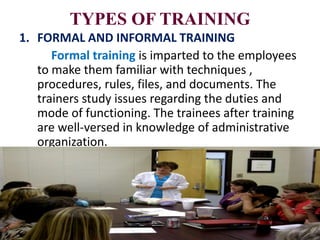
Formal training is imparted to the employees
to make them familiar with techniques ,
procedures, rules, files, and documents. The
trainers study issues regarding the duties and
mode of functioning. The trainees after training
are well-versed in knowledge of administrative
organization.
TYPES OF TRAINING
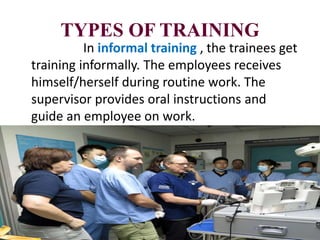
In informal training , the trainees get
training informally. The employees receives
himself/herself during routine work. The
supervisor provides oral instructions and
guide an employee on work.
TYPES OF TRAINING
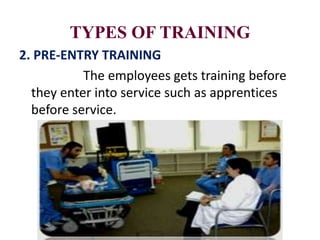
2. PRE-ENTRY TRAINING
The employees gets training before
they enter into service such as apprentices
before service.
TYPES OF TRAINING
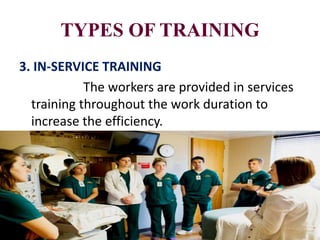
3. IN-SERVICE TRAINING
The workers are provided in services
training throughout the work duration to
increase the efficiency.
TYPES OF TRAINING
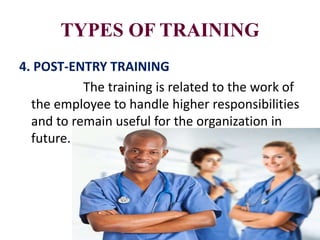
4. POST-ENTRY TRAINING
The training is related to the work of
the employee to handle higher responsibilities
and to remain useful for the organization in
future.
TYPES OF TRAINING
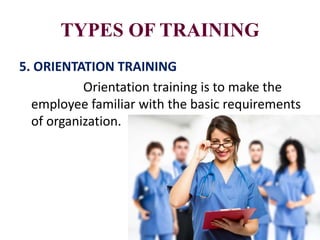
5. ORIENTATION TRAINING
Orientation training is to make the
employee familiar with the basic requirements
of organization.
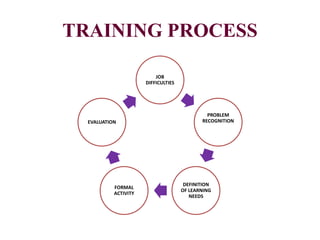
TRAINING PROCESS
JOB
DIFFICULTIES
PROBLEM
RECOGNITION
DEFINITION
OF LEARNING
NEEDS
FORMAL
ACTIVITY
EVALUATION
STEPS OF DISCOVERING
TRAINING NEEDS
1. ANALYZING JOB AND MEN.
2. IDENTIFYING PRODUCTION
PROBLEMS.
3. COLLECTING EMPLOYEES AND
MANAGERIAL OPINION.
4. ANTICIPATING REQUIREMENTS FOR
DIFFERENT JOBS.
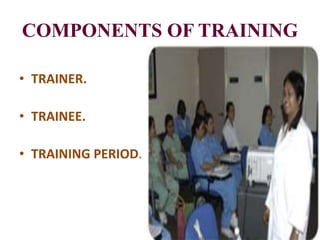
COMPONENTS OF TRAINING
• TRAINER.
• TRAINEE.
• TRAINING PERIOD.
SIGNIFICANT VALUES OF
TRAINING / ADVANTAGES OF
TRAINING
• Is a useful tool for providing needed skills to the
employees.
• Training is a service to management.
• Reduced supervision.
• Economy .
• Increased morale.
• Fill man power needs.
• It is a continuous never ending process.
• Helps in better management.
• For organizational stability and flexibility.
TRAINING METHODS AND
TECHNIQUES
• ON-THE-JOB TRAINING = This enables him/her to
get training under the same working conditions
and with the same processes, materials and
equipments that he/she will be using ultimately.
• VESTIBULE TRAINING = used to impart training in
a classroom for semi-skilled jobs in the plant and
the office. It is more suitable where a large
number of employees need to be trained at the
same kind of work. It is commonly used to train
clerks, machine operators, typists etc
TRAINING METHODS AND
TECHNIQUES
• CLASSROOM TRAINING = Classroom
instructions are most useful when concepts,
attitudes, theories and problem solving
abilities are to be taught. It is associate more
with knowledge than skill. The other
classroom methods are; conferences, case
study and role playing. These can be
employed to train and educate the employees
prearing for various executive positions.
TRAINING METHODS AND
TECHNIQUES
• APPRENTICES TRAINING = The usual
apprenticeship programs combine on-the-job
training and experience with classroom
instruction in particular subjects. The advantages
of apprenticeship training to the trainees are that
they receive wages while learning and they
acquire a variable skill which help them to secure
a job. This is also advantageous to the employers
and some employers look upon apprentices as a
source of cheap labor .
TRAINING METHODS AND
TECHNIQUES
• INDUCTION TRAINING = Is concerned with the
problem of introducing or orienting a new
employee to the organization after the
candidate is finally selected.
FRAMEWORK FOR TRAINING
EVALUATION
• CONTEXT EVALUATION.
• INPUT EVALUATION.
• OUTCOME EVALUATION.
• REACTION EVALUATION.
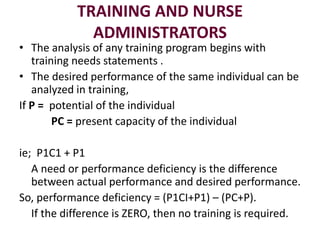
TRAINING AND NURSE
ADMINISTRATORS
• The analysis of any training program begins with
training needs statements .
• The desired performance of the same individual can be
analyzed in training,
If P = potential of the individual
PC = present capacity of the individual
ie; P1C1 + P1
A need or performance deficiency is the difference
between actual performance and desired performance.
So, performance deficiency = (P1CI+P1) – (PC+P).
If the difference is ZERO, then no training is required.

Training in staff development of nursing

  • 1.
    TRAINING IN STAFF DEVELOPMENTOF NURSING By; Mr. MANULAL. V.S FACULTY CACEE, University of Kerala, Thiruvananthapuram.
  • 2.
    INTRODUCTION TO TRAINING/ SKILL TRAINING • Training is actually a component of staff development. • Growth cannot takes place without trained man power. Definition - Training may be defined as an organized method of ensuring that the people have acquired the necessary knowledge and skill to perform specific job. - Training refers to a process of developing skills, habits, knowledge and attitude in employees. - -------- By……. Torpe.
  • 3.
    IMPORTANCE / NEEDOF TRAINIG • For the achievement of departmental / organizational objectives. • Helps in developing the attitude of trainees uniform and universal. • For better job security for the employees and greater opportunity for advancements. • Helps the trainers to make them elegible for recruitment.
  • 4.
    IMPORTANCE / NEEDOF TRAINIG … cont… • Enhances the standard of the organization. • Training equips the trainer with knowledge and skill about the post on which he/she has been recruited. • Training enhances the efficiency of trainers and helps them to achieve the targets.
  • 5.
    TYPES OF TRAINING 1.FORMAL AND INFORMAL TRAINING Formal training is imparted to the employees to make them familiar with techniques , procedures, rules, files, and documents. The trainers study issues regarding the duties and mode of functioning. The trainees after training are well-versed in knowledge of administrative organization.
  • 6.
    TYPES OF TRAINING Ininformal training , the trainees get training informally. The employees receives himself/herself during routine work. The supervisor provides oral instructions and guide an employee on work.
  • 7.
    TYPES OF TRAINING 2.PRE-ENTRY TRAINING The employees gets training before they enter into service such as apprentices before service.
  • 8.
    TYPES OF TRAINING 3.IN-SERVICE TRAINING The workers are provided in services training throughout the work duration to increase the efficiency.
  • 9.
    TYPES OF TRAINING 4.POST-ENTRY TRAINING The training is related to the work of the employee to handle higher responsibilities and to remain useful for the organization in future.
  • 10.
    TYPES OF TRAINING 5.ORIENTATION TRAINING Orientation training is to make the employee familiar with the basic requirements of organization.
  • 11.
  • 12.
    STEPS OF DISCOVERING TRAININGNEEDS 1. ANALYZING JOB AND MEN. 2. IDENTIFYING PRODUCTION PROBLEMS. 3. COLLECTING EMPLOYEES AND MANAGERIAL OPINION. 4. ANTICIPATING REQUIREMENTS FOR DIFFERENT JOBS.
  • 13.
    COMPONENTS OF TRAINING •TRAINER. • TRAINEE. • TRAINING PERIOD.
  • 14.
    SIGNIFICANT VALUES OF TRAINING/ ADVANTAGES OF TRAINING • Is a useful tool for providing needed skills to the employees. • Training is a service to management. • Reduced supervision. • Economy . • Increased morale. • Fill man power needs. • It is a continuous never ending process. • Helps in better management. • For organizational stability and flexibility.
  • 15.
    TRAINING METHODS AND TECHNIQUES •ON-THE-JOB TRAINING = This enables him/her to get training under the same working conditions and with the same processes, materials and equipments that he/she will be using ultimately. • VESTIBULE TRAINING = used to impart training in a classroom for semi-skilled jobs in the plant and the office. It is more suitable where a large number of employees need to be trained at the same kind of work. It is commonly used to train clerks, machine operators, typists etc
  • 16.
    TRAINING METHODS AND TECHNIQUES •CLASSROOM TRAINING = Classroom instructions are most useful when concepts, attitudes, theories and problem solving abilities are to be taught. It is associate more with knowledge than skill. The other classroom methods are; conferences, case study and role playing. These can be employed to train and educate the employees prearing for various executive positions.
  • 17.
    TRAINING METHODS AND TECHNIQUES •APPRENTICES TRAINING = The usual apprenticeship programs combine on-the-job training and experience with classroom instruction in particular subjects. The advantages of apprenticeship training to the trainees are that they receive wages while learning and they acquire a variable skill which help them to secure a job. This is also advantageous to the employers and some employers look upon apprentices as a source of cheap labor .
  • 18.
    TRAINING METHODS AND TECHNIQUES •INDUCTION TRAINING = Is concerned with the problem of introducing or orienting a new employee to the organization after the candidate is finally selected.
  • 19.
    FRAMEWORK FOR TRAINING EVALUATION •CONTEXT EVALUATION. • INPUT EVALUATION. • OUTCOME EVALUATION. • REACTION EVALUATION.
  • 20.
    TRAINING AND NURSE ADMINISTRATORS •The analysis of any training program begins with training needs statements . • The desired performance of the same individual can be analyzed in training, If P = potential of the individual PC = present capacity of the individual ie; P1C1 + P1 A need or performance deficiency is the difference between actual performance and desired performance. So, performance deficiency = (P1CI+P1) – (PC+P). If the difference is ZERO, then no training is required.