1
Controlling as a
Management Function
 Controlling
A process of monitoring
performance and taking action to
ensure desired results.
It sees to it that the right things
happen, in the right ways, and at
the right time.
2
Controlling as a
Management Function
 Controlling
Done well, it ensures that the
overall directions of individuals
and groups are consistent with
short and long range plans.
It helps ensure that objectives and
accomplishments are consistent
with one another throughout an
organization.
3
Controlling as a
Management Function
 Controlling
It helps maintain compliance with
essential organizational rules and
policies.
4
Controlling as a
Management Function
 Cybernetic Control System
One that is self-contained in its
performance monitoring and
correction capabilities.
(thermostat)
The control process practiced in
organizations is not cybernetic,
but it does follow similar
principles.
5
The Control Process
 Establish objectives and
standards.
 Measure actual performance.
 Compare results with objectives
and standards.
 Take necessary action.
6
Establish Objectives and
Standards
 The control process begins with
planning and the establishment
of performance objectives.
 Performance objectives are
defined and the standards for
measuring them are set.
7
Establish Objectives and
Standards
 There are two types of standards:
Output Standards - measures
performance results in terms of
quantity, quality, cost, or time.
Input Standards - measures work
efforts that go into a performance
task.
8
Measuring Actual
Performance
 Measurements must be
accurate enough to spot
deviations or variances between
what really occurs and what is
most desired.
 Without measurement, effective
control is not possible.
9
Comparing Results with
Objectives and Standards
 The comparison of actual
performance with desired
performance establishes the need for
action.
 Ways of making such comparisons
include:
Historical / Relative / Engineering
Benchmarking
10
Taking Corrective Action
 Taking any action necessary to
correct or improve things.
 Management-by-Exception focuses
managerial attention on substantial
differences between actual and
desired performance.
11
Taking Corrective Action
Management-by Exception can
save the managers time, energy,
and other resources, and
concentrates efforts on areas
showing the greatest need.
There are two types of exceptions:
•Problems - below standard
•Opportunities - above standard
12
Effective Controls
The Best Controls in Organizations
are
 Strategic and results oriented
 Understandable
 Encourage self-control
13
Effective Controls
The Best Controls in Organizations
are
 Timely and exception oriented
 Positive in nature
 Fair and objective
 Flexible
14
Types of Control
 Preliminary
Sometimes called the
feedforward controls, they are
accomplished before a work
activity begins.
They make sure that proper
directions are set and that the
right resources are available to
accomplish them.
15
Types of Control
 Concurrent
Focus on what happens during
the work process. Sometimes
called steering controls, they
monitor ongoing operations and
activities to make sure that
things are being done correctly.
16
Types of Control
 Postaction
Sometimes called feedback
controls, they take place after
an action is completed. They
focus on end results, as opposed
to inputs and activities.
17
Types of Controls
Managers have two broad
options with respect to control.
 They can rely on people to
exercise self-control (internal)
over their own behavior.
 Alternatively, managers can
take direct action (external) to
control the behavior of others.
18
Types of Control
 Internal Controls
Allows motivated individuals to
exercise self-control in fulfilling
job expectations.
The potential for self-control is
enhanced when capable people have
clear performance objectives and
proper resource support.
19
Types of Control
 External Controls
It occurs through personal supervision
and the use of formal administrative
systems.
Performance appraisal systems,
compensation and benefit systems,
employee discipline systems, and
management-by-objectives.
20
Organizational Control
Systems
 Management Processes
Strategy and objectives
Policies and procedures
Selection and training
Performance appraisal
Job design and work structures
Performance modeling, norms, and
organization culture
21
Organizational Control
Systems
 Compensation and Benefits
Attract talented people and
retain them.
Motivate people to exert
maximum effort in their work.
Recognize the value of their
performance contributions.
22
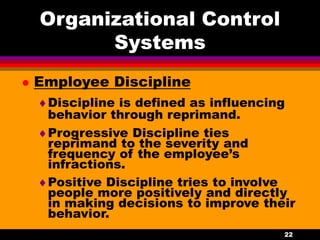
Organizational Control
Systems
 Employee Discipline
Discipline is defined as influencing
behavior through reprimand.
Progressive Discipline ties
reprimand to the severity and
frequency of the employee’s
infractions.
Positive Discipline tries to involve
people more positively and directly
in making decisions to improve their
behavior.
23
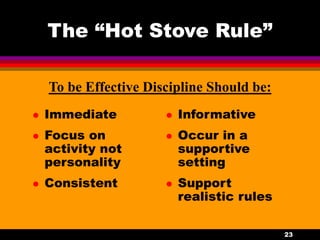
The “Hot Stove Rule”
 Immediate
 Focus on
activity not
personality
 Consistent
 Informative
 Occur in a
supportive
setting
 Support
realistic rules
To be Effective Discipline Should be:
24
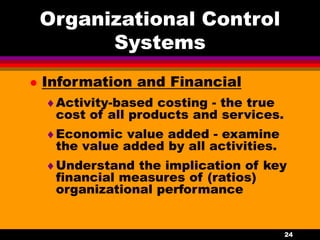
Organizational Control
Systems
 Information and Financial
Activity-based costing - the true
cost of all products and services.
Economic value added - examine
the value added by all activities.
Understand the implication of key
financial measures of (ratios)
organizational performance
25
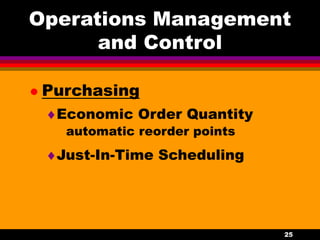
Operations Management
and Control
 Purchasing
Economic Order Quantity
automatic reorder points
Just-In-Time Scheduling
26
Operations Management
and Control
 Project Management
Program Evaluation and Review
Technique (PERT) - Identifies and
controls the many separate events
in complex projects.
27
Operations Management
and Control
 Statistical Quality Control
Based on the establishment of
upper and lower control limits,
that can be graphically and
statistically monitored to ensure
that products meet standards.

OD_09.ppt

  • 1.
    1 Controlling as a ManagementFunction  Controlling A process of monitoring performance and taking action to ensure desired results. It sees to it that the right things happen, in the right ways, and at the right time.
  • 2.
    2 Controlling as a ManagementFunction  Controlling Done well, it ensures that the overall directions of individuals and groups are consistent with short and long range plans. It helps ensure that objectives and accomplishments are consistent with one another throughout an organization.
  • 3.
    3 Controlling as a ManagementFunction  Controlling It helps maintain compliance with essential organizational rules and policies.
  • 4.
    4 Controlling as a ManagementFunction  Cybernetic Control System One that is self-contained in its performance monitoring and correction capabilities. (thermostat) The control process practiced in organizations is not cybernetic, but it does follow similar principles.
  • 5.
    5 The Control Process Establish objectives and standards.  Measure actual performance.  Compare results with objectives and standards.  Take necessary action.
  • 6.
    6 Establish Objectives and Standards The control process begins with planning and the establishment of performance objectives.  Performance objectives are defined and the standards for measuring them are set.
  • 7.
    7 Establish Objectives and Standards There are two types of standards: Output Standards - measures performance results in terms of quantity, quality, cost, or time. Input Standards - measures work efforts that go into a performance task.
  • 8.
    8 Measuring Actual Performance  Measurementsmust be accurate enough to spot deviations or variances between what really occurs and what is most desired.  Without measurement, effective control is not possible.
  • 9.
    9 Comparing Results with Objectivesand Standards  The comparison of actual performance with desired performance establishes the need for action.  Ways of making such comparisons include: Historical / Relative / Engineering Benchmarking
  • 10.
    10 Taking Corrective Action Taking any action necessary to correct or improve things.  Management-by-Exception focuses managerial attention on substantial differences between actual and desired performance.
  • 11.
    11 Taking Corrective Action Management-byException can save the managers time, energy, and other resources, and concentrates efforts on areas showing the greatest need. There are two types of exceptions: •Problems - below standard •Opportunities - above standard
  • 12.
    12 Effective Controls The BestControls in Organizations are  Strategic and results oriented  Understandable  Encourage self-control
  • 13.
    13 Effective Controls The BestControls in Organizations are  Timely and exception oriented  Positive in nature  Fair and objective  Flexible
  • 14.
    14 Types of Control Preliminary Sometimes called the feedforward controls, they are accomplished before a work activity begins. They make sure that proper directions are set and that the right resources are available to accomplish them.
  • 15.
    15 Types of Control Concurrent Focus on what happens during the work process. Sometimes called steering controls, they monitor ongoing operations and activities to make sure that things are being done correctly.
  • 16.
    16 Types of Control Postaction Sometimes called feedback controls, they take place after an action is completed. They focus on end results, as opposed to inputs and activities.
  • 17.
    17 Types of Controls Managershave two broad options with respect to control.  They can rely on people to exercise self-control (internal) over their own behavior.  Alternatively, managers can take direct action (external) to control the behavior of others.
  • 18.
    18 Types of Control Internal Controls Allows motivated individuals to exercise self-control in fulfilling job expectations. The potential for self-control is enhanced when capable people have clear performance objectives and proper resource support.
  • 19.
    19 Types of Control External Controls It occurs through personal supervision and the use of formal administrative systems. Performance appraisal systems, compensation and benefit systems, employee discipline systems, and management-by-objectives.
  • 20.
    20 Organizational Control Systems  ManagementProcesses Strategy and objectives Policies and procedures Selection and training Performance appraisal Job design and work structures Performance modeling, norms, and organization culture
  • 21.
    21 Organizational Control Systems  Compensationand Benefits Attract talented people and retain them. Motivate people to exert maximum effort in their work. Recognize the value of their performance contributions.
  • 22.
    22 Organizational Control Systems  EmployeeDiscipline Discipline is defined as influencing behavior through reprimand. Progressive Discipline ties reprimand to the severity and frequency of the employee’s infractions. Positive Discipline tries to involve people more positively and directly in making decisions to improve their behavior.
  • 23.
    23 The “Hot StoveRule”  Immediate  Focus on activity not personality  Consistent  Informative  Occur in a supportive setting  Support realistic rules To be Effective Discipline Should be:
  • 24.
    24 Organizational Control Systems  Informationand Financial Activity-based costing - the true cost of all products and services. Economic value added - examine the value added by all activities. Understand the implication of key financial measures of (ratios) organizational performance
  • 25.
    25 Operations Management and Control Purchasing Economic Order Quantity automatic reorder points Just-In-Time Scheduling
  • 26.
    26 Operations Management and Control Project Management Program Evaluation and Review Technique (PERT) - Identifies and controls the many separate events in complex projects.
  • 27.
    27 Operations Management and Control Statistical Quality Control Based on the establishment of upper and lower control limits, that can be graphically and statistically monitored to ensure that products meet standards.