Asian Journal of Applied Science and Technology (AJAST)
Volume 1, Issue 2, Pages 224-228, March 2017
© 2017 AJAST All rights reserved. www.ajast.net
Page | 224
Controller Tuning Method for Non-Linear Conical Tank System
Dr.G.Saravanakumar1
, Dinesh.S2
, Preteep.S3
, Sridhar.P4
and Suresh.M5
1Professor, Department of Instrumentation and Control Engineering, Tamilnadu College of Engineering, Coimbatore, India.
2Final Year Student, Department of Instrumentation and Control Engineering, Tamilnadu College of Engineering, Coimbatore, India.
3Final Year Student, Department of Instrumentation and Control Engineering, Tamilnadu College of Engineering, Coimbatore, India.
4Final Year Student, Department of Instrumentation and Control Engineering, Tamilnadu College of Engineering, Coimbatore, India.
5Final Year Student, Department of Instrumentation and Control Engineering, Tamilnadu College of Engineering, Coimbatore, India.
Article Received: 11 March 2017 Article Accepted: 21 March 2017 Article Published: 23 March 2017
1. INTRODUCTION
Each and every industry phase the flow control and level
control problem. So that canonical tank level process is used.
Canonical tank level process is used. Canonical tank is the
highly non-linear system. Because of this, reason sometimes
output may be affected. Due to its shape, the conical tank is
lead to non-linearity control of conical tank is the challenging
problem so many researchers have been carried out in the
level control of conical process. For complete drainage of
fluids, a conical bottomed cylindrical tank is used in some of
the process industries, where its nonlinearity might be at the
bottom only. The drainage efficiency can be improved further
if the tank is fully conical. But continuous variation in the tank
system makes it highly non-linear and hence the liquid level
control in such systems is difficult. A conical shaped tank
system are mainly used in Colloidal mills, Leaching
extractions in pharmaceutical and chemical industries, food
processing industries, Petroleum industries, Molasses, Liquid
feed and Liquid fertilizer storage, Chemical holding & mix
tank, Biodiesel processing and reactor tank. To avoid
settlement and sludge in Storage and holding tanks, the
conical tanks are used.
2. PROPOSED WORK
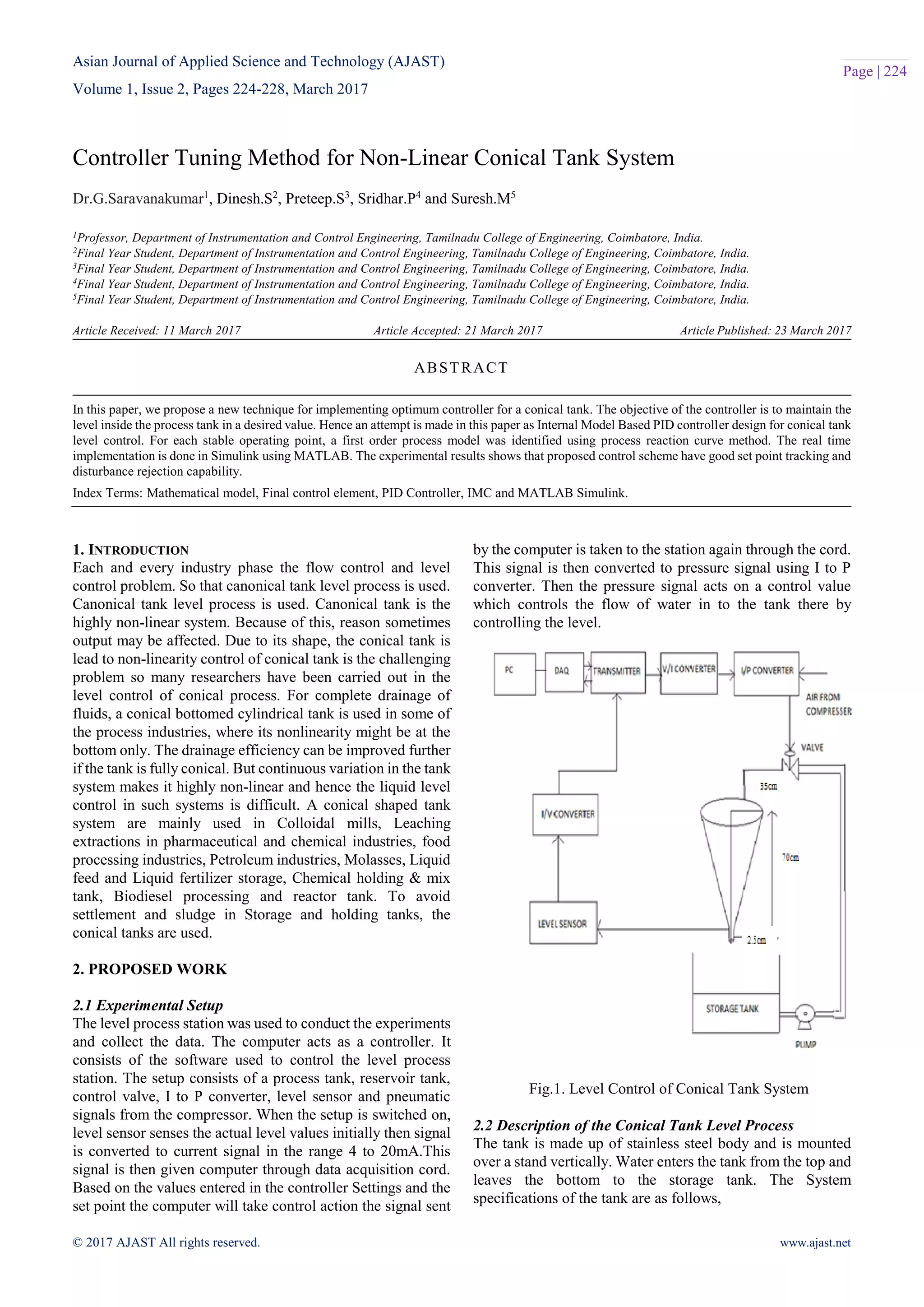
2.1 Experimental Setup
The level process station was used to conduct the experiments
and collect the data. The computer acts as a controller. It
consists of the software used to control the level process
station. The setup consists of a process tank, reservoir tank,
control valve, I to P converter, level sensor and pneumatic
signals from the compressor. When the setup is switched on,
level sensor senses the actual level values initially then signal
is converted to current signal in the range 4 to 20mA.This
signal is then given computer through data acquisition cord.
Based on the values entered in the controller Settings and the
set point the computer will take control action the signal sent
by the computer is taken to the station again through the cord.
This signal is then converted to pressure signal using I to P
converter. Then the pressure signal acts on a control value
which controls the flow of water in to the tank there by
controlling the level.
Fig.1. Level Control of Conical Tank System
2.2 Description of the Conical Tank Level Process
The tank is made up of stainless steel body and is mounted
over a stand vertically. Water enters the tank from the top and
leaves the bottom to the storage tank. The System
specifications of the tank are as follows,
ABSTRACT
In this paper, we propose a new technique for implementing optimum controller for a conical tank. The objective of the controller is to maintain the
level inside the process tank in a desired value. Hence an attempt is made in this paper as Internal Model Based PID controller design for conical tank
level control. For each stable operating point, a first order process model was identified using process reaction curve method. The real time
implementation is done in Simulink using MATLAB. The experimental results shows that proposed control scheme have good set point tracking and
disturbance rejection capability.
Index Terms: Mathematical model, Final control element, PID Controller, IMC and MATLAB Simulink.
Asian Journal of Applied Science and Technology (AJAST)
Volume 1, Issue 2, Pages 224-228, March 2017
© 2017 AJAST All rights reserved. www.ajast.net
Page | 225
Technical Specification
Equipments Details
Conical tank Stainless steel body,
height– 70 cm, Top
diameter–35 cm
Bottom diameter
2.5cm
Differential Pressure
Level Transmitter
Differential Pressure
Level Transmitter
Pump Centrifugal 800LPH
Control Valve Size ¼ Pneumatic
actuated Type: Air to
open, Input 3-15PSI
Rota meter Range 0-600 LPH
3. MATHEMATICAL MODELLING
Where,
R=Radius of the tank [Constant]
H=Total height [Constant]
r=radius of the liquid level [Constant]
h=level of the water [variable]
Consider the tank with the angle .
= = =
r/h =R/H
r =R*h/H -------->1
Area =πr2
-------->2
Sub 1 in 2 and differentiating,
= [ ]2
2h -------->3
Volume of cone,V= -------->4
Differentiating the above equation
= [A ] -------->5
Sub 3 in 5
= [A+2 ] -------->6
By Newton’s law:
Fin-Fout= [A+2 ] -------->7
Fout =k -------->8
Fin – k
=
Sub Area in above equation,
=
= -
Let, =
= - =
= - -------->9
Taylor Series,
For linerisingFh-2
And in -------->9
F(h1Fin) = F(hs,Fins) – 2Fin hs
-3
(h - hs)+ hs
-2
(F-Fins) ---->10
= h-3/2
[Initially]
h-3/2
= hs
-3/2
- hs
-5/2
(h – hs) -------->11
Sub 11 and 10 in 9
= [F(hs , Fins) – 2Fin hs
-3
(h - hs) + hs
-2
(F - Fins)] – [hs
-3/2
- hs
-5/2
(h - hs) -------------->12
At initial and steady state condition,
= [-2Fins hs
-3
(h - hs) + hs
-2
(F - Fins) + hs
-5/2
(h –
hs)] ------------>13
Let y=(h - hs) and u = F - Fins sub in equ -----13
=-2 Fins
-3
y+ hs
-2
u+ hs
-5/2
y -------->14
------15
-------->16
-------->17
-------->18
Comparing 17 and 18,
C=
Applying laplace transform for equ----->18
The transfer function for the different height of the tank,
Model Height Transfer function
1 10 =
2 15 =
3 20 =
The transfer function of the model is,
The transfer of the sensor is,
The process transfer function is represented as,
Asian Journal of Applied Science and Technology (AJAST)
Volume 1, Issue 2, Pages 224-228, March 2017
© 2017 AJAST All rights reserved. www.ajast.net
Page | 226
Model Height Transfer function
1 10 =
2 15 =
3 20 =
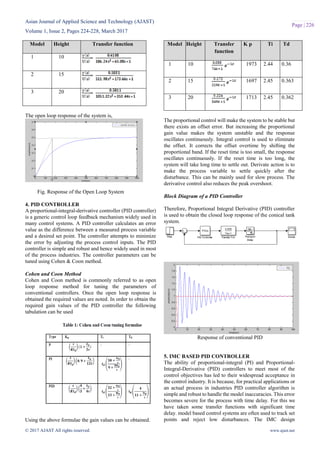
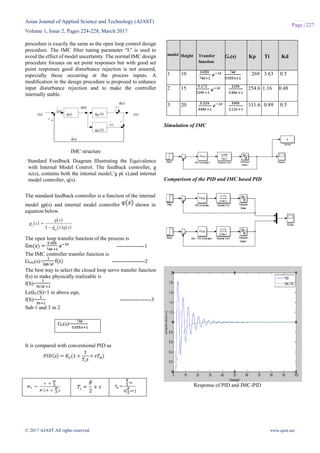
The open loop response of the system is,
Fig. Response of the Open Loop System
4. PID CONTROLLER
A proportional-integral-derivative controller (PID controller)
is a generic control loop feedback mechanism widely used in
many control systems. A PID controller calculates an error
value as the difference between a measured process variable
and a desired set point. The controller attempts to minimize
the error by adjusting the process control inputs. The PID
controller is simple and robust and hence widely used in most
of the process industries. The controller parameters can be
tuned using Cohen & Coon method.
Cohen and Coon Method
Cohen and Coon method is commonly referred to as open
loop response method for tuning the parameters of
conventional controllers. Once the open loop response is
obtained the required values are noted. In order to obtain the
required gain values of the PID controller the following
tabulation can be used
Using the above formulae the gain values can be obtained.
Model Height Transfer
function
K p Ti Td
1 10 1973 2.44 0.36
2 15 1697 2.45 0.363
3 20 1713 2.45 0.362
The proportional control will make the system to be stable but
there exists an offset error. But increasing the proportional
gain value makes the system unstable and the response
oscillates continuously. Integral control is used to eliminate
the offset. It corrects the offset overtime by shifting the
proportional band. If the reset time is too small, the response
oscillates continuously. If the reset time is too long, the
system will take long time to settle out. Derivate action is to
make the process variable to settle quickly after the
disturbance. This can be mainly used for slow process. The
derivative control also reduces the peak overshoot.
Block Diagram of a PID Controller
Therefore, Proportional Integral Derivative (PID) controller
is used to obtain the closed loop response of the conical tank
system.
Response of conventional PID
5. IMC BASED PID CONTROLLER
The ability of proportional-integral (PI) and Proportional-
Integral-Derivative (PID) controllers to meet most of the
control objectives has led to their widespread acceptance in
the control industry. It is because, for practical applications or
an actual process in industries PID controller algorithm is
simple and robust to handle the model inaccuracies. This error
becomes severe for the process with time delay. For this we
have taken some transfer functions with significant time
delay. model based control systems are often used to track set
points and reject low disturbances. The IMC design
Asian Journal of Applied Science and Technology (AJAST)
Volume 1, Issue 2, Pages 224-228, March 2017
© 2017 AJAST All rights reserved. www.ajast.net
Page | 227
procedure is exactly the same as the open loop control design
procedure. The IMC filter tuning parameter “ƛ” is used to
avoid the effect of model uncertainty. The normal IMC design
procedure focuses on set point responses but with good set
point responses good disturbance rejection is not assured,
especially those occurring at the process inputs. A
modification in the design procedure is proposed to enhance
input disturbance rejection and to make the controller
internally stable.
IMC structure
Standard Feedback Diagram Illustrating the Equivalence
with Internal Model Control. The feedback controller, g
sc(s), contains both the internal model,˜g p( s),and internal
model controller, q(s).
The standard feedback controller is a function of the internal
model gp(s) and internal model controller shown in
equation below.
The open loop transfer function of the process is
----------------1
The IMC controller transfer function is
Gimc(s)= -------------------2
The best way to select the closed loop servo transfer function
f(s) to make physically realizable is
f(S)=
LetƛC(S)=1 in above eqn,
f(S)= ------------------3
Sub 1 and 3 in 2
It is compared with conventional PID as
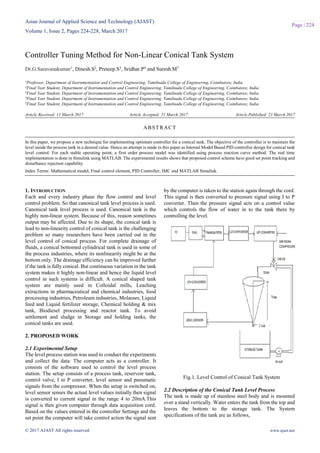
Simulation of IMC
Comparison of the PID and IMC based PID
Response of PID and IMC-PID
Gc(s)=
model Height Transfer
function
Gc(s) Kp
TI
Ti Kd
1 10 269 3.63 0.5
2 15 254.6 1.16 0.48
3 20 311.6 0.89 0.5
Asian Journal of Applied Science and Technology (AJAST)
Volume 1, Issue 2, Pages 224-228, March 2017
© 2017 AJAST All rights reserved. www.ajast.net
Page | 228
Hardware implementation kit
Comparison Table
6. CONCLUSION
The nonlinearity of the conical tank is analyzed. Conventional
PID, Cohen and coon tuned PID controller and IMC Tuned
PID controller is implemented in simulation .Cohen and coon
tuned PID Controller and IMC tuned PID Controller results
are compared. IMC Tuned PID controller gives the better
performance. As far as the tuning of the controller is
concerned we have and optimum filter tuning factor λ
(lambda) value which compromises the effects of
discrepancies entering into the system to achieve the best
performance. Thus, what we mean by the best filter structure
is the filter that gives the best PID performance for the
optimum λ value. The PID and IMC controllers are designed
in such a way that the system is physically reliable. But due to
the presence of dead time, the performance of the system is
affected. The simulation results shows the IMC based PID
controller have minimum settling time and rise time in order
to reach steady state value when compare to conventional
controller. To avoid the minimum rise time advanced control
schemes such as Model Reference Adaptive Controller will
be implement in future.
REFERENCES
[1] Rajesh.T, Arun jayakar.S, Siddharth.S.G, “Design and
Implementation of IMC Based PID Controller for Conical
Tank Level Control Process”, in International Journal of
Innovative Research in Electrical, Electronics,
Instrumentation and Control Engineering in Sep 2014.
[2] Sukanya R. Warier, Sivanandam Venkatesh “Design of
controller based on MPC for a conical tank system”, IEEE
International Conference on Advances in Engineering,
Science and Management (ICAESM - 2012), March 30-31,
2012.
[3] Korkmaz, M. Aydogdu, O. Dogan, H. “Design and
performance comparison of variable parameter nonlinear PID
controller and genetic algorithm based PID controller
Innovations”, Intelligent Systems and Applications (INISTA),
2012 International Symposium.
[4] S.Nithya, N.Sivakumaran, T.K.Radhakrishnan and
N.Anantharaman, “Soft Computing Based Controllers
Implementation for Non-linear Process in Real Time”
Proceedings of the World Congress on Engineering and
Computer Science (WCECS), 2010, Vol – 2.
[5] Anand, S., Aswin, V., Kumar, S.R., “Simple tuned
adaptive PI controller for conical tank process”, Recent
Advancements in Electrical, Electronics and Control
Engineering 2011 International Conference.
Set point
(cm)
Controller overshoot Settling time
(sec)
15 PID 18% 60
IMC – PID 2.5% 25
20 PID 16% 38
IMC -PID 1.8% 21

Controller Tuning Method for Non-Linear Conical Tank System

  • 1.
    Asian Journal ofApplied Science and Technology (AJAST) Volume 1, Issue 2, Pages 224-228, March 2017 © 2017 AJAST All rights reserved. www.ajast.net Page | 224 Controller Tuning Method for Non-Linear Conical Tank System Dr.G.Saravanakumar1 , Dinesh.S2 , Preteep.S3 , Sridhar.P4 and Suresh.M5 1Professor, Department of Instrumentation and Control Engineering, Tamilnadu College of Engineering, Coimbatore, India. 2Final Year Student, Department of Instrumentation and Control Engineering, Tamilnadu College of Engineering, Coimbatore, India. 3Final Year Student, Department of Instrumentation and Control Engineering, Tamilnadu College of Engineering, Coimbatore, India. 4Final Year Student, Department of Instrumentation and Control Engineering, Tamilnadu College of Engineering, Coimbatore, India. 5Final Year Student, Department of Instrumentation and Control Engineering, Tamilnadu College of Engineering, Coimbatore, India. Article Received: 11 March 2017 Article Accepted: 21 March 2017 Article Published: 23 March 2017 1. INTRODUCTION Each and every industry phase the flow control and level control problem. So that canonical tank level process is used. Canonical tank level process is used. Canonical tank is the highly non-linear system. Because of this, reason sometimes output may be affected. Due to its shape, the conical tank is lead to non-linearity control of conical tank is the challenging problem so many researchers have been carried out in the level control of conical process. For complete drainage of fluids, a conical bottomed cylindrical tank is used in some of the process industries, where its nonlinearity might be at the bottom only. The drainage efficiency can be improved further if the tank is fully conical. But continuous variation in the tank system makes it highly non-linear and hence the liquid level control in such systems is difficult. A conical shaped tank system are mainly used in Colloidal mills, Leaching extractions in pharmaceutical and chemical industries, food processing industries, Petroleum industries, Molasses, Liquid feed and Liquid fertilizer storage, Chemical holding & mix tank, Biodiesel processing and reactor tank. To avoid settlement and sludge in Storage and holding tanks, the conical tanks are used. 2. PROPOSED WORK 2.1 Experimental Setup The level process station was used to conduct the experiments and collect the data. The computer acts as a controller. It consists of the software used to control the level process station. The setup consists of a process tank, reservoir tank, control valve, I to P converter, level sensor and pneumatic signals from the compressor. When the setup is switched on, level sensor senses the actual level values initially then signal is converted to current signal in the range 4 to 20mA.This signal is then given computer through data acquisition cord. Based on the values entered in the controller Settings and the set point the computer will take control action the signal sent by the computer is taken to the station again through the cord. This signal is then converted to pressure signal using I to P converter. Then the pressure signal acts on a control value which controls the flow of water in to the tank there by controlling the level. Fig.1. Level Control of Conical Tank System 2.2 Description of the Conical Tank Level Process The tank is made up of stainless steel body and is mounted over a stand vertically. Water enters the tank from the top and leaves the bottom to the storage tank. The System specifications of the tank are as follows, ABSTRACT In this paper, we propose a new technique for implementing optimum controller for a conical tank. The objective of the controller is to maintain the level inside the process tank in a desired value. Hence an attempt is made in this paper as Internal Model Based PID controller design for conical tank level control. For each stable operating point, a first order process model was identified using process reaction curve method. The real time implementation is done in Simulink using MATLAB. The experimental results shows that proposed control scheme have good set point tracking and disturbance rejection capability. Index Terms: Mathematical model, Final control element, PID Controller, IMC and MATLAB Simulink.
  • 2.
    Asian Journal ofApplied Science and Technology (AJAST) Volume 1, Issue 2, Pages 224-228, March 2017 © 2017 AJAST All rights reserved. www.ajast.net Page | 225 Technical Specification Equipments Details Conical tank Stainless steel body, height– 70 cm, Top diameter–35 cm Bottom diameter 2.5cm Differential Pressure Level Transmitter Differential Pressure Level Transmitter Pump Centrifugal 800LPH Control Valve Size ¼ Pneumatic actuated Type: Air to open, Input 3-15PSI Rota meter Range 0-600 LPH 3. MATHEMATICAL MODELLING Where, R=Radius of the tank [Constant] H=Total height [Constant] r=radius of the liquid level [Constant] h=level of the water [variable] Consider the tank with the angle . = = = r/h =R/H r =R*h/H -------->1 Area =πr2 -------->2 Sub 1 in 2 and differentiating, = [ ]2 2h -------->3 Volume of cone,V= -------->4 Differentiating the above equation = [A ] -------->5 Sub 3 in 5 = [A+2 ] -------->6 By Newton’s law: Fin-Fout= [A+2 ] -------->7 Fout =k -------->8 Fin – k = Sub Area in above equation, = = - Let, = = - = = - -------->9 Taylor Series, For linerisingFh-2 And in -------->9 F(h1Fin) = F(hs,Fins) – 2Fin hs -3 (h - hs)+ hs -2 (F-Fins) ---->10 = h-3/2 [Initially] h-3/2 = hs -3/2 - hs -5/2 (h – hs) -------->11 Sub 11 and 10 in 9 = [F(hs , Fins) – 2Fin hs -3 (h - hs) + hs -2 (F - Fins)] – [hs -3/2 - hs -5/2 (h - hs) -------------->12 At initial and steady state condition, = [-2Fins hs -3 (h - hs) + hs -2 (F - Fins) + hs -5/2 (h – hs)] ------------>13 Let y=(h - hs) and u = F - Fins sub in equ -----13 =-2 Fins -3 y+ hs -2 u+ hs -5/2 y -------->14 ------15 -------->16 -------->17 -------->18 Comparing 17 and 18, C= Applying laplace transform for equ----->18 The transfer function for the different height of the tank, Model Height Transfer function 1 10 = 2 15 = 3 20 = The transfer function of the model is, The transfer of the sensor is, The process transfer function is represented as,
  • 3.
    Asian Journal ofApplied Science and Technology (AJAST) Volume 1, Issue 2, Pages 224-228, March 2017 © 2017 AJAST All rights reserved. www.ajast.net Page | 226 Model Height Transfer function 1 10 = 2 15 = 3 20 = The open loop response of the system is, Fig. Response of the Open Loop System 4. PID CONTROLLER A proportional-integral-derivative controller (PID controller) is a generic control loop feedback mechanism widely used in many control systems. A PID controller calculates an error value as the difference between a measured process variable and a desired set point. The controller attempts to minimize the error by adjusting the process control inputs. The PID controller is simple and robust and hence widely used in most of the process industries. The controller parameters can be tuned using Cohen & Coon method. Cohen and Coon Method Cohen and Coon method is commonly referred to as open loop response method for tuning the parameters of conventional controllers. Once the open loop response is obtained the required values are noted. In order to obtain the required gain values of the PID controller the following tabulation can be used Using the above formulae the gain values can be obtained. Model Height Transfer function K p Ti Td 1 10 1973 2.44 0.36 2 15 1697 2.45 0.363 3 20 1713 2.45 0.362 The proportional control will make the system to be stable but there exists an offset error. But increasing the proportional gain value makes the system unstable and the response oscillates continuously. Integral control is used to eliminate the offset. It corrects the offset overtime by shifting the proportional band. If the reset time is too small, the response oscillates continuously. If the reset time is too long, the system will take long time to settle out. Derivate action is to make the process variable to settle quickly after the disturbance. This can be mainly used for slow process. The derivative control also reduces the peak overshoot. Block Diagram of a PID Controller Therefore, Proportional Integral Derivative (PID) controller is used to obtain the closed loop response of the conical tank system. Response of conventional PID 5. IMC BASED PID CONTROLLER The ability of proportional-integral (PI) and Proportional- Integral-Derivative (PID) controllers to meet most of the control objectives has led to their widespread acceptance in the control industry. It is because, for practical applications or an actual process in industries PID controller algorithm is simple and robust to handle the model inaccuracies. This error becomes severe for the process with time delay. For this we have taken some transfer functions with significant time delay. model based control systems are often used to track set points and reject low disturbances. The IMC design
  • 4.
    Asian Journal ofApplied Science and Technology (AJAST) Volume 1, Issue 2, Pages 224-228, March 2017 © 2017 AJAST All rights reserved. www.ajast.net Page | 227 procedure is exactly the same as the open loop control design procedure. The IMC filter tuning parameter “ƛ” is used to avoid the effect of model uncertainty. The normal IMC design procedure focuses on set point responses but with good set point responses good disturbance rejection is not assured, especially those occurring at the process inputs. A modification in the design procedure is proposed to enhance input disturbance rejection and to make the controller internally stable. IMC structure Standard Feedback Diagram Illustrating the Equivalence with Internal Model Control. The feedback controller, g sc(s), contains both the internal model,˜g p( s),and internal model controller, q(s). The standard feedback controller is a function of the internal model gp(s) and internal model controller shown in equation below. The open loop transfer function of the process is ----------------1 The IMC controller transfer function is Gimc(s)= -------------------2 The best way to select the closed loop servo transfer function f(s) to make physically realizable is f(S)= LetƛC(S)=1 in above eqn, f(S)= ------------------3 Sub 1 and 3 in 2 It is compared with conventional PID as Simulation of IMC Comparison of the PID and IMC based PID Response of PID and IMC-PID Gc(s)= model Height Transfer function Gc(s) Kp TI Ti Kd 1 10 269 3.63 0.5 2 15 254.6 1.16 0.48 3 20 311.6 0.89 0.5
  • 5.
    Asian Journal ofApplied Science and Technology (AJAST) Volume 1, Issue 2, Pages 224-228, March 2017 © 2017 AJAST All rights reserved. www.ajast.net Page | 228 Hardware implementation kit Comparison Table 6. CONCLUSION The nonlinearity of the conical tank is analyzed. Conventional PID, Cohen and coon tuned PID controller and IMC Tuned PID controller is implemented in simulation .Cohen and coon tuned PID Controller and IMC tuned PID Controller results are compared. IMC Tuned PID controller gives the better performance. As far as the tuning of the controller is concerned we have and optimum filter tuning factor λ (lambda) value which compromises the effects of discrepancies entering into the system to achieve the best performance. Thus, what we mean by the best filter structure is the filter that gives the best PID performance for the optimum λ value. The PID and IMC controllers are designed in such a way that the system is physically reliable. But due to the presence of dead time, the performance of the system is affected. The simulation results shows the IMC based PID controller have minimum settling time and rise time in order to reach steady state value when compare to conventional controller. To avoid the minimum rise time advanced control schemes such as Model Reference Adaptive Controller will be implement in future. REFERENCES [1] Rajesh.T, Arun jayakar.S, Siddharth.S.G, “Design and Implementation of IMC Based PID Controller for Conical Tank Level Control Process”, in International Journal of Innovative Research in Electrical, Electronics, Instrumentation and Control Engineering in Sep 2014. [2] Sukanya R. Warier, Sivanandam Venkatesh “Design of controller based on MPC for a conical tank system”, IEEE International Conference on Advances in Engineering, Science and Management (ICAESM - 2012), March 30-31, 2012. [3] Korkmaz, M. Aydogdu, O. Dogan, H. “Design and performance comparison of variable parameter nonlinear PID controller and genetic algorithm based PID controller Innovations”, Intelligent Systems and Applications (INISTA), 2012 International Symposium. [4] S.Nithya, N.Sivakumaran, T.K.Radhakrishnan and N.Anantharaman, “Soft Computing Based Controllers Implementation for Non-linear Process in Real Time” Proceedings of the World Congress on Engineering and Computer Science (WCECS), 2010, Vol – 2. [5] Anand, S., Aswin, V., Kumar, S.R., “Simple tuned adaptive PI controller for conical tank process”, Recent Advancements in Electrical, Electronics and Control Engineering 2011 International Conference. Set point (cm) Controller overshoot Settling time (sec) 15 PID 18% 60 IMC – PID 2.5% 25 20 PID 16% 38 IMC -PID 1.8% 21