
ANDROID TECHNOLOGY
PRESENTED BY
E.ESSA
V.GULSHAN
Department of ECE
KRCT
ANDROID
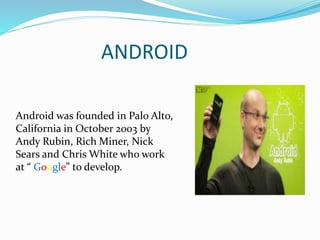
Android was founded in Palo Alto,
California in October 2003 by
Andy Rubin, Rich Miner, Nick
Sears and Chris White who work
at “ Google” to develop.
ORIGIN OF ANDROID
 It was Initially developed by Android, Inc., which
Google backed financially and later bought in 2005 for
25 million $.
 It is Linux based operating system for mobile devices
 It is based on JAVA Language
VERSIONS OF ANDROID
 Android 1.0
 Android 1.1
 Android 1.5 cupcake
 Android 1.6 donut
 Android 2.0 Éclair (2.0-2.1)
 Android 2.2 Froyo (2.2-2.2.3)
 Android 2.3 Gingerbread (2.3-2.3.7)
 Android 3.0 Honeycomb (3.0-3.2.6)
 Android 4.0 Icecream sandwich (4.0-4.0.4)
VERSIONS OF ANDROID
 Android 4.1 Jelly Bean (4.1-4.3.1)
 Android 4.4 Kitkat (4.4-4.4.4)
 Android 5.0 Lollipop (5.0-5.1.1)
 Android 6.0 Marshmallow (6.0-6.0.1)
 Android 7.0 Nougat
VERSION 1.0 &1.1
 Version 1.0 Released on 23 sep, 2008
 Version 1.1 Released on 9 Feb, 2009
 Instant messaging and MMS
 Access to web email server
 Ability to save attachments in messages
VERSION 1.5 CUPCAKE
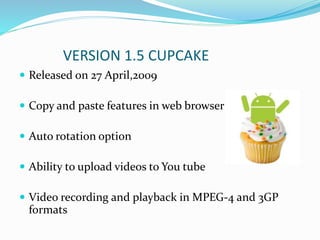
 Released on 27 April,2009
 Copy and paste features in web browser
 Auto rotation option
 Ability to upload videos to You tube
 Video recording and playback in MPEG-4 and 3GP
formats
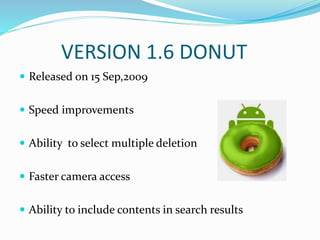
VERSION 1.6 DONUT
 Released on 15 Sep,2009
 Speed improvements
 Ability to select multiple deletion
 Faster camera access
 Ability to include contents in search results
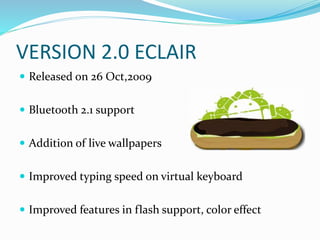
VERSION 2.0 ECLAIR
 Released on 26 Oct,2009
 Bluetooth 2.1 support
 Addition of live wallpapers
 Improved typing speed on virtual keyboard
 Improved features in flash support, color effect
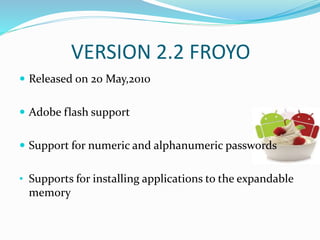
VERSION 2.2 FROYO
 Released on 20 May,2010
 Adobe flash support
 Support for numeric and alphanumeric passwords
• Supports for installing applications to the expandable
memory
VERSION 2.3 GINGERBREAD
 Released on 6 Dec,2010
 Front-facing camera
 Improved power management
 Faster voice input mode
 Native support for more sensors
VERSION 3.0 HONEYCOMB
 Released on 22 Feb,2011
 Support for multi-core processor
 Resizable home screen widgets
 High performance Wi-Fi lock
 Support for joysticks and gamepads
VERSION 4.0 ICE CREAM SANDWICH
 Released on 8 oct,2011
 Data usage sections in settings
 Integrated screenshot capture
 Built in photo editor
 Improved phone number recognition
VERSION 4.1 JELLYBEAN
 Released on 9 July,2012
 Ability to turn off notifications
 Lock/home screen rotations
 Group messaging
 Clock in the status bar disappears if clock is selected as
lock screen widget
VERSION 4.4 KITKAT
 Released on 1 Oct,2013
 GPS support
 Offline music playback
 Camera application now loads Google+ photos instead
of gallery swiping away from the camera view
VERSION 5.0 LOLLIPOP
 Released on 12 Nov,2014
 Smart lock feature
 Addition of 15 new languages
 Improved battery life
 Improve camera flash
VERSION 6.0 MARSHMALLOW
 Released on 5 Oct,2015
 Introduction of Doze mode
 Google “Now on Tap” feature
 184 new emojis , changes to 48 existing emojis and
other emoji related tweaks
VERSION 7.0 NOUGAT
 Released on 22 Aug,2016
 Multi window support
 “Clear all” button in overview button
 New data server mode
 Improved Doze functionality , which aims to prolong
battery life
ADVANTAGES
 Supports all Google services
 With Google Chrome you can open many window at
once
 A more mature platform
 Ability for anyone to customize the Google Android
platform
DISADVANTAGES
 Uses more amount of battery
 Very unstable and often hang or crash
 Small memory size
 Mozilla won’t support Java
Android technology

Android technology

  • 1.
  • 2.
    ANDROID Android was foundedin Palo Alto, California in October 2003 by Andy Rubin, Rich Miner, Nick Sears and Chris White who work at “ Google” to develop.
  • 3.
    ORIGIN OF ANDROID It was Initially developed by Android, Inc., which Google backed financially and later bought in 2005 for 25 million $.  It is Linux based operating system for mobile devices  It is based on JAVA Language
  • 4.
    VERSIONS OF ANDROID Android 1.0  Android 1.1  Android 1.5 cupcake  Android 1.6 donut  Android 2.0 Éclair (2.0-2.1)  Android 2.2 Froyo (2.2-2.2.3)  Android 2.3 Gingerbread (2.3-2.3.7)  Android 3.0 Honeycomb (3.0-3.2.6)  Android 4.0 Icecream sandwich (4.0-4.0.4)
  • 5.
    VERSIONS OF ANDROID Android 4.1 Jelly Bean (4.1-4.3.1)  Android 4.4 Kitkat (4.4-4.4.4)  Android 5.0 Lollipop (5.0-5.1.1)  Android 6.0 Marshmallow (6.0-6.0.1)  Android 7.0 Nougat
  • 6.
    VERSION 1.0 &1.1 Version 1.0 Released on 23 sep, 2008  Version 1.1 Released on 9 Feb, 2009  Instant messaging and MMS  Access to web email server  Ability to save attachments in messages
  • 7.
    VERSION 1.5 CUPCAKE Released on 27 April,2009  Copy and paste features in web browser  Auto rotation option  Ability to upload videos to You tube  Video recording and playback in MPEG-4 and 3GP formats
  • 8.
    VERSION 1.6 DONUT Released on 15 Sep,2009  Speed improvements  Ability to select multiple deletion  Faster camera access  Ability to include contents in search results
  • 9.
    VERSION 2.0 ECLAIR Released on 26 Oct,2009  Bluetooth 2.1 support  Addition of live wallpapers  Improved typing speed on virtual keyboard  Improved features in flash support, color effect
  • 10.
    VERSION 2.2 FROYO Released on 20 May,2010  Adobe flash support  Support for numeric and alphanumeric passwords • Supports for installing applications to the expandable memory
  • 11.
    VERSION 2.3 GINGERBREAD Released on 6 Dec,2010  Front-facing camera  Improved power management  Faster voice input mode  Native support for more sensors
  • 12.
    VERSION 3.0 HONEYCOMB Released on 22 Feb,2011  Support for multi-core processor  Resizable home screen widgets  High performance Wi-Fi lock  Support for joysticks and gamepads
  • 13.
    VERSION 4.0 ICECREAM SANDWICH  Released on 8 oct,2011  Data usage sections in settings  Integrated screenshot capture  Built in photo editor  Improved phone number recognition
  • 14.
    VERSION 4.1 JELLYBEAN Released on 9 July,2012  Ability to turn off notifications  Lock/home screen rotations  Group messaging  Clock in the status bar disappears if clock is selected as lock screen widget
  • 15.
    VERSION 4.4 KITKAT Released on 1 Oct,2013  GPS support  Offline music playback  Camera application now loads Google+ photos instead of gallery swiping away from the camera view
  • 16.
    VERSION 5.0 LOLLIPOP Released on 12 Nov,2014  Smart lock feature  Addition of 15 new languages  Improved battery life  Improve camera flash
  • 17.
    VERSION 6.0 MARSHMALLOW Released on 5 Oct,2015  Introduction of Doze mode  Google “Now on Tap” feature  184 new emojis , changes to 48 existing emojis and other emoji related tweaks
  • 18.
    VERSION 7.0 NOUGAT Released on 22 Aug,2016  Multi window support  “Clear all” button in overview button  New data server mode  Improved Doze functionality , which aims to prolong battery life
  • 19.
    ADVANTAGES  Supports allGoogle services  With Google Chrome you can open many window at once  A more mature platform  Ability for anyone to customize the Google Android platform
  • 20.
    DISADVANTAGES  Uses moreamount of battery  Very unstable and often hang or crash  Small memory size  Mozilla won’t support Java