

Routh Array Hurwitz criterion
Presented by
Mr. C.S.Satheesh, M.E.,
Assistant Professor, Department of EEE,
Muthayammal Engineering College (Autonomous),
Namakkal (Dt), Rasipuram – 637408
MUTHAYAMMAL ENGINEERING COLLEGE
(An Autonomous Institution)
(Approved by AICTE, New Delhi, Accredited by NAAC, NBA & Affiliated to Anna University),
Rasipuram - 637 408, Namakkal Dist., Tamil Nadu, India.
Stability
 The term stability refers to the stable working condition of a
control system.Every working system is designed to be
stable.In a stable system,the response or output is
predictable,finite and stable for a given input( or for any
changes in system parameters).
2
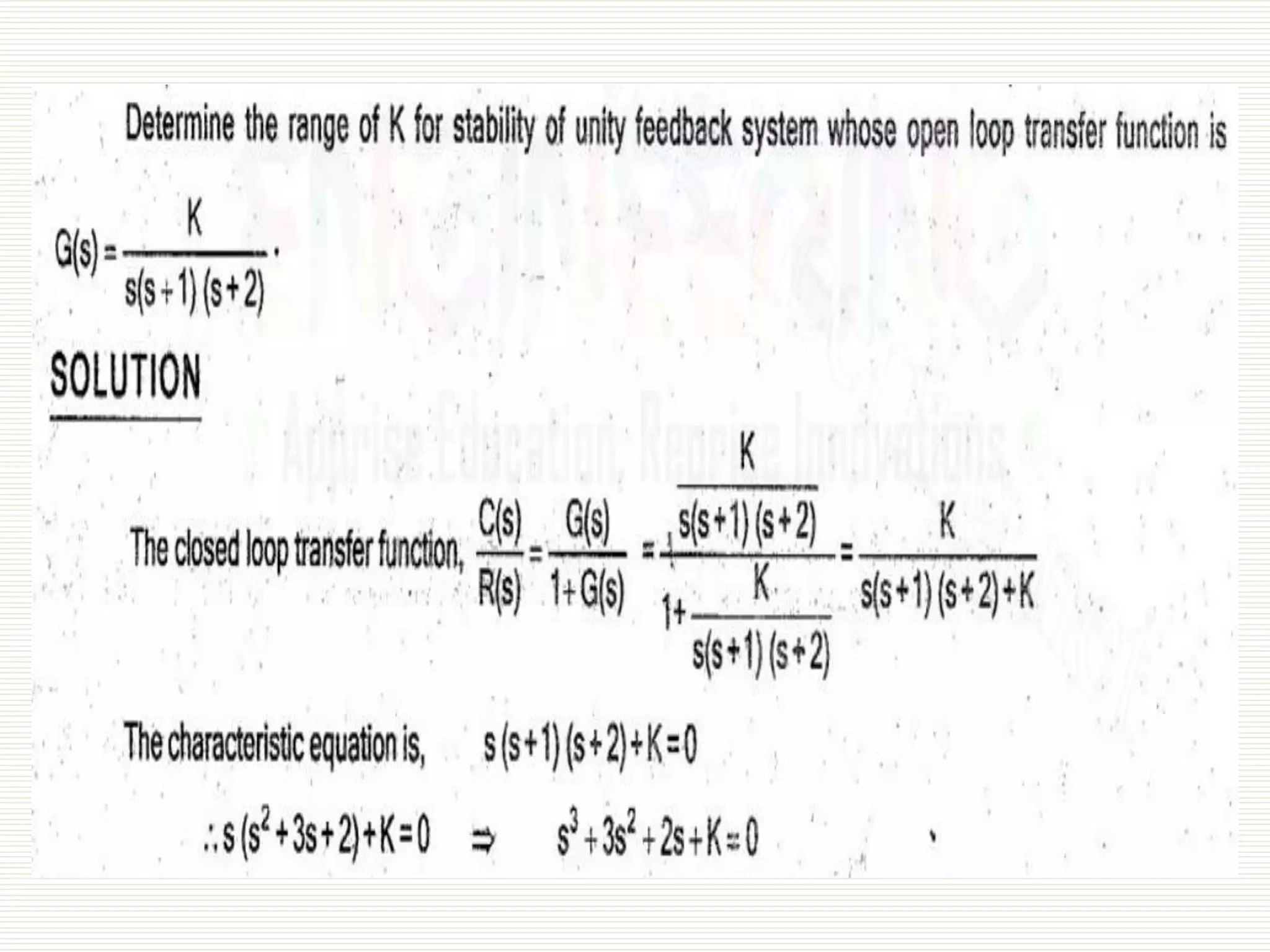
 Routh Hurwitz criterion is an analytical procedure for determining whether all
the roots of a polynomial have negative real part or not.
 To analyse the stability of a system, the first step is to examine its
characteristic equation.
 The necessary condition for stability is that all the coefficients of the
polynomial be positive.
 If some of the coefficients are zero or negative it can be concluded that the
system is not stable.
Routh Hurwitz criterion
 When all the coefficients are positive, the system is not necessarily stable.
Even the coefficients are positive, the roots may lie on the right half of S-plane or
on imaginary axis.
 Hurwitz and Routh published the method of investigating the sufficient
conditions of stability of a system.
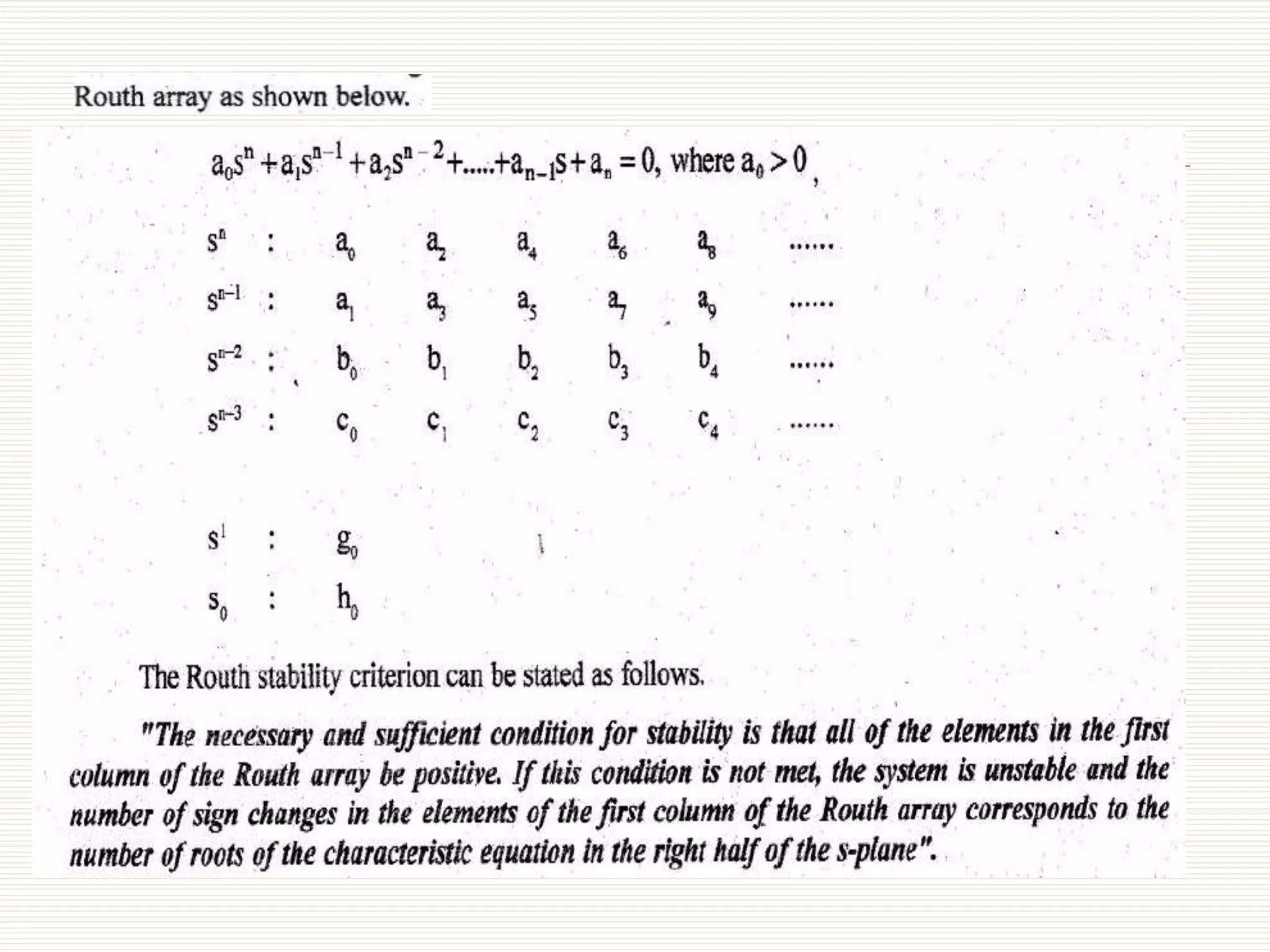
 Routh stability criterion is based on ordering the coefficients of the
characteristic equation, in to a schedule, called the Routh array.
Routh Hurwitz criterion
⮚
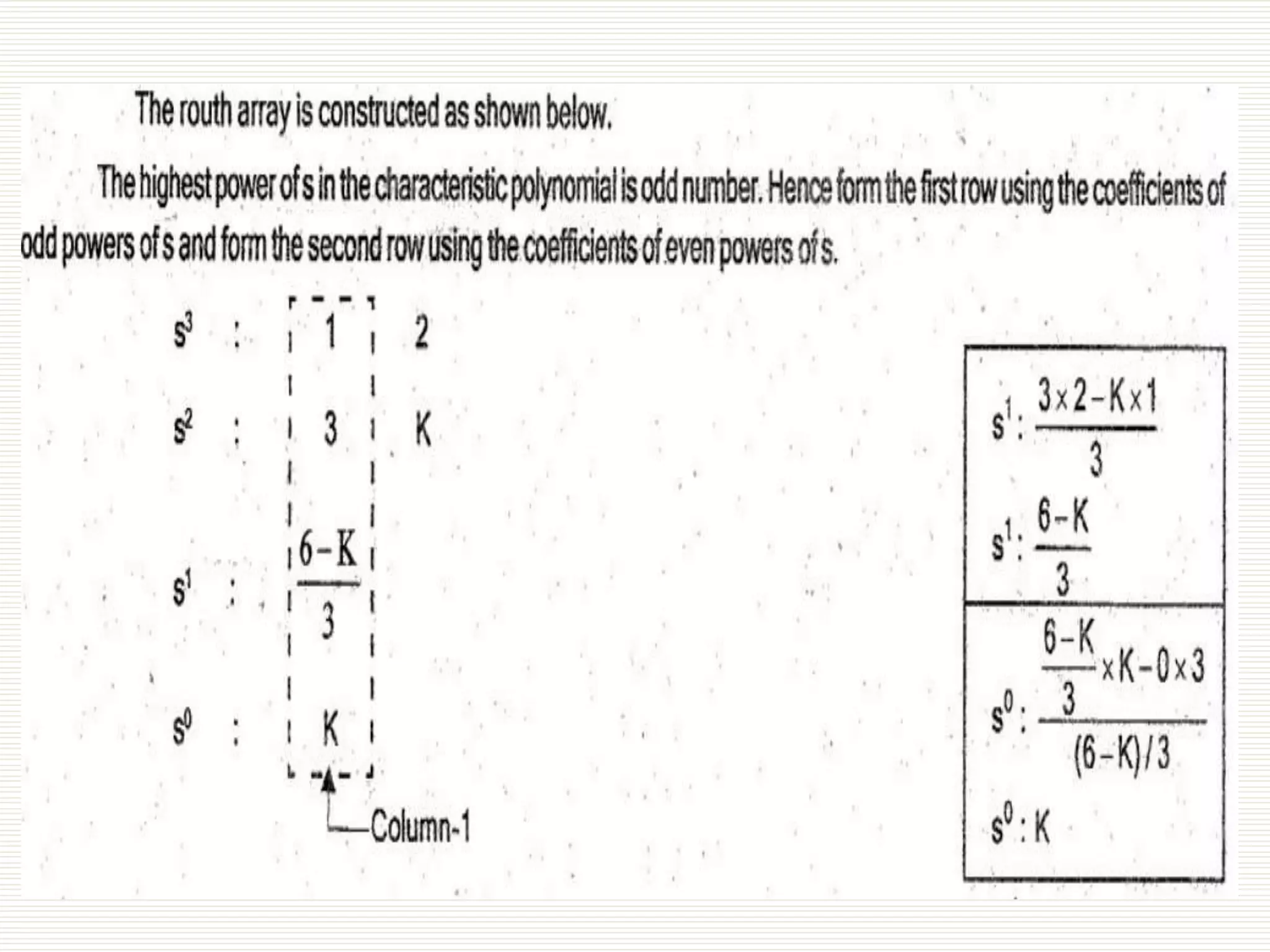
⮚ Construction of Routh Array:
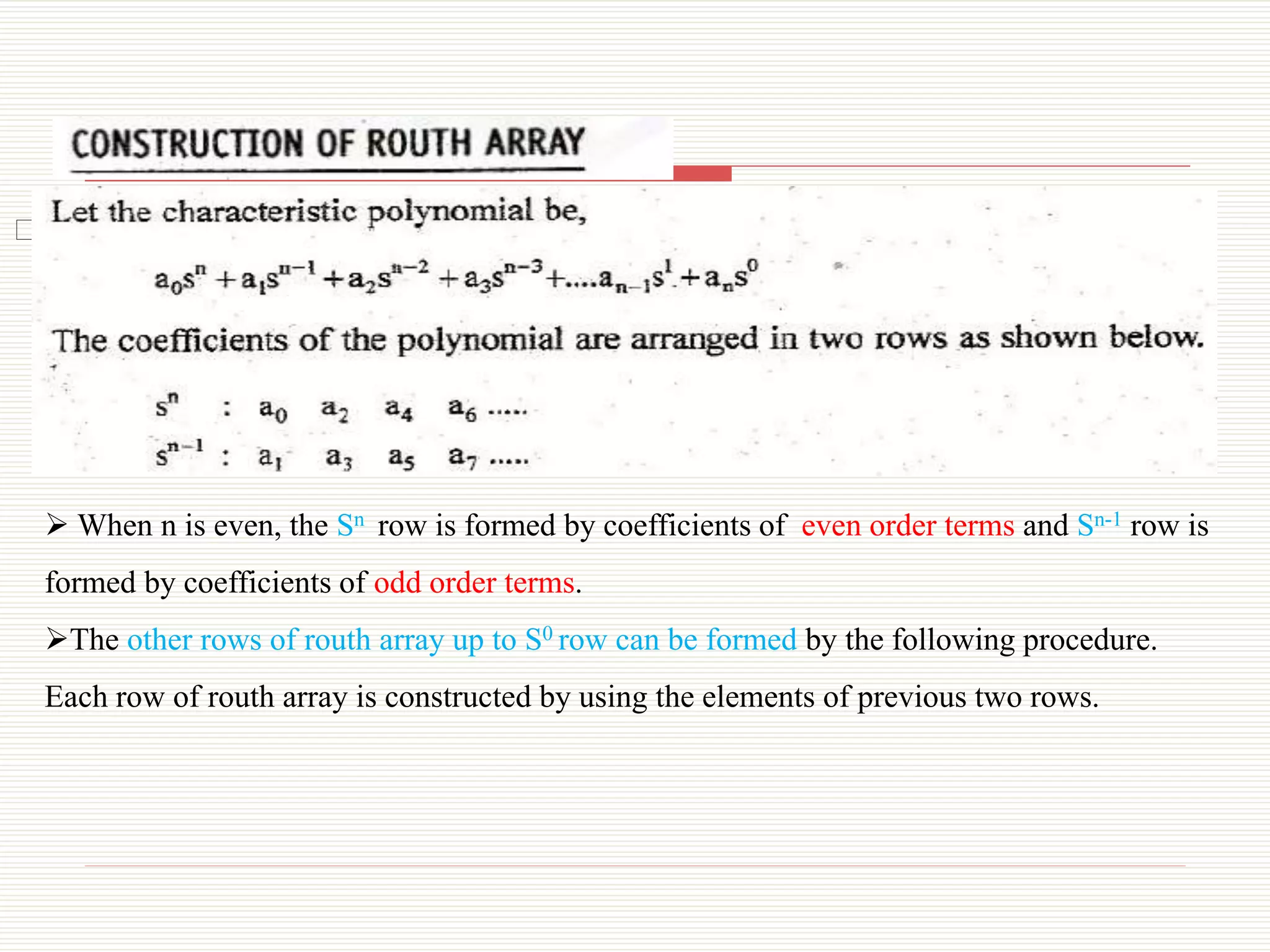
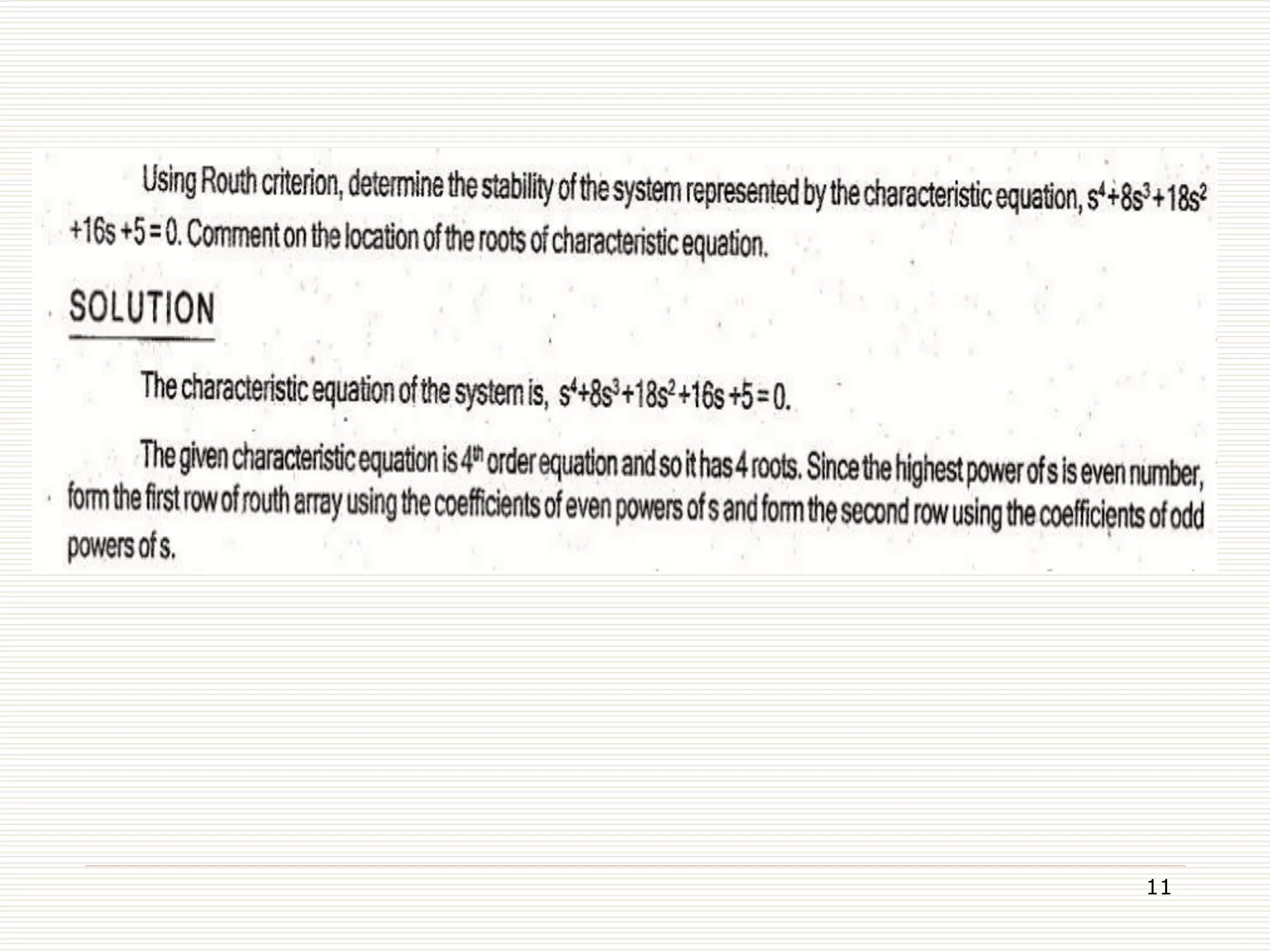
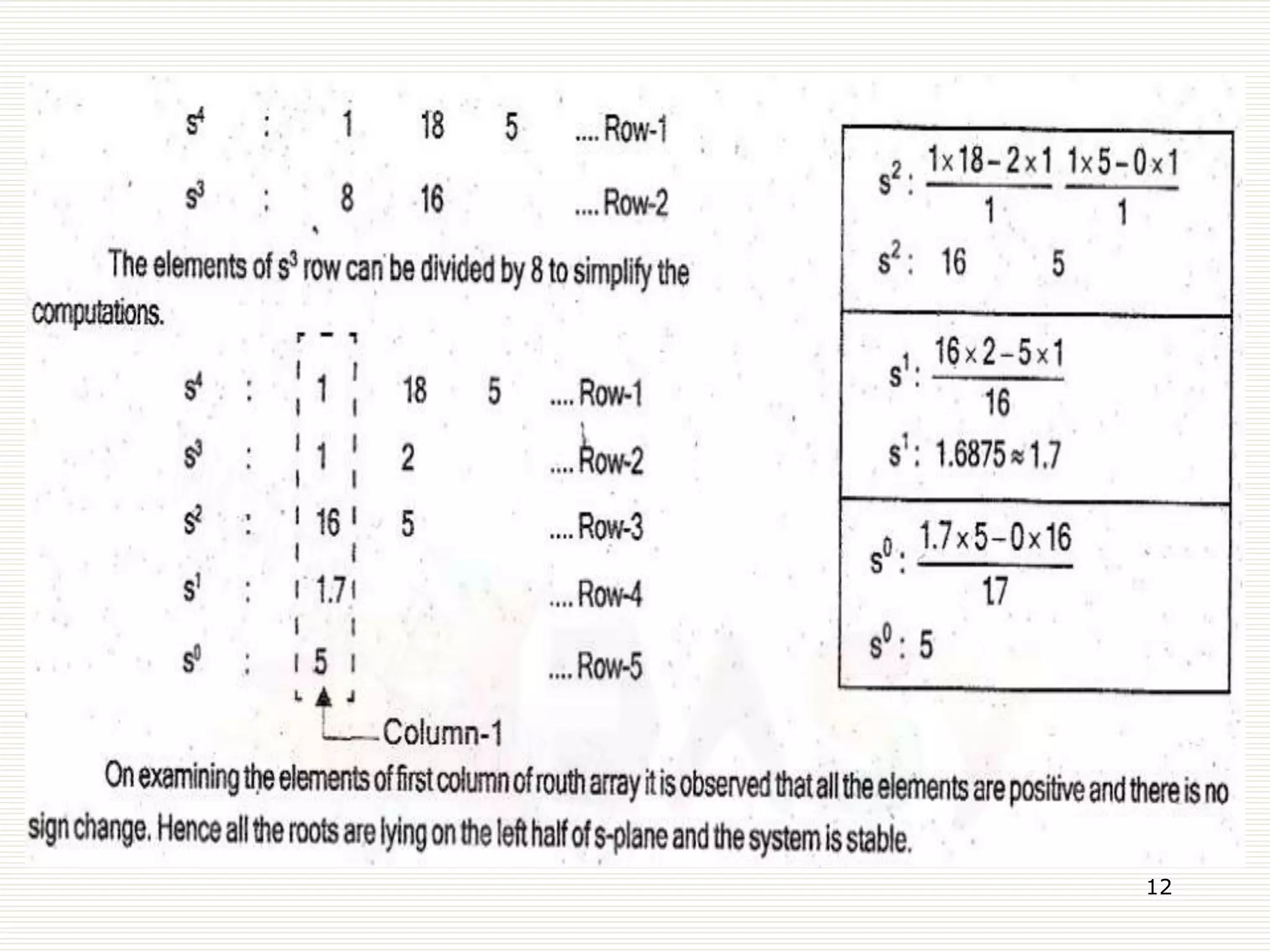
 When n is even, the Sn row is formed by coefficients of even order terms and Sn-1 row is
formed by coefficients of odd order terms.
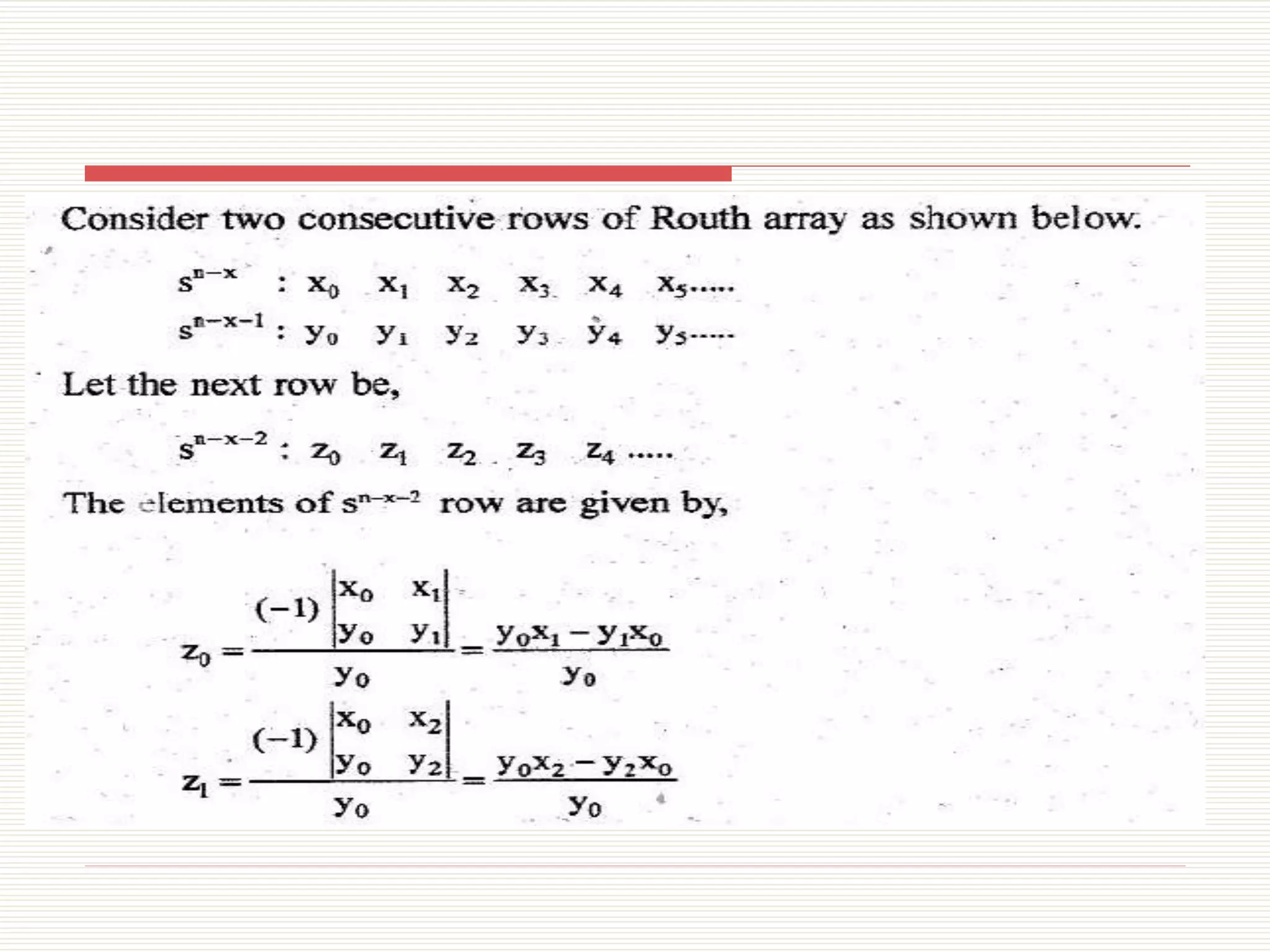
The other rows of routh array up to S0 row can be formed by the following procedure.
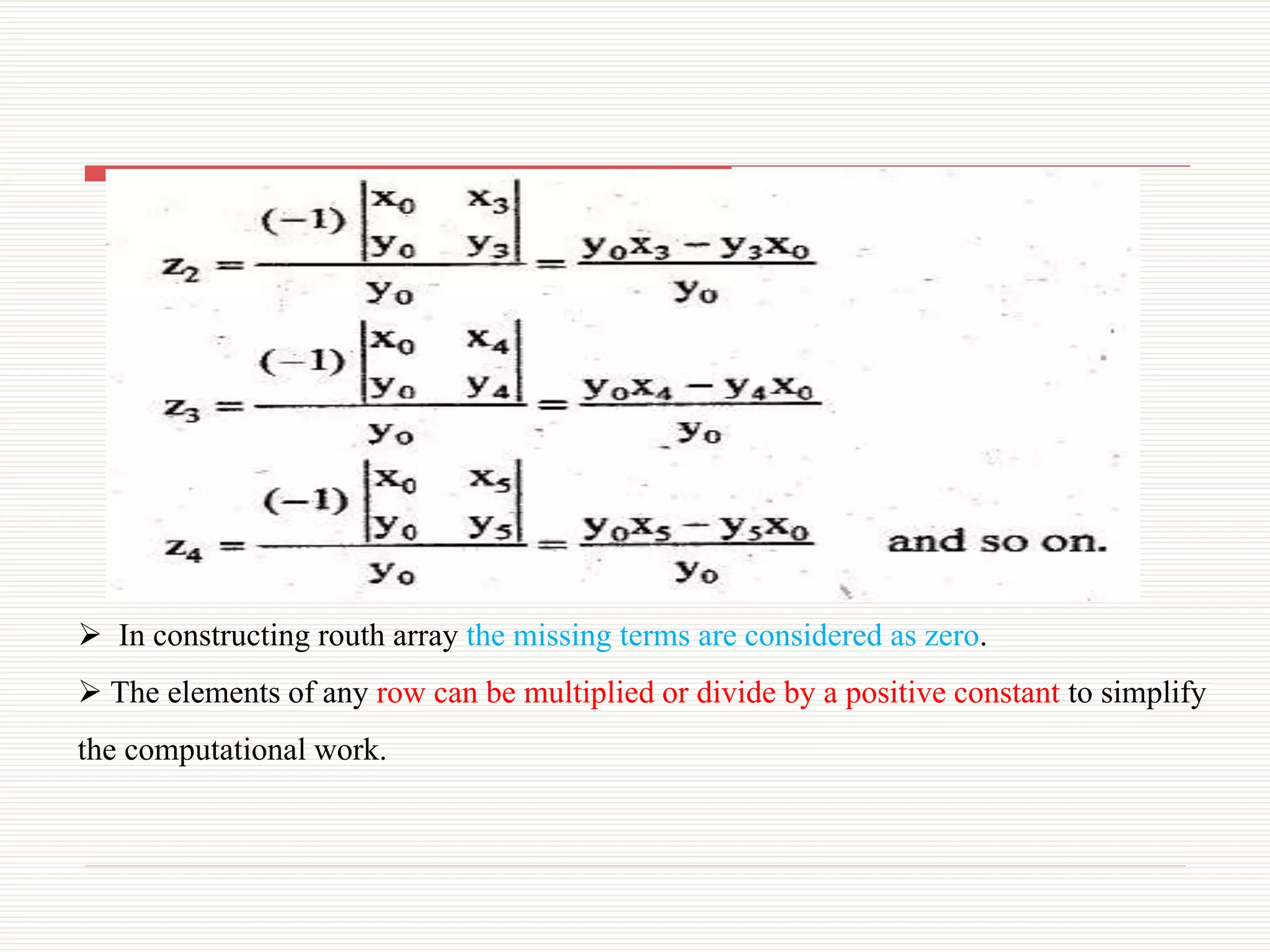
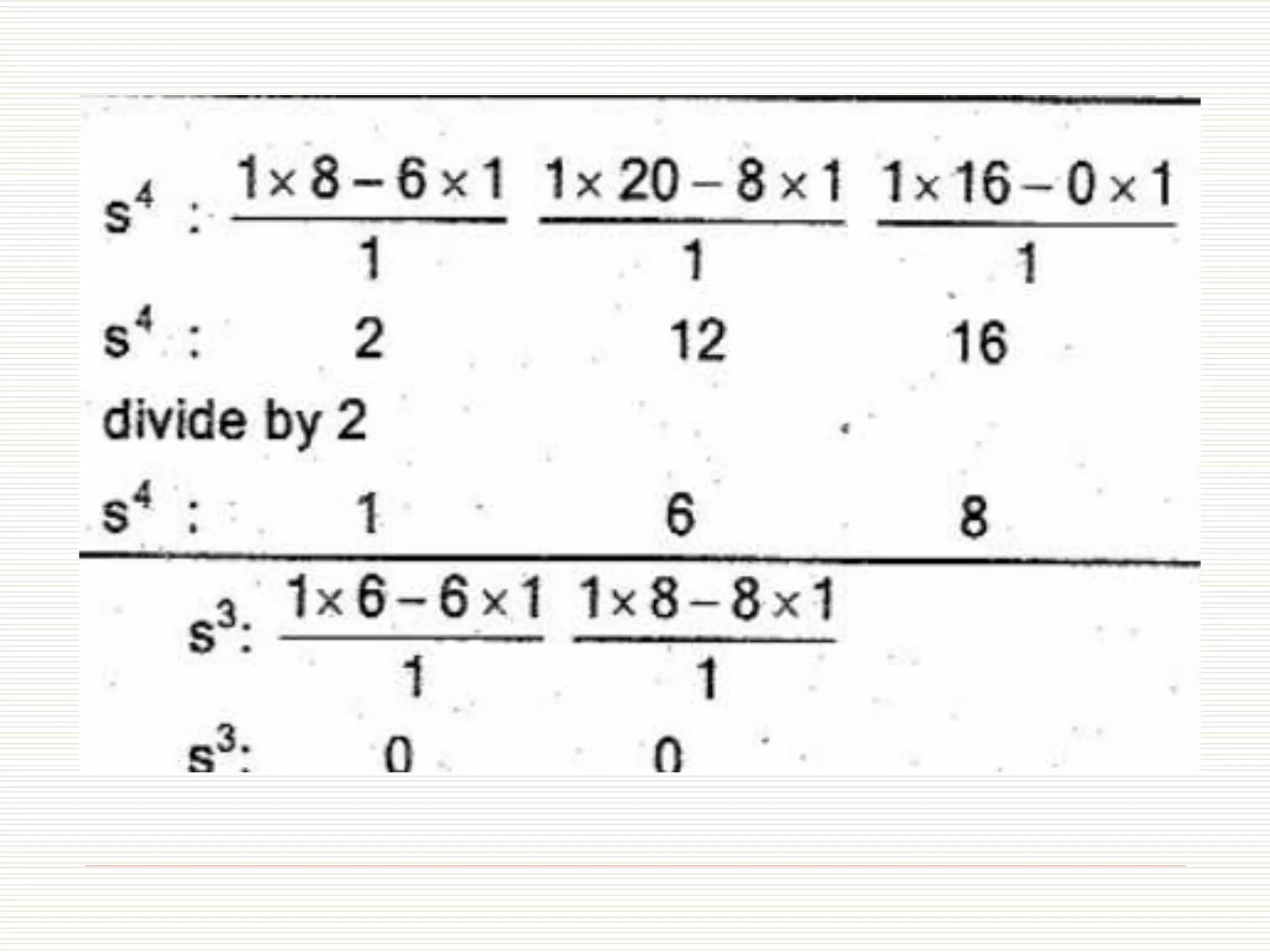
Each row of routh array is constructed by using the elements of previous two rows.
 In constructing routh array the missing terms are considered as zero.
 The elements of any row can be multiplied or divide by a positive constant to simplify
the computational work.
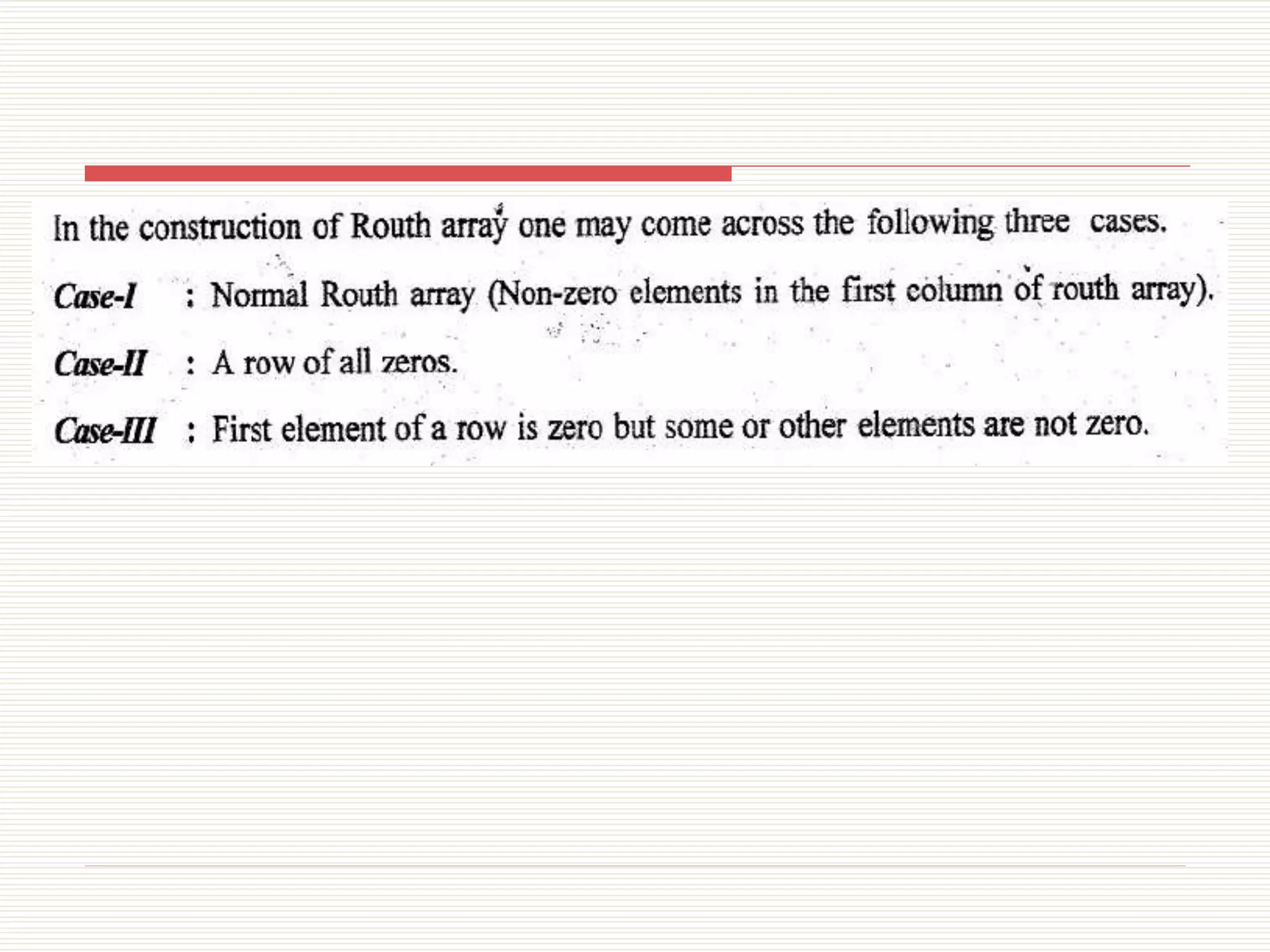
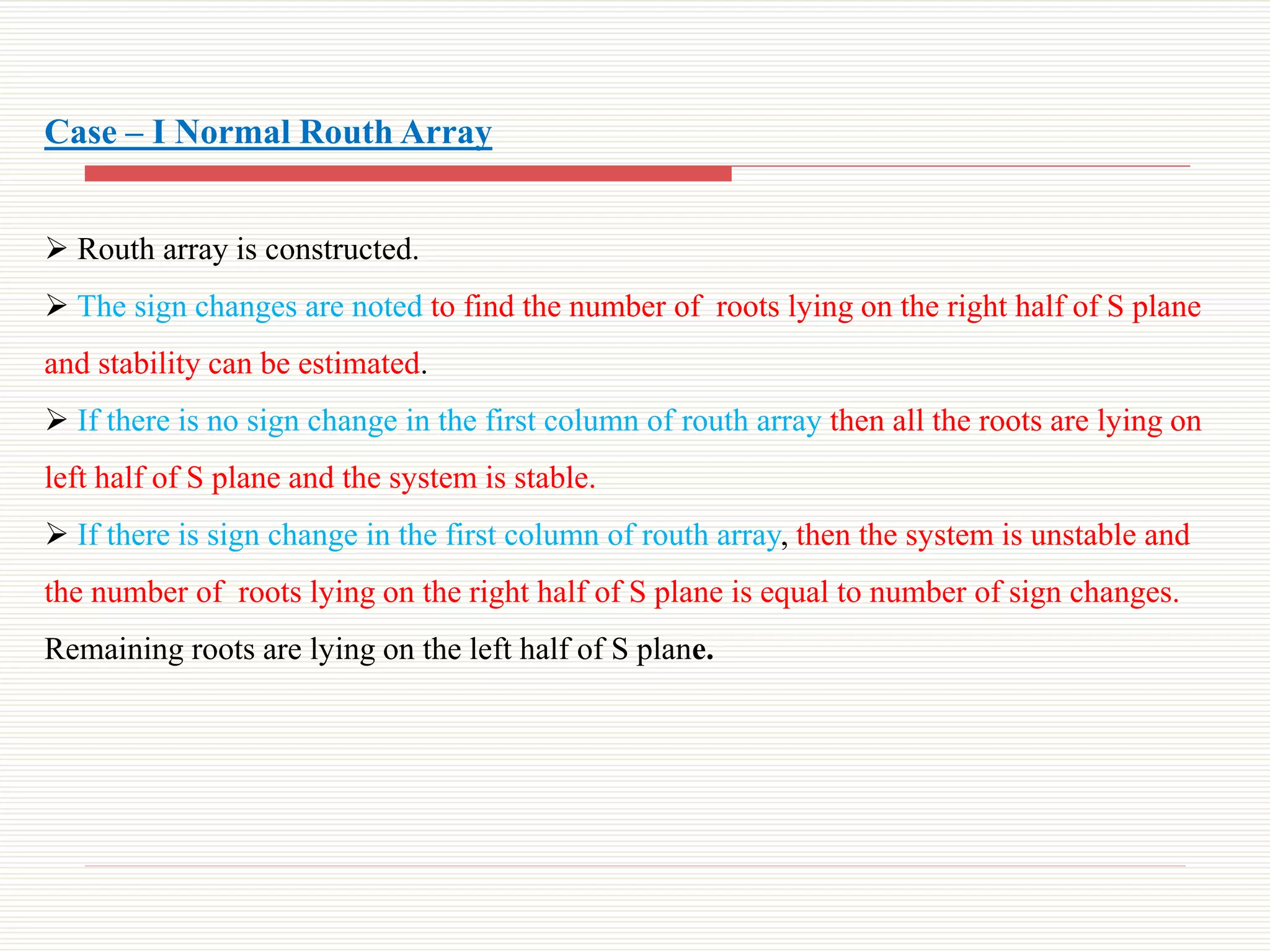
Case – I Normal Routh Array
 Routh array is constructed.
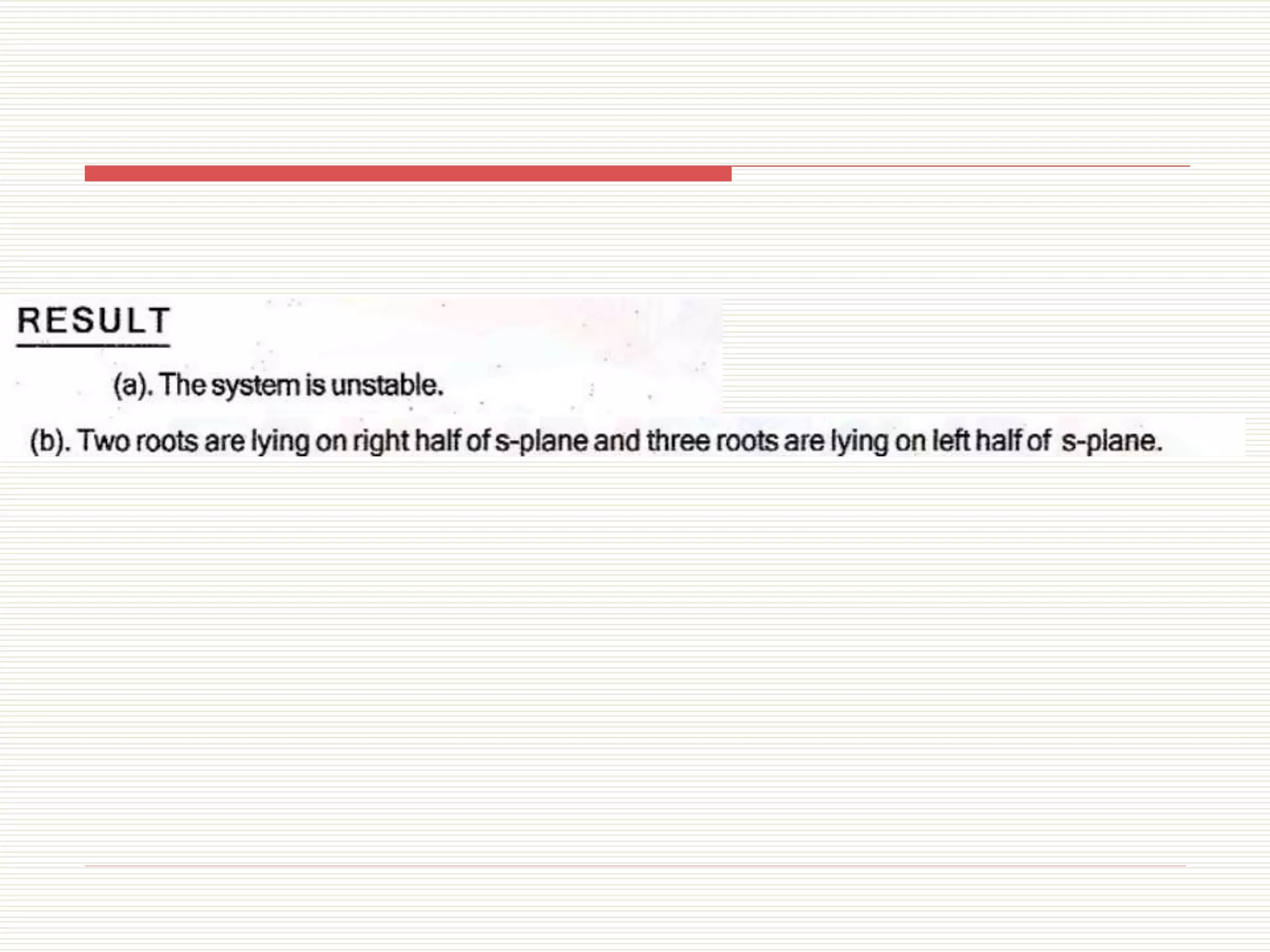
 The sign changes are noted to find the number of roots lying on the right half of S plane
and stability can be estimated.
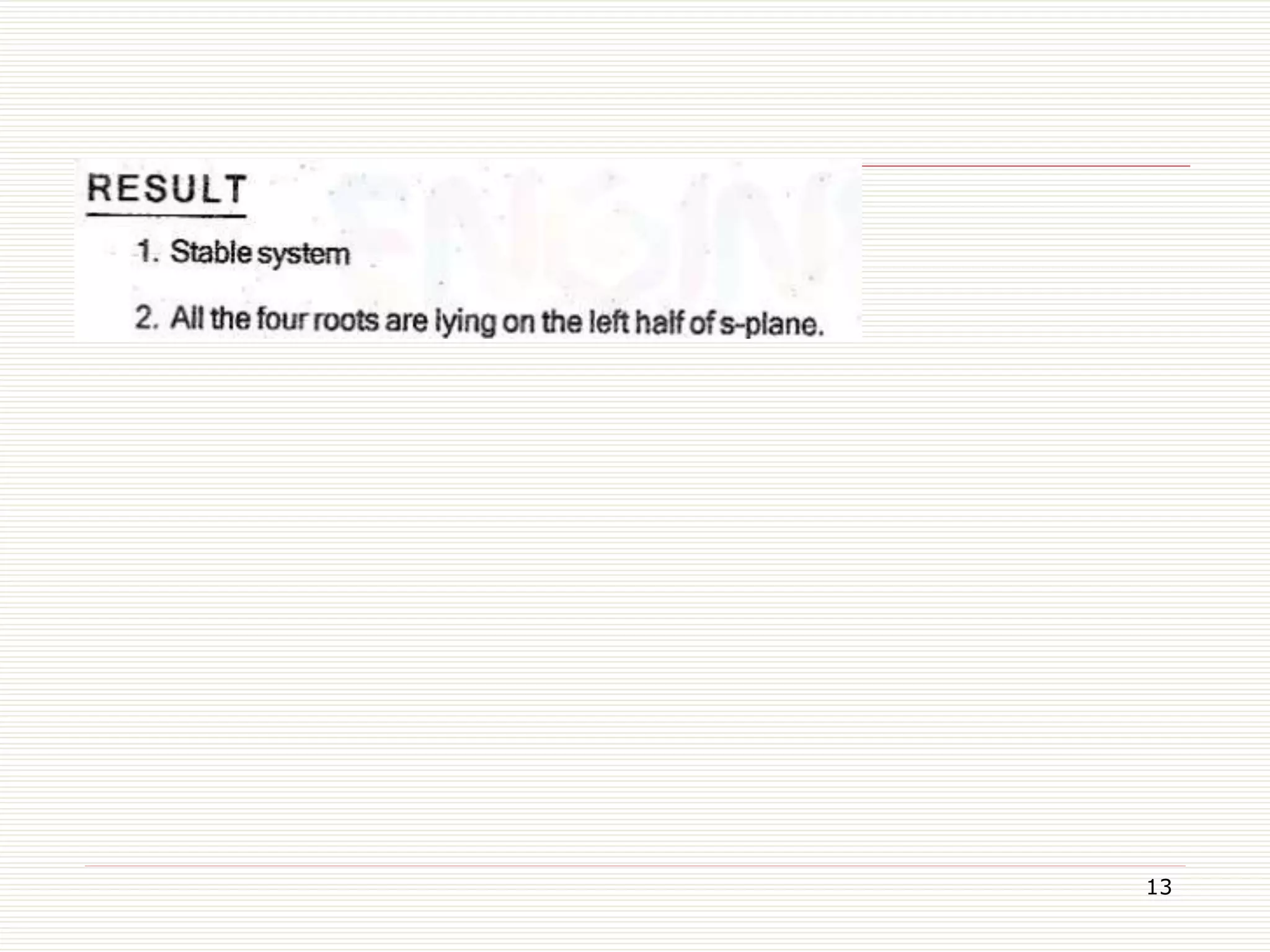
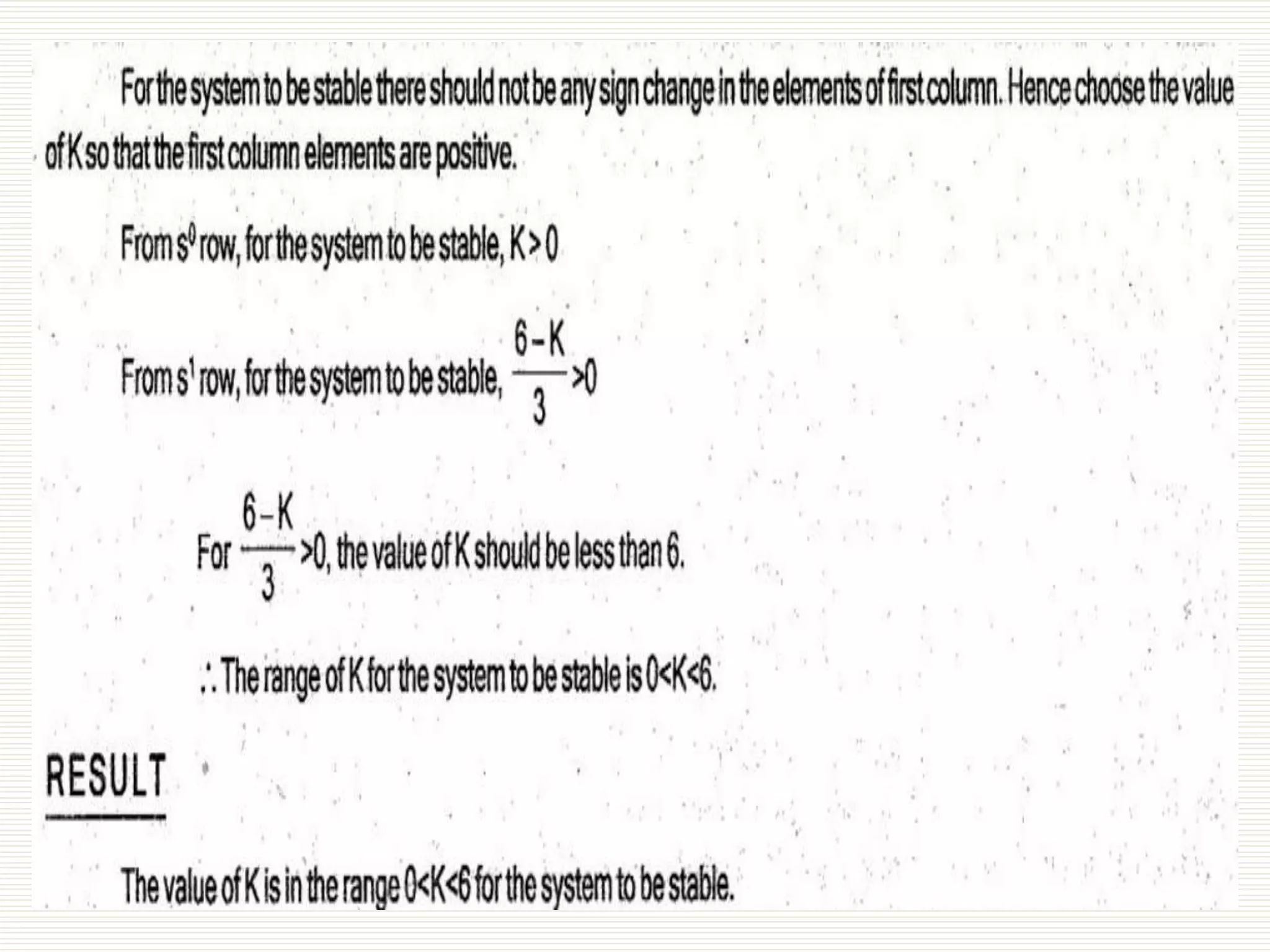
 If there is no sign change in the first column of routh array then all the roots are lying on
left half of S plane and the system is stable.
 If there is sign change in the first column of routh array, then the system is unstable and
the number of roots lying on the right half of S plane is equal to number of sign changes.
Remaining roots are lying on the left half of S plane.
11
12
13
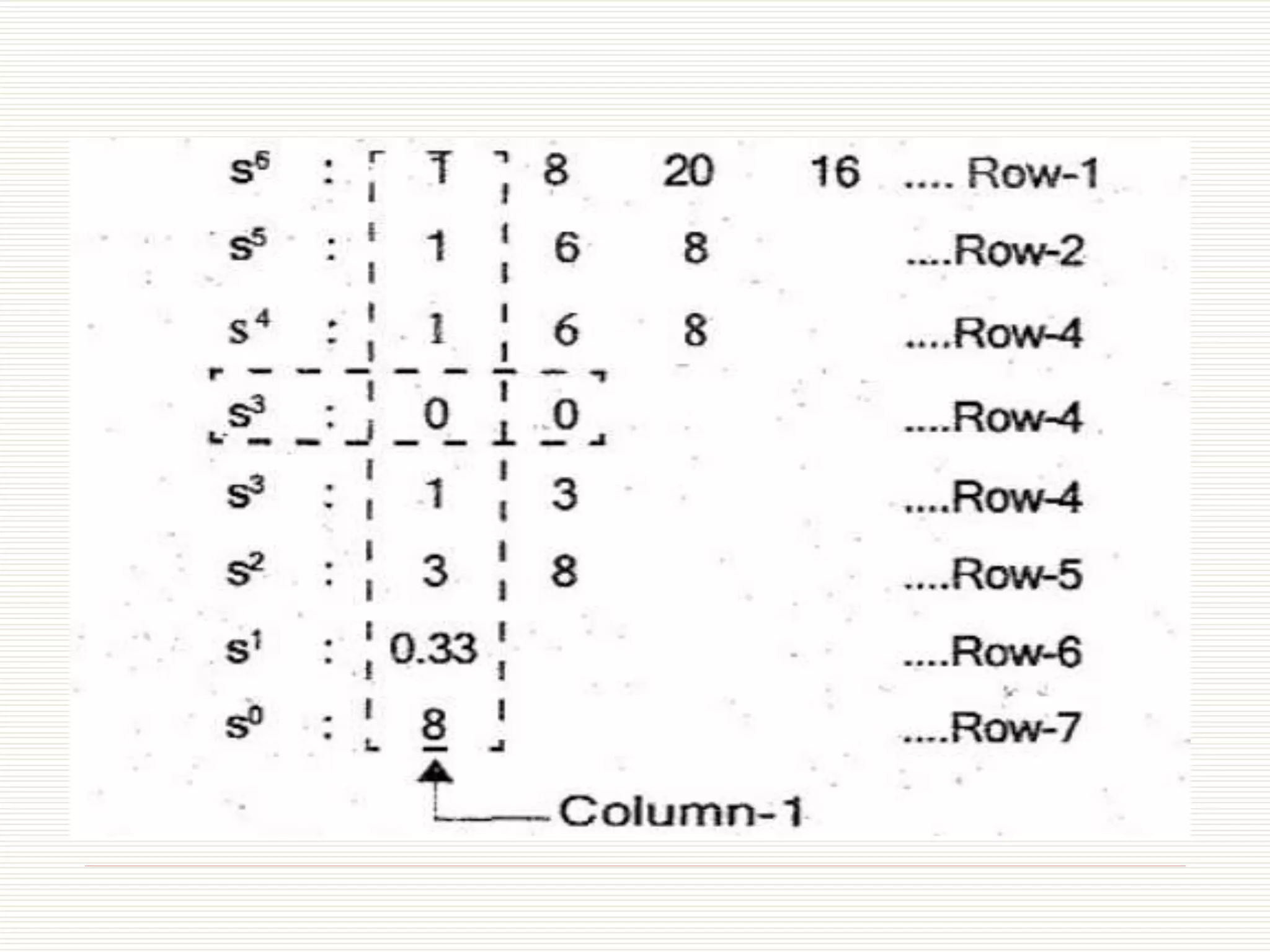
Case – II A row of all Zero
 All zero row indicates the existence of an even polynomial as a factor of the
characteristic equation.
 Even polynomial the exponents of S are even integers or zero only.
 Even polynomial factor is also called auxiliary polynomial.
 The coefficients of the auxiliary polynomial will be the elements of the row
directly above the row of zeros in the array.
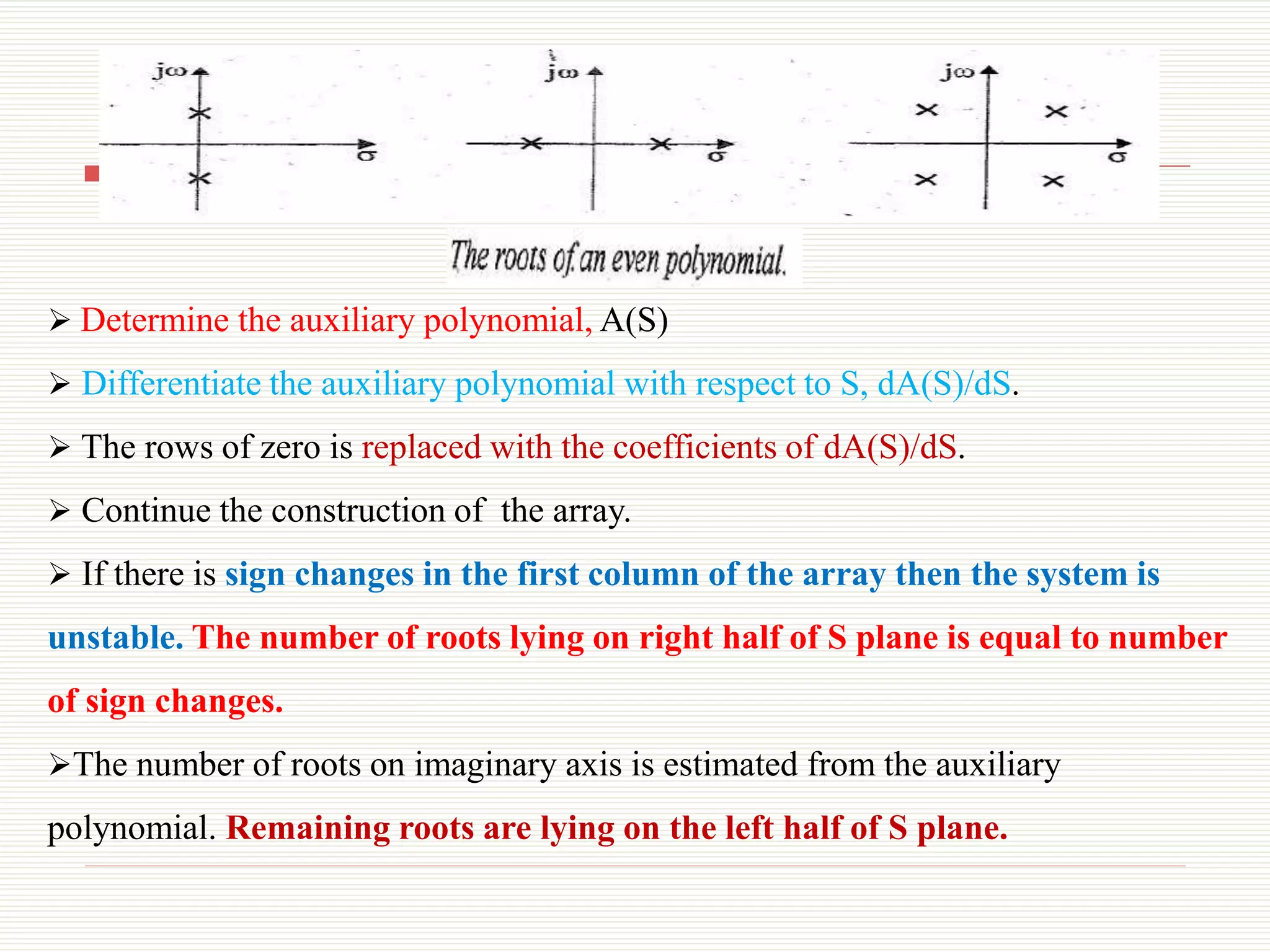
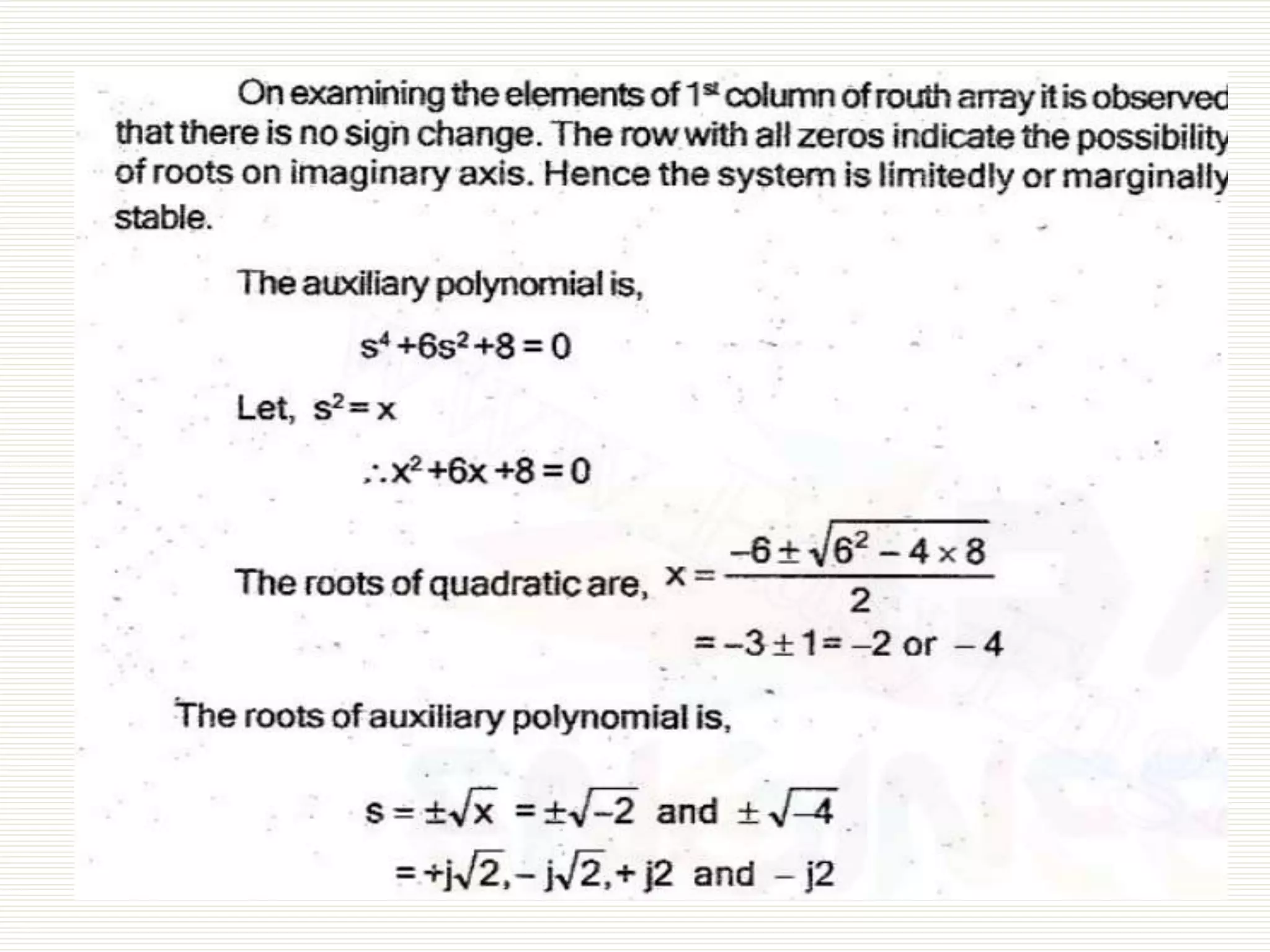
 The roots of a even polynomial occurs in pair that are equal in magnitude and
opposite in sign. So the roots can be purely imaginary, purely real or complex.
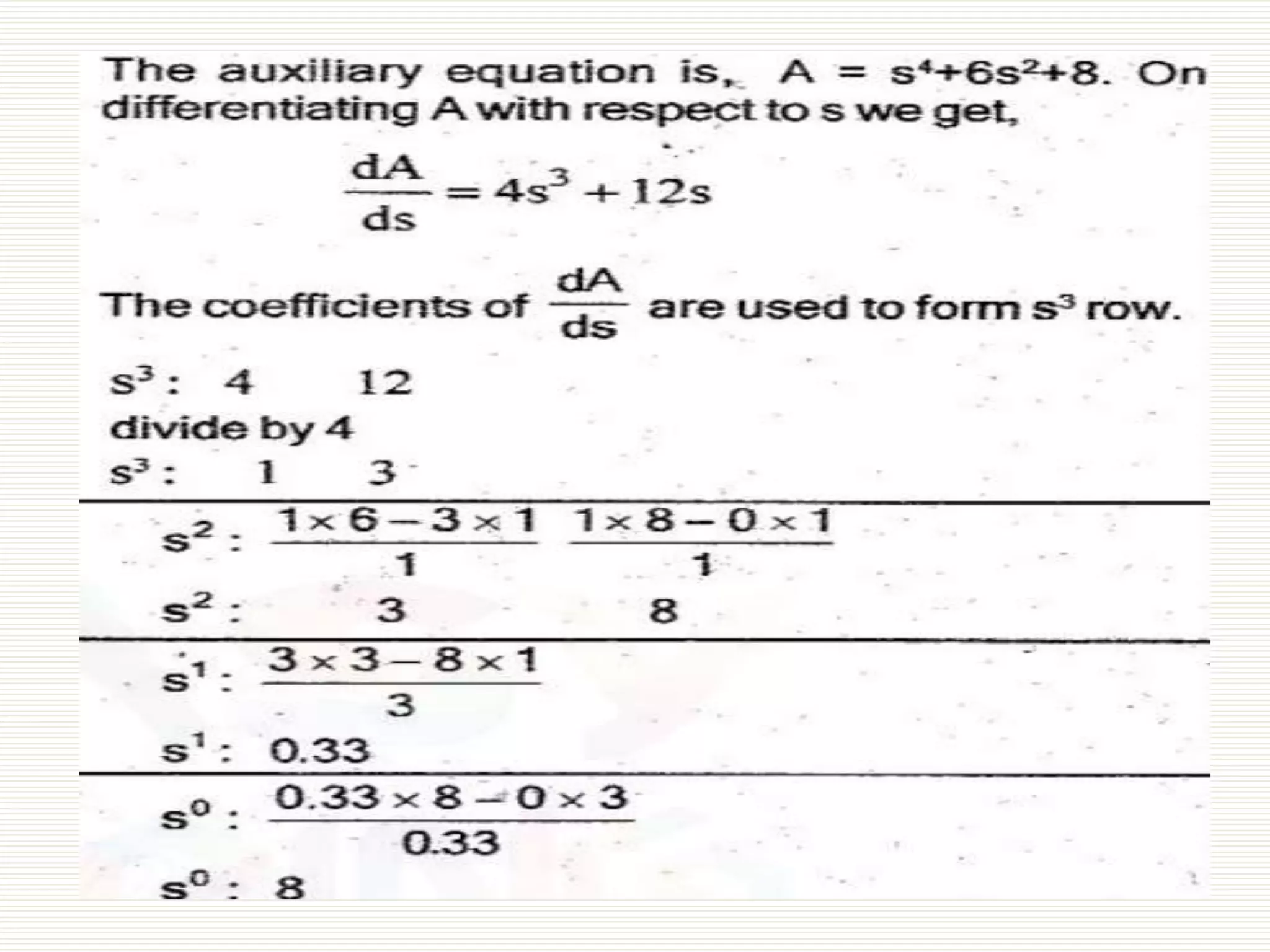
 Determine the auxiliary polynomial, A(S)
 Differentiate the auxiliary polynomial with respect to S, dA(S)/dS.
 The rows of zero is replaced with the coefficients of dA(S)/dS.
 Continue the construction of the array.
 If there is sign changes in the first column of the array then the system is
unstable. The number of roots lying on right half of S plane is equal to number
of sign changes.
The number of roots on imaginary axis is estimated from the auxiliary
polynomial. Remaining roots are lying on the left half of S plane.
 If there are no sign changes in the first column of routh array then all zero row
indicate the existence of purely imaginary roots so the system is limitedly or
marginally stable.
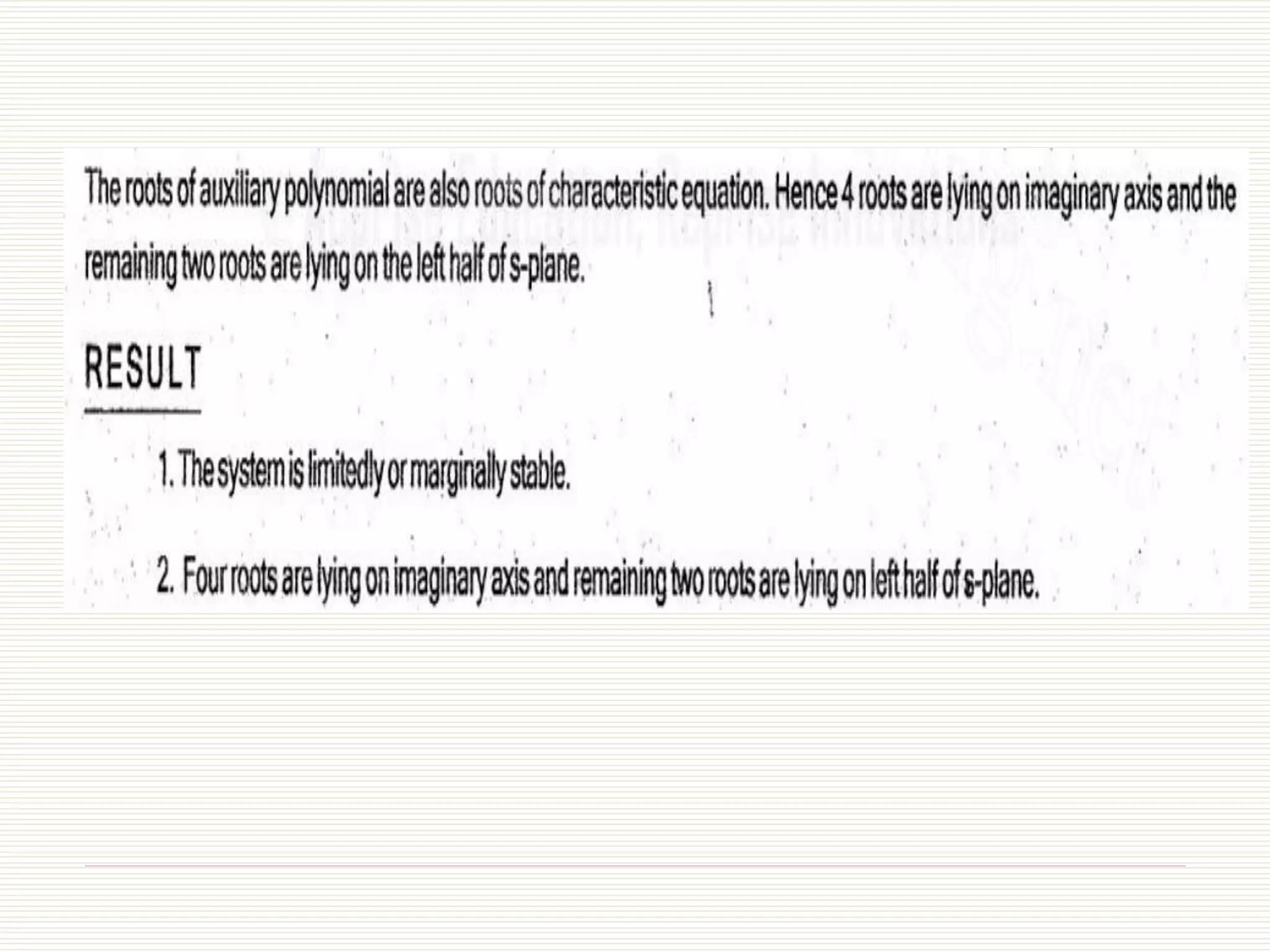
Roots of auxiliary equation lies on imaginary axis and remaining roots lies on
left half of S plane.
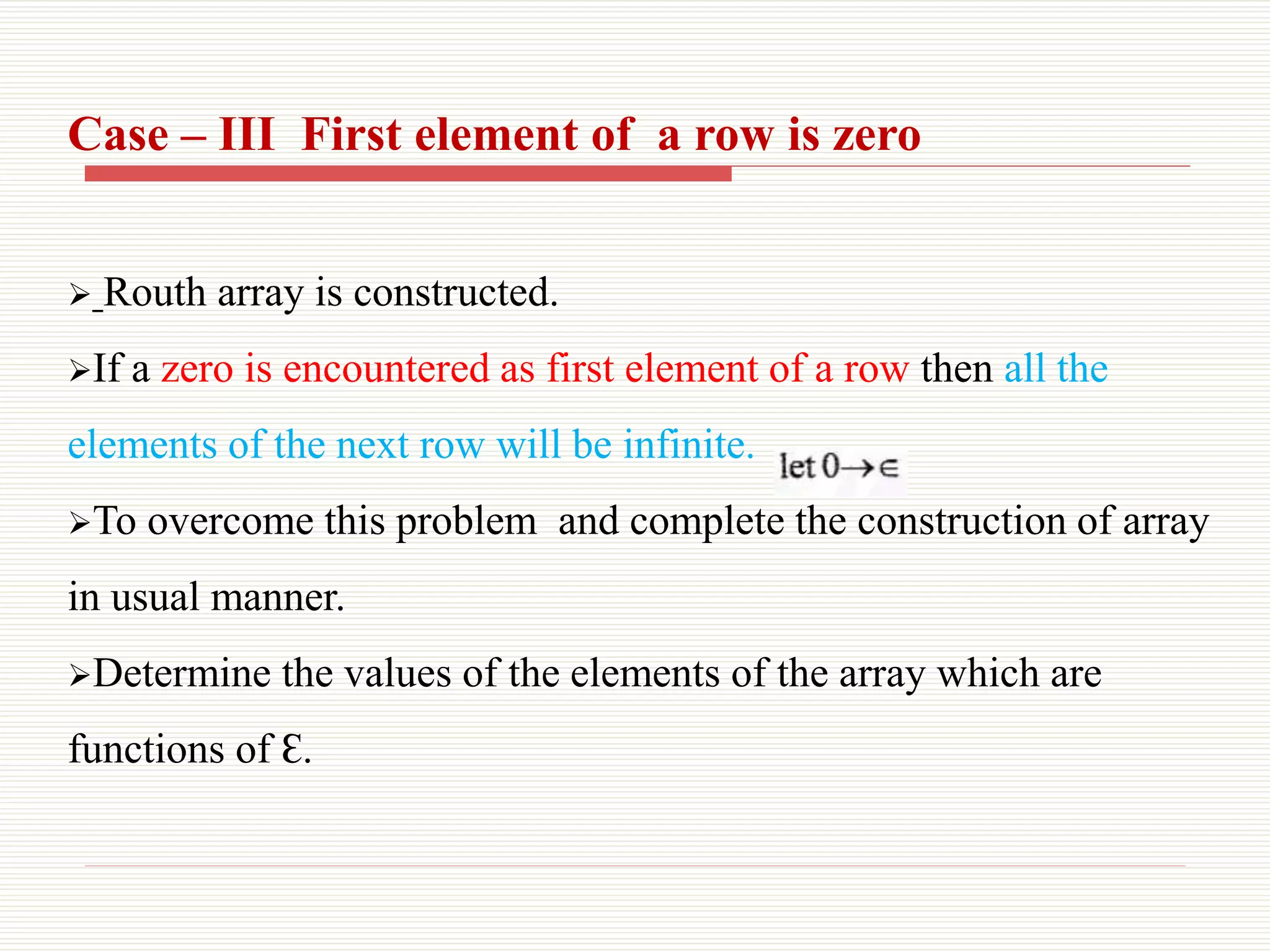
Case – III First element of a row is zero
 Routh array is constructed.
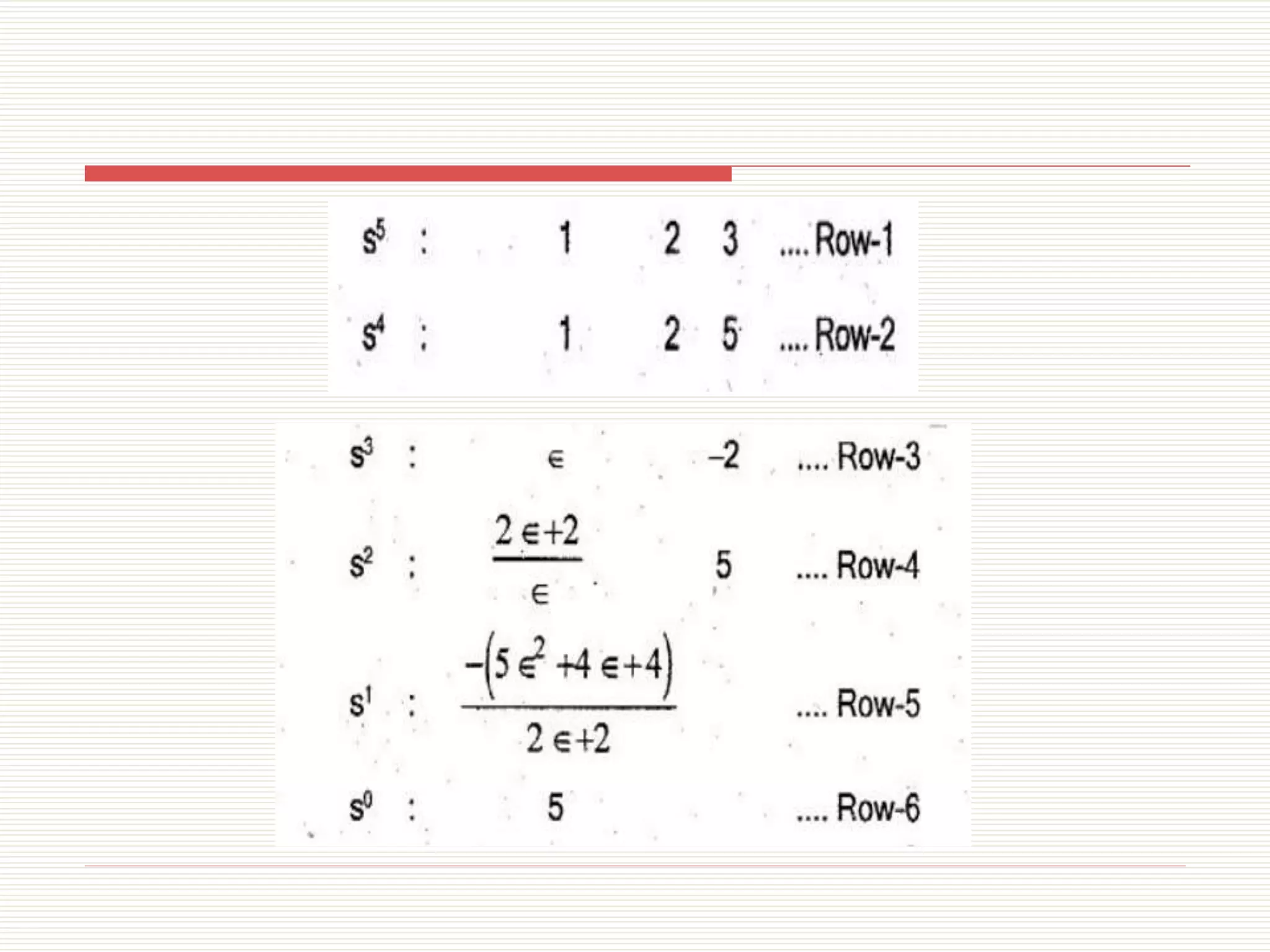
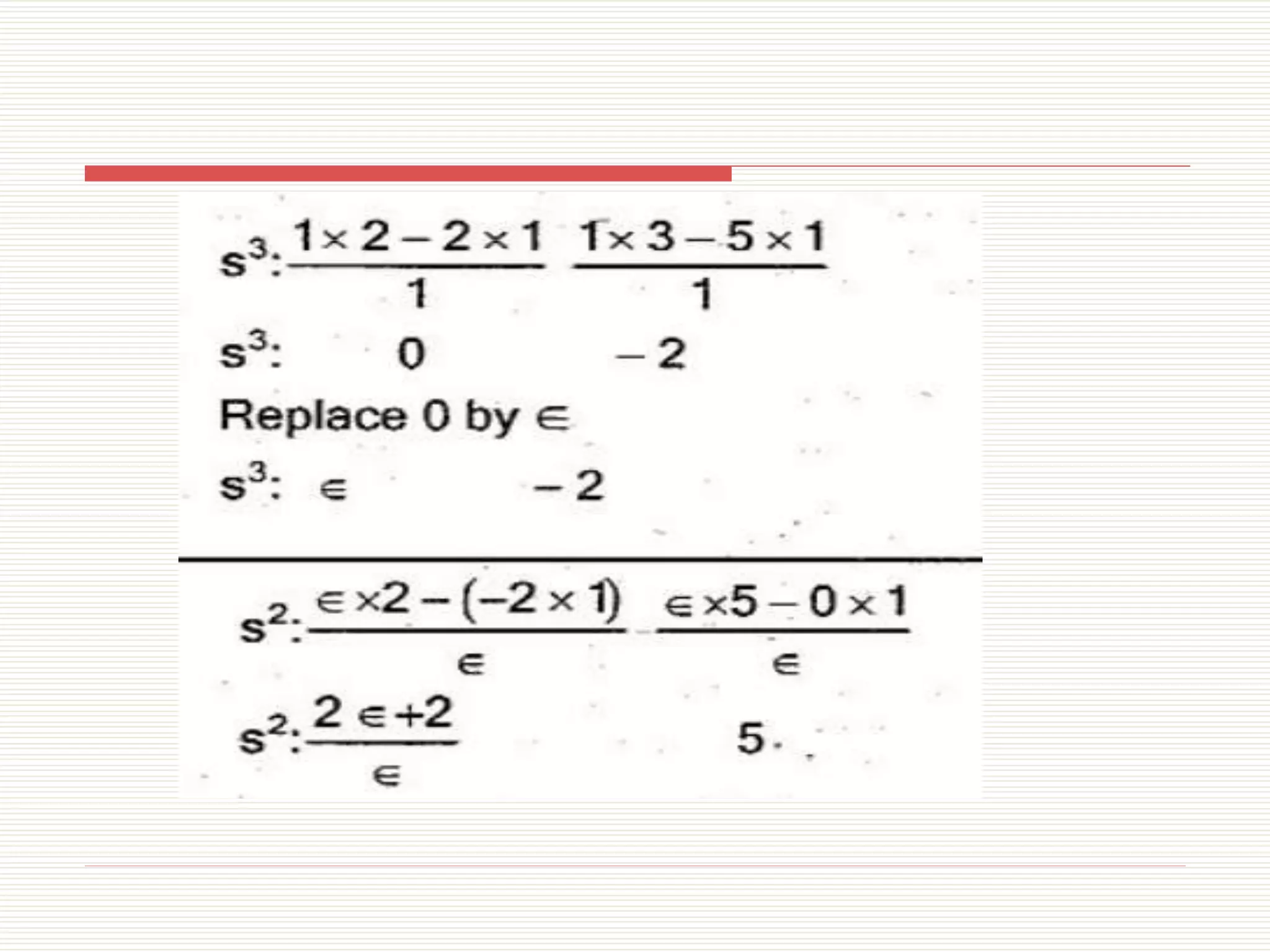
If a zero is encountered as first element of a row then all the
elements of the next row will be infinite.
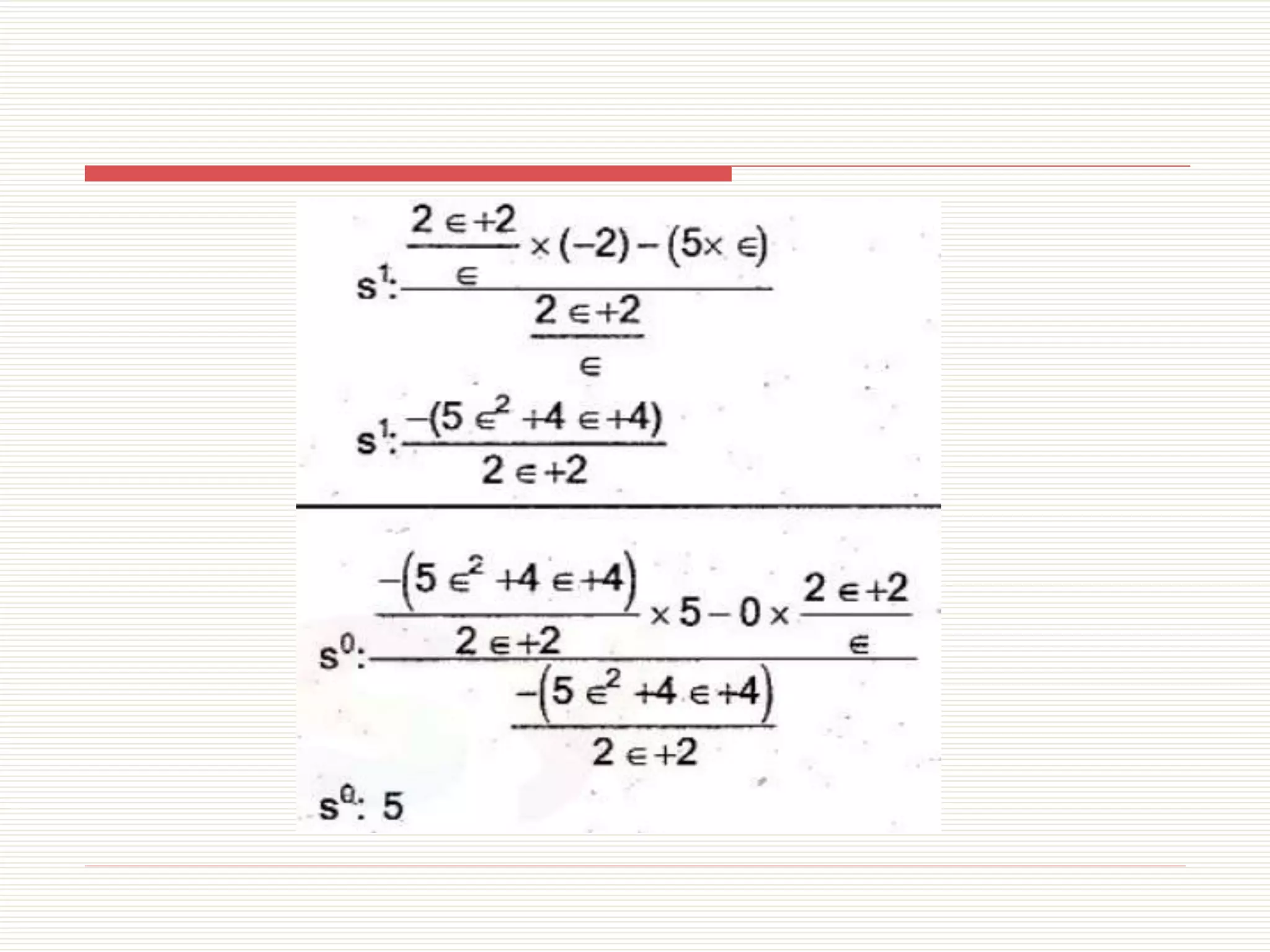
To overcome this problem and complete the construction of array
in usual manner.
Determine the values of the elements of the array which are
functions of Ԑ.
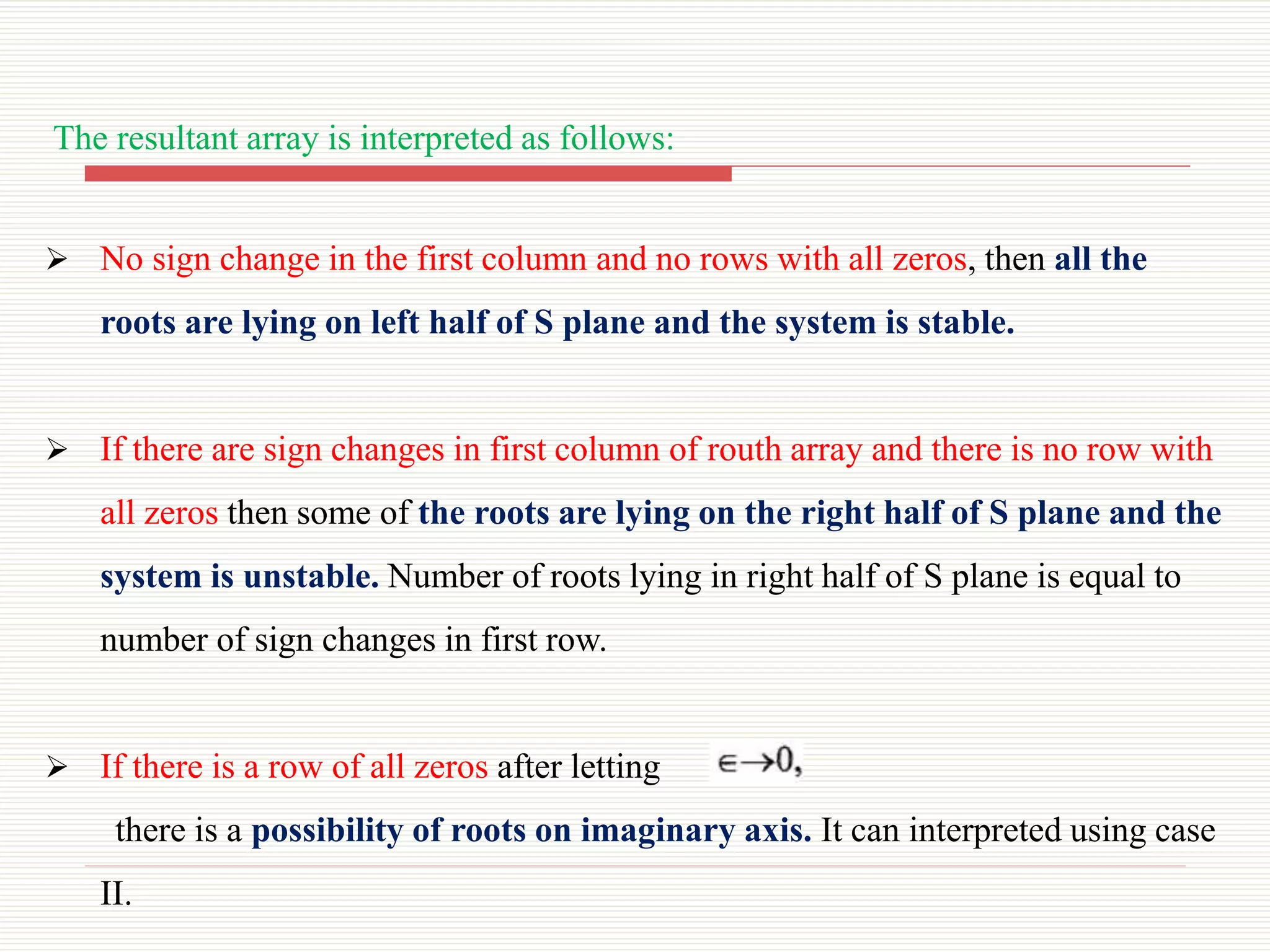
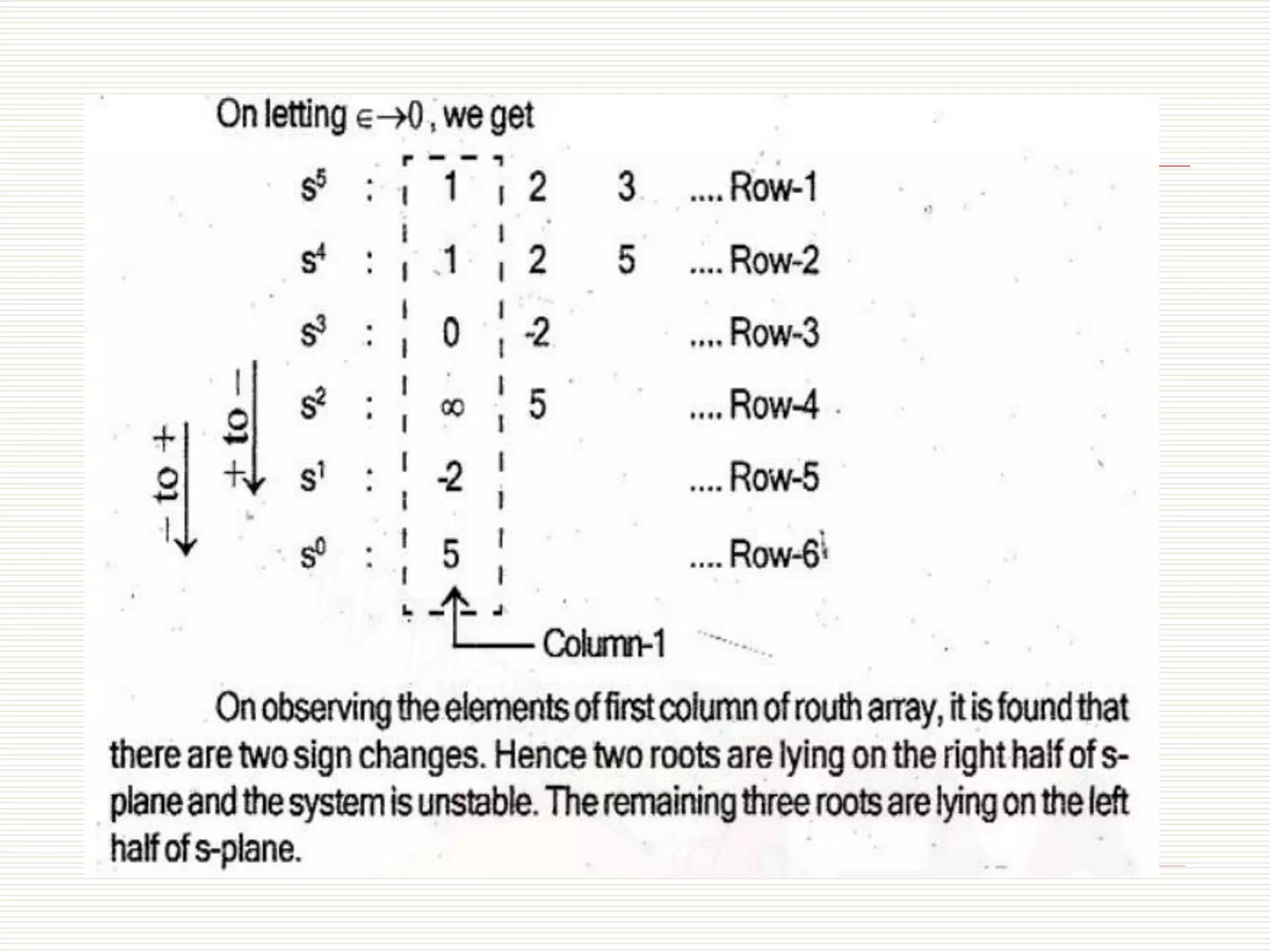
The resultant array is interpreted as follows:
 No sign change in the first column and no rows with all zeros, then all the
roots are lying on left half of S plane and the system is stable.
 If there are sign changes in first column of routh array and there is no row with
all zeros then some of the roots are lying on the right half of S plane and the
system is unstable. Number of roots lying in right half of S plane is equal to
number of sign changes in first row.
 If there is a row of all zeros after letting
there is a possibility of roots on imaginary axis. It can interpreted using case
II.
32
33
References :
 A.Nagoorkani, Control Systems,
RBA Publications.
4/5/2021 34
Thank You
35

Routh array hurwitz criterion

  • 1.
    Routh Array Hurwitzcriterion Presented by Mr. C.S.Satheesh, M.E., Assistant Professor, Department of EEE, Muthayammal Engineering College (Autonomous), Namakkal (Dt), Rasipuram – 637408 MUTHAYAMMAL ENGINEERING COLLEGE (An Autonomous Institution) (Approved by AICTE, New Delhi, Accredited by NAAC, NBA & Affiliated to Anna University), Rasipuram - 637 408, Namakkal Dist., Tamil Nadu, India.
  • 2.
    Stability  The termstability refers to the stable working condition of a control system.Every working system is designed to be stable.In a stable system,the response or output is predictable,finite and stable for a given input( or for any changes in system parameters). 2
  • 3.
     Routh Hurwitzcriterion is an analytical procedure for determining whether all the roots of a polynomial have negative real part or not.  To analyse the stability of a system, the first step is to examine its characteristic equation.  The necessary condition for stability is that all the coefficients of the polynomial be positive.  If some of the coefficients are zero or negative it can be concluded that the system is not stable. Routh Hurwitz criterion
  • 4.
     When allthe coefficients are positive, the system is not necessarily stable. Even the coefficients are positive, the roots may lie on the right half of S-plane or on imaginary axis.  Hurwitz and Routh published the method of investigating the sufficient conditions of stability of a system.  Routh stability criterion is based on ordering the coefficients of the characteristic equation, in to a schedule, called the Routh array. Routh Hurwitz criterion
  • 5.
  • 6.
    ⮚ Construction ofRouth Array:  When n is even, the Sn row is formed by coefficients of even order terms and Sn-1 row is formed by coefficients of odd order terms. The other rows of routh array up to S0 row can be formed by the following procedure. Each row of routh array is constructed by using the elements of previous two rows.
  • 8.
     In constructingrouth array the missing terms are considered as zero.  The elements of any row can be multiplied or divide by a positive constant to simplify the computational work.
  • 10.
    Case – INormal Routh Array  Routh array is constructed.  The sign changes are noted to find the number of roots lying on the right half of S plane and stability can be estimated.  If there is no sign change in the first column of routh array then all the roots are lying on left half of S plane and the system is stable.  If there is sign change in the first column of routh array, then the system is unstable and the number of roots lying on the right half of S plane is equal to number of sign changes. Remaining roots are lying on the left half of S plane.
  • 11.
  • 12.
  • 13.
  • 14.
    Case – IIA row of all Zero  All zero row indicates the existence of an even polynomial as a factor of the characteristic equation.  Even polynomial the exponents of S are even integers or zero only.  Even polynomial factor is also called auxiliary polynomial.  The coefficients of the auxiliary polynomial will be the elements of the row directly above the row of zeros in the array.  The roots of a even polynomial occurs in pair that are equal in magnitude and opposite in sign. So the roots can be purely imaginary, purely real or complex.
  • 15.
     Determine theauxiliary polynomial, A(S)  Differentiate the auxiliary polynomial with respect to S, dA(S)/dS.  The rows of zero is replaced with the coefficients of dA(S)/dS.  Continue the construction of the array.  If there is sign changes in the first column of the array then the system is unstable. The number of roots lying on right half of S plane is equal to number of sign changes. The number of roots on imaginary axis is estimated from the auxiliary polynomial. Remaining roots are lying on the left half of S plane.
  • 16.
     If thereare no sign changes in the first column of routh array then all zero row indicate the existence of purely imaginary roots so the system is limitedly or marginally stable. Roots of auxiliary equation lies on imaginary axis and remaining roots lies on left half of S plane.
  • 23.
    Case – IIIFirst element of a row is zero  Routh array is constructed. If a zero is encountered as first element of a row then all the elements of the next row will be infinite. To overcome this problem and complete the construction of array in usual manner. Determine the values of the elements of the array which are functions of Ԑ.
  • 24.
    The resultant arrayis interpreted as follows:  No sign change in the first column and no rows with all zeros, then all the roots are lying on left half of S plane and the system is stable.  If there are sign changes in first column of routh array and there is no row with all zeros then some of the roots are lying on the right half of S plane and the system is unstable. Number of roots lying in right half of S plane is equal to number of sign changes in first row.  If there is a row of all zeros after letting there is a possibility of roots on imaginary axis. It can interpreted using case II.
  • 32.
  • 33.
  • 34.
    References :  A.Nagoorkani,Control Systems, RBA Publications. 4/5/2021 34
  • 35.