Continuous Application
with
Apache® Spark™ 2.0
Jules S. Damji
Spark Community Evangelist
QconfSF 11/10.2016
@2twitme
$ whoami
• Spark Community Evangelist @ Databricks
• Previously Developer Advocate @ Hortonworks
• In the past engineering roles at:
• Sun Microsystems, Netscape, @Home, VeriSign,
Scalix, Centrify, LoudCloud/Opsware, ProQuest
• jules@databricks.com
• https://www.linkedin.com/in/dmatrix
Introduction to Structured
Streaming
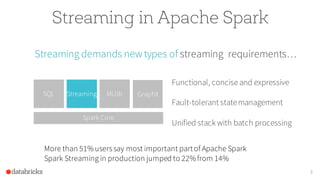
Streaming in Apache Spark
Streaming demands newtypes of streaming requirements…
3
SQL Streaming MLlib
Spark Core
GraphX
Functional, conciseand expressive
Fault-tolerant statemanagement
Unified stack with batch processing
More than 51%users say most important partof Apache Spark
Spark Streaming in production jumped to 22%from 14%
Streaming apps are
growing more complex
4
Streaming computations
don’t run in isolation
• Need to interact with batch data,
interactive analysis, machine learning, etc.
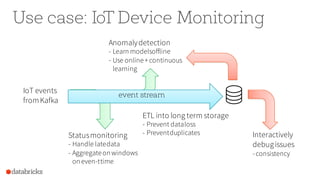
Use case: IoT Device Monitoring
IoT events
fromKafka
ETL into long term storage
- Prevent dataloss
- PreventduplicatesStatusmonitoring
- Handle latedata
- Aggregateon windows
on even-ttime
Interactively
debugissues
-consistency
event stream
Anomalydetection
- Learn modelsoffline
- Use online+continuous
learning
Use case: IoT Device Monitoring
Anomalydetection
- Learn modelsoffline
- Useonline + continuous
learning
IoT events event stream
fromKafka
ETL into long term storage
- Prevent dataloss
Status monitoring - Preventduplicates Interactively
- Handle late data debugissues
- Aggregateon windows -consistency
on eventtime
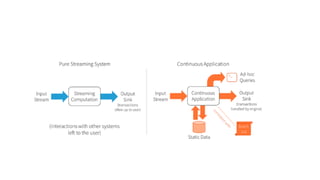
Continuous Applications
Not just streaming any more
The simplest way to perform streaming analytics
is not having to reason about streaming at all
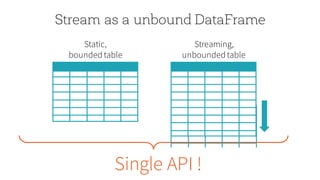
Static,
bounded table
Stream as a unbound DataFrame
Streaming,
unbounded table
Single API !
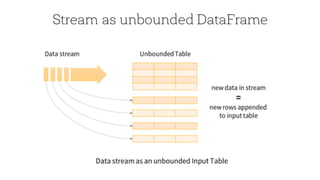
Stream as unbounded DataFrame
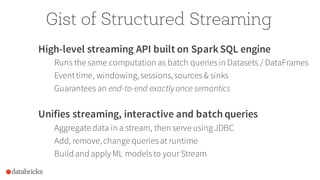
Gist of Structured Streaming
High-level streaming API built on SparkSQL engine
Runs the same computation as batch queriesin Datasets / DataFrames
Eventtime, windowing,sessions,sources& sinks
Guaranteesan end-to-end exactlyonce semantics
Unifies streaming, interactive and batch queries
Aggregate data in a stream, then serve using JDBC
Add, remove,change queriesat runtime
Build and apply ML modelsto your Stream
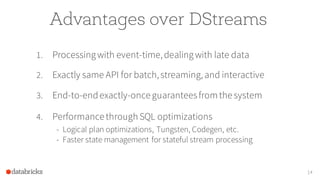
Advantages over DStreams
1. Processingwith event-time,dealingwith late data
2. Exactly same API for batch,streaming,and interactive
3. End-to-endexactly-once guaranteesfromthe system
4. Performance through SQL optimizations
- Logical plan optimizations, Tungsten, Codegen, etc.
- Faster state management for stateful stream processing
14
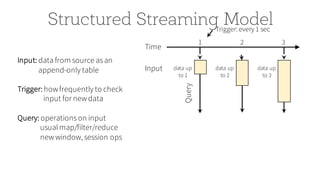
Structured Streaming ModelTrigger: every 1 sec
1 2 3
Time
data up
to 1
Input data up
to 2
data up
to 3
Query
Input: data from source as an
append-only table
Trigger: howfrequently to check
input for newdata
Query: operations on input
usual map/filter/reduce
newwindow, session ops
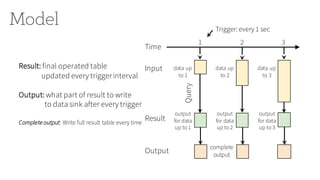
Model Trigger: every 1 sec
1 2 3
output
for data
up to 1
Result
Query
Time
data up
to 1
Input data up
to 2
output
for data
up to 2
data up
to 3
output
for data
up to 3
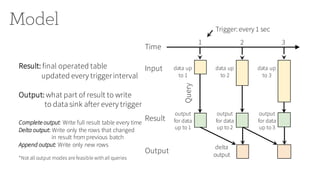
Result: final operated table
updated every triggerinterval
Output: what part of result to write
to data sink after every trigger
Complete output: Write full result table every time
Output
complete
output
Model Trigger: every 1 sec
1 2 3
output
for data
up to 1
Result
Query
Time
data up
to 1
Input data up
to 2
output
for data
up to 2
data up
to 3
output
for data
up to 3
Output
delta
output
Result: final operated table
updated every triggerinterval
Output: what part of result to write
to data sink after every trigger
Complete output: Write full result table every time
Delta output: Write only the rows that changed
in result from previous batch
Append output: Write only new rows
*Not all output modes are feasible withall queries
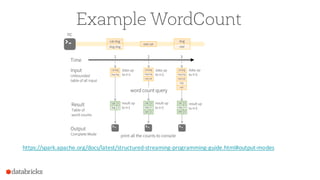
Example WordCount
https://spark.apache.org/docs/latest/structured-streaming-programming-guide.html#output-modes
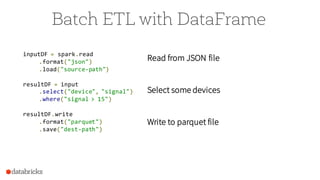
Batch ETL with DataFrame
inputDF = spark.read
.format("json")
.load("source-path")
resultDF = input
.select("device", "signal")
.where("signal > 15")
resultDF.write
.format("parquet")
.save("dest-path")
Read from JSON file
Select some devices
Write to parquet file
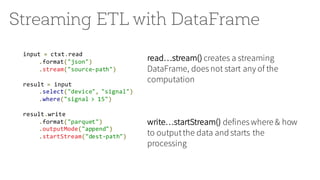
Streaming ETL with DataFrame
input = ctxt.read
.format("json")
.stream("source-path")
result = input
.select("device", "signal")
.where("signal > 15")
result.write
.format("parquet")
.outputMode("append")
.startStream("dest-path")
read…stream() creates a streaming
DataFrame, doesnot start any of the
computation
write…startStream() defineswhere & how
to outputthe data and starts the
processing
Streaming ETL with DataFrame
input = spark.read
.format("json")
.stream("source-path")
result = input
.select("device", "signal")
.where("signal > 15")
result.write
.format("parquet")
.outputMode("append")
.startStream("dest-path")
1 2 3
Result
[append-only table]
Input
Output
[append mode]
new rows
in result
of 2
new rows
in result
of 3
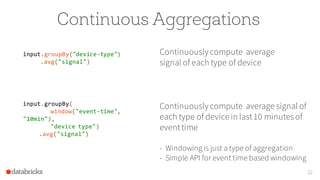
Continuous Aggregations
Continuously compute average
signal of each type of device
22
input.groupBy("device-type")
.avg("signal")
input.groupBy(
window("event-time",
"10min"),
"device type")
.avg("signal")
Continuously compute average signal of
each type of device in last10 minutesof
eventtime
- Windowing is just a type of aggregation
- Simple API for event time based windowing
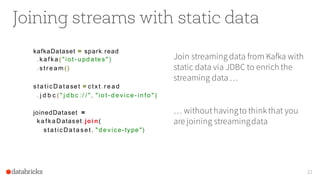
Joining streams with static data
kafkaDataset = spark.read
. ka f ka ( "io t - u pd a te s")
. st r e a m ()
st a t icDa t a se t = ct xt . r e a d
. j d b c ( " j d b c : / / ", "io t - d e vice - in f o ")
joinedDataset =
ka f ka Dataset .joi n(
st a t icDa t a se t , "d e vice- type ")
21
Join streaming data from Kafka with
static data via JDBC to enrich the
streaming data …
… withouthavingto thinkthat you
are joining streamingdata
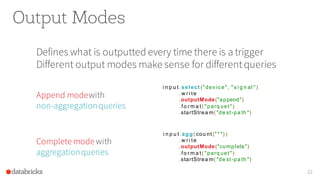
Output Modes
Defines what is outputted every time there is a trigger
Different output modes make sense for differentqueries
22
i n p u t.select ("dev ic e", "s i g n al ")
.w r i te
.outputMode("append")
.fo r m a t( "parq uet")
.startStrea m( "de st-pa th ")
Append modewith
non-aggregationqueries
i n p u t.agg( cou nt("* ") )
.w r i te
.outputMode("complete")
.fo r m a t( "parq uet")
.startStrea m( "de st-pa th ")
Complete mode with
aggregationqueries
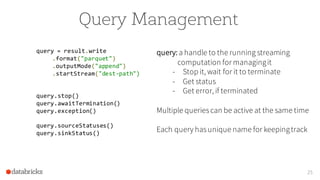
Query Management
query = result.write
.format("parquet")
.outputMode("append")
.startStream("dest-path")
query.stop()
query.awaitTermination()
query.exception()
query.sourceStatuses()
query.sinkStatus()
25
query: a handle to the running streaming
computation for managingit
- Stop it, wait for it to terminate
- Get status
- Get error, if terminated
Multiple queries can be active at the same time
Each query has unique name for keepingtrack
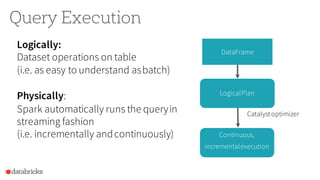
Logically:
Dataset operations on table
(i.e. as easy to understand asbatch)
Physically:
Spark automatically runs the queryin
streaming fashion
(i.e. incrementally andcontinuously)
DataFrame
LogicalPlan
Catalystoptimizer
Continuous,
incrementalexecution
Query Execution
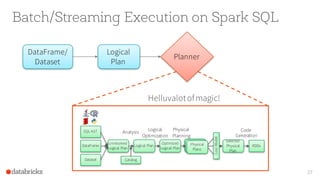
Batch/Streaming Execution on Spark SQL
27
DataFrame/
Dataset
Logical
Plan
Planner
SQL AST
DataFrame
Unresolved
Logical Plan
Logical Plan
Optimized
Logical Plan
RDDs
Selected
Physical
Plan
Analysis
Logical
Optimization
Physical
Planning
CostModel
Physical
Plans
Code
Generation
CatalogDataset
Helluvalotofmagic!
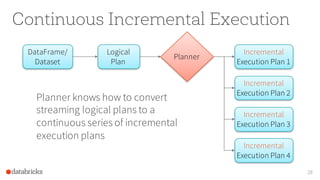
Continuous Incremental Execution
Planner knows how to convert
streaming logical plans to a
continuous series of incremental
execution plans
28
DataFrame/
Dataset
Logical
Plan
Incremental
Execution Plan 1
Incremental
Execution Plan 2
Incremental
Execution Plan 3
Planner
Incremental
Execution Plan 4
Structured Streaming: Recap
• High-level streaming API built on Datasets/DataFrames
• Eventtime, windowing,sessions,sources&
sinks End-to-end exactly once semantics
• Unifies streaming, interactive and batch queries
• Aggregate data in a stream, then serveusing
JDBC Add, remove,change queriesat runtime
• Build and applyML models
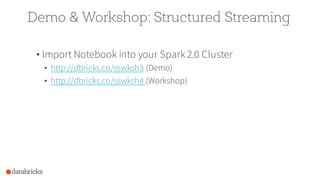
Demo & Workshop: Structured Streaming
• Import Notebook into your Spark 2.0 Cluster
• http://dbricks.co/sswksh3 (Demo)
• http://dbricks.co/sswksh4 (Workshop)
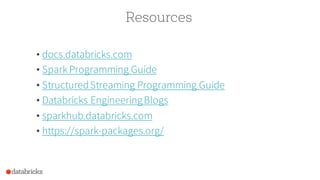
Resources
• docs.databricks.com
• Spark Programming Guide
• StructuredStreaming Programming Guide
• Databricks EngineeringBlogs
• sparkhub.databricks.com
• https://spark-packages.org/
Do you have any questions
for my prepared answers?

Continuous Application with Structured Streaming 2.0

  • 1.
    Continuous Application with Apache® Spark™2.0 Jules S. Damji Spark Community Evangelist QconfSF 11/10.2016 @2twitme
  • 2.
    $ whoami • SparkCommunity Evangelist @ Databricks • Previously Developer Advocate @ Hortonworks • In the past engineering roles at: • Sun Microsystems, Netscape, @Home, VeriSign, Scalix, Centrify, LoudCloud/Opsware, ProQuest • jules@databricks.com • https://www.linkedin.com/in/dmatrix
  • 3.
  • 4.
    Streaming in ApacheSpark Streaming demands newtypes of streaming requirements… 3 SQL Streaming MLlib Spark Core GraphX Functional, conciseand expressive Fault-tolerant statemanagement Unified stack with batch processing More than 51%users say most important partof Apache Spark Spark Streaming in production jumped to 22%from 14%
  • 5.
  • 6.
    Streaming computations don’t runin isolation • Need to interact with batch data, interactive analysis, machine learning, etc.
  • 7.
    Use case: IoTDevice Monitoring IoT events fromKafka ETL into long term storage - Prevent dataloss - PreventduplicatesStatusmonitoring - Handle latedata - Aggregateon windows on even-ttime Interactively debugissues -consistency event stream Anomalydetection - Learn modelsoffline - Use online+continuous learning
  • 8.
    Use case: IoTDevice Monitoring Anomalydetection - Learn modelsoffline - Useonline + continuous learning IoT events event stream fromKafka ETL into long term storage - Prevent dataloss Status monitoring - Preventduplicates Interactively - Handle late data debugissues - Aggregateon windows -consistency on eventtime Continuous Applications Not just streaming any more
  • 10.
    The simplest wayto perform streaming analytics is not having to reason about streaming at all
  • 11.
    Static, bounded table Stream asa unbound DataFrame Streaming, unbounded table Single API !
  • 12.
  • 13.
    Gist of StructuredStreaming High-level streaming API built on SparkSQL engine Runs the same computation as batch queriesin Datasets / DataFrames Eventtime, windowing,sessions,sources& sinks Guaranteesan end-to-end exactlyonce semantics Unifies streaming, interactive and batch queries Aggregate data in a stream, then serve using JDBC Add, remove,change queriesat runtime Build and apply ML modelsto your Stream
  • 14.
    Advantages over DStreams 1.Processingwith event-time,dealingwith late data 2. Exactly same API for batch,streaming,and interactive 3. End-to-endexactly-once guaranteesfromthe system 4. Performance through SQL optimizations - Logical plan optimizations, Tungsten, Codegen, etc. - Faster state management for stateful stream processing 14
  • 15.
    Structured Streaming ModelTrigger:every 1 sec 1 2 3 Time data up to 1 Input data up to 2 data up to 3 Query Input: data from source as an append-only table Trigger: howfrequently to check input for newdata Query: operations on input usual map/filter/reduce newwindow, session ops
  • 16.
    Model Trigger: every1 sec 1 2 3 output for data up to 1 Result Query Time data up to 1 Input data up to 2 output for data up to 2 data up to 3 output for data up to 3 Result: final operated table updated every triggerinterval Output: what part of result to write to data sink after every trigger Complete output: Write full result table every time Output complete output
  • 17.
    Model Trigger: every1 sec 1 2 3 output for data up to 1 Result Query Time data up to 1 Input data up to 2 output for data up to 2 data up to 3 output for data up to 3 Output delta output Result: final operated table updated every triggerinterval Output: what part of result to write to data sink after every trigger Complete output: Write full result table every time Delta output: Write only the rows that changed in result from previous batch Append output: Write only new rows *Not all output modes are feasible withall queries
  • 18.
  • 19.
    Batch ETL withDataFrame inputDF = spark.read .format("json") .load("source-path") resultDF = input .select("device", "signal") .where("signal > 15") resultDF.write .format("parquet") .save("dest-path") Read from JSON file Select some devices Write to parquet file
  • 20.
    Streaming ETL withDataFrame input = ctxt.read .format("json") .stream("source-path") result = input .select("device", "signal") .where("signal > 15") result.write .format("parquet") .outputMode("append") .startStream("dest-path") read…stream() creates a streaming DataFrame, doesnot start any of the computation write…startStream() defineswhere & how to outputthe data and starts the processing
  • 21.
    Streaming ETL withDataFrame input = spark.read .format("json") .stream("source-path") result = input .select("device", "signal") .where("signal > 15") result.write .format("parquet") .outputMode("append") .startStream("dest-path") 1 2 3 Result [append-only table] Input Output [append mode] new rows in result of 2 new rows in result of 3
  • 22.
    Continuous Aggregations Continuously computeaverage signal of each type of device 22 input.groupBy("device-type") .avg("signal") input.groupBy( window("event-time", "10min"), "device type") .avg("signal") Continuously compute average signal of each type of device in last10 minutesof eventtime - Windowing is just a type of aggregation - Simple API for event time based windowing
  • 23.
    Joining streams withstatic data kafkaDataset = spark.read . ka f ka ( "io t - u pd a te s") . st r e a m () st a t icDa t a se t = ct xt . r e a d . j d b c ( " j d b c : / / ", "io t - d e vice - in f o ") joinedDataset = ka f ka Dataset .joi n( st a t icDa t a se t , "d e vice- type ") 21 Join streaming data from Kafka with static data via JDBC to enrich the streaming data … … withouthavingto thinkthat you are joining streamingdata
  • 24.
    Output Modes Defines whatis outputted every time there is a trigger Different output modes make sense for differentqueries 22 i n p u t.select ("dev ic e", "s i g n al ") .w r i te .outputMode("append") .fo r m a t( "parq uet") .startStrea m( "de st-pa th ") Append modewith non-aggregationqueries i n p u t.agg( cou nt("* ") ) .w r i te .outputMode("complete") .fo r m a t( "parq uet") .startStrea m( "de st-pa th ") Complete mode with aggregationqueries
  • 25.
    Query Management query =result.write .format("parquet") .outputMode("append") .startStream("dest-path") query.stop() query.awaitTermination() query.exception() query.sourceStatuses() query.sinkStatus() 25 query: a handle to the running streaming computation for managingit - Stop it, wait for it to terminate - Get status - Get error, if terminated Multiple queries can be active at the same time Each query has unique name for keepingtrack
  • 26.
    Logically: Dataset operations ontable (i.e. as easy to understand asbatch) Physically: Spark automatically runs the queryin streaming fashion (i.e. incrementally andcontinuously) DataFrame LogicalPlan Catalystoptimizer Continuous, incrementalexecution Query Execution
  • 27.
    Batch/Streaming Execution onSpark SQL 27 DataFrame/ Dataset Logical Plan Planner SQL AST DataFrame Unresolved Logical Plan Logical Plan Optimized Logical Plan RDDs Selected Physical Plan Analysis Logical Optimization Physical Planning CostModel Physical Plans Code Generation CatalogDataset Helluvalotofmagic!
  • 28.
    Continuous Incremental Execution Plannerknows how to convert streaming logical plans to a continuous series of incremental execution plans 28 DataFrame/ Dataset Logical Plan Incremental Execution Plan 1 Incremental Execution Plan 2 Incremental Execution Plan 3 Planner Incremental Execution Plan 4
  • 29.
    Structured Streaming: Recap •High-level streaming API built on Datasets/DataFrames • Eventtime, windowing,sessions,sources& sinks End-to-end exactly once semantics • Unifies streaming, interactive and batch queries • Aggregate data in a stream, then serveusing JDBC Add, remove,change queriesat runtime • Build and applyML models
  • 31.
    Demo & Workshop:Structured Streaming • Import Notebook into your Spark 2.0 Cluster • http://dbricks.co/sswksh3 (Demo) • http://dbricks.co/sswksh4 (Workshop)
  • 32.
    Resources • docs.databricks.com • SparkProgramming Guide • StructuredStreaming Programming Guide • Databricks EngineeringBlogs • sparkhub.databricks.com • https://spark-packages.org/
  • 33.
    Do you haveany questions for my prepared answers?