Online Learning with Structured
Streaming
Ram Sriharsha, Vlad Feinberg
@halfabrane
Spark Summit, Brussels
27 October 2016
What is online learning?
• Update model parameters on each data point
• In batch setting get to see the entire dataset before update
• Cannot visit data points again
• In batch setting, can iterate over data points as many
times as we want!
2
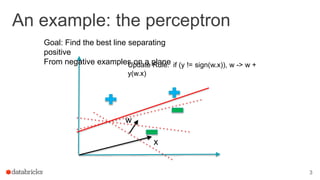
An example: the perceptron
3
x
w
Update Rule: if (y != sign(w.x)), w -> w +
y(w.x)
Goal: Find the best line separating
positive
From negative examples on a plane
Why learn online?
• I want to adapt to changing patterns quickly
• data distribution can change
– e.g, distribution of features that affect learning might change
over time
• I need to learn a good model within resource +
time constraints (large-scale learning)
• Time to a given accuracy might be faster for certain online
algorithms
4
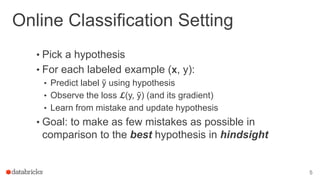
Online Classification Setting
• Pick a hypothesis
• For each labeled example (𝘅, y):
• Predict label ỹ using hypothesis
• Observe the loss 𝓛(y, ỹ) (and its gradient)
• Learn from mistake and update hypothesis
• Goal: to make as few mistakes as possible in
comparison to the best hypothesis in hindsight
5
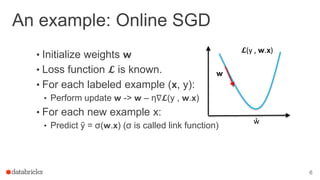
An example: Online SGD
• Initialize weights 𝘄
• Loss function 𝓛 is known.
• For each labeled example (𝘅, y):
• Perform update 𝘄 -> 𝘄 – η∇𝓛(y , 𝘄.𝘅)
• For each new example x:
• Predict ỹ = σ(𝘄.𝘅) (σ is called link function)
6
𝓛(y , 𝘄.𝘅)
𝘄
ẘ
Distributed Online Learning
• Synchronous
• On each worker:
– Load training data, compute gradients and update model, push
model to driver
• On some node:
– Perform model merge
• Asynchronous
• On each worker:
– Load training data, compute gradients and push to server
• On each server:
– Aggregate the gradients, perform update step
7
Challenges
• Not all algorithms admit efficient online versions
• Lack of infrastructure
• (Single machine) Vowpal Wabbit works great but hard to use
from Scala, Java and other languages.
• (Distributed) No implementation that is fault tolerant,
scalable, robust
• Lack of framework in open source to provide
extensible algorithms
• Adagrad, normalized learning, L1 regularization,…
• Online SGD, FTRL, ...
8
Structured Streaming
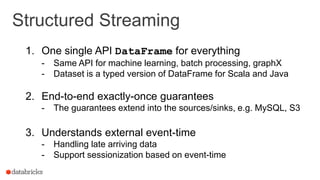
1. One single API DataFrame for everything
- Same API for machine learning, batch processing, graphX
- Dataset is a typed version of DataFrame for Scala and Java
2. End-to-end exactly-once guarantees
- The guarantees extend into the sources/sinks, e.g. MySQL, S3
3. Understands external event-time
- Handling late arriving data
- Support sessionization based on event-time
Structured Streaming
How does it work?
at any time, the output of the application is
equivalent to executing a batch job on a prefix of
the data
11
The Model Trigger: every 1 sec
1 2 3
Time
data up
to 1
Input data up
to 2
data up
to 3
Quer
y
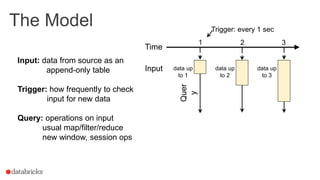
Input: data from source as an
append-only table
Trigger: how frequently to check
input for new data
Query: operations on input
usual map/filter/reduce
new window, session ops
The Model Trigger: every 1 sec
1 2 3
output
for data
up to 1
Result
Quer
y
Time
data up
to 1
Input data up
to 2
output
for data
up to 2
data up
to 3
output
for data
up to 3
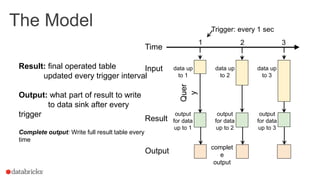
Result: final operated table
updated every trigger interval
Output: what part of result to write
to data sink after every
trigger
Complete output: Write full result table every
time
Output
complet
e
output
The Model Trigger: every 1 sec
1 2 3
output
for data
up to 1
Result
Quer
y
Time
data up
to 1
Input data up
to 2
output
for data
up to 2
data up
to 3
output
for data
up to 3
Output
delta
output
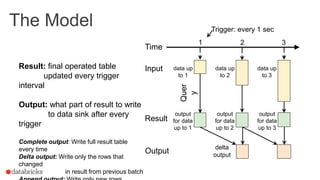
Result: final operated table
updated every trigger
interval
Output: what part of result to write
to data sink after every
trigger
Complete output: Write full result table
every time
Delta output: Write only the rows that
changed
in result from previous batch
Streaming ML on
Structured Streaming
Streaming ML on Structured
Streaming
Trigger: every 1 sec
1 2 3
Time
data up
to 1
Input data up
to 2
data up
to 3
Quer
y
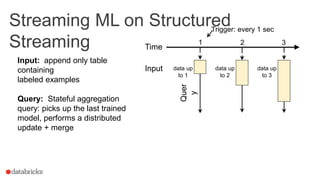
Input: append only table
containing
labeled examples
Query: Stateful aggregation
query: picks up the last trained
model, performs a distributed
update + merge
Streaming ML on Structured
Streaming
Trigger: every 1 sec
1 2 3
model
for data
up to t
Result
Quer
y
Time
labeled
examples
up
to time t
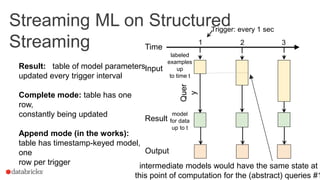
InputResult: table of model parameters
updated every trigger interval
Complete mode: table has one
row,
constantly being updated
Append mode (in the works):
table has timestamp-keyed model,
one
row per trigger
Output
intermediate models would have the same state at
this point of computation for the (abstract) queries #1
Why is this hard?
• Need to update model, i.e
• Update(previousModel, newDataPoint) = newModel
• Typical aggregation is associative, commutative
• e.g. sum( P1: sum(sum(0, data[0]), data[1]), P2:
sum(sum(0, data[2]), data[3]))
• General model update violates associativity +
commutativity!
18
Solution: Make Assumptions
• Result may be partition-dependent, but we don’t
care as long as we get some valid result.
average-models(
P1: update(update(previous model, data[0]), data[1]),
P2: update(update(previous model, data[2]), data[3]))
• Only partition-dependent if update and average
don’t commute - can still be deterministic
otherwise!
19
Stateful Aggregator
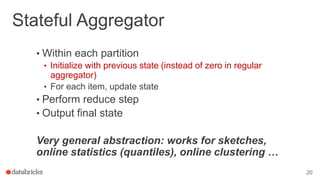
• Within each partition
• Initialize with previous state (instead of zero in regular
aggregator)
• For each item, update state
• Perform reduce step
• Output final state
Very general abstraction: works for sketches,
online statistics (quantiles), online clustering …
20
How does it work?
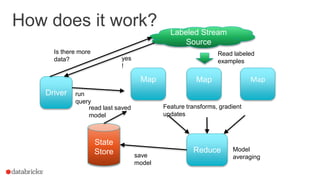
Driver
Map Map
State
Store
Labeled Stream
Source
Reduce
Is there more
data? yes
!
run
query
Map
Read labeled
examples
Feature transforms, gradient
updates
Model
averagingsave
model
read last saved
model
APIs
Spark Summit Brussels
27 October 2016
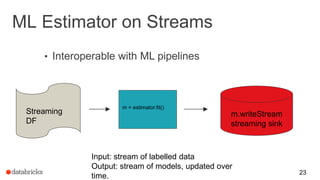
ML Estimator on Streams
• Interoperable with ML pipelines
23
Streaming
DF
m = estimator.fit()
m.writeStream
streaming sink
Input: stream of labelled data
Output: stream of models, updated over
time.
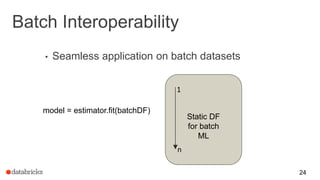
Batch Interoperability
• Seamless application on batch datasets
24
Static DF
for batch
ML
model = estimator.fit(batchDF)
1
n
API Goals
• Provide modern, regret-minimization-based
online algorithms.
• Online Logistic Regression
• Adagrad
• Online gradient descent
• L2 regularization
• Input streams of any kind accepted.
• Streaming aware feature engineering
26
What’s next?
Spark Summit Brussels
27 October 2016
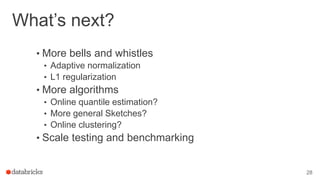
What’s next?
• More bells and whistles
• Adaptive normalization
• L1 regularization
• More algorithms
• Online quantile estimation?
• More general Sketches?
• Online clustering?
• Scale testing and benchmarking
28
Demo
Spark Summit Brussels
27 October 2016

Online learning with structured streaming, spark summit brussels 2016

  • 1.
    Online Learning withStructured Streaming Ram Sriharsha, Vlad Feinberg @halfabrane Spark Summit, Brussels 27 October 2016
  • 2.
    What is onlinelearning? • Update model parameters on each data point • In batch setting get to see the entire dataset before update • Cannot visit data points again • In batch setting, can iterate over data points as many times as we want! 2
  • 3.
    An example: theperceptron 3 x w Update Rule: if (y != sign(w.x)), w -> w + y(w.x) Goal: Find the best line separating positive From negative examples on a plane
  • 4.
    Why learn online? •I want to adapt to changing patterns quickly • data distribution can change – e.g, distribution of features that affect learning might change over time • I need to learn a good model within resource + time constraints (large-scale learning) • Time to a given accuracy might be faster for certain online algorithms 4
  • 5.
    Online Classification Setting •Pick a hypothesis • For each labeled example (𝘅, y): • Predict label ỹ using hypothesis • Observe the loss 𝓛(y, ỹ) (and its gradient) • Learn from mistake and update hypothesis • Goal: to make as few mistakes as possible in comparison to the best hypothesis in hindsight 5
  • 6.
    An example: OnlineSGD • Initialize weights 𝘄 • Loss function 𝓛 is known. • For each labeled example (𝘅, y): • Perform update 𝘄 -> 𝘄 – η∇𝓛(y , 𝘄.𝘅) • For each new example x: • Predict ỹ = σ(𝘄.𝘅) (σ is called link function) 6 𝓛(y , 𝘄.𝘅) 𝘄 ẘ
  • 7.
    Distributed Online Learning •Synchronous • On each worker: – Load training data, compute gradients and update model, push model to driver • On some node: – Perform model merge • Asynchronous • On each worker: – Load training data, compute gradients and push to server • On each server: – Aggregate the gradients, perform update step 7
  • 8.
    Challenges • Not allalgorithms admit efficient online versions • Lack of infrastructure • (Single machine) Vowpal Wabbit works great but hard to use from Scala, Java and other languages. • (Distributed) No implementation that is fault tolerant, scalable, robust • Lack of framework in open source to provide extensible algorithms • Adagrad, normalized learning, L1 regularization,… • Online SGD, FTRL, ... 8
  • 9.
  • 10.
    1. One singleAPI DataFrame for everything - Same API for machine learning, batch processing, graphX - Dataset is a typed version of DataFrame for Scala and Java 2. End-to-end exactly-once guarantees - The guarantees extend into the sources/sinks, e.g. MySQL, S3 3. Understands external event-time - Handling late arriving data - Support sessionization based on event-time Structured Streaming
  • 11.
    How does itwork? at any time, the output of the application is equivalent to executing a batch job on a prefix of the data 11
  • 12.
    The Model Trigger:every 1 sec 1 2 3 Time data up to 1 Input data up to 2 data up to 3 Quer y Input: data from source as an append-only table Trigger: how frequently to check input for new data Query: operations on input usual map/filter/reduce new window, session ops
  • 13.
    The Model Trigger:every 1 sec 1 2 3 output for data up to 1 Result Quer y Time data up to 1 Input data up to 2 output for data up to 2 data up to 3 output for data up to 3 Result: final operated table updated every trigger interval Output: what part of result to write to data sink after every trigger Complete output: Write full result table every time Output complet e output
  • 14.
    The Model Trigger:every 1 sec 1 2 3 output for data up to 1 Result Quer y Time data up to 1 Input data up to 2 output for data up to 2 data up to 3 output for data up to 3 Output delta output Result: final operated table updated every trigger interval Output: what part of result to write to data sink after every trigger Complete output: Write full result table every time Delta output: Write only the rows that changed in result from previous batch
  • 15.
  • 16.
    Streaming ML onStructured Streaming Trigger: every 1 sec 1 2 3 Time data up to 1 Input data up to 2 data up to 3 Quer y Input: append only table containing labeled examples Query: Stateful aggregation query: picks up the last trained model, performs a distributed update + merge
  • 17.
    Streaming ML onStructured Streaming Trigger: every 1 sec 1 2 3 model for data up to t Result Quer y Time labeled examples up to time t InputResult: table of model parameters updated every trigger interval Complete mode: table has one row, constantly being updated Append mode (in the works): table has timestamp-keyed model, one row per trigger Output intermediate models would have the same state at this point of computation for the (abstract) queries #1
  • 18.
    Why is thishard? • Need to update model, i.e • Update(previousModel, newDataPoint) = newModel • Typical aggregation is associative, commutative • e.g. sum( P1: sum(sum(0, data[0]), data[1]), P2: sum(sum(0, data[2]), data[3])) • General model update violates associativity + commutativity! 18
  • 19.
    Solution: Make Assumptions •Result may be partition-dependent, but we don’t care as long as we get some valid result. average-models( P1: update(update(previous model, data[0]), data[1]), P2: update(update(previous model, data[2]), data[3])) • Only partition-dependent if update and average don’t commute - can still be deterministic otherwise! 19
  • 20.
    Stateful Aggregator • Withineach partition • Initialize with previous state (instead of zero in regular aggregator) • For each item, update state • Perform reduce step • Output final state Very general abstraction: works for sketches, online statistics (quantiles), online clustering … 20
  • 21.
    How does itwork? Driver Map Map State Store Labeled Stream Source Reduce Is there more data? yes ! run query Map Read labeled examples Feature transforms, gradient updates Model averagingsave model read last saved model
  • 22.
  • 23.
    ML Estimator onStreams • Interoperable with ML pipelines 23 Streaming DF m = estimator.fit() m.writeStream streaming sink Input: stream of labelled data Output: stream of models, updated over time.
  • 24.
    Batch Interoperability • Seamlessapplication on batch datasets 24 Static DF for batch ML model = estimator.fit(batchDF) 1 n
  • 25.
    API Goals • Providemodern, regret-minimization-based online algorithms. • Online Logistic Regression • Adagrad • Online gradient descent • L2 regularization • Input streams of any kind accepted. • Streaming aware feature engineering 26
  • 26.
    What’s next? Spark SummitBrussels 27 October 2016
  • 27.
    What’s next? • Morebells and whistles • Adaptive normalization • L1 regularization • More algorithms • Online quantile estimation? • More general Sketches? • Online clustering? • Scale testing and benchmarking 28
  • 28.