Real-Time Data Pipelines Made Easy with Structured Streaming in Apache Spark.pdf
1.
Real-time Data Pipelineswith
Structured Streaming in
DataEngConf 2018
18th April, San Francisco
Tathagata “TD” Das
@tathadas
2.
About Me
Started SparkStreaming project in AMPLab, UC Berkeley
Currently focused on building Structured Streaming
PMC Member of
Engineer on the StreamTeam @
"we make all your streams come true"
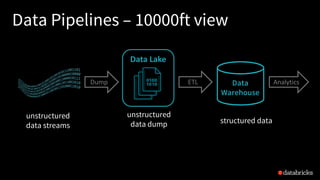
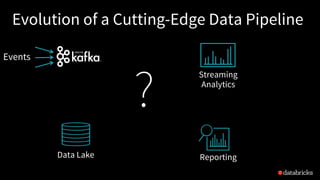
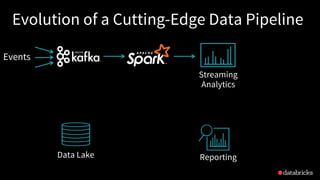
Data Pipelines –10000ft view
Data
Warehouse
Dump ETL
structured data
Data Lake
unstructured
data dump
unstructured
data streams
Analytics
5.
Messy data notready
for analytics
DATALAKE1
DW3
DW2
DW1
Incidence
Response
Alerting
Reports
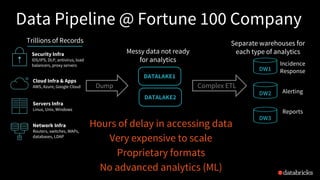
Data Pipeline @ Fortune 100 Company
Security Infra
IDS/IPS, DLP, antivirus, load
balancers, proxy servers
Cloud Infra & Apps
AWS, Azure, Google Cloud
Servers Infra
Linux, Unix, Windows
Network Infra
Routers, switches, WAPs,
databases, LDAP
Trillions of Records Separate warehouses for
each type of analytics
Dump Complex ETL
Hours of delay in accessing data
Very expensive to scale
Proprietary formats
No advanced analytics (ML)
DATALAKE2
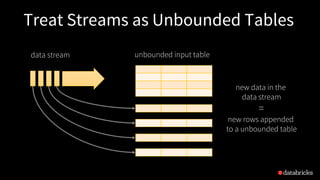
Treat Streams asUnbounded Tables
data stream unbounded input table
new data in the
data stream
=
new rows appended
to a unbounded table
11.
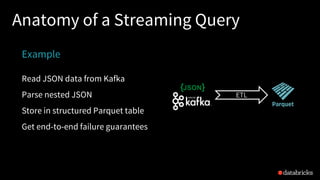
Anatomy of aStreaming Query
Example
Read JSON data from Kafka
Parse nested JSON
Store in structured Parquet table
Get end-to-end failure guarantees
ETL
12.
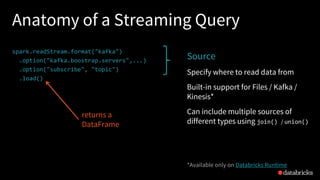
Anatomy of aStreaming Query
spark.readStream.format("kafka")
.option("kafka.boostrap.servers",...)
.option("subscribe", "topic")
.load()
Source
Specify where to read data from
Built-in support for Files / Kafka /
Kinesis*
Can include multiple sources of
different types using join() / union()
*Available only on Databricks Runtime
returns a
DataFrame
13.
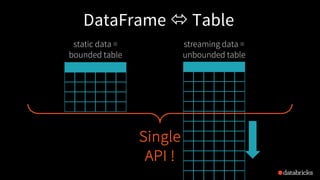
static data =
boundedtable
streaming data =
unbounded table
Single
API !
DataFrame ó Table
14.
DataFrame/Dataset
SQL
spark.sql("
SELECT type, sum(signal)
FROMdevices
GROUP BY type
")
Most familiar to BI Analysts
Supports SQL-2003, HiveQL
val df: DataFrame =
spark.table("device-data")
.groupBy("type")
.sum("signal"))
Great for Data Scientists familiar
with Pandas, R Dataframes
DataFrame Dataset
val ds: Dataset[(String, Double)] =
spark.table("device-data")
.as[DeviceData]
.groupByKey(_.type)
.mapValues(_.signal)
.reduceGroups(_ + _)
Great for Data Engineers who
want compile-time type safety
Choose your hammer for whatever nail you have!
Same semantics, same performance
Anatomy of aStreaming Query
spark.readStream.format("kafka")
.option("kafka.boostrap.servers",...)
.option("subscribe", "topic")
.load()
.selectExpr("cast (value as string) as json")
.select(from_json("json", schema).as("data"))
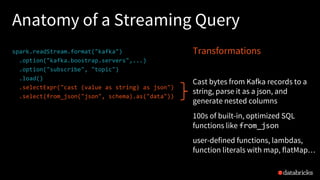
Transformations
Cast bytes from Kafka records to a
string, parse it as a json, and
generate nested columns
100s of built-in, optimized SQL
functions like from_json
user-defined functions, lambdas,
function literals with map, flatMap…
17.
Anatomy of aStreaming Query
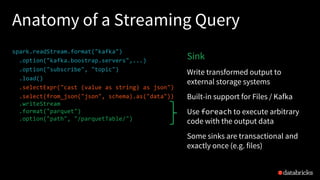
Sink
Write transformed output to
external storage systems
Built-in support for Files / Kafka
Use foreach to execute arbitrary
code with the output data
Some sinks are transactional and
exactly once (e.g. files)
spark.readStream.format("kafka")
.option("kafka.boostrap.servers",...)
.option("subscribe", "topic")
.load()
.selectExpr("cast (value as string) as json")
.select(from_json("json", schema).as("data"))
.writeStream
.format("parquet")
.option("path", "/parquetTable/")
18.
Anatomy of aStreaming Query
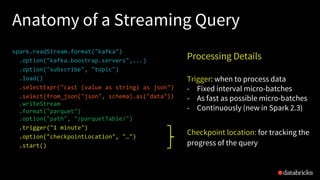
Processing Details
Trigger: when to process data
- Fixed interval micro-batches
- As fast as possible micro-batches
- Continuously (new in Spark 2.3)
Checkpoint location: for tracking the
progress of the query
spark.readStream.format("kafka")
.option("kafka.boostrap.servers",...)
.option("subscribe", "topic")
.load()
.selectExpr("cast (value as string) as json")
.select(from_json("json", schema).as("data"))
.writeStream
.format("parquet")
.option("path", "/parquetTable/")
.trigger("1 minute")
.option("checkpointLocation", "…")
.start()
19.
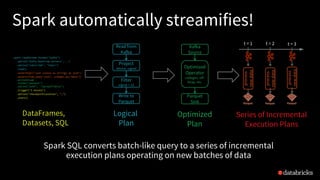
DataFrames,
Datasets, SQL
Logical
Plan
Read from
Kafka
Project
device,signal
Filter
signal > 15
Write to
Parquet
Spark automatically streamifies!
Spark SQL converts batch-like query to a series of incremental
execution plans operating on new batches of data
Kafka
Source
Optimized
Operator
codegen, off-
heap, etc.
Parquet
Sink
Optimized
Plan
spark.readStream.format("kafka")
.option("kafka.boostrap.servers",...)
.option("subscribe", "topic")
.load()
.selectExpr("cast (value as string) as json")
.select(from_json("json", schema).as("data"))
.writeStream
.format("parquet")
.option("path", "/parquetTable/")
.trigger("1 minute")
.option("checkpointLocation", "…")
.start()
Series of Incremental
Execution Plans
process
new
data
t = 1 t = 2 t = 3
process
new
data
process
new
data
20.
process
new
data
t = 1t = 2 t = 3
process
new
data
process
new
data
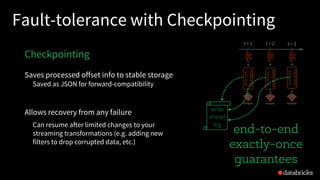
Fault-tolerance with Checkpointing
Checkpointing
Saves processed offset info to stable storage
Saved as JSON for forward-compatibility
Allows recovery from any failure
Can resume after limited changes to your
streaming transformations (e.g. adding new
filters to drop corrupted data, etc.)
end-to-end
exactly-once
guarantees
write
ahead
log
21.
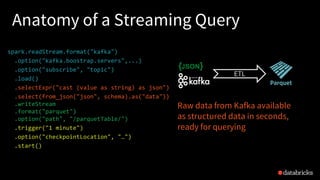
Anatomy of aStreaming Query
ETL
Raw data from Kafka available
as structured data in seconds,
ready for querying
spark.readStream.format("kafka")
.option("kafka.boostrap.servers",...)
.option("subscribe", "topic")
.load()
.selectExpr("cast (value as string) as json")
.select(from_json("json", schema).as("data"))
.writeStream
.format("parquet")
.option("path", "/parquetTable/")
.trigger("1 minute")
.option("checkpointLocation", "…")
.start()
22.
3x
faster
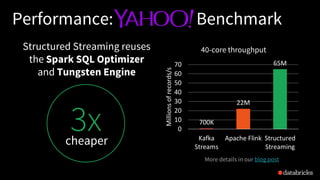
Structured Streaming reuses
theSpark SQL Optimizer
and Tungsten Engine
Performance: Benchmark
40-core throughput
700K
22M
65M
0
10
20
30
40
50
60
70
Kafka
Streams
Apache Flink Structured
Streaming
Millions
of
records/s
More details in our blog post
cheaper
23.
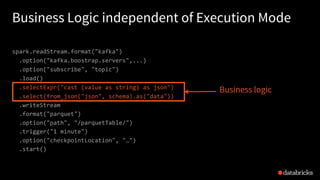
Business Logic independentof Execution Mode
spark.readStream.format("kafka")
.option("kafka.boostrap.servers",...)
.option("subscribe", "topic")
.load()
.selectExpr("cast (value as string) as json")
.select(from_json("json", schema).as("data"))
.writeStream
.format("parquet")
.option("path", "/parquetTable/")
.trigger("1 minute")
.option("checkpointLocation", "…")
.start()
Business logic
remains unchanged
24.
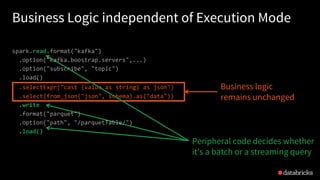
Business Logic independentof Execution Mode
.selectExpr("cast (value as string) as json")
.select(from_json("json", schema).as("data"))
Business logic
remains unchanged
Peripheral code decides whether
it’s a batch or a streaming query
spark.read.format("kafka")
.option("kafka.boostrap.servers",...)
.option("subscribe", "topic")
.load()
.write
.format("parquet")
.option("path", "/parquetTable/")
.load()
25.
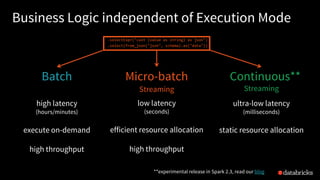
Business Logic independentof Execution Mode
.selectExpr("cast (value as string) as json")
.select(from_json("json", schema).as("data"))
Batch
high latency
(hours/minutes)
execute on-demand
high throughput
Micro-batch
Streaming
low latency
(seconds)
efficient resource allocation
high throughput
Continuous**
Streaming
ultra-low latency
(milliseconds)
static resource allocation
**experimental release in Spark 2.3, read our blog
26.
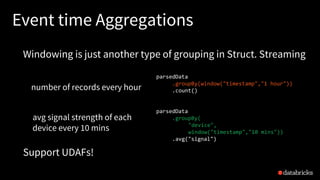
Event time Aggregations
Windowingis just another type of grouping in Struct. Streaming
number of records every hour
Support UDAFs!
parsedData
.groupBy(window("timestamp","1 hour"))
.count()
parsedData
.groupBy(
"device",
window("timestamp","10 mins"))
.avg("signal")
avg signal strength of each
device every 10 mins
27.
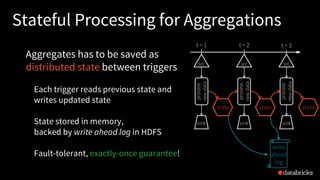
Stateful Processing forAggregations
Aggregates has to be saved as
distributed state between triggers
Each trigger reads previous state and
writes updated state
State stored in memory,
backed by write ahead log in HDFS
Fault-tolerant, exactly-once guarantee!
process
new
data
t = 1
sink
src
t = 2
process
new
data
sink
src
t = 3
process
new
data
sink
src
state state
write
ahead
log
state updates
are written to
log for checkpointing
state
28.
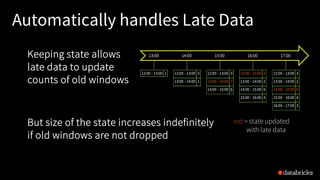
Automatically handles LateData
12:00 - 13:00 1 12:00 - 13:00 3
13:00 - 14:00 1
12:00 - 13:00 3
13:00 - 14:00 2
14:00 - 15:00 5
12:00 - 13:00 5
13:00 - 14:00 2
14:00 - 15:00 5
15:00 - 16:00 4
12:00 - 13:00 3
13:00 - 14:00 2
14:00 - 15:00 6
15:00 - 16:00 4
16:00 - 17:00 3
13:00 14:00 15:00 16:00 17:00
Keeping state allows
late data to update
counts of old windows
red = state updated
with late data
But size of the state increases indefinitely
if old windows are not dropped
29.
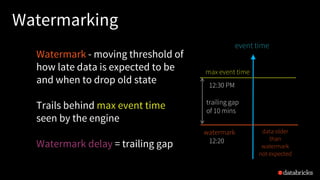
Watermarking
Watermark - movingthreshold of
how late data is expected to be
and when to drop old state
Trails behind max event time
seen by the engine
Watermark delay = trailing gap
event time
max event time
watermark data older
than
watermark
not expected
12:30 PM
12:20 PM
trailing gap
of 10 mins
30.
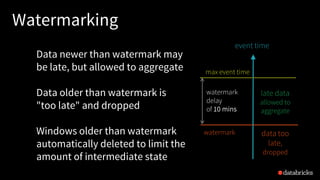
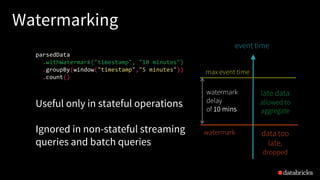
Watermarking
Data newer thanwatermark may
be late, but allowed to aggregate
Data older than watermark is
"too late" and dropped
Windows older than watermark
automatically deleted to limit the
amount of intermediate state
max event time
event time
watermark
late data
allowed to
aggregate
data too
late,
dropped
watermark
delay
of 10 mins
31.
Watermarking
max event time
eventtime
watermark
parsedData
.withWatermark("timestamp", "10 minutes")
.groupBy(window("timestamp","5 minutes"))
.count()
late data
allowed to
aggregate
data too
late,
dropped
Useful only in stateful operations
Ignored in non-stateful streaming
queries and batch queries
watermark
delay
of 10 mins
32.
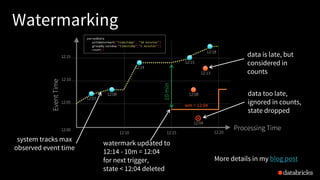
Watermarking
data too late,
ignoredin counts,
state dropped
Processing Time
12:00
12:05
12:10
12:15
12:10 12:15 12:20
12:07
12:13
12:08
Event
Time
12:15
12:18
12:04
watermark updated to
12:14 - 10m = 12:04
for next trigger,
state < 12:04 deleted
data is late, but
considered in
counts
system tracks max
observed event time
12:08
wm = 12:04
10
min
12:14
More details in my blog post
parsedData
.withWatermark("timestamp", "10 minutes")
.groupBy(window("timestamp","5 minutes"))
.count()
33.
Other Interesting Operations
StreamingDeduplication
Joins
Stream-batch joins
Stream-stream joins
Arbitrary Stateful Processing
[map|flatMap]GroupsWithState
stream1.join(stream2, "device")
parsedData.dropDuplicates("eventId")
See my previous Spark Summit talk and blog posts (here and here)
ds.groupByKey(_.id)
.mapGroupsWithState
(timeoutConf)
(mappingWithStateFunc)
Let’s try itinstead with
DELTA
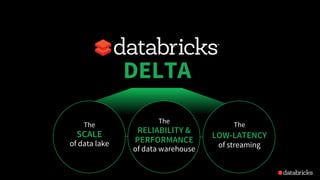
The
LOW-LATENCY
of streaming
The
RELIABILITY &
PERFORMANCE
of data warehouse
The
SCALE
of data lake
44.
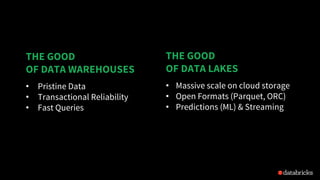
THE GOOD
OF DATALAKES
• Massive scale on cloud storage
• Open Formats (Parquet, ORC)
• Predictions (ML) & Streaming
THE GOOD
OF DATA WAREHOUSES
• Pristine Data
• Transactional Reliability
• Fast Queries
45.
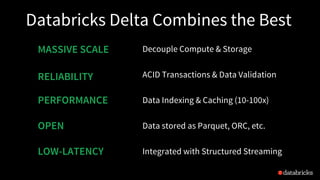
Databricks Delta Combinesthe Best
Decouple Compute & Storage
ACID Transactions & Data Validation
Data Indexing & Caching (10-100x)
Data stored as Parquet, ORC, etc.
Integrated with Structured Streaming
MASSIVE SCALE
RELIABILITY
PERFORMANCE
LOW-LATENCY
OPEN
46.
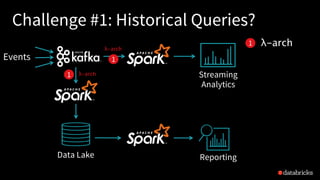
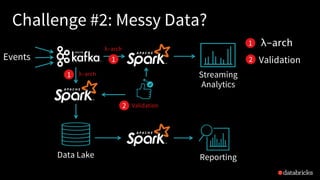
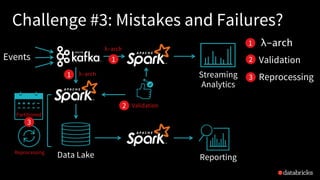
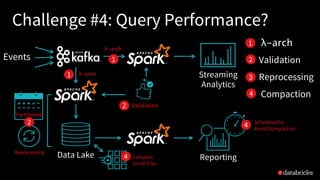
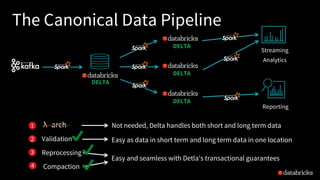
The Canonical DataPipeline
λ-arch
Validation
Reprocessing
Compaction
1
2
3
4
DELTA
DELTA
DELTA
DELTA
Streaming
Analytics
Reporting
Easy as data in short term and long term data in one location
Easy and seamless with Detla's transactional guarantees
Not needed, Delta handles both short and long term data
47.
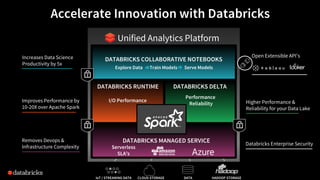
Accelerate Innovation withDatabricks
Unified Analytics Platform
DATA
CLOUD STORAGE HADOOP STORAGE
IoT / STREAMING DATA
Higher Performance &
Reliability for your Data Lake
Explore Data Train Models Serve Models
DATABRICKS COLLABORATIVE NOTEBOOKS
Increases Data Science
Productivity by 5x
Databricks Enterprise Security
Open Extensible API’s
Removes Devops &
Infrastructure Complexity
DATABRICKS MANAGED SERVICE
Serverless
SLA’s
DATABRICKS DELTA
Performance
Reliability
Improves Performance by
10-20X over Apache Spark
DATABRICKS RUNTIME
I/O Performance
48.
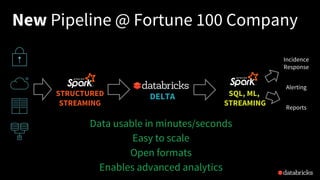
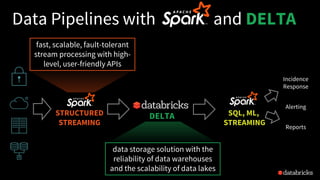
Incidence
Response
Alerting
Reports
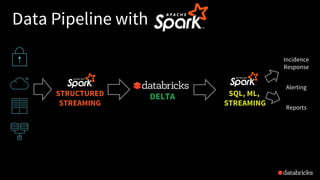
Data Pipelines withand DELTA
STRUCTURED
STREAMING
Dump Complex
ETL
DELTA SQL, ML,
STREAMING
fast, scalable, fault-tolerant
stream processing with high-
level, user-friendly APIs
data storage solution with the
reliability of data warehouses
and the scalability of data lakes
49.
More Info
Structured StreamingProgramming Guide
http://spark.apache.org/docs/latest/structured-streaming-programming-guide.html
Databricks blog posts for more focused discussions on streaming
https://databricks.com/blog/category/engineering/streaming
Databricks Delta
https://databricks.com/product/databricks-delta
![DataFrame/Dataset
SQL
spark.sql("
SELECT type, sum(signal)
FROM devices
GROUP BY type
")
Most familiar to BI Analysts
Supports SQL-2003, HiveQL
val df: DataFrame =
spark.table("device-data")
.groupBy("type")
.sum("signal"))
Great for Data Scientists familiar
with Pandas, R Dataframes
DataFrame Dataset
val ds: Dataset[(String, Double)] =
spark.table("device-data")
.as[DeviceData]
.groupByKey(_.type)
.mapValues(_.signal)
.reduceGroups(_ + _)
Great for Data Engineers who
want compile-time type safety
Choose your hammer for whatever nail you have!
Same semantics, same performance](https://image.slidesharecdn.com/real-timedatapipelinesmadeeasywithstructuredstreaminginapachespark-250421184755-4a1803e6/85/Real-Time-Data-Pipelines-Made-Easy-with-Structured-Streaming-in-Apache-Spark-pdf-14-320.jpg)
![Anatomy of a Streaming Query
spark.readStream.format("kafka")
.option("kafka.boostrap.servers",...)
.option("subscribe", "topic")
.load()
Kafka DataFrame
key value topic partition offset timestamp
[binary] [binary] "topic" 0 345 1486087873
[binary] [binary] "topic" 3 2890 1486086721](https://image.slidesharecdn.com/real-timedatapipelinesmadeeasywithstructuredstreaminginapachespark-250421184755-4a1803e6/85/Real-Time-Data-Pipelines-Made-Easy-with-Structured-Streaming-in-Apache-Spark-pdf-15-320.jpg)
![Other Interesting Operations
Streaming Deduplication
Joins
Stream-batch joins
Stream-stream joins
Arbitrary Stateful Processing
[map|flatMap]GroupsWithState
stream1.join(stream2, "device")
parsedData.dropDuplicates("eventId")
See my previous Spark Summit talk and blog posts (here and here)
ds.groupByKey(_.id)
.mapGroupsWithState
(timeoutConf)
(mappingWithStateFunc)](https://image.slidesharecdn.com/real-timedatapipelinesmadeeasywithstructuredstreaminginapachespark-250421184755-4a1803e6/85/Real-Time-Data-Pipelines-Made-Easy-with-Structured-Streaming-in-Apache-Spark-pdf-33-320.jpg)



![[DSC Europe 25] Laila Kakar - Leveraging AI for Strategic Excellence: Enhanci...](https://cdn.slidesharecdn.com/ss_thumbnails/eykmhrtsqmaaftwkexh7-dsc-lailakakar-1-260119101520-5f3b5616-thumbnail.jpg?width=640&height=640&fit=bounds)
![[DSC Europe 25] Marcos Heidemann - Beyond the Hype: Making AI Coding Assistan...](https://cdn.slidesharecdn.com/ss_thumbnails/eexkhvldrjsopspdjbur-marcos-heidemann-beyond-the-hype-getting-real-value-out-of-ai-assisted-coding-260121115910-7e9d41ec-thumbnail.jpg?width=640&height=640&fit=bounds)


![[DSC Europe 25] Andrzej Kowalczyk - AI - how to start small and grow in the f...](https://cdn.slidesharecdn.com/ss_thumbnails/oy1zmo94qv6vpcqjvno2-andrzej-kowalczyk-ai-how-to-start-small-and-grow-in-the-future-1-260119121559-cf093b23-thumbnail.jpg?width=640&height=640&fit=bounds)
![[DSC Europe 25] Bojan Djuricic - Predictive Design Process.pdf](https://cdn.slidesharecdn.com/ss_thumbnails/5awdrbedqdek3gqu2ezy-4-the-predictive-design-bojan-djuricic-260120105856-6c399e9b-thumbnail.jpg?width=640&height=640&fit=bounds)
![[DSC Europe 25] Gordana Milutinovic Dumbelovic - From Insight to Oversight: A...](https://cdn.slidesharecdn.com/ss_thumbnails/t7dkjsfxqwwzceropjv4-gordana-milutinovicdumbelovic-from-insight-to-oversight-ai-driven-power-bi-moni-260119121559-9e0bf11b-thumbnail.jpg?width=640&height=640&fit=bounds)
![[DSC Europe 25] Tali Fulman - Guild Meetings, Then What? Building Data Commun...](https://cdn.slidesharecdn.com/ss_thumbnails/fgohhi33rwmhqdowdj5k-tali-fulman-guild-meetings-then-what-building-data-communities-that-actually-ch-260120105855-528492c3-thumbnail.jpg?width=640&height=640&fit=bounds)

![[DSC Europe 25] Borko Kozomora - Optimizing business workflows with advances ...](https://cdn.slidesharecdn.com/ss_thumbnails/hbgekyb0txw0xpo4yfml-borko-kozomora-leading-ai-transformation-260122103838-cc29ee38-thumbnail.jpg?width=640&height=640&fit=bounds)


![[DSC Europe 25] Srdj Stanisic - Local and Private AI in UX.pdf](https://cdn.slidesharecdn.com/ss_thumbnails/vwmetykqmztgmokmmkfa-3-srdjan-stanisic-local-and-small-ai-in-ux-260120105855-55a31869-thumbnail.jpg?width=640&height=640&fit=bounds)