ONLINE
CLASSROOM
RULES
The Evidence For
Continental Drift.
CONTEN
T
STANDA
RD
•The learners
demonstrate
understanding of the
relationship among the
locations of volcanoes,
earthquake epicenters,
and mountain ranges.
PERFORMANCE STANDARD
The learners should be able to demonstrate ways to:
• Suggest ways by which he/she can contribute to
government efforts in reducing damage due to
earthquakes, tsunamis and volcanic eruptions.
LEARNING COMPETENCY
Enumerate the lines of evidence
that support plate movement
(S10ES -la-j-36.6
OBJECTIVES
➢ Trace the existence of fossils of plants and animals as evidences
found in the present continents that supports the fitting of drifted
continents
➢ Cite other proofs of continental drift theory
➢ Explain the cause of movement of tectonic plates
➢ Describe how evidences of plate movement were collected
➢ Cite other proofs of plate movement
6
RECAP
SHUFFLE PUZZLE
WORD
8
a German meteorologist
and geophysicist, once
hypothesized that
continents were once joined
as a single landmass called
PANGAEA
9
Refer to the human,
plant, and animal
remains that have
been preserved
through time like
human or animal
teeth, skull, and
bone fragments.
10
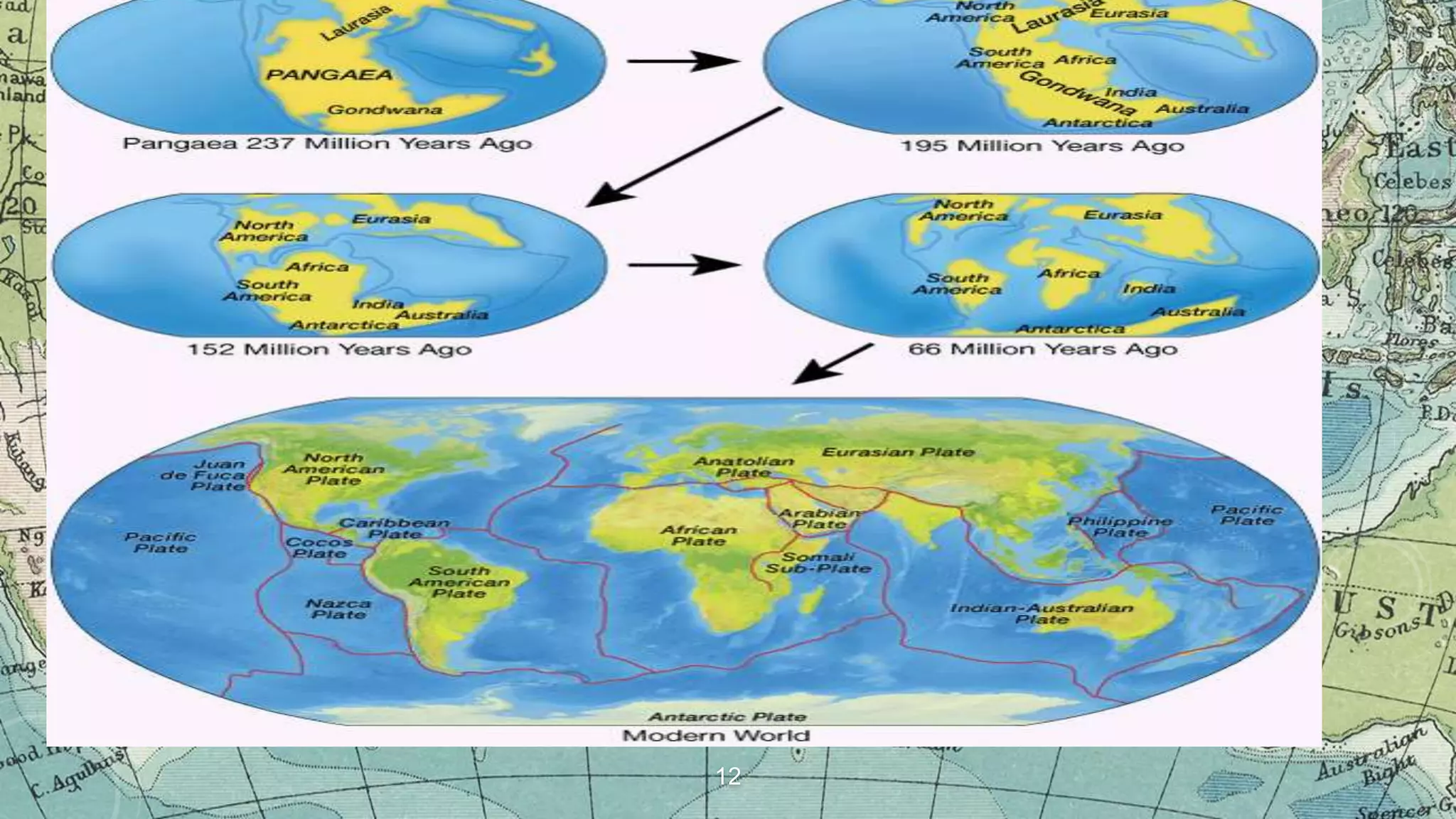
A supercontinent that
existed during the late
paleozoic and early
mesozoic eras. It
assembled from earlier
continental units
approximately 335 million
years ago, and it began to
break apart about 175
million years ago.
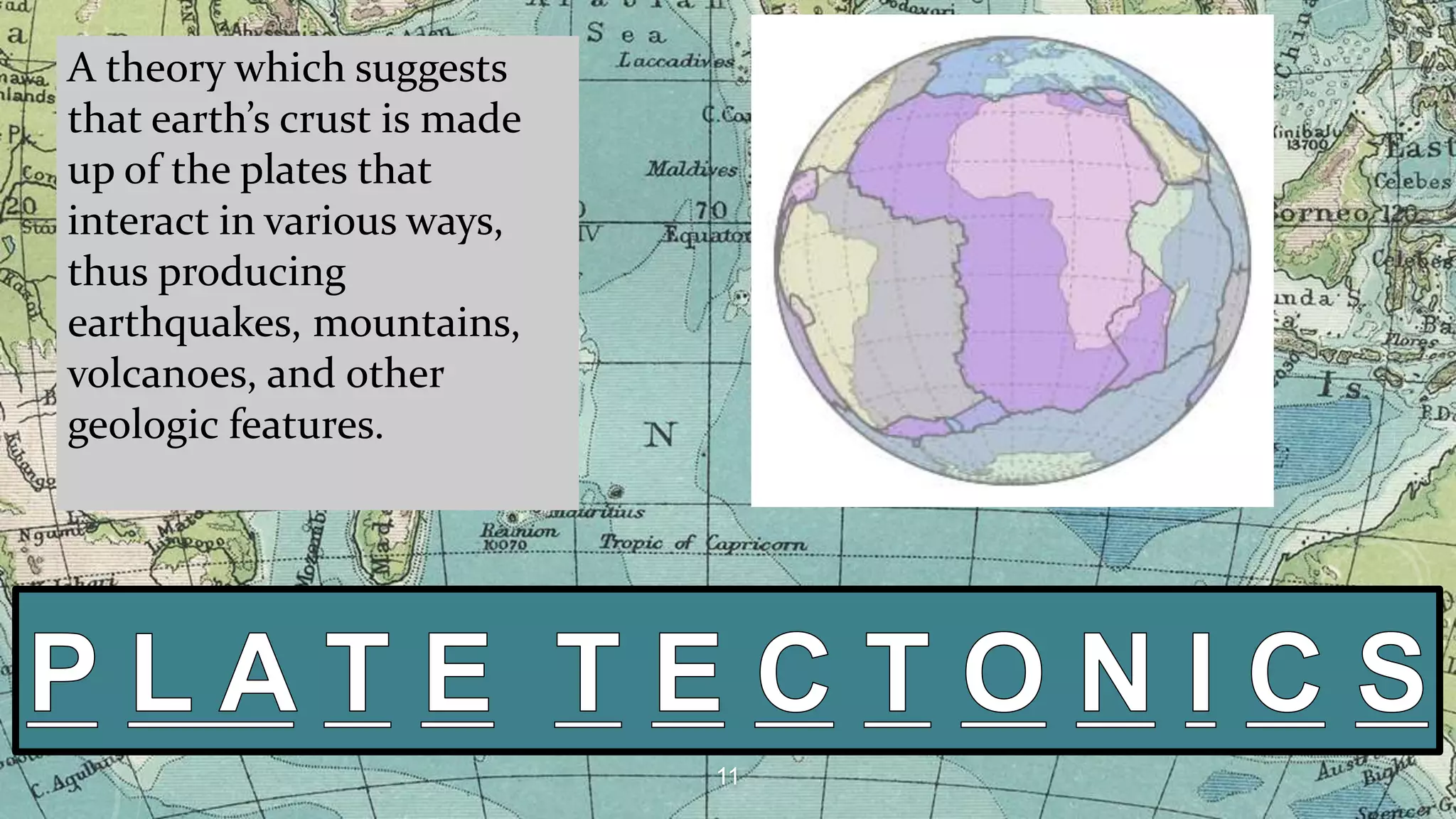
11
A theory which suggests
that earth’s crust is made
up of the plates that
interact in various ways,
thus producing
earthquakes, mountains,
volcanoes, and other
geologic features.
12
13
a German meteorologist and
geophysicist, once hypothesized that
continents were once joined as a single
landmass called PANGAEA
Alfred Wegener
14
States that all the continents
were once one large landmass
that broke apart and where the
pieces moved slowly to their
current locations.
Continental Drift Theory
CONTINENTAL DRIFT THEORY
⮚ States that all the
continents were once
one large landmass
that broke apart and
where the pieces
moved slowly to their
current locations.
16
EVIDENCES OF CONTINENTAL
DRIFT THEORY
17
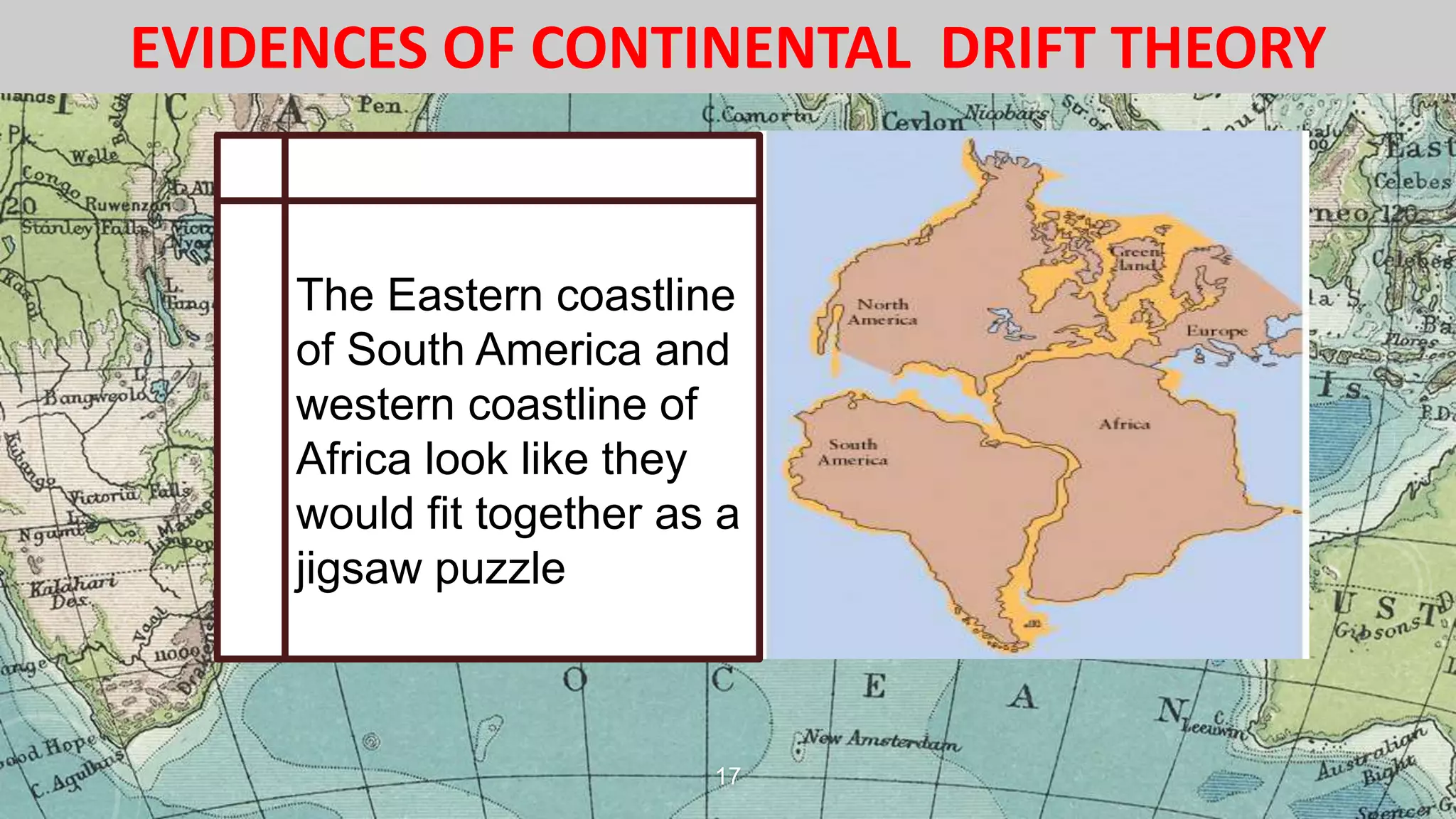
The Eastern coastline
of South America and
western coastline of
Africa look like they
would fit together as a
jigsaw puzzle
EVIDENCES OF CONTINENTAL DRIFT THEORY
18
EVIDENCES OF CONTINENTAL
DRIFT THEORY
PUZZLE FITTING OF CONTINENTS
19
Fossilized remains of Mesosaurus were found in South
America and Africa
20
Do you think they swam
all the way across the
oceans?
NO!
21
WHAT IS YOUR
INFERENCE ON THE
POSSIBLE REASON?
22
EVIDENCES OF CONTINENTAL
DRIFT THEORY
PUZZLE FITTING OF CONTINENTS
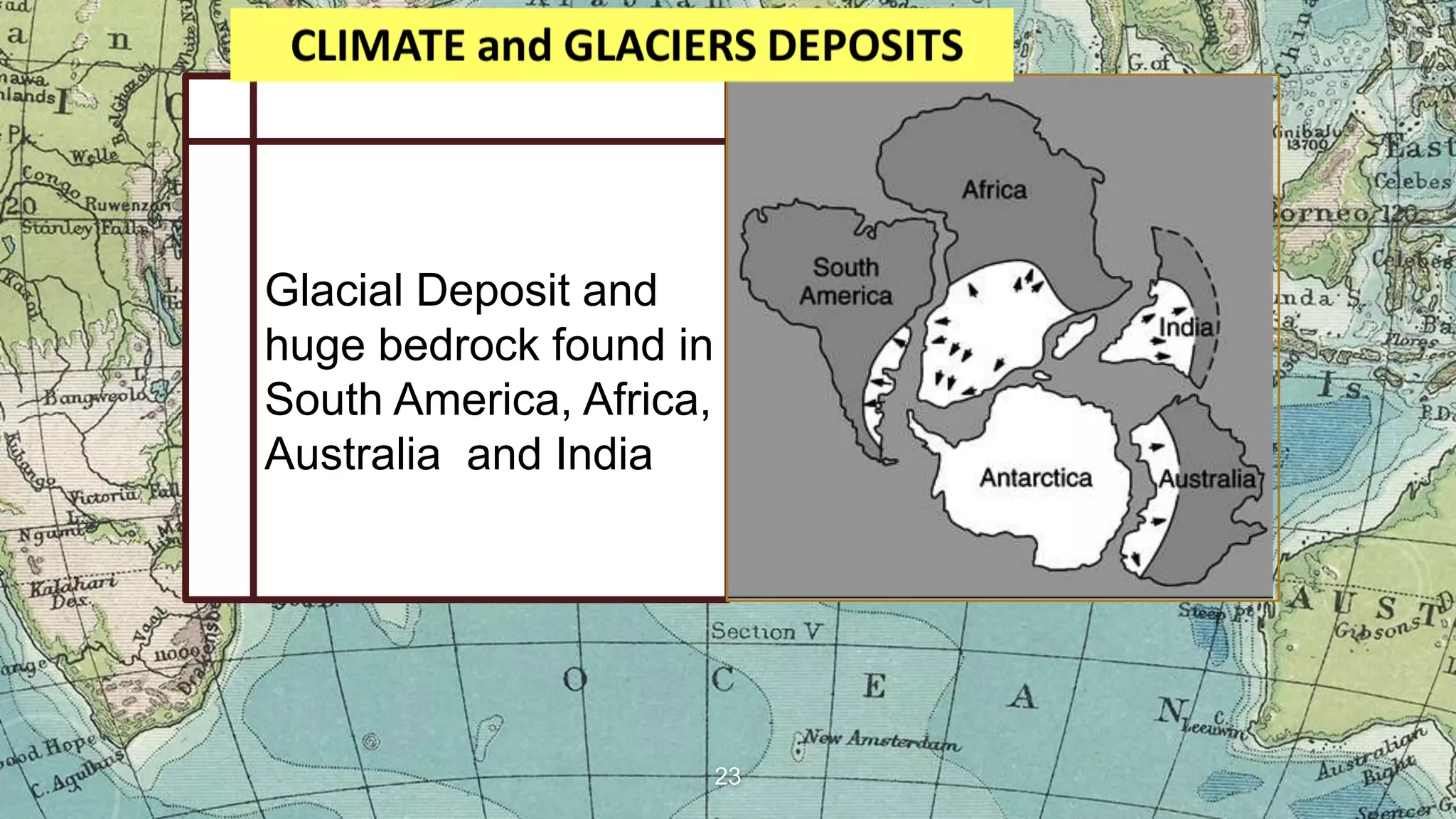
CLIMATE and GLACIERS DEPOSITS
23
Glacial Deposit and
huge bedrock found in
South America, Africa,
Australia and India
24
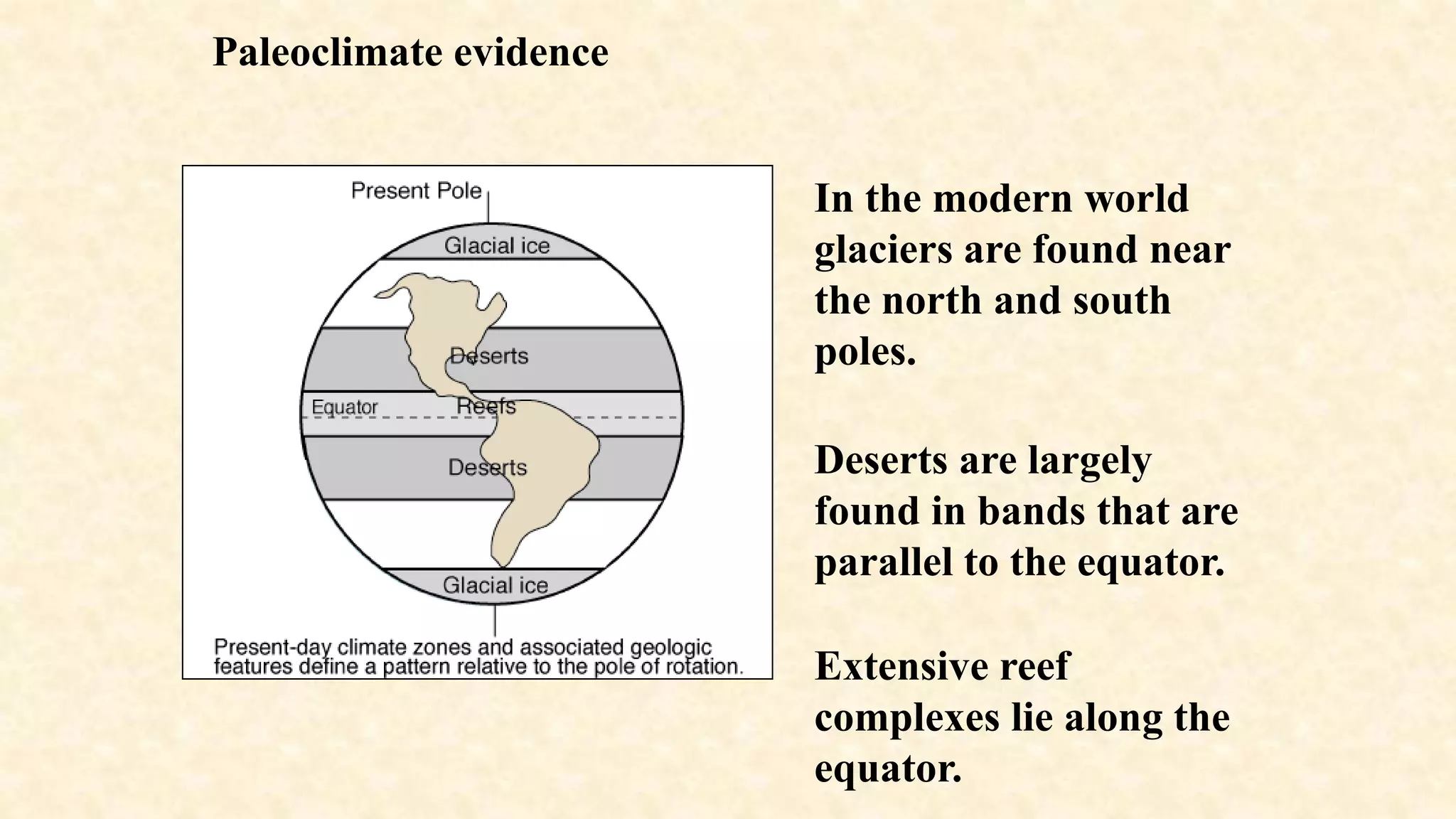
Paleoclimate evidence
In the modern world
glaciers are found near
the north and south
poles.
Deserts are largely
found in bands that are
parallel to the equator.
Extensive reef
complexes lie along the
equator.
26
Glacial Striations…Scratches
glaciers leave on rocks as they travel
27
There is proof that glaciers moved from Africa,
through the Atlantic Ocean, and then on towards
South America. This would be much easier if the
Atlantic Ocean were not there
What did you notice?
28
Climate changed
when continents
drifted apart.
29
Warm weather plants have been found in the Arctic… but
it’s not warm there!
Glacier deposits have been discovered in tropical and
desert locations…it’s not cold there, either!
30
How could you explain this?
why glacial deposits were
found in areas where no
glaciers exist today?
31
EVIDENCES OF CONTINENTAL
DRIFT THEORY
PUZZLE FITTING OF CONTINENTS
ROCKS
CLIMATE and GLACIERS DEPOSITS
32
SAD FACT!
Wegener had evidence of one large land mass, he
didn’t have the answers to what force (engine)
“floated the plates”. He was laughed at and did not live
to see his theory accepted.
33
ROCKS
Huge belts of rocks found in
Africa and South America
were identical. Not only
were they the same, but
they would match up (age,
thickness, types) if the
continents were put
together.
34
• Mountains
– Some mountain ranges on different contin
– ents seem to match.
• Ex: ranges in Canada match Norway and Sweden
• Ex: Appalachian Mtn. match UK mtn
35
WHAT PROVES THE THEORY TO BE
CORRECT?
Sea floor Spreading
36
Is it possible that the
current position of the
continents will change
after 100 years?
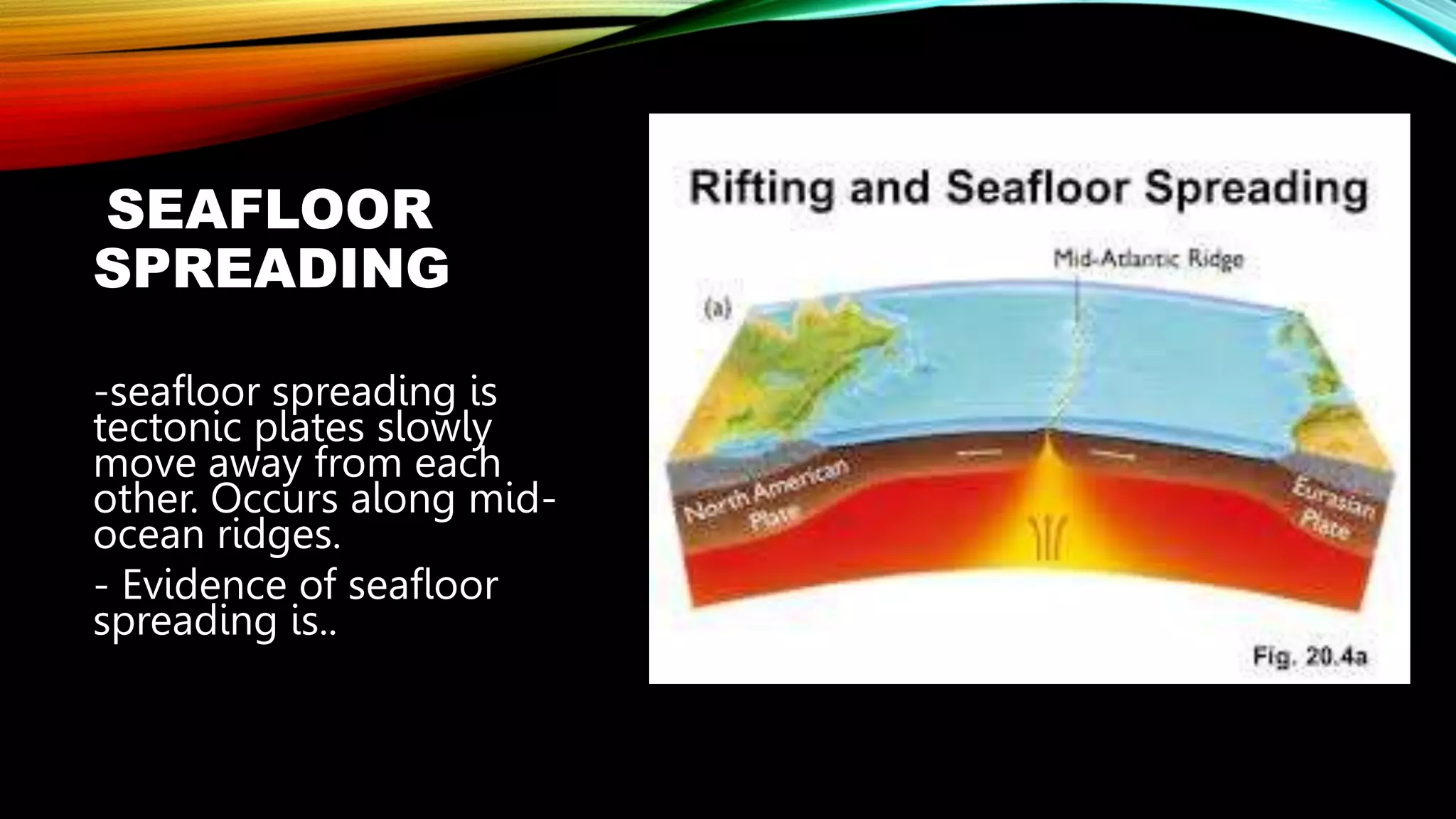
SEAFLOOR
SPREADING
-seafloor spreading is
tectonic plates slowly
move away from each
other. Occurs along mid-
ocean ridges.
- Evidence of seafloor
spreading is..
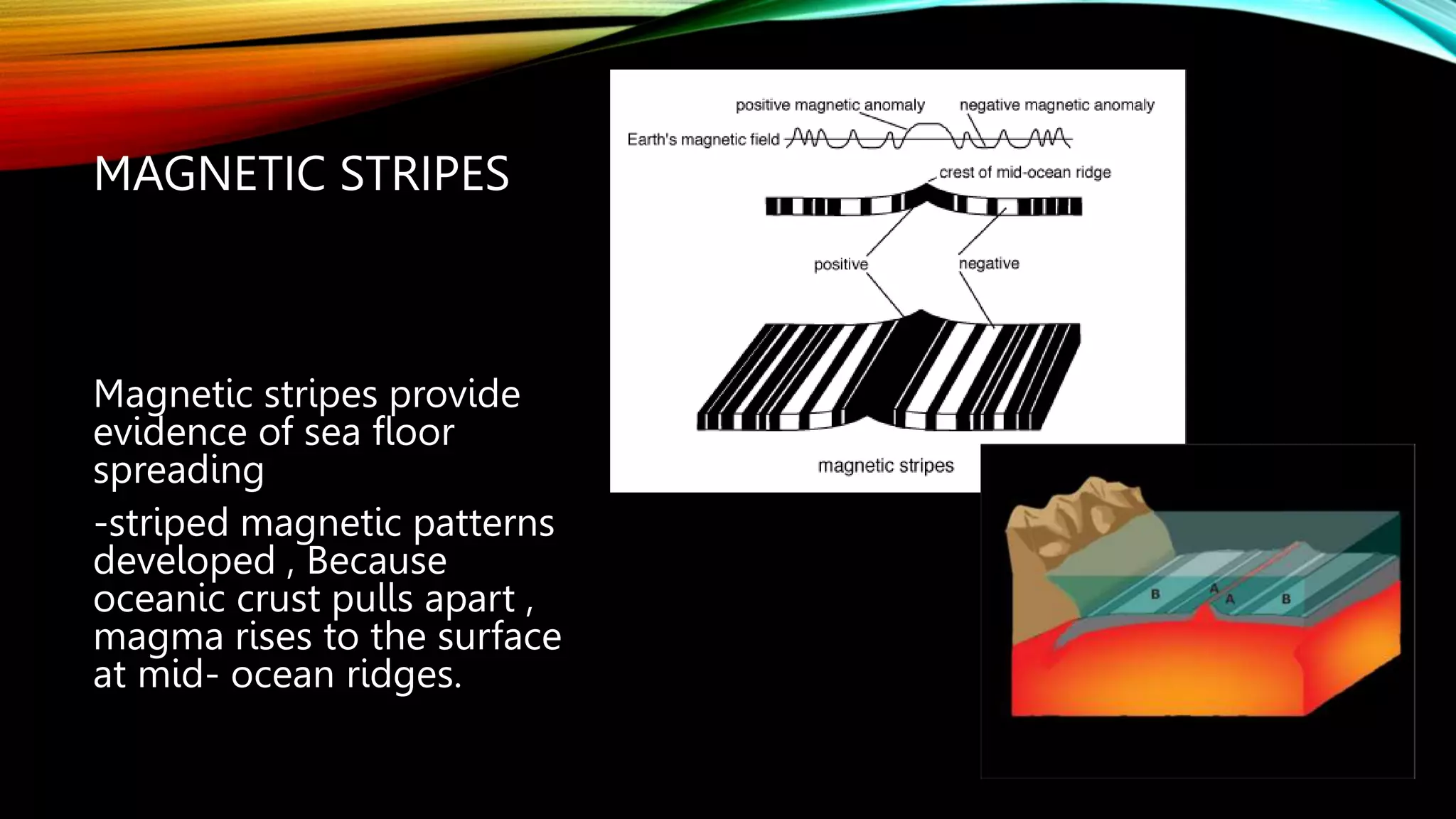
MAGNETIC STRIPES
Magnetic stripes provide
evidence of sea floor
spreading
-striped magnetic patterns
developed , Because
oceanic crust pulls apart ,
magma rises to the surface
at mid- ocean ridges.
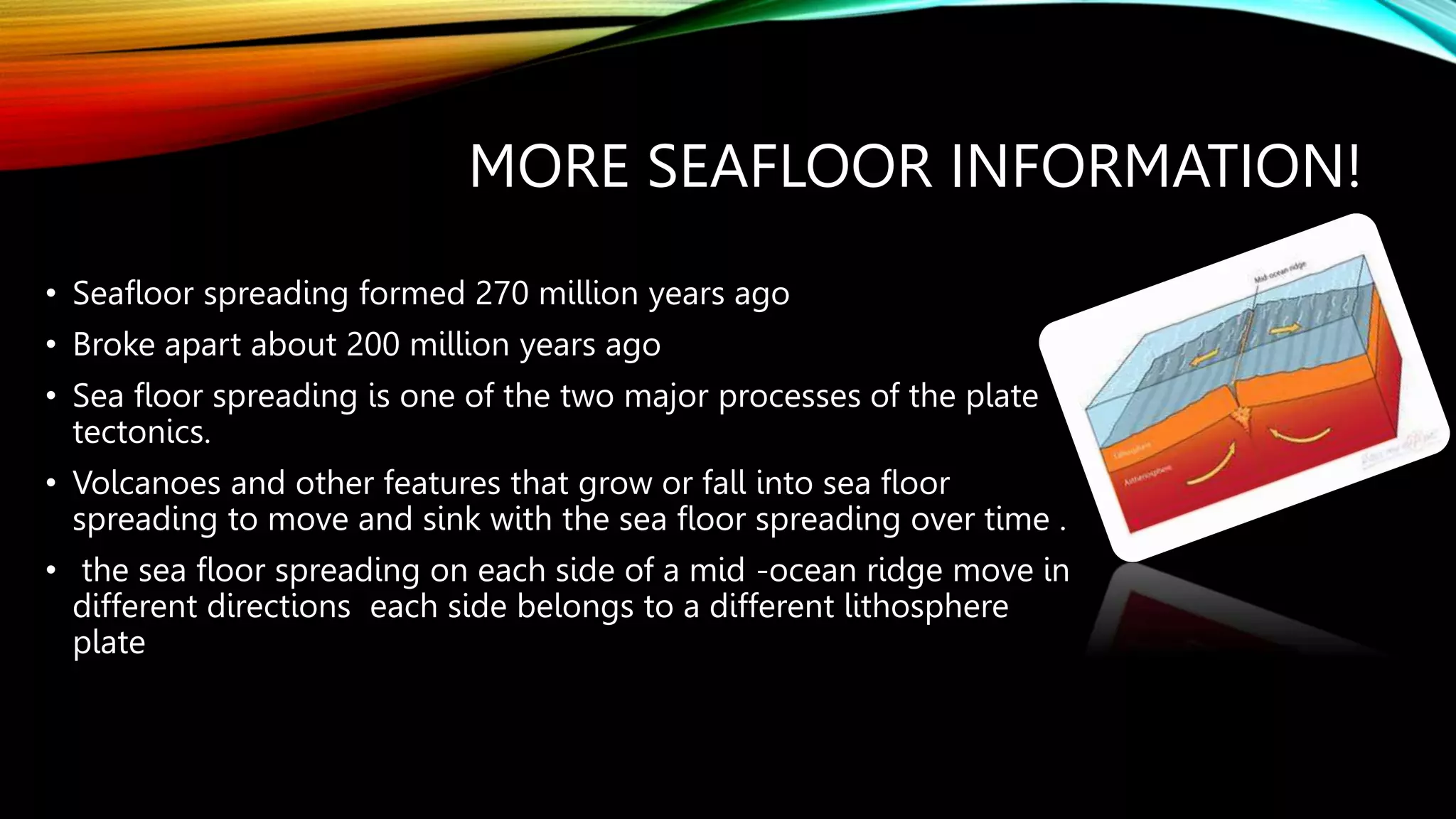
MORE SEAFLOOR INFORMATION!
• Seafloor spreading formed 270 million years ago
• Broke apart about 200 million years ago
• Sea floor spreading is one of the two major processes of the plate
tectonics.
• Volcanoes and other features that grow or fall into sea floor
spreading to move and sink with the sea floor spreading over time .
• the sea floor spreading on each side of a mid -ocean ridge move in
different directions each side belongs to a different lithosphere
plate
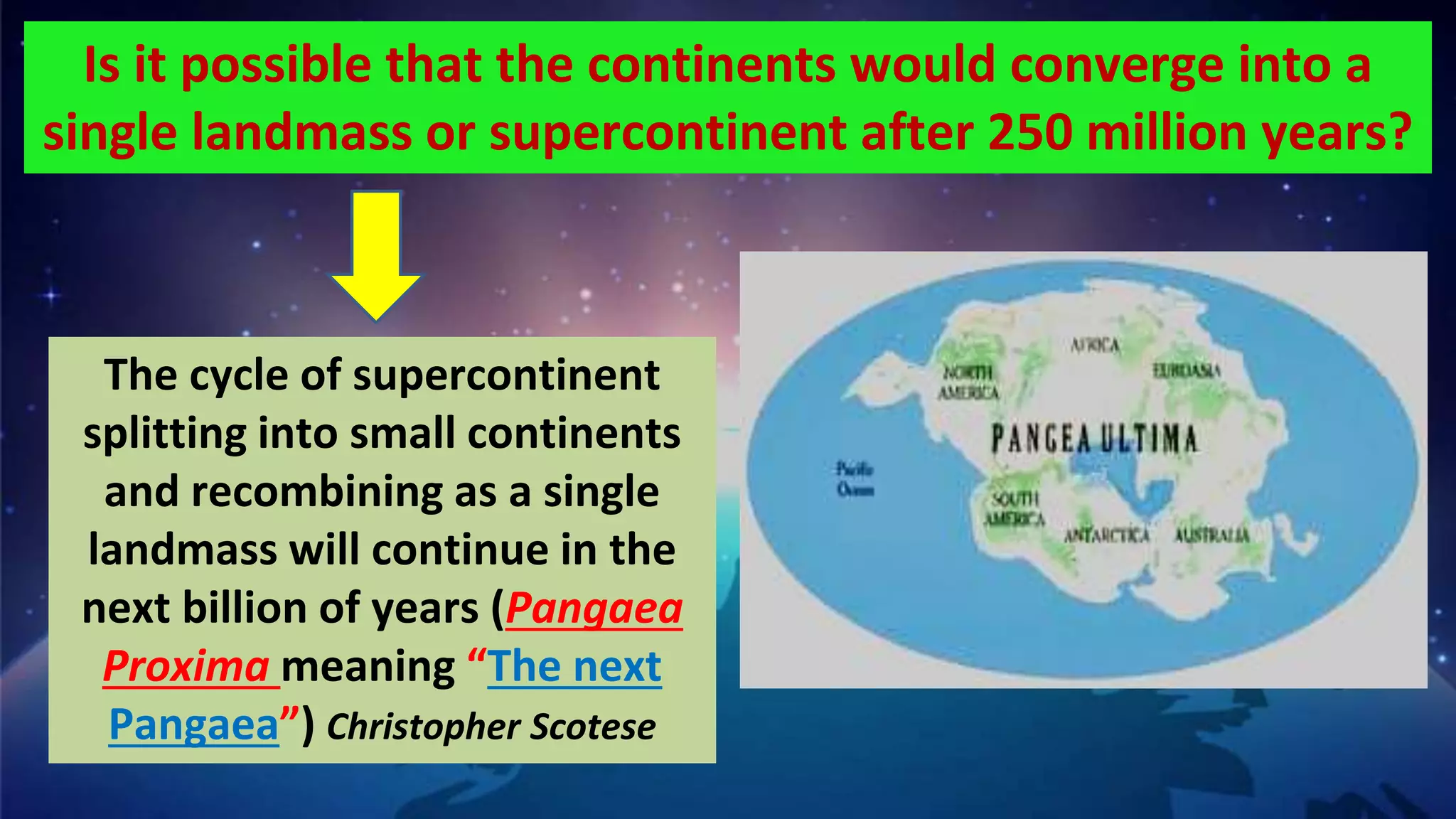
Is it possible that the continents would converge into a
single landmass or supercontinent after 250 million years?
The cycle of supercontinent
splitting into small continents
and recombining as a single
landmass will continue in the
next billion of years (Pangaea
Proxima meaning “The next
Pangaea”) Christopher Scotese
41
42
Use the words in
formulating a stories
about Continental Drift
Theory.
“
Fossils
Rocks
Glacial deposits
Puzzle
Sea floor spreading
Mountains
43
EVALUATION
➢ Who was the person who came up with the hypothesis of
Continental Drift?
➢ What was the large landmass called?
➢ Name four evidences the supports Continental Drift
➢ What is the one question that needs to be answered to prove the
Continental drift theory?
➢ What phenomenon proves the continental drift theory? (happens
under the sea)
44
References
➢ Science Learner’s Module 1: Grade 10
➢ Department of Education, Bureau of Secondary Education. Project EASE
➢ Integrated Science 1, Module 12: Inside the Earth.
➢ Department of Education, Bureau of Secondary Education (2013). Science
➢ Grade 8 Learner’s Module. Vibal Publishing House, Inc.
➢ Tarbuck, E.J. et al. (2009). Earth Science 12th ed. Pearson Education
➢ South Asia Pte Ltd.
➢ http://www.skoool.ie/ accessed March 3, 2014
45
Don’t Forget!
Please do the
enrichment
activities within
the week!
47

PPT Science10_Lesson 8_Evidences that Support Plate Movements FINAL.pptx

  • 1.
  • 2.
  • 3.
    CONTEN T STANDA RD •The learners demonstrate understanding ofthe relationship among the locations of volcanoes, earthquake epicenters, and mountain ranges.
  • 4.
    PERFORMANCE STANDARD The learnersshould be able to demonstrate ways to: • Suggest ways by which he/she can contribute to government efforts in reducing damage due to earthquakes, tsunamis and volcanic eruptions.
  • 5.
    LEARNING COMPETENCY Enumerate thelines of evidence that support plate movement (S10ES -la-j-36.6
  • 6.
    OBJECTIVES ➢ Trace theexistence of fossils of plants and animals as evidences found in the present continents that supports the fitting of drifted continents ➢ Cite other proofs of continental drift theory ➢ Explain the cause of movement of tectonic plates ➢ Describe how evidences of plate movement were collected ➢ Cite other proofs of plate movement 6
  • 7.
  • 8.
    8 a German meteorologist andgeophysicist, once hypothesized that continents were once joined as a single landmass called PANGAEA
  • 9.
    9 Refer to thehuman, plant, and animal remains that have been preserved through time like human or animal teeth, skull, and bone fragments.
  • 10.
    10 A supercontinent that existedduring the late paleozoic and early mesozoic eras. It assembled from earlier continental units approximately 335 million years ago, and it began to break apart about 175 million years ago.
  • 11.
    11 A theory whichsuggests that earth’s crust is made up of the plates that interact in various ways, thus producing earthquakes, mountains, volcanoes, and other geologic features.
  • 12.
  • 13.
    13 a German meteorologistand geophysicist, once hypothesized that continents were once joined as a single landmass called PANGAEA Alfred Wegener
  • 14.
    14 States that allthe continents were once one large landmass that broke apart and where the pieces moved slowly to their current locations. Continental Drift Theory
  • 15.
    CONTINENTAL DRIFT THEORY ⮚States that all the continents were once one large landmass that broke apart and where the pieces moved slowly to their current locations.
  • 16.
  • 17.
    17 The Eastern coastline ofSouth America and western coastline of Africa look like they would fit together as a jigsaw puzzle EVIDENCES OF CONTINENTAL DRIFT THEORY
  • 18.
    18 EVIDENCES OF CONTINENTAL DRIFTTHEORY PUZZLE FITTING OF CONTINENTS
  • 19.
    19 Fossilized remains ofMesosaurus were found in South America and Africa
  • 20.
    20 Do you thinkthey swam all the way across the oceans? NO!
  • 21.
    21 WHAT IS YOUR INFERENCEON THE POSSIBLE REASON?
  • 22.
    22 EVIDENCES OF CONTINENTAL DRIFTTHEORY PUZZLE FITTING OF CONTINENTS CLIMATE and GLACIERS DEPOSITS
  • 23.
    23 Glacial Deposit and hugebedrock found in South America, Africa, Australia and India
  • 24.
  • 25.
    Paleoclimate evidence In themodern world glaciers are found near the north and south poles. Deserts are largely found in bands that are parallel to the equator. Extensive reef complexes lie along the equator.
  • 26.
  • 27.
    27 There is proofthat glaciers moved from Africa, through the Atlantic Ocean, and then on towards South America. This would be much easier if the Atlantic Ocean were not there What did you notice?
  • 28.
  • 29.
    29 Warm weather plantshave been found in the Arctic… but it’s not warm there! Glacier deposits have been discovered in tropical and desert locations…it’s not cold there, either!
  • 30.
    30 How could youexplain this? why glacial deposits were found in areas where no glaciers exist today?
  • 31.
    31 EVIDENCES OF CONTINENTAL DRIFTTHEORY PUZZLE FITTING OF CONTINENTS ROCKS CLIMATE and GLACIERS DEPOSITS
  • 32.
    32 SAD FACT! Wegener hadevidence of one large land mass, he didn’t have the answers to what force (engine) “floated the plates”. He was laughed at and did not live to see his theory accepted.
  • 33.
    33 ROCKS Huge belts ofrocks found in Africa and South America were identical. Not only were they the same, but they would match up (age, thickness, types) if the continents were put together.
  • 34.
    34 • Mountains – Somemountain ranges on different contin – ents seem to match. • Ex: ranges in Canada match Norway and Sweden • Ex: Appalachian Mtn. match UK mtn
  • 35.
    35 WHAT PROVES THETHEORY TO BE CORRECT? Sea floor Spreading
  • 36.
    36 Is it possiblethat the current position of the continents will change after 100 years?
  • 37.
    SEAFLOOR SPREADING -seafloor spreading is tectonicplates slowly move away from each other. Occurs along mid- ocean ridges. - Evidence of seafloor spreading is..
  • 38.
    MAGNETIC STRIPES Magnetic stripesprovide evidence of sea floor spreading -striped magnetic patterns developed , Because oceanic crust pulls apart , magma rises to the surface at mid- ocean ridges.
  • 39.
    MORE SEAFLOOR INFORMATION! •Seafloor spreading formed 270 million years ago • Broke apart about 200 million years ago • Sea floor spreading is one of the two major processes of the plate tectonics. • Volcanoes and other features that grow or fall into sea floor spreading to move and sink with the sea floor spreading over time . • the sea floor spreading on each side of a mid -ocean ridge move in different directions each side belongs to a different lithosphere plate
  • 40.
    Is it possiblethat the continents would converge into a single landmass or supercontinent after 250 million years? The cycle of supercontinent splitting into small continents and recombining as a single landmass will continue in the next billion of years (Pangaea Proxima meaning “The next Pangaea”) Christopher Scotese
  • 41.
  • 42.
    42 Use the wordsin formulating a stories about Continental Drift Theory.
  • 43.
  • 44.
    EVALUATION ➢ Who wasthe person who came up with the hypothesis of Continental Drift? ➢ What was the large landmass called? ➢ Name four evidences the supports Continental Drift ➢ What is the one question that needs to be answered to prove the Continental drift theory? ➢ What phenomenon proves the continental drift theory? (happens under the sea) 44
  • 45.
    References ➢ Science Learner’sModule 1: Grade 10 ➢ Department of Education, Bureau of Secondary Education. Project EASE ➢ Integrated Science 1, Module 12: Inside the Earth. ➢ Department of Education, Bureau of Secondary Education (2013). Science ➢ Grade 8 Learner’s Module. Vibal Publishing House, Inc. ➢ Tarbuck, E.J. et al. (2009). Earth Science 12th ed. Pearson Education ➢ South Asia Pte Ltd. ➢ http://www.skoool.ie/ accessed March 3, 2014 45
  • 46.
    Don’t Forget! Please dothe enrichment activities within the week!
  • 47.