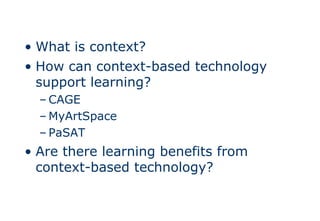
Context in Mobile LearningMike SharplesLearning Sciences Research InstituteUniversity of Nottinghamwww.nottingham.ac.uk/lsri/msh
What is context?How can context-based technology support learning?CAGEMyArtSpacePaSATAre there learning benefits from context-based technology?
What is context? “that which surrounds us”“that which weaves together”Cole, M. (1996). Cultural psychology: A once and future discipline.Cambridge, MA: Harvard University Press.
Mirrors a distinction in human-computer interaction between:context as a ‘shell’ that surrounds the human user of technology context created by the constructive interaction between people and technology
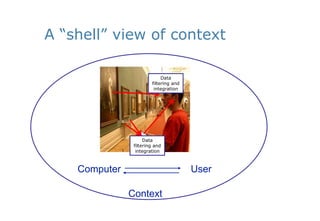
A “shell” view of contextData filtering and integrationData filtering and integrationComputerUserContext
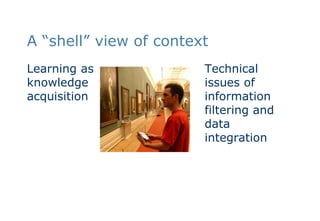
A “shell” view of contextLearning as knowledge acquisitionTechnical issues of information filtering and data integration
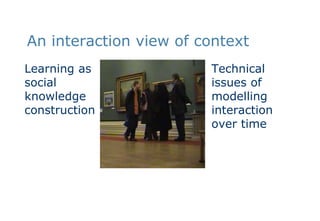
An interaction view of contextLearning as social knowledge constructionTechnical issues of modelling interaction over time
An interaction view of contextContext is adynamic and historical processto enable appropriate action (learning)constructed through interaction between people, settings, technologies, objects and activities
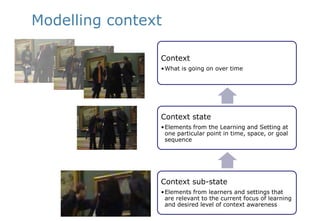
Modelling context
How can context-based technology support learning?CAGELearning through exploration of contextMyArtSpaceLearning through connecting contextsPaSATLearning through engagement and reflection in contexts
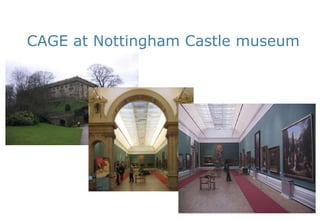
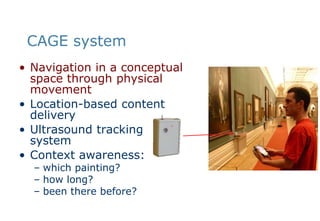
CAGE at Nottingham Castle museum
CAGE systemNavigation in a conceptual space through physical movementLocation-based content deliveryUltrasound tracking systemContext awareness:which painting?how long?been there before?
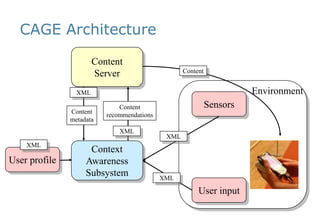
CAGE ArchitectureContentServerContentEnvironmentXMLSensorsContentrecommendationsContentmetadataXMLXMLContextAwarenessSubsystemXMLUser profileXMLUser input
Visitor studyBaseline: normal visitorsControl: visitors with printed guideExperimental: visitors with handheld guide
ObservationsPaper guide promoted a more ‘rigid’ pattern of movementVisitors with the PDA were more likely to move around the gallery according to what interested them
Interface challengesNavigation by physical movement through a knowledge spaceKeeping the user in controlBalance between manual and automatic functionality
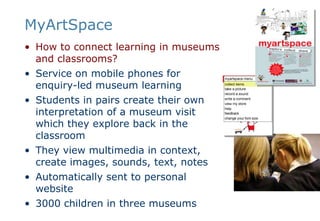
MyArtSpaceHow to connect learning in museums and classrooms?Service on mobile phones for enquiry-led museum learningStudents in pairs create their own interpretation of a museum visit which they explore back in the classroomThey view multimedia in context, create images, sounds, text, notesAutomatically sent to personal website3000 children in three museums
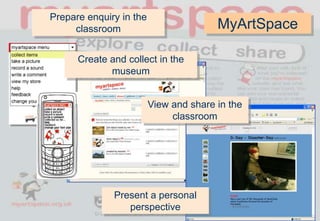
Prepare enquiry in the classroomMyArtSpaceCreate and collect in the museumView and share in the classroomPresent a personal perspective
Summary of findingsThe technology workedPhotos, information on exhibits, notes, automatic sending to websiteStudents spent longer (90 mins compared to 20 mins)Supported enquiry learningEncouraged children to make active choices Connected school and museumNeed for more teacher preparationManaging the amount of collected material back in the classroom
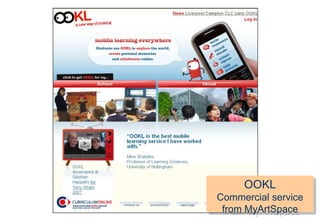
OOKLCommercial service from MyArtSpace
PaSATLearning through engagement and reflection across contextsCustom software to author and run location-based gamesLaptop server, PDA clients, GPS positioning, wireless-LAN
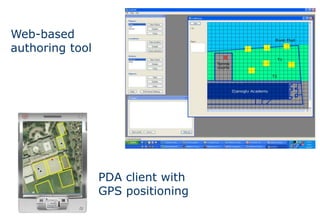
Web-based authoring tool PDA client with GPS positioning
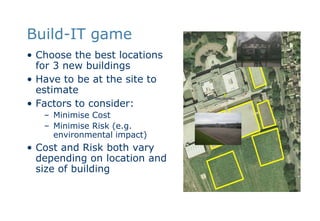
Build-IT gameChoose the best locations for 3 new buildingsHave to be at the site to estimateFactors to consider: Minimise CostMinimise Risk (e.g. environmental impact)Cost and Risk both vary depending on location and size of building
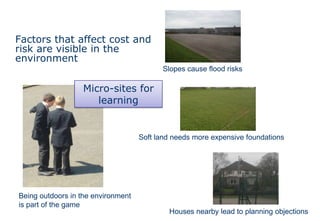
Factors that affect cost and risk are visible in the environmentSlopes cause flood risksMicro-sites for learningSoft land needs more expensive foundationsBeing outdoors in the environment is part of the gameHouses nearby lead to planning objections
Initial resultsHighly engagingEngagement and reflection outdoorsStructured learningNeed more support to use data gathering tools and strategies effectivelyNeed more connection back to the classroomTo share and present results
Successful context-based learningLearning through exploration of augmented physical spaceInquiry learning that connects formal and non-formal settingsCycle of engagement and reflection across contextsCreating location-based micro-sites for learning
Creating contextTraditional classroom learning is founded on an illusion of stability of context, by setting up a fixed location with common resources, a single teacher, and an agreed curriculum that allows a semblance of common ground to be maintained from day to day. If all these are removed, as may be the case with learning in the mobile age, then creating temporary islands of relatively stable context is a central concern. In this respect, the historic construction of context, the process by which we arrive at current understanding, assumes greater importance.Sharples, M., Taylor, J., & Vavoula, G. (2007) A Theory of Learning for the Mobile Age. In R. Andrews and C. Haythornthwaite (eds.)The Sage Handbook of Elearning Research. London: Sage, pp. 221-47.
CreditsCAGEMOBIlearn IST Framework 5 projectSystems design by Peter LondsaleMyArtSpaceFunded by Department of Culture Media and SportEvaluation team: Peter Lonsdale, Julia Meek, Paul Rudman, Mike Sharples, Giasemi Vavoula Systems design by The SEAPaSATPhD project, Peter Lonsdale

Context in Mobile Learning

  • 1.
    Context in MobileLearningMike SharplesLearning Sciences Research InstituteUniversity of Nottinghamwww.nottingham.ac.uk/lsri/msh
  • 2.
    What is context?Howcan context-based technology support learning?CAGEMyArtSpacePaSATAre there learning benefits from context-based technology?
  • 3.
    What is context?“that which surrounds us”“that which weaves together”Cole, M. (1996). Cultural psychology: A once and future discipline.Cambridge, MA: Harvard University Press.
  • 4.
    Mirrors a distinctionin human-computer interaction between:context as a ‘shell’ that surrounds the human user of technology context created by the constructive interaction between people and technology
  • 5.
    A “shell” viewof contextData filtering and integrationData filtering and integrationComputerUserContext
  • 6.
    A “shell” viewof contextLearning as knowledge acquisitionTechnical issues of information filtering and data integration
  • 7.
    An interaction viewof contextLearning as social knowledge constructionTechnical issues of modelling interaction over time
  • 8.
    An interaction viewof contextContext is adynamic and historical processto enable appropriate action (learning)constructed through interaction between people, settings, technologies, objects and activities
  • 9.
  • 10.
    How can context-basedtechnology support learning?CAGELearning through exploration of contextMyArtSpaceLearning through connecting contextsPaSATLearning through engagement and reflection in contexts
  • 11.
    CAGE at NottinghamCastle museum
  • 12.
    CAGE systemNavigation ina conceptual space through physical movementLocation-based content deliveryUltrasound tracking systemContext awareness:which painting?how long?been there before?
  • 13.
  • 14.
    Visitor studyBaseline: normalvisitorsControl: visitors with printed guideExperimental: visitors with handheld guide
  • 15.
    ObservationsPaper guide promoteda more ‘rigid’ pattern of movementVisitors with the PDA were more likely to move around the gallery according to what interested them
  • 16.
    Interface challengesNavigation byphysical movement through a knowledge spaceKeeping the user in controlBalance between manual and automatic functionality
  • 17.
    MyArtSpaceHow to connectlearning in museums and classrooms?Service on mobile phones for enquiry-led museum learningStudents in pairs create their own interpretation of a museum visit which they explore back in the classroomThey view multimedia in context, create images, sounds, text, notesAutomatically sent to personal website3000 children in three museums
  • 18.
    Prepare enquiry inthe classroomMyArtSpaceCreate and collect in the museumView and share in the classroomPresent a personal perspective
  • 19.
    Summary of findingsThetechnology workedPhotos, information on exhibits, notes, automatic sending to websiteStudents spent longer (90 mins compared to 20 mins)Supported enquiry learningEncouraged children to make active choices Connected school and museumNeed for more teacher preparationManaging the amount of collected material back in the classroom
  • 20.
  • 21.
    PaSATLearning through engagementand reflection across contextsCustom software to author and run location-based gamesLaptop server, PDA clients, GPS positioning, wireless-LAN
  • 22.
    Web-based authoring toolPDA client with GPS positioning
  • 23.
    Build-IT gameChoose thebest locations for 3 new buildingsHave to be at the site to estimateFactors to consider: Minimise CostMinimise Risk (e.g. environmental impact)Cost and Risk both vary depending on location and size of building
  • 24.
    Factors that affectcost and risk are visible in the environmentSlopes cause flood risksMicro-sites for learningSoft land needs more expensive foundationsBeing outdoors in the environment is part of the gameHouses nearby lead to planning objections
  • 25.
    Initial resultsHighly engagingEngagementand reflection outdoorsStructured learningNeed more support to use data gathering tools and strategies effectivelyNeed more connection back to the classroomTo share and present results
  • 26.
    Successful context-based learningLearningthrough exploration of augmented physical spaceInquiry learning that connects formal and non-formal settingsCycle of engagement and reflection across contextsCreating location-based micro-sites for learning
  • 27.
    Creating contextTraditional classroomlearning is founded on an illusion of stability of context, by setting up a fixed location with common resources, a single teacher, and an agreed curriculum that allows a semblance of common ground to be maintained from day to day. If all these are removed, as may be the case with learning in the mobile age, then creating temporary islands of relatively stable context is a central concern. In this respect, the historic construction of context, the process by which we arrive at current understanding, assumes greater importance.Sharples, M., Taylor, J., & Vavoula, G. (2007) A Theory of Learning for the Mobile Age. In R. Andrews and C. Haythornthwaite (eds.)The Sage Handbook of Elearning Research. London: Sage, pp. 221-47.
  • 28.
    CreditsCAGEMOBIlearn IST Framework5 projectSystems design by Peter LondsaleMyArtSpaceFunded by Department of Culture Media and SportEvaluation team: Peter Lonsdale, Julia Meek, Paul Rudman, Mike Sharples, Giasemi Vavoula Systems design by The SEAPaSATPhD project, Peter Lonsdale