Mobile Learning Group   Convenor John Cook Professor of Technology Enhanced Learning and E-Learning Project Leader Learning Technology Research Institute, London Metropolitan University
Overview Focus on devices Focus on learning outside the classroom   Focus on the mobility of the learner Personalised learning environments Key publications PhD students  and research environment Funding opportunities
Focus on devices Widespread experimentation mid 1990s PDAs, tablets, laptops and mobile phones Affordances of mobile devices e-books classroom response systems handheld computers in classrooms data logging devices reusable learning objects
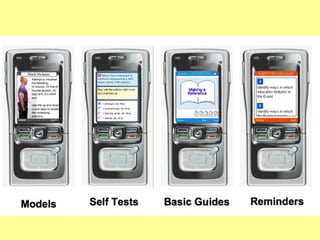
UK’s Centre for Excellence in Teaching and Learning (CETL) in Reusable Learning Objects ( http://www.rlo-cetl.ac.uk / ) Explored converged multimedia capabilities of smartphones as platform for storing learning resources is based in the  This work uses smartphones as a desk-top, placing rich multi-media mobile learning objects in the phone’s memory to scaffold (Wood, Bruner and Ross, 1976) different types of learning.
 
 
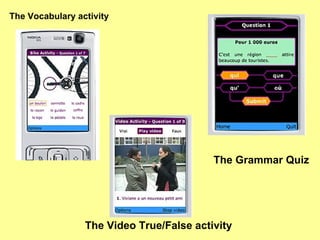
The Vocabulary activity  The Grammar Quiz  The Video True/False activity
Focus on learning outside the classroom Affordances include  field trips museum visits professional updating bite-sized learning personal learning organisers
Focus on the mobility of the learner Characterised by a focus on  the mobility of the learner,  the design or the appropriation of learning spaces  informal learning and lifelong learning Three important affordances can be distinguished mixed reality learning context-sensitive learning  ambient learning
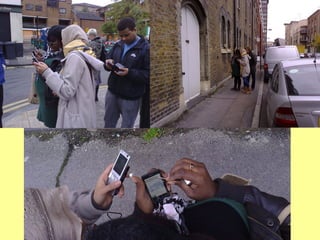
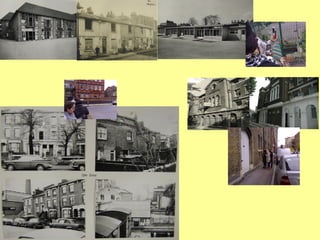
The ‘CONTSENS’ project developed a series of mobile learning applications that are being used to support student teachers in exploring their knowledge and understanding of urban education in a meaningful context (Smith, Cook and  Pratt-Adams , 2008).   http://www.ericsson.com/ericsson/corpinfo/programs/using_wireless_technologies_for_context_sensitive_education_and_training/
 
Location-aware services offer to transfer background information services such as finding places and giving directions help identify potential interactors in physical proximity of the learner Context-sensitive learning aware of the activities of learners and can thus offer to give assistance E.g. if a student’s course work is due in soon, the context-sensitive system can send a tip giving the location of resources that may help with an assignment continually derive what intervention is appropriate and can provide relevant services to aid learning
Context-sensitive learning could include (Sharples, 2006) location-based guides and customised help systems systems that enable activities in context, e.g. data logging game learning offering services and options such as communication and awareness of other game players customise content adaptive interface and interaction, where the level of detail and order of presentation can vary and be made appropriate for context and for display on different devices.


Ambient learning  makes use of the digital artefacts to augment the environment and enable learning (see e.g. Price, 2007).  technological tools are used to augment user activity in context.  this view of context invests effort in designing a rich environment that in turn mediates innovative forms of learning and teaching.
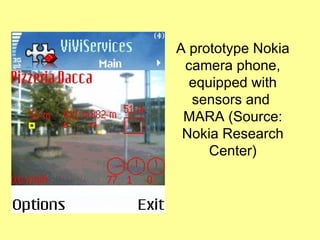
A prototype Nokia camera phone, equipped with sensors and  MARA (Source: Nokia Research Center)
Emerging trends over the three phases enhancement of the desktop  support for learning outside the classroom and the notion of learner mobility with location and context sensitive systems that enable life-long learning transitions across multiple contexts   ambient and mixed-reality systems and environments may soon be teaching us about themselves.  wide area educational gaming may draw in learners who may be at distance to the school.  we saw in the ’CONTSENS’ project that zone-based notifications provides a form of tracking and survellance that has major ethical implications.
Personal Learning and Personalised Learning Environments I would argue that we need Personalised Learning Environments (PLEs) A loosely coupled set of tools and resources that are learner defined, i.e. where the learner creates their own context for learning This is what I and LTRI colleagues are involved in building in the EC (FP7) MATURE project  http://mature-ip.eu/en/start Lots of design studies and ethnographic work with users Have developed a context sensitive dialogues use case
Personal Learning and Personalised Learning Environments A PLE provides support for the learning journey as learners: Set their own learning goals Manage their learning (by managing both content and process) Communicate with others across multiple contexts in the process of learning (i.e. support student experience of e-learning as they move between work/life/learning contexts) Appropriate digital tools and media And thereby achieve learning goals
The mobile clouds are here already PLEs can be built if we make creative use of existing and emerging infrastructures and innovations and an understanding of appropriation The following is a ‘mashup’ of Horizon 2008/9 reports from both Australasia and USA We need to share the task globally! next generation mobile devices mobile broadband cloud computing to provide mobile PLE virtual worlds immersive environments collaborative webs Geo-everything and context aware learning deep tagging tools social operating systems/ personal web semantic-aware applications smart objects
Key publications Cook, J. (2009). The Digitally Literate Learner and the Appropriation of New Technologies and Media for Education. Inaugural Professorial Lecture, 3 rd  Feb, Holloway Road, London Metropolitan University. Slides available:  http:// www.slideshare.net/johnnigelcook   Smith, C., Cook, J. and Pratt-Adams, S. (2009).  Context Sensitive Mobile Learning: Designing a ‘Technoscape’ for Urban Planners.  Mobile Learning, Barcelona, 26-28 February.  Cook, J., Pachler, N. and Bradley, C. (2008).  Appropriation of mobile phones for learning.  mLearn 2008, Telford, Shropshire, UK, 8-10 October.
Key publications Cook, J., Pachler, N. and Bradley, C. (2008). Bridging the Gap? Mobile Phones at the Interface between Informal and Formal Learning.  Journal of the Research Center for Educational Technology,  Spring. Available from:  http:// www.rcetj.org /?type= ci&id   Cook, J., Patchler, N. and Bradley, C. (2007).  Whither Case-Cased Approaches to Understanding Off-Site and On-Campus Mobile Learning?  Paper presented at Workshop on Research Methods in Informal and Mobile Learning: How to get the data we really want, 14 December, WLE Centre, Institute of Education London, UK. Download book from:  http:// www.wlecentre.ac.uk/cms/files/events/book.pdf   Cook, J., Bradley, C., Lance, J., Smith, C. and Haynes, R. (2007). Generating Learning Contexts with Mobile Devices. In Norbert Pachler (Ed.),  Mobile Learning: Towards a Research Agenda,  WLE Occasional Papers in Work-Based Learning 1, London. Download book from:  http://www.wlecentre.ac.uk/cms/files/occasionalpapers/mobilelearning_pachler2007.pdf
Key publications Bradley, C., Haynes, R., Cook, J., Boyle, T. and Smith, C. (in press). Design and development of multimedia learning objects for mobile phones. In Mohamed, A. (ed)  Mobile Learning in Education and Training.  Athabasca University Press Smith, C., Cook, J. Bradley, C., Gossett, R. and Haynes, R. (2007). Motivating learners: mobile learning objects and reusable learning objects for the X-box generation. Paper presented at  ALT-C 2007 , 14th International Conference of the Association for Learning Technology, University of Nottingham, September 2007.
PhD Students and research environment Carl Smith, LTRI Title: An approach to the design of context sensitive mobile learning environments for museum/heritage/architectural sites
PhD Students and research environment London Mobile Learning Group -  http://www.londonmobilelearning.net/ , based at Institute of Education Setting up local MLG group web page (learningonthemove)
PhD Students and research environment John Cook has been invited to give a lecture and run a workshop on mobile learning at Joint European Summer School on Technology Enhanced Learning (TEL) 2009. The lecture is on 'Phases of mobile learning'. Carl Smith will provide supporting expertise derived through the CONTSENS and MATURE projects for the workshop, which is called 'Context sensitive, location aware mobile learning'. This week long event is run by EC Framework (FP7) projects and networks: "Our ambition is to foster cross-domain training and collaboration opportunities among researchers in Europe and beyond, working in the disparate fields of expertise which promote the advancement of TEL at the workplace. The programme includes lectures and working sessions from leading professors in the field, tutoring, mentoring, and joint research opportunities. Additionally the school will offer practical sessions in research methodology for Technology Enhanced Learning." To be held Terchova, Slovakia, May 30 - June 6, 2009. More details:  http://www.jTELSummerSchool.eu
Funding opportunities Technology-enhanced learning: ICT Call 5 http://cordis.europa.eu/fetch?CALLER=EN_NEWS_EVENT&ACTION=D&DOC=30&CAT=NEWS&QUERY=011fa928c3c8:d65a:5194b871&RCN=30450 The call, expected to be published on 31 July 2009  information day 24 March in Luxembourg
Funding opportunities Others ??

Mobile Learning Group

  • 1.
    Mobile Learning Group Convenor John Cook Professor of Technology Enhanced Learning and E-Learning Project Leader Learning Technology Research Institute, London Metropolitan University
  • 2.
    Overview Focus ondevices Focus on learning outside the classroom Focus on the mobility of the learner Personalised learning environments Key publications PhD students and research environment Funding opportunities
  • 3.
    Focus on devicesWidespread experimentation mid 1990s PDAs, tablets, laptops and mobile phones Affordances of mobile devices e-books classroom response systems handheld computers in classrooms data logging devices reusable learning objects
  • 4.
    UK’s Centre forExcellence in Teaching and Learning (CETL) in Reusable Learning Objects ( http://www.rlo-cetl.ac.uk / ) Explored converged multimedia capabilities of smartphones as platform for storing learning resources is based in the This work uses smartphones as a desk-top, placing rich multi-media mobile learning objects in the phone’s memory to scaffold (Wood, Bruner and Ross, 1976) different types of learning.
  • 5.
  • 6.
  • 7.
    The Vocabulary activity The Grammar Quiz The Video True/False activity
  • 8.
    Focus on learningoutside the classroom Affordances include field trips museum visits professional updating bite-sized learning personal learning organisers
  • 9.
    Focus on themobility of the learner Characterised by a focus on the mobility of the learner, the design or the appropriation of learning spaces informal learning and lifelong learning Three important affordances can be distinguished mixed reality learning context-sensitive learning ambient learning
  • 10.
    The ‘CONTSENS’ projectdeveloped a series of mobile learning applications that are being used to support student teachers in exploring their knowledge and understanding of urban education in a meaningful context (Smith, Cook and Pratt-Adams , 2008). http://www.ericsson.com/ericsson/corpinfo/programs/using_wireless_technologies_for_context_sensitive_education_and_training/
  • 11.
  • 12.
    Location-aware services offerto transfer background information services such as finding places and giving directions help identify potential interactors in physical proximity of the learner Context-sensitive learning aware of the activities of learners and can thus offer to give assistance E.g. if a student’s course work is due in soon, the context-sensitive system can send a tip giving the location of resources that may help with an assignment continually derive what intervention is appropriate and can provide relevant services to aid learning
  • 13.
    Context-sensitive learning couldinclude (Sharples, 2006) location-based guides and customised help systems systems that enable activities in context, e.g. data logging game learning offering services and options such as communication and awareness of other game players customise content adaptive interface and interaction, where the level of detail and order of presentation can vary and be made appropriate for context and for display on different devices.
  • 14.
  • 15.
  • 16.
  • 17.
    Ambient learning makes use of the digital artefacts to augment the environment and enable learning (see e.g. Price, 2007). technological tools are used to augment user activity in context. this view of context invests effort in designing a rich environment that in turn mediates innovative forms of learning and teaching.
  • 18.
    A prototype Nokiacamera phone, equipped with sensors and MARA (Source: Nokia Research Center)
  • 19.
    Emerging trends overthe three phases enhancement of the desktop support for learning outside the classroom and the notion of learner mobility with location and context sensitive systems that enable life-long learning transitions across multiple contexts ambient and mixed-reality systems and environments may soon be teaching us about themselves. wide area educational gaming may draw in learners who may be at distance to the school. we saw in the ’CONTSENS’ project that zone-based notifications provides a form of tracking and survellance that has major ethical implications.
  • 20.
    Personal Learning andPersonalised Learning Environments I would argue that we need Personalised Learning Environments (PLEs) A loosely coupled set of tools and resources that are learner defined, i.e. where the learner creates their own context for learning This is what I and LTRI colleagues are involved in building in the EC (FP7) MATURE project http://mature-ip.eu/en/start Lots of design studies and ethnographic work with users Have developed a context sensitive dialogues use case
  • 21.
    Personal Learning andPersonalised Learning Environments A PLE provides support for the learning journey as learners: Set their own learning goals Manage their learning (by managing both content and process) Communicate with others across multiple contexts in the process of learning (i.e. support student experience of e-learning as they move between work/life/learning contexts) Appropriate digital tools and media And thereby achieve learning goals
  • 22.
    The mobile cloudsare here already PLEs can be built if we make creative use of existing and emerging infrastructures and innovations and an understanding of appropriation The following is a ‘mashup’ of Horizon 2008/9 reports from both Australasia and USA We need to share the task globally! next generation mobile devices mobile broadband cloud computing to provide mobile PLE virtual worlds immersive environments collaborative webs Geo-everything and context aware learning deep tagging tools social operating systems/ personal web semantic-aware applications smart objects
  • 23.
    Key publications Cook,J. (2009). The Digitally Literate Learner and the Appropriation of New Technologies and Media for Education. Inaugural Professorial Lecture, 3 rd Feb, Holloway Road, London Metropolitan University. Slides available: http:// www.slideshare.net/johnnigelcook Smith, C., Cook, J. and Pratt-Adams, S. (2009). Context Sensitive Mobile Learning: Designing a ‘Technoscape’ for Urban Planners. Mobile Learning, Barcelona, 26-28 February. Cook, J., Pachler, N. and Bradley, C. (2008). Appropriation of mobile phones for learning. mLearn 2008, Telford, Shropshire, UK, 8-10 October.
  • 24.
    Key publications Cook,J., Pachler, N. and Bradley, C. (2008). Bridging the Gap? Mobile Phones at the Interface between Informal and Formal Learning. Journal of the Research Center for Educational Technology, Spring. Available from: http:// www.rcetj.org /?type= ci&id Cook, J., Patchler, N. and Bradley, C. (2007). Whither Case-Cased Approaches to Understanding Off-Site and On-Campus Mobile Learning? Paper presented at Workshop on Research Methods in Informal and Mobile Learning: How to get the data we really want, 14 December, WLE Centre, Institute of Education London, UK. Download book from: http:// www.wlecentre.ac.uk/cms/files/events/book.pdf Cook, J., Bradley, C., Lance, J., Smith, C. and Haynes, R. (2007). Generating Learning Contexts with Mobile Devices. In Norbert Pachler (Ed.), Mobile Learning: Towards a Research Agenda, WLE Occasional Papers in Work-Based Learning 1, London. Download book from: http://www.wlecentre.ac.uk/cms/files/occasionalpapers/mobilelearning_pachler2007.pdf
  • 25.
    Key publications Bradley,C., Haynes, R., Cook, J., Boyle, T. and Smith, C. (in press). Design and development of multimedia learning objects for mobile phones. In Mohamed, A. (ed) Mobile Learning in Education and Training. Athabasca University Press Smith, C., Cook, J. Bradley, C., Gossett, R. and Haynes, R. (2007). Motivating learners: mobile learning objects and reusable learning objects for the X-box generation. Paper presented at ALT-C 2007 , 14th International Conference of the Association for Learning Technology, University of Nottingham, September 2007.
  • 26.
    PhD Students andresearch environment Carl Smith, LTRI Title: An approach to the design of context sensitive mobile learning environments for museum/heritage/architectural sites
  • 27.
    PhD Students andresearch environment London Mobile Learning Group - http://www.londonmobilelearning.net/ , based at Institute of Education Setting up local MLG group web page (learningonthemove)
  • 28.
    PhD Students andresearch environment John Cook has been invited to give a lecture and run a workshop on mobile learning at Joint European Summer School on Technology Enhanced Learning (TEL) 2009. The lecture is on 'Phases of mobile learning'. Carl Smith will provide supporting expertise derived through the CONTSENS and MATURE projects for the workshop, which is called 'Context sensitive, location aware mobile learning'. This week long event is run by EC Framework (FP7) projects and networks: "Our ambition is to foster cross-domain training and collaboration opportunities among researchers in Europe and beyond, working in the disparate fields of expertise which promote the advancement of TEL at the workplace. The programme includes lectures and working sessions from leading professors in the field, tutoring, mentoring, and joint research opportunities. Additionally the school will offer practical sessions in research methodology for Technology Enhanced Learning." To be held Terchova, Slovakia, May 30 - June 6, 2009. More details: http://www.jTELSummerSchool.eu
  • 29.
    Funding opportunities Technology-enhancedlearning: ICT Call 5 http://cordis.europa.eu/fetch?CALLER=EN_NEWS_EVENT&ACTION=D&DOC=30&CAT=NEWS&QUERY=011fa928c3c8:d65a:5194b871&RCN=30450 The call, expected to be published on 31 July 2009 information day 24 March in Luxembourg
  • 30.