Content Writing Writing to Learn
Key Concepts Part 1: Active engagement in subject matter through writing Part 2: Standards and structures Part 3: Writing: part of a better life
Todayโ€ฆ What is written, published and demanded by readers is non-fiction. Experts in all content areas agree that students need more writing instruction, And teachers need to teach students to write well about the world in which they live. Experts: National Council for Teaching of Mathematics, National Science Educational Standards, National Council of Social Studies, et.al
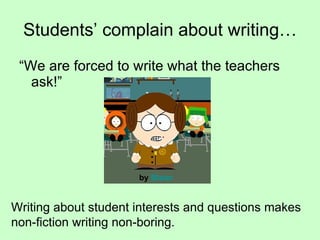
Studentsโ€™ complain about writingโ€ฆ โ€œWe are forced to write what the teachers ask!โ€  by  Blaisr Writing about student interests and questions makes non-fiction writing non-boring.
Benefits of Content Writing Students get more actively engaged in the subject matter. Students understand information and concepts more deeply. Students make connections and raise questions more fluently. Students remember ideas longer and apply learning in new situations.
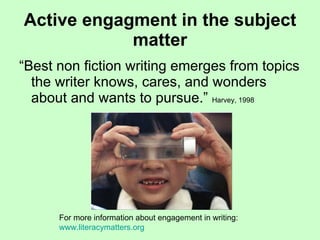
Active engagment in the subject matter โ€œBest non fiction writing emerges from topics the writer knows, cares, and wonders about and wants to pursue.โ€  Harvey, 1998 For more information about engagement in writing:  www.literacymatters.org
From  On Writing Well   by William Zinsser Students willingly write about subjects that touch their lives or at which they are skilled Students learning to write are most comfortable with nonfiction โ€œMotivation is at the heart of writingโ€ฆGo where your interests lies, or your heart or your passionโ€ (Zinsser, 1990).
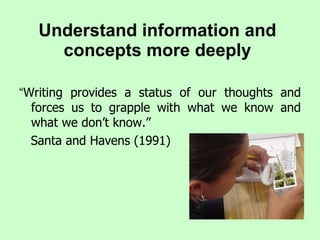
Understand information and concepts more deeply โ€œ Writing provides a status of our thoughts and forces us to grapple with what we know and what we donโ€™t know.โ€  Santa and Havens (1991)
โ€œ The act of writing by its very nature may enhance thinking. Writing may achieve this by demanding the learner to organize knowledge.โ€ โ€œ Writing is an important tool for transforming claims and evidence into knowledge that is more coherent and  structured.โ€  The Effect of Talking and Writing on Learning Science:  An Exploratory Study   (Rivard amd Straw. 2000)
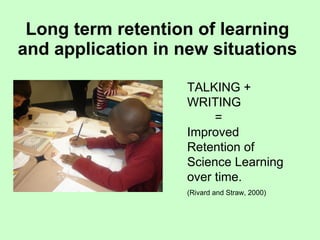
Long term retention of learning and application in new situations TALKING + WRITING = Improved Retention of  Science Learning over time. (Rivard and Straw, 2000)
Writing may force the integration of new ideas and relationships with prior knowledge and encourage personal involvement with the new information.  (Kleinsasser, et al, 1992) Written and oral language opportunities to explain, describe, predict and integrate new information allow students to make conceptual shifts and facilitate retention.  (Fellows, 1994)
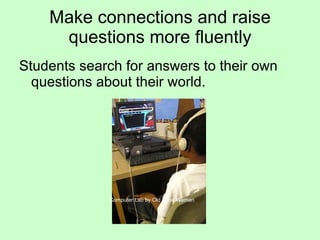
Make connections and raise questions more fluently Students search for answers to their own questions about their world. Computer Lab by Old Shoe Woman
Coherent Instruction โ€ฆ is teaching that connects.  It connects the studentโ€™s reading skills to  writing . It connects reading and writing to  content .  It links content learning to student interests.  Coherent teaching makes it easy for students to learn because it combines the  strange-new with the familiar-old .  When the classroom is coherent, teachers help students make  connections among reading, writing and content. (Guthrie, 2000)
Related Video The Power of Non Fiction Writing by Doug Reeves  (5 min.) http://www.curriculum.org/secretariat/april18.shtml
Part 2: Standards and Structures
Top 10 Reasons to Engage in Expository Writing โ€œ Good non-fiction writing is โ€˜facts ignited by passionโ€™โ€โ€”Jean Fritz
10.  To share our expertise with others and develop self-confidence and self-esteem allows young writers to express their interests and expertise for both personal knowledge and expertiseโ€”Kletzien and Drehr (2004)
9.  To write for wider audiences with authentic purposes addresses issues of audience, purpose and formโ€”Pike and Mumper (2006) gives opportunity to write for many audiences and purposes
8.  To obtain a thorough understanding of a topic of study writers of non-fiction become teachers who help others learn what they knowโ€”interested and knowledgeable about oneโ€™s topic
7.  To enhance our vocabulary, visual literacy, and use of technology engages students in non-fiction writing so can read non-fiction text with deeper understandingโ€”Calkins and Pessah (2003)
6.  To demonstrate our ability to write in different text forms acquire understanding of features, structures, point-of-view, and voiceโ€”Calkins and Pessah (2003)
5.  To take ownership for learning about our world and being able to share that knowledge with others gives opportunity to go beyond classroom walls and make a connection with global ideas from around the world
4.  To make use of powerful scaffolds to help create new and enjoyable patterns for our writing immerses us in reading the genre while learning to writing it unique and interesting use of language
3.  To develop myriad strategies for building content and to find ways to organize and synthesize our learning writing non-fiction refines thinking skills and the organization of ideas and our understanding of the world โ€” Laura Robb (2004) improves communication and problem-solving skills in writing and eventually changes problem-solving strategies in all arenas of learning
2.  To continue to build our curiosity for our world by promoting a spirit of inquiry collecting data from numerous sources both primary and secondary
1.  To provide choiceโ€”especially for those of us who would prefer reading and writing nonfiction over reading and writing fiction
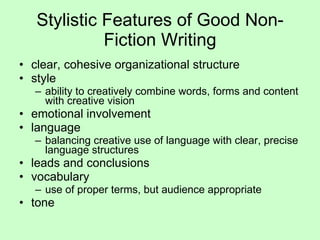
Stylistic Features of Good Non-Fiction Writing clear, cohesive organizational structure style ability to creatively combine words, forms and content with creative vision emotional involvement language balancing creative use of language with clear, precise language structures leads and conclusions vocabulary use of proper terms, but audience appropriate tone
Resources Bamford, Rosemary and Janice Kristo, 1998.  Making Facts Come Alive:  Choosing Quality Nonfiction Literature K-8.  Christopher-Gordon Publishers, Inc., Norwood, MA. Daniels, Harvey, Steven Zemelman & Nancy Steineke, 2007.  Content-Area Writing.  Heinemann, Portsmouth, NH. Dorfman, Lynne and Rose Cappelli, 2008.  Nonfiction Mentor Texts:  Teaching Informational Writing Through Childrenโ€™s Literature, K-8.  Stenhouse Publishers, Portland, ME.
Part 3:  Writing, Part of a Better Life
History to 21 st  Century โ€œ National Council of Education 1894 report of the Committee of Ten on Secondary School Studies, headed by Harvard President Charles Eliot, urged โ€œThat the admission of a student to college should be made to depend largely on his ability to write Englishโ€ฆโ€ Holding On To Good Ideas in a Time of Bad Ones by Thomas Newkirk. P55. Heineman. 2009
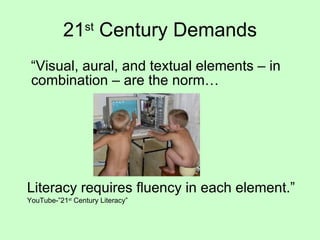
21 st  Century Demands โ€œVisual, aural, and textual elements โ€“ in combination โ€“ are the normโ€ฆ Literacy requires fluency in each element.โ€ YouTube-โ€21 st  Century Literacyโ€
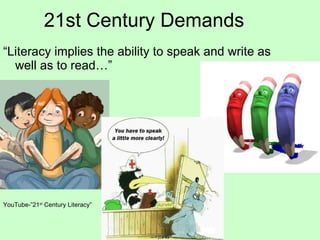
โ€œ Literacy implies the ability to speak and write as well as to readโ€ฆโ€ YouTube-โ€21 st  Century Literacyโ€ 21st Century Demands
โ€œ NEA (National Endowment for the Arts published a study showing the decline in book reading butโ€ฆthe study also noted that there was a 30% increase in the number of people engaged in creative writing.โ€ Holding On To Good Ideas in a Time of Bad Ones by Thomas Newkirk. P55. Heineman. 2009 21st Century Demands
โ€œBrandt has shown how societal shifts have increased the demand for writing.โ€ 21st Century Demands
News & Observer  โ€“ July 27 th , 2009 โ€œ Theyโ€™ll (students) need new and enhanced skills:  analytical and critical thinking, science and math literacy, global and cultural awareness, excellent communication skills and foreign language proficiency.โ€  by Susan Parry, Kenan Fellows Program for Curriculum and Leadership Development. 21st Century Demands
Case Technologies to Enhance Literacy Learning:  Charles K.  Kinzer  Teachers College, Columbia University  Linda D.  Labbo , University of Georgia  Donald J.  Leu , University of Connecticut    William H.  Teale , University of Illinois, Chicago This group is an example of how we need to change how we teach our pre-service teachers.  See PDF

Content Area Writing

  • 1.
  • 2.
    Key Concepts Part1: Active engagement in subject matter through writing Part 2: Standards and structures Part 3: Writing: part of a better life
  • 3.
    Todayโ€ฆ What iswritten, published and demanded by readers is non-fiction. Experts in all content areas agree that students need more writing instruction, And teachers need to teach students to write well about the world in which they live. Experts: National Council for Teaching of Mathematics, National Science Educational Standards, National Council of Social Studies, et.al
  • 4.
    Studentsโ€™ complain aboutwritingโ€ฆ โ€œWe are forced to write what the teachers ask!โ€ by Blaisr Writing about student interests and questions makes non-fiction writing non-boring.
  • 5.
    Benefits of ContentWriting Students get more actively engaged in the subject matter. Students understand information and concepts more deeply. Students make connections and raise questions more fluently. Students remember ideas longer and apply learning in new situations.
  • 6.
    Active engagment inthe subject matter โ€œBest non fiction writing emerges from topics the writer knows, cares, and wonders about and wants to pursue.โ€ Harvey, 1998 For more information about engagement in writing: www.literacymatters.org
  • 7.
    From OnWriting Well by William Zinsser Students willingly write about subjects that touch their lives or at which they are skilled Students learning to write are most comfortable with nonfiction โ€œMotivation is at the heart of writingโ€ฆGo where your interests lies, or your heart or your passionโ€ (Zinsser, 1990).
  • 8.
    Understand information andconcepts more deeply โ€œ Writing provides a status of our thoughts and forces us to grapple with what we know and what we donโ€™t know.โ€ Santa and Havens (1991)
  • 9.
    โ€œ The actof writing by its very nature may enhance thinking. Writing may achieve this by demanding the learner to organize knowledge.โ€ โ€œ Writing is an important tool for transforming claims and evidence into knowledge that is more coherent and structured.โ€ The Effect of Talking and Writing on Learning Science: An Exploratory Study (Rivard amd Straw. 2000)
  • 10.
    Long term retentionof learning and application in new situations TALKING + WRITING = Improved Retention of Science Learning over time. (Rivard and Straw, 2000)
  • 11.
    Writing may forcethe integration of new ideas and relationships with prior knowledge and encourage personal involvement with the new information. (Kleinsasser, et al, 1992) Written and oral language opportunities to explain, describe, predict and integrate new information allow students to make conceptual shifts and facilitate retention. (Fellows, 1994)
  • 12.
    Make connections andraise questions more fluently Students search for answers to their own questions about their world. Computer Lab by Old Shoe Woman
  • 13.
    Coherent Instruction โ€ฆis teaching that connects. It connects the studentโ€™s reading skills to writing . It connects reading and writing to content . It links content learning to student interests. Coherent teaching makes it easy for students to learn because it combines the strange-new with the familiar-old . When the classroom is coherent, teachers help students make connections among reading, writing and content. (Guthrie, 2000)
  • 14.
    Related Video ThePower of Non Fiction Writing by Doug Reeves (5 min.) http://www.curriculum.org/secretariat/april18.shtml
  • 15.
    Part 2: Standardsand Structures
  • 16.
    Top 10 Reasonsto Engage in Expository Writing โ€œ Good non-fiction writing is โ€˜facts ignited by passionโ€™โ€โ€”Jean Fritz
  • 17.
    10. Toshare our expertise with others and develop self-confidence and self-esteem allows young writers to express their interests and expertise for both personal knowledge and expertiseโ€”Kletzien and Drehr (2004)
  • 18.
    9. Towrite for wider audiences with authentic purposes addresses issues of audience, purpose and formโ€”Pike and Mumper (2006) gives opportunity to write for many audiences and purposes
  • 19.
    8. Toobtain a thorough understanding of a topic of study writers of non-fiction become teachers who help others learn what they knowโ€”interested and knowledgeable about oneโ€™s topic
  • 20.
    7. Toenhance our vocabulary, visual literacy, and use of technology engages students in non-fiction writing so can read non-fiction text with deeper understandingโ€”Calkins and Pessah (2003)
  • 21.
    6. Todemonstrate our ability to write in different text forms acquire understanding of features, structures, point-of-view, and voiceโ€”Calkins and Pessah (2003)
  • 22.
    5. Totake ownership for learning about our world and being able to share that knowledge with others gives opportunity to go beyond classroom walls and make a connection with global ideas from around the world
  • 23.
    4. Tomake use of powerful scaffolds to help create new and enjoyable patterns for our writing immerses us in reading the genre while learning to writing it unique and interesting use of language
  • 24.
    3. Todevelop myriad strategies for building content and to find ways to organize and synthesize our learning writing non-fiction refines thinking skills and the organization of ideas and our understanding of the world โ€” Laura Robb (2004) improves communication and problem-solving skills in writing and eventually changes problem-solving strategies in all arenas of learning
  • 25.
    2. Tocontinue to build our curiosity for our world by promoting a spirit of inquiry collecting data from numerous sources both primary and secondary
  • 26.
    1. Toprovide choiceโ€”especially for those of us who would prefer reading and writing nonfiction over reading and writing fiction
  • 27.
    Stylistic Features ofGood Non-Fiction Writing clear, cohesive organizational structure style ability to creatively combine words, forms and content with creative vision emotional involvement language balancing creative use of language with clear, precise language structures leads and conclusions vocabulary use of proper terms, but audience appropriate tone
  • 28.
    Resources Bamford, Rosemaryand Janice Kristo, 1998. Making Facts Come Alive: Choosing Quality Nonfiction Literature K-8. Christopher-Gordon Publishers, Inc., Norwood, MA. Daniels, Harvey, Steven Zemelman & Nancy Steineke, 2007. Content-Area Writing. Heinemann, Portsmouth, NH. Dorfman, Lynne and Rose Cappelli, 2008. Nonfiction Mentor Texts: Teaching Informational Writing Through Childrenโ€™s Literature, K-8. Stenhouse Publishers, Portland, ME.
  • 29.
    Part 3: Writing, Part of a Better Life
  • 30.
    History to 21st Century โ€œ National Council of Education 1894 report of the Committee of Ten on Secondary School Studies, headed by Harvard President Charles Eliot, urged โ€œThat the admission of a student to college should be made to depend largely on his ability to write Englishโ€ฆโ€ Holding On To Good Ideas in a Time of Bad Ones by Thomas Newkirk. P55. Heineman. 2009
  • 31.
    21 st Century Demands โ€œVisual, aural, and textual elements โ€“ in combination โ€“ are the normโ€ฆ Literacy requires fluency in each element.โ€ YouTube-โ€21 st Century Literacyโ€
  • 32.
    โ€œ Literacy impliesthe ability to speak and write as well as to readโ€ฆโ€ YouTube-โ€21 st Century Literacyโ€ 21st Century Demands
  • 33.
    โ€œ NEA (NationalEndowment for the Arts published a study showing the decline in book reading butโ€ฆthe study also noted that there was a 30% increase in the number of people engaged in creative writing.โ€ Holding On To Good Ideas in a Time of Bad Ones by Thomas Newkirk. P55. Heineman. 2009 21st Century Demands
  • 34.
    โ€œBrandt has shownhow societal shifts have increased the demand for writing.โ€ 21st Century Demands
  • 35.
    News & Observer โ€“ July 27 th , 2009 โ€œ Theyโ€™ll (students) need new and enhanced skills: analytical and critical thinking, science and math literacy, global and cultural awareness, excellent communication skills and foreign language proficiency.โ€ by Susan Parry, Kenan Fellows Program for Curriculum and Leadership Development. 21st Century Demands
  • 36.
    Case Technologies toEnhance Literacy Learning: Charles K. Kinzer Teachers College, Columbia University Linda D. Labbo , University of Georgia Donald J. Leu , University of Connecticut William H. Teale , University of Illinois, Chicago This group is an example of how we need to change how we teach our pre-service teachers. See PDF

Editor's Notes

  • #5ย From Zissler, On Writing Well non fiction writing about student interests and questions makes non-fiction writing non-boring
  • #30ย http://gurugilbert.com/wp-content/happiness.jpg
  • #32ย http://www.seniorark.com/multitasking.jpg
  • #33ย http://extend.schoolwires.com/clipartgallery/images/32972510.gif http://lowe.lib.wv.us/read01.jpg http://www.joe-ks.com/archives_nov2003/SpeakClearly.jpg
  • #35ย http://www.nolo.com/images/special/tilt_cover_IEP.gif http://blog.ning.com/blog/blog_logo.jpg http://www.designnetworks.co.uk/images/documentation.jpg