Elements of a Comprehensive Classroom Program to Develop Academic Literacy TED 406 Teaching Secondary Reading Jill A. Aguilar
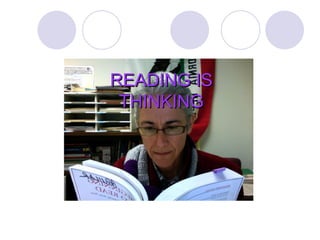
READING IS THINKING
Teaching Reading is Teaching Thinking Reading Instruction Vocabulary Development Grammar Instruction Independent Choice Reading Pre- Assessment Writing Instruction  Post- Assessment
Developing Academic Literacy Pre- Assessment
Developing Academic Literacy Pre- Assessment Before we begin teaching, we need to  know what students already know. What do they know about the content?
Developing Academic Literacy Pre- Assessment Before we begin teaching, we need to  know what students already know. What do they know about the content? What vocabulary do they know? What do they know about how to read this kind of text (genre)? How confident is their reading?
Developing Academic Literacy Vocabulary Development
Developing Academic Literacy Vocabulary Development Schoolchildren need to increase their vocabulary at the rate of about 3,000 words per year!
Developing Academic Literacy Vocabulary Development Schoolchildren need to increase their vocabulary at the rate of about 3,000 words per year!  Since teachers obviously can’t teach that many words, they need to be selective about the words they do teach.
Developing Academic Literacy Grammar Instruction
Developing Academic Literacy Grammar Instruction Students do need some grammar instruction, but it  Should only be relevant and in context-- Grammar workbook pages don’t achieve grammar learning.
Developing Academic Literacy Independent Choice Reading
Developing Academic Literacy Independent Choice Reading At the same time that students are receiving vocabulary and grammar instruction, they should be independently reading texts that they choose.
Developing Academic Literacy Independent Choice Reading At the same time that students are receiving vocabulary and grammar instruction, they should be independently reading texts that they choose.  Independent  reading level means 95% or higher accuracy rate. Instructional  reading level is at 90-94% accuracy rate. Frustration  reading level is an accuracy rate below 90%.
Developing Academic Literacy Reading Instruction
Developing Academic Literacy Reading Instruction Strategically select vocabulary, grammar or genre structures to teach.
Developing Academic Literacy Reading Instruction Strategically select vocabulary, grammar or genre structures to teach. Strategically select which texts to teach.
Developing Academic Literacy Reading Instruction Strategically select vocabulary, grammar or genre structures to teach. Strategically select which texts to teach. Use TEXT SETS to help make content accessible and increase fluency and comprehension.
Developing Academic Literacy Reading Instruction Use TEXT SETS to help make content accessible and increase fluency and comprehension.
Developing Academic Literacy Reading Instruction
Developing Academic Literacy Reading Instruction PREREADING
Developing Academic Literacy Reading Instruction PREREADING   Establish a purpose  Draw or build upon students’ knowledge Preview text Present vocabulary Build motivation
Developing Academic Literacy Reading Instruction PREREADING  READING   Establish a purpose  Draw or build upon students’ knowledge Preview text Present vocabulary Build motivation Focus attention Stimulate discussion Relate prior knowledge to text information
Developing Academic Literacy  Reflect  Engage in higher levels of thinking  Synthesize ideas; create non-textual products  Facilitate written and oral summaries Reading Instruction PREREADING  READING  POSTREADING   Establish a purpose  Draw or build upon students’ knowledge Preview text Present vocabulary Build motivation Focus attention Stimulate discussion Relate prior knowledge to text information
Teaching Reading is Teaching Thinking Writing Instruction
Teaching Reading is Teaching Thinking Writing Instruction  The Writing Process
Teaching Reading is Teaching Thinking Writing Instruction  The Writing Process PREWRITING
Teaching Reading is Teaching Thinking Writing Instruction  The Writing Process PREWRITING WRITING
Teaching Reading is Teaching Thinking Writing Instruction  The Writing Process PREWRITING WRITING REVISING
Teaching Reading is Teaching Thinking Writing Instruction  The Writing Process PREWRITING WRITING REVISING EDITING
Teaching Reading is Teaching Thinking Writing Instruction  The Writing Process PREWRITING WRITING REVISING EDITING PUBLISHING EVALUATING
Developing Academic Literacy Post- Assessment
Developing Academic Literacy Post- Assessment Opportunities to Demonstrate and Celebrate What we have  Learned.
Teaching Reading is Teaching Thinking Reading Instruction Vocabulary Development Grammar Instruction Independent Choice Reading Pre- Assessment Writing Instruction  Post- Assessment

Developing Academic Literacy

  • 1.
    Elements of aComprehensive Classroom Program to Develop Academic Literacy TED 406 Teaching Secondary Reading Jill A. Aguilar
  • 2.
  • 3.
    Teaching Reading isTeaching Thinking Reading Instruction Vocabulary Development Grammar Instruction Independent Choice Reading Pre- Assessment Writing Instruction Post- Assessment
  • 4.
  • 5.
    Developing Academic LiteracyPre- Assessment Before we begin teaching, we need to know what students already know. What do they know about the content?
  • 6.
    Developing Academic LiteracyPre- Assessment Before we begin teaching, we need to know what students already know. What do they know about the content? What vocabulary do they know? What do they know about how to read this kind of text (genre)? How confident is their reading?
  • 7.
    Developing Academic LiteracyVocabulary Development
  • 8.
    Developing Academic LiteracyVocabulary Development Schoolchildren need to increase their vocabulary at the rate of about 3,000 words per year!
  • 9.
    Developing Academic LiteracyVocabulary Development Schoolchildren need to increase their vocabulary at the rate of about 3,000 words per year! Since teachers obviously can’t teach that many words, they need to be selective about the words they do teach.
  • 10.
    Developing Academic LiteracyGrammar Instruction
  • 11.
    Developing Academic LiteracyGrammar Instruction Students do need some grammar instruction, but it Should only be relevant and in context-- Grammar workbook pages don’t achieve grammar learning.
  • 12.
    Developing Academic LiteracyIndependent Choice Reading
  • 13.
    Developing Academic LiteracyIndependent Choice Reading At the same time that students are receiving vocabulary and grammar instruction, they should be independently reading texts that they choose.
  • 14.
    Developing Academic LiteracyIndependent Choice Reading At the same time that students are receiving vocabulary and grammar instruction, they should be independently reading texts that they choose. Independent reading level means 95% or higher accuracy rate. Instructional reading level is at 90-94% accuracy rate. Frustration reading level is an accuracy rate below 90%.
  • 15.
    Developing Academic LiteracyReading Instruction
  • 16.
    Developing Academic LiteracyReading Instruction Strategically select vocabulary, grammar or genre structures to teach.
  • 17.
    Developing Academic LiteracyReading Instruction Strategically select vocabulary, grammar or genre structures to teach. Strategically select which texts to teach.
  • 18.
    Developing Academic LiteracyReading Instruction Strategically select vocabulary, grammar or genre structures to teach. Strategically select which texts to teach. Use TEXT SETS to help make content accessible and increase fluency and comprehension.
  • 19.
    Developing Academic LiteracyReading Instruction Use TEXT SETS to help make content accessible and increase fluency and comprehension.
  • 20.
    Developing Academic LiteracyReading Instruction Use TEXT SETS to help make content accessible and increase fluency and comprehension.
  • 21.
    Developing Academic LiteracyReading Instruction Use TEXT SETS to help make content accessible and increase fluency and comprehension.
  • 22.
    Developing Academic LiteracyReading Instruction Use TEXT SETS to help make content accessible and increase fluency and comprehension.
  • 23.
    Developing Academic LiteracyReading Instruction Use TEXT SETS to help make content accessible and increase fluency and comprehension.
  • 24.
    Developing Academic LiteracyReading Instruction Use TEXT SETS to help make content accessible and increase fluency and comprehension.
  • 25.
    Developing Academic LiteracyReading Instruction Use TEXT SETS to help make content accessible and increase fluency and comprehension.
  • 26.
    Developing Academic LiteracyReading Instruction
  • 27.
    Developing Academic LiteracyReading Instruction PREREADING
  • 28.
    Developing Academic LiteracyReading Instruction PREREADING  Establish a purpose  Draw or build upon students’ knowledge Preview text Present vocabulary Build motivation
  • 29.
    Developing Academic LiteracyReading Instruction PREREADING READING  Establish a purpose  Draw or build upon students’ knowledge Preview text Present vocabulary Build motivation Focus attention Stimulate discussion Relate prior knowledge to text information
  • 30.
    Developing Academic Literacy Reflect  Engage in higher levels of thinking  Synthesize ideas; create non-textual products  Facilitate written and oral summaries Reading Instruction PREREADING READING POSTREADING  Establish a purpose  Draw or build upon students’ knowledge Preview text Present vocabulary Build motivation Focus attention Stimulate discussion Relate prior knowledge to text information
  • 31.
    Teaching Reading isTeaching Thinking Writing Instruction
  • 32.
    Teaching Reading isTeaching Thinking Writing Instruction The Writing Process
  • 33.
    Teaching Reading isTeaching Thinking Writing Instruction The Writing Process PREWRITING
  • 34.
    Teaching Reading isTeaching Thinking Writing Instruction The Writing Process PREWRITING WRITING
  • 35.
    Teaching Reading isTeaching Thinking Writing Instruction The Writing Process PREWRITING WRITING REVISING
  • 36.
    Teaching Reading isTeaching Thinking Writing Instruction The Writing Process PREWRITING WRITING REVISING EDITING
  • 37.
    Teaching Reading isTeaching Thinking Writing Instruction The Writing Process PREWRITING WRITING REVISING EDITING PUBLISHING EVALUATING
  • 38.
  • 39.
    Developing Academic LiteracyPost- Assessment Opportunities to Demonstrate and Celebrate What we have Learned.
  • 40.
    Teaching Reading isTeaching Thinking Reading Instruction Vocabulary Development Grammar Instruction Independent Choice Reading Pre- Assessment Writing Instruction Post- Assessment