Literacy
        Across the
        Curriculum


Wayne
What is “Literacy Across the
Curriculum”?
Literacy across the curriculum means
that students are learning literacy
skills while learning other content
areas like math, science, social
studies, art, and music.


Jane
Why is literacy across the curriculum
important?
   Learning in any subject area requires the use of
language; therefore, reading and writing are used as
tools for learning that subject area.

   Connecting literacy learning to other content areas
reinforces learning in all areas.
              http://mason.gmu.edu/~cwallac7/TAP/TEST/
           comprehension/4.html


Isabella
There is no question that reading, writing, speaking,
and listening are interconnected skills that develop
synergistically. They are also the key to teaching
thinking.


The more fluent students become as readers, writers,
speakers, and listeners, the clearer, more coherent,
and more flexible their thinking will become.
           Terry Roberts and Laura Billings
           Thinking is Literacy, Literacy Thinking
           Educational Leadership/February 2008


Isabella
Reading transcends the mere transmission of
information: It fosters an imaginative dialogue
between the text and the reader’s mind that actually
helps people to think.
                  Stratford P. Sherman, Author of “America
Won’t Win Till It Reads More”

Learning to read is critical to a child’s overall well-
being. If a youngster does not learn to read in a
literacy-driven society, hope for a fulfilling productive
life diminishes.
               G.Reid Lyon, Chief of Child Development and Behavior
       Branch of the National Institute of Child health and
Human Development


Paul
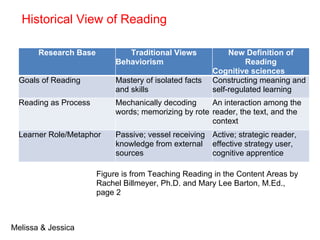
Historical View of Reading

       Research Base           Traditional Views             New Definition of
                            Behaviorism                           Reading
                                                        Cognitive sciences
  Goals of Reading          Mastery of isolated facts   Constructing meaning and
                            and skills                  self-regulated learning
  Reading as Process        Mechanically decoding     An interaction among the
                            words; memorizing by rote reader, the text, and the
                                                      context
  Learner Role/Metaphor     Passive; vessel receiving Active; strategic reader,
                            knowledge from external effective strategy user,
                            sources                   cognitive apprentice

                       Figure is from Teaching Reading in the Content Areas by
                       Rachel Billmeyer, Ph.D. and Mary Lee Barton, M.Ed.,
                       page 2


Melissa & Jessica
Why is literacy across the curriculum
important in middle school?
Middle school students are required to read and
understand "information-heavy" textbooks,
especially in their middle school science and
social studies classes. It is important for them to
learn how to read a non-fiction book.


Wayne
What does an effective literacy program
look like?
Effective literacy programs are those that do
not exist in a vacuum.
Teaching reading and writing skills must not
be reserved solely for language arts
classrooms.
Students need multiple opportunities
to learn reading and writing strategies
in a variety of class settings.

Paul
What are the characteristics of an
  effective literacy program?
 ● is student-centered
 ● responds to students' needs
 ● includes ongoing practice; regular
 inclusion of reading and writing activities
 ● focuses on positive outcomes
 ● incorporates a variety of reading and
 writing strategies


               http://teachingtoday.glencoe.
          com/howtoarticles/promoting-literacy-across-
Jessica
          the-curriculum-in-the-middle-grades
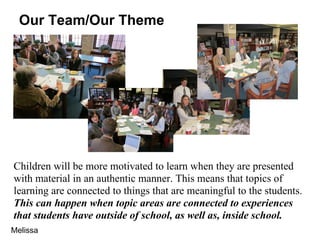
Our Team/Our Theme


Children will be more motivated to learn when they are presented
with material in an authentic manner. This means that topics of
learning are connected to things that are meaningful to the students.
This can happen when topic areas are connected to experiences
that students have outside of school, as well as, inside school.
Melissa
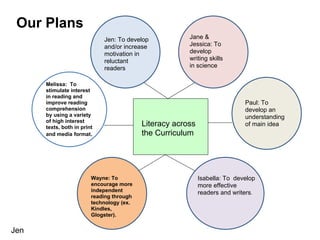
Our Plans
                             Jen: To develop            Jane &
                             and/or increase            Jessica: To
                             motivation in              develop
                             reluctant                  writing skills
                             readers                    in science

      Melissa: To
      stimulate interest
      in reading and
      improve reading                                                        Paul: To
      comprehension                                                          develop an
      by using a variety                                                     understanding
      of high interest
      texts, both in print
                                           Literacy across                   of main idea
      and media format.                    the Curriculum


                         Wayne: To                           Isabella: To develop
                         encourage more                      more effective
                         independent                         readers and writers.
                         reading through
                         technology (ex.
                         Kindles,
                         Glogster).


Jen
Jane & Jessica’s Project

Question: Can student thinking in science be deepened and can student
writing skills improve through meaningful and authentic writing
assignments?

I am placing a special focus on student writing this year through the use of
interactive science notebooks, lab reports, science literature reports, and
content writing assignments.

We are collaborating, and I am providing the technical and pedagogical
support. Our hope is to improve student writing and deepen student thinking
in science through content area writing. Students work is being graded on
content as well as grammar and usage using a Writing Across the
Curriculum checklist. Assignments are followed up with a writer’s reflection
sheet, which allows the students to analyze their finished products and the
grades they received.

The idea for this question came from               http://writingfix.
com/WAC/sciencefix.htm
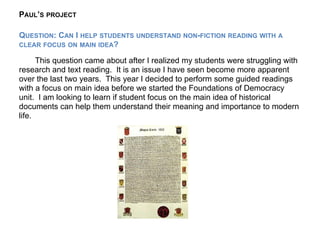
PAUL’S PROJECT

QUESTION: CAN I HELP STUDENTS UNDERSTAND NON-FICTION READING WITH A
CLEAR FOCUS ON MAIN IDEA?

      This question came about after I realized my students were struggling with
research and text reading. It is an issue I have seen become more apparent
over the last two years. This year I decided to perform some guided readings
with a focus on main idea before we started the Foundations of Democracy
unit. I am looking to learn if student focus on the main idea of historical
documents can help them understand their meaning and importance to modern
life.
Isabella’s Project

Question: Will the use of reading/thinking
strategies help my students construct a better
understanding of science concepts?

Beginning with the 2010 – 2011 school year, I included
reading /thinking strategies as part of my warm up
activities. This year I am continuing to implement these
strategies on a more consistent basis. I am doing this in
an effort to improve comprehension of science text and
support students as they construct understanding of the
main concepts presented in my science class.

I would like to determine if these reading/thinking
strategies make an impact on student understanding of
science text, including the textbook, science articles, non-
fiction picture books, and excerpts from science -based
fiction books.
Resources for Strategies:
●   But I’m Not the Reading Teacher
    (Amy Benjamin)

●   Strategies to Engage the Mind of the Learner
    (Rachel Billmeyer)

●   Teaching Reading in the Content Areas
    (Rachel Billmeyer and Mary Lee Barton)

●   Thinking Strategies for Science
    (Sally Berman)

●   The Strategic Teacher
    (Harvey F. Silver, Richard W. Strong and Matthew J. Perini)
Jen’s Project
Question: How can I, as an effective teacher, increase and
develop motivation in reluctant readers?
    I strongly feel that in today’s “texting generation”, motivating
students to read is harder than ever. With all the other forms of
media out there, it is difficult to engage students in reading without a
struggle. One of the main complexities in getting students to read is
getting them to do it without making reading a punishment. While
this may “get the job done”, it creates a disdain for reading, and thus,
negates our goal of motivating students to WANT to read.
Throughout the year, I play on focusing in on increasing students’
motivation and desire to read.
Jen’s Project Continued:

    Throughout my research of motivating students to read, I
 found two common pieces of advice:

   ●Provide a choice in what students read
   ●Motivate by example: show students that you love to read!


         “Engaged readers want to choose their own books. Choice is
 vital to reading engagement. As children learn to self-select their
 reading materials, they become discriminating and independent
 readers.”
       - Susan E. Snell, Pearson Allyn Bacon Prentice Hall
Jen’s Project Continued:

            Plans: Increasing Motivation in Reading
1. I will assign multi-genre monthly book reports (fiction, science-
fiction, mystery, Newberry Award Winner, historical fiction,
fantasy/adventure, biography/autobiography, and a “choice” book).
I feel that by assigning the students a different genre to read from
each month- it will increase the chances of each student, especially
those who “hate reading”, of finding a book or a genre that they
actually enjoy. For each genre, I will also make suggestions of my
personal favorites to show my love of reading, as well.

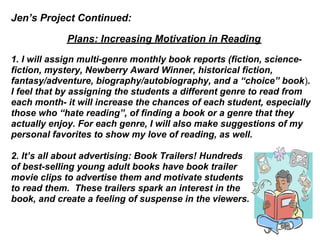
2. It’s all about advertising: Book Trailers! Hundreds
of best-selling young adult books have book trailer
movie clips to advertise them and motivate students
to read them. These trailers spark an interest in the
book, and create a feeling of suspense in the viewers.
Melissa’s and Wayne’s Project
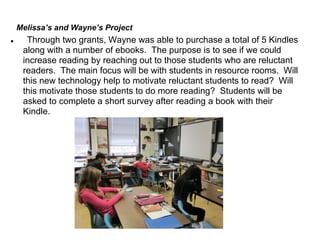
●     Through two grants, Wayne was able to purchase a total of 5 Kindles
     along with a number of ebooks. The purpose is to see if we could
     increase reading by reaching out to those students who are reluctant
     readers. The main focus will be with students in resource rooms. Will
     this new technology help to motivate reluctant students to read? Will
     this motivate those students to do more reading? Students will be
     asked to complete a short survey after reading a book with their
     Kindle.
Wayne’s Project

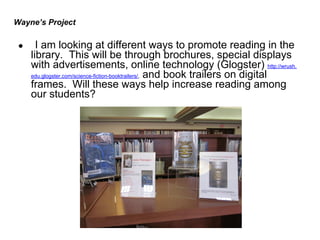
 ●     I am looking at different ways to promote reading in the
     library. This will be through brochures, special displays
     with advertisements, online technology (Glogster) http://wrush.
     edu.glogster.com/science-fiction-booktrailers/, and book trailers on digital
     frames. Will these ways help increase reading among
     our students?
Melissa’s Project

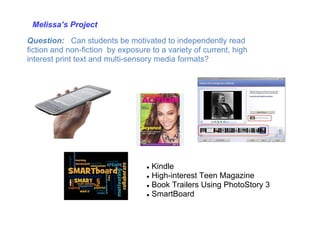
Question: Can students be motivated to independently read
fiction and non-fiction by exposure to a variety of current, high
interest print text and multi-sensory media formats?


                                   ● Kindle
                                   ● High-interest Teen Magazine
                                   ● Book Trailers Using PhotoStory 3
                                   ● SmartBoard
Our Goal
Literacy learning throughout the middle
school curriculum is integral to producing
literate adults.
As students see that reading and writing
proficiency is valued in all
subject areas, they are
encouraged to become
life-long learners.


Jen

Literacy Across the Curriculum

  • 1.
    Literacy Across the Curriculum Wayne
  • 2.
    What is “LiteracyAcross the Curriculum”? Literacy across the curriculum means that students are learning literacy skills while learning other content areas like math, science, social studies, art, and music. Jane
  • 3.
    Why is literacyacross the curriculum important? Learning in any subject area requires the use of language; therefore, reading and writing are used as tools for learning that subject area. Connecting literacy learning to other content areas reinforces learning in all areas. http://mason.gmu.edu/~cwallac7/TAP/TEST/ comprehension/4.html Isabella
  • 4.
    There is noquestion that reading, writing, speaking, and listening are interconnected skills that develop synergistically. They are also the key to teaching thinking. The more fluent students become as readers, writers, speakers, and listeners, the clearer, more coherent, and more flexible their thinking will become. Terry Roberts and Laura Billings Thinking is Literacy, Literacy Thinking Educational Leadership/February 2008 Isabella
  • 5.
    Reading transcends themere transmission of information: It fosters an imaginative dialogue between the text and the reader’s mind that actually helps people to think. Stratford P. Sherman, Author of “America Won’t Win Till It Reads More” Learning to read is critical to a child’s overall well- being. If a youngster does not learn to read in a literacy-driven society, hope for a fulfilling productive life diminishes. G.Reid Lyon, Chief of Child Development and Behavior Branch of the National Institute of Child health and Human Development Paul
  • 6.
    Historical View ofReading Research Base Traditional Views New Definition of Behaviorism Reading Cognitive sciences Goals of Reading Mastery of isolated facts Constructing meaning and and skills self-regulated learning Reading as Process Mechanically decoding An interaction among the words; memorizing by rote reader, the text, and the context Learner Role/Metaphor Passive; vessel receiving Active; strategic reader, knowledge from external effective strategy user, sources cognitive apprentice Figure is from Teaching Reading in the Content Areas by Rachel Billmeyer, Ph.D. and Mary Lee Barton, M.Ed., page 2 Melissa & Jessica
  • 7.
    Why is literacyacross the curriculum important in middle school? Middle school students are required to read and understand "information-heavy" textbooks, especially in their middle school science and social studies classes. It is important for them to learn how to read a non-fiction book. Wayne
  • 8.
    What does aneffective literacy program look like? Effective literacy programs are those that do not exist in a vacuum. Teaching reading and writing skills must not be reserved solely for language arts classrooms. Students need multiple opportunities to learn reading and writing strategies in a variety of class settings. Paul
  • 9.
    What are thecharacteristics of an effective literacy program? ● is student-centered ● responds to students' needs ● includes ongoing practice; regular inclusion of reading and writing activities ● focuses on positive outcomes ● incorporates a variety of reading and writing strategies http://teachingtoday.glencoe. com/howtoarticles/promoting-literacy-across- Jessica the-curriculum-in-the-middle-grades
  • 10.
    Our Team/Our Theme Childrenwill be more motivated to learn when they are presented with material in an authentic manner. This means that topics of learning are connected to things that are meaningful to the students. This can happen when topic areas are connected to experiences that students have outside of school, as well as, inside school. Melissa
  • 11.
    Our Plans Jen: To develop Jane & and/or increase Jessica: To motivation in develop reluctant writing skills readers in science Melissa: To stimulate interest in reading and improve reading Paul: To comprehension develop an by using a variety understanding of high interest texts, both in print Literacy across of main idea and media format. the Curriculum Wayne: To Isabella: To develop encourage more more effective independent readers and writers. reading through technology (ex. Kindles, Glogster). Jen
  • 12.
    Jane & Jessica’sProject Question: Can student thinking in science be deepened and can student writing skills improve through meaningful and authentic writing assignments? I am placing a special focus on student writing this year through the use of interactive science notebooks, lab reports, science literature reports, and content writing assignments. We are collaborating, and I am providing the technical and pedagogical support. Our hope is to improve student writing and deepen student thinking in science through content area writing. Students work is being graded on content as well as grammar and usage using a Writing Across the Curriculum checklist. Assignments are followed up with a writer’s reflection sheet, which allows the students to analyze their finished products and the grades they received. The idea for this question came from http://writingfix. com/WAC/sciencefix.htm
  • 13.
    PAUL’S PROJECT QUESTION: CANI HELP STUDENTS UNDERSTAND NON-FICTION READING WITH A CLEAR FOCUS ON MAIN IDEA? This question came about after I realized my students were struggling with research and text reading. It is an issue I have seen become more apparent over the last two years. This year I decided to perform some guided readings with a focus on main idea before we started the Foundations of Democracy unit. I am looking to learn if student focus on the main idea of historical documents can help them understand their meaning and importance to modern life.
  • 14.
    Isabella’s Project Question: Willthe use of reading/thinking strategies help my students construct a better understanding of science concepts? Beginning with the 2010 – 2011 school year, I included reading /thinking strategies as part of my warm up activities. This year I am continuing to implement these strategies on a more consistent basis. I am doing this in an effort to improve comprehension of science text and support students as they construct understanding of the main concepts presented in my science class. I would like to determine if these reading/thinking strategies make an impact on student understanding of science text, including the textbook, science articles, non- fiction picture books, and excerpts from science -based fiction books.
  • 15.
    Resources for Strategies: ● But I’m Not the Reading Teacher (Amy Benjamin) ● Strategies to Engage the Mind of the Learner (Rachel Billmeyer) ● Teaching Reading in the Content Areas (Rachel Billmeyer and Mary Lee Barton) ● Thinking Strategies for Science (Sally Berman) ● The Strategic Teacher (Harvey F. Silver, Richard W. Strong and Matthew J. Perini)
  • 16.
    Jen’s Project Question: Howcan I, as an effective teacher, increase and develop motivation in reluctant readers? I strongly feel that in today’s “texting generation”, motivating students to read is harder than ever. With all the other forms of media out there, it is difficult to engage students in reading without a struggle. One of the main complexities in getting students to read is getting them to do it without making reading a punishment. While this may “get the job done”, it creates a disdain for reading, and thus, negates our goal of motivating students to WANT to read. Throughout the year, I play on focusing in on increasing students’ motivation and desire to read.
  • 17.
    Jen’s Project Continued: Throughout my research of motivating students to read, I found two common pieces of advice: ●Provide a choice in what students read ●Motivate by example: show students that you love to read! “Engaged readers want to choose their own books. Choice is vital to reading engagement. As children learn to self-select their reading materials, they become discriminating and independent readers.” - Susan E. Snell, Pearson Allyn Bacon Prentice Hall
  • 18.
    Jen’s Project Continued: Plans: Increasing Motivation in Reading 1. I will assign multi-genre monthly book reports (fiction, science- fiction, mystery, Newberry Award Winner, historical fiction, fantasy/adventure, biography/autobiography, and a “choice” book). I feel that by assigning the students a different genre to read from each month- it will increase the chances of each student, especially those who “hate reading”, of finding a book or a genre that they actually enjoy. For each genre, I will also make suggestions of my personal favorites to show my love of reading, as well. 2. It’s all about advertising: Book Trailers! Hundreds of best-selling young adult books have book trailer movie clips to advertise them and motivate students to read them. These trailers spark an interest in the book, and create a feeling of suspense in the viewers.
  • 19.
    Melissa’s and Wayne’sProject ● Through two grants, Wayne was able to purchase a total of 5 Kindles along with a number of ebooks. The purpose is to see if we could increase reading by reaching out to those students who are reluctant readers. The main focus will be with students in resource rooms. Will this new technology help to motivate reluctant students to read? Will this motivate those students to do more reading? Students will be asked to complete a short survey after reading a book with their Kindle.
  • 20.
    Wayne’s Project ● I am looking at different ways to promote reading in the library. This will be through brochures, special displays with advertisements, online technology (Glogster) http://wrush. edu.glogster.com/science-fiction-booktrailers/, and book trailers on digital frames. Will these ways help increase reading among our students?
  • 21.
    Melissa’s Project Question: Canstudents be motivated to independently read fiction and non-fiction by exposure to a variety of current, high interest print text and multi-sensory media formats? ● Kindle ● High-interest Teen Magazine ● Book Trailers Using PhotoStory 3 ● SmartBoard
  • 22.
    Our Goal Literacy learningthroughout the middle school curriculum is integral to producing literate adults. As students see that reading and writing proficiency is valued in all subject areas, they are encouraged to become life-long learners. Jen