ONLINE ASSIGNMENT 
PREPARED & SUBMITTED BY 
JASMIN. J 
OPTION: MATHEMATICS 
KUCTE, ARYAD 
2013-2014
INTRODUCTION 
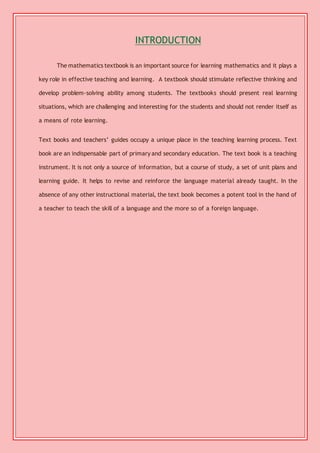
The mathematics textbook is an important source for learning mathematics and it plays a 
key role in effective teaching and learning. A textbook should stimulate reflective thinking and 
develop problem-solving ability among students. The textbooks should present real learning 
situations, which are challenging and interesting for the students and should not render itself as 
a means of rote learning. 
Text books and teachers’ guides occupy a unique place in the teaching learning process. Text 
book are an indispensable part of primary and secondary education. The text book is a teaching 
instrument. It is not only a source of information, but a course of study, a set of unit plans and 
learning guide. It helps to revise and reinforce the language material already taught. In the 
absence of any other instructional material, the text book becomes a potent tool in the hand of 
a teacher to teach the skill of a language and the more so of a foreign language.
QUALITIES OF A GOOD MATHEMATICS TEXTBOOK 
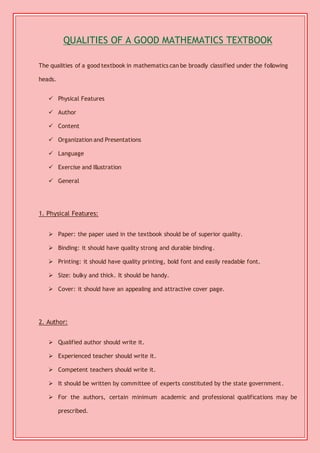
The qualities of a good textbook in mathematics can be broadly classified under the following 
heads. 
 Physical Features 
 Author 
 Content 
 Organization and Presentations 
 Language 
 Exercise and Illustration 
 General 
1. Physical Features: 
 Paper: the paper used in the textbook should be of superior quality. 
 Binding: it should have quality strong and durable binding. 
 Printing: it should have quality printing, bold font and easily readable font. 
 Size: bulky and thick. It should be handy. 
 Cover: it should have an appealing and attractive cover page. 
2. Author: 
 Qualified author should write it. 
 Experienced teacher should write it. 
 Competent teachers should write it. 
 It should be written by committee of experts constituted by the state government. 
 For the authors, certain minimum academic and professional qualifications may be 
prescribed.
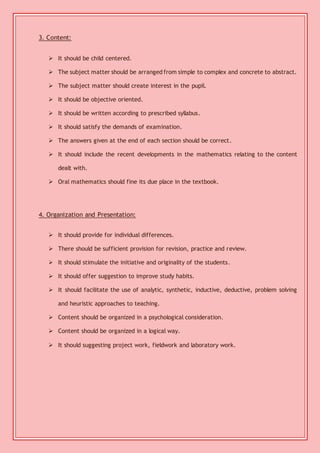
3. Content: 
 It should be child centered. 
 The subject matter should be arranged from simple to complex and concrete to abstract. 
 The subject matter should create interest in the pupil. 
 It should be objective oriented. 
 It should be written according to prescribed syllabus. 
 It should satisfy the demands of examination. 
 The answers given at the end of each section should be correct. 
 It should include the recent developments in the mathematics relating to the content 
dealt with. 
 Oral mathematics should fine its due place in the textbook. 
4. Organization and Presentation: 
 It should provide for individual differences. 
 There should be sufficient provision for revision, practice and review. 
 It should stimulate the initiative and originality of the students. 
 It should offer suggestion to improve study habits. 
 It should facilitate the use of analytic, synthetic, inductive, deductive, problem solving 
and heuristic approaches to teaching. 
 Content should be organized in a psychological consideration. 
 Content should be organized in a logical way. 
 It should suggesting project work, fieldwork and laboratory work.
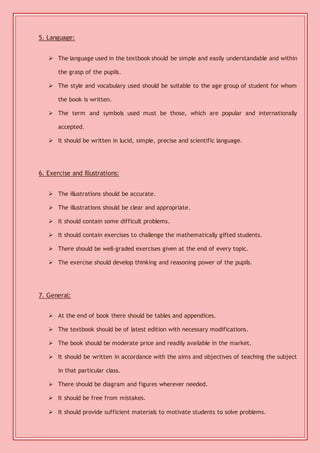
5. Language: 
 The language used in the textbook should be simple and easily understandable and within 
the grasp of the pupils. 
 The style and vocabulary used should be suitable to the age group of student for whom 
the book is written. 
 The term and symbols used must be those, which are popular and internationally 
accepted. 
 It should be written in lucid, simple, precise and scientific language. 
6. Exercise and Illustrations: 
 The illustrations should be accurate. 
 The illustrations should be clear and appropriate. 
 It should contain some difficult problems. 
 It should contain exercises to challenge the mathematically gifted students. 
 There should be well-graded exercises given at the end of every topic. 
 The exercise should develop thinking and reasoning power of the pupils. 
7. General: 
 At the end of book there should be tables and appendices. 
 The textbook should be of latest edition with necessary modifications. 
 The book should be moderate price and readily available in the market. 
 It should be written in accordance with the aims and objectives of teaching the subject 
in that particular class. 
 There should be diagram and figures wherever needed. 
 It should be free from mistakes. 
 It should provide sufficient materials to motivate students to solve problems.
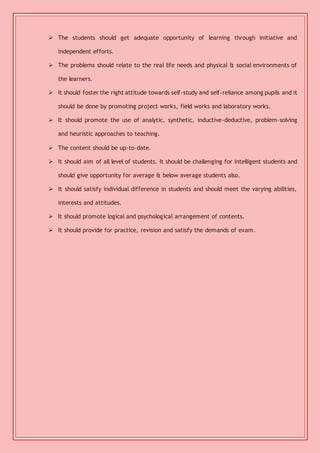
 The students should get adequate opportunity of learning through initiative and 
independent efforts. 
 The problems should relate to the real life needs and physical & social environments of 
the learners. 
 It should foster the right attitude towards self-study and self-reliance among pupils and it 
should be done by promoting project works, field works and laboratory works. 
 It should promote the use of analytic, synthetic, inductive-deductive, problem-solving 
and heuristic approaches to teaching. 
 The content should be up-to-date. 
 It should aim of all level of students. It should be challenging for intelligent students and 
should give opportunity for average & below average students also. 
 It should satisfy individual difference in students and should meet the varying abilities, 
interests and attitudes. 
 It should promote logical and psychological arrangement of contents. 
 It should provide for practice, revision and satisfy the demands of exam.
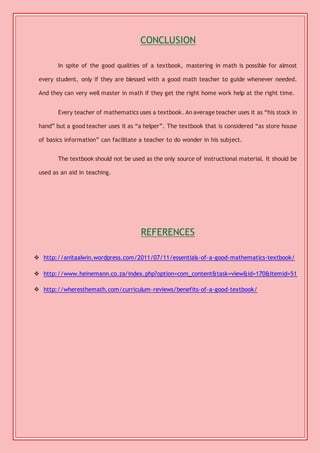
CONCLUSION 
In spite of the good qualities of a textbook, mastering in math is possible for almost 
every student, only if they are blessed with a good math teacher to guide whenever needed. 
And they can very well master in math if they get the right home work help at the right time. 
Every teacher of mathematics uses a textbook. An average teacher uses it as “his stock in 
hand” but a good teacher uses it as “a helper”. The textbook that is considered “as store house 
of basics information” can facilitate a teacher to do wonder in his subject. 
The textbook should not be used as the only source of instructional material. It should be 
used as an aid in teaching. 
REFERENCES 
 http://anitaalwin.wordpress.com/2011/07/11/essentials-of-a-good-mathematics-textbook/ 
 http://www.heinemann.co.za/index.php?option=com_content&task=view&id=170&Itemid=51 
 http://wheresthemath.com/curriculum-reviews/benefits-of-a-good-textbook/

Qualities of a Good Mathematics Text Book

  • 1.
    ONLINE ASSIGNMENT PREPARED& SUBMITTED BY JASMIN. J OPTION: MATHEMATICS KUCTE, ARYAD 2013-2014
  • 3.
    INTRODUCTION The mathematicstextbook is an important source for learning mathematics and it plays a key role in effective teaching and learning. A textbook should stimulate reflective thinking and develop problem-solving ability among students. The textbooks should present real learning situations, which are challenging and interesting for the students and should not render itself as a means of rote learning. Text books and teachers’ guides occupy a unique place in the teaching learning process. Text book are an indispensable part of primary and secondary education. The text book is a teaching instrument. It is not only a source of information, but a course of study, a set of unit plans and learning guide. It helps to revise and reinforce the language material already taught. In the absence of any other instructional material, the text book becomes a potent tool in the hand of a teacher to teach the skill of a language and the more so of a foreign language.
  • 4.
    QUALITIES OF AGOOD MATHEMATICS TEXTBOOK The qualities of a good textbook in mathematics can be broadly classified under the following heads.  Physical Features  Author  Content  Organization and Presentations  Language  Exercise and Illustration  General 1. Physical Features:  Paper: the paper used in the textbook should be of superior quality.  Binding: it should have quality strong and durable binding.  Printing: it should have quality printing, bold font and easily readable font.  Size: bulky and thick. It should be handy.  Cover: it should have an appealing and attractive cover page. 2. Author:  Qualified author should write it.  Experienced teacher should write it.  Competent teachers should write it.  It should be written by committee of experts constituted by the state government.  For the authors, certain minimum academic and professional qualifications may be prescribed.
  • 5.
    3. Content: It should be child centered.  The subject matter should be arranged from simple to complex and concrete to abstract.  The subject matter should create interest in the pupil.  It should be objective oriented.  It should be written according to prescribed syllabus.  It should satisfy the demands of examination.  The answers given at the end of each section should be correct.  It should include the recent developments in the mathematics relating to the content dealt with.  Oral mathematics should fine its due place in the textbook. 4. Organization and Presentation:  It should provide for individual differences.  There should be sufficient provision for revision, practice and review.  It should stimulate the initiative and originality of the students.  It should offer suggestion to improve study habits.  It should facilitate the use of analytic, synthetic, inductive, deductive, problem solving and heuristic approaches to teaching.  Content should be organized in a psychological consideration.  Content should be organized in a logical way.  It should suggesting project work, fieldwork and laboratory work.
  • 6.
    5. Language: The language used in the textbook should be simple and easily understandable and within the grasp of the pupils.  The style and vocabulary used should be suitable to the age group of student for whom the book is written.  The term and symbols used must be those, which are popular and internationally accepted.  It should be written in lucid, simple, precise and scientific language. 6. Exercise and Illustrations:  The illustrations should be accurate.  The illustrations should be clear and appropriate.  It should contain some difficult problems.  It should contain exercises to challenge the mathematically gifted students.  There should be well-graded exercises given at the end of every topic.  The exercise should develop thinking and reasoning power of the pupils. 7. General:  At the end of book there should be tables and appendices.  The textbook should be of latest edition with necessary modifications.  The book should be moderate price and readily available in the market.  It should be written in accordance with the aims and objectives of teaching the subject in that particular class.  There should be diagram and figures wherever needed.  It should be free from mistakes.  It should provide sufficient materials to motivate students to solve problems.
  • 7.
     The studentsshould get adequate opportunity of learning through initiative and independent efforts.  The problems should relate to the real life needs and physical & social environments of the learners.  It should foster the right attitude towards self-study and self-reliance among pupils and it should be done by promoting project works, field works and laboratory works.  It should promote the use of analytic, synthetic, inductive-deductive, problem-solving and heuristic approaches to teaching.  The content should be up-to-date.  It should aim of all level of students. It should be challenging for intelligent students and should give opportunity for average & below average students also.  It should satisfy individual difference in students and should meet the varying abilities, interests and attitudes.  It should promote logical and psychological arrangement of contents.  It should provide for practice, revision and satisfy the demands of exam.
  • 8.
    CONCLUSION In spiteof the good qualities of a textbook, mastering in math is possible for almost every student, only if they are blessed with a good math teacher to guide whenever needed. And they can very well master in math if they get the right home work help at the right time. Every teacher of mathematics uses a textbook. An average teacher uses it as “his stock in hand” but a good teacher uses it as “a helper”. The textbook that is considered “as store house of basics information” can facilitate a teacher to do wonder in his subject. The textbook should not be used as the only source of instructional material. It should be used as an aid in teaching. REFERENCES  http://anitaalwin.wordpress.com/2011/07/11/essentials-of-a-good-mathematics-textbook/  http://www.heinemann.co.za/index.php?option=com_content&task=view&id=170&Itemid=51  http://wheresthemath.com/curriculum-reviews/benefits-of-a-good-textbook/