The Revolution Has BegunHigh School Teachers, Take Notice:Maggie CottoENC 6712December 6, 2009
Purpose of this Presentation:To provide busy high school teachers with current information regarding writing instruction and education policies.
To suggest new instructional goals proven to increase learning proficiency in writing skills.
To provide teachers with resources and guidance to achieve these goals.Recent Legislation related to Writing Instruction:2002: College Board establishes the National Commission on Writing in America’s Schools and Colleges.
2003: This Commission publishes a report calling for a revolution in writing instruction entitled “The Neglected ‘R’: The Need for a Writing Revolution.”
February, 2009: President Obama signs a stimulus law that “requires states receiving stabilization money to work to improve courses and tests so that high school graduates can succeed without remedial classes.”
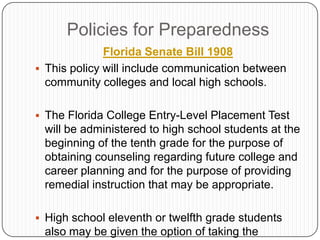
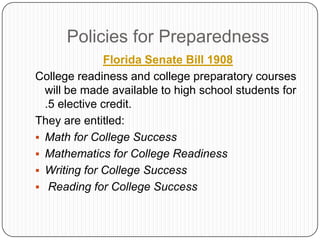
April, 2009: Florida Department of Education notifies schools of Senate Bill 1908 implementing college readiness testing in high school, along with college readiness and college success prep courses.Why this Call for a Revolution?Nationwide decline in writing scores.
Secondary schools found to neglect significant writing instruction.
Changes in college-level writing curricula.
Wide gap between secondary and post-secondary writing instruction.
New research and theories in the field of writing instruction.
Increase in standardized testing, which complicates classroom objectives.
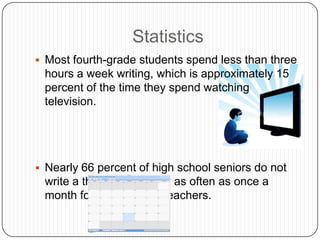
Advances in technology offering new tools for communication and composition.StatisticsMost fourth-grade students spend less than three hours a week writing, which is approximately 15 percent of the time they spend watching television.
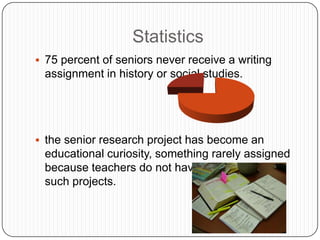
Nearly 66 percent of high school seniors do not write a three-page paper as often as once a month for their English teachers.Statistics 75 percent of seniors never receive a writing assignment in history or social studies.
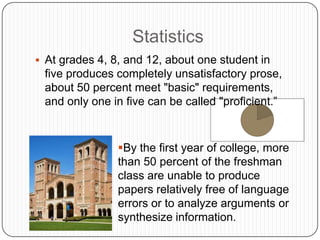
the senior research project has become an educational curiosity, something rarely assigned because teachers do not have time to correct such projects. StatisticsAt grades 4, 8, and 12, about one student in five produces completely unsatisfactory prose, about 50 percent meet "basic" requirements, and only one in five can be called "proficient.”
By the first year of college, more than 50 percent of the freshman class are unable to produce papers relatively free of language errors or to analyze arguments or synthesize information.ConclusionsThese statistics demonstrate that schools across the nation are in drastic need of changing their writing instruction policies and techniques.  The writing commission states clearly:“Although there is much good work taking place in our classrooms, the quality of writing must be improved if students are to succeed in college and in life.”
The Strategy of the Revolution--According to the National Commission on Writing1. A Writing Agenda for the NationAll states’ standards ought to include a comprehensive national writing policy, which would require schools to double the current amount of time spent writing in all of the students’ subject areas.
New education students would take a course in writing theory and practice before obtaining a teaching certificate.
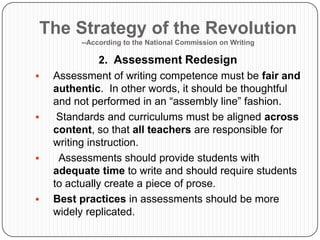
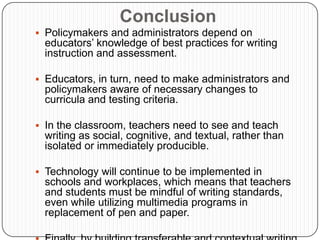
Congress would provide the financial resources necessary for the additional time and personnel required to make writing a centerpiece in the curriculum. The Strategy of the Revolution--According to the National Commission on Writing2.  Assessment RedesignAssessment of writing competence must be fair and authentic.  In other words, it should be thoughtful and not performed in an “assembly line” fashion.
 Standards and curriculums must be aligned across content, so that all teachers are responsible for writing instruction.
  Assessments should provide students with adequate time to write and should require students to actually create a piece of prose.
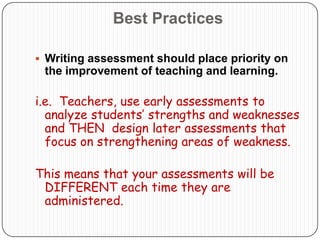
Best practices in assessments should be more widely replicated.Best PracticesWriting assessment should place priority on the improvement of teaching and learning.i.e.  Teachers, use early assessments to analyze students’ strengths and weaknesses and THEN  design later assessments that focus on strengthening areas of weakness.This means that your assessments will be DIFFERENT each time they are administered.
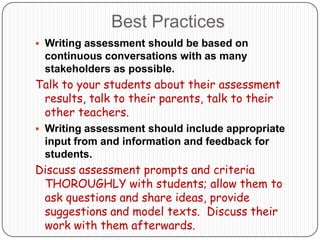
Best PracticesWriting assessment should be based on continuous conversations with as many stakeholders as possible.Talk to your students about their assessment results, talk to their parents, talk to their other teachers.Writing assessment should include appropriate input from and information and feedback for students.Discuss assessment prompts and criteria THOROUGHLY with students; allow them to ask questions and share ideas, provide suggestions and model texts.  Discuss their work with them afterwards.
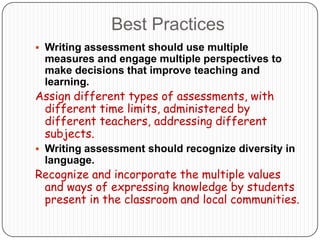
Best PracticesWriting assessment should use multiple measures and engage multiple perspectives to make decisions that improve teaching and learning.Assign different types of assessments, with different time limits, administered by different teachers, addressing different subjects.Writing assessment should recognize diversity in language.Recognize and incorporate the multiple values and ways of expressing knowledge by students present in the classroom and local communities.
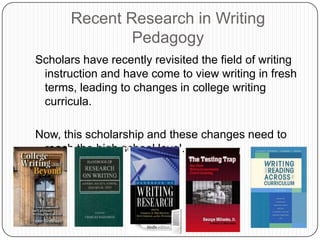
Recent Research in Writing PedagogyScholars have recently revisited the field of writing instruction and have come to view writing in fresh terms, leading to changes in college writing curricula.Now, this scholarship and these changes need to reach the high school level.
Current Theories of WritingWriting is a SOCIAL PRACTICEWhen students understand that writing functions within various social contexts, and that the writing itself varies respectively, they can then learn to transfer skills and adapt to different writing situations better than practicing the act of writing as an isolated task separate from the environment in which it is accomplished.
The social dimension of the activity of writing involves the relationship between the writer and the audience, as well as the socially-constructed artifacts that the writer makes use of during the activity of writing.
The act of writing is not social just because of its communicative purpose… it is also social because it is a social artifact and is carried out in a social setting.Current Theories of WritingWriting is COGNITIVEWriting to Learn- is a pedagogical approach that values writing as a method of learning. When students write reactions to information received in class or in reading, they often comprehend and retain the information better. Writing can also help students work through confusing new ideas and apply what they learn to their own lives and interests. Also, because students write more frequently, they become more comfortable with writing and are able to maintain or even improve upon their writing skills.
 WTL assignments are typically short and informal and can be performed either in or out of class. Examples include writing and reading journals, summaries, response papers, learning logs, problem analyses, and more.  Current Theories of WritingWriting is CONTEXTUALWriting in the Disciplines - recognizes that each discipline has its own unique language conventions, format, and structure.The style, organization, and format that is acceptable in one discipline may not be at all acceptable in another.

Writing Revolution

  • 1.
    The Revolution HasBegunHigh School Teachers, Take Notice:Maggie CottoENC 6712December 6, 2009
  • 2.
    Purpose of thisPresentation:To provide busy high school teachers with current information regarding writing instruction and education policies.
  • 3.
    To suggest newinstructional goals proven to increase learning proficiency in writing skills.
  • 4.
    To provide teacherswith resources and guidance to achieve these goals.Recent Legislation related to Writing Instruction:2002: College Board establishes the National Commission on Writing in America’s Schools and Colleges.
  • 5.
    2003: This Commissionpublishes a report calling for a revolution in writing instruction entitled “The Neglected ‘R’: The Need for a Writing Revolution.”
  • 6.
    February, 2009: PresidentObama signs a stimulus law that “requires states receiving stabilization money to work to improve courses and tests so that high school graduates can succeed without remedial classes.”
  • 7.
    April, 2009: FloridaDepartment of Education notifies schools of Senate Bill 1908 implementing college readiness testing in high school, along with college readiness and college success prep courses.Why this Call for a Revolution?Nationwide decline in writing scores.
  • 8.
    Secondary schools foundto neglect significant writing instruction.
  • 9.
    Changes in college-levelwriting curricula.
  • 10.
    Wide gap betweensecondary and post-secondary writing instruction.
  • 11.
    New research andtheories in the field of writing instruction.
  • 12.
    Increase in standardizedtesting, which complicates classroom objectives.
  • 13.
    Advances in technologyoffering new tools for communication and composition.StatisticsMost fourth-grade students spend less than three hours a week writing, which is approximately 15 percent of the time they spend watching television.
  • 14.
    Nearly 66 percentof high school seniors do not write a three-page paper as often as once a month for their English teachers.Statistics 75 percent of seniors never receive a writing assignment in history or social studies.
  • 15.
    the senior researchproject has become an educational curiosity, something rarely assigned because teachers do not have time to correct such projects. StatisticsAt grades 4, 8, and 12, about one student in five produces completely unsatisfactory prose, about 50 percent meet "basic" requirements, and only one in five can be called "proficient.”
  • 16.
    By the firstyear of college, more than 50 percent of the freshman class are unable to produce papers relatively free of language errors or to analyze arguments or synthesize information.ConclusionsThese statistics demonstrate that schools across the nation are in drastic need of changing their writing instruction policies and techniques. The writing commission states clearly:“Although there is much good work taking place in our classrooms, the quality of writing must be improved if students are to succeed in college and in life.”
  • 17.
    The Strategy ofthe Revolution--According to the National Commission on Writing1. A Writing Agenda for the NationAll states’ standards ought to include a comprehensive national writing policy, which would require schools to double the current amount of time spent writing in all of the students’ subject areas.
  • 18.
    New education studentswould take a course in writing theory and practice before obtaining a teaching certificate.
  • 19.
    Congress would providethe financial resources necessary for the additional time and personnel required to make writing a centerpiece in the curriculum. The Strategy of the Revolution--According to the National Commission on Writing2. Assessment RedesignAssessment of writing competence must be fair and authentic. In other words, it should be thoughtful and not performed in an “assembly line” fashion.
  • 20.
    Standards andcurriculums must be aligned across content, so that all teachers are responsible for writing instruction.
  • 21.
    Assessmentsshould provide students with adequate time to write and should require students to actually create a piece of prose.
  • 22.
    Best practices inassessments should be more widely replicated.Best PracticesWriting assessment should place priority on the improvement of teaching and learning.i.e. Teachers, use early assessments to analyze students’ strengths and weaknesses and THEN design later assessments that focus on strengthening areas of weakness.This means that your assessments will be DIFFERENT each time they are administered.
  • 23.
    Best PracticesWriting assessmentshould be based on continuous conversations with as many stakeholders as possible.Talk to your students about their assessment results, talk to their parents, talk to their other teachers.Writing assessment should include appropriate input from and information and feedback for students.Discuss assessment prompts and criteria THOROUGHLY with students; allow them to ask questions and share ideas, provide suggestions and model texts. Discuss their work with them afterwards.
  • 24.
    Best PracticesWriting assessmentshould use multiple measures and engage multiple perspectives to make decisions that improve teaching and learning.Assign different types of assessments, with different time limits, administered by different teachers, addressing different subjects.Writing assessment should recognize diversity in language.Recognize and incorporate the multiple values and ways of expressing knowledge by students present in the classroom and local communities.
  • 25.
    Recent Research inWriting PedagogyScholars have recently revisited the field of writing instruction and have come to view writing in fresh terms, leading to changes in college writing curricula.Now, this scholarship and these changes need to reach the high school level.
  • 26.
    Current Theories ofWritingWriting is a SOCIAL PRACTICEWhen students understand that writing functions within various social contexts, and that the writing itself varies respectively, they can then learn to transfer skills and adapt to different writing situations better than practicing the act of writing as an isolated task separate from the environment in which it is accomplished.
  • 27.
    The social dimensionof the activity of writing involves the relationship between the writer and the audience, as well as the socially-constructed artifacts that the writer makes use of during the activity of writing.
  • 28.
    The act ofwriting is not social just because of its communicative purpose… it is also social because it is a social artifact and is carried out in a social setting.Current Theories of WritingWriting is COGNITIVEWriting to Learn- is a pedagogical approach that values writing as a method of learning. When students write reactions to information received in class or in reading, they often comprehend and retain the information better. Writing can also help students work through confusing new ideas and apply what they learn to their own lives and interests. Also, because students write more frequently, they become more comfortable with writing and are able to maintain or even improve upon their writing skills.
  • 29.
    WTL assignmentsare typically short and informal and can be performed either in or out of class. Examples include writing and reading journals, summaries, response papers, learning logs, problem analyses, and more. Current Theories of WritingWriting is CONTEXTUALWriting in the Disciplines - recognizes that each discipline has its own unique language conventions, format, and structure.The style, organization, and format that is acceptable in one discipline may not be at all acceptable in another.