The Literacy-Rich ClassroomJessica CrookerLiteracy CoachNorth View Junior High
Guiding questions:Why should literacy be central to our curriculum?How can teachers provide literacy-rich experiences for their students and teach the standards?What is the role of Language Arts and Social Studies teachers in teaching reading?To accelerate reading growth? To provide opportunities for students to read informational texts and literature within the appropriate grade-level complexity band?
Why Should Literacy be central to our curriculum?Adora Svitakhttp://www.youtube.com/watch?v=V-bjOJzB7LY
Her articulate dialogue?Her confidence in public speaking? Her vast vocabulary?Children grow up to be adults?The need to teach children to be better adults than us? Her ability to ask, “why not?”
Instructional InventoryBrainstorm typical activities in your classroom & assigned as homeworkAdd, if appropriate:Reading with a purposeRe-reading for deeper learningWriting to learnWriting: expository, creative, persuasiveThinking analytically, criticallyEvaluating based on reading or writingParticipating in academic discourse
Instructional InventoryTwo most frequent * (star)Two least frequent – (minus)Which column is more literacy-rich?Classroom activitiesHomework
Reading with a purposeRe-reading for deeper learningWriting to learnWriting: expository, creative, persuasiveThinking analytically, criticallyEvaluating based on reading or writingParticipating in academic discourse
	“Wise teachers (and coaches and orchestra conductors) do not spend time rehearsing what students, athletes, and musicians can already do well – they invest precious practice time on activities that are challenging and difficult.”						(Reeves, 2010)
“Reading, writing, and discussion—these three—are the foundation for a well-equipped mind.”				    (Schmoker, 2006, p. 72)
	“In a recent report, the National Commission on Writing also addresses this concern. They say, ‘If students are to make knowledge their own, they must struggle with the details, wrestle with the facts, and rework raw information and dimly understood concepts into language they can communicate to someone else. In short, if students are to learn, they must write.’”		   Carnegie Corporation Writing to Read				   (Graham & Hebert, 2010)
Traditional uses of WritingEvaluative Evidence of understandingMeasurement of what learning has been gainedHigh-stakes SummativeEnd of unitIndividualistic Not sharedLimited in genre essay, academic in nature
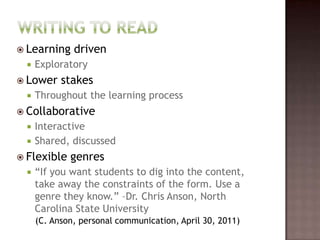
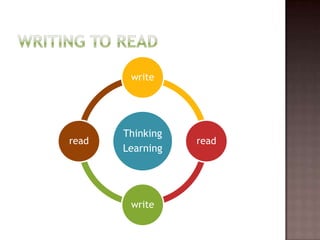
Writing to ReadLearning drivenExploratory Lower stakesThroughout the learning processCollaborativeInteractiveShared, discussedFlexible genres“If you want students to dig into the content, take away the constraints of the form. Use a genre they know.” –Dr. Chris Anson, North Carolina State University(C. Anson, personal communication, April 30, 2011)
Writing to Read
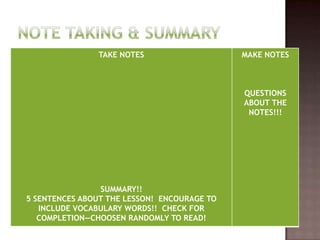
Note Taking & SUmmary
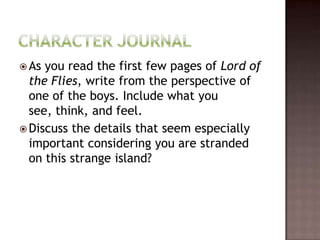
Character JournalAs you read the first few pages of Lord of the Flies, write from the perspective of one of the boys. Include what you see, think, and feel. Discuss the details that seem especially important considering you are stranded on this strange island?
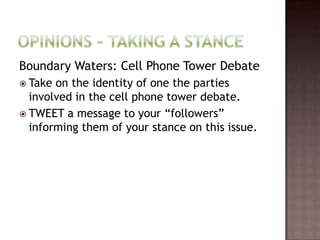
Opinions – taking a stanceBoundary Waters: Cell Phone Tower DebateTake on the identity of one the parties involved in the cell phone tower debate.TWEET a message to your “followers” informing them of your stance on this issue.
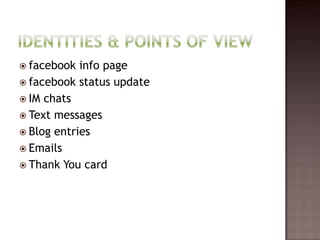
Identities & Points of Viewfacebook info page facebook status updateIM chatsText messagesBlog entriesEmailsThank You card
“If you want students to dig into the content, take away the constraints of the form. Use a genre they know.” 				–Dr. Chris Anson North Carolina State University(C. Anson, personal communication, April 30, 2011)
What is the role of Language Arts and Social Studies teachers?To accelerate reading growth? To provide opportunities for students to read informational texts and literature within the appropriate grade-level complexity band?
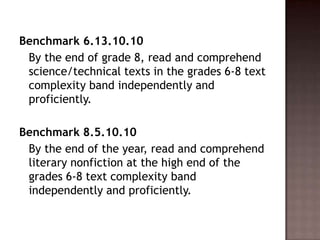
Benchmark 6.13.10.10	By the end of grade 8, read and comprehend science/technical texts in the grades 6-8 text complexity band independently and proficiently. Benchmark 8.5.10.10	By the end of the year, read and comprehend literary nonfiction at the high end of the grades 6-8 text complexity band independently and proficiently.
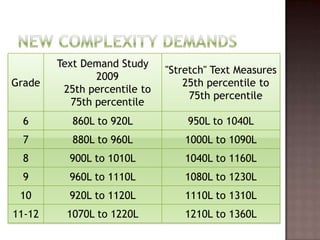
New complexity Demands
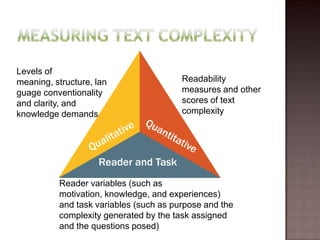
Measuring text complexityLevels of meaning, structure, language conventionality and clarity, and    knowledge demands Readability measures and other scores of text complexityReader variables (such as motivation, knowledge, and experiences) and task variables (such as purpose and the complexity generated by the task assigned and the questions posed)
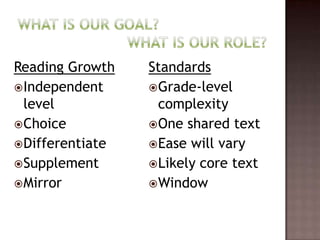
Reading GrowthIndependent levelChoiceDifferentiateSupplementMirrorStandardsGrade-level complexityOne shared textEase will varyLikely core textWindowWhat is our goal? 			   What is our role?
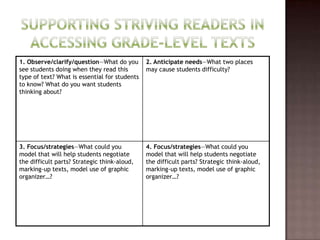
Supporting striving readers in accessing grade-level texts
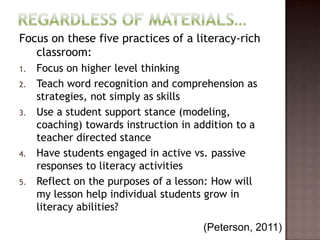
Regardless of materials…Focus on these five practices of a literacy-rich classroom:Focus on higher level thinkingTeach word recognition and comprehension as strategies, not simply as skillsUse a student support stance (modeling, coaching) towards instruction in addition to a teacher directed stanceHave students engaged in active vs. passive responses to literacy activitiesReflect on the purposes of a lesson: How will my lesson help individual students grow in literacy abilities?(Peterson, 2011)
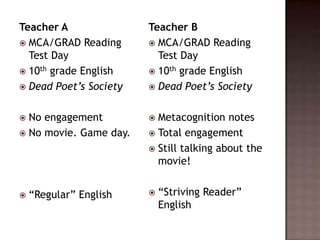
Teacher AMCA/GRAD Reading Test Day10th grade EnglishDead Poet’s SocietyNo engagementNo movie. Game day.“Regular” EnglishTeacher BMCA/GRAD Reading Test Day10th grade EnglishDead Poet’s SocietyMetacognition notesTotal engagementStill talking about the movie!“Striving Reader” English
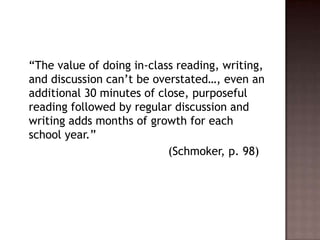
	“The value of doing in-class reading, writing, and discussion can’t be overstated…, even an additional 30 minutes of close, purposeful reading followed by regular discussion and writing adds months of growth for each school year.”					      (Schmoker, p. 98)
ResourcesGraham, S., and Hebert, M. A. (2010). Writing to read: Evidence for how writing can improve reading. A Carnegie Corporation Time to Act Report. Washington, DC: Alliance for Excellent Education.Peterson, D. (2011) Developing Effective Teachers of Reading through School-wide Change [PowerPoint slides]. Retrieved from http://www.cehd.umn.edu/reading/Reeves, D. (2010, Oct. 20). Leading the Change in the Face of Criticism. Retrieved from http://www.leadandlearn.com/blog/2010/10/leading-change-face-criticismSchmoker, M. (2006). Results Now: How we can achieve unprecedented improvements in teaching and learning. Alexandra, Virginia: ASCD.

The Literacy-Rich Classroom

  • 1.
    The Literacy-Rich ClassroomJessicaCrookerLiteracy CoachNorth View Junior High
  • 2.
    Guiding questions:Why shouldliteracy be central to our curriculum?How can teachers provide literacy-rich experiences for their students and teach the standards?What is the role of Language Arts and Social Studies teachers in teaching reading?To accelerate reading growth? To provide opportunities for students to read informational texts and literature within the appropriate grade-level complexity band?
  • 3.
    Why Should Literacybe central to our curriculum?Adora Svitakhttp://www.youtube.com/watch?v=V-bjOJzB7LY
  • 4.
    Her articulate dialogue?Herconfidence in public speaking? Her vast vocabulary?Children grow up to be adults?The need to teach children to be better adults than us? Her ability to ask, “why not?”
  • 5.
    Instructional InventoryBrainstorm typicalactivities in your classroom & assigned as homeworkAdd, if appropriate:Reading with a purposeRe-reading for deeper learningWriting to learnWriting: expository, creative, persuasiveThinking analytically, criticallyEvaluating based on reading or writingParticipating in academic discourse
  • 6.
    Instructional InventoryTwo mostfrequent * (star)Two least frequent – (minus)Which column is more literacy-rich?Classroom activitiesHomework
  • 7.
    Reading with apurposeRe-reading for deeper learningWriting to learnWriting: expository, creative, persuasiveThinking analytically, criticallyEvaluating based on reading or writingParticipating in academic discourse
  • 8.
    “Wise teachers (andcoaches and orchestra conductors) do not spend time rehearsing what students, athletes, and musicians can already do well – they invest precious practice time on activities that are challenging and difficult.” (Reeves, 2010)
  • 9.
    “Reading, writing, anddiscussion—these three—are the foundation for a well-equipped mind.” (Schmoker, 2006, p. 72)
  • 10.
    “In a recentreport, the National Commission on Writing also addresses this concern. They say, ‘If students are to make knowledge their own, they must struggle with the details, wrestle with the facts, and rework raw information and dimly understood concepts into language they can communicate to someone else. In short, if students are to learn, they must write.’” Carnegie Corporation Writing to Read (Graham & Hebert, 2010)
  • 11.
    Traditional uses ofWritingEvaluative Evidence of understandingMeasurement of what learning has been gainedHigh-stakes SummativeEnd of unitIndividualistic Not sharedLimited in genre essay, academic in nature
  • 12.
    Writing to ReadLearningdrivenExploratory Lower stakesThroughout the learning processCollaborativeInteractiveShared, discussedFlexible genres“If you want students to dig into the content, take away the constraints of the form. Use a genre they know.” –Dr. Chris Anson, North Carolina State University(C. Anson, personal communication, April 30, 2011)
  • 13.
  • 14.
  • 15.
    Character JournalAs youread the first few pages of Lord of the Flies, write from the perspective of one of the boys. Include what you see, think, and feel. Discuss the details that seem especially important considering you are stranded on this strange island?
  • 16.
    Opinions – takinga stanceBoundary Waters: Cell Phone Tower DebateTake on the identity of one the parties involved in the cell phone tower debate.TWEET a message to your “followers” informing them of your stance on this issue.
  • 17.
    Identities & Pointsof Viewfacebook info page facebook status updateIM chatsText messagesBlog entriesEmailsThank You card
  • 18.
    “If you wantstudents to dig into the content, take away the constraints of the form. Use a genre they know.” –Dr. Chris Anson North Carolina State University(C. Anson, personal communication, April 30, 2011)
  • 19.
    What is therole of Language Arts and Social Studies teachers?To accelerate reading growth? To provide opportunities for students to read informational texts and literature within the appropriate grade-level complexity band?
  • 20.
    Benchmark 6.13.10.10 By theend of grade 8, read and comprehend science/technical texts in the grades 6-8 text complexity band independently and proficiently. Benchmark 8.5.10.10 By the end of the year, read and comprehend literary nonfiction at the high end of the grades 6-8 text complexity band independently and proficiently.
  • 21.
  • 22.
    Measuring text complexityLevelsof meaning, structure, language conventionality and clarity, and knowledge demands Readability measures and other scores of text complexityReader variables (such as motivation, knowledge, and experiences) and task variables (such as purpose and the complexity generated by the task assigned and the questions posed)
  • 23.
    Reading GrowthIndependent levelChoiceDifferentiateSupplementMirrorStandardsGrade-levelcomplexityOne shared textEase will varyLikely core textWindowWhat is our goal? What is our role?
  • 24.
    Supporting striving readersin accessing grade-level texts
  • 25.
    Regardless of materials…Focuson these five practices of a literacy-rich classroom:Focus on higher level thinkingTeach word recognition and comprehension as strategies, not simply as skillsUse a student support stance (modeling, coaching) towards instruction in addition to a teacher directed stanceHave students engaged in active vs. passive responses to literacy activitiesReflect on the purposes of a lesson: How will my lesson help individual students grow in literacy abilities?(Peterson, 2011)
  • 26.
    Teacher AMCA/GRAD ReadingTest Day10th grade EnglishDead Poet’s SocietyNo engagementNo movie. Game day.“Regular” EnglishTeacher BMCA/GRAD Reading Test Day10th grade EnglishDead Poet’s SocietyMetacognition notesTotal engagementStill talking about the movie!“Striving Reader” English
  • 27.
    “The value ofdoing in-class reading, writing, and discussion can’t be overstated…, even an additional 30 minutes of close, purposeful reading followed by regular discussion and writing adds months of growth for each school year.” (Schmoker, p. 98)
  • 28.
    ResourcesGraham, S., andHebert, M. A. (2010). Writing to read: Evidence for how writing can improve reading. A Carnegie Corporation Time to Act Report. Washington, DC: Alliance for Excellent Education.Peterson, D. (2011) Developing Effective Teachers of Reading through School-wide Change [PowerPoint slides]. Retrieved from http://www.cehd.umn.edu/reading/Reeves, D. (2010, Oct. 20). Leading the Change in the Face of Criticism. Retrieved from http://www.leadandlearn.com/blog/2010/10/leading-change-face-criticismSchmoker, M. (2006). Results Now: How we can achieve unprecedented improvements in teaching and learning. Alexandra, Virginia: ASCD.

Editor's Notes

  • #26 You have to start small and not feel the need to throw everything out and start all over. Instead…1.  Higher order talk and writing about text (remember it is not enough to just ask higher order questions, we need to teach students how to give higher order responses).2.  Teaching comprehension and word recognition as strategies not just skills.3.  Using modeling, coaching, and listening and giving feedback more than just telling and recitation (Q-A-Q-A).4.  Having all students be actively engaged (i.e. every single child reading, writing, manipulating, or sharing with a partner) rather than listening or waiting for a turn.5. Telling the students the purpose of the lesson and how it will help them as readers and writers.