Promoting Writing
Dr. Terri-Jo Brodeur
National Writing Project
Writing Project’s Advanced Summer Institute
Introduction
• 80% of Americans believe there is a greater
need than ever before to be able to write well
(National Writing Project, 2009).
• Many high school seniors appear to be lacking
the skills needed for college (National
Assessment of Educational Progress, 2007).
Statistics
• National Assessment of Educational Progress (2007)
▫ 7 out of 10 high school seniors failed to achieve the benchmark of
proficient writing
▫ 57% of seniors scored at the lower level of basic writing
▫ 12% failed to meet the basic requirements
▫ Only 1 out of every 5 scored at or above the expected level of
proficiency
• Additional task practice is needed where students are engaged and
functioning as experienced writers (Kellogg & Whiteford, 2009)
Problem Statement
• To overcome writing deficiencies at the secondary level,
the cognitive process of writing must become relatively
automatic and effortless for students.
• Additional task practice is needed where students are
engaged and functioning as experienced writers (Kellogg
& Whiteford, 2009).
• The general problem is despite high school seniors
lacking the written skills needed for college or the
workplace, there is a lack of focus on writing in all
content area classes (Applebee & Langer, 2011; Dana,
Hancock, & Phillips, 2011; Haynes, 2009; NWP, 2008).
• A shared commitment is needed among subject areas so
children can become better writers (Applebee & Langer,
2011).
Problem Statement (cont)
• School policy and the associated professional development
opportunities have not kept up with the national trends
(National Governors Association, 2010).
• To maneuver these demands curriculum must move
from the individual act of instructing writing in one
core class to one of training writers in all classrooms
across the curriculum.
• Power of skill acquisition: the role of deliberate
practice coupled with the intensive demands that written
composition and reflection places on an individuals’
working memory (Kellogg & Whiteford, 2009; Strong,
2006; Torrance, Galbrith, & Waes., 2007).
Writing Across
the Curriculum
The lack of guidelines provided to educators in the area of
writing and utilizing writing to learn activities has added to
the general problem. The major impediments faced by
educators in adding sufficient task practice is the time and
effort needed in grading writing, the lack of knowledge in
providing quality feedback, insufficient understanding of the
benefits writing can instill in students, and the role identity
holds in teaching writing (Cremin & Baker, 2010; Kellogg &
Whiteford, 2009; Strong, 2006; Torrance et al., 2007).
Many educators have neglected the shared commitment needed
to promote the interrelationship of writing, learning, and
thinking through writing across content areas (Applebee &
Langer, 2006; Kahn & Holody, 2009; Nagin, 2006; Torrance et
al., 2007).
Significance of Writing
• To provide quality instruction it is necessary to
link the instructional writing practice to the
growing base of knowledge on the need to
promote writing in all content areas. The
production of up-to-date data relating to
outcomes and practices is necessary to describe
the current state of knowledge and actual
practice (Henriquez, 2010).
Writing and Cognitive
Thought
• In order for learning to occur, students first gain an
understanding by looking for meaning as it relates
to the world while constructing relationships based
on existing schema (Olson, 1977).
• Applebee (1984) further discussed the process of
learning is amplified through writing because
students become involved in the task of making
sense of the new information while trying to
organize it within preexisting schemata.
• A writer’s schemata in turn leads to new
interpretations as relationships are located,
explored, activated, and analyzed through the
writing process.
Writing to Learn
• Writing to learn is different from writing to convey a message
through communication. Under the term WTL, students use
written language to represent an understanding through a
personal experience.
• Writing to learn generally involved a variety of skills including
problem solving processes and critical thinking. When
involved in WTL students tend to become better
communicators and learners (Holliway, 2009).
• Writing to learn followed the premise if students can learn by
writing, then this same writing can assist in learning in
multiple disciplines. In many instances students grow in the
desire to take ownership of learning while building more
concrete meaning (Klein & Rose, 2010).
Writing to Learn (cont)
• Research on WTL has been ongoing for several decades and
supported students involved in writing to learn strategies to build
stronger comprehension skills than peers who were not actively
involved in writing about the new content material (Duke &
Pearson, 2002; Fisher & Frey, 2008).
• Many teachers however see writing to learn as part of the language
arts classroom and not applicable to other content area classes.
According to research, the physical act of writing does play a large
role in the development of meta-cognitive skills (Carr, 2002; Fisher
& Frey, 2008).
• Writing further fosters the advancement of reasoning skills and
provides students with an avenue to organize and evaluate the
content material. Writing also develops a higher cognitive thought
process such as analysis and synthesis while entailing some
conscious exploration through active reflection (Fisher & Frey,
2008).
References
• Applebee, A. N. (1984). Writing and reasoning. Review of Educational Research,
54(4), 577-596. doi:10.2307/1170176
• Applebee, A. N., & Langer, J. A. (2011). A snapshot of writing instruction in middle schools
and high schools. English Journal, 100(6), 14-27.
• Applebee, A. N., & Langer, J. A. (2006). The state of writing instruction in America’s
schools: What existing data tells us. Albany, NY: Center on English Learning and
Achievement, SUNY University.
• Carr, S. C. (2002). Assessing learning processes: Useful information for teachers and
students. Intervention in School and Clinic, 37(1), 156-162.
doi:10.1177/105345120203700304
• Creswell, J. W. (2005). Educational research: Planning, conducting, and evaluating
quantitative and qualitative research (2nd ed.). Upper Saddle River, NJ: Pearson.
• Cremin, T., & Baker, S. (2010). Exploring teacher-writer identities in the classroom:
Conceptualizing the struggle. English Teaching: Practice and Critique, 9(3), 8-25.
• Dana, H., Hancock, C., & Phillips, J. (2011). A research proposal to evaluate the merits of
writing across the curriculum. American Journal of Business Education, 4(5), 15-20.
• Duke, N. K. & Pearson, P. D. (2002). Effective practices for developing reading
comprehension. In A. E. Farstup & S. J. Samuels (Eds), What research has to say about
reading instruction. (2nd ed.). Newark, DE: International Reading Association.
• Fisher, D., & Frey, N. (2008). Better learning through structured teaching. Alexandria:
ASCD.
References
• Haynes, M. (2009). State actions to improve adolescent literacy- Results from NASBE’s
state adolescent literacy network. New York: National Association of State Boards of
Education.
• Henriquez, A. (2010). Time to Act: An agenda for advancing adolescent literacy for college
and career success. New York, NY: Final Report from Carnegie Corporation of New York’s
Council on Advancing Adolescent Literacy.
• Holliway, D. (2009). Towards a sense-making pedagogy: Writing activities in an
undergraduate learning theories course. International Journal of Teaching and Learning in
Higher Education, 20(3), 447-461.
• Kahn, J., & Holody, R. (2009). WAC: A strengths-based approach to student learning.
Journal of Baccalaureate Social Work, 14(1), 83-94.
• Kellogg, R., & Whiteford, A. (2009). Training advanced writing skills: The case for
deliberate practice. Educational Psychologist, 44(4), 250-266. Retrieved from
ebscohost.com.ezproxy.apollolibrary.com
• Klein, P., & Rose, M. (2010). Teaching argument and explanation to prepare junior students
for writing to learn. Reading Research Quarterly, 45(4), 433-461. doi:10.1598/RRQ.45.4.4
• Nagin, C. (2006). Because writing matters: Improving student writing in our schools
(2nd ed.). San Francisco, CA: Jossey-Bass.
• Olson, D. (1977). Oral and written language and the cognitive processes of children.
Journal of Communication, 27(3), 10-26. doi:10.1111/j.1460-2466.1977.tb02119.x
References
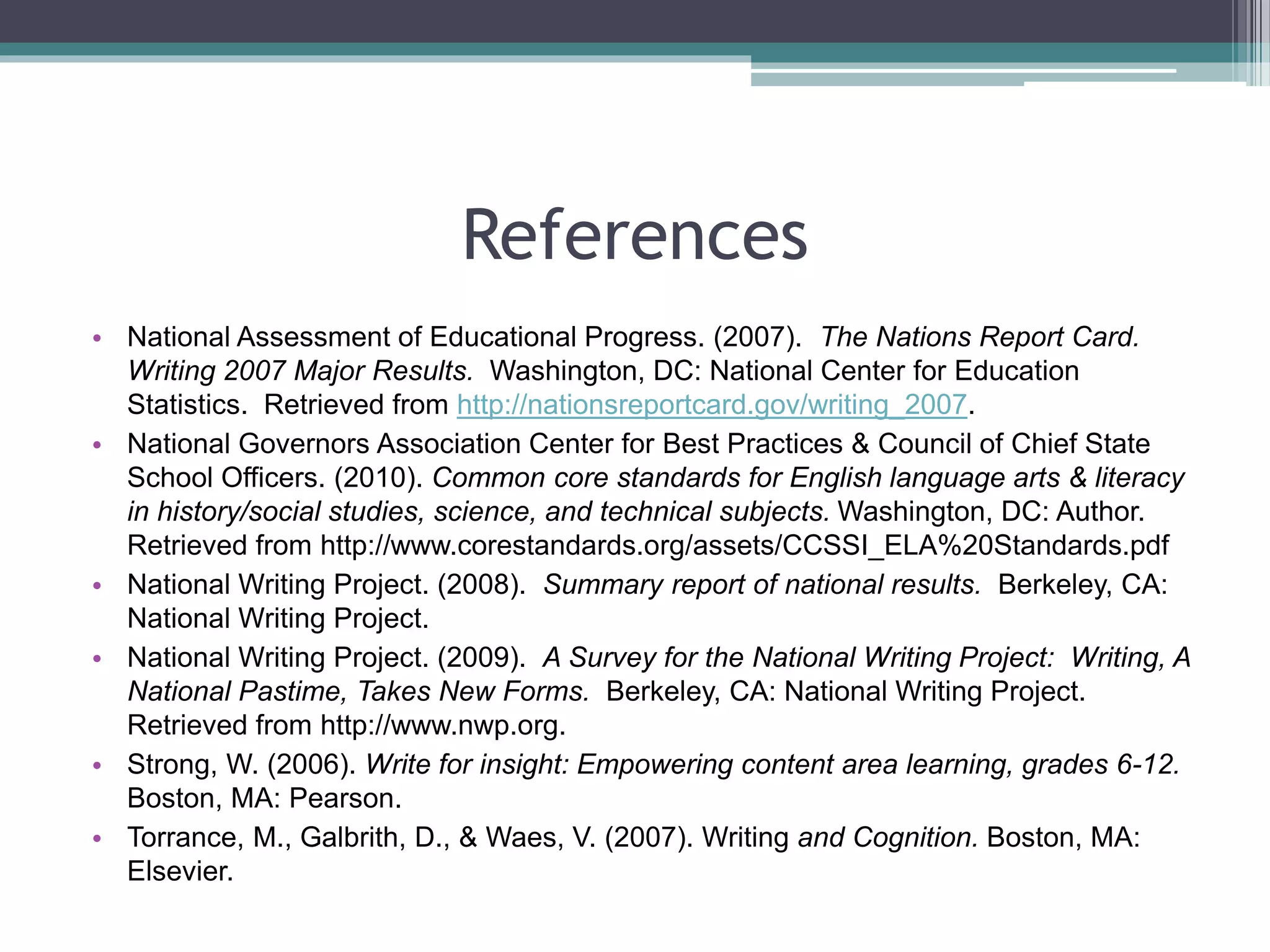
• National Assessment of Educational Progress. (2007). The Nations Report Card.
Writing 2007 Major Results. Washington, DC: National Center for Education
Statistics. Retrieved from http://nationsreportcard.gov/writing_2007.
• National Governors Association Center for Best Practices & Council of Chief State
School Officers. (2010). Common core standards for English language arts & literacy
in history/social studies, science, and technical subjects. Washington, DC: Author.
Retrieved from http://www.corestandards.org/assets/CCSSI_ELA%20Standards.pdf
• National Writing Project. (2008). Summary report of national results. Berkeley, CA:
National Writing Project.
• National Writing Project. (2009). A Survey for the National Writing Project: Writing, A
National Pastime, Takes New Forms. Berkeley, CA: National Writing Project.
Retrieved from http://www.nwp.org.
• Strong, W. (2006). Write for insight: Empowering content area learning, grades 6-12.
Boston, MA: Pearson.
• Torrance, M., Galbrith, D., & Waes, V. (2007). Writing and Cognition. Boston, MA:
Elsevier.

Promoting writing power point

  • 1.
    Promoting Writing Dr. Terri-JoBrodeur National Writing Project Writing Project’s Advanced Summer Institute
  • 2.
    Introduction • 80% ofAmericans believe there is a greater need than ever before to be able to write well (National Writing Project, 2009). • Many high school seniors appear to be lacking the skills needed for college (National Assessment of Educational Progress, 2007).
  • 3.
    Statistics • National Assessmentof Educational Progress (2007) ▫ 7 out of 10 high school seniors failed to achieve the benchmark of proficient writing ▫ 57% of seniors scored at the lower level of basic writing ▫ 12% failed to meet the basic requirements ▫ Only 1 out of every 5 scored at or above the expected level of proficiency • Additional task practice is needed where students are engaged and functioning as experienced writers (Kellogg & Whiteford, 2009)
  • 4.
    Problem Statement • Toovercome writing deficiencies at the secondary level, the cognitive process of writing must become relatively automatic and effortless for students. • Additional task practice is needed where students are engaged and functioning as experienced writers (Kellogg & Whiteford, 2009). • The general problem is despite high school seniors lacking the written skills needed for college or the workplace, there is a lack of focus on writing in all content area classes (Applebee & Langer, 2011; Dana, Hancock, & Phillips, 2011; Haynes, 2009; NWP, 2008). • A shared commitment is needed among subject areas so children can become better writers (Applebee & Langer, 2011).
  • 5.
    Problem Statement (cont) •School policy and the associated professional development opportunities have not kept up with the national trends (National Governors Association, 2010). • To maneuver these demands curriculum must move from the individual act of instructing writing in one core class to one of training writers in all classrooms across the curriculum. • Power of skill acquisition: the role of deliberate practice coupled with the intensive demands that written composition and reflection places on an individuals’ working memory (Kellogg & Whiteford, 2009; Strong, 2006; Torrance, Galbrith, & Waes., 2007).
  • 6.
    Writing Across the Curriculum Thelack of guidelines provided to educators in the area of writing and utilizing writing to learn activities has added to the general problem. The major impediments faced by educators in adding sufficient task practice is the time and effort needed in grading writing, the lack of knowledge in providing quality feedback, insufficient understanding of the benefits writing can instill in students, and the role identity holds in teaching writing (Cremin & Baker, 2010; Kellogg & Whiteford, 2009; Strong, 2006; Torrance et al., 2007). Many educators have neglected the shared commitment needed to promote the interrelationship of writing, learning, and thinking through writing across content areas (Applebee & Langer, 2006; Kahn & Holody, 2009; Nagin, 2006; Torrance et al., 2007).
  • 7.
    Significance of Writing •To provide quality instruction it is necessary to link the instructional writing practice to the growing base of knowledge on the need to promote writing in all content areas. The production of up-to-date data relating to outcomes and practices is necessary to describe the current state of knowledge and actual practice (Henriquez, 2010).
  • 8.
    Writing and Cognitive Thought •In order for learning to occur, students first gain an understanding by looking for meaning as it relates to the world while constructing relationships based on existing schema (Olson, 1977). • Applebee (1984) further discussed the process of learning is amplified through writing because students become involved in the task of making sense of the new information while trying to organize it within preexisting schemata. • A writer’s schemata in turn leads to new interpretations as relationships are located, explored, activated, and analyzed through the writing process.
  • 9.
    Writing to Learn •Writing to learn is different from writing to convey a message through communication. Under the term WTL, students use written language to represent an understanding through a personal experience. • Writing to learn generally involved a variety of skills including problem solving processes and critical thinking. When involved in WTL students tend to become better communicators and learners (Holliway, 2009). • Writing to learn followed the premise if students can learn by writing, then this same writing can assist in learning in multiple disciplines. In many instances students grow in the desire to take ownership of learning while building more concrete meaning (Klein & Rose, 2010).
  • 10.
    Writing to Learn(cont) • Research on WTL has been ongoing for several decades and supported students involved in writing to learn strategies to build stronger comprehension skills than peers who were not actively involved in writing about the new content material (Duke & Pearson, 2002; Fisher & Frey, 2008). • Many teachers however see writing to learn as part of the language arts classroom and not applicable to other content area classes. According to research, the physical act of writing does play a large role in the development of meta-cognitive skills (Carr, 2002; Fisher & Frey, 2008). • Writing further fosters the advancement of reasoning skills and provides students with an avenue to organize and evaluate the content material. Writing also develops a higher cognitive thought process such as analysis and synthesis while entailing some conscious exploration through active reflection (Fisher & Frey, 2008).
  • 11.
    References • Applebee, A.N. (1984). Writing and reasoning. Review of Educational Research, 54(4), 577-596. doi:10.2307/1170176 • Applebee, A. N., & Langer, J. A. (2011). A snapshot of writing instruction in middle schools and high schools. English Journal, 100(6), 14-27. • Applebee, A. N., & Langer, J. A. (2006). The state of writing instruction in America’s schools: What existing data tells us. Albany, NY: Center on English Learning and Achievement, SUNY University. • Carr, S. C. (2002). Assessing learning processes: Useful information for teachers and students. Intervention in School and Clinic, 37(1), 156-162. doi:10.1177/105345120203700304 • Creswell, J. W. (2005). Educational research: Planning, conducting, and evaluating quantitative and qualitative research (2nd ed.). Upper Saddle River, NJ: Pearson. • Cremin, T., & Baker, S. (2010). Exploring teacher-writer identities in the classroom: Conceptualizing the struggle. English Teaching: Practice and Critique, 9(3), 8-25. • Dana, H., Hancock, C., & Phillips, J. (2011). A research proposal to evaluate the merits of writing across the curriculum. American Journal of Business Education, 4(5), 15-20. • Duke, N. K. & Pearson, P. D. (2002). Effective practices for developing reading comprehension. In A. E. Farstup & S. J. Samuels (Eds), What research has to say about reading instruction. (2nd ed.). Newark, DE: International Reading Association. • Fisher, D., & Frey, N. (2008). Better learning through structured teaching. Alexandria: ASCD.
  • 12.
    References • Haynes, M.(2009). State actions to improve adolescent literacy- Results from NASBE’s state adolescent literacy network. New York: National Association of State Boards of Education. • Henriquez, A. (2010). Time to Act: An agenda for advancing adolescent literacy for college and career success. New York, NY: Final Report from Carnegie Corporation of New York’s Council on Advancing Adolescent Literacy. • Holliway, D. (2009). Towards a sense-making pedagogy: Writing activities in an undergraduate learning theories course. International Journal of Teaching and Learning in Higher Education, 20(3), 447-461. • Kahn, J., & Holody, R. (2009). WAC: A strengths-based approach to student learning. Journal of Baccalaureate Social Work, 14(1), 83-94. • Kellogg, R., & Whiteford, A. (2009). Training advanced writing skills: The case for deliberate practice. Educational Psychologist, 44(4), 250-266. Retrieved from ebscohost.com.ezproxy.apollolibrary.com • Klein, P., & Rose, M. (2010). Teaching argument and explanation to prepare junior students for writing to learn. Reading Research Quarterly, 45(4), 433-461. doi:10.1598/RRQ.45.4.4 • Nagin, C. (2006). Because writing matters: Improving student writing in our schools (2nd ed.). San Francisco, CA: Jossey-Bass. • Olson, D. (1977). Oral and written language and the cognitive processes of children. Journal of Communication, 27(3), 10-26. doi:10.1111/j.1460-2466.1977.tb02119.x
  • 13.
    References • National Assessmentof Educational Progress. (2007). The Nations Report Card. Writing 2007 Major Results. Washington, DC: National Center for Education Statistics. Retrieved from http://nationsreportcard.gov/writing_2007. • National Governors Association Center for Best Practices & Council of Chief State School Officers. (2010). Common core standards for English language arts & literacy in history/social studies, science, and technical subjects. Washington, DC: Author. Retrieved from http://www.corestandards.org/assets/CCSSI_ELA%20Standards.pdf • National Writing Project. (2008). Summary report of national results. Berkeley, CA: National Writing Project. • National Writing Project. (2009). A Survey for the National Writing Project: Writing, A National Pastime, Takes New Forms. Berkeley, CA: National Writing Project. Retrieved from http://www.nwp.org. • Strong, W. (2006). Write for insight: Empowering content area learning, grades 6-12. Boston, MA: Pearson. • Torrance, M., Galbrith, D., & Waes, V. (2007). Writing and Cognition. Boston, MA: Elsevier.