Pearson Bolt
   What is “Constructivism?”
   Who created it?
   How could it be practically applied to the
    classroom?
   Constructivism & Me!
   A personalized theory of how individuals see
    the world
   Subjective learning theory
   Roots in philosophy, psychology, and even
    cybernetics!
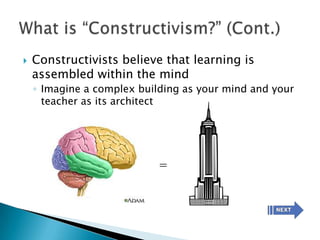
   Constructivists believe that learning is
    assembled within the mind
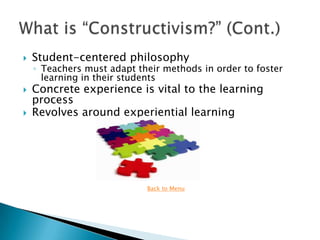
    ◦ Imagine a complex building as your mind and your
      teacher as its architect


                            =
   Student-centered philosophy
    ◦ Teachers must adapt their methods in order to foster
      learning in their students
   Concrete experience is vital to the learning
    process
   Revolves around experiential learning


                            Back to Menu
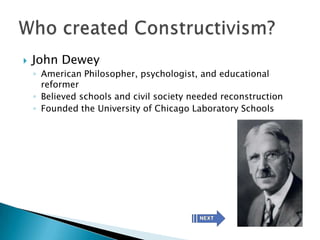
   John Dewey
    ◦ American Philosopher, psychologist, and educational
      reformer
    ◦ Believed schools and civil society needed reconstruction
    ◦ Founded the University of Chicago Laboratory Schools
   Other Notable Constructivists
    ◦   Maria Montessori
    ◦   David A. Kolb
    ◦   Heinz von Foerster
    ◦   Paul Watzlawick


                             Back To Menu
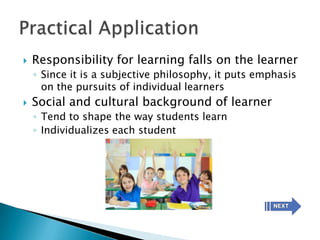
   Responsibility for learning falls on the learner
    ◦ Since it is a subjective philosophy, it puts emphasis
      on the pursuits of individual learners
   Social and cultural background of learner
    ◦ Tend to shape the way students learn
    ◦ Individualizes each student
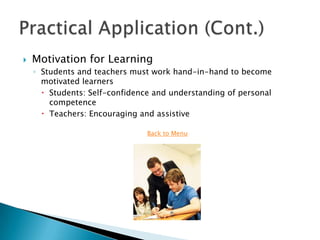
   Motivation for Learning
    ◦ Students and teachers must work hand-in-hand to become
      motivated learners
       Students: Self-confidence and understanding of personal
        competence
       Teachers: Encouraging and assistive

                                Back to Menu
   Constructivism & My Teaching Philosophy
    ◦ Part of my teaching philosophy encompasses a
      value for the individual
      Through learning, the individual comes to value and
       appreciate his or herself
      Additionally, constructivism allows students to
       understand the importance of their community
        As a student begins to value his or herself, they also begin
         to value others

       “Teachers should pollute their students’ minds with humanity.”
                                                 - Kurt Vonnegut
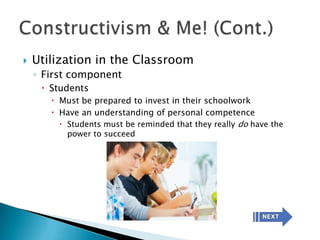
   Utilization in the Classroom
    ◦ First component
      Students
        Must be prepared to invest in their schoolwork
        Have an understanding of personal competence
          Students must be reminded that they really do have the
           power to succeed
   Utilization in the Classroom (Cont.)
    ◦ Second Component
      As a constructivist teacher, I must
        Be attentive to my students and their needs
        Be consistent in words of encouragement and affirmation
        Do everything in my power to capture and hold my
         students’ attention

Constructivism - Pearson Bolt

  • 1.
  • 2.
    What is “Constructivism?”  Who created it?  How could it be practically applied to the classroom?  Constructivism & Me!
  • 3.
    A personalized theory of how individuals see the world  Subjective learning theory  Roots in philosophy, psychology, and even cybernetics!
  • 4.
    Constructivists believe that learning is assembled within the mind ◦ Imagine a complex building as your mind and your teacher as its architect =
  • 5.
    Student-centered philosophy ◦ Teachers must adapt their methods in order to foster learning in their students  Concrete experience is vital to the learning process  Revolves around experiential learning Back to Menu
  • 6.
    John Dewey ◦ American Philosopher, psychologist, and educational reformer ◦ Believed schools and civil society needed reconstruction ◦ Founded the University of Chicago Laboratory Schools
  • 7.
    Other Notable Constructivists ◦ Maria Montessori ◦ David A. Kolb ◦ Heinz von Foerster ◦ Paul Watzlawick Back To Menu
  • 8.
    Responsibility for learning falls on the learner ◦ Since it is a subjective philosophy, it puts emphasis on the pursuits of individual learners  Social and cultural background of learner ◦ Tend to shape the way students learn ◦ Individualizes each student
  • 9.
    Motivation for Learning ◦ Students and teachers must work hand-in-hand to become motivated learners  Students: Self-confidence and understanding of personal competence  Teachers: Encouraging and assistive Back to Menu
  • 10.
    Constructivism & My Teaching Philosophy ◦ Part of my teaching philosophy encompasses a value for the individual  Through learning, the individual comes to value and appreciate his or herself  Additionally, constructivism allows students to understand the importance of their community  As a student begins to value his or herself, they also begin to value others “Teachers should pollute their students’ minds with humanity.” - Kurt Vonnegut
  • 11.
    Utilization in the Classroom ◦ First component  Students  Must be prepared to invest in their schoolwork  Have an understanding of personal competence  Students must be reminded that they really do have the power to succeed
  • 12.
    Utilization in the Classroom (Cont.) ◦ Second Component  As a constructivist teacher, I must  Be attentive to my students and their needs  Be consistent in words of encouragement and affirmation  Do everything in my power to capture and hold my students’ attention