The Big Picture Constructivism has roots in philosophy, psychology, sociology, and education.  Source: Wesley Hoover,  The Practice Implications of Constructivism
The Big Picture Constructivism's central idea is that human learning is  constructed , that learners build new knowledge upon the foundation of previous learning.  Source: Wesley Hoover,  The Practice Implications of Constructivism
The Big Picture This view of learning sharply contrasts with one in which learning is the passive transmission of information from one individual to another, a view in which reception, not construction, is key.  Source: Wesley Hoover,  The Practice Implications of Constructivism
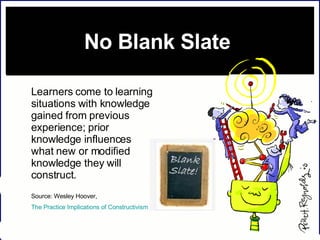
No Blank Slate   Learners come to learning situations with knowledge gained from previous experience; prior knowledge influences what new or modified knowledge they will construct. Source: Wesley Hoover,  The Practice Implications of Constructivism
Learning is Active   Learners confront their understanding when they encounter a new learning situation. If what learners encounter is inconsistent with their current understanding, their understanding can change to accommodate new experience.    Source: Wesley Hoover,  The Practice Implications of Constructivism
Learning is Active   Learners apply current understandings, note relevant elements, judge the consistency of prior and emerging knowledge, and based on that judgment, they can modify knowledge.   Source: Wesley Hoover,  The Practice Implications of Constructivism
Authentic Learning  Constructivist approach to learning emphasizes authentic, challenging projects that include students, teachers and experts in the learning community.  Source: Jy Wana Daphne Lin Hsiao  link
Authentic Learning  In an authentic environment, learners assume the responsibilities of their own learning, they have to develop metacognitive abilities to monitor and direct their own learning and performance.  Source: Jy Wana Daphne Lin Hsiao  link
Collaboration  When people work collaboratively, they bring their own framework and perspectives to the activity. They are able to negotiate and generate meanings and solution through shared understanding .  Source: Jy Wana Daphne Lin Hsiao  link

Constructivism Basics

  • 1.
    The Big PictureConstructivism has roots in philosophy, psychology, sociology, and education. Source: Wesley Hoover, The Practice Implications of Constructivism
  • 2.
    The Big PictureConstructivism's central idea is that human learning is constructed , that learners build new knowledge upon the foundation of previous learning. Source: Wesley Hoover, The Practice Implications of Constructivism
  • 3.
    The Big PictureThis view of learning sharply contrasts with one in which learning is the passive transmission of information from one individual to another, a view in which reception, not construction, is key. Source: Wesley Hoover, The Practice Implications of Constructivism
  • 4.
    No Blank Slate Learners come to learning situations with knowledge gained from previous experience; prior knowledge influences what new or modified knowledge they will construct. Source: Wesley Hoover, The Practice Implications of Constructivism
  • 5.
    Learning is Active Learners confront their understanding when they encounter a new learning situation. If what learners encounter is inconsistent with their current understanding, their understanding can change to accommodate new experience. Source: Wesley Hoover, The Practice Implications of Constructivism
  • 6.
    Learning is Active Learners apply current understandings, note relevant elements, judge the consistency of prior and emerging knowledge, and based on that judgment, they can modify knowledge. Source: Wesley Hoover, The Practice Implications of Constructivism
  • 7.
    Authentic Learning Constructivist approach to learning emphasizes authentic, challenging projects that include students, teachers and experts in the learning community. Source: Jy Wana Daphne Lin Hsiao link
  • 8.
    Authentic Learning In an authentic environment, learners assume the responsibilities of their own learning, they have to develop metacognitive abilities to monitor and direct their own learning and performance. Source: Jy Wana Daphne Lin Hsiao link
  • 9.
    Collaboration Whenpeople work collaboratively, they bring their own framework and perspectives to the activity. They are able to negotiate and generate meanings and solution through shared understanding . Source: Jy Wana Daphne Lin Hsiao link
  • 10.
    Collaboration Whenpeople work collaboratively, they bring their own framework and perspectives to the activity. They are able to negotiate and generate meanings and solution through shared understanding . Source: Jy Wana Daphne Lin Hsiao link