Constructivism

           C. B.
Theory definition
   Constructivism is a philosophical position
    that views knowledge as the outcome of
    experience mediated by one’s own prior
    knowledge and the experience of others.
Central ideas
   Learning is an active process
   Learners select and transform information
   Construct hypotheses
   Make decisions
   Rely on cognitive structure (schema)
   Possess motivation to learn
Influential proponents
   Albert Bandura
   Jerome Bruner
   Jean Piaget
   Lev Vygotsky
   John Dewey
   William Clancey
   Carl Bereiter, etc.
The constructive teacher
   Is an active participant in communication
    exchange as both lecturer and listener.
   Harbors a creative learning environment.
   Allows open interpretation and insemination
    of information and facts.
   Presents curriculum in a manner that is
    beneficial to all learning styles.
   Conforms to the needs of student adaptation.
The constructive student
   Responds to the teacher and peer group
    through social networking/open forum.
   Engages in exploratory learning built upon
    personal interests.
   Is subjective to various educational view
    points.
   Takes ownership of individualized learning.
   Shares in the role of teacher instruction.
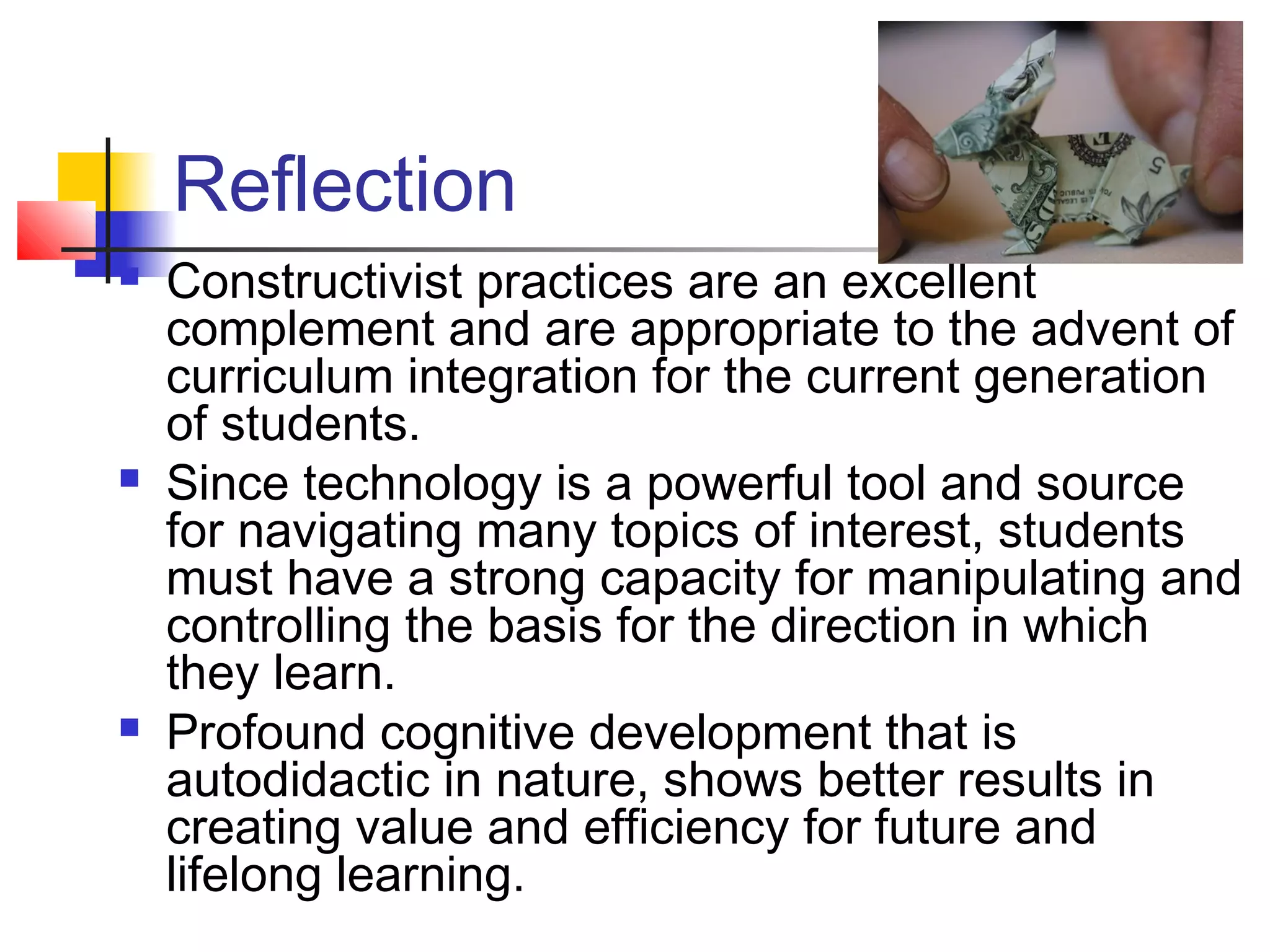
Reflection
   Constructivist practices are an excellent
    complement and are appropriate to the advent of
    curriculum integration for the current generation
    of students.
   Since technology is a powerful tool and source
    for navigating many topics of interest, students
    must have a strong capacity for manipulating and
    controlling the basis for the direction in which
    they learn.
   Profound cognitive development that is
    autodidactic in nature, shows better results in
    creating value and efficiency for future and
    lifelong learning.
Credits
   http://carbon.ucdenver.edu/~mryder/savage.html#def_constructivism
   http://www.instructionaldesign.org/theories/constructivist.html
   http://www.exploratorium.edu/IFI/resources/constructivistlearning.html
   http://www.hitl.washington.edu/publications/r-97-47/two.html
   http://wordplay.blogs.nytimes.com/2010/03/26/origami-artists/
   http://www.clipartof.com/portfolio/toonaday/illustration/cartoon-
    philosopher-holding-an-apple-1047420.html
   http://www.javelin-tech.com/blog/2012/04/control-plane-front-
    back/golden-key/
   http://learningdynamicsinc.org/2011/04/26/autism-awareness-
    month-autism-prevelance/

C.b. learning theory power point presentation constructivism

  • 1.
  • 2.
    Theory definition  Constructivism is a philosophical position that views knowledge as the outcome of experience mediated by one’s own prior knowledge and the experience of others.
  • 3.
    Central ideas  Learning is an active process  Learners select and transform information  Construct hypotheses  Make decisions  Rely on cognitive structure (schema)  Possess motivation to learn
  • 4.
    Influential proponents  Albert Bandura  Jerome Bruner  Jean Piaget  Lev Vygotsky  John Dewey  William Clancey  Carl Bereiter, etc.
  • 5.
    The constructive teacher  Is an active participant in communication exchange as both lecturer and listener.  Harbors a creative learning environment.  Allows open interpretation and insemination of information and facts.  Presents curriculum in a manner that is beneficial to all learning styles.  Conforms to the needs of student adaptation.
  • 6.
    The constructive student  Responds to the teacher and peer group through social networking/open forum.  Engages in exploratory learning built upon personal interests.  Is subjective to various educational view points.  Takes ownership of individualized learning.  Shares in the role of teacher instruction.
  • 7.
    Reflection  Constructivist practices are an excellent complement and are appropriate to the advent of curriculum integration for the current generation of students.  Since technology is a powerful tool and source for navigating many topics of interest, students must have a strong capacity for manipulating and controlling the basis for the direction in which they learn.  Profound cognitive development that is autodidactic in nature, shows better results in creating value and efficiency for future and lifelong learning.
  • 8.
    Credits  http://carbon.ucdenver.edu/~mryder/savage.html#def_constructivism  http://www.instructionaldesign.org/theories/constructivist.html  http://www.exploratorium.edu/IFI/resources/constructivistlearning.html  http://www.hitl.washington.edu/publications/r-97-47/two.html  http://wordplay.blogs.nytimes.com/2010/03/26/origami-artists/  http://www.clipartof.com/portfolio/toonaday/illustration/cartoon- philosopher-holding-an-apple-1047420.html  http://www.javelin-tech.com/blog/2012/04/control-plane-front- back/golden-key/  http://learningdynamicsinc.org/2011/04/26/autism-awareness- month-autism-prevelance/