By: Monique B.
 What   is Constructivism?

 Who   is involved in the theory?

 How    can the theory be seen in the classroom?

 How    to use Constructivism in the classroom
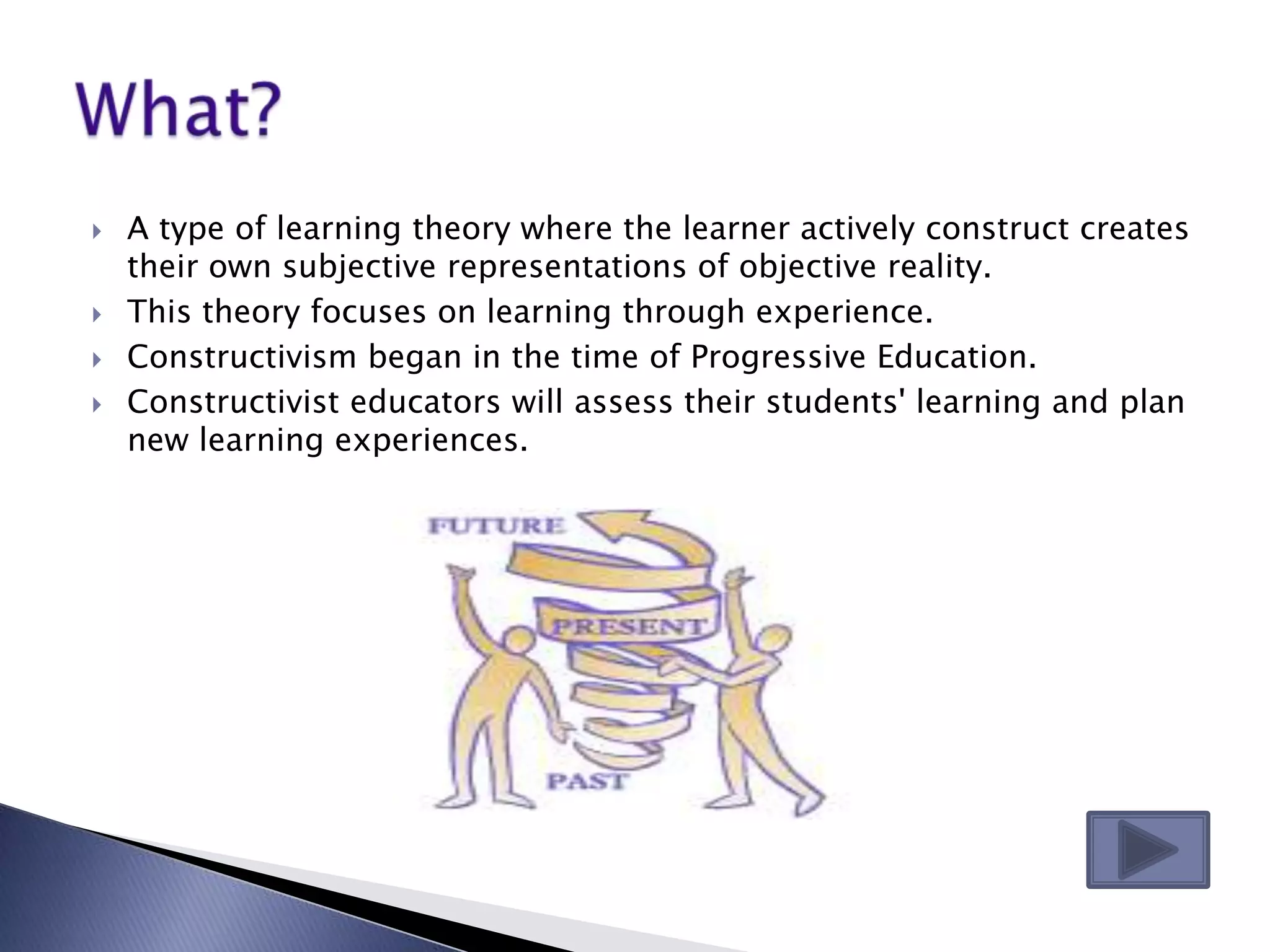
   A type of learning theory where the learner actively construct creates
    their own subjective representations of objective reality.
   This theory focuses on learning through experience.
   Constructivism began in the time of Progressive Education.
   Constructivist educators will assess their students' learning and plan
    new learning experiences.
   Each individual is an active creator of their own knowledge.
   It’s often misconstrued as a learning theory that compels
    students to "reinvent the wheel."
   Students attempt to understand how the wheel functions by
    applying their existing knowledge and real-world experience.
   Jean Piaget- was a Swiss professor of psychology and sociology

   Jerome Bruner-published documents about that examined theories
    of cognitive development for curriculum innovation.

   Lev Vygotsky- was a scholar that proposed a theory of cognitive
    development that focused in the underlying process rather than the
    stage of development

   John Dewey- was an American philosopher and educator

   All of these individuals were influential in the evolution of this
    learning theory .
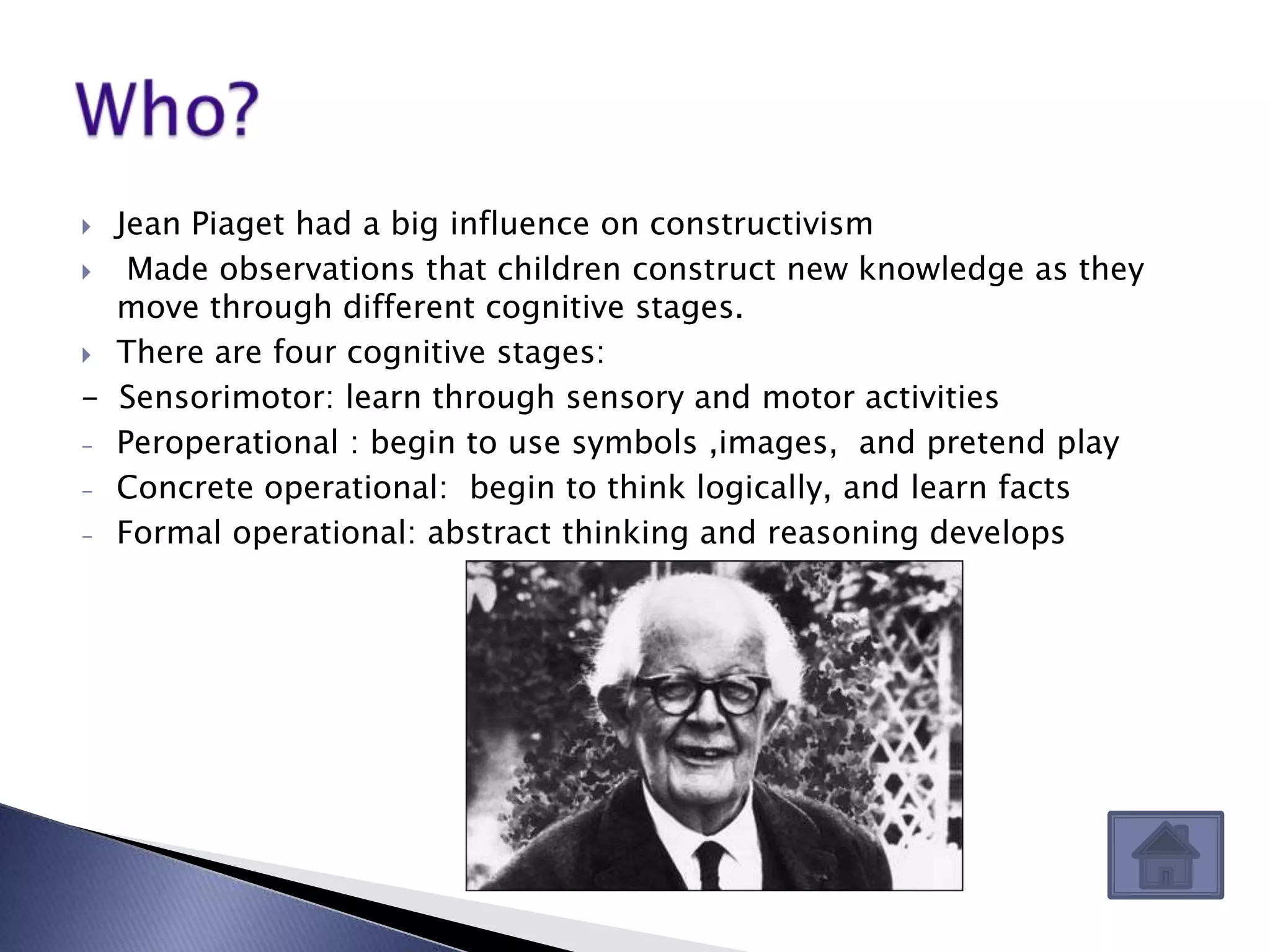
 Jean Piaget had a big influence on constructivism
  Made observations that children construct new knowledge as they
  move through different cognitive stages.
 There are four cognitive stages:

- Sensorimotor: learn through sensory and motor activities
- Peroperational : begin to use symbols ,images, and pretend play

- Concrete operational: begin to think logically, and learn facts

- Formal operational: abstract thinking and reasoning develops
   Teachers encourage students to constantly assess how the activity is
    helping them gain understanding by questioning themselves and
    their strategies.
   Teachers help students to construct knowledge rather than to
    reproduce a series of facts.
   Students become "expert learners," because their knowledge of
    tools continue to broaden tool, they learn to learn.
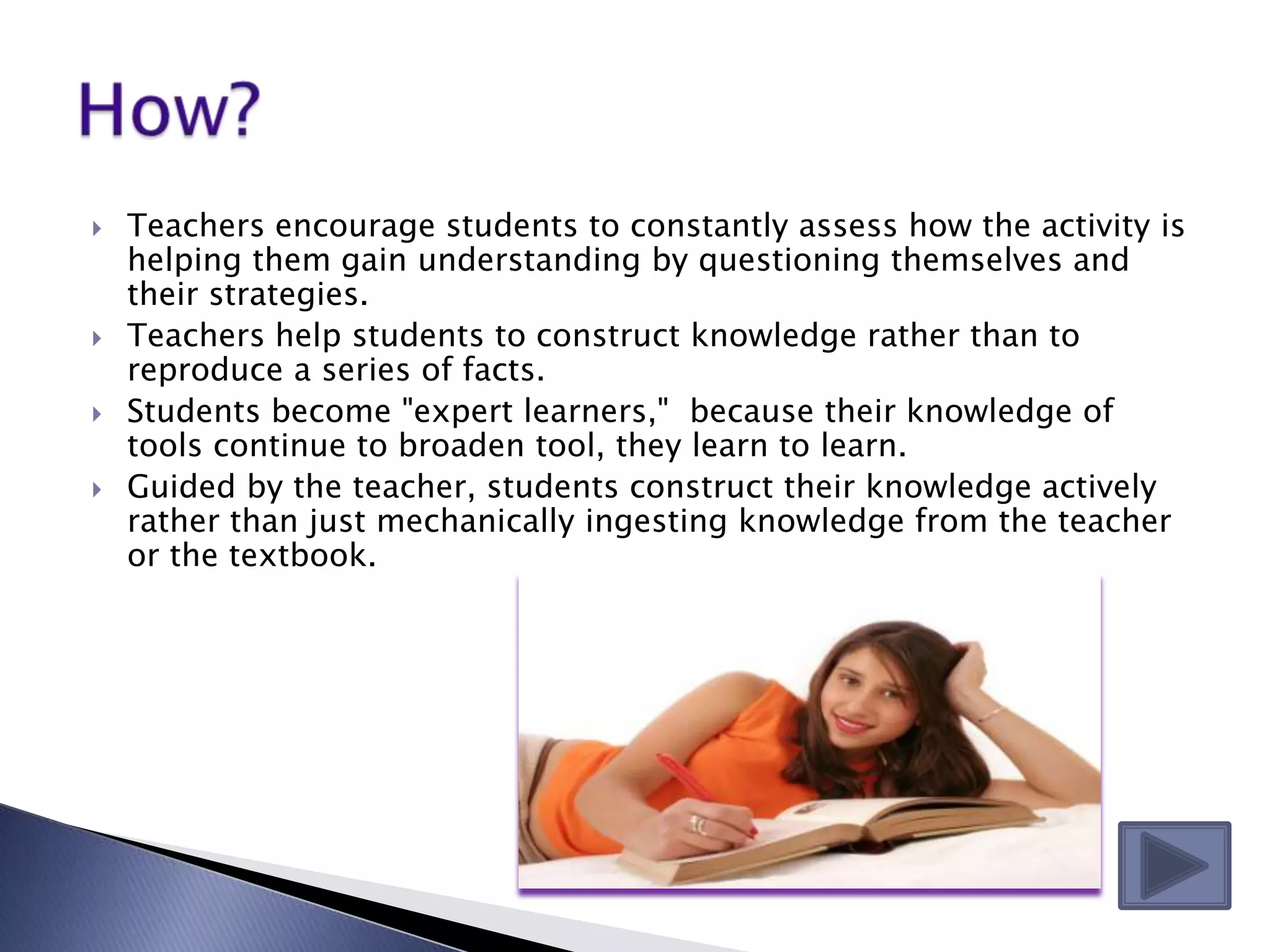
   Guided by the teacher, students construct their knowledge actively
    rather than just mechanically ingesting knowledge from the teacher
    or the textbook.
   Students will continuously reflect on their experiences.
   They begin to develop increasingly strong abilities to integrate
    new information.
   One of the teacher's main roles becomes to encourage this
    learning and reflection process.
   Problem-solving and inquiry-based learning activities are seen in
    the construcitvism classroom .
   This allows students to formulate and test their ideas in a
    collaborative learning environment.
   The student becomes an active participant in the learning
    process versus a passive recipient of information.
   In my classroom I would apply this learning theory by having
    activities that promotes both group collaboration and individual
    creativity.
   Each activity will be followed by a reflection statement to see what
    the student gained from the information.
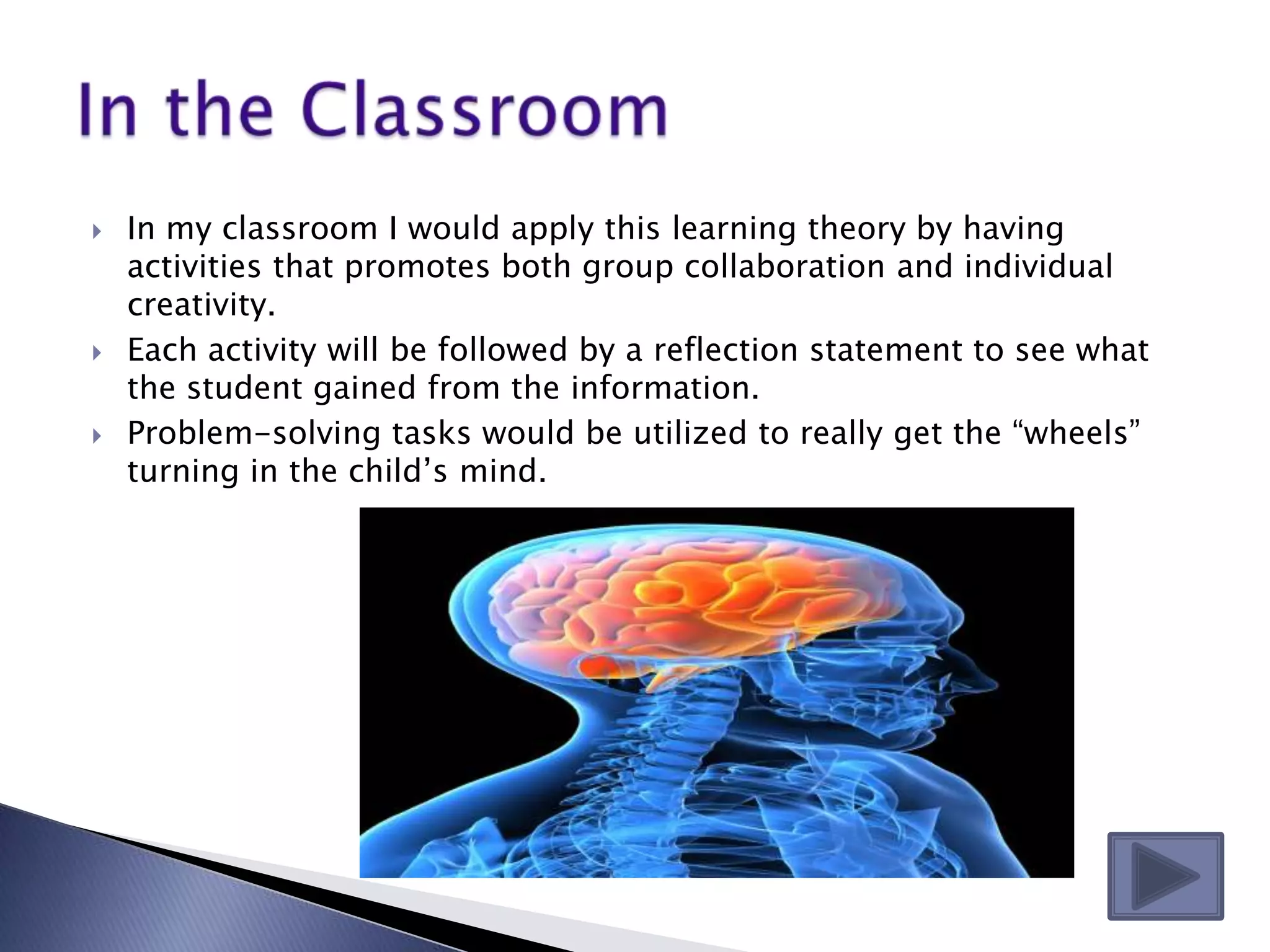
   Problem-solving tasks would be utilized to really get the “wheels”
    turning in the child’s mind.
   The children would also participate in more hands-on tasks versus
    always having just traditional lectures.
   I think also having very sensory components to be used can assist
    with the child gathering the information.
   I would use teaching ideas such as whole language, fuzzy math, and
    invented spelling.
   I would make sure when implementing this learning theory to have
    the environment structured because having activities that emphasis
    on students' self-esteem versus self-discipline can lead to
    disciplinary concerns if not implemented properly
   http://www.thirteen.org/edonline/concept2cl
    ass/constructivism/lp_elem1.html
   http://www.illinoisloop.org/whatswrong.html
   http://faculty.frostburg.edu/mbradley/psyog
    raphy/piaget.jpg (Image)
   Clip art images within powerpoint

Behaviorism

  • 1.
  • 2.
     What is Constructivism?  Who is involved in the theory?  How can the theory be seen in the classroom?  How to use Constructivism in the classroom
  • 3.
    A type of learning theory where the learner actively construct creates their own subjective representations of objective reality.  This theory focuses on learning through experience.  Constructivism began in the time of Progressive Education.  Constructivist educators will assess their students' learning and plan new learning experiences.
  • 4.
    Each individual is an active creator of their own knowledge.  It’s often misconstrued as a learning theory that compels students to "reinvent the wheel."  Students attempt to understand how the wheel functions by applying their existing knowledge and real-world experience.
  • 5.
    Jean Piaget- was a Swiss professor of psychology and sociology  Jerome Bruner-published documents about that examined theories of cognitive development for curriculum innovation.  Lev Vygotsky- was a scholar that proposed a theory of cognitive development that focused in the underlying process rather than the stage of development  John Dewey- was an American philosopher and educator  All of these individuals were influential in the evolution of this learning theory .
  • 6.
     Jean Piagethad a big influence on constructivism  Made observations that children construct new knowledge as they move through different cognitive stages.  There are four cognitive stages: - Sensorimotor: learn through sensory and motor activities - Peroperational : begin to use symbols ,images, and pretend play - Concrete operational: begin to think logically, and learn facts - Formal operational: abstract thinking and reasoning develops
  • 7.
    Teachers encourage students to constantly assess how the activity is helping them gain understanding by questioning themselves and their strategies.  Teachers help students to construct knowledge rather than to reproduce a series of facts.  Students become "expert learners," because their knowledge of tools continue to broaden tool, they learn to learn.  Guided by the teacher, students construct their knowledge actively rather than just mechanically ingesting knowledge from the teacher or the textbook.
  • 8.
    Students will continuously reflect on their experiences.  They begin to develop increasingly strong abilities to integrate new information.  One of the teacher's main roles becomes to encourage this learning and reflection process.  Problem-solving and inquiry-based learning activities are seen in the construcitvism classroom .  This allows students to formulate and test their ideas in a collaborative learning environment.  The student becomes an active participant in the learning process versus a passive recipient of information.
  • 9.
    In my classroom I would apply this learning theory by having activities that promotes both group collaboration and individual creativity.  Each activity will be followed by a reflection statement to see what the student gained from the information.  Problem-solving tasks would be utilized to really get the “wheels” turning in the child’s mind.
  • 10.
    The children would also participate in more hands-on tasks versus always having just traditional lectures.  I think also having very sensory components to be used can assist with the child gathering the information.  I would use teaching ideas such as whole language, fuzzy math, and invented spelling.  I would make sure when implementing this learning theory to have the environment structured because having activities that emphasis on students' self-esteem versus self-discipline can lead to disciplinary concerns if not implemented properly
  • 11.
    http://www.thirteen.org/edonline/concept2cl ass/constructivism/lp_elem1.html  http://www.illinoisloop.org/whatswrong.html  http://faculty.frostburg.edu/mbradley/psyog raphy/piaget.jpg (Image)  Clip art images within powerpoint