Constructivism
By Zach
What is constructivism?
       The learner learns by “doing,” so he
        constructs comprehension
       Knowledge is gained by an interplay of
        experience and ideas
       “We have to focus on the learner in
        thinking about learning”
       “There is no knowledge independent of
        the meaning attributed to experience”
        (Hein)
http://www.exploratorium.edu/IFI/resources/constructivistlearning.html
Jean Piaget (1869 – 1980)
 Founder  of constructivism
 Said that children gained knowledge by
  experiences in schemas. Early schemas are –
    Sensorimotor: learning through senses & motor
     actions
    Preoperational: begin to use symbols & images, learn
     through language
    Concrete operational: Logical thinking, can
     understand other points of views (besides their own)
    Formal operational: concrete to abstract thinking
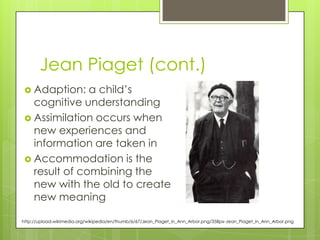
Jean Piaget (cont.)
  Adaption:   a child‟s
   cognitive understanding
  Assimilation occurs when
   new experiences and
   information are taken in
  Accommodation is the
   result of combining the
   new with the old to create
   new meaning

http://upload.wikimedia.org/wikipedia/en/thumb/6/67/Jean_Piaget_in_Ann_Arbor.png/358px-Jean_Piaget_in_Ann_Arbor.png
Lev Vygotsky (1896 – 1934)
 Discovered   social cognition, or that we learn
  through social development
 For instance, children learn language through
  social interaction, learning that certain sounds
  carry meaning
 Children can learn better through „collaborative
  learning‟ than they can alone
 Collaborative learning: learning in a group
  setting, with someone „more advanced‟
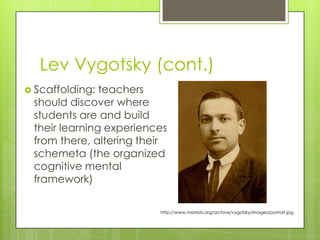
Lev Vygotsky (cont.)
 Scaffolding: teachers
 should discover where
 students are and build
 their learning experiences
 from there, altering their
 schemeta (the organized
 cognitive mental
 framework)

                         http://www.marxists.org/archive/vygotsky/images/portrait.jpg
What does this mean for
   teachers?
 Don‟tfocus on the
  material; focus on the
  students
 We need to offer
  students the
  opportunity to –
     Interact with sensory
      data
     Construct their own
                              http://educ6040fall10.wikispaces.com/file/view/connections.png
      world
What does this mean for
students?
 They must experience to learn
 Learning with others will help the group
  advance farther than any individual
  would alone
 Students need motivation to learn!
Personally...
 Thismodel of learning challenges much of
  the „conventional‟ education system we
  see in the US today
 I would like to make use of it, especially
  with guiding learning and helping to
  motivate students to learn

Constructivism

  • 1.
  • 2.
    What is constructivism?  The learner learns by “doing,” so he constructs comprehension  Knowledge is gained by an interplay of experience and ideas  “We have to focus on the learner in thinking about learning”  “There is no knowledge independent of the meaning attributed to experience” (Hein) http://www.exploratorium.edu/IFI/resources/constructivistlearning.html
  • 3.
    Jean Piaget (1869– 1980)  Founder of constructivism  Said that children gained knowledge by experiences in schemas. Early schemas are –  Sensorimotor: learning through senses & motor actions  Preoperational: begin to use symbols & images, learn through language  Concrete operational: Logical thinking, can understand other points of views (besides their own)  Formal operational: concrete to abstract thinking
  • 4.
    Jean Piaget (cont.)  Adaption: a child‟s cognitive understanding  Assimilation occurs when new experiences and information are taken in  Accommodation is the result of combining the new with the old to create new meaning http://upload.wikimedia.org/wikipedia/en/thumb/6/67/Jean_Piaget_in_Ann_Arbor.png/358px-Jean_Piaget_in_Ann_Arbor.png
  • 5.
    Lev Vygotsky (1896– 1934)  Discovered social cognition, or that we learn through social development  For instance, children learn language through social interaction, learning that certain sounds carry meaning  Children can learn better through „collaborative learning‟ than they can alone  Collaborative learning: learning in a group setting, with someone „more advanced‟
  • 6.
    Lev Vygotsky (cont.) Scaffolding: teachers should discover where students are and build their learning experiences from there, altering their schemeta (the organized cognitive mental framework) http://www.marxists.org/archive/vygotsky/images/portrait.jpg
  • 7.
    What does thismean for teachers?  Don‟tfocus on the material; focus on the students  We need to offer students the opportunity to –  Interact with sensory data  Construct their own http://educ6040fall10.wikispaces.com/file/view/connections.png world
  • 8.
    What does thismean for students?  They must experience to learn  Learning with others will help the group advance farther than any individual would alone  Students need motivation to learn!
  • 9.
    Personally...  Thismodel oflearning challenges much of the „conventional‟ education system we see in the US today  I would like to make use of it, especially with guiding learning and helping to motivate students to learn