


BRITISH INSTITUTIONS
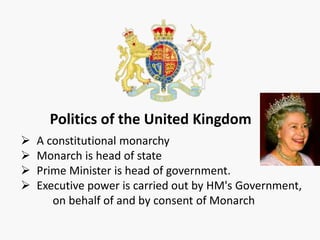
Politics of the United Kingdom
 A constitutional monarchy
 Monarch is head of state
 Prime Minister is head of government.
 Executive power is carried out by HM's Government,
on behalf of and by consent of Monarch
Principles of the Constitution
Two basic principles govern the
Constitution:
The Rule of Law
The Supremacy of Parliament
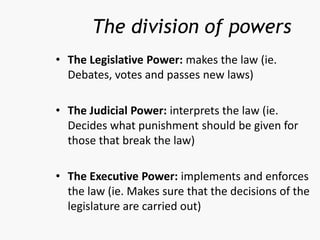
• The Legislative Power: makes the law (ie.
Debates, votes and passes new laws)
• The Judicial Power: interprets the law (ie.
Decides what punishment should be given for
those that break the law)
• The Executive Power: implements and enforces
the law (ie. Makes sure that the decisions of the
legislature are carried out)
The division of powers
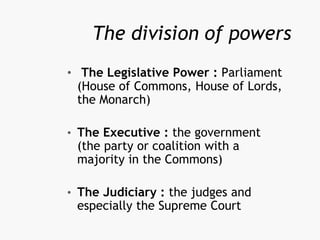
• The Legislative Power : Parliament
(House of Commons, House of Lords,
the Monarch)
• The Executive : the government
(the party or coalition with a
majority in the Commons)
• The Judiciary : the judges and
especially the Supreme Court
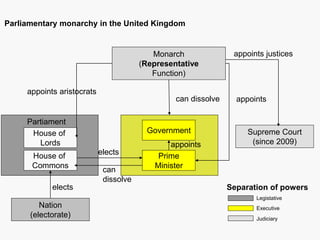
Monarch
(Representative
Function)
Supreme Court
(since 2009)
House of
Lords
House of
Commons
Government
Prime
Minister
Nation
(electorate)
Partiament
elects
elects
can
dissolve
appoints aristocrats
can dissolve appoints
appoints justices
Legistative
Executive
Judiciary
Separation of powers
appoints
Parliamentary monarchy in the United Kingdom
The British Constitution
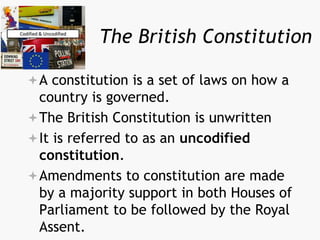
A constitution is a set of laws on how a
country is governed.
The British Constitution is unwritten
It is referred to as an uncodified
constitution.
Amendments to constitution are made
by a majority support in both Houses of
Parliament to be followed by the Royal
Assent.
Sources of the Constitution:
Statutes such as the Magna Carta of
1215, the Bill of Rights and the Act of
Settlement of 1701.
Laws and Customs of Parliament;
Political conventions
Decisions in a court of law
Constitutional experts who have
written on the subject such as Walter
Bagehot and A.V Dicey.
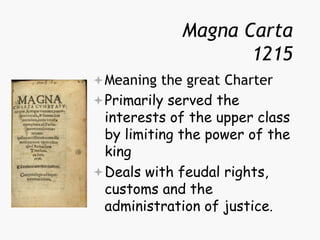
Magna Carta
1215
Meaning the great Charter
Primarily served the
interests of the upper class
by limiting the power of the
king
Deals with feudal rights,
customs and the
administration of justice.
10
Why is the Magna Carta
important?
The Magna Carta was the first
example of an English king setting
specific limits on royal power.
The Magna Carta tried to prevent the
king from abusing his power and it
made clear that the king was subject
to the law, not above it.
11
Which clauses of the Magna
Carta are valid today?
the liberties of the English Church;
the privileges of the city of London and
other towns;
no free man shall be imprisoned,
dispossessed, outlawed or exiled
without the lawful judgement of his
equals or by the law of the land.
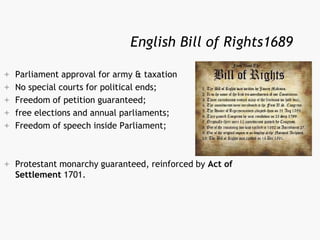
English Bill of Rights1689
 Parliament approval for army & taxation
 No special courts for political ends;
 Freedom of petition guaranteed;
 free elections and annual parliaments;
 Freedom of speech inside Parliament;
 Protestant monarchy guaranteed, reinforced by Act of
Settlement 1701.
For or Against
Pros: Flexibility and change
Cons: no public access– Only
constitutional experts know where to
look and how to interpret it.
Strengths
• Coherent system of government
• Evolved over time: flexible & changes,
reflecting the values of the British People
 • Parliamentary sovereignty ensures a
clear centre of authority
• The rule of law protects the rights of
citizens • Government is accountable to
parliament and the electorate
Weaknesses
• centralised government
• Local and sub-national governments are
not constitutionally protected
• The rights of citizens are weak and not
safeguarded effectively
• Undemocratic elements survive e.g. the
monarchy, House of Lords
•The separation of powers remains
ambiguous
Monarch
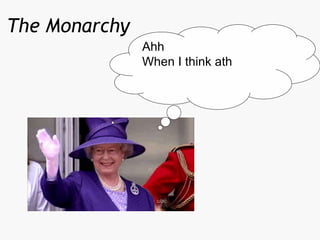
The Monarchy
Ahh
When I think ath
The Monarch: Head of Nation
and Head of State
Monarch (referred to as
the Sovereign or "His/Her Majesty",
abbreviated H.M.) is Head of State
and head of government.
Oaths of allegiance are made to the
Monarch
 "God Save the Queen" (or "God Save
the King") is the British national.
Primogeniture
 Throne is inherited:
 Throne goes to the eldest son when a monarch dies
 when no sons, the eldest daughter ascends the throne.
 This was the case when Elizabeth II succeeded to
the throne in February 1952 upon the death of her
father, George VI.
 Her husband, Prince Philip, has the title of Prince
Consort, but no rank or privileges.
 The current heir to the throne is Elizabeth II’s
eldest son, Charles, Prince of Wales.
 A regent may be appointed to rule for the sovereign if
he or she is underage or incapacitated
The Queen
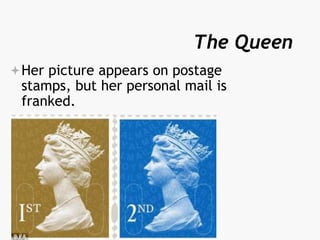
Her picture appears on postage
stamps, but her personal mail is
franked.
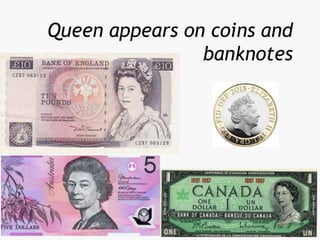
Queen appears on coins and
banknotes
What the Queen Can Do
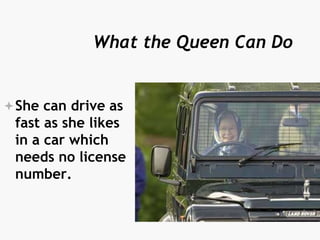
She can drive as
fast as she likes
in a car which
needs no license
number.
What the Queen Can Do
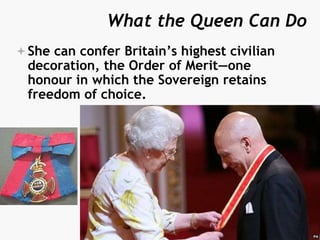
She can confer Britain’s highest civilian
decoration, the Order of Merit—one
honour in which the Sovereign retains
freedom of choice.
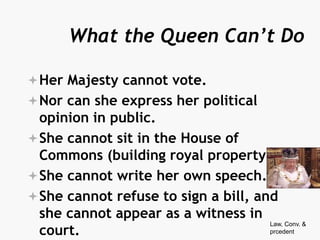
What the Queen Can’t Do
Her Majesty cannot vote.
Nor can she express her political
opinion in public.
She cannot sit in the House of
Commons (building royal property).
She cannot write her own speech.
She cannot refuse to sign a bill, and
she cannot appear as a witness in
court.
Law, Conv. &
prcedent
Law vs. Convention &
Precedent
Role of the Monarch is determined by
law, but also by convention and
precedent: by law , the monarch
 has, the right to take a more active
role – to refuse to sign new legislation,
for example, but by convention she
never makes use of this right.
The role of the monarch: By
law
Prerogatives of the monarch :
opens and dissolves parliament
gives her assent to all legislation by
signing parliamentary bills so they become
law
Appoints prime minister after general
election.
has weekly audience with the prime
minister.
The role of the monarch: By
convention and Precedent
In accordance with unwritten
constitutional conventions, Sovereign
appoints the Prime Minister, usually
the leader of the party or coalition
that has a majority in that House.
The monarch is commander-in-chief of
the British Armed Forces.
The monarch can dissolve parliament
on the advice of the PM.
Reigns but does not rule!
Monarchy is a ‘dignified’ institution,
plays vital role BUT no meaningful
political power.
Fount of Honours
Defender of Faith
Fount of Justice
Head of Nation
Head of State
Head of the Commonwealth!
The Queen’s role
Constitutional Arbitration – In times of
Crisis
Stability –1,000 years of Sovereignty
Continuity –helps to bridge the discontinuities
of party politics
Experience –reading state papers, meeting
heads of state and ambassadors, and weekly
audiences with Prime Ministers
The Queen’s role (2)
Unity: Party politics = disagreement and
confrontation. (rich vs poor, north vs south,
management vs unions, Catholic vs Protestant…)
Moral Leadership & Model Behaviour
Custodianship of the Past – Through its
ceremony, pageantry and ritual, the monarchy
preserves the link with Britain’s history
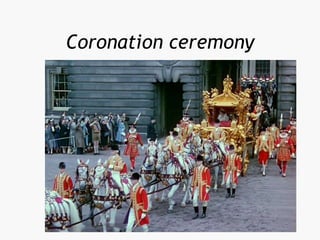
Coronation ceremony
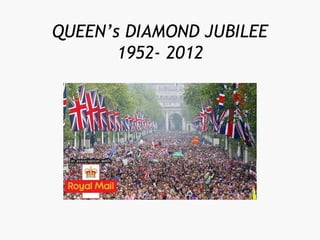
QUEEN’s DIAMOND JUBILEE
1952- 2012
Shall the monarchy be
abolished?
The head of state should be elected in a
democratic country.
·The royal family is elitist.
· It is a very expensive institution.
· Functions formal and automatic.
Royal family not always a good example
in family life and private morals.
 Secession within a monarchy does not
guarantee competency.
Coming next
The House of Lords!
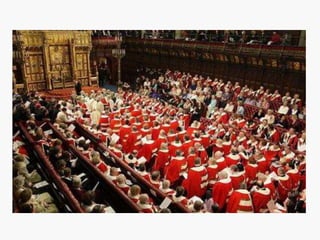
The House of Lords
Parliament's second chamber.
Role: 'double check' new laws.
About 800 members. Not elected.
No power to stop a new law but can
delay it (veto lost in 1911)
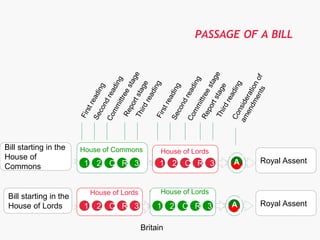
Bills must go through both Houses
before becoming 'Acts' (laws).
Who sits in the House of
Lords?
Peers!
Life peers appointed by the Queen on
advice of Prime minister and 26 bishops
Lords Spiritual (bishops)
Hereditary peers: 90
The House of Lords Debated
unelected
unaccountable
Too much
power
mostly live in
London, the
east and the
south east
 Experience &
expertise
 Retired
generals, trade
union leaders,
academics and
judges
 Stability
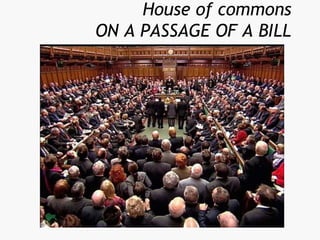
House of Commons
The most powerful of the two houses.
659 elected members. (427 green
seats)
Members are called MPs.
The Commons is the most important
place for discussing policies and
making laws.
House of commons
ON A PASSAGE OF A BILL
PASSAGE OF A BILL
House of Commons
House of Lords
House of Lords
House of Lords
3RC21
1 2 C R 31 2 C R 3
3RC21
Royal Assent
Bill starting in the
House of Lords
Bill starting in the
House of
Commons
Royal AssentA
A
Britain
And politics
2017 General Elections
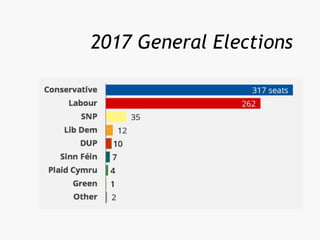
Two-party system
majority of MPs in the House of
Commons belong to:
The Conservative party (the tories), or
The Labour Party
Power has always alternated between
the two major parties.
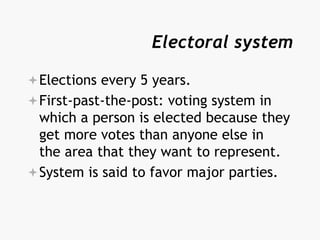
Electoral system
Elections every 5 years.
First-past-the-post: voting system in
which a person is elected because they
get more votes than anyone else in
the area that they want to represent.
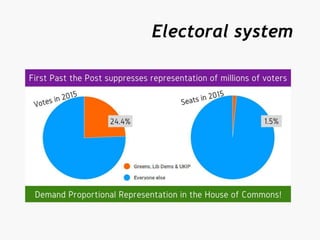
System is said to favor major parties.
Electoral system
Political Parties
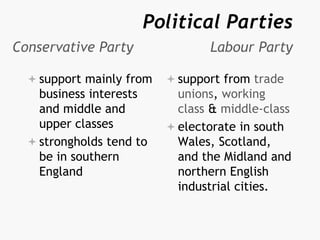
Conservative Party Labour Party
 support mainly from
business interests
and middle and
upper classes
 strongholds tend to
be in southern
England
 support from trade
unions, working
class & middle-class
 electorate in south
Wales, Scotland,
and the Midland and
northern English
industrial cities.
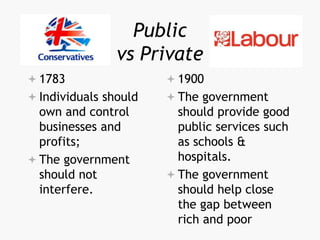
Public
vs Private
 1783
 Individuals should
own and control
businesses and
profits;
 The government
should not
interfere.
 1900
 The government
should provide good
public services such
as schools &
hospitals.
 The government
should help close
the gap between
rich and poor
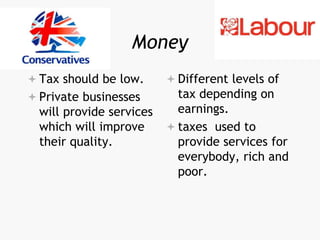
Money
 Tax should be low.
 Private businesses
will provide services
which will improve
their quality.
 Different levels of
tax depending on
earnings.
 taxes used to
provide services for
everybody, rich and
poor.
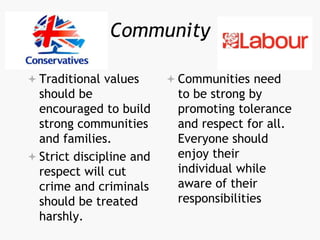
Community
 Traditional values
should be
encouraged to build
strong communities
and families.
 Strict discipline and
respect will cut
crime and criminals
should be treated
harshly.
 Communities need
to be strong by
promoting tolerance
and respect for all.
Everyone should
enjoy their
individual while
aware of their
responsibilities
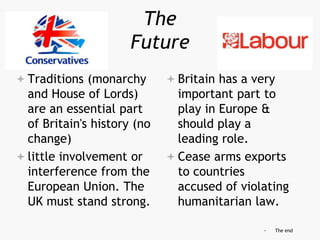
The
Future
 Traditions (monarchy
and House of Lords)
are an essential part
of Britain's history (no
change)
 little involvement or
interference from the
European Union. The
UK must stand strong.
 Britain has a very
important part to
play in Europe &
should play a
leading role.
 Cease arms exports
to countries
accused of violating
humanitarian law.
 The end
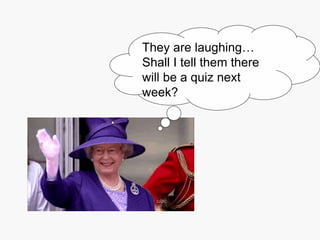
They are laughing…
Shall I tell them there
will be a quiz next
week?
1st year lecture 2 british institutions 2018

1st year lecture 2 british institutions 2018

  • 1.
  • 2.
    Politics of theUnited Kingdom  A constitutional monarchy  Monarch is head of state  Prime Minister is head of government.  Executive power is carried out by HM's Government, on behalf of and by consent of Monarch
  • 3.
    Principles of theConstitution Two basic principles govern the Constitution: The Rule of Law The Supremacy of Parliament
  • 4.
    • The LegislativePower: makes the law (ie. Debates, votes and passes new laws) • The Judicial Power: interprets the law (ie. Decides what punishment should be given for those that break the law) • The Executive Power: implements and enforces the law (ie. Makes sure that the decisions of the legislature are carried out) The division of powers
  • 5.
    The division ofpowers • The Legislative Power : Parliament (House of Commons, House of Lords, the Monarch) • The Executive : the government (the party or coalition with a majority in the Commons) • The Judiciary : the judges and especially the Supreme Court
  • 6.
    Monarch (Representative Function) Supreme Court (since 2009) Houseof Lords House of Commons Government Prime Minister Nation (electorate) Partiament elects elects can dissolve appoints aristocrats can dissolve appoints appoints justices Legistative Executive Judiciary Separation of powers appoints Parliamentary monarchy in the United Kingdom
  • 7.
    The British Constitution Aconstitution is a set of laws on how a country is governed. The British Constitution is unwritten It is referred to as an uncodified constitution. Amendments to constitution are made by a majority support in both Houses of Parliament to be followed by the Royal Assent.
  • 8.
    Sources of theConstitution: Statutes such as the Magna Carta of 1215, the Bill of Rights and the Act of Settlement of 1701. Laws and Customs of Parliament; Political conventions Decisions in a court of law Constitutional experts who have written on the subject such as Walter Bagehot and A.V Dicey.
  • 9.
    Magna Carta 1215 Meaning thegreat Charter Primarily served the interests of the upper class by limiting the power of the king Deals with feudal rights, customs and the administration of justice.
  • 10.
    10 Why is theMagna Carta important? The Magna Carta was the first example of an English king setting specific limits on royal power. The Magna Carta tried to prevent the king from abusing his power and it made clear that the king was subject to the law, not above it.
  • 11.
    11 Which clauses ofthe Magna Carta are valid today? the liberties of the English Church; the privileges of the city of London and other towns; no free man shall be imprisoned, dispossessed, outlawed or exiled without the lawful judgement of his equals or by the law of the land.
  • 12.
    English Bill ofRights1689  Parliament approval for army & taxation  No special courts for political ends;  Freedom of petition guaranteed;  free elections and annual parliaments;  Freedom of speech inside Parliament;  Protestant monarchy guaranteed, reinforced by Act of Settlement 1701.
  • 13.
    For or Against Pros:Flexibility and change Cons: no public access– Only constitutional experts know where to look and how to interpret it.
  • 14.
    Strengths • Coherent systemof government • Evolved over time: flexible & changes, reflecting the values of the British People  • Parliamentary sovereignty ensures a clear centre of authority • The rule of law protects the rights of citizens • Government is accountable to parliament and the electorate
  • 15.
    Weaknesses • centralised government •Local and sub-national governments are not constitutionally protected • The rights of citizens are weak and not safeguarded effectively • Undemocratic elements survive e.g. the monarchy, House of Lords •The separation of powers remains ambiguous Monarch
  • 23.
  • 24.
    The Monarch: Headof Nation and Head of State Monarch (referred to as the Sovereign or "His/Her Majesty", abbreviated H.M.) is Head of State and head of government. Oaths of allegiance are made to the Monarch  "God Save the Queen" (or "God Save the King") is the British national.
  • 25.
    Primogeniture  Throne isinherited:  Throne goes to the eldest son when a monarch dies  when no sons, the eldest daughter ascends the throne.  This was the case when Elizabeth II succeeded to the throne in February 1952 upon the death of her father, George VI.  Her husband, Prince Philip, has the title of Prince Consort, but no rank or privileges.  The current heir to the throne is Elizabeth II’s eldest son, Charles, Prince of Wales.  A regent may be appointed to rule for the sovereign if he or she is underage or incapacitated
  • 26.
    The Queen Her pictureappears on postage stamps, but her personal mail is franked.
  • 27.
    Queen appears oncoins and banknotes
  • 28.
    What the QueenCan Do She can drive as fast as she likes in a car which needs no license number.
  • 29.
    What the QueenCan Do She can confer Britain’s highest civilian decoration, the Order of Merit—one honour in which the Sovereign retains freedom of choice.
  • 30.
    What the QueenCan’t Do Her Majesty cannot vote. Nor can she express her political opinion in public. She cannot sit in the House of Commons (building royal property). She cannot write her own speech. She cannot refuse to sign a bill, and she cannot appear as a witness in court. Law, Conv. & prcedent
  • 32.
    Law vs. Convention& Precedent Role of the Monarch is determined by law, but also by convention and precedent: by law , the monarch  has, the right to take a more active role – to refuse to sign new legislation, for example, but by convention she never makes use of this right.
  • 33.
    The role ofthe monarch: By law Prerogatives of the monarch : opens and dissolves parliament gives her assent to all legislation by signing parliamentary bills so they become law Appoints prime minister after general election. has weekly audience with the prime minister.
  • 34.
    The role ofthe monarch: By convention and Precedent In accordance with unwritten constitutional conventions, Sovereign appoints the Prime Minister, usually the leader of the party or coalition that has a majority in that House. The monarch is commander-in-chief of the British Armed Forces. The monarch can dissolve parliament on the advice of the PM.
  • 35.
    Reigns but doesnot rule! Monarchy is a ‘dignified’ institution, plays vital role BUT no meaningful political power. Fount of Honours Defender of Faith Fount of Justice Head of Nation Head of State Head of the Commonwealth!
  • 36.
    The Queen’s role ConstitutionalArbitration – In times of Crisis Stability –1,000 years of Sovereignty Continuity –helps to bridge the discontinuities of party politics Experience –reading state papers, meeting heads of state and ambassadors, and weekly audiences with Prime Ministers
  • 37.
    The Queen’s role(2) Unity: Party politics = disagreement and confrontation. (rich vs poor, north vs south, management vs unions, Catholic vs Protestant…) Moral Leadership & Model Behaviour Custodianship of the Past – Through its ceremony, pageantry and ritual, the monarchy preserves the link with Britain’s history
  • 38.
  • 39.
  • 40.
    Shall the monarchybe abolished? The head of state should be elected in a democratic country. ·The royal family is elitist. · It is a very expensive institution. · Functions formal and automatic. Royal family not always a good example in family life and private morals.  Secession within a monarchy does not guarantee competency.
  • 41.
  • 43.
    The House ofLords Parliament's second chamber. Role: 'double check' new laws. About 800 members. Not elected. No power to stop a new law but can delay it (veto lost in 1911) Bills must go through both Houses before becoming 'Acts' (laws).
  • 44.
    Who sits inthe House of Lords? Peers! Life peers appointed by the Queen on advice of Prime minister and 26 bishops Lords Spiritual (bishops) Hereditary peers: 90
  • 45.
    The House ofLords Debated unelected unaccountable Too much power mostly live in London, the east and the south east  Experience & expertise  Retired generals, trade union leaders, academics and judges  Stability
  • 46.
    House of Commons Themost powerful of the two houses. 659 elected members. (427 green seats) Members are called MPs. The Commons is the most important place for discussing policies and making laws.
  • 47.
    House of commons ONA PASSAGE OF A BILL
  • 48.
    PASSAGE OF ABILL House of Commons House of Lords House of Lords House of Lords 3RC21 1 2 C R 31 2 C R 3 3RC21 Royal Assent Bill starting in the House of Lords Bill starting in the House of Commons Royal AssentA A Britain
  • 49.
  • 50.
  • 51.
    Two-party system majority ofMPs in the House of Commons belong to: The Conservative party (the tories), or The Labour Party Power has always alternated between the two major parties.
  • 52.
    Electoral system Elections every5 years. First-past-the-post: voting system in which a person is elected because they get more votes than anyone else in the area that they want to represent. System is said to favor major parties.
  • 53.
  • 54.
    Political Parties Conservative PartyLabour Party  support mainly from business interests and middle and upper classes  strongholds tend to be in southern England  support from trade unions, working class & middle-class  electorate in south Wales, Scotland, and the Midland and northern English industrial cities.
  • 55.
    Public vs Private  1783 Individuals should own and control businesses and profits;  The government should not interfere.  1900  The government should provide good public services such as schools & hospitals.  The government should help close the gap between rich and poor
  • 56.
    Money  Tax shouldbe low.  Private businesses will provide services which will improve their quality.  Different levels of tax depending on earnings.  taxes used to provide services for everybody, rich and poor.
  • 57.
    Community  Traditional values shouldbe encouraged to build strong communities and families.  Strict discipline and respect will cut crime and criminals should be treated harshly.  Communities need to be strong by promoting tolerance and respect for all. Everyone should enjoy their individual while aware of their responsibilities
  • 58.
    The Future  Traditions (monarchy andHouse of Lords) are an essential part of Britain's history (no change)  little involvement or interference from the European Union. The UK must stand strong.  Britain has a very important part to play in Europe & should play a leading role.  Cease arms exports to countries accused of violating humanitarian law.  The end
  • 59.
    They are laughing… ShallI tell them there will be a quiz next week?