
National Teaching
     Fellow 2012


Trajectories of e-learning: theory
    and methodology explore
                     Gráinne Conole
                  University of Leicester
                     18thApril 2013
Outline
• The technological context
• Research complex online
  interactions
• Approaches
  – Social Network Analysis
  – Actor Network Theory
• Learning design
  – Activity Theory
  – Design-Based Research
  – Community Indicator Framework
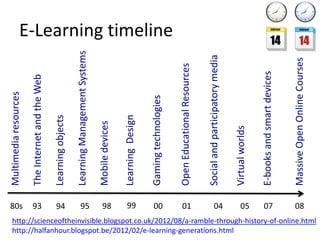
Multimedia resources


                                                                                              80s
                                                                                              93
                                                                                                    The Internet and the Web


                                                                                              94
                                                                                                    Learning objects

                                                                                                    Learning Management Systems


                                                                                              95
                                                                                                    Mobile devices


                                                                                              98
                                                                                                    Learning Design


                                                                                              99
                                                                                                    Gaming technologies


                                                                                              00
                                                                                                                                     E-Learning timeline


                                                                                              01
                                                                                                    Open Educational Resources

                                                                                                    Social and participatory media
                                                                                              04

http://halfanhour.blogspot.be/2012/02/e-learning-generations.html
                                                                                                    Virtual worlds
                                                                                              05
                                                                                              07


                                                                                                    E-books and smart devices
                                                                                              08


                                                                                                    Massive Open Online Courses
http://scienceoftheinvisible.blogspot.co.uk/2012/08/a-ramble-through-history-of-online.html
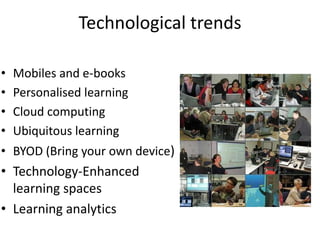
Technological trends

•   Mobiles and e-books
•   Personalised learning
•   Cloud computing
•   Ubiquitous learning
• BYOD (Bring your own device)
• Technology-Enhanced
  learning spaces
• Learning analytics
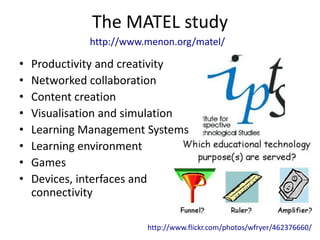
The MATEL study
              http://www.menon.org/matel/

•   Productivity and creativity
•   Networked collaboration
•   Content creation
•   Visualisation and simulation
•   Learning Management Systems
•   Learning environment
•   Games
•   Devices, interfaces and
    connectivity

                         http://www.flickr.com/photos/wfryer/462376660/
Game changers
• Harnessing the power of new
  media
• Need to rethink education
• Key questions
   – How can we reach more
     learners, more effectively?
   – What is the impact of free
     resources, tools and expertise?
   – What new business models are
     emerging?
   – What new digital literacies are
     needed?

                        http://www.educause.edu/game-changers
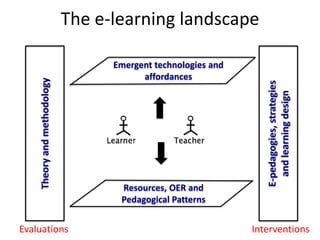
The e-learning landscape

                                   Emergent technologies and
                                         affordances
    Theory and methodology


                                                                  E-pedagogies, strategies
                                                                    and learning design
                                    Resources, OER and
                                    Pedagogical Patterns


Evaluations                                                    Interventions
MOOCS


                                        Helen
                                        Keegan
www.evolllution.com/distance_online_learning/massive-open-online-learning-creativity-and-competency/
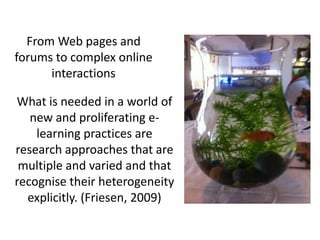
From Web pages and
forums to complex online
      interactions

What is needed in a world of
   new and proliferating e-
    learning practices are
research approaches that are
 multiple and varied and that
recognise their heterogeneity
  explicitly. (Friesen, 2009)
Themes
• Complex,
  disruptive,
  evolving
• More open
  practices
• Distributed,
  networked
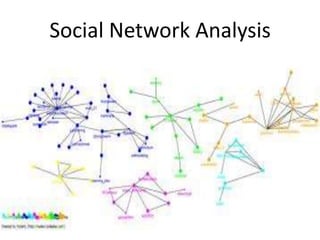
Social Network Analysis
OER communities
• 7 in-depth case studies
• Articulate the nature of the OER communities
  and the patterns of user behaviour
• Using the LOOK SNA tool
• Relationships between individuals and themes
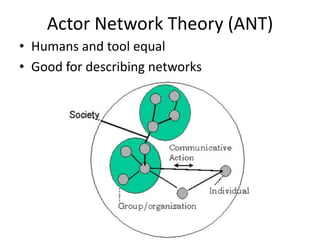
Actor Network Theory (ANT)
• Humans and tool equal
• Good for describing networks
Learning design

• Activity Theory
• Design-Based Research
• Community Indicators
  Framework


                     http://www.flickr.com/photos/pcoutas/4996881007/
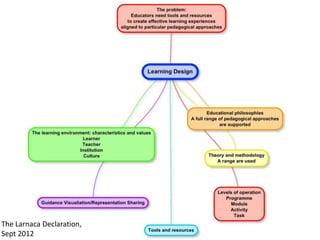
The Larnaca Declaration,
Sept 2012
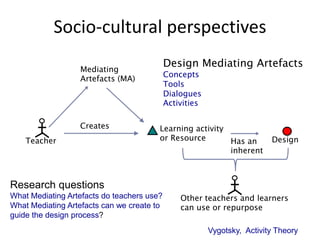
Socio-cultural perspectives

                  Mediating
                                            Design Mediating Artefacts
                                            Concepts
                  Artefacts (MA)
                                            Tools
                                            Dialogues
                                            Activities

                  Creates               Learning activity
    Teacher                             or Resource       Has an          Design
                                                          inherent


Research questions
What Mediating Artefacts do teachers use?       Other teachers and learners
What Mediating Artefacts can we create to       can use or repurpose
guide the design process?
                                                         Vygotsky, Activity Theory
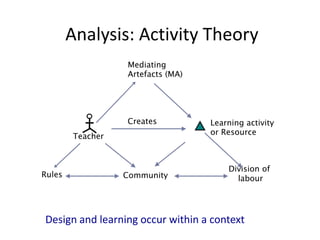
Analysis: Activity Theory
                  Mediating
                  Artefacts (MA)


                  Creates          Learning activity
                                   or Resource
        Teacher


                                       Division of
Rules             Community              labour


Design and learning occur within a context
Design-Based Research


A systematic, but flexible methodology aimed to
improve educational practice through iterative
analysis, design, development and implementation,
based on collaboration between researchers and
practitioners in real-world settings, and leading to
contextually-sensitive design principles and theories.


                                Wang and Hannafin, 2005
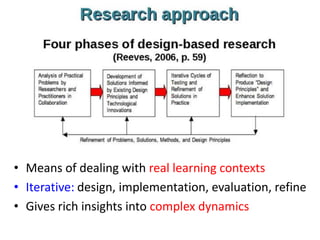
• Means of dealing with real learning contexts
• Iterative: design, implementation, evaluation, refine
• Gives rich insights into complex dynamics
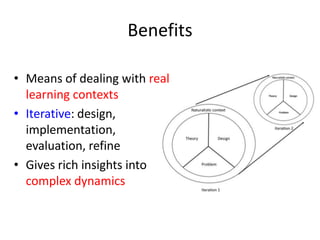
Benefits

• Means of dealing with real
  learning contexts
• Iterative: design,
  implementation,
  evaluation, refine
• Gives rich insights into
  complex dynamics
Facets
•   Make assumptions and theoretical bases explicit
•   Collect multiple types of data
•   Conduct ongoing data analysis
•   Invite multiple voices to critique
•   Have multiple accountability structures
•   Engage in dialectic among theory, design and
    extant literature

                                        Barab, 2006
DBR and Learning Design
• Builds on theory & prior   • Builds on ID, OER, Ped Patterns
  research                     research etc.
• Pragmatic                  • Practical tools & resources
• Collaborative              • Work with practitioners
• Contextual                 • Real, authentic contexts
• Integrative                • Mixed-method approach
• Iterative – problem,       • Problem, implementation,
  solution, evaluation         evaluation and refinement
• Adaptive and flexible      • Agile, based on practice
• Generalisation             • Coherent LD framework
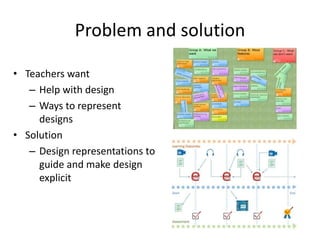
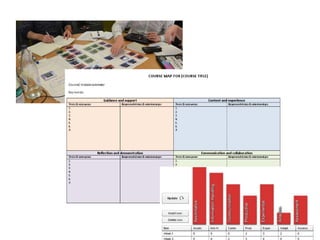
Problem and solution

• Teachers want
   – Help with design
   – Ways to represent
     designs
• Solution
   – Design representations to
     guide and make design
     explicit
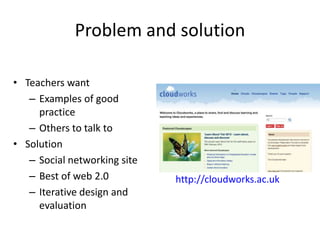
Problem and solution

• Teachers want
   – Examples of good
     practice
   – Others to talk to
• Solution
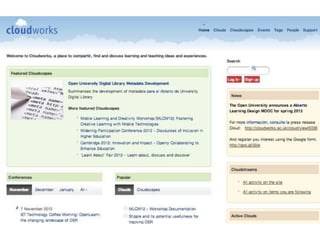
   – Social networking site
   – Best of web 2.0          http://cloudworks.ac.uk
   – Iterative design and
     evaluation
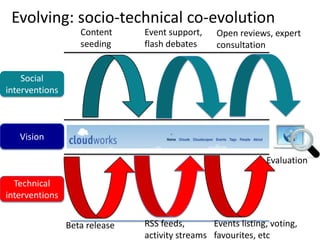
Evolving: socio-technical co-evolution
                   Content     Event support,    Open reviews, expert
                   seeding     flash debates     consultation


    Social
interventions


   Vision

                                                              Evaluation

  Technical
interventions


                Beta release   RSS feeds,       Events listing, voting,
                               activity streams favourites, etc
Interactions and
           Communities
• Interactions
  – Type
  – Time
  – Location
• Communities
http://www.slideshare.net/GrainneConole
http://www2.le.ac.uk/departments/beyond-distance-research-alliance
                    grainne.conole@le.ac.uk
                    http://e4innovation.com

Conole research methods

  • 1.
    National Teaching Fellow 2012 Trajectories of e-learning: theory and methodology explore Gráinne Conole University of Leicester 18thApril 2013
  • 2.
    Outline • The technologicalcontext • Research complex online interactions • Approaches – Social Network Analysis – Actor Network Theory • Learning design – Activity Theory – Design-Based Research – Community Indicator Framework
  • 3.
    Multimedia resources 80s 93 The Internet and the Web 94 Learning objects Learning Management Systems 95 Mobile devices 98 Learning Design 99 Gaming technologies 00 E-Learning timeline 01 Open Educational Resources Social and participatory media 04 http://halfanhour.blogspot.be/2012/02/e-learning-generations.html Virtual worlds 05 07 E-books and smart devices 08 Massive Open Online Courses http://scienceoftheinvisible.blogspot.co.uk/2012/08/a-ramble-through-history-of-online.html
  • 4.
    Technological trends • Mobiles and e-books • Personalised learning • Cloud computing • Ubiquitous learning • BYOD (Bring your own device) • Technology-Enhanced learning spaces • Learning analytics
  • 5.
    The MATEL study http://www.menon.org/matel/ • Productivity and creativity • Networked collaboration • Content creation • Visualisation and simulation • Learning Management Systems • Learning environment • Games • Devices, interfaces and connectivity http://www.flickr.com/photos/wfryer/462376660/
  • 6.
    Game changers • Harnessingthe power of new media • Need to rethink education • Key questions – How can we reach more learners, more effectively? – What is the impact of free resources, tools and expertise? – What new business models are emerging? – What new digital literacies are needed? http://www.educause.edu/game-changers
  • 7.
    The e-learning landscape Emergent technologies and affordances Theory and methodology E-pedagogies, strategies and learning design Resources, OER and Pedagogical Patterns Evaluations Interventions
  • 8.
    MOOCS Helen Keegan www.evolllution.com/distance_online_learning/massive-open-online-learning-creativity-and-competency/
  • 9.
    From Web pagesand forums to complex online interactions What is needed in a world of new and proliferating e- learning practices are research approaches that are multiple and varied and that recognise their heterogeneity explicitly. (Friesen, 2009)
  • 10.
    Themes • Complex, disruptive, evolving • More open practices • Distributed, networked
  • 11.
  • 12.
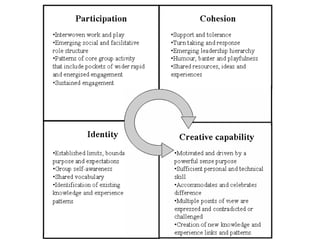
    OER communities • 7in-depth case studies • Articulate the nature of the OER communities and the patterns of user behaviour • Using the LOOK SNA tool • Relationships between individuals and themes
  • 13.
    Actor Network Theory(ANT) • Humans and tool equal • Good for describing networks
  • 14.
    Learning design • ActivityTheory • Design-Based Research • Community Indicators Framework http://www.flickr.com/photos/pcoutas/4996881007/
  • 15.
  • 16.
    Socio-cultural perspectives Mediating Design Mediating Artefacts Concepts Artefacts (MA) Tools Dialogues Activities Creates Learning activity Teacher or Resource Has an Design inherent Research questions What Mediating Artefacts do teachers use? Other teachers and learners What Mediating Artefacts can we create to can use or repurpose guide the design process? Vygotsky, Activity Theory
  • 17.
    Analysis: Activity Theory Mediating Artefacts (MA) Creates Learning activity or Resource Teacher Division of Rules Community labour Design and learning occur within a context
  • 18.
    Design-Based Research A systematic,but flexible methodology aimed to improve educational practice through iterative analysis, design, development and implementation, based on collaboration between researchers and practitioners in real-world settings, and leading to contextually-sensitive design principles and theories. Wang and Hannafin, 2005
  • 19.
    • Means ofdealing with real learning contexts • Iterative: design, implementation, evaluation, refine • Gives rich insights into complex dynamics
  • 20.
    Benefits • Means ofdealing with real learning contexts • Iterative: design, implementation, evaluation, refine • Gives rich insights into complex dynamics
  • 21.
    Facets • Make assumptions and theoretical bases explicit • Collect multiple types of data • Conduct ongoing data analysis • Invite multiple voices to critique • Have multiple accountability structures • Engage in dialectic among theory, design and extant literature Barab, 2006
  • 22.
    DBR and LearningDesign • Builds on theory & prior • Builds on ID, OER, Ped Patterns research research etc. • Pragmatic • Practical tools & resources • Collaborative • Work with practitioners • Contextual • Real, authentic contexts • Integrative • Mixed-method approach • Iterative – problem, • Problem, implementation, solution, evaluation evaluation and refinement • Adaptive and flexible • Agile, based on practice • Generalisation • Coherent LD framework
  • 23.
    Problem and solution •Teachers want – Help with design – Ways to represent designs • Solution – Design representations to guide and make design explicit
  • 25.
    Problem and solution •Teachers want – Examples of good practice – Others to talk to • Solution – Social networking site – Best of web 2.0 http://cloudworks.ac.uk – Iterative design and evaluation
  • 27.
    Evolving: socio-technical co-evolution Content Event support, Open reviews, expert seeding flash debates consultation Social interventions Vision Evaluation Technical interventions Beta release RSS feeds, Events listing, voting, activity streams favourites, etc
  • 28.
    Interactions and Communities • Interactions – Type – Time – Location • Communities
  • 30.

Editor's Notes