edfuture.net MOOC on Current/Future State of HigherEd


Learning Analytics
what are we optimizing for?                             Knowledge Media Institute


           Simon Buckingham Shum
           Knowledge Media Institute
           The Open University UK
                            http://twitter.com/sbskmi
           simon.buckinghamshum.net          @


                                                                               1
edX: “this is big data, giving us the chance
to ask big questions about learning”


                                     Will the tomorrow’s
                                  educational researcher be
                                    as helpless without an
                                  analytics infrastructure, as
                                     a geneticist without
                                   genome databases, or a
                                   physicist without CERN? 2
the plan…

joined-up multi-layer analytics
    an analytics ecosystem
 are analytics (r)evolutionary?


                                  3
the convergence of
  analytics layers


                     4
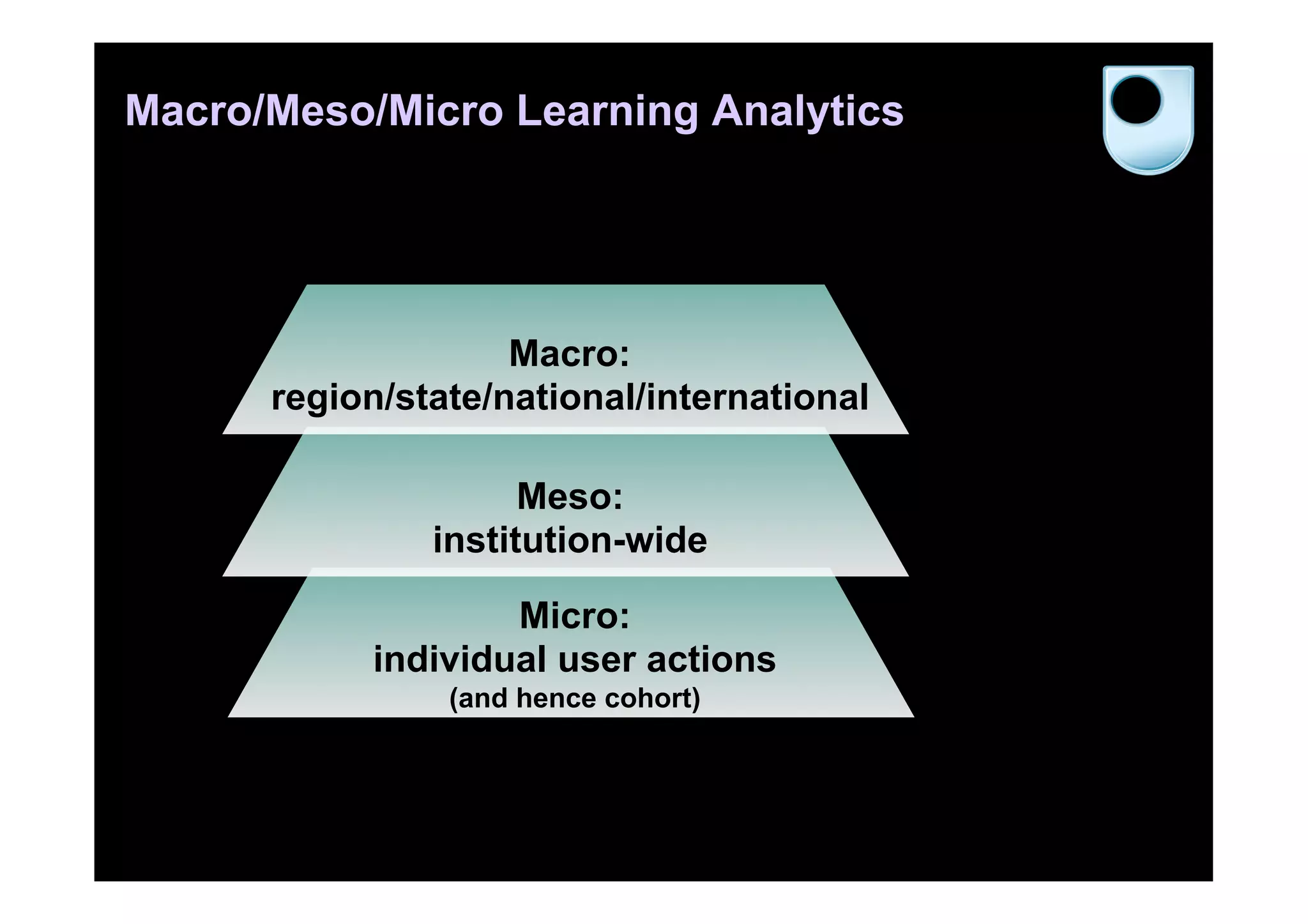
Macro/Meso/Micro Learning Analytics


                    Macro:
      region/state/national/international

                     Meso:
               institution-wide

                   Micro:
           individual user actions
                (and hence cohort)
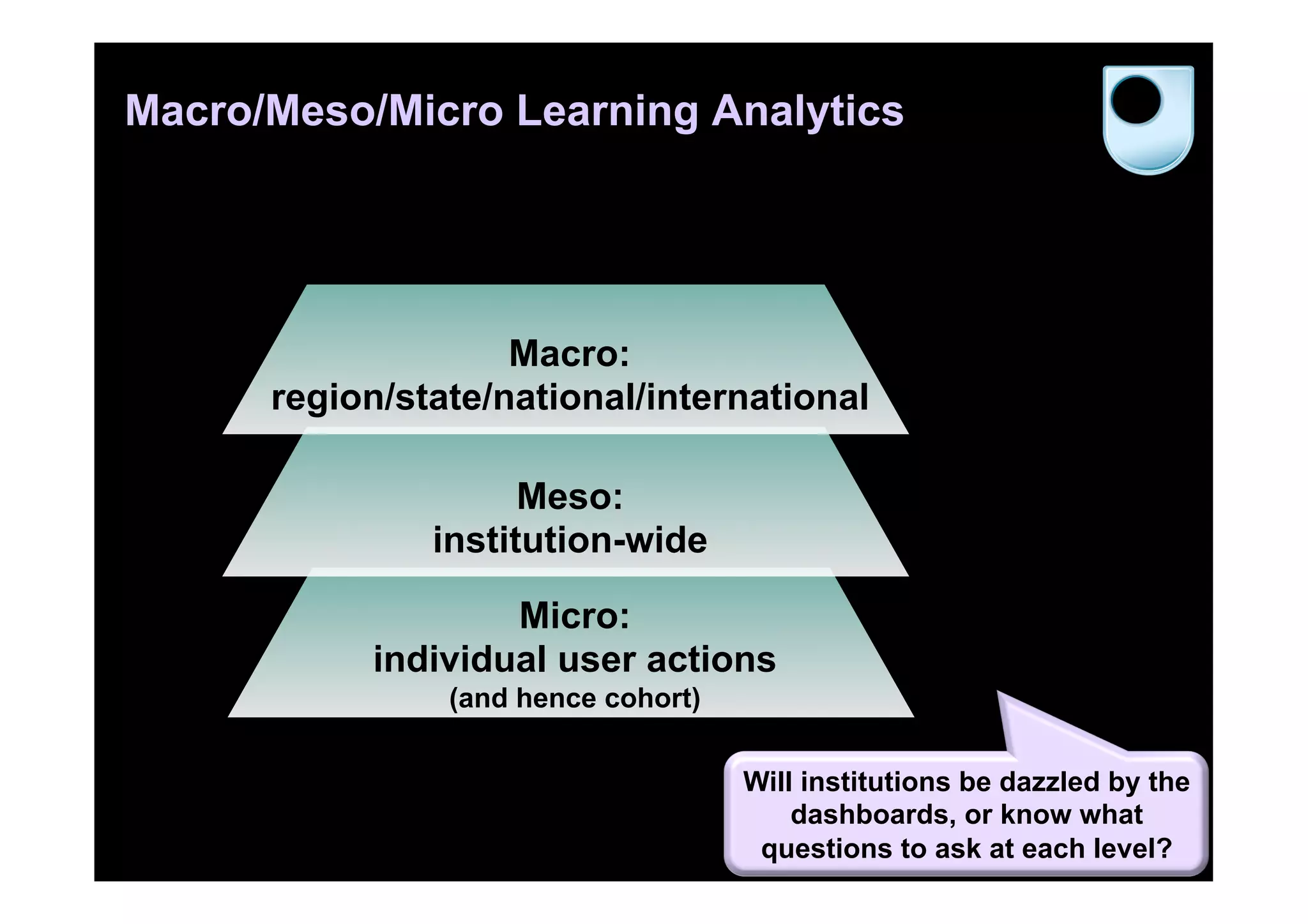
Macro/Meso/Micro Learning Analytics


                    Macro:
      region/state/national/international

                     Meso:
               institution-wide

                   Micro:
           individual user actions
                (and hence cohort)

                                     Will institutions be dazzled by the
                                         dashboards, or know what
                                      questions to ask at each level?
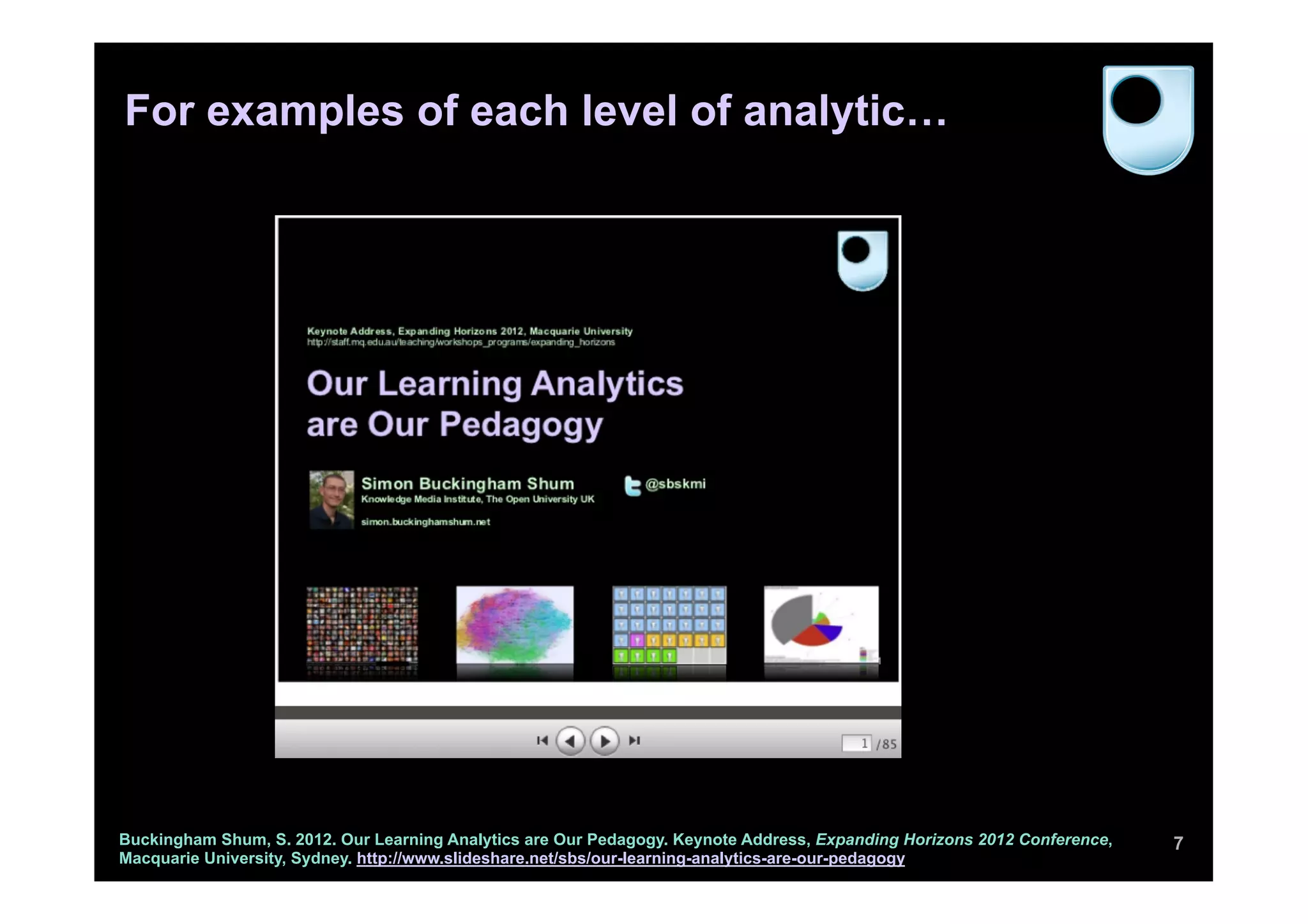
For examples of each level of analytic…


Buckingham Shum, S. 2012. Our Learning Analytics are Our Pedagogy. Keynote Address, Expanding Horizons 2012 Conference,   7
Macquarie University, Sydney. http://www.slideshare.net/sbs/our-learning-analytics-are-our-pedagogy
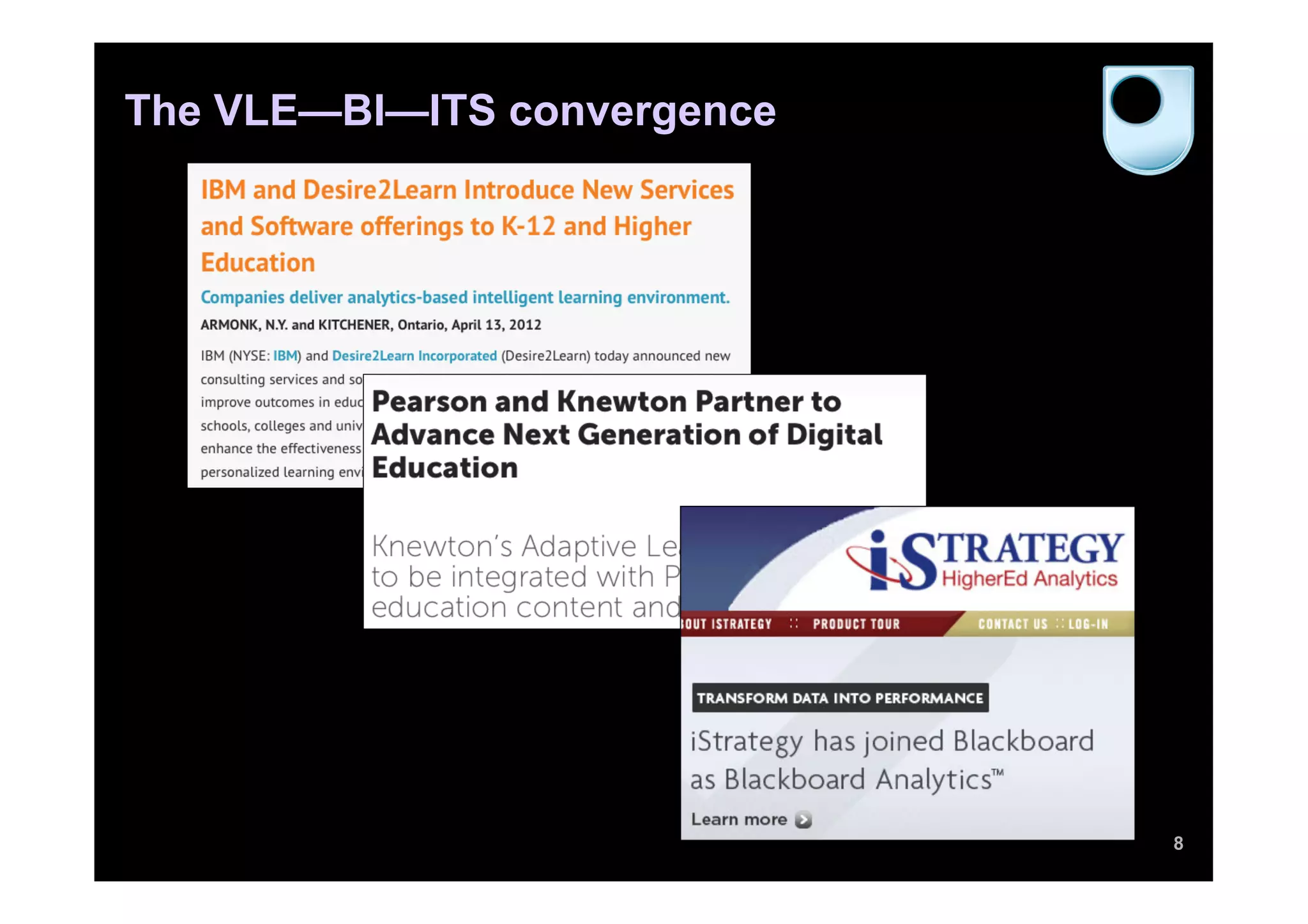
The VLE—BI—ITS convergence


                             8
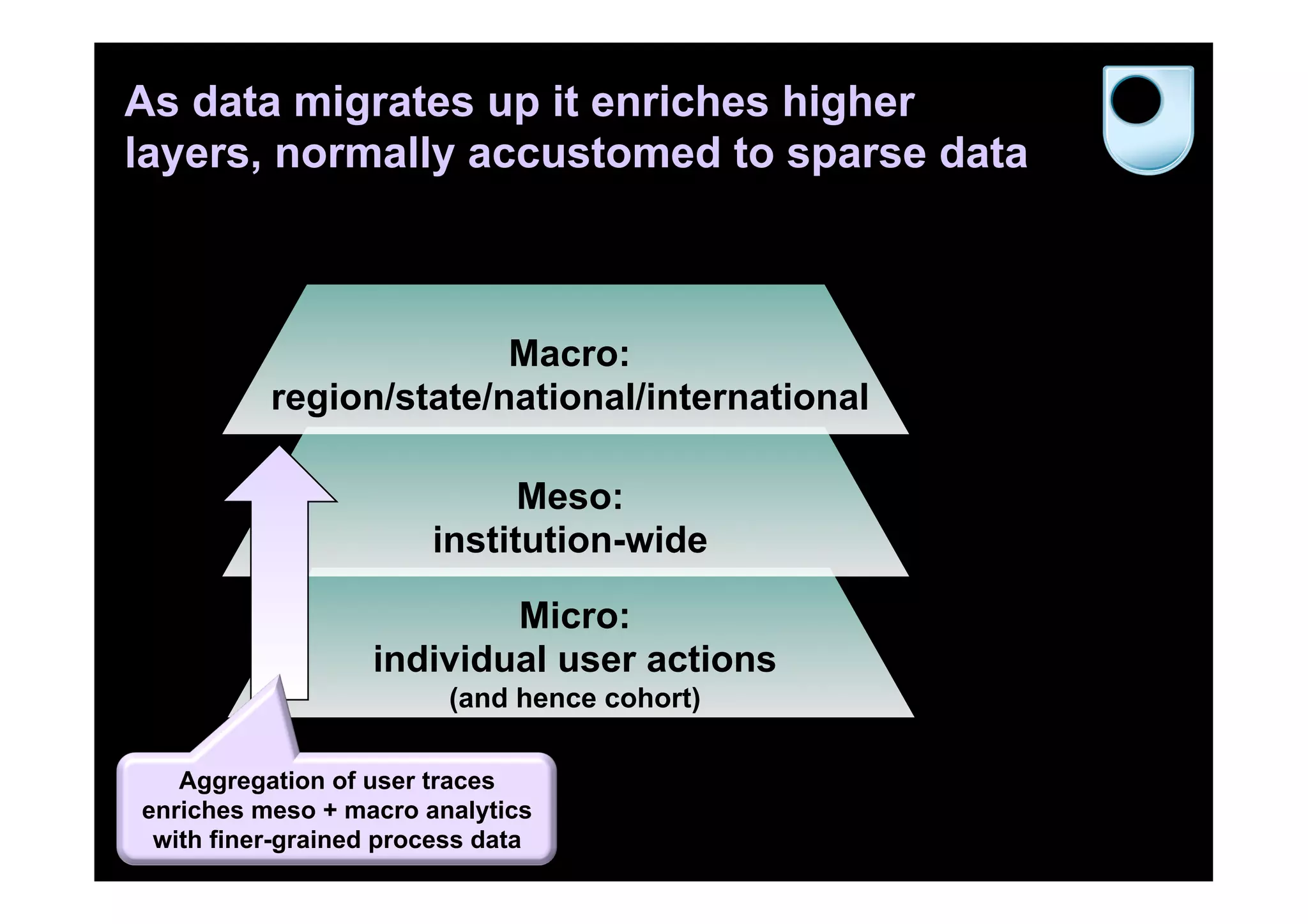
As data migrates up it enriches higher
layers, normally accustomed to sparse data


                        Macro:
          region/state/national/international

                             Meso:
                       institution-wide

                          Micro:
                  individual user actions
                         (and hence cohort)

   Aggregation of user traces
enriches meso + macro analytics
 with finer-grained process data
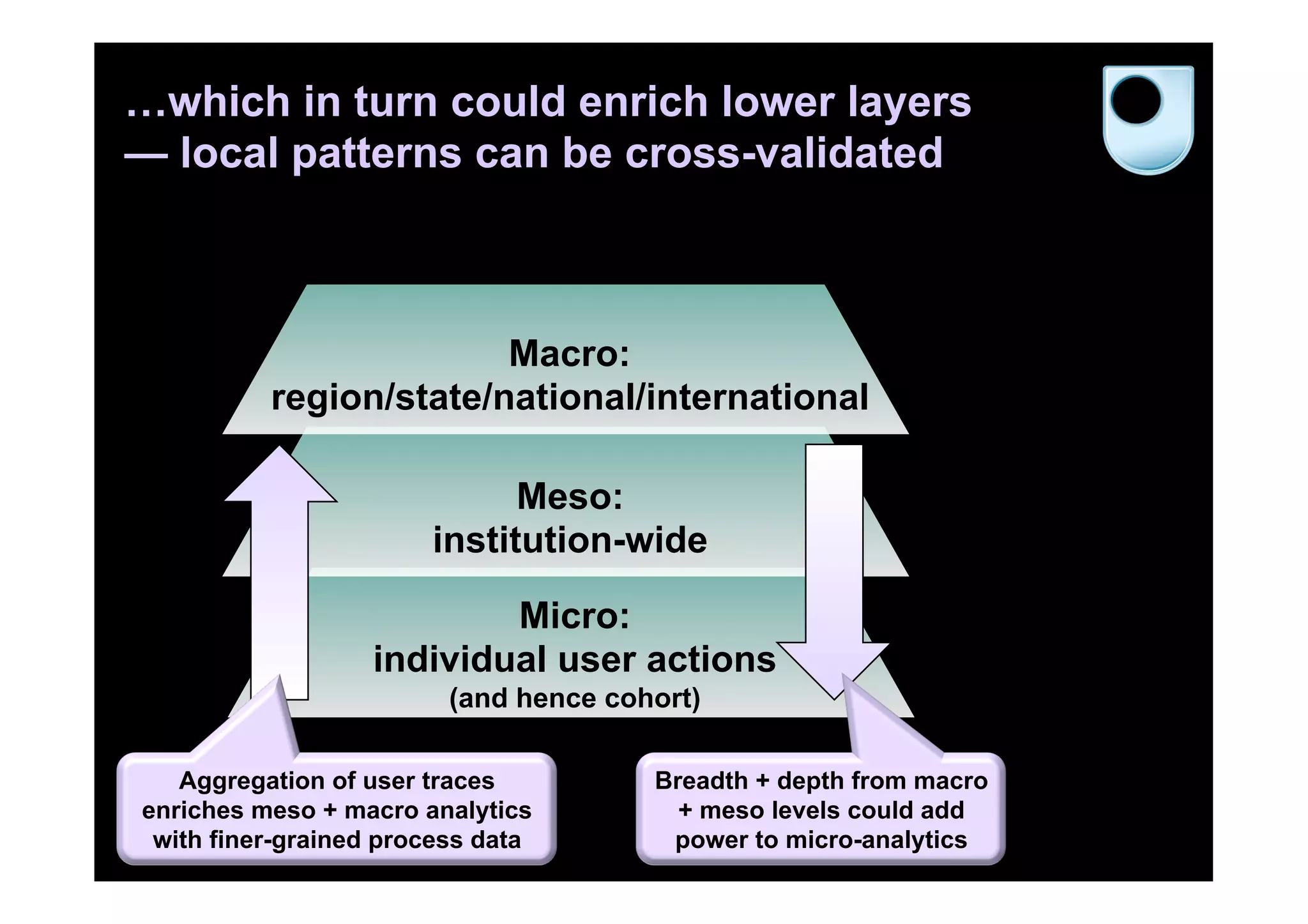
…which in turn could enrich lower layers
— local patterns can be cross-validated


                        Macro:
          region/state/national/international

                             Meso:
                       institution-wide

                          Micro:
                  individual user actions
                         (and hence cohort)

   Aggregation of user traces          Breadth + depth from macro
enriches meso + macro analytics          + meso levels could add
 with finer-grained process data        power to micro-analytics
anatomy of an
analytics ecosystem


                      11
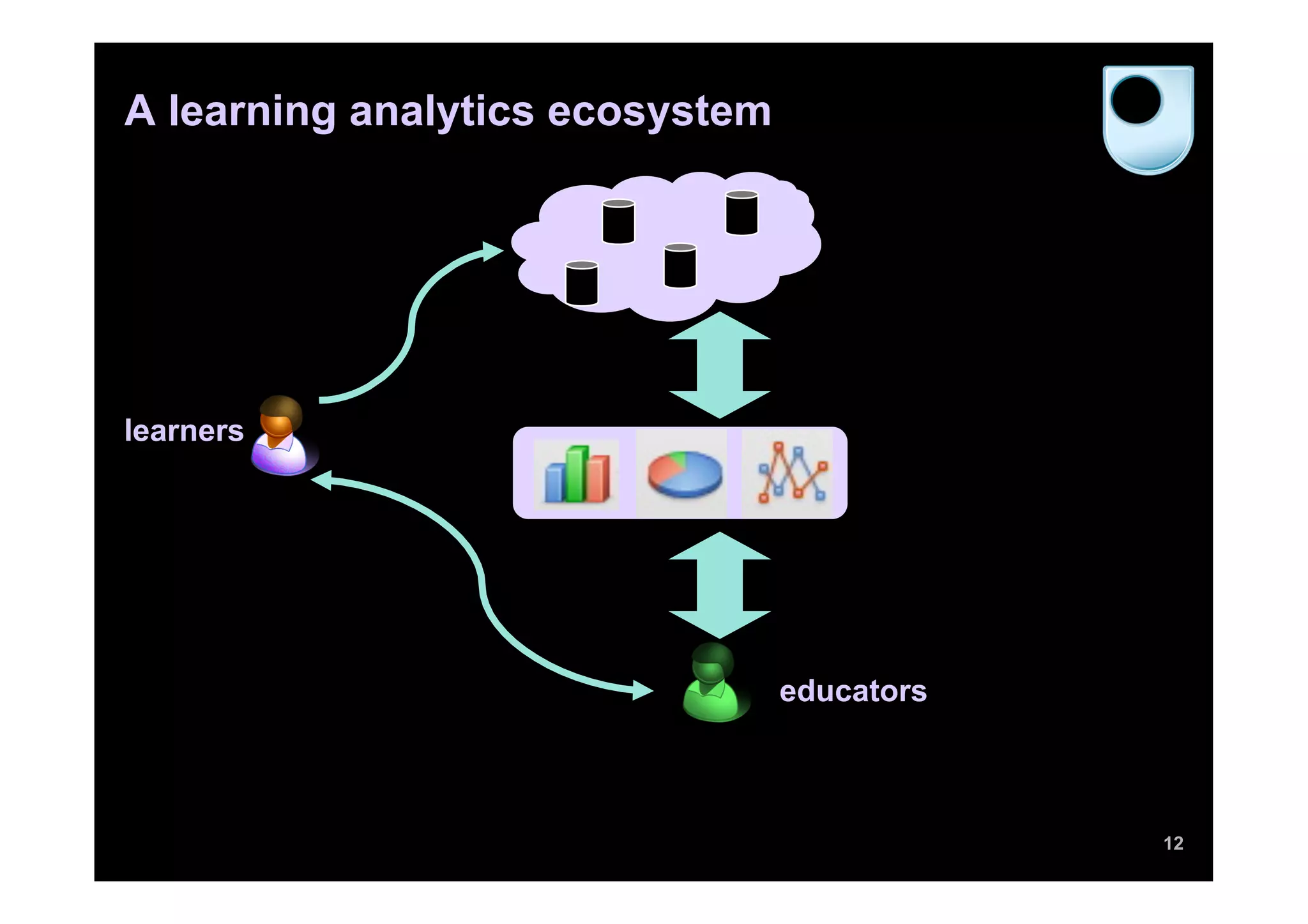
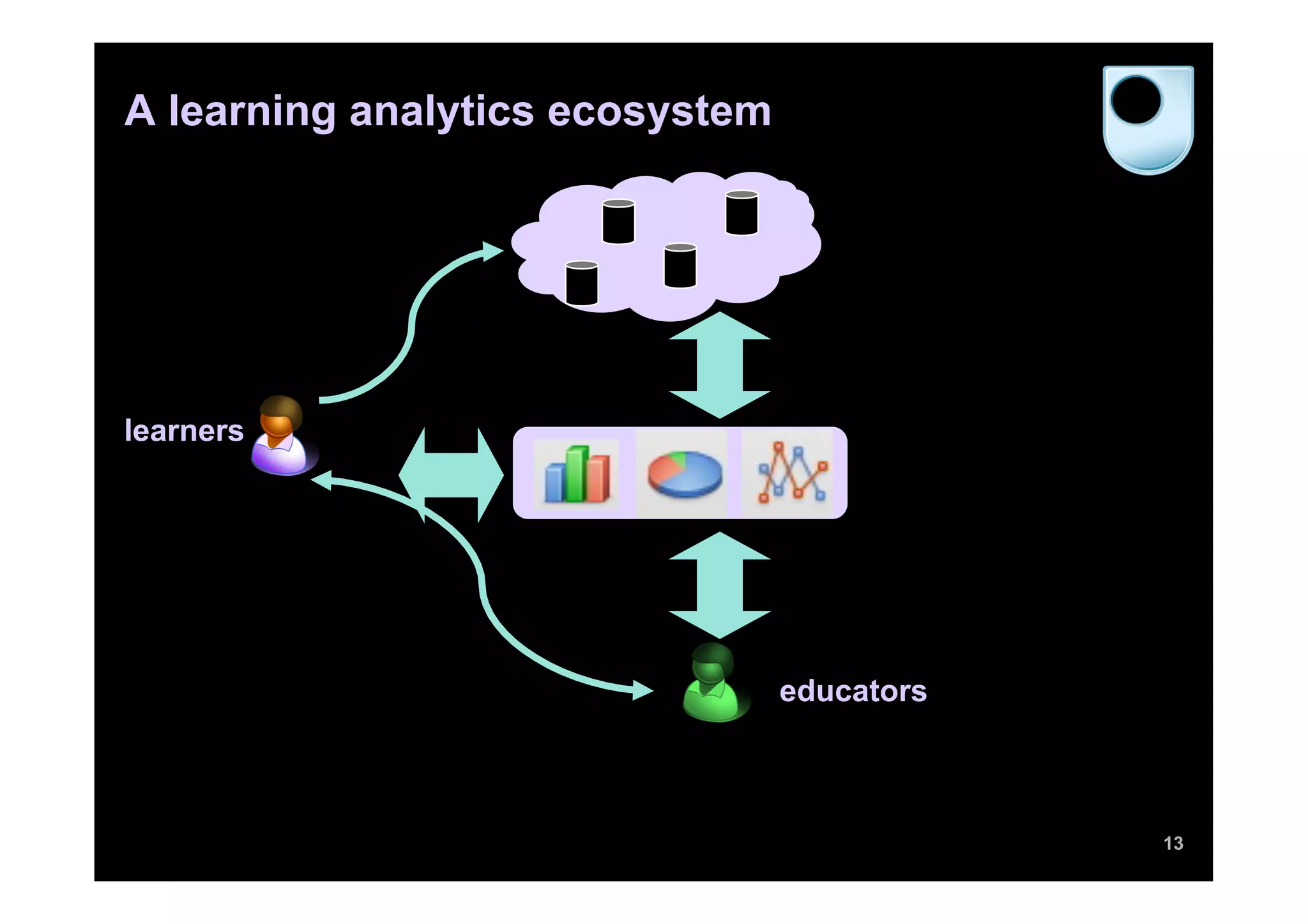
A learning analytics ecosystem


learners


                                 educators


                                             12
A learning analytics ecosystem


learners


                                 educators


                                             13
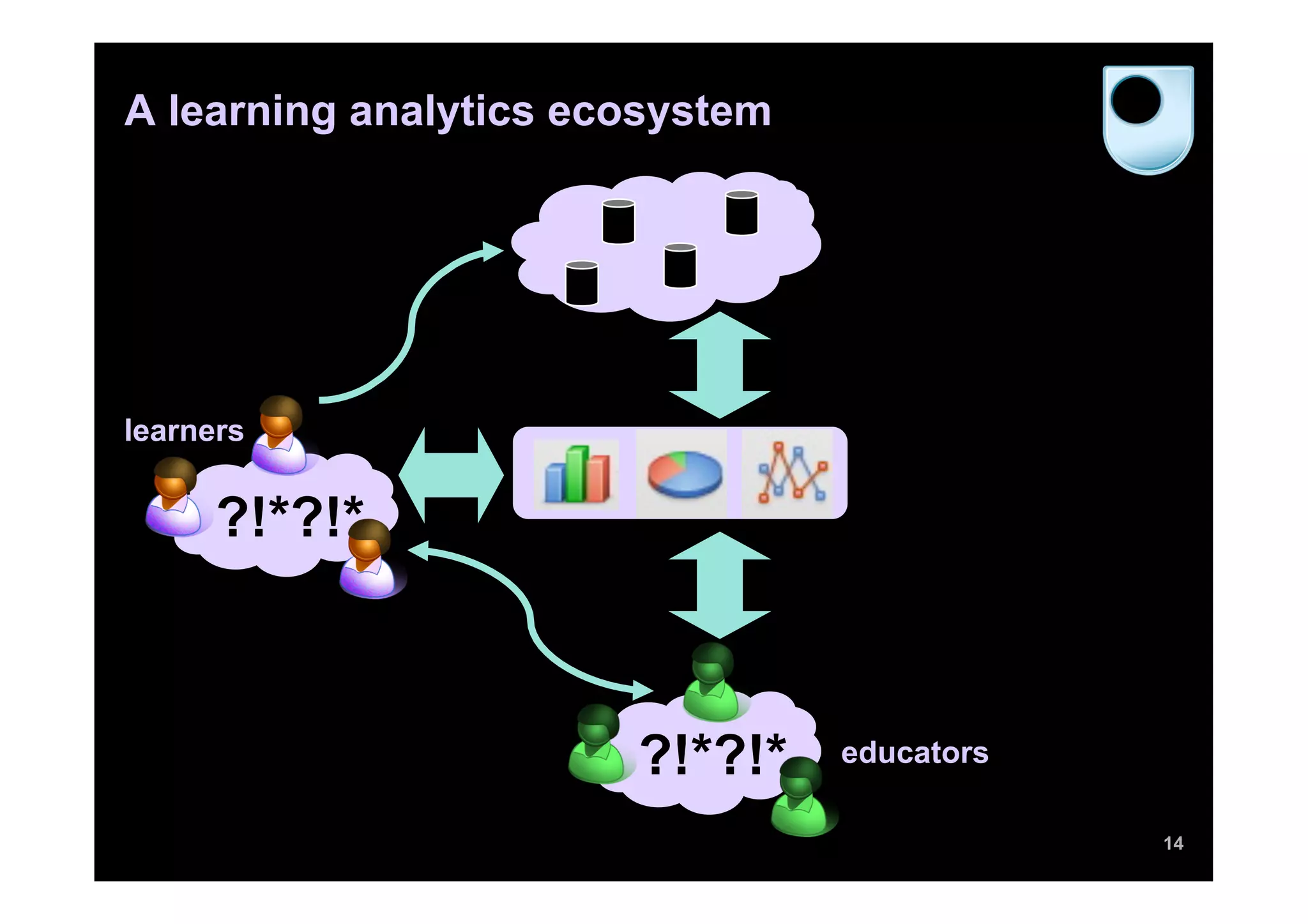
A learning analytics ecosystem


learners


      ?!*?!*


                       ?!*?!*    educators

                                             14
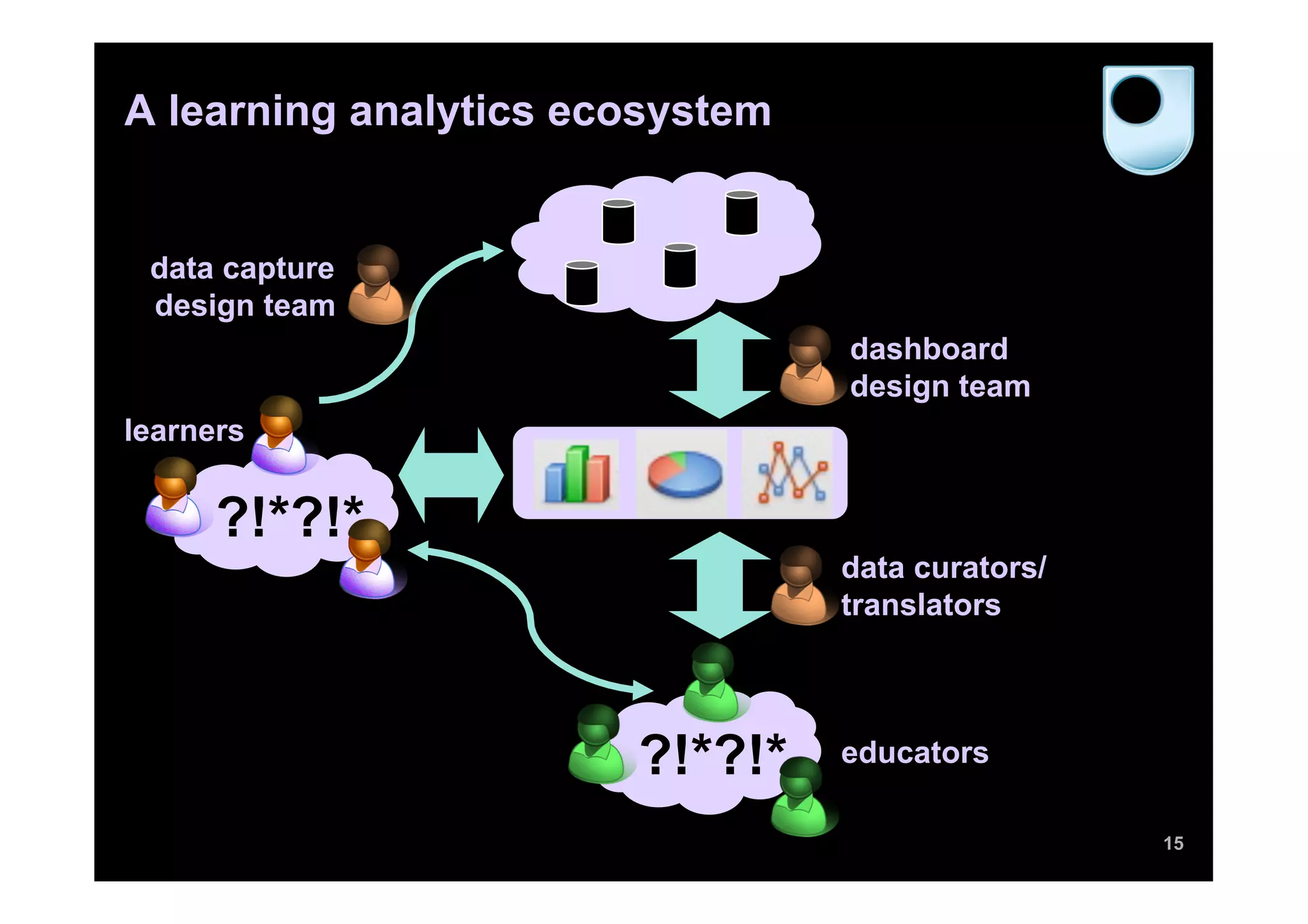
A learning analytics ecosystem


 data capture
 design team
                                 dashboard
                                 design team
learners


      ?!*?!*
                                 data curators/
                                 translators


                       ?!*?!*    educators

                                                  15
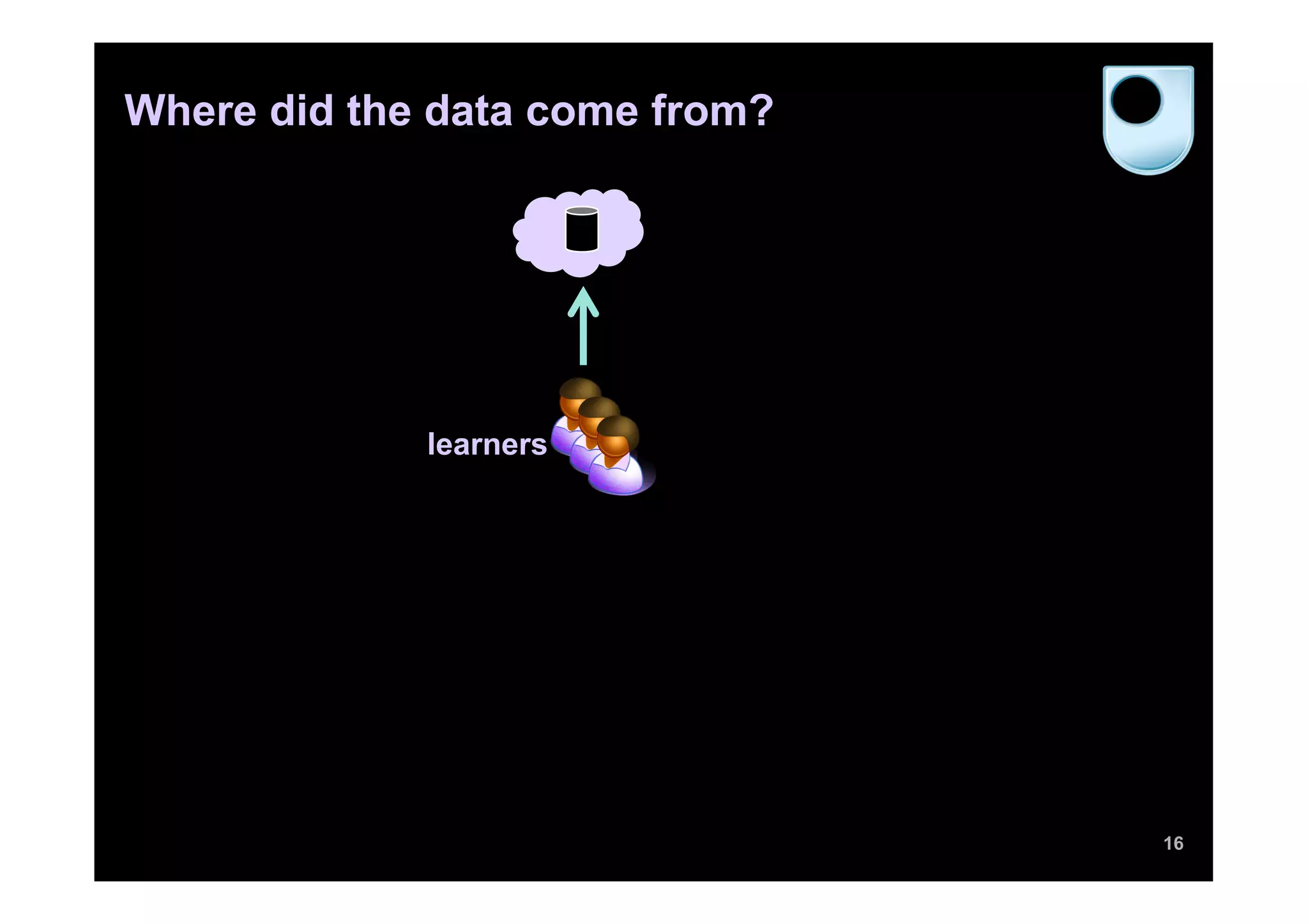
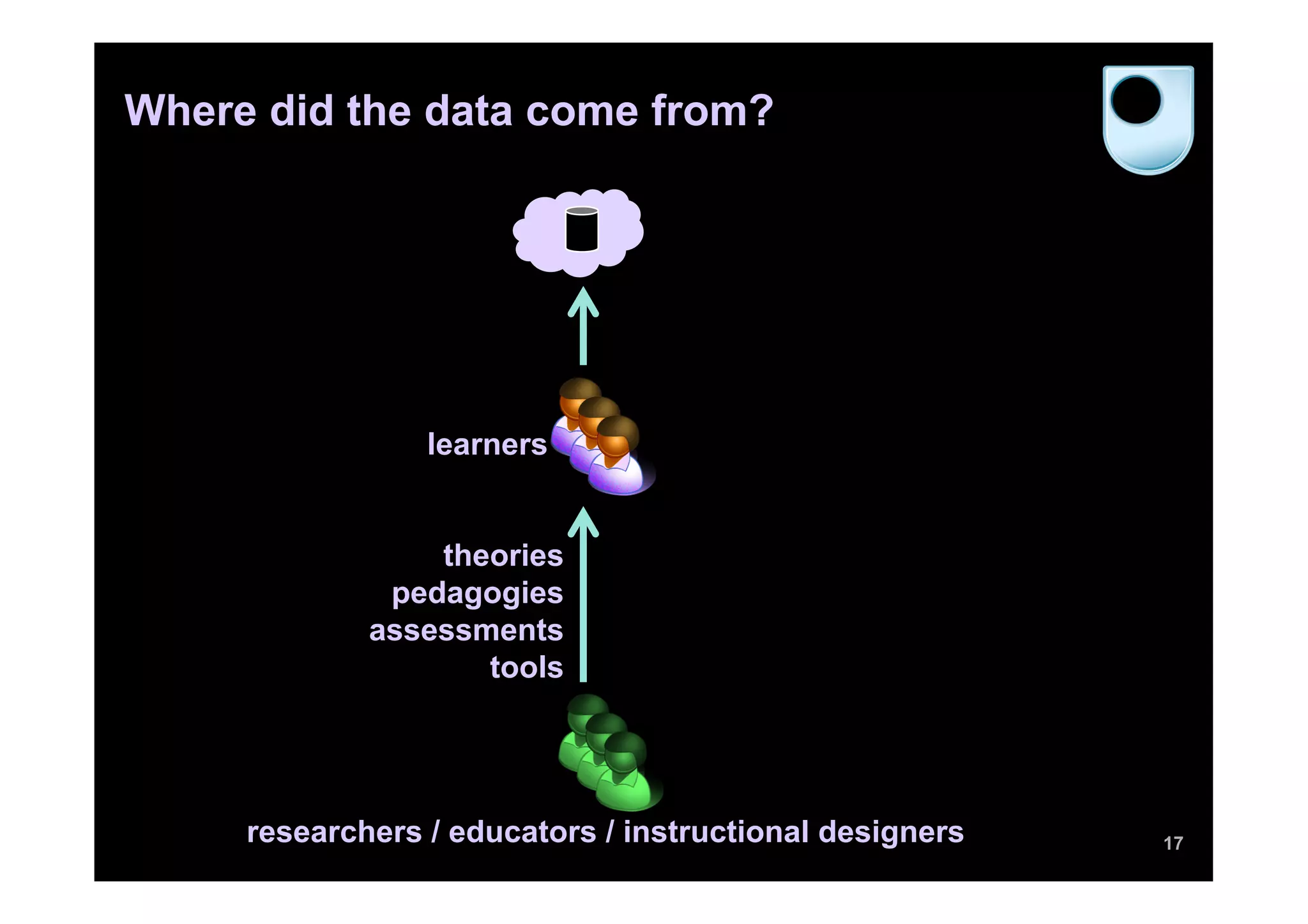
Where did the data come from?


             learners


                                16
Where did the data come from?


                 learners


                 theories
              pedagogies
             assessments
                    tools


     researchers / educators / instructional designers   17
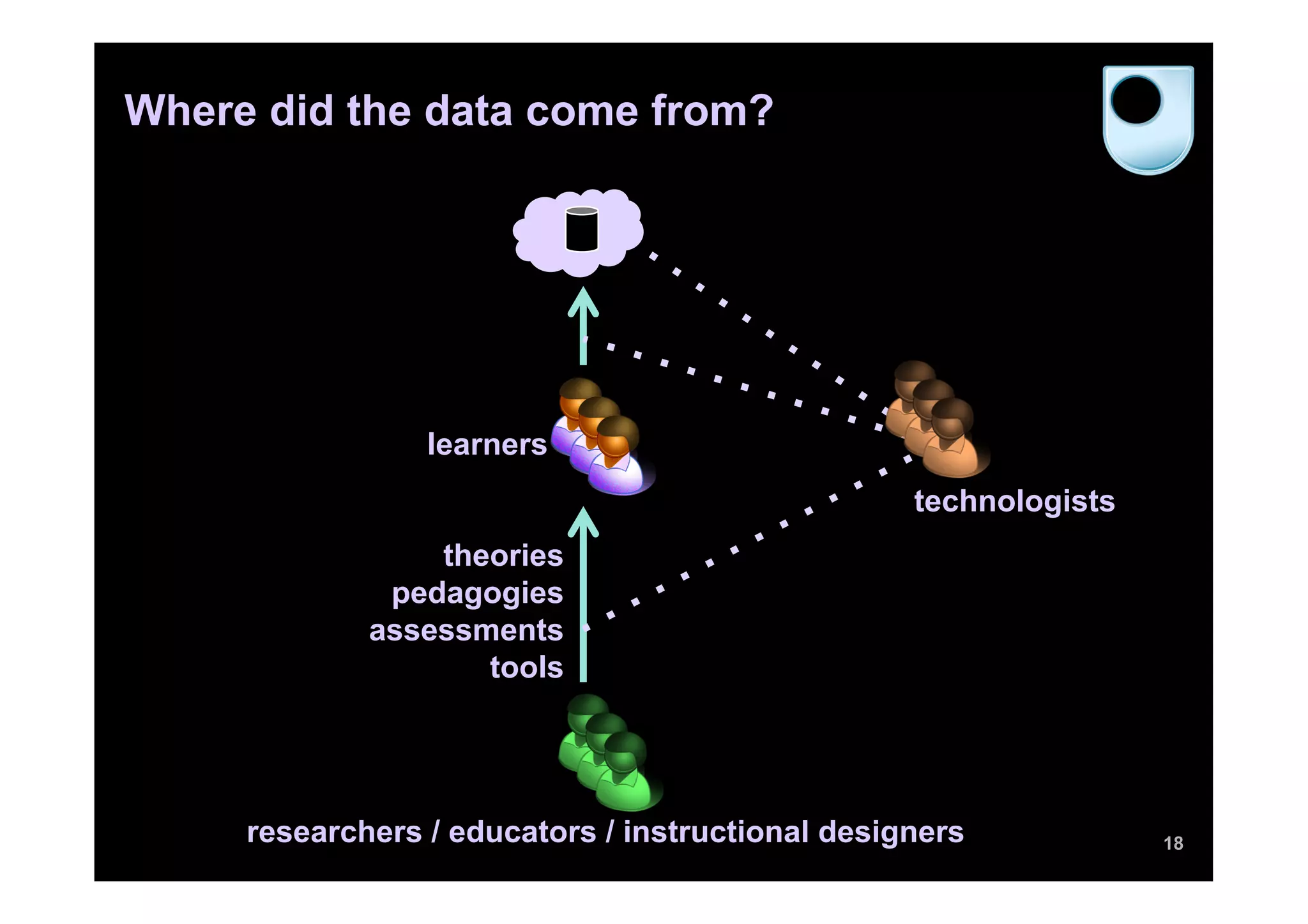
Where did the data come from?


                 learners
                                                  technologists
                 theories
              pedagogies
             assessments
                    tools


     researchers / educators / instructional designers            18
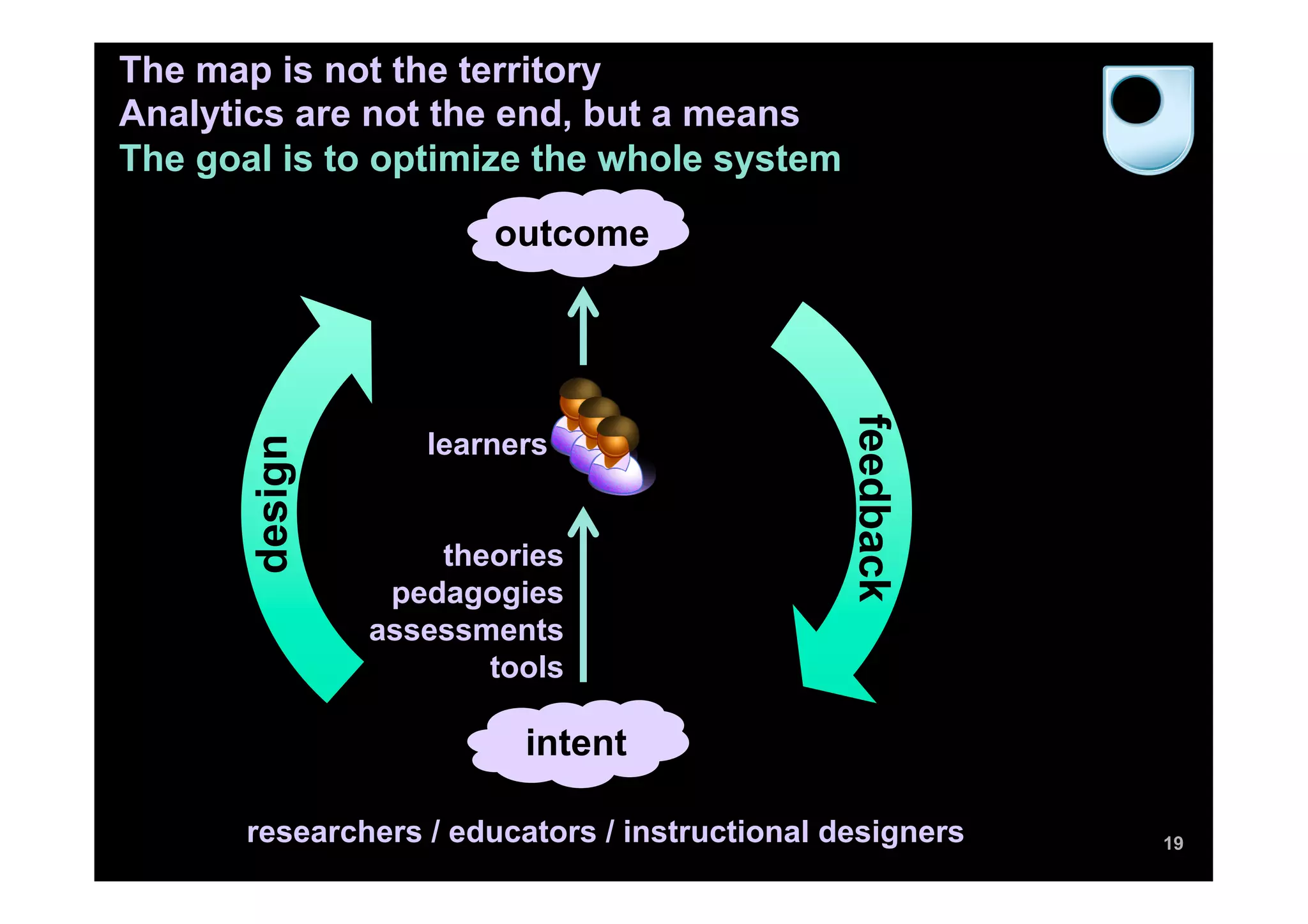
The map is not the territory
Analytics are not the end, but a means
The goal is to optimize the whole system

                       outcome


                                                feedback
                   learners
       design


    Intent          theories
                                    Data
                 pedagogies
                assessments
                       tools

                          intent

       researchers / educators / instructional designers   19
Optimize the system
     for what?


                      20
Same outcomes,
but higher scores?
  Learning Analytics as
 Evolutionary Technology

        • more engaging
       • better assessed
       • better outcomes
     • deliverable at scale

                              21
New outcomes we
couldn’t assess before?
    Learning Analytics as
   Revolutionary Technology

      • learner behaviours quantifiable
   • interpersonal networks quantifiable
           • discourse quantifiable
  • moods and dispositions quantifiable

                                           22
Learning analytics for this?


“We are preparing students for jobs
 that do not exist yet, that will use
 technologies that have not been
 invented yet, in order to solve
 problems that are not even
 problems yet.”

                                “Shift Happens”
            http://shifthappens.wikispaces.com


                                                  23
Learning analytics for this?

“While employers continue to demand high academic
 standards, they also now want more. They want
 people who can adapt, see connections,
 innovate, communicate and work with
 others. This is true in many areas of work. The new
 knowledge-based economies in particular will
 increasingly depend on these abilities. Many
 businesses are paying for courses to promote creative
 abilities, to teach the skills
                       and attitudes that
 are now essential for economic
 success…”
                    All our Futures: Creativity, culture & education, May 1999 24
Learning analytics for this?

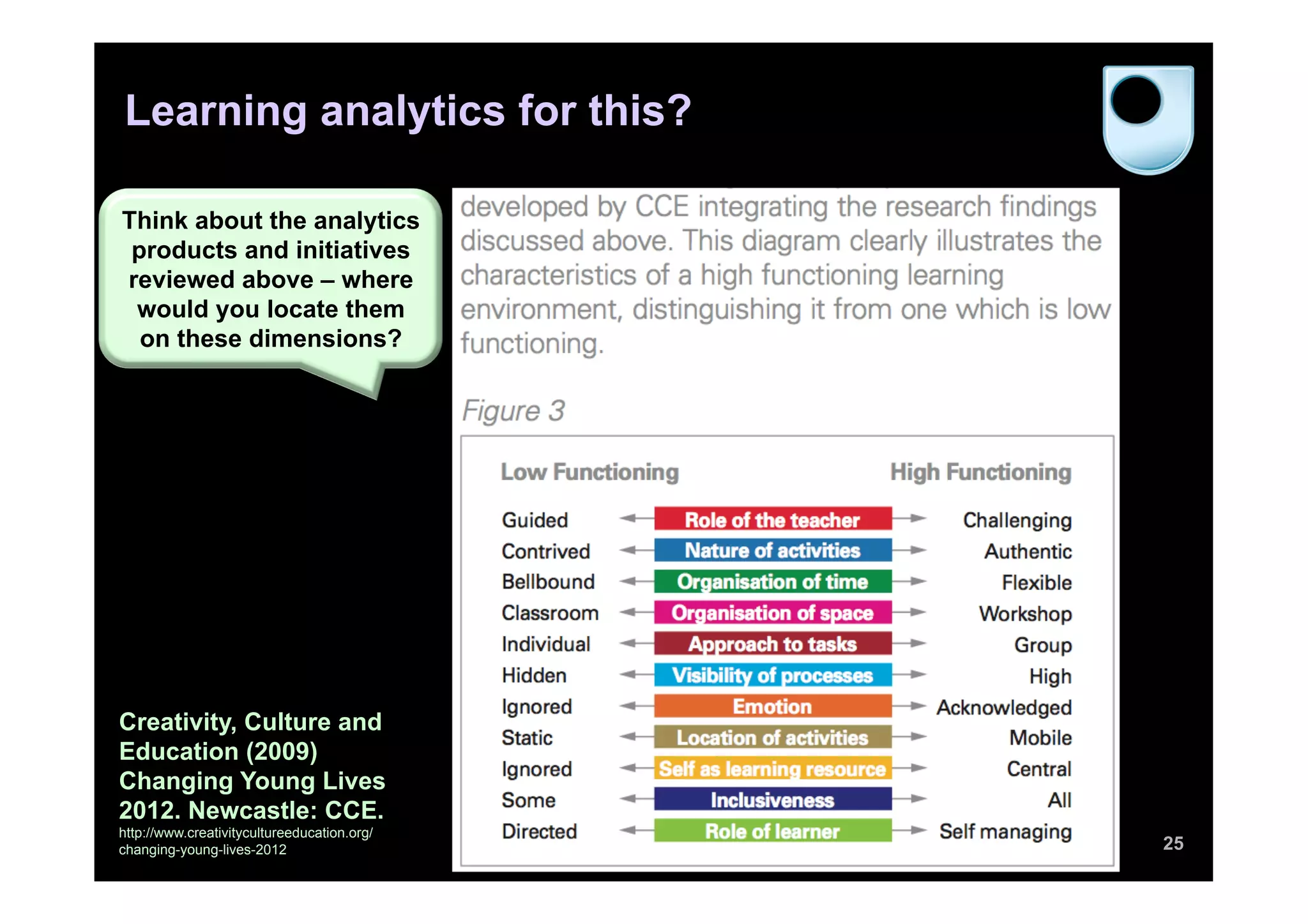
Think about the analytics
 products and initiatives
reviewed above – where
 would you locate them
  on these dimensions?


Creativity, Culture and
Education (2009)
Changing Young Lives
2012. Newcastle: CCE.
http://www.creativitycultureeducation.org/
changing-young-lives-2012                    25
Learning analytics for this?


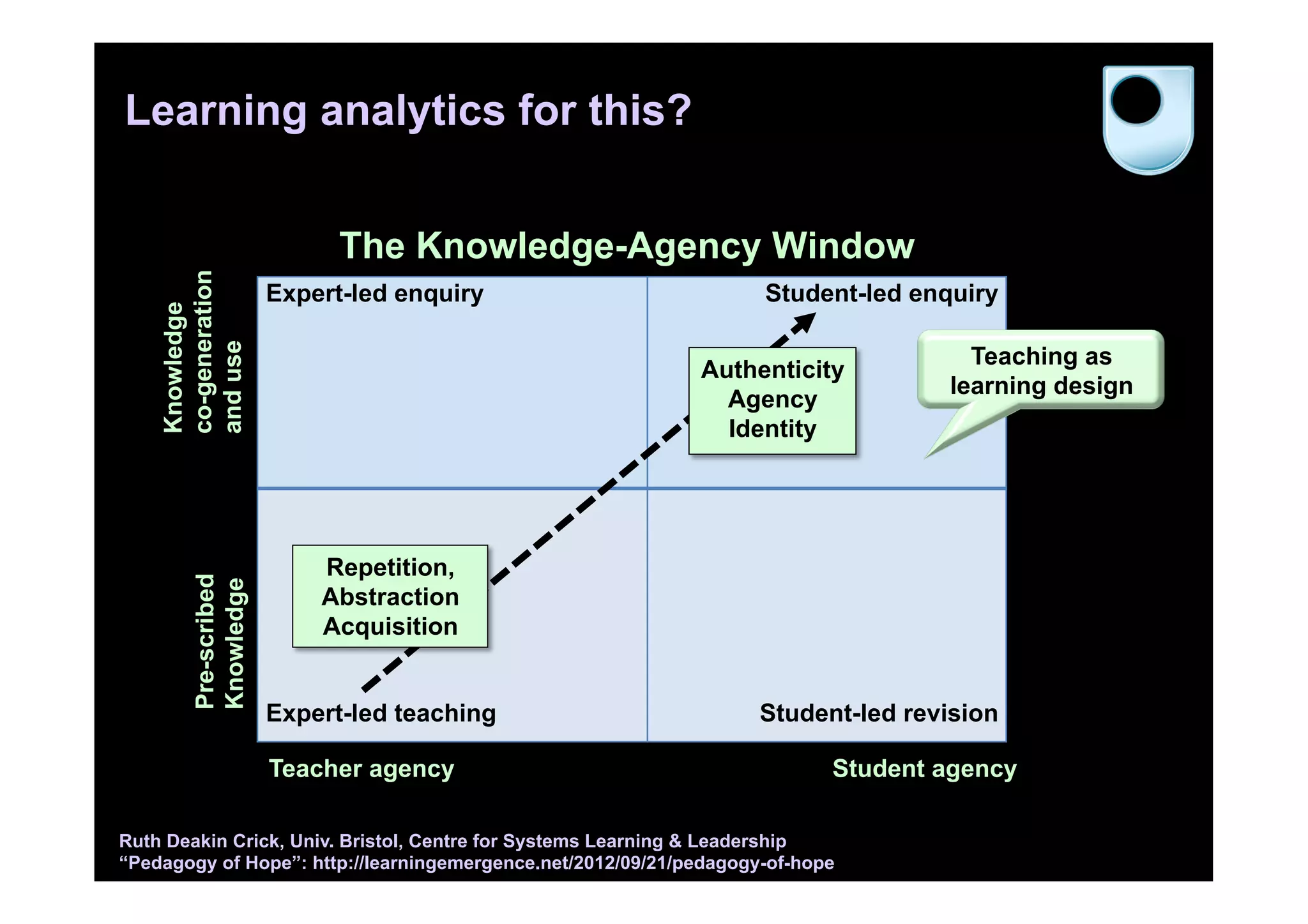
                            The Knowledge-Agency Window
    co-generation


                      Expert-led enquiry                            Student-led enquiry
    Knowledge

    and use


                                                                                     Teaching as
                                                             Authenticity
                                                                                   learning design
                                                               Agency
                                                               Identity


                          Repetition,
        Pre-scribed
        Knowledge


                          Abstraction
                          Acquisition


                      Expert-led teaching                           Student-led revision

                      Teacher agency                                       Student agency

Ruth Deakin Crick, Univ. Bristol, Centre for Systems Learning & Leadership
“Pedagogy of Hope”: http://learningemergence.net/2012/09/21/pedagogy-of-hope
analytics grounded in the
   principles of good
       assessment
       for learning?
      (not summative assessment for
         grading pupils, teachers,
           institutions or nations)

                                      27
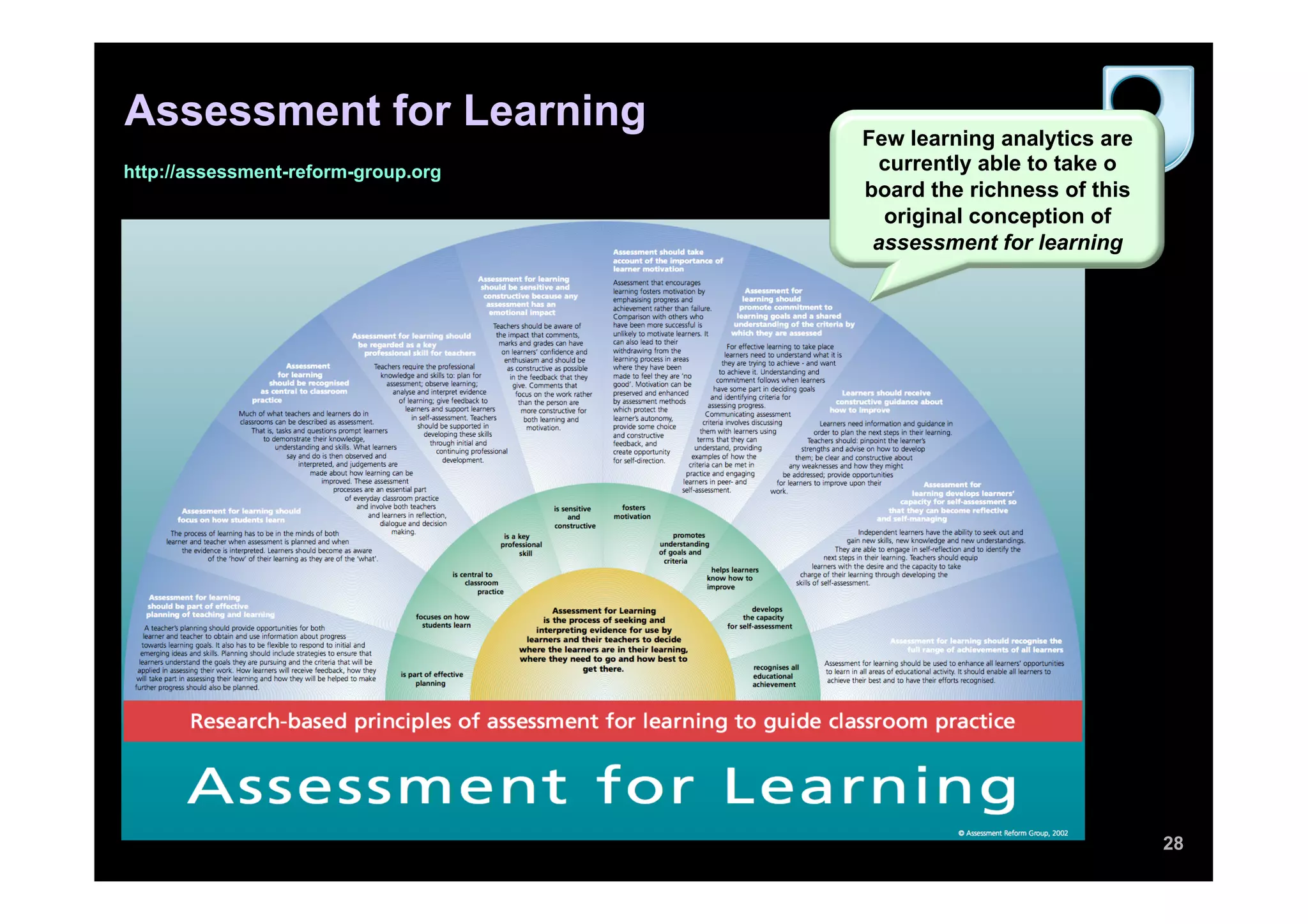
Assessment for Learning              Few learning analytics are
http://assessment-reform-group.org     currently able to take o
                                     board the richness of this
                                       original conception of
                                      assessment for learning


                                                                  28
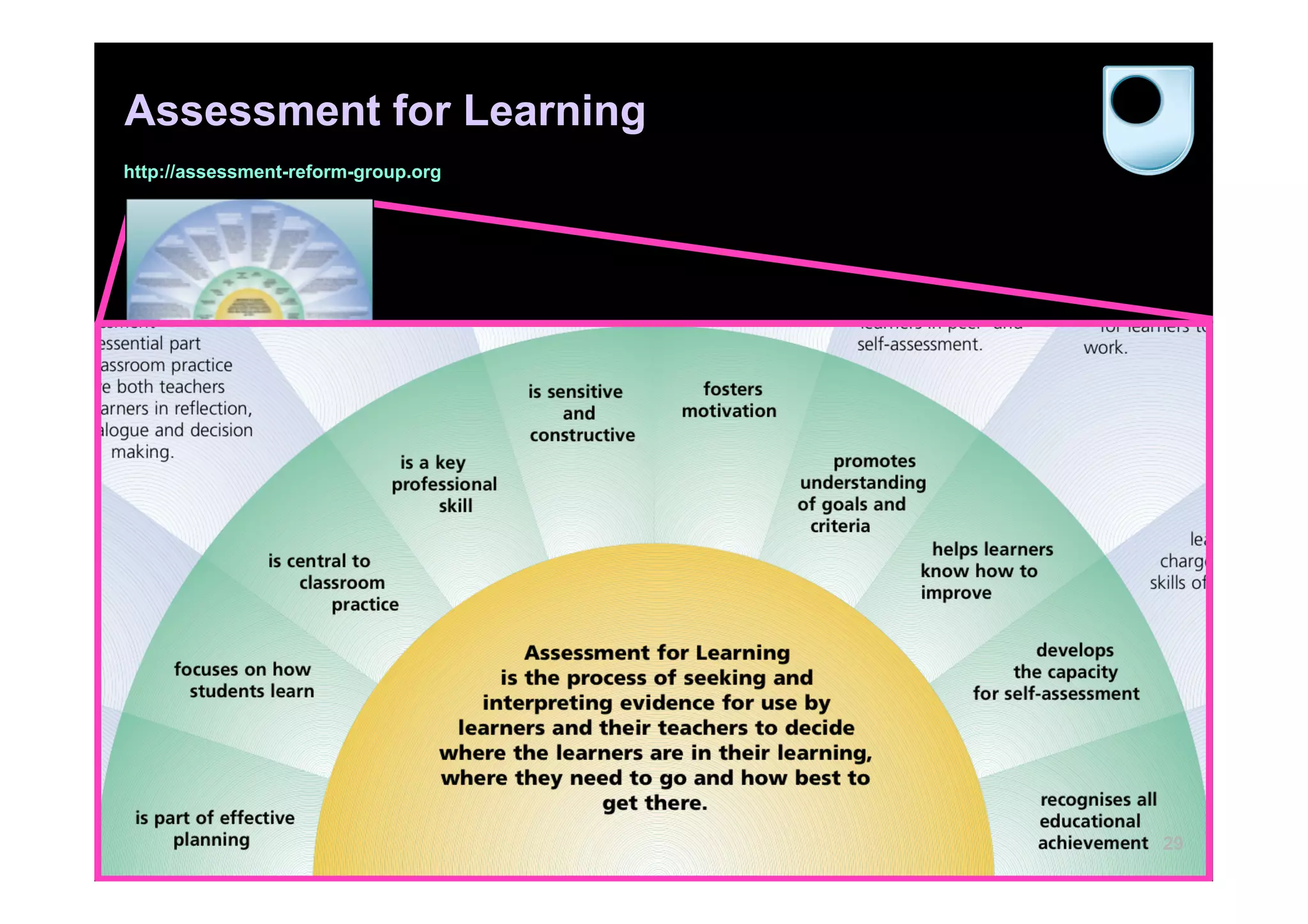
Assessment for Learning
http://assessment-reform-group.org


                                     29
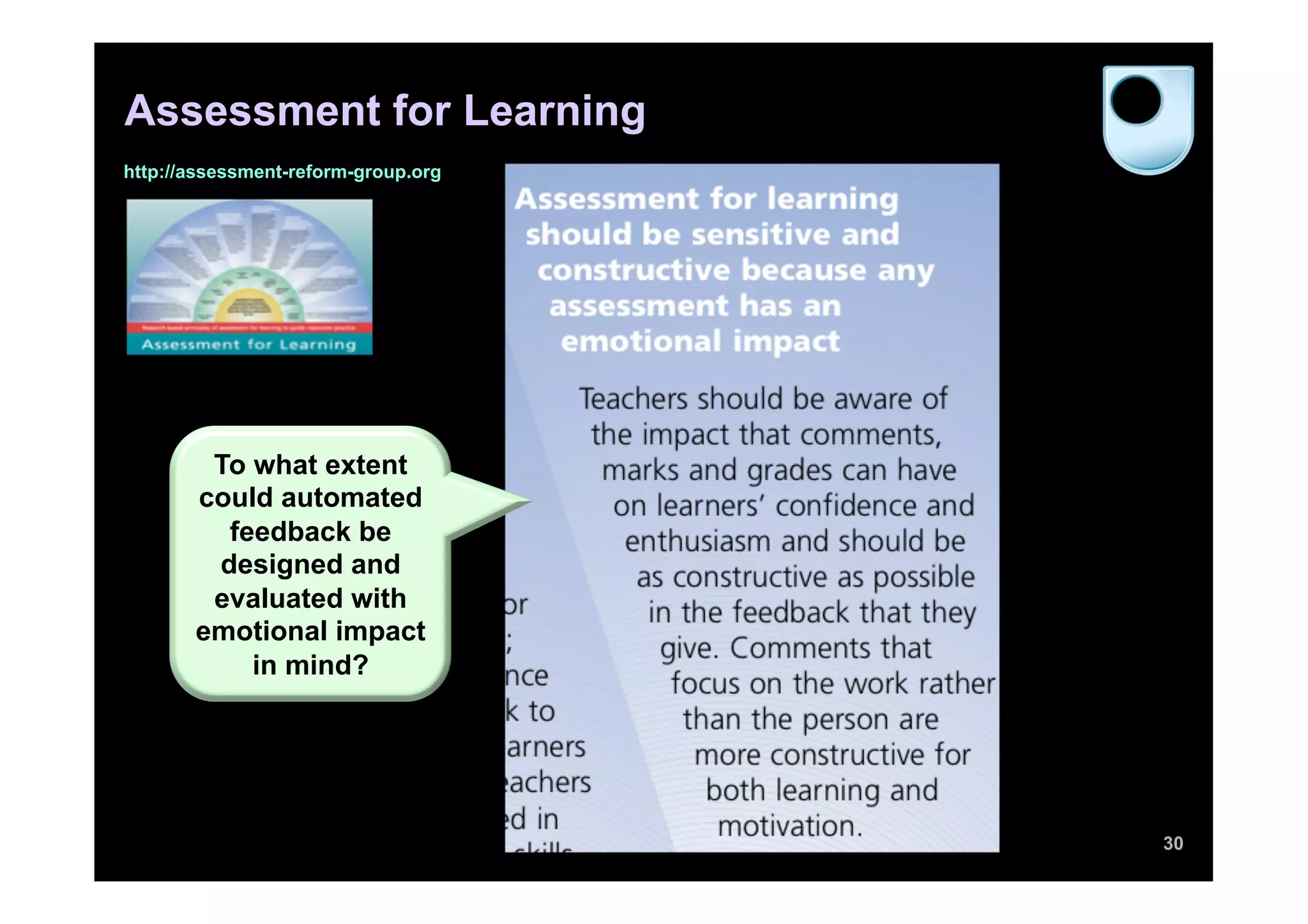
Assessment for Learning
http://assessment-reform-group.org


        To what extent
       could automated
         feedback be
        designed and
        evaluated with
       emotional impact
           in mind?


                                     30
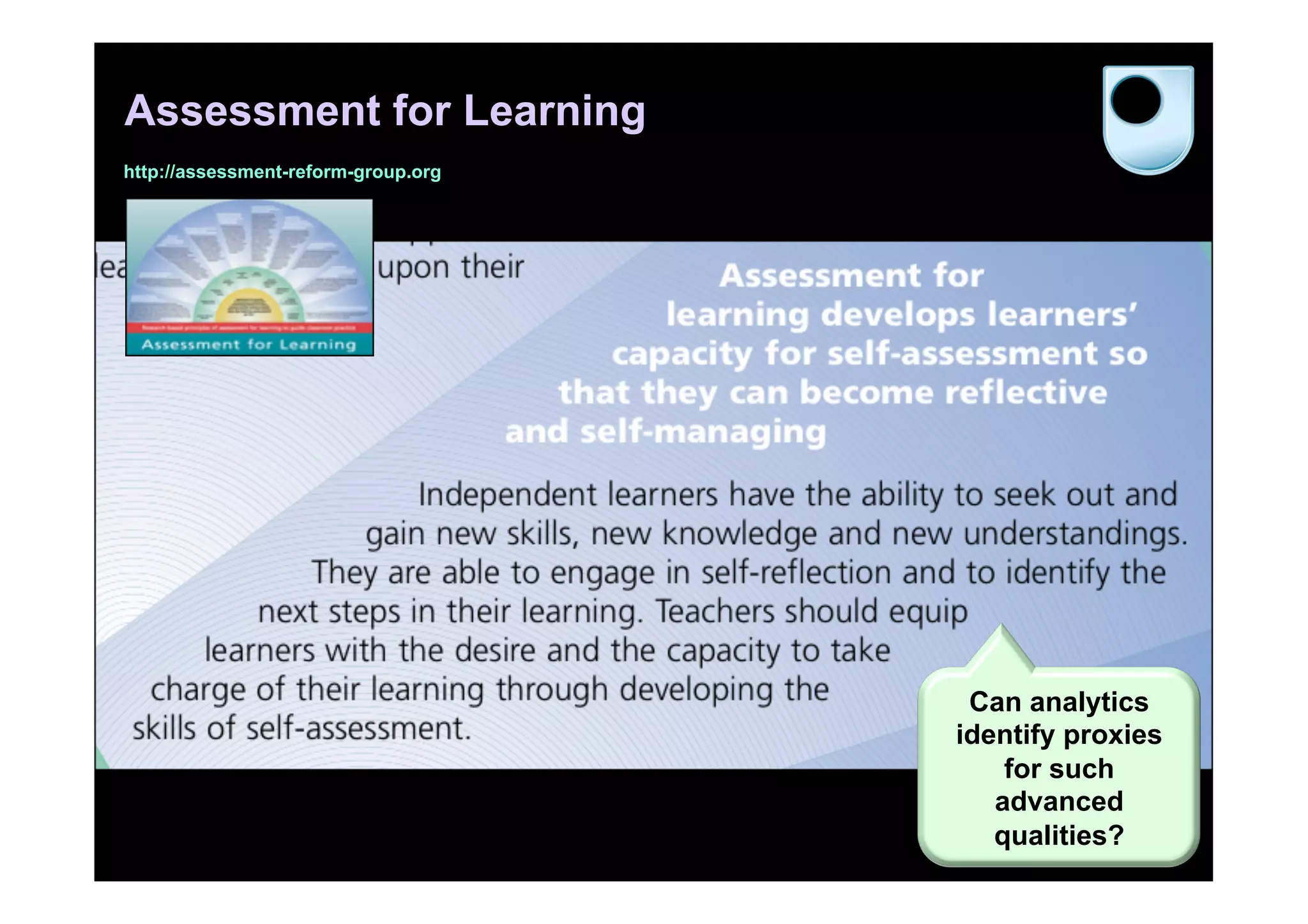
Assessment for Learning
http://assessment-reform-group.org


                                      Can analytics
                                     identify proxies
                                         for such
                                        advanced
                                        qualities? 31
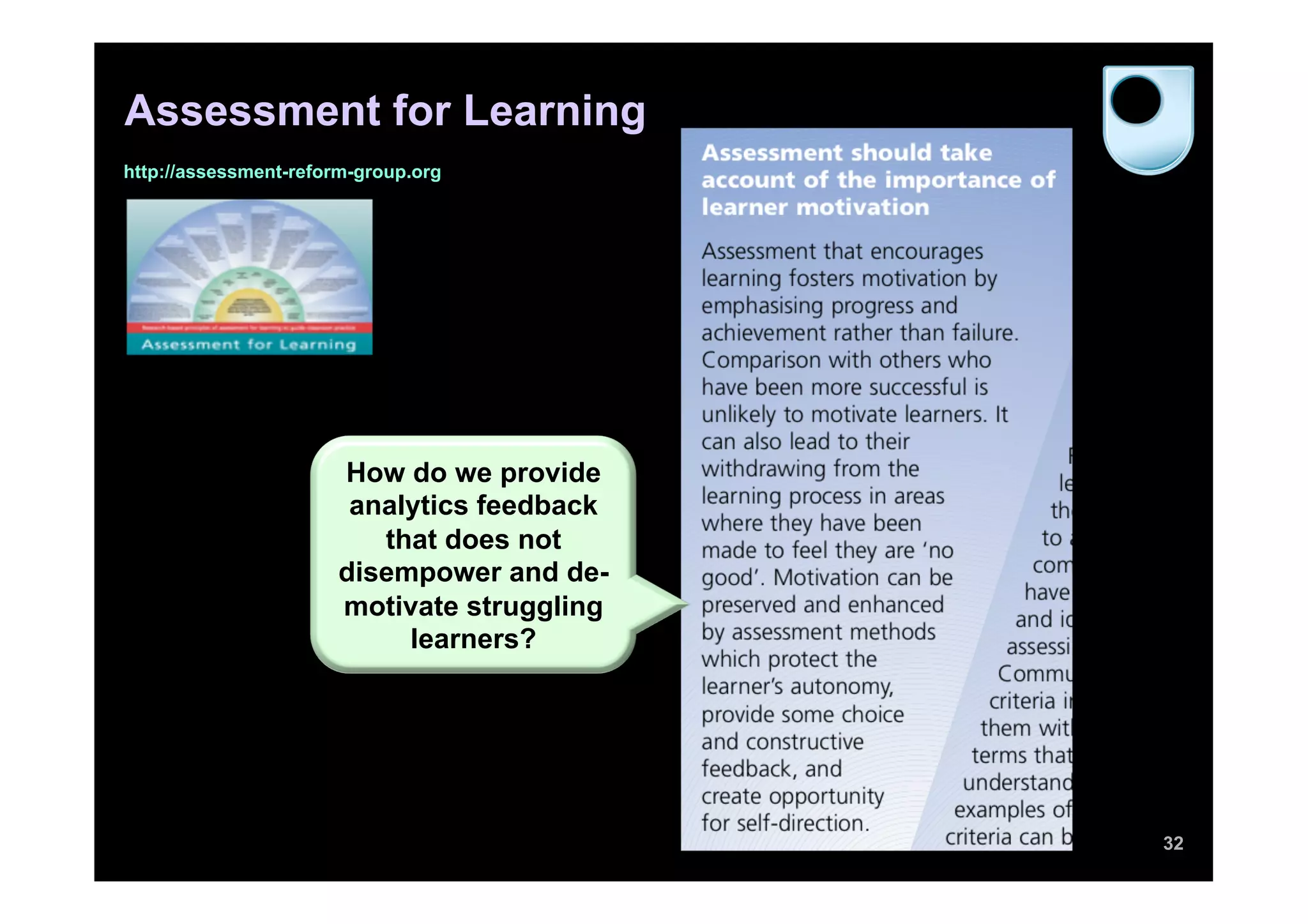
Assessment for Learning
http://assessment-reform-group.org


                      How do we provide
                       analytics feedback
                         that does not
                      disempower and de-
                      motivate struggling
                           learners?


                                            32
analytics for
learning conversations


                         33
Socio-cultural discourse analysis
(Mercer et al, OU)


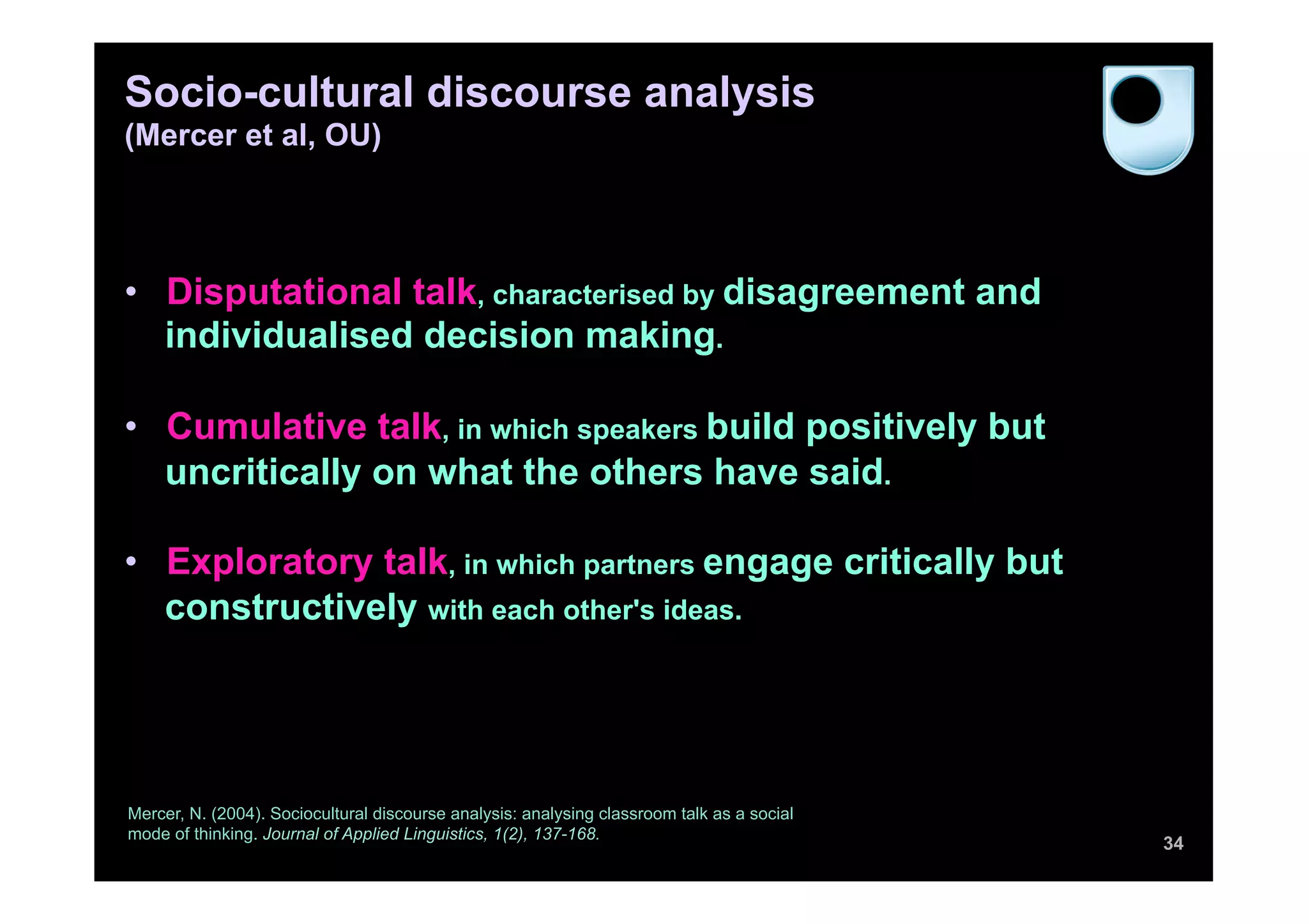
•  Disputational talk, characterised by disagreement and
   individualised decision making.

•  Cumulative talk, in which speakers build positively but
   uncritically on what the others have said.

•  Exploratory talk, in which partners engage critically but
   constructively with each other's ideas.


Mercer, N. (2004). Sociocultural discourse analysis: analysing classroom talk as a social
mode of thinking. Journal of Applied Linguistics, 1(2), 137-168.
                                                                                            34
Socio-cultural discourse analysis
(Mercer et al, OU)


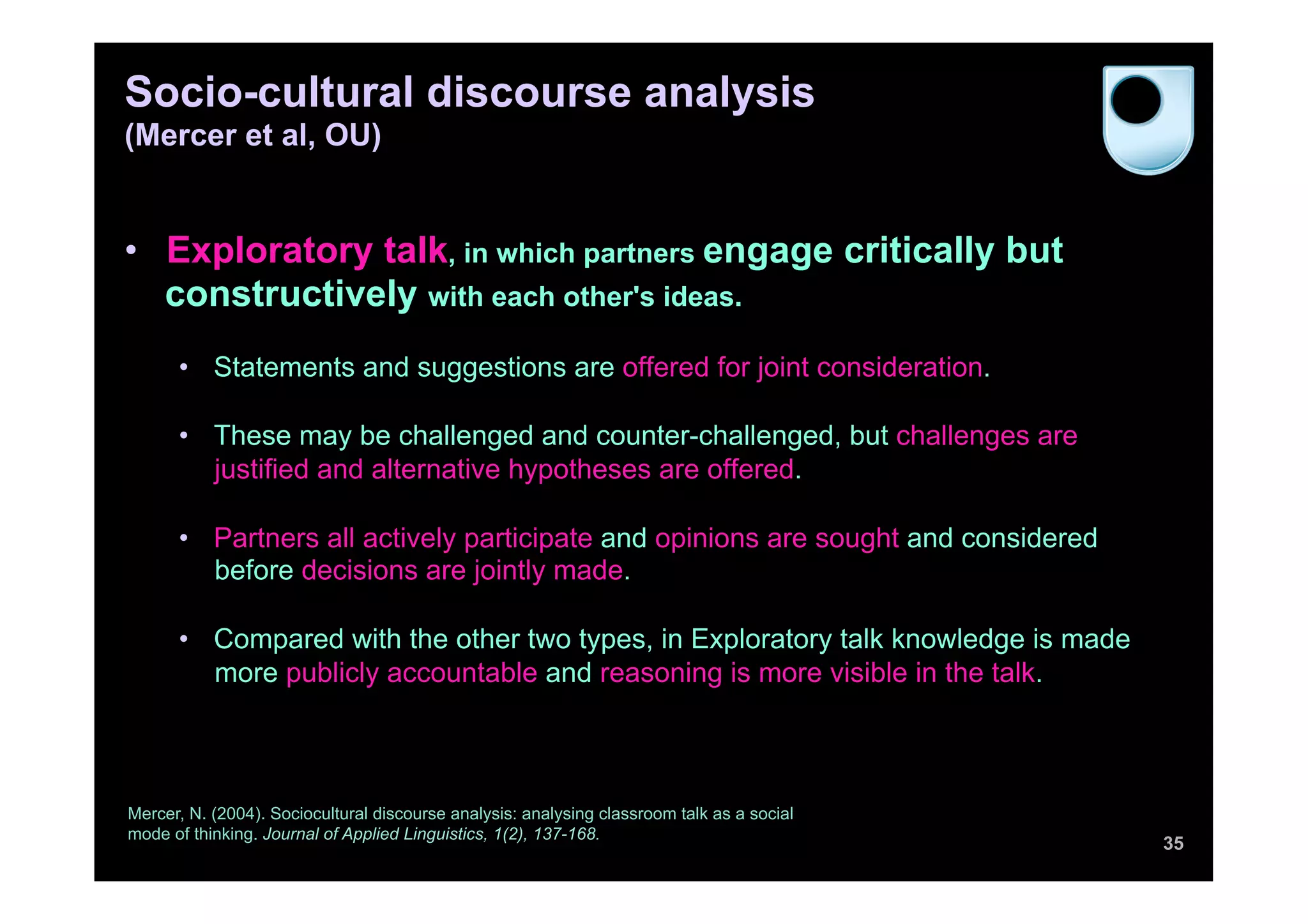
•  Exploratory talk, in which partners engage critically but
   constructively with each other's ideas.
      •  Statements and suggestions are offered for joint consideration.

      •  These may be challenged and counter-challenged, but challenges are
         justified and alternative hypotheses are offered.

      •  Partners all actively participate and opinions are sought and considered
         before decisions are jointly made.

      •  Compared with the other two types, in Exploratory talk knowledge is made
         more publicly accountable and reasoning is more visible in the talk.


Mercer, N. (2004). Sociocultural discourse analysis: analysing classroom talk as a social
mode of thinking. Journal of Applied Linguistics, 1(2), 137-168.
                                                                                            35
Analytics for identifying Exploratory talk

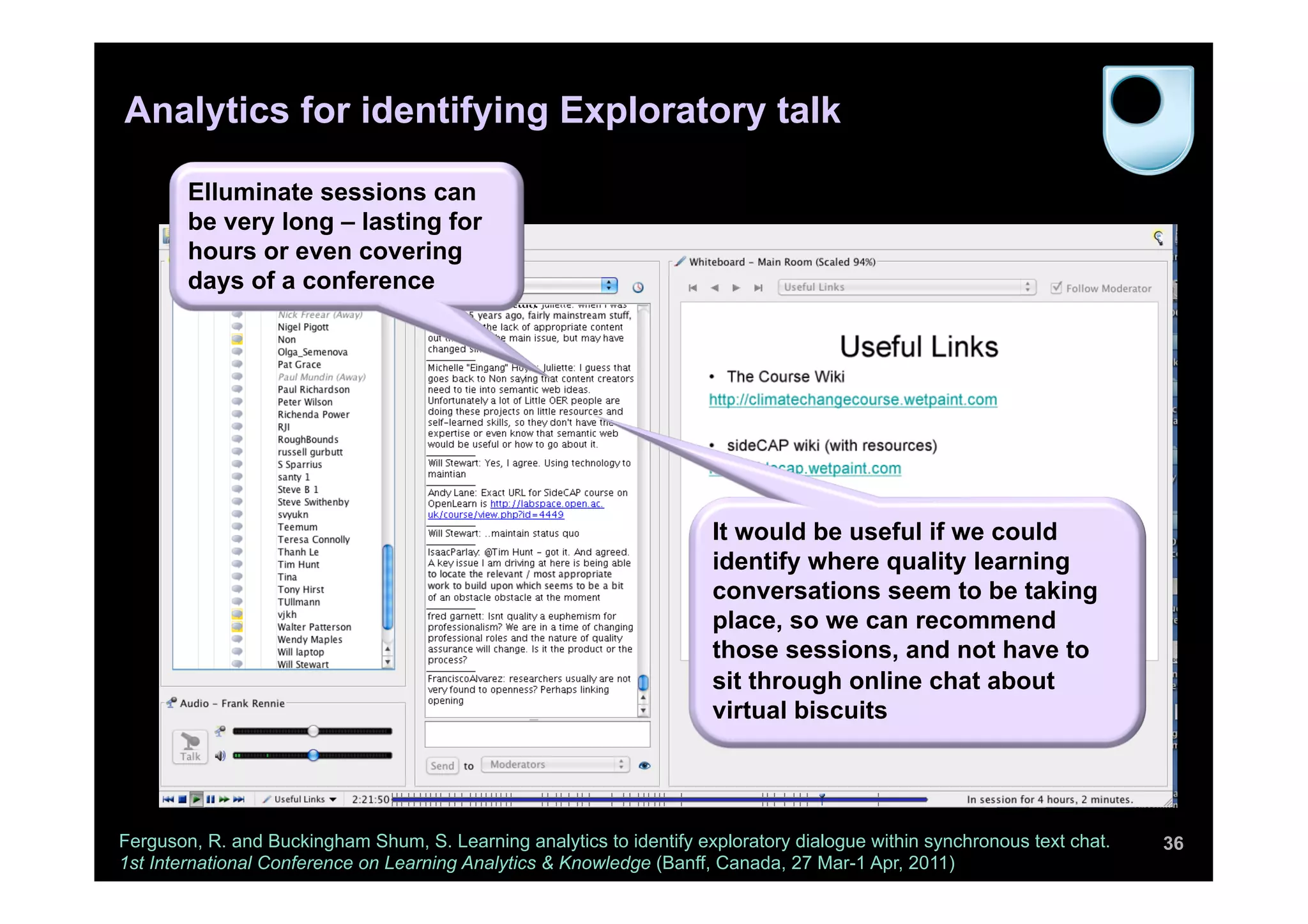
        Elluminate sessions can
        be very long – lasting for
        hours or even covering
        days of a conference


                                                                      It would be useful if we could
                                                                      identify where quality learning
                                                                      conversations seem to be taking
                                                                      place, so we can recommend
                                                                      those sessions, and not have to
                                                                      sit through online chat about
                                                                      virtual biscuits


Ferguson, R. and Buckingham Shum, S. Learning analytics to identify exploratory dialogue within synchronous text chat.   36
1st International Conference on Learning Analytics & Knowledge (Banff, Canada, 27 Mar-1 Apr, 2011)
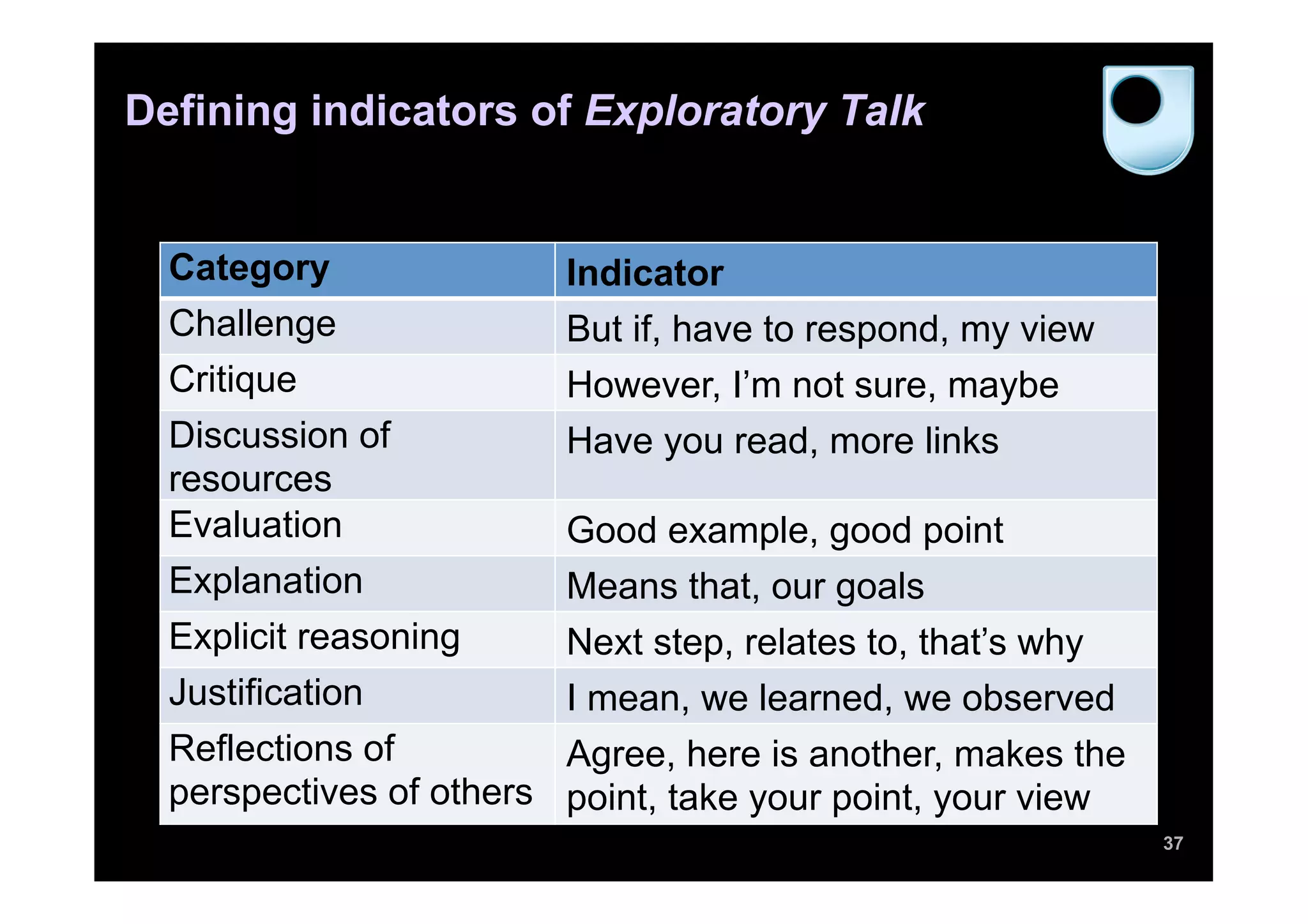
Defining indicators of Exploratory Talk


  Category               Indicator
  Challenge              But if, have to respond, my view
  Critique               However, I’m not sure, maybe
  Discussion of          Have you read, more links
  resources
  Evaluation             Good example, good point
  Explanation            Means that, our goals
  Explicit reasoning     Next step, relates to, that’s why
  Justification          I mean, we learned, we observed
  Reflections of         Agree, here is another, makes the
  perspectives of others point, take your point, your view
                                                             37
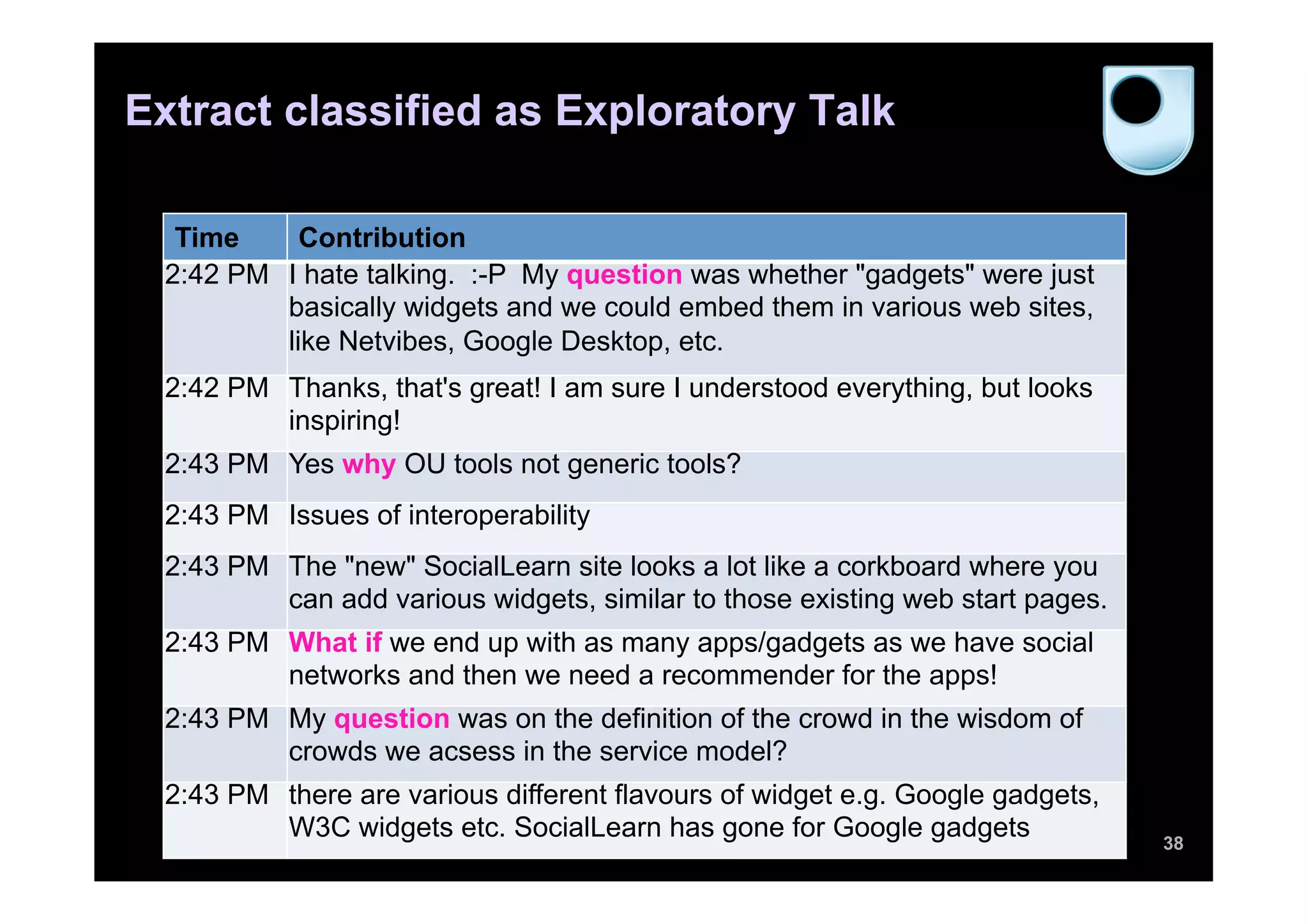
Extract classified as Exploratory Talk

  Time     Contribution
 2:42 PM I hate talking. :-P My question was whether "gadgets" were just
         basically widgets and we could embed them in various web sites,
         like Netvibes, Google Desktop, etc.
 2:42 PM Thanks, that's great! I am sure I understood everything, but looks
         inspiring!
 2:43 PM Yes why OU tools not generic tools?
 2:43 PM Issues of interoperability
 2:43 PM The "new" SocialLearn site looks a lot like a corkboard where you
         can add various widgets, similar to those existing web start pages.
 2:43 PM What if we end up with as many apps/gadgets as we have social
         networks and then we need a recommender for the apps!
 2:43 PM My question was on the definition of the crowd in the wisdom of
         crowds we acsess in the service model?
 2:43 PM there are various different flavours of widget e.g. Google gadgets,
         W3C widgets etc. SocialLearn has gone for Google gadgets              38
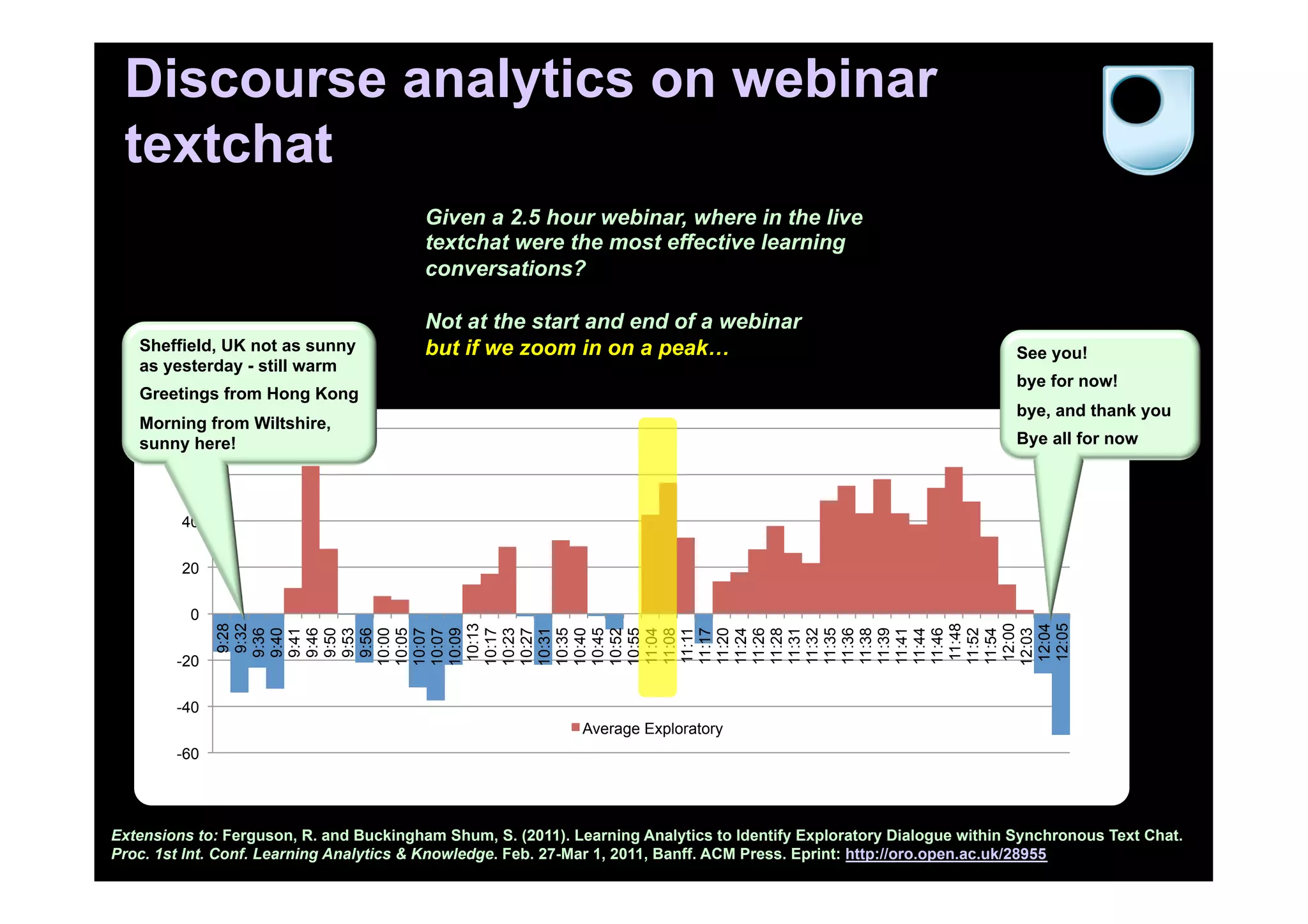
Discourse analytics on webinar
 textchat
                                         Given a 2.5 hour webinar, where in the live
                                         textchat were the most effective learning
                                         conversations?

                                         Not at the start and end of a webinar
   Sheffield, UK not as sunny            but if we zoom in on a peak…                                                  See you!
   as yesterday - still warm
                                                                                                                       bye for now!
   Greetings from Hong Kong
                                                                                                                       bye, and thank you
   Morning from Wiltshire,
       80
   sunny here!                                                                                                         Bye all for now

         60

         40

         20

          0
                9:28
                9:32


              10:13


               11:48


              12:00


              12:05
              12:04
               9:36
               9:40
               9:41
               9:46
               9:50
               9:53
               9:56
              10:00
              10:05
              10:07
              10:07
              10:09

              10:17
              10:23
              10:27
              10:31
              10:35
              10:40
              10:45
              10:52
              10:55
              11:04
              11:08
              11:11
              11:17
              11:20
              11:24
              11:26
              11:28
              11:31
              11:32
              11:35
              11:36
              11:38
              11:39
              11:41
              11:44
              11:46

              11:52
              11:54

              12:03
        -20

        -40
                                                              Average Exploratory
        -60


Extensions to: Ferguson, R. and Buckingham Shum, S. (2011). Learning Analytics to Identify Exploratory Dialogue within Synchronous Text Chat.
Proc. 1st Int. Conf. Learning Analytics & Knowledge. Feb. 27-Mar 1, 2011, Banff. ACM Press. Eprint: http://oro.open.ac.uk/28955
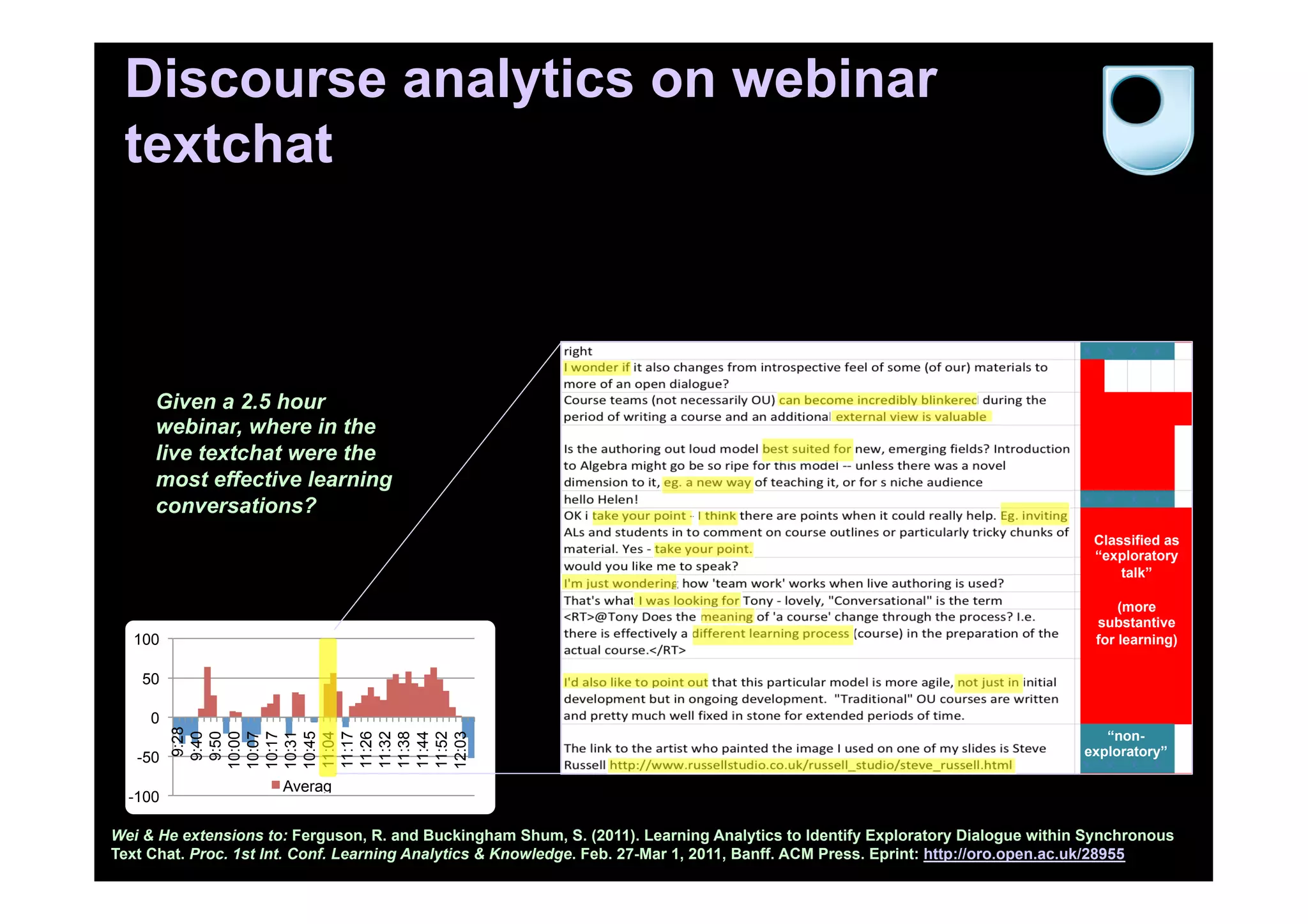
Discourse analytics on webinar
 textchat


     Given a 2.5 hour
     webinar, where in the
     live textchat were the
     most effective learning
     conversations?
                                                                                                                                Classified as
                                                                                                                                “exploratory
                                                                                                                                    talk”

                                                                                                                                    (more
                                                                                                                                substantive
  100                                                                                                                           for learning)

    50

     0
           9:28


                                                                                                                                  “non-
          9:40
          9:50
         10:00
         10:07
         10:17
         10:31
         10:45
         11:04
         11:17
         11:26
         11:32
         11:38
         11:44
         11:52
         12:03


   -50                                                                                                                         exploratory”

                      Averag
  -100

Wei & He extensions to: Ferguson, R. and Buckingham Shum, S. (2011). Learning Analytics to Identify Exploratory Dialogue within Synchronous
Text Chat. Proc. 1st Int. Conf. Learning Analytics & Knowledge. Feb. 27-Mar 1, 2011, Banff. ACM Press. Eprint: http://oro.open.ac.uk/28955
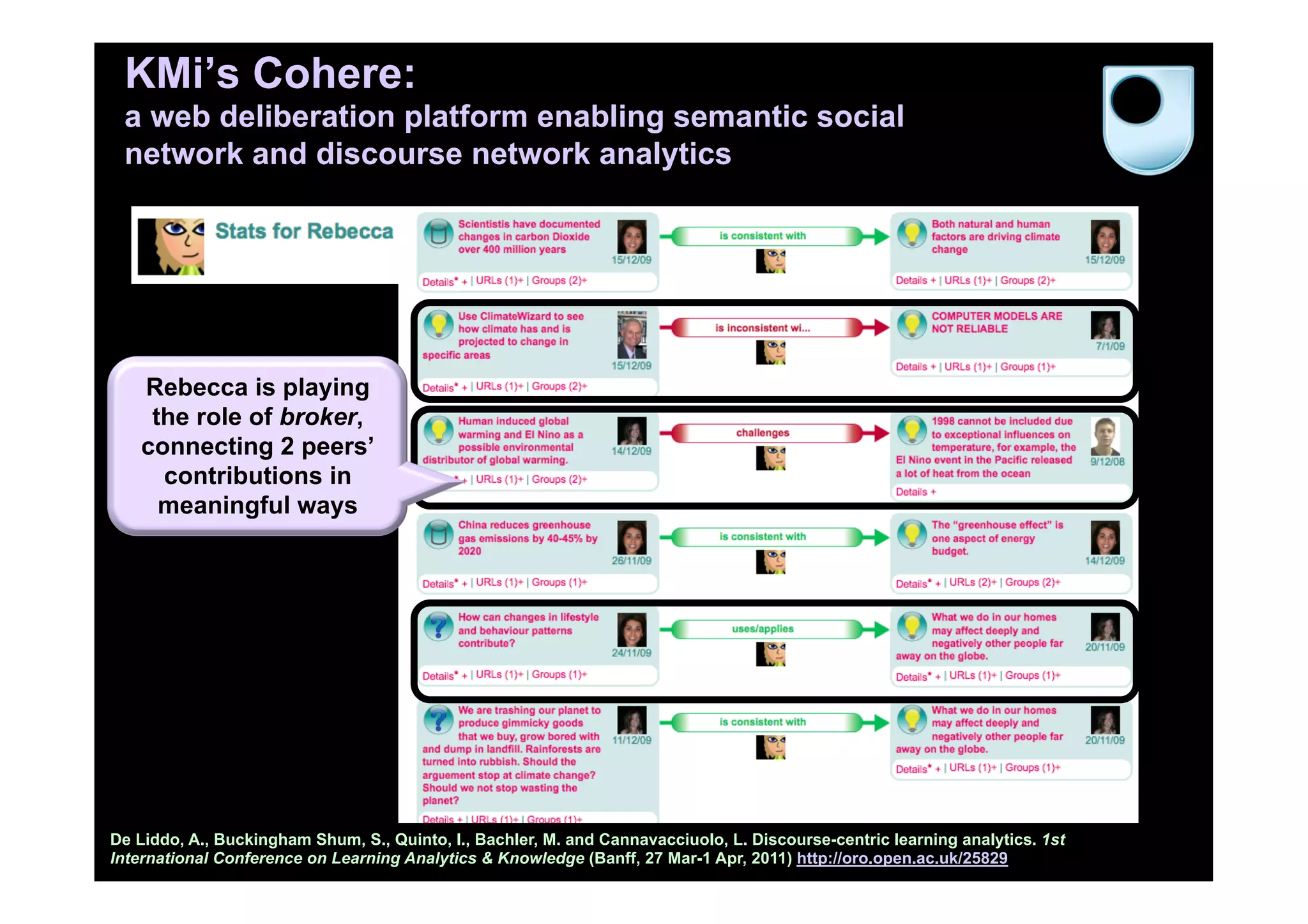
KMi’s Cohere:
 a web deliberation platform enabling semantic social
 network and discourse network analytics


   Rebecca is playing
    the role of broker,
   connecting 2 peers’
     contributions in
     meaningful ways


De Liddo, A., Buckingham Shum, S., Quinto, I., Bachler, M. and Cannavacciuolo, L. Discourse-centric learning analytics. 1st
International Conference on Learning Analytics & Knowledge (Banff, 27 Mar-1 Apr, 2011) http://oro.open.ac.uk/25829
analytics for
scholarly writing


                    42
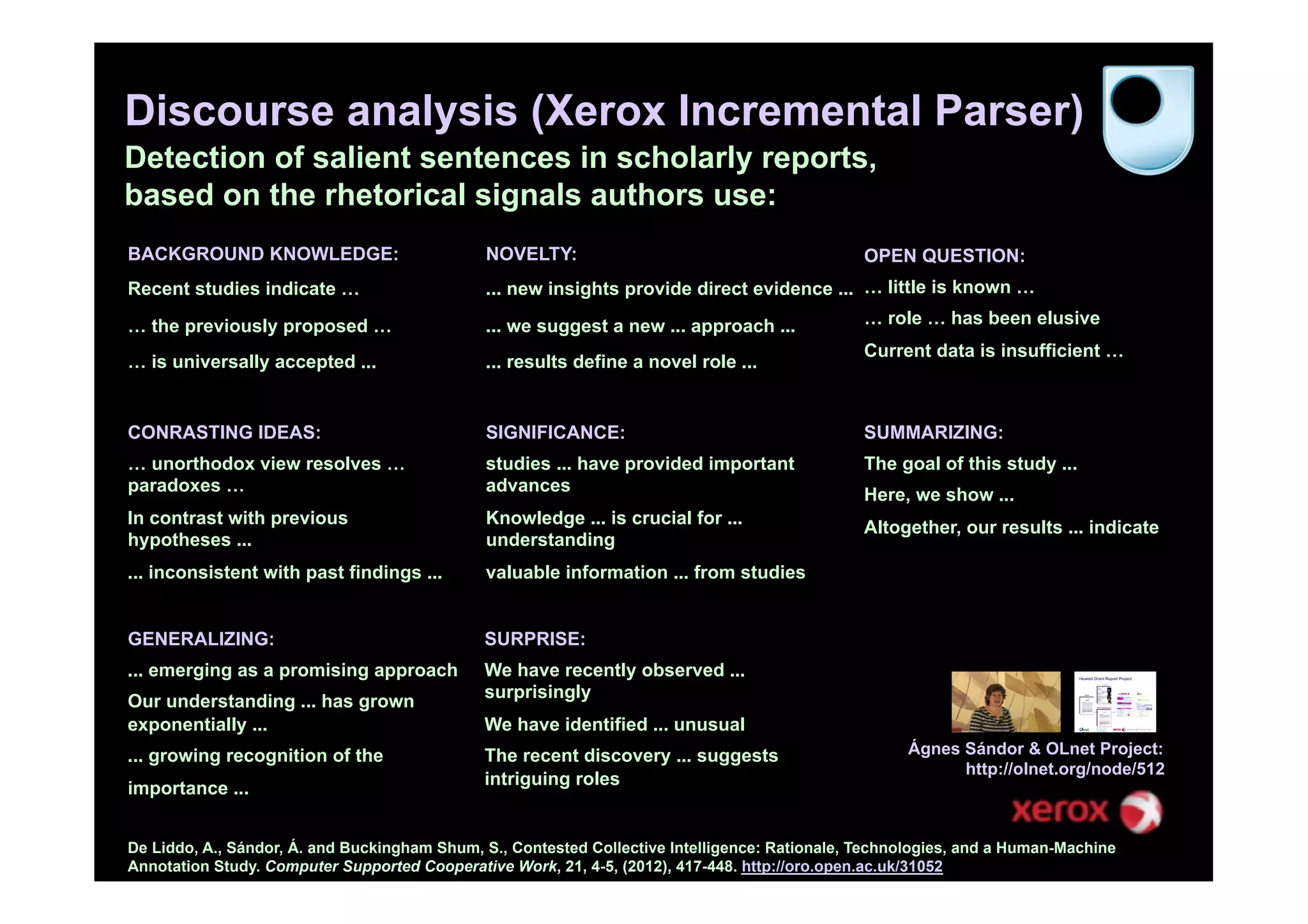
Discourse analysis (Xerox Incremental Parser)
Detection of salient sentences in scholarly reports,
based on the rhetorical signals authors use:
BACKGROUND KNOWLEDGE:                         NOVELTY:                                          OPEN QUESTION:
Recent studies indicate …                     ... new insights provide direct evidence ... … little is known …

… the previously proposed …                   ... we suggest a new ... approach ...             … role … has been elusive
                                                                                                Current data is insufficient …
… is universally accepted ...                 ... results define a novel role ...


CONRASTING IDEAS:                             SIGNIFICANCE:                                     SUMMARIZING:
… unorthodox view resolves …                  studies ... have provided important               The goal of this study ...
paradoxes …                                   advances                                          Here, we show ...
In contrast with previous                     Knowledge ... is crucial for ...                  Altogether, our results ... indicate
hypotheses ...                                understanding
... inconsistent with past findings ...       valuable information ... from studies


GENERALIZING:                                 SURPRISE:
... emerging as a promising approach          We have recently observed ...
                                              surprisingly
Our understanding ... has grown
exponentially ...                             We have identified ... unusual
... growing recognition of the                The recent discovery ... suggests                      Ágnes Sándor & OLnet Project:
                                                                                                           http://olnet.org/node/512
                                              intriguing roles
importance ...


De Liddo, A., Sándor, Á. and Buckingham Shum, S., Contested Collective Intelligence: Rationale, Technologies, and a Human-Machine
Annotation Study. Computer Supported Cooperative Work, 21, 4-5, (2012), 417-448. http://oro.open.ac.uk/31052
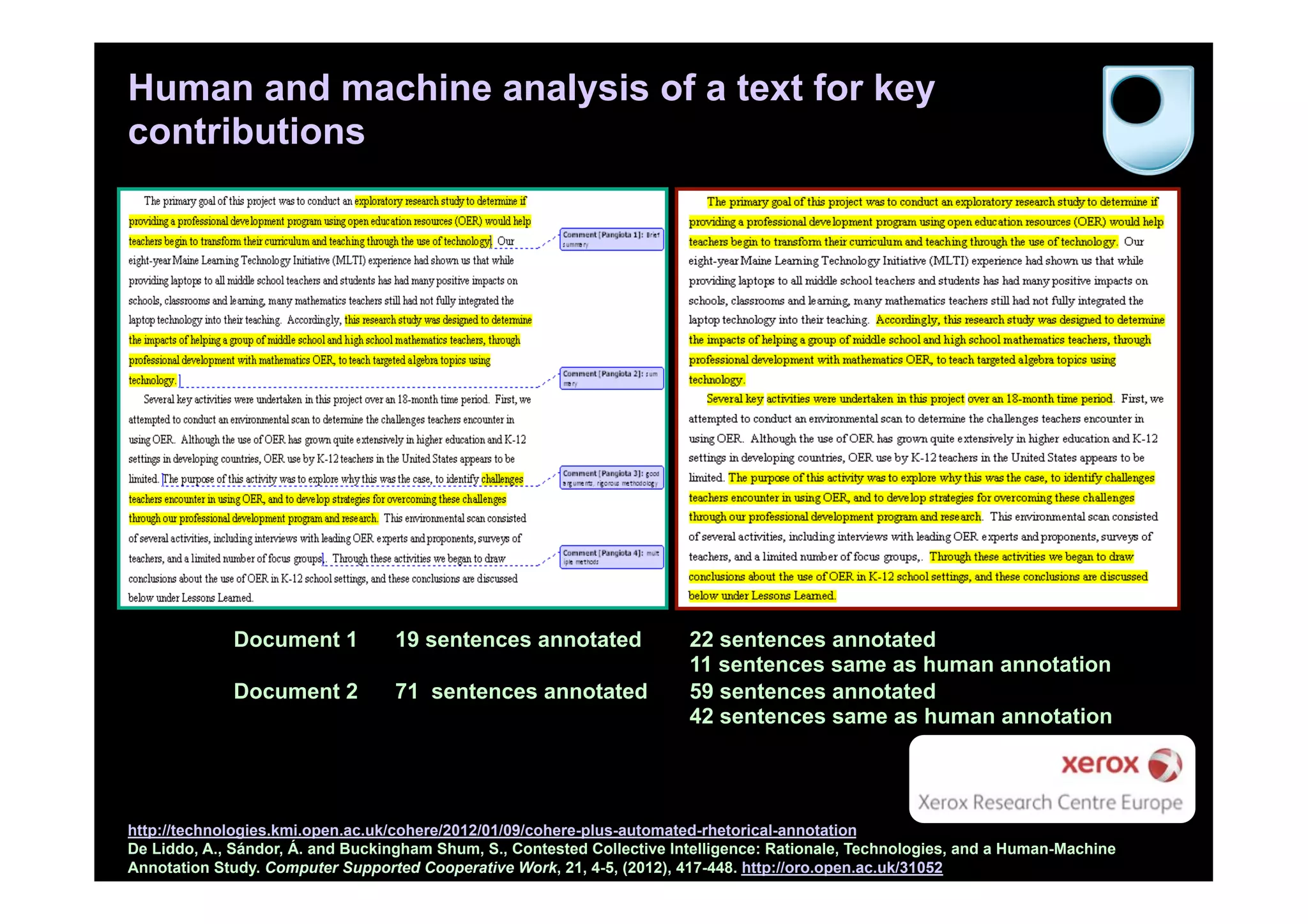
Human and machine analysis of a text for key
contributions


             Document 1           19 sentences annotated                 22 sentences annotated
                                                                         11 sentences same as human annotation
             Document 2           71 sentences annotated                 59 sentences annotated
                                                                         42 sentences same as human annotation


http://technologies.kmi.open.ac.uk/cohere/2012/01/09/cohere-plus-automated-rhetorical-annotation
De Liddo, A., Sándor, Á. and Buckingham Shum, S., Contested Collective Intelligence: Rationale, Technologies, and a Human-Machine
Annotation Study. Computer Supported Cooperative Work, 21, 4-5, (2012), 417-448. http://oro.open.ac.uk/31052
analytics for
intepersonal networking


                          45
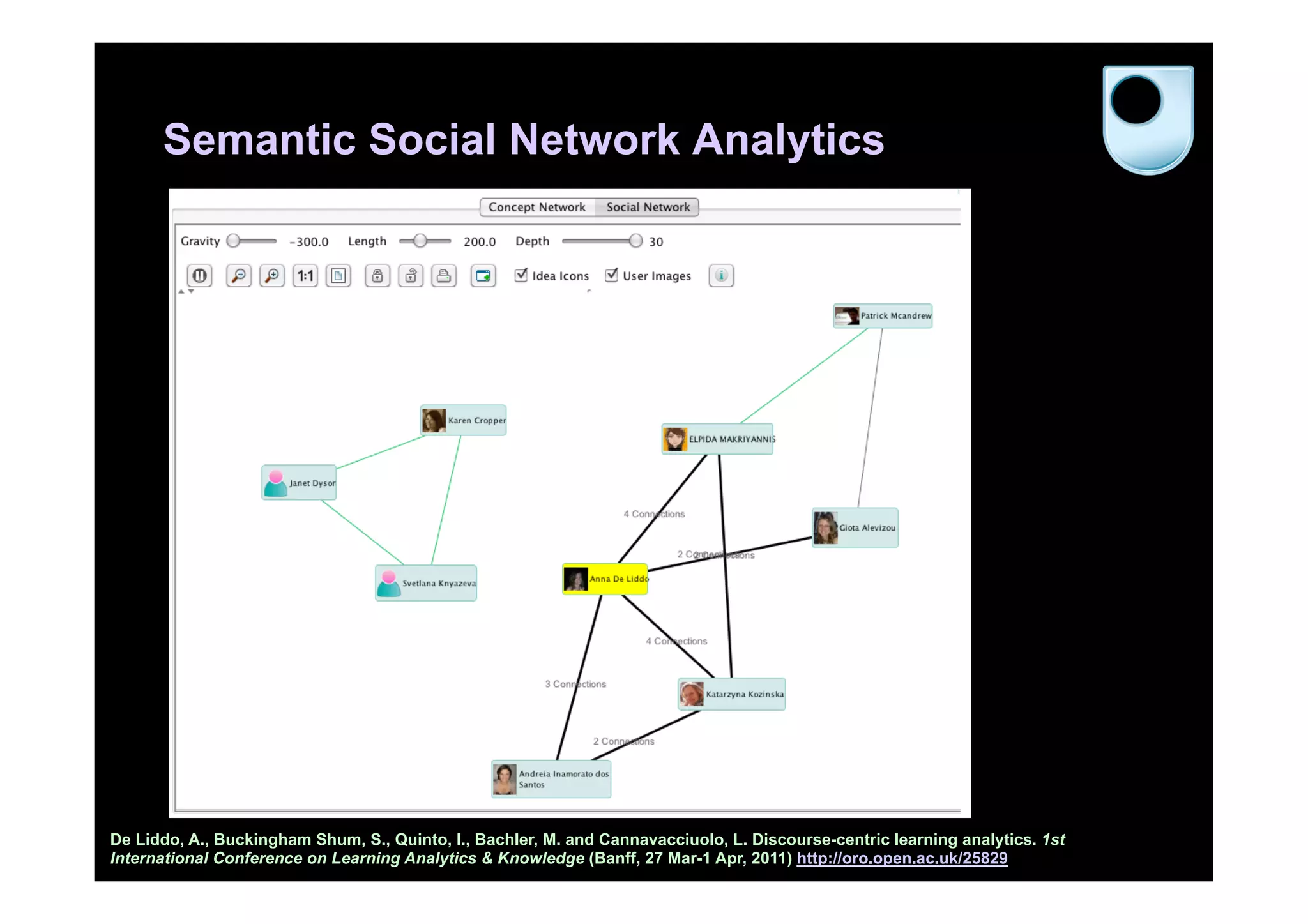
Semantic Social Network Analytics


De Liddo, A., Buckingham Shum, S., Quinto, I., Bachler, M. and Cannavacciuolo, L. Discourse-centric learning analytics. 1st
International Conference on Learning Analytics & Knowledge (Banff, 27 Mar-1 Apr, 2011) http://oro.open.ac.uk/25829
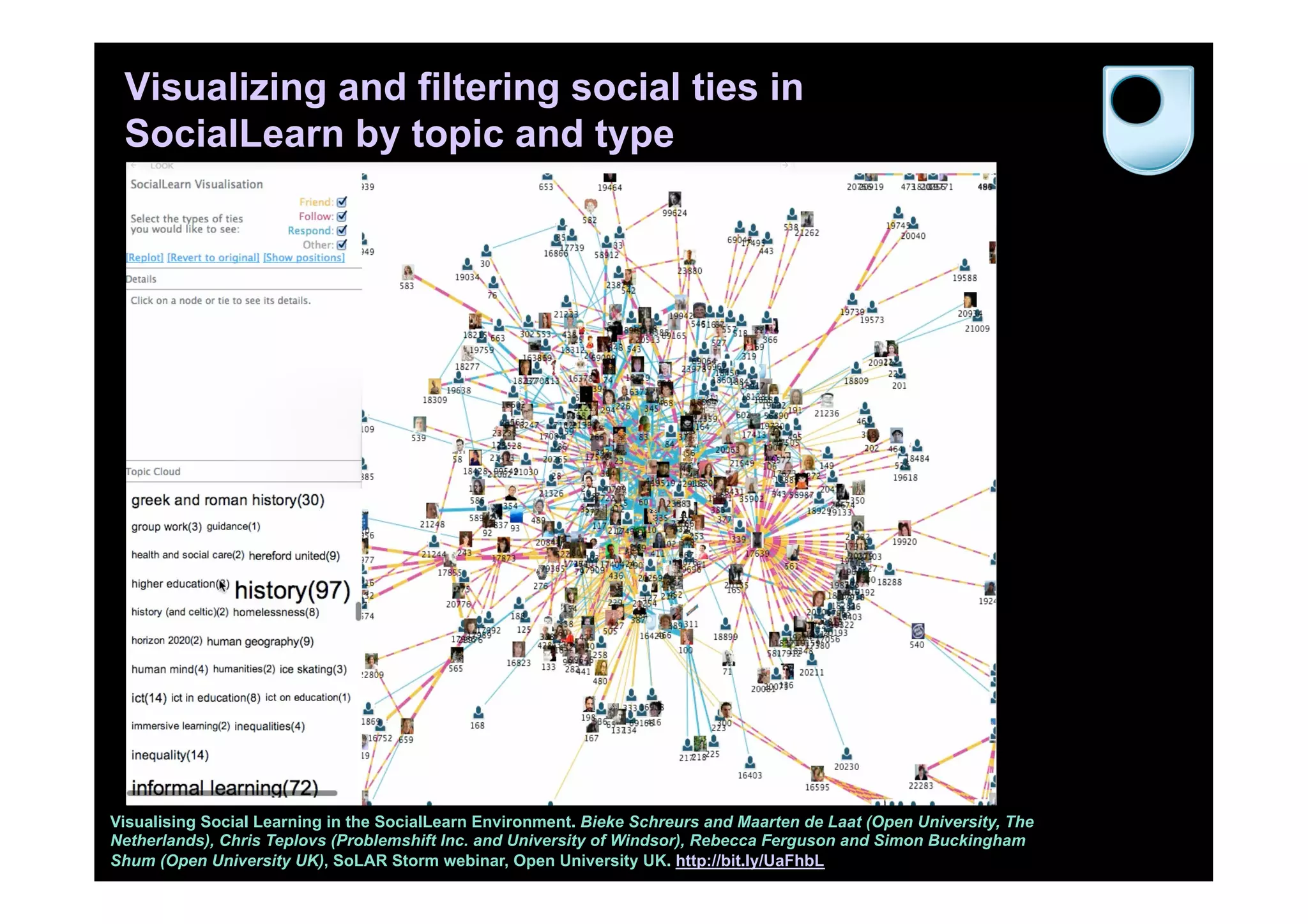
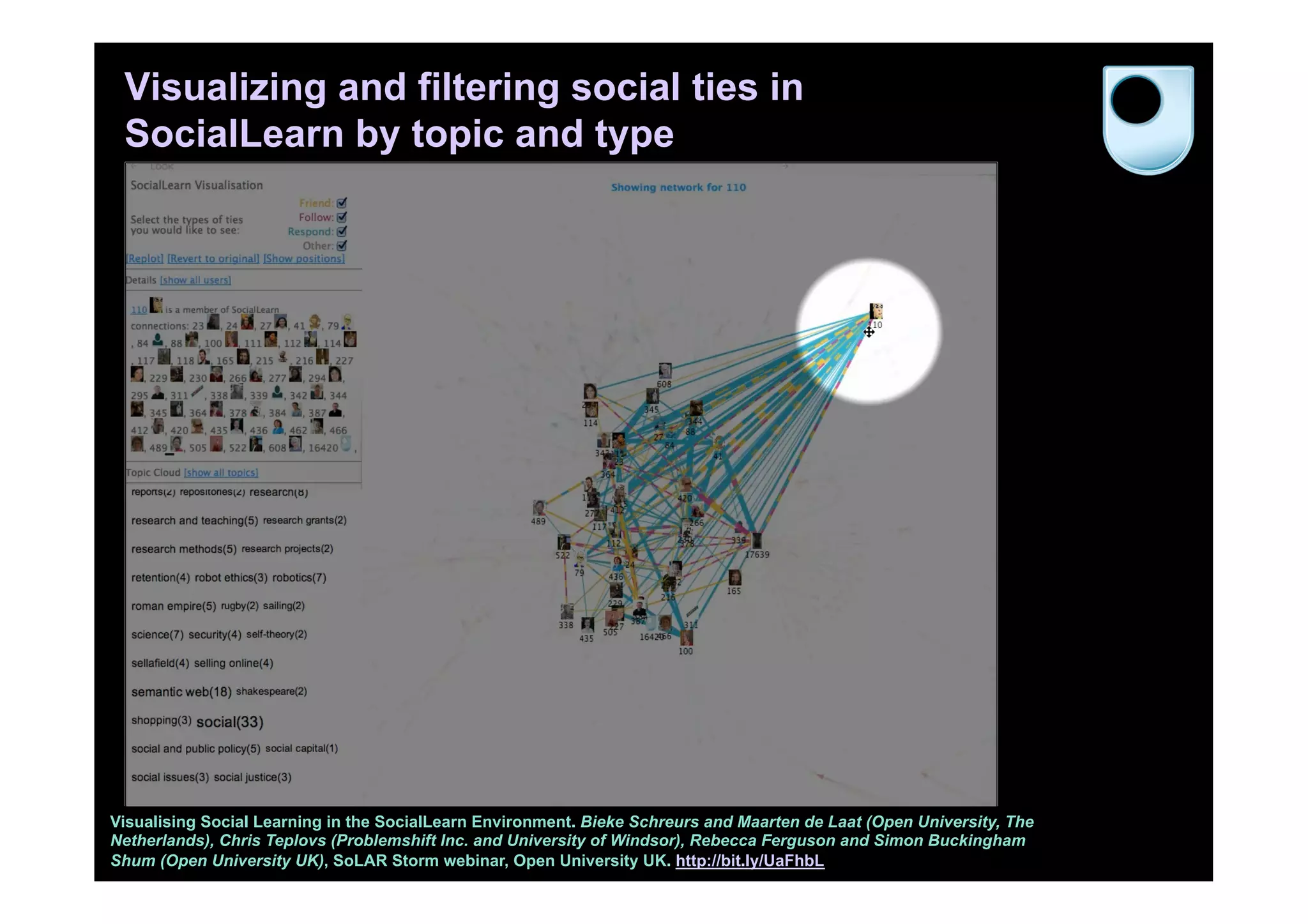
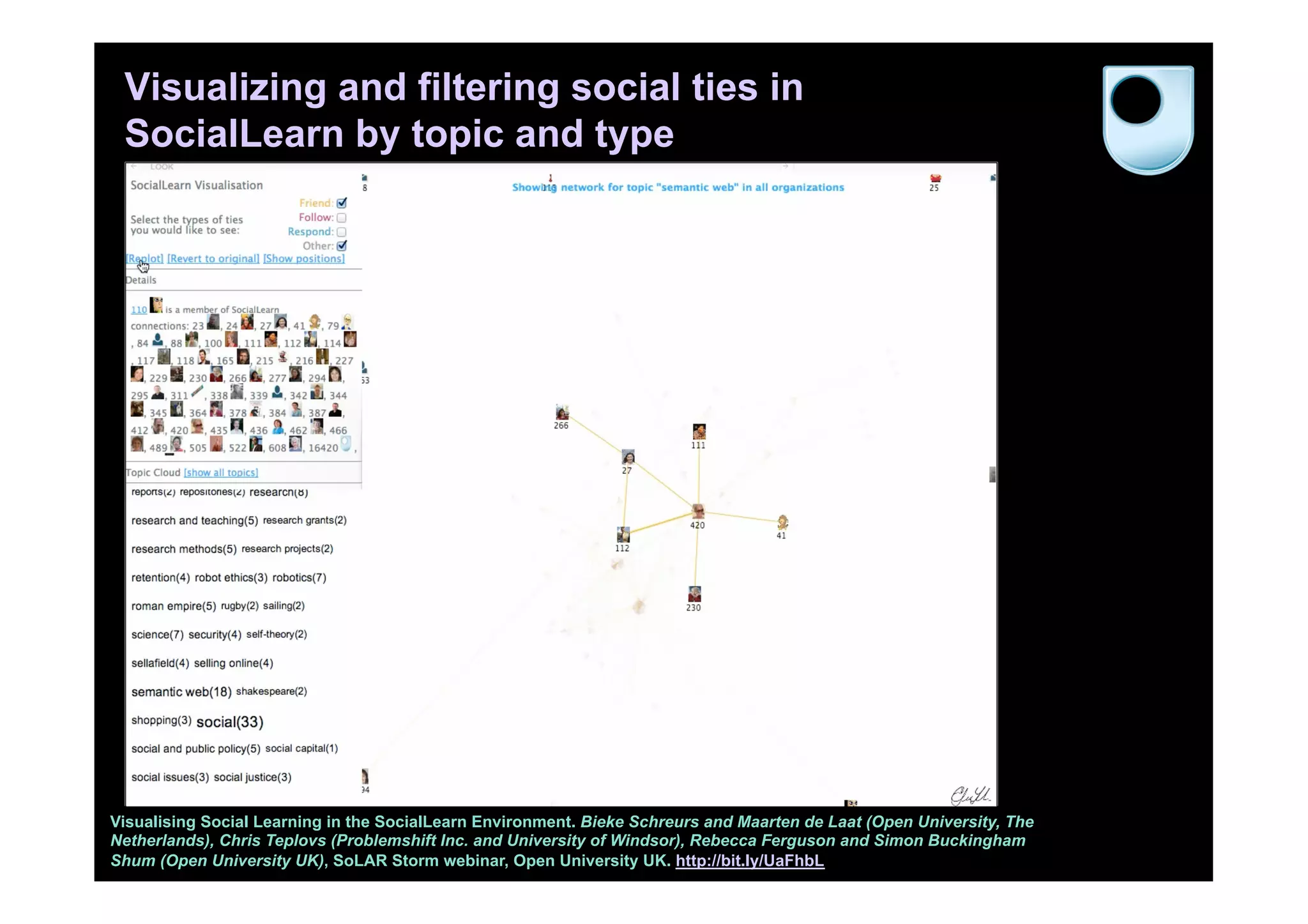
Visualizing and filtering social ties in
 SocialLearn by topic and type


Visualising Social Learning in the SocialLearn Environment. Bieke Schreurs and Maarten de Laat (Open University, The
Netherlands), Chris Teplovs (Problemshift Inc. and University of Windsor), Rebecca Ferguson and Simon Buckingham
Shum (Open University UK), SoLAR Storm webinar, Open University UK. http://bit.ly/UaFhbL
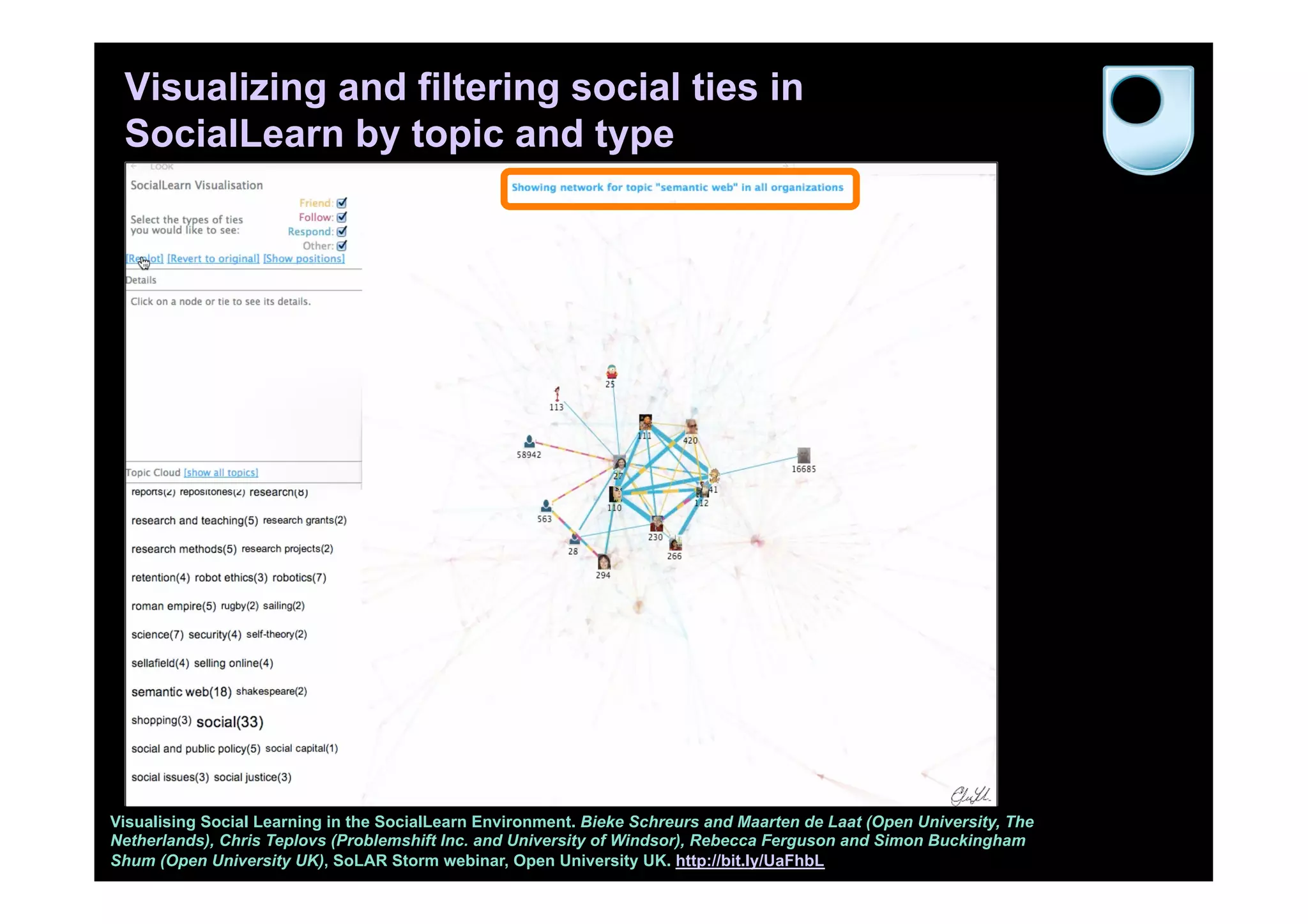
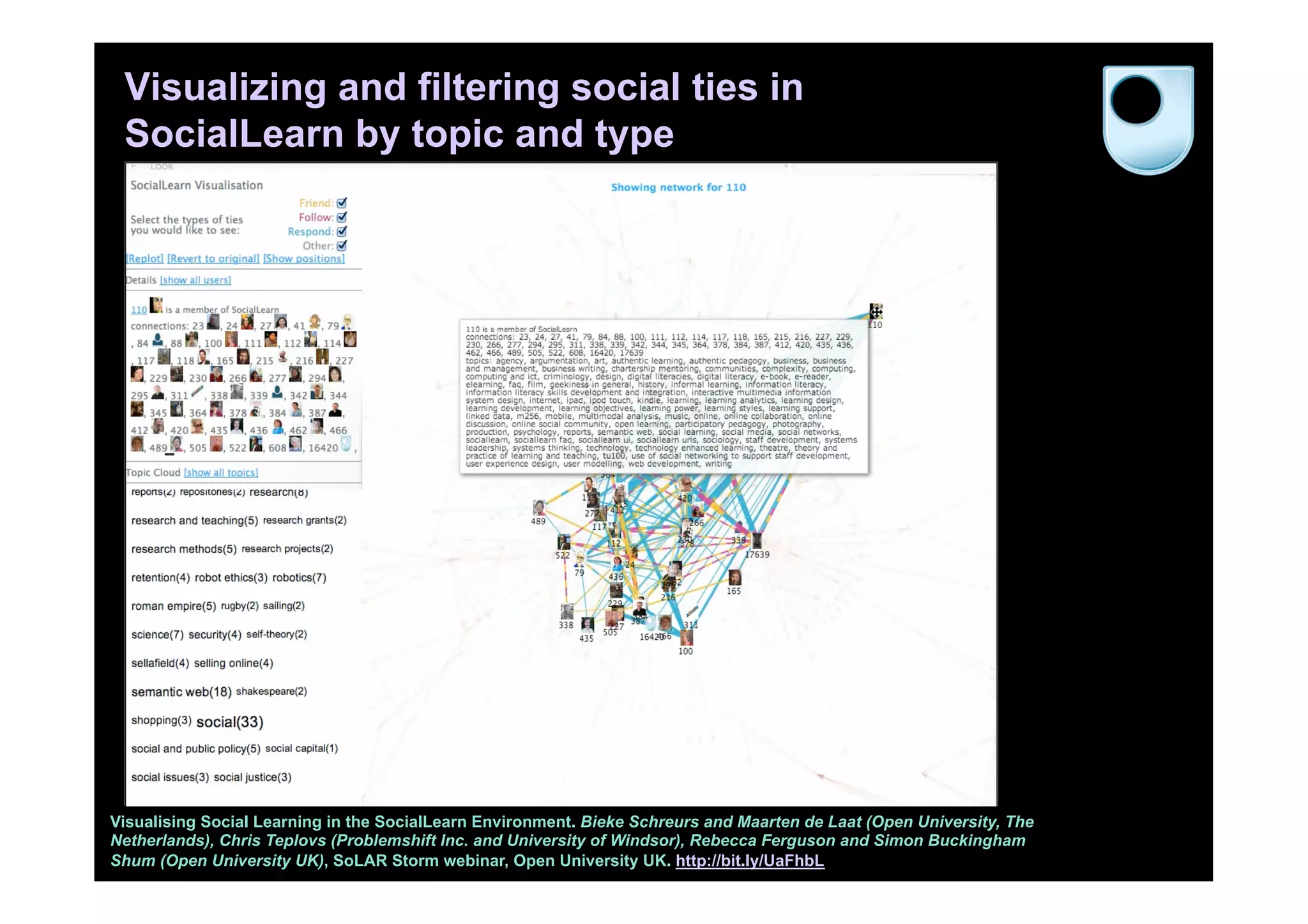
Visualizing and filtering social ties in
 SocialLearn by topic and type


Visualising Social Learning in the SocialLearn Environment. Bieke Schreurs and Maarten de Laat (Open University, The
Netherlands), Chris Teplovs (Problemshift Inc. and University of Windsor), Rebecca Ferguson and Simon Buckingham
Shum (Open University UK), SoLAR Storm webinar, Open University UK. http://bit.ly/UaFhbL
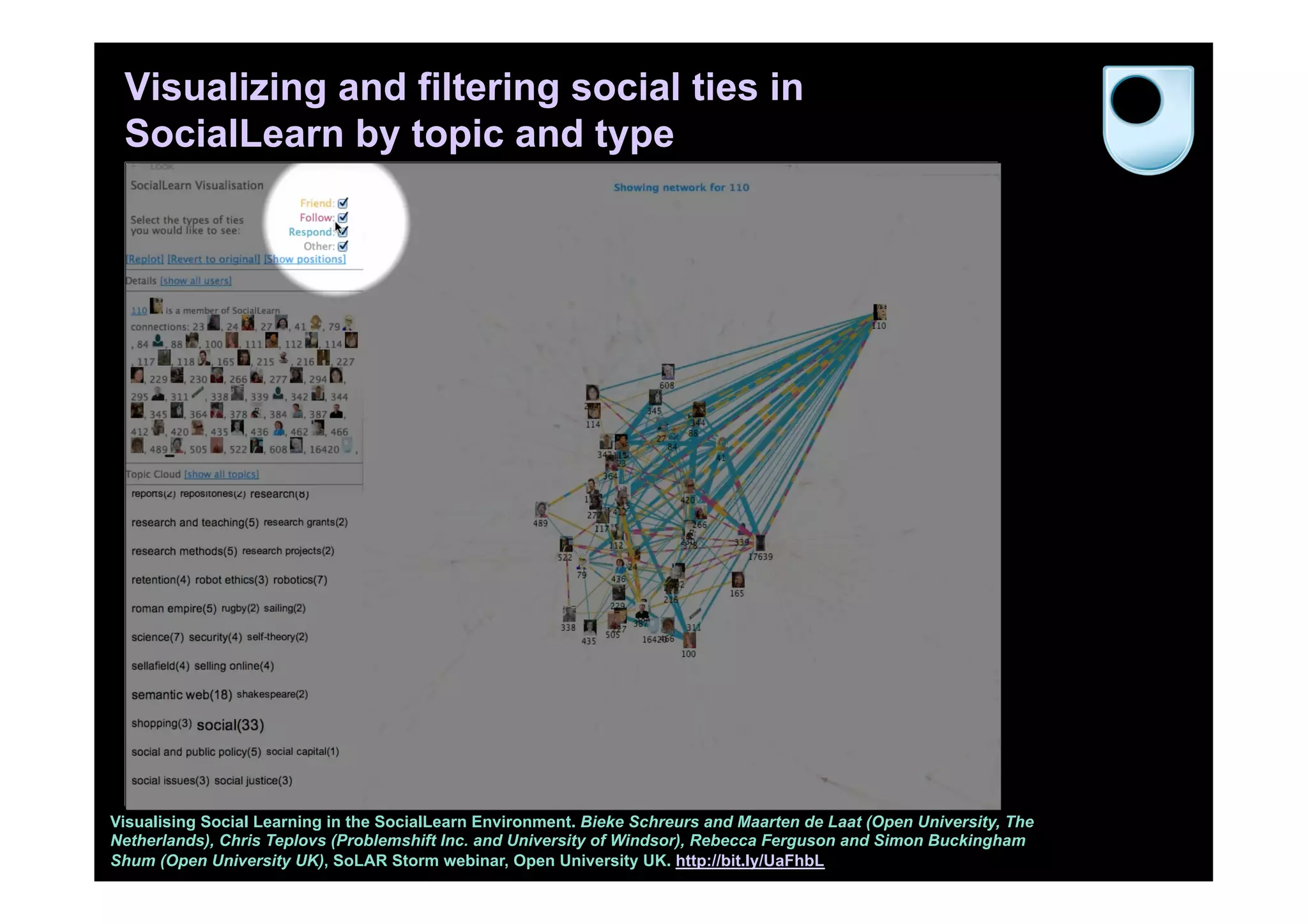
Visualizing and filtering social ties in
 SocialLearn by topic and type


Visualising Social Learning in the SocialLearn Environment. Bieke Schreurs and Maarten de Laat (Open University, The
Netherlands), Chris Teplovs (Problemshift Inc. and University of Windsor), Rebecca Ferguson and Simon Buckingham
Shum (Open University UK), SoLAR Storm webinar, Open University UK. http://bit.ly/UaFhbL
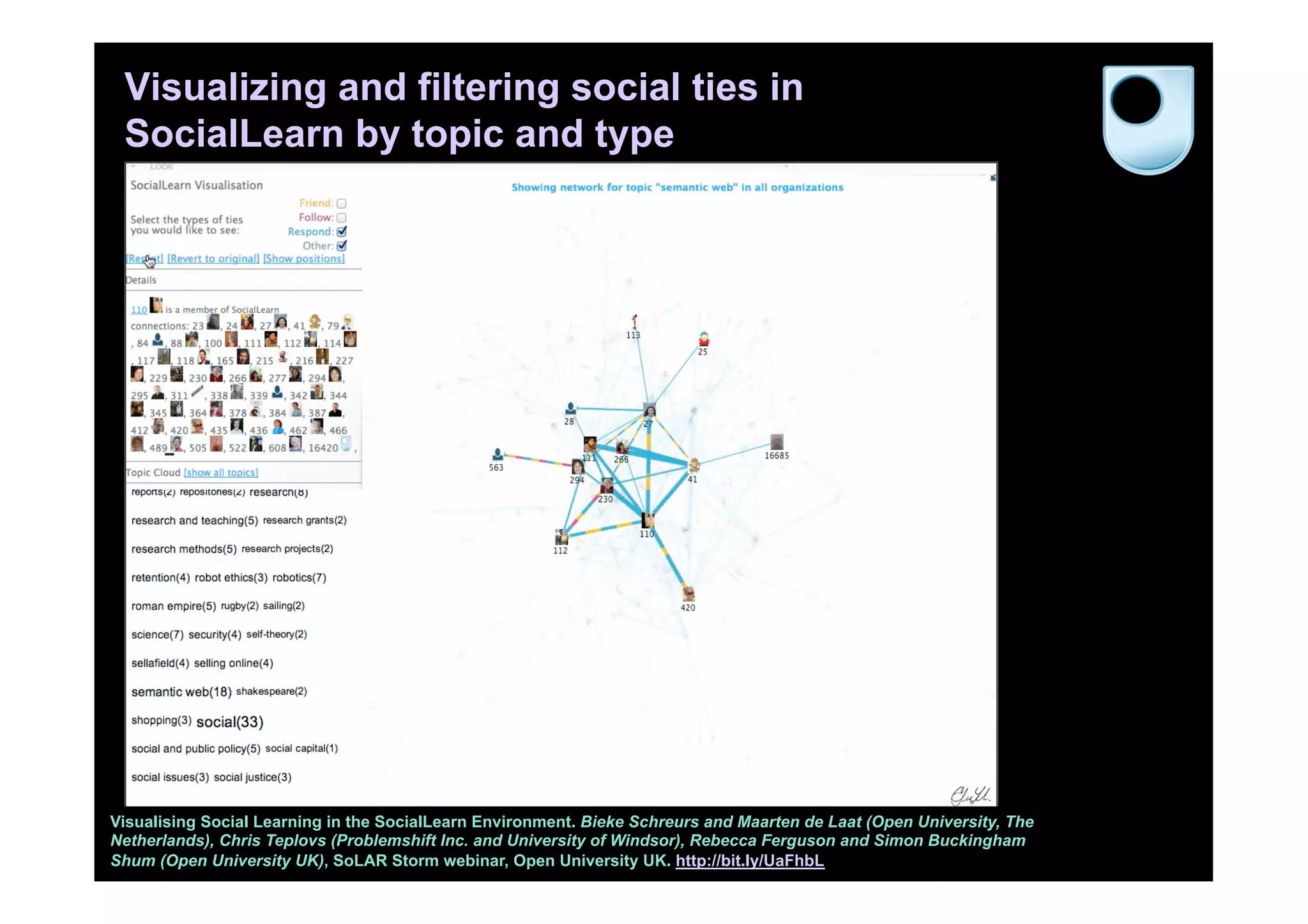
Visualizing and filtering social ties in
 SocialLearn by topic and type


Visualising Social Learning in the SocialLearn Environment. Bieke Schreurs and Maarten de Laat (Open University, The
Netherlands), Chris Teplovs (Problemshift Inc. and University of Windsor), Rebecca Ferguson and Simon Buckingham
Shum (Open University UK), SoLAR Storm webinar, Open University UK. http://bit.ly/UaFhbL
Visualizing and filtering social ties in
 SocialLearn by topic and type


Visualising Social Learning in the SocialLearn Environment. Bieke Schreurs and Maarten de Laat (Open University, The
Netherlands), Chris Teplovs (Problemshift Inc. and University of Windsor), Rebecca Ferguson and Simon Buckingham
Shum (Open University UK), SoLAR Storm webinar, Open University UK. http://bit.ly/UaFhbL
Visualizing and filtering social ties in
 SocialLearn by topic and type


Visualising Social Learning in the SocialLearn Environment. Bieke Schreurs and Maarten de Laat (Open University, The
Netherlands), Chris Teplovs (Problemshift Inc. and University of Windsor), Rebecca Ferguson and Simon Buckingham
Shum (Open University UK), SoLAR Storm webinar, Open University UK. http://bit.ly/UaFhbL
Visualizing and filtering social ties in
 SocialLearn by topic and type


Visualising Social Learning in the SocialLearn Environment. Bieke Schreurs and Maarten de Laat (Open University, The
Netherlands), Chris Teplovs (Problemshift Inc. and University of Windsor), Rebecca Ferguson and Simon Buckingham
Shum (Open University UK), SoLAR Storm webinar, Open University UK. http://bit.ly/UaFhbL
Closing thoughts


                   54
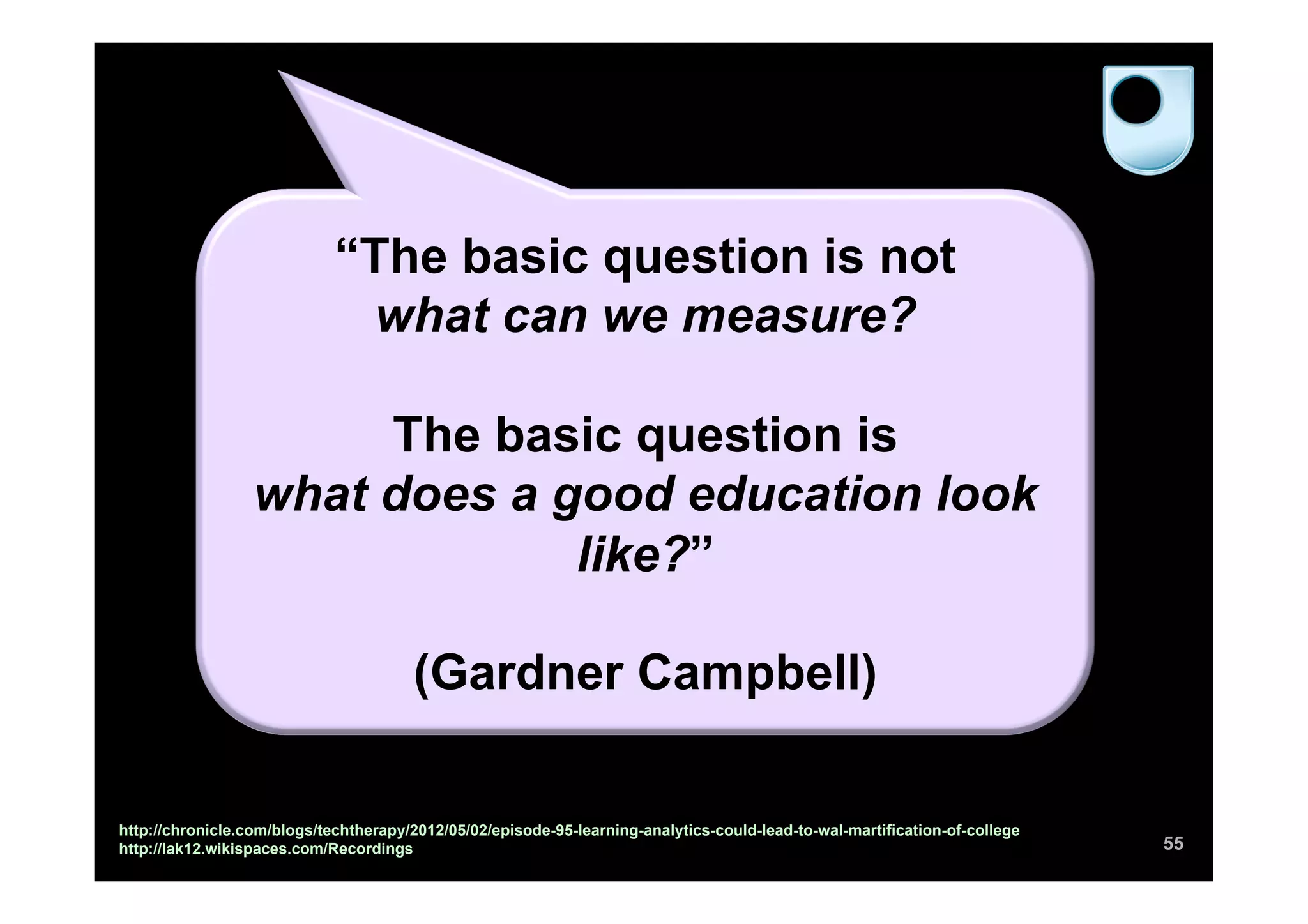
“The basic question is not
                              what can we measure?

                       The basic question is
                  what does a good education look
                               like?”

                                       (Gardner Campbell)

http://chronicle.com/blogs/techtherapy/2012/05/02/episode-95-learning-analytics-could-lead-to-wal-martification-of-college
http://lak12.wikispaces.com/Recordings                                                                                       55
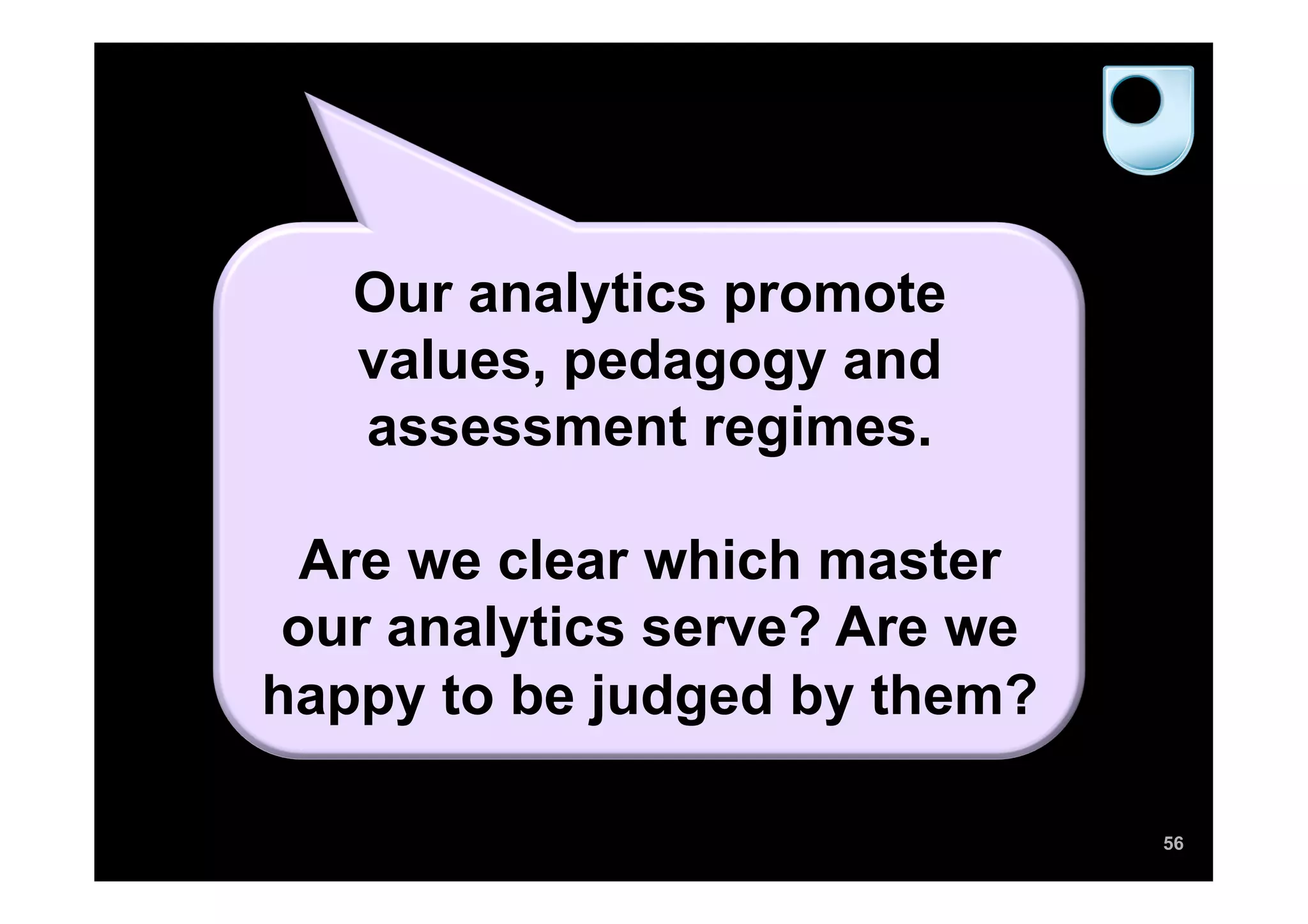
Our analytics promote
   values, pedagogy and
   assessment regimes.

  Are we clear which master
 our analytics serve? Are we
happy to be judged by them?

                               56
Will learning analytics merely
  turbocharge the current
   educational paradigm?

— which is so often declared
   not fit for purpose…


                                 57
…or will learning analytics
  reflect what we now know
 about designing authentic,
engaged learning, developing
   the new qualities that a
 complex society demands?


                               58

Learning Analytics: what are we optimizing for?

  • 1.
    edfuture.net MOOC onCurrent/Future State of HigherEd Learning Analytics what are we optimizing for? Knowledge Media Institute Simon Buckingham Shum Knowledge Media Institute The Open University UK http://twitter.com/sbskmi simon.buckinghamshum.net @ 1
  • 2.
    edX: “this isbig data, giving us the chance to ask big questions about learning” Will the tomorrow’s educational researcher be as helpless without an analytics infrastructure, as a geneticist without genome databases, or a physicist without CERN? 2
  • 3.
    the plan… joined-up multi-layeranalytics an analytics ecosystem are analytics (r)evolutionary? 3
  • 4.
    the convergence of analytics layers 4
  • 5.
    Macro/Meso/Micro Learning Analytics Macro: region/state/national/international Meso: institution-wide Micro: individual user actions (and hence cohort)
  • 6.
    Macro/Meso/Micro Learning Analytics Macro: region/state/national/international Meso: institution-wide Micro: individual user actions (and hence cohort) Will institutions be dazzled by the dashboards, or know what questions to ask at each level?
  • 7.
    For examples ofeach level of analytic… Buckingham Shum, S. 2012. Our Learning Analytics are Our Pedagogy. Keynote Address, Expanding Horizons 2012 Conference, 7 Macquarie University, Sydney. http://www.slideshare.net/sbs/our-learning-analytics-are-our-pedagogy
  • 8.
  • 9.
    As data migratesup it enriches higher layers, normally accustomed to sparse data Macro: region/state/national/international Meso: institution-wide Micro: individual user actions (and hence cohort) Aggregation of user traces enriches meso + macro analytics with finer-grained process data
  • 10.
    …which in turncould enrich lower layers — local patterns can be cross-validated Macro: region/state/national/international Meso: institution-wide Micro: individual user actions (and hence cohort) Aggregation of user traces Breadth + depth from macro enriches meso + macro analytics + meso levels could add with finer-grained process data power to micro-analytics
  • 11.
  • 12.
    A learning analyticsecosystem learners educators 12
  • 13.
    A learning analyticsecosystem learners educators 13
  • 14.
    A learning analyticsecosystem learners ?!*?!* ?!*?!* educators 14
  • 15.
    A learning analyticsecosystem data capture design team dashboard design team learners ?!*?!* data curators/ translators ?!*?!* educators 15
  • 16.
    Where did thedata come from? learners 16
  • 17.
    Where did thedata come from? learners theories pedagogies assessments tools researchers / educators / instructional designers 17
  • 18.
    Where did thedata come from? learners technologists theories pedagogies assessments tools researchers / educators / instructional designers 18
  • 19.
    The map isnot the territory Analytics are not the end, but a means The goal is to optimize the whole system outcome feedback learners design Intent theories Data pedagogies assessments tools intent researchers / educators / instructional designers 19
  • 20.
  • 21.
    Same outcomes, but higherscores? Learning Analytics as Evolutionary Technology • more engaging • better assessed • better outcomes • deliverable at scale 21
  • 22.
    New outcomes we couldn’tassess before? Learning Analytics as Revolutionary Technology • learner behaviours quantifiable • interpersonal networks quantifiable • discourse quantifiable • moods and dispositions quantifiable 22
  • 23.
    Learning analytics forthis? “We are preparing students for jobs that do not exist yet, that will use technologies that have not been invented yet, in order to solve problems that are not even problems yet.” “Shift Happens” http://shifthappens.wikispaces.com 23
  • 24.
    Learning analytics forthis? “While employers continue to demand high academic standards, they also now want more. They want people who can adapt, see connections, innovate, communicate and work with others. This is true in many areas of work. The new knowledge-based economies in particular will increasingly depend on these abilities. Many businesses are paying for courses to promote creative abilities, to teach the skills and attitudes that are now essential for economic success…” All our Futures: Creativity, culture & education, May 1999 24
  • 25.
    Learning analytics forthis? Think about the analytics products and initiatives reviewed above – where would you locate them on these dimensions? Creativity, Culture and Education (2009) Changing Young Lives 2012. Newcastle: CCE. http://www.creativitycultureeducation.org/ changing-young-lives-2012 25
  • 26.
    Learning analytics forthis? The Knowledge-Agency Window co-generation Expert-led enquiry Student-led enquiry Knowledge and use Teaching as Authenticity learning design Agency Identity Repetition, Pre-scribed Knowledge Abstraction Acquisition Expert-led teaching Student-led revision Teacher agency Student agency Ruth Deakin Crick, Univ. Bristol, Centre for Systems Learning & Leadership “Pedagogy of Hope”: http://learningemergence.net/2012/09/21/pedagogy-of-hope
  • 27.
    analytics grounded inthe principles of good assessment for learning? (not summative assessment for grading pupils, teachers, institutions or nations) 27
  • 28.
    Assessment for Learning Few learning analytics are http://assessment-reform-group.org currently able to take o board the richness of this original conception of assessment for learning 28
  • 29.
  • 30.
    Assessment for Learning http://assessment-reform-group.org To what extent could automated feedback be designed and evaluated with emotional impact in mind? 30
  • 31.
    Assessment for Learning http://assessment-reform-group.org Can analytics identify proxies for such advanced qualities? 31
  • 32.
    Assessment for Learning http://assessment-reform-group.org How do we provide analytics feedback that does not disempower and de- motivate struggling learners? 32
  • 33.
  • 34.
    Socio-cultural discourse analysis (Merceret al, OU) •  Disputational talk, characterised by disagreement and individualised decision making. •  Cumulative talk, in which speakers build positively but uncritically on what the others have said. •  Exploratory talk, in which partners engage critically but constructively with each other's ideas. Mercer, N. (2004). Sociocultural discourse analysis: analysing classroom talk as a social mode of thinking. Journal of Applied Linguistics, 1(2), 137-168. 34
  • 35.
    Socio-cultural discourse analysis (Merceret al, OU) •  Exploratory talk, in which partners engage critically but constructively with each other's ideas. •  Statements and suggestions are offered for joint consideration. •  These may be challenged and counter-challenged, but challenges are justified and alternative hypotheses are offered. •  Partners all actively participate and opinions are sought and considered before decisions are jointly made. •  Compared with the other two types, in Exploratory talk knowledge is made more publicly accountable and reasoning is more visible in the talk. Mercer, N. (2004). Sociocultural discourse analysis: analysing classroom talk as a social mode of thinking. Journal of Applied Linguistics, 1(2), 137-168. 35
  • 36.
    Analytics for identifyingExploratory talk Elluminate sessions can be very long – lasting for hours or even covering days of a conference It would be useful if we could identify where quality learning conversations seem to be taking place, so we can recommend those sessions, and not have to sit through online chat about virtual biscuits Ferguson, R. and Buckingham Shum, S. Learning analytics to identify exploratory dialogue within synchronous text chat. 36 1st International Conference on Learning Analytics & Knowledge (Banff, Canada, 27 Mar-1 Apr, 2011)
  • 37.
    Defining indicators ofExploratory Talk Category Indicator Challenge But if, have to respond, my view Critique However, I’m not sure, maybe Discussion of Have you read, more links resources Evaluation Good example, good point Explanation Means that, our goals Explicit reasoning Next step, relates to, that’s why Justification I mean, we learned, we observed Reflections of Agree, here is another, makes the perspectives of others point, take your point, your view 37
  • 38.
    Extract classified asExploratory Talk Time Contribution 2:42 PM I hate talking. :-P My question was whether "gadgets" were just basically widgets and we could embed them in various web sites, like Netvibes, Google Desktop, etc. 2:42 PM Thanks, that's great! I am sure I understood everything, but looks inspiring! 2:43 PM Yes why OU tools not generic tools? 2:43 PM Issues of interoperability 2:43 PM The "new" SocialLearn site looks a lot like a corkboard where you can add various widgets, similar to those existing web start pages. 2:43 PM What if we end up with as many apps/gadgets as we have social networks and then we need a recommender for the apps! 2:43 PM My question was on the definition of the crowd in the wisdom of crowds we acsess in the service model? 2:43 PM there are various different flavours of widget e.g. Google gadgets, W3C widgets etc. SocialLearn has gone for Google gadgets 38
  • 39.
    Discourse analytics onwebinar textchat Given a 2.5 hour webinar, where in the live textchat were the most effective learning conversations? Not at the start and end of a webinar Sheffield, UK not as sunny but if we zoom in on a peak… See you! as yesterday - still warm bye for now! Greetings from Hong Kong bye, and thank you Morning from Wiltshire, 80 sunny here! Bye all for now 60 40 20 0 9:28 9:32 10:13 11:48 12:00 12:05 12:04 9:36 9:40 9:41 9:46 9:50 9:53 9:56 10:00 10:05 10:07 10:07 10:09 10:17 10:23 10:27 10:31 10:35 10:40 10:45 10:52 10:55 11:04 11:08 11:11 11:17 11:20 11:24 11:26 11:28 11:31 11:32 11:35 11:36 11:38 11:39 11:41 11:44 11:46 11:52 11:54 12:03 -20 -40 Average Exploratory -60 Extensions to: Ferguson, R. and Buckingham Shum, S. (2011). Learning Analytics to Identify Exploratory Dialogue within Synchronous Text Chat. Proc. 1st Int. Conf. Learning Analytics & Knowledge. Feb. 27-Mar 1, 2011, Banff. ACM Press. Eprint: http://oro.open.ac.uk/28955
  • 40.
    Discourse analytics onwebinar textchat Given a 2.5 hour webinar, where in the live textchat were the most effective learning conversations? Classified as “exploratory talk” (more substantive 100 for learning) 50 0 9:28 “non- 9:40 9:50 10:00 10:07 10:17 10:31 10:45 11:04 11:17 11:26 11:32 11:38 11:44 11:52 12:03 -50 exploratory” Averag -100 Wei & He extensions to: Ferguson, R. and Buckingham Shum, S. (2011). Learning Analytics to Identify Exploratory Dialogue within Synchronous Text Chat. Proc. 1st Int. Conf. Learning Analytics & Knowledge. Feb. 27-Mar 1, 2011, Banff. ACM Press. Eprint: http://oro.open.ac.uk/28955
  • 41.
    KMi’s Cohere: aweb deliberation platform enabling semantic social network and discourse network analytics Rebecca is playing the role of broker, connecting 2 peers’ contributions in meaningful ways De Liddo, A., Buckingham Shum, S., Quinto, I., Bachler, M. and Cannavacciuolo, L. Discourse-centric learning analytics. 1st International Conference on Learning Analytics & Knowledge (Banff, 27 Mar-1 Apr, 2011) http://oro.open.ac.uk/25829
  • 42.
  • 43.
    Discourse analysis (XeroxIncremental Parser) Detection of salient sentences in scholarly reports, based on the rhetorical signals authors use: BACKGROUND KNOWLEDGE: NOVELTY: OPEN QUESTION: Recent studies indicate … ... new insights provide direct evidence ... … little is known … … the previously proposed … ... we suggest a new ... approach ... … role … has been elusive Current data is insufficient … … is universally accepted ... ... results define a novel role ... CONRASTING IDEAS: SIGNIFICANCE: SUMMARIZING: … unorthodox view resolves … studies ... have provided important The goal of this study ... paradoxes … advances Here, we show ... In contrast with previous Knowledge ... is crucial for ... Altogether, our results ... indicate hypotheses ... understanding ... inconsistent with past findings ... valuable information ... from studies GENERALIZING: SURPRISE: ... emerging as a promising approach We have recently observed ... surprisingly Our understanding ... has grown exponentially ... We have identified ... unusual ... growing recognition of the The recent discovery ... suggests Ágnes Sándor & OLnet Project: http://olnet.org/node/512 intriguing roles importance ... De Liddo, A., Sándor, Á. and Buckingham Shum, S., Contested Collective Intelligence: Rationale, Technologies, and a Human-Machine Annotation Study. Computer Supported Cooperative Work, 21, 4-5, (2012), 417-448. http://oro.open.ac.uk/31052
  • 44.
    Human and machineanalysis of a text for key contributions Document 1 19 sentences annotated 22 sentences annotated 11 sentences same as human annotation Document 2 71 sentences annotated 59 sentences annotated 42 sentences same as human annotation http://technologies.kmi.open.ac.uk/cohere/2012/01/09/cohere-plus-automated-rhetorical-annotation De Liddo, A., Sándor, Á. and Buckingham Shum, S., Contested Collective Intelligence: Rationale, Technologies, and a Human-Machine Annotation Study. Computer Supported Cooperative Work, 21, 4-5, (2012), 417-448. http://oro.open.ac.uk/31052
  • 45.
  • 46.
    Semantic Social NetworkAnalytics De Liddo, A., Buckingham Shum, S., Quinto, I., Bachler, M. and Cannavacciuolo, L. Discourse-centric learning analytics. 1st International Conference on Learning Analytics & Knowledge (Banff, 27 Mar-1 Apr, 2011) http://oro.open.ac.uk/25829
  • 47.
    Visualizing and filteringsocial ties in SocialLearn by topic and type Visualising Social Learning in the SocialLearn Environment. Bieke Schreurs and Maarten de Laat (Open University, The Netherlands), Chris Teplovs (Problemshift Inc. and University of Windsor), Rebecca Ferguson and Simon Buckingham Shum (Open University UK), SoLAR Storm webinar, Open University UK. http://bit.ly/UaFhbL
  • 48.
    Visualizing and filteringsocial ties in SocialLearn by topic and type Visualising Social Learning in the SocialLearn Environment. Bieke Schreurs and Maarten de Laat (Open University, The Netherlands), Chris Teplovs (Problemshift Inc. and University of Windsor), Rebecca Ferguson and Simon Buckingham Shum (Open University UK), SoLAR Storm webinar, Open University UK. http://bit.ly/UaFhbL
  • 49.
    Visualizing and filteringsocial ties in SocialLearn by topic and type Visualising Social Learning in the SocialLearn Environment. Bieke Schreurs and Maarten de Laat (Open University, The Netherlands), Chris Teplovs (Problemshift Inc. and University of Windsor), Rebecca Ferguson and Simon Buckingham Shum (Open University UK), SoLAR Storm webinar, Open University UK. http://bit.ly/UaFhbL
  • 50.
    Visualizing and filteringsocial ties in SocialLearn by topic and type Visualising Social Learning in the SocialLearn Environment. Bieke Schreurs and Maarten de Laat (Open University, The Netherlands), Chris Teplovs (Problemshift Inc. and University of Windsor), Rebecca Ferguson and Simon Buckingham Shum (Open University UK), SoLAR Storm webinar, Open University UK. http://bit.ly/UaFhbL
  • 51.
    Visualizing and filteringsocial ties in SocialLearn by topic and type Visualising Social Learning in the SocialLearn Environment. Bieke Schreurs and Maarten de Laat (Open University, The Netherlands), Chris Teplovs (Problemshift Inc. and University of Windsor), Rebecca Ferguson and Simon Buckingham Shum (Open University UK), SoLAR Storm webinar, Open University UK. http://bit.ly/UaFhbL
  • 52.
    Visualizing and filteringsocial ties in SocialLearn by topic and type Visualising Social Learning in the SocialLearn Environment. Bieke Schreurs and Maarten de Laat (Open University, The Netherlands), Chris Teplovs (Problemshift Inc. and University of Windsor), Rebecca Ferguson and Simon Buckingham Shum (Open University UK), SoLAR Storm webinar, Open University UK. http://bit.ly/UaFhbL
  • 53.
    Visualizing and filteringsocial ties in SocialLearn by topic and type Visualising Social Learning in the SocialLearn Environment. Bieke Schreurs and Maarten de Laat (Open University, The Netherlands), Chris Teplovs (Problemshift Inc. and University of Windsor), Rebecca Ferguson and Simon Buckingham Shum (Open University UK), SoLAR Storm webinar, Open University UK. http://bit.ly/UaFhbL
  • 54.
  • 55.
    “The basic questionis not what can we measure? The basic question is what does a good education look like?” (Gardner Campbell) http://chronicle.com/blogs/techtherapy/2012/05/02/episode-95-learning-analytics-could-lead-to-wal-martification-of-college http://lak12.wikispaces.com/Recordings 55
  • 56.
    Our analytics promote values, pedagogy and assessment regimes. Are we clear which master our analytics serve? Are we happy to be judged by them? 56
  • 57.
    Will learning analyticsmerely turbocharge the current educational paradigm? — which is so often declared not fit for purpose… 57
  • 58.
    …or will learninganalytics reflect what we now know about designing authentic, engaged learning, developing the new qualities that a complex society demands? 58