Where computer game playing
meets learning - Opportunities for
near market research and
innovative prototyping

   Dr. Derek Nicoll


               Where Computer Games Playing meets   Page 1
               learning
Games design, HCI, educational
models, organisation and users
                                                                   Software/hardware
                                                                        /internet
 Pedagogy
                                                            Games
                                              HCI and
                                                          technology
                                              usability

    Educational   Training
      Models                     Particular
                                  training
                                 objective

                                                           Organisational
                               Learners/Users/            culture, aims and
                                   Players                    objectives

                                                                      Theories of the
                                                                       organisation


                    Where Computer Games Playing meets    Page 2
                    learning
Games design, HCI, educational
models, organisation and users
                                                                   Software/hardware
                                                                        /internet
 Pedagogy
                                                            Games
                                              HCI and
                                                          technology
                                              usability

    Educational   Training
      Models

                                 Particular
                                   Learner
                                                           Organisational
                               Learners/Users/            culture, aims and
                                   Players                    objectives

                                                                      Theories of the
                                                                       organisation


                    Where Computer Games Playing meets    Page 3
                    learning
Games design, HCI, educational
models, organisation and users
  —Games for training an learning is pioneering work
  —Traditional corporate training often employs games-based
   exercises and simulations to bridge knowledge and skills gaps
   between novices and experts
  —Construtivist theories of learning ‘ learning by doing’ have gained
   popularity in education and training - CAI and ITS
  —Games, simulations and prototypes inherently offer this
   opportunity for ‘serious play’ in prototyping
  —Learners’ understanding grows as they engage in and continue
   to engage in new work practices -motivation/scaffolding
  —Unitary and modular building blocks in experience design
  —Cognitive, cognitive behavioural or behavioural facets


                     Where Computer Games Playing meets   Page 4
                     learning
Experiential learning
                             Concrete
                            experience

           Testing
        Implications of                  Observations and
       concepts in new                      reflections
          situations
                         Formation of
                       abstract concepts                    The cycle of
                              and                       experiential learning
                        generalizations                  after Kolb and Fry
                                                                (1975)


                   Where Computer Games Playing meets       Page 5
                   learning
Opportunities
   —Cost - reducing training costs for individuals and firms
   —Effectiveness - providing more effective training
   —Motivation -training becoming more effective due to increased
    motivation to participate in and/or absorb training?
   —Relevance - providing training which is more focussed upon the
    training need of the individual learner and/or the individual
    organisation
   —Applicability, Convenience, Mobility - Easier, more accessible
    and immediate training, free of time and space constraints,
    available at any time, through multiple platforms
   —Provide opportunity to radically modify accepted practices and
    enable entirely new approaches and thus open possibilities for
    innovation to learning theories and theories of the organisation
    (learning about learning)


                     Where Computer Games Playing meets   Page 6
                     learning
Near market research
  —Cost - understanding how games can incorporate into existing
   training programs or may even replace them (organisational)
  —Effectiveness - Where do games work best? In which training
   areas? Can they be properly benchmarked against live or alternate
   forms of training? (user-learner research)
  —Motivation - Do they enhance participation, level of interest,
   engagement and immersion? Can they do this equally between
   subjects or do individual/cultural/generational differences play some
   role? (user-learner research)
  —Hogan et al. Point to the fact that motivation suffers as learners
   encounter obstacles - bad interfaces, gameplay not only meets
   learning but new kinds of usability challenge


                      Where Computer Games Playing meets   Page 7
                      learning
Cost of training
   —Deep understanding of the training need as seen from multiple
    actors’ perspective (heterogeneity)
   —Likewise deep understanding of technical and interface needs
    from these multiple perspectives (co-design)
   —Learning to attract and manage feedback from all actors into the
    innovation of training materials, game elements and interfaces
    (evaluation and research)
   —Developing models of cost and price with respect to identifying
    training need, capturing and codifying data? Model of software and
    media development, man hours? Cost of evaluation?
   —Developing a pioneering unitary and modular view to games
    production - development of suitable generic components using
    Java, Python??


                     Where Computer Games Playing meets   Page 8
                     learning
Prototyping games -problems
  —Supply chain management issues - aligning the vision of the
   various actors, development of open and effective communications
   (user needs and requirements into engineering requirements )
  —The keys to managing prototyping include knowing what you
   want to learn from the prototype, access to, and understanding of
   rapid prototyping tools and techniques, and end-user involvement in
   development of the prototype
  —Training and presentation must be cogent with company culture
   and ways of doing things - knowledge is in part a product of the
   activity, context and culture in which it is developed and used . . .


                      Where Computer Games Playing meets   Page 9
                      learning
Constituency of learning
                            Organisational
                              structure          Organisational
               External                             climate
              influences                                          Advance training
                                                                  resource - game
     Make-up of                                                     or simulation
     workforce

   Organisational                   Training                         Cost vs. benefits
       goals                          Need

     Proactive vs.
       reactive                                                      Time required

           Individual vs.
               group                                            Nature of
                            Training design                 learning required
                              complexity


                       Where Computer Games Playing meets            Page 10
                       learning
Example cost of 1 week live
training
—Salaries 12 x £425                 £5100
—Classroom overhead                 £1479
—materials                          £150
—Admin                              £425
—Replacement staff                  £1950
—Instructor                         £475
—Audio-visual                       £175
—Transport                          £1400
—Misc.                              £425

—TOTAL                              £12,174 not including accommodation and meals


                      Where Computer Games Playing meets   Page 11
                      learning
Cost of games development
  — Costs over development/implementation lifecycle


    cost


                                                                      Time
      Training need     Training need Requirements/Game Deployment/
                      identification and development     evaluation
                           analysis


                       Where Computer Games Playing meets   Page 12
                       learning
Cost of games development
 — Cost against development
 £,£££,£££


     cost


         £££
             Generic -    Bespoke-                Modular-        Bespoke - software-
               web       web based -              software-         based - original
              based      Java,Python            based - off the      development
                                                    shelf


                         Where Computer Games Playing meets       Page 13
                         learning
Cost of learning
 — Costs over development/implementation lifecycle


                                                        ?
     cost
                                                                         Ongoing
                                                                         Support?
                                                  iterations


                                                                                    Time
       Training need     Training need Requirements/Game Deployment/
                       identification and development     evaluation
                            analysis


                        Where Computer Games Playing meets     Page 14
                        learning
Cost of learning
 — Costs over development/implementation lifecycle


                                             Learning £ VALUE

                                                       £?
     cost
                                                      COST
                                                                          Ongoing
                                                                          Support?
                                                  iterations


                                                                                     Time
       Training need     Training need Requirements/Game Deployment/
                       identification and development     evaluation
                            analysis


                        Where Computer Games Playing meets      Page 15
                        learning
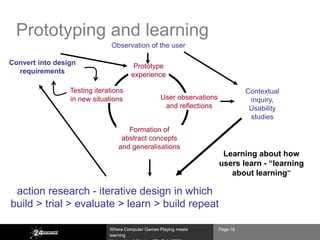
Prototyping and learning
                               Observation of the user

Convert into design                     Prototype
  requirements                         experience

                 Testing iterations                                               Contextual
                 in new situations                  User observations              inquiry,
                                                     and reflections               Usability
                                                                                   studies
                                    Formation of
                                  abstract concepts
                                 and generalisations
                                                                         Learning about how
                                                                        users learn - “learning
                                                                           about learning”

 action research - iterative design in which
build > trial > evaluate > learn > build repeat

                              Where Computer Games Playing meets        Page 16
                              learning
Monitoring/evaluation

  —Impact upon learners and organisation
     – Reactions of learners - I.e. quality of interaction, usability
       issues, entertainment value etc.
     – Learning - skills, knowledge and attitudes - have the learning
       objectives been met? (tests, exams, quizzes)
     – Behavioural - Did the learning transfer do the job? (Speed of
       completing processes)
     – Result on organisation - has the training impacted upon
       general efficiency (more diffuse, interviews with management)


                      Where Computer Games Playing meets   Page 17
                      learning
Threats
  —Danger to engage all too readily in training and/or technology as
   panacea for all a human performance problems
  —Prototyping and iterative design have a reputation for being
   difficult to manage
  —Failure to meet deadlines
  —Failure to gain the trust and co-operation of key actors in the
   organisation
  —Seamless - learning to use the game should not interfere with
   training objectives - distinctive need for good usability
  —Difficult to persuade companies that performing one more
   iteration is far less costly than releasing a flawed or incomplete
   product
  —Accurately estimating the size of the implementation challenge


                     Where Computer Games Playing meets   Page 18
                     learning
Opportunities
  —The research is pioneering so there are inherently vast
   opportunities to contribute to both training practice and also
   games design
  —Needs to draw upon an awareness of games - their potentials
   and constraints from a user perspective (generic),
  —from a technology/software/media perspective (generic)
  —from a human and social factors perspective (generic)
  —from a training perspective (generic)
  —from the perspective of particular organisation (learning to be
   customised and specific)


                    Where Computer Games Playing meets   Page 19
                    learning

Abertay4

  • 1.
    Where computer gameplaying meets learning - Opportunities for near market research and innovative prototyping Dr. Derek Nicoll Where Computer Games Playing meets Page 1 learning
  • 2.
    Games design, HCI,educational models, organisation and users Software/hardware /internet Pedagogy Games HCI and technology usability Educational Training Models Particular training objective Organisational Learners/Users/ culture, aims and Players objectives Theories of the organisation Where Computer Games Playing meets Page 2 learning
  • 3.
    Games design, HCI,educational models, organisation and users Software/hardware /internet Pedagogy Games HCI and technology usability Educational Training Models Particular Learner Organisational Learners/Users/ culture, aims and Players objectives Theories of the organisation Where Computer Games Playing meets Page 3 learning
  • 4.
    Games design, HCI,educational models, organisation and users —Games for training an learning is pioneering work —Traditional corporate training often employs games-based exercises and simulations to bridge knowledge and skills gaps between novices and experts —Construtivist theories of learning ‘ learning by doing’ have gained popularity in education and training - CAI and ITS —Games, simulations and prototypes inherently offer this opportunity for ‘serious play’ in prototyping —Learners’ understanding grows as they engage in and continue to engage in new work practices -motivation/scaffolding —Unitary and modular building blocks in experience design —Cognitive, cognitive behavioural or behavioural facets Where Computer Games Playing meets Page 4 learning
  • 5.
    Experiential learning Concrete experience Testing Implications of Observations and concepts in new reflections situations Formation of abstract concepts The cycle of and experiential learning generalizations after Kolb and Fry (1975) Where Computer Games Playing meets Page 5 learning
  • 6.
    Opportunities —Cost - reducing training costs for individuals and firms —Effectiveness - providing more effective training —Motivation -training becoming more effective due to increased motivation to participate in and/or absorb training? —Relevance - providing training which is more focussed upon the training need of the individual learner and/or the individual organisation —Applicability, Convenience, Mobility - Easier, more accessible and immediate training, free of time and space constraints, available at any time, through multiple platforms —Provide opportunity to radically modify accepted practices and enable entirely new approaches and thus open possibilities for innovation to learning theories and theories of the organisation (learning about learning) Where Computer Games Playing meets Page 6 learning
  • 7.
    Near market research —Cost - understanding how games can incorporate into existing training programs or may even replace them (organisational) —Effectiveness - Where do games work best? In which training areas? Can they be properly benchmarked against live or alternate forms of training? (user-learner research) —Motivation - Do they enhance participation, level of interest, engagement and immersion? Can they do this equally between subjects or do individual/cultural/generational differences play some role? (user-learner research) —Hogan et al. Point to the fact that motivation suffers as learners encounter obstacles - bad interfaces, gameplay not only meets learning but new kinds of usability challenge Where Computer Games Playing meets Page 7 learning
  • 8.
    Cost of training —Deep understanding of the training need as seen from multiple actors’ perspective (heterogeneity) —Likewise deep understanding of technical and interface needs from these multiple perspectives (co-design) —Learning to attract and manage feedback from all actors into the innovation of training materials, game elements and interfaces (evaluation and research) —Developing models of cost and price with respect to identifying training need, capturing and codifying data? Model of software and media development, man hours? Cost of evaluation? —Developing a pioneering unitary and modular view to games production - development of suitable generic components using Java, Python?? Where Computer Games Playing meets Page 8 learning
  • 9.
    Prototyping games -problems —Supply chain management issues - aligning the vision of the various actors, development of open and effective communications (user needs and requirements into engineering requirements ) —The keys to managing prototyping include knowing what you want to learn from the prototype, access to, and understanding of rapid prototyping tools and techniques, and end-user involvement in development of the prototype —Training and presentation must be cogent with company culture and ways of doing things - knowledge is in part a product of the activity, context and culture in which it is developed and used . . . Where Computer Games Playing meets Page 9 learning
  • 10.
    Constituency of learning Organisational structure Organisational External climate influences Advance training resource - game Make-up of or simulation workforce Organisational Training Cost vs. benefits goals Need Proactive vs. reactive Time required Individual vs. group Nature of Training design learning required complexity Where Computer Games Playing meets Page 10 learning
  • 11.
    Example cost of1 week live training —Salaries 12 x £425 £5100 —Classroom overhead £1479 —materials £150 —Admin £425 —Replacement staff £1950 —Instructor £475 —Audio-visual £175 —Transport £1400 —Misc. £425 —TOTAL £12,174 not including accommodation and meals Where Computer Games Playing meets Page 11 learning
  • 12.
    Cost of gamesdevelopment — Costs over development/implementation lifecycle cost Time Training need Training need Requirements/Game Deployment/ identification and development evaluation analysis Where Computer Games Playing meets Page 12 learning
  • 13.
    Cost of gamesdevelopment — Cost against development £,£££,£££ cost £££ Generic - Bespoke- Modular- Bespoke - software- web web based - software- based - original based Java,Python based - off the development shelf Where Computer Games Playing meets Page 13 learning
  • 14.
    Cost of learning — Costs over development/implementation lifecycle ? cost Ongoing Support? iterations Time Training need Training need Requirements/Game Deployment/ identification and development evaluation analysis Where Computer Games Playing meets Page 14 learning
  • 15.
    Cost of learning — Costs over development/implementation lifecycle Learning £ VALUE £? cost COST Ongoing Support? iterations Time Training need Training need Requirements/Game Deployment/ identification and development evaluation analysis Where Computer Games Playing meets Page 15 learning
  • 16.
    Prototyping and learning Observation of the user Convert into design Prototype requirements experience Testing iterations Contextual in new situations User observations inquiry, and reflections Usability studies Formation of abstract concepts and generalisations Learning about how users learn - “learning about learning” action research - iterative design in which build > trial > evaluate > learn > build repeat Where Computer Games Playing meets Page 16 learning
  • 17.
    Monitoring/evaluation —Impactupon learners and organisation – Reactions of learners - I.e. quality of interaction, usability issues, entertainment value etc. – Learning - skills, knowledge and attitudes - have the learning objectives been met? (tests, exams, quizzes) – Behavioural - Did the learning transfer do the job? (Speed of completing processes) – Result on organisation - has the training impacted upon general efficiency (more diffuse, interviews with management) Where Computer Games Playing meets Page 17 learning
  • 18.
    Threats —Dangerto engage all too readily in training and/or technology as panacea for all a human performance problems —Prototyping and iterative design have a reputation for being difficult to manage —Failure to meet deadlines —Failure to gain the trust and co-operation of key actors in the organisation —Seamless - learning to use the game should not interfere with training objectives - distinctive need for good usability —Difficult to persuade companies that performing one more iteration is far less costly than releasing a flawed or incomplete product —Accurately estimating the size of the implementation challenge Where Computer Games Playing meets Page 18 learning
  • 19.
    Opportunities —Theresearch is pioneering so there are inherently vast opportunities to contribute to both training practice and also games design —Needs to draw upon an awareness of games - their potentials and constraints from a user perspective (generic), —from a technology/software/media perspective (generic) —from a human and social factors perspective (generic) —from a training perspective (generic) —from the perspective of particular organisation (learning to be customised and specific) Where Computer Games Playing meets Page 19 learning