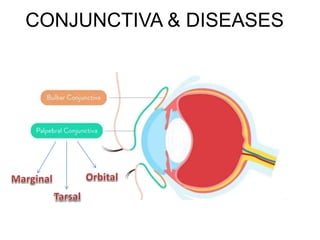
CONJUNCTIVA & DISEASES
Glands of conjunctiva
• Mucous secreting glands
 Goblet cells
 Crypts of henle
 Glands of manz
• Accessory lacrimal glands
 Glands of Krause
 Glands of wolfring
INFECTIVE CONJUNCTIVITIS
• BACTERIAL CONJUNCTIVITIS:
ETIOLOGY :
1. Predisposing factors: unhygienic conditions, flies, hot dry climate,
dirty habits, poor sanitation
2. Causative organisms: Staphylococcus aureus/epidermidis,
Streptococcus pyogenes/pneumoniae,
Pseudomonas, Moraxella lacunata, Neisseria gonorrhea,
Meningococcus, Hemophilus influenza
3. Mode of infection: exogenous, local spread, endogenous
PATHOLOGY :
1. Vascular response: congestion, permeabilility of
conjunctival vessels, proliferation of capillaries.
2. Cellular response: exudation of PMN cells into
subconjunctival propria.
3. Conjunctival tissue response: edematous, superficial
epithelial cells degenerate and desquamate. Proliferation
of basal layer of epithelium and inc. in goblet cells.
4. Conjunctival discharge: consists of tears, mucous,
inflammatory cells, desquamated cells, fibrin and bacteria.
Clinical types
• Acute bacterial conjunctivitis
• Hyper acute bacterial conjunctivitis
• Chronic bacterial conjunctivitis
• Angular bacterial conjunctivitis
ACUTE BACTERIAL
CONJUNCTIVITIS
• M/c
• A.k.a acute muco-purulent conjunctivitis
• Marked conjunctival hyperemia and
mucopurulent discharge.
• Common causative organisms: staph. Strep.
pneumococcus
Clinical features:
Symptoms:
• Redness
• Mild photophobia
• Discomfort, foreign body,
grittiness
• Muco-purulent discharge
• Stickiness of lids during
sleep
• Colored halos
• Slight blurring
Signs :
• Flakes of mucopus in
fornices canthi and lid
margins
• Congestion – fiery red eye
• Chemosis
• Papillae
• Petechial hemorrhage-
pneumococcus
• Odematous eyelids
• Cilia matted with yellow
crusts
Complications:
• Marginal corneal ulceration
• Dacrocystitis
• Superficial keratitis
• Blepharitis
Course:
• One eye affected 1-2 days before other eye
• Untreated mild case- 10-15 days
• Or becomes chronic catarrhal conjunctivitis .
Differential Diagnosis:
Differentiate from other causes of red eye:
• Conjunctivitis
• Acute iridocyclitis
• Acute congestive glaucoma
Differentiate from other causes of
conjunctivitis:
• Bacterial
• Viral
• Allergic
Treatment:
• Topical antibiotics- main treatment
 Start with Chloramphenicol, Gentamicin, Tobramycin eye
drops in day and ointment at night. (stickiness+ Ab. effect)
 If not responding – Ciprofloxacin, Ofloxacin, Gatifloxacin,
Moxifloxacin.
• Dark goggles
• Irrigation- with sterile luke warm saline 1-2/day
• No bandage & no steroids
• Anti inflammatory/ analgesic drugs
Preventive measures:
• Frequent hand washing
• Avoid sharing towels, applicators, pillows
HYPERACUTE BACTERIAL
CONJUNCTIVITIS
• A.k.a acute purulent conjunctivitis
• Violent inflammatory response
• 2 types: gonococcal conjunctivitis &
ophthalmia neonatorum
GONOCOCCAL
CONJUNCTIVITISEtiology:
• spread from genitals to eye, m/c in males
Symptoms:
• Pain
• Discharge- purulent/ sanguineous(bloody)
• Mild photophobia
• Swelling of eyelids
• Sticking of lid margins
• Slight blurring - mucous flakes
Signs:
• Eyelids- tense and swollen
• Tenderness marked
• Copious discharge trickling onto cheeks
• Enlarged pre-auricular lymph nodes
• Conjunctive- Chemosis, papillae, congestion, pseudo-membrane
Association:
• Urethritis
• Arthritis
Complications:
• Corneal involvement- haze, ulceration, perforation, central
necrosis ( gonococcus can invade intact epithelium )
• Iridocyclitis
• Systemic complications- arthritis, endocarditis, septicemia.
TREATMENT :
• Systemic therapy- 3rd gen. cephalosporin followed by
a week of doxycycline or erythromycin.
• Topical antibiotic therapy- ofloxacin/ ciprofloxacin/
Tobramycin
• Irrigation- sterile saline
• General measures- goggles, avoid sharing, maintain
hygiene.
• Topical atropine- if cornea involved.
N.B – both sexual partners given systemic therapy
and evaluated for other STD’s
OPHTHALMIA NEONATORUM
• A.k.a neonatal conjunctivitis
• Hyperacute conjunctivitis in neonates(<30 days old )
• bilateral inflammation
Etiology:
• Before birth- infected liquor amnii>>PROM
• During birth- face presentation in infected birth canal
• After birth- soiled clothes or fingers
CAUSATIVE AGENTS:
• Chemical - (6hrs) Crede’s method (AgNO3)
• Gonococcal- (2-5days)
• Other bacteria- (5-8 days)
• Neonatal inclusion- (5-14days) Chlamydia (D-K)
• Herpes simplex- viral cause(6-15days)
SYMPTOMS & SIGNS:
• Swollen eyelid- infective cause
• Discharge- purulent/ mucopurulent
• Congestion and Chemosis
• Pain and tenderness
• Corneal involvement
Complications:
• Corneal involvement >> ulceration >> opacification
and staphyloma formation
TREATMENT
• Chemical: self limiting
• Gonococcal: topical + systemic
• Other bacteria: broad spec Ab. Neomycin/ bacitracin/
Tobramycin
• Neonatal inclusion: topical tetracycline/ erythromycin
+ systemic erythromycin for URTI.
Saline lavage
Penicillin drops/
bacitracin ointment
Atropine sulphate
3rd gen cephalosporin-
•Cefotaxime
•ceftriaxone
Ciprofloxacin
CHRONIC BACTERIAL
CONJUNCTIVITIS• A.k.a chronic catarrhal conjunctivitis
Etiology:
Predisposing factors:
• Exposure to dust, smoke, irritants
• Local irritation- trichiasis, foreign body
• Eye strain
• Alcohol abuse, insomnia
Causative organism:
• Staph aureus, proteus, Klebsiella, E.coli, moraxella lacunata
Source/ mode of infection:
• Continuation of ac. Conj.
• Chronic inf. from Dacrocystitis, chronic rhinitis.
• Exogenously from contact, airborne, material transfer
Clinical features:
Symptoms:
• Mild redness
• Discharge- mucoid at canthi
• On and off watering
• Burning, grittiness
• Difficult to keep eyes open
Signs:
• Congestion of posterior
conjunctival vessels
• Lid congestion
• Sticky look of conjunctiva
• Papillary hypertrophy
TREATMENT:
• Eliminate pre- disposing factors
• Topical antibiotics- chloramphenicol,
tobramycin, gentamicin
• Astringent eye drops- zinc-boric drops
ANGULAR BACTERIAL
CONJUNCTIVITIS
Mild inflammation confined to conjunctiva and lid margins
@ canthi
Etiology:
• Pre-disposing factors similar to chronic conj.
• Moraxella Lacunata/ Axenfeld
• Source- nasal cavity
• Mode of spread- from nasal cavity to eyes by contaminated fingers/
handkerchief
Pathology:
• Proteolytic enzyme from organism >>> accumulates at canthi >>>
maceration of epithelium of conjunctiva, lid margin, skin surrounding
angle of eye >>> vascular/cellular responses
Clinical features
Symptoms:
• Irritation/ discomfort/
burning sensation
• Redness at angles
• Dirty white foamy
discharge at angles
Signs:
• Hyperemia of bulbar
conjunctiva at canthi
• Hyperemia of lid
margins at angles
• Excoriation of skin
around angles
• Foamy mucopurulent
discharge at angles
TREATMENT
• PROPHYLAXIS: good personal hygiene,
treat ass. Nasal infection.
• CURATIVE: oxytetracycline eye ointment ,
zinc lotion in day time and zinc oxide ointment
at bed time.
TRACHOMA
(EGYPTIAN OPHTHALMIA)
DEFINITION :
“Chronic keratoconjunctivitis primarily
affecting superficial epithelium of
conjunctiva and cornea simultaneously.
Characterized by mixed follicular and
papillary response of conjunctival tissue,
pannus formation, and in late stages
cicatrization giving it a rough appearance.”
Etiology :
• Causative organisms: Chlamydia trachomatis
Serotypes A, B, Ba, C- blinding trachoma
(EYE TO EYE)
Serotypes D-K – oculogenital chlamydial disease
(GENITALS TO EYE)
• Predisposing factors:
a) Age- childhood and infancy
b) Sex- females
c) Socioeconomic status- poor classes
d) Climate- dry dusty weather
e) Environmental factors- dust, smoke, irritants
Source of infection:
• Conjunctival discharge from affected persons
Mode of infection:
• Direct spread
• Material transfer
• Vector transmission through flies
Phases of trachoma:
I. Phase of active trachoma
II. Phase of cicatricial trachoma
1. Phase of active trachoma
(Occurs in childhood)
• Symptoms: (in absence of
secondary infection)
 Mild foreign body sensation
 Occasional lacrimation
 Slight stickiness
 Mucoid discharge
• Signs:
Conjunctival –
 Follicles- boiled sago grain
 congestion
 papillary hyperplasia
Corneal-
 ulcer
 superficial keratitis
 Herbert follicles
 progressive pannus
2. Phase of cicatricial trachoma
• Type 4 delayed hypersensitivity reaction
Conjunctival signs:
• Scarring- ARLT’s LINE
• Concretions
• Pseudocyst
• Xerosis
• symblepharon
Corneal signs:
• Regressive pannus
• Corneal opacity
WHO classification:
• F – stage of inflammation- follicular
• I – stage of intense inflammation
• S – stage of scarring
• T – stage of trichiasis
• O – stage of corneal opacity
TREATMENT
Of active trachoma : (TF &TI stages)
• Topical:
a) Tetracycline/ erythromycin (1%)
b) Sulfacetamide(20%)
• Systemic:
a) Doxycycline, tetracycline/erythromycin
b) Azithromycin-DOC(single oral dose)- not in pregnancy and
<6yrs.
• Both: in severe ocular inf. + genital inf.
a) Tetracycline/ erythromycin
b) Azithromycin
Of cicatricial (inactive) trachoma: (TS, TT &CO stages)
TS stage: scarring
• Concretions removed with hypodermic needle
• Conjunctival Xerosis treated with artificial lubricating drops
TT stage: trichiasis
• Permanent removal of lash by electrolysis, cryolysis or
radiofrequency epilation.
• Bilamellar tarsal resection
CO stage: corneal opacity
• PK- penetrating keratoplasty
• KP- keratoprosthesis
PROPHYLAXIS
SAFE strategy:
• S- surgery (tertiary prevention)
• A- antibiotics (secondary prevention)
• F- facial hygiene (primary prevention)
• E- environmental hygiene (primordial prevention)
ALLERGIC CONJUNCTIVITIS
• Inflammation in response to hypersensitivity
• Humoral/ cellular
Types:
Simple allergic- seasonal, perennial
Vernal keratoconjunctivitis
Atopic keratoconjunctivitis
Phlyctenular conjunctivitis
Giant papillary conjunctivitis
Dermatoconjunctivitis
VERNAL KERATO
CONJUNCTIVITIS(VKC)
SPRING CATARRH
• Recurrent, bilateral, self-limiting allergic inflammation with
seasonal incidence
• Etiopathogenesis: IgE mediated hypersensitivity reaction
• Predisposing factors: more common in boys of 4-20 yrs,
family h/o atopy, summer, eczema/asthma
• Pathology: various proliferative and infiltrative changes in
conjunctival epithelium/ vessels, adenoid and fibrous layers
leads to formation of multiple papillae .
• Symptoms: intolerable burning/ itching sensation, mild
photophobia, lacrimation, ropy discharge, heaviness of lids.
Signs:
• Palpebral form: cobble stone/ pavement appearance.
Severe- cauliflower like excrescences.
• Bulbar form: gelatinous membrane around limbus,
Horner - Tranta’s dots
• Mixed form: combined features of both
• Vernal keratopathy:
involvement of cornea in VKC due to extension of
limbal lesions m/c due to palpebral form.
a. Punctate epithelial keratitis
b. Frank epithelial erosions
c. Vernal corneal plaques
d. Shield ulcerations
e. Sub-epithelial scarring
f. Pseudogerontoxon
Differential Diagnosis:
VKC should be differentiated from
atopic keratoconjunctivitis (AKC) and papillary hypertrophy.
TREATMENT
Topical anti-inflammatory therapy:
• Steroids- fluorometholone, medrysone, beta/
dexamethasone
• Mast cell stabilizer- sodium cromoglycate (2%)
• Dual action antihistamine and mast cell
stabilizer- olopatidine, ketotifen
• NSAID eye drops- diclofenac, ketorolac
• Tacrolimus
• Topical cyclosporine
Topical lubricating and mucolytics
• Artificial tears
• Acetyl cysteine
Systemic therapy:
• Oral antihistamines
• Oral steroids
Rx of large papillae:
• Surgical excision
Supportive measures:
• Dark goggles
• Maintain air conditioned
• Ice compress/ packs
Rx of vernal keratopathy:
• Large vernal plaque- surgical excision
• Shield ulcers- debridement, superficial keratectomy
PINGUECULA
• Common degenerative condition
“Elastotic degeneration of collagen fibers of
substantia propria of conjunctiva associated
with deposition of amorphous hyaline
material in conjunctiva.”
• B/L yellowish white triangular patch near
limbus, nasal side first.
• Complications- calcification, intraepithelial
abscess, doubtful conversion into pterygium.
• Treatment- c/o inflammation- topical steroids
& c/o cosmetic defect- surgical excision.
PTERYGIUM
• Degenerative & hyperplastic condn. of conjunctiva
• U/L or B/L wing shaped fold of conjunctiva
encroaching upon cornea from either side.
• Etiology- hot dry climate, prolonged exposure to UV
rays, high wind and abundance of dust.
• Pathology- elastotic degeneration and proliferation of
subconjunctival tissue as vascularised granulation
tissue which encroaches onto cornea.
• Symptoms-
Cosmetic
Foreign body sensation/ irritation
Diplopia
Dec. vision- if grown onto cornea
• Signs-
• Triangular fold of conjunctiva
• Stocker’s line- deposition of iron
• Differential diagnosis- pseudo-pterygium
• Treatment:
Medical- tear substitutes/ topical steroids,
protection from UV rays
Surgical excision- best method
Recurrence- CLAU( surgical excision with free
conjunctival limbal autograft)/ surgical excision
with amniotic membrane and mitomycin C
application.

Conjunctiva

  • 1.
  • 2.
    Glands of conjunctiva •Mucous secreting glands  Goblet cells  Crypts of henle  Glands of manz • Accessory lacrimal glands  Glands of Krause  Glands of wolfring
  • 3.
    INFECTIVE CONJUNCTIVITIS • BACTERIALCONJUNCTIVITIS: ETIOLOGY : 1. Predisposing factors: unhygienic conditions, flies, hot dry climate, dirty habits, poor sanitation 2. Causative organisms: Staphylococcus aureus/epidermidis, Streptococcus pyogenes/pneumoniae, Pseudomonas, Moraxella lacunata, Neisseria gonorrhea, Meningococcus, Hemophilus influenza 3. Mode of infection: exogenous, local spread, endogenous
  • 4.
    PATHOLOGY : 1. Vascularresponse: congestion, permeabilility of conjunctival vessels, proliferation of capillaries. 2. Cellular response: exudation of PMN cells into subconjunctival propria. 3. Conjunctival tissue response: edematous, superficial epithelial cells degenerate and desquamate. Proliferation of basal layer of epithelium and inc. in goblet cells. 4. Conjunctival discharge: consists of tears, mucous, inflammatory cells, desquamated cells, fibrin and bacteria.
  • 5.
    Clinical types • Acutebacterial conjunctivitis • Hyper acute bacterial conjunctivitis • Chronic bacterial conjunctivitis • Angular bacterial conjunctivitis
  • 6.
    ACUTE BACTERIAL CONJUNCTIVITIS • M/c •A.k.a acute muco-purulent conjunctivitis • Marked conjunctival hyperemia and mucopurulent discharge. • Common causative organisms: staph. Strep. pneumococcus
  • 7.
    Clinical features: Symptoms: • Redness •Mild photophobia • Discomfort, foreign body, grittiness • Muco-purulent discharge • Stickiness of lids during sleep • Colored halos • Slight blurring Signs : • Flakes of mucopus in fornices canthi and lid margins • Congestion – fiery red eye • Chemosis • Papillae • Petechial hemorrhage- pneumococcus • Odematous eyelids • Cilia matted with yellow crusts
  • 8.
    Complications: • Marginal cornealulceration • Dacrocystitis • Superficial keratitis • Blepharitis Course: • One eye affected 1-2 days before other eye • Untreated mild case- 10-15 days • Or becomes chronic catarrhal conjunctivitis .
  • 9.
    Differential Diagnosis: Differentiate fromother causes of red eye: • Conjunctivitis • Acute iridocyclitis • Acute congestive glaucoma Differentiate from other causes of conjunctivitis: • Bacterial • Viral • Allergic
  • 10.
    Treatment: • Topical antibiotics-main treatment  Start with Chloramphenicol, Gentamicin, Tobramycin eye drops in day and ointment at night. (stickiness+ Ab. effect)  If not responding – Ciprofloxacin, Ofloxacin, Gatifloxacin, Moxifloxacin. • Dark goggles • Irrigation- with sterile luke warm saline 1-2/day • No bandage & no steroids • Anti inflammatory/ analgesic drugs Preventive measures: • Frequent hand washing • Avoid sharing towels, applicators, pillows
  • 11.
    HYPERACUTE BACTERIAL CONJUNCTIVITIS • A.k.aacute purulent conjunctivitis • Violent inflammatory response • 2 types: gonococcal conjunctivitis & ophthalmia neonatorum
  • 12.
    GONOCOCCAL CONJUNCTIVITISEtiology: • spread fromgenitals to eye, m/c in males Symptoms: • Pain • Discharge- purulent/ sanguineous(bloody) • Mild photophobia • Swelling of eyelids • Sticking of lid margins • Slight blurring - mucous flakes Signs: • Eyelids- tense and swollen • Tenderness marked • Copious discharge trickling onto cheeks • Enlarged pre-auricular lymph nodes • Conjunctive- Chemosis, papillae, congestion, pseudo-membrane
  • 13.
    Association: • Urethritis • Arthritis Complications: •Corneal involvement- haze, ulceration, perforation, central necrosis ( gonococcus can invade intact epithelium ) • Iridocyclitis • Systemic complications- arthritis, endocarditis, septicemia.
  • 14.
    TREATMENT : • Systemictherapy- 3rd gen. cephalosporin followed by a week of doxycycline or erythromycin. • Topical antibiotic therapy- ofloxacin/ ciprofloxacin/ Tobramycin • Irrigation- sterile saline • General measures- goggles, avoid sharing, maintain hygiene. • Topical atropine- if cornea involved. N.B – both sexual partners given systemic therapy and evaluated for other STD’s
  • 15.
    OPHTHALMIA NEONATORUM • A.k.aneonatal conjunctivitis • Hyperacute conjunctivitis in neonates(<30 days old ) • bilateral inflammation Etiology: • Before birth- infected liquor amnii>>PROM • During birth- face presentation in infected birth canal • After birth- soiled clothes or fingers
  • 16.
    CAUSATIVE AGENTS: • Chemical- (6hrs) Crede’s method (AgNO3) • Gonococcal- (2-5days) • Other bacteria- (5-8 days) • Neonatal inclusion- (5-14days) Chlamydia (D-K) • Herpes simplex- viral cause(6-15days)
  • 17.
    SYMPTOMS & SIGNS: •Swollen eyelid- infective cause • Discharge- purulent/ mucopurulent • Congestion and Chemosis • Pain and tenderness • Corneal involvement Complications: • Corneal involvement >> ulceration >> opacification and staphyloma formation
  • 18.
    TREATMENT • Chemical: selflimiting • Gonococcal: topical + systemic • Other bacteria: broad spec Ab. Neomycin/ bacitracin/ Tobramycin • Neonatal inclusion: topical tetracycline/ erythromycin + systemic erythromycin for URTI. Saline lavage Penicillin drops/ bacitracin ointment Atropine sulphate 3rd gen cephalosporin- •Cefotaxime •ceftriaxone Ciprofloxacin
  • 19.
    CHRONIC BACTERIAL CONJUNCTIVITIS• A.k.achronic catarrhal conjunctivitis Etiology: Predisposing factors: • Exposure to dust, smoke, irritants • Local irritation- trichiasis, foreign body • Eye strain • Alcohol abuse, insomnia Causative organism: • Staph aureus, proteus, Klebsiella, E.coli, moraxella lacunata Source/ mode of infection: • Continuation of ac. Conj. • Chronic inf. from Dacrocystitis, chronic rhinitis. • Exogenously from contact, airborne, material transfer
  • 20.
    Clinical features: Symptoms: • Mildredness • Discharge- mucoid at canthi • On and off watering • Burning, grittiness • Difficult to keep eyes open Signs: • Congestion of posterior conjunctival vessels • Lid congestion • Sticky look of conjunctiva • Papillary hypertrophy
  • 21.
    TREATMENT: • Eliminate pre-disposing factors • Topical antibiotics- chloramphenicol, tobramycin, gentamicin • Astringent eye drops- zinc-boric drops
  • 22.
    ANGULAR BACTERIAL CONJUNCTIVITIS Mild inflammationconfined to conjunctiva and lid margins @ canthi Etiology: • Pre-disposing factors similar to chronic conj. • Moraxella Lacunata/ Axenfeld • Source- nasal cavity • Mode of spread- from nasal cavity to eyes by contaminated fingers/ handkerchief Pathology: • Proteolytic enzyme from organism >>> accumulates at canthi >>> maceration of epithelium of conjunctiva, lid margin, skin surrounding angle of eye >>> vascular/cellular responses
  • 23.
    Clinical features Symptoms: • Irritation/discomfort/ burning sensation • Redness at angles • Dirty white foamy discharge at angles Signs: • Hyperemia of bulbar conjunctiva at canthi • Hyperemia of lid margins at angles • Excoriation of skin around angles • Foamy mucopurulent discharge at angles
  • 24.
    TREATMENT • PROPHYLAXIS: goodpersonal hygiene, treat ass. Nasal infection. • CURATIVE: oxytetracycline eye ointment , zinc lotion in day time and zinc oxide ointment at bed time.
  • 25.
    TRACHOMA (EGYPTIAN OPHTHALMIA) DEFINITION : “Chronickeratoconjunctivitis primarily affecting superficial epithelium of conjunctiva and cornea simultaneously. Characterized by mixed follicular and papillary response of conjunctival tissue, pannus formation, and in late stages cicatrization giving it a rough appearance.”
  • 26.
    Etiology : • Causativeorganisms: Chlamydia trachomatis Serotypes A, B, Ba, C- blinding trachoma (EYE TO EYE) Serotypes D-K – oculogenital chlamydial disease (GENITALS TO EYE) • Predisposing factors: a) Age- childhood and infancy b) Sex- females c) Socioeconomic status- poor classes d) Climate- dry dusty weather e) Environmental factors- dust, smoke, irritants
  • 27.
    Source of infection: •Conjunctival discharge from affected persons Mode of infection: • Direct spread • Material transfer • Vector transmission through flies Phases of trachoma: I. Phase of active trachoma II. Phase of cicatricial trachoma
  • 28.
    1. Phase ofactive trachoma (Occurs in childhood) • Symptoms: (in absence of secondary infection)  Mild foreign body sensation  Occasional lacrimation  Slight stickiness  Mucoid discharge • Signs: Conjunctival –  Follicles- boiled sago grain  congestion  papillary hyperplasia Corneal-  ulcer  superficial keratitis  Herbert follicles  progressive pannus
  • 29.
    2. Phase ofcicatricial trachoma • Type 4 delayed hypersensitivity reaction Conjunctival signs: • Scarring- ARLT’s LINE • Concretions • Pseudocyst • Xerosis • symblepharon Corneal signs: • Regressive pannus • Corneal opacity
  • 30.
    WHO classification: • F– stage of inflammation- follicular • I – stage of intense inflammation • S – stage of scarring • T – stage of trichiasis • O – stage of corneal opacity
  • 31.
    TREATMENT Of active trachoma: (TF &TI stages) • Topical: a) Tetracycline/ erythromycin (1%) b) Sulfacetamide(20%) • Systemic: a) Doxycycline, tetracycline/erythromycin b) Azithromycin-DOC(single oral dose)- not in pregnancy and <6yrs. • Both: in severe ocular inf. + genital inf. a) Tetracycline/ erythromycin b) Azithromycin
  • 32.
    Of cicatricial (inactive)trachoma: (TS, TT &CO stages) TS stage: scarring • Concretions removed with hypodermic needle • Conjunctival Xerosis treated with artificial lubricating drops TT stage: trichiasis • Permanent removal of lash by electrolysis, cryolysis or radiofrequency epilation. • Bilamellar tarsal resection CO stage: corneal opacity • PK- penetrating keratoplasty • KP- keratoprosthesis
  • 33.
    PROPHYLAXIS SAFE strategy: • S-surgery (tertiary prevention) • A- antibiotics (secondary prevention) • F- facial hygiene (primary prevention) • E- environmental hygiene (primordial prevention)
  • 34.
    ALLERGIC CONJUNCTIVITIS • Inflammationin response to hypersensitivity • Humoral/ cellular Types: Simple allergic- seasonal, perennial Vernal keratoconjunctivitis Atopic keratoconjunctivitis Phlyctenular conjunctivitis Giant papillary conjunctivitis Dermatoconjunctivitis
  • 35.
    VERNAL KERATO CONJUNCTIVITIS(VKC) SPRING CATARRH •Recurrent, bilateral, self-limiting allergic inflammation with seasonal incidence • Etiopathogenesis: IgE mediated hypersensitivity reaction • Predisposing factors: more common in boys of 4-20 yrs, family h/o atopy, summer, eczema/asthma • Pathology: various proliferative and infiltrative changes in conjunctival epithelium/ vessels, adenoid and fibrous layers leads to formation of multiple papillae . • Symptoms: intolerable burning/ itching sensation, mild photophobia, lacrimation, ropy discharge, heaviness of lids.
  • 36.
    Signs: • Palpebral form:cobble stone/ pavement appearance. Severe- cauliflower like excrescences. • Bulbar form: gelatinous membrane around limbus, Horner - Tranta’s dots • Mixed form: combined features of both
  • 37.
    • Vernal keratopathy: involvementof cornea in VKC due to extension of limbal lesions m/c due to palpebral form. a. Punctate epithelial keratitis b. Frank epithelial erosions c. Vernal corneal plaques d. Shield ulcerations e. Sub-epithelial scarring f. Pseudogerontoxon Differential Diagnosis: VKC should be differentiated from atopic keratoconjunctivitis (AKC) and papillary hypertrophy.
  • 38.
    TREATMENT Topical anti-inflammatory therapy: •Steroids- fluorometholone, medrysone, beta/ dexamethasone • Mast cell stabilizer- sodium cromoglycate (2%) • Dual action antihistamine and mast cell stabilizer- olopatidine, ketotifen • NSAID eye drops- diclofenac, ketorolac • Tacrolimus • Topical cyclosporine
  • 39.
    Topical lubricating andmucolytics • Artificial tears • Acetyl cysteine Systemic therapy: • Oral antihistamines • Oral steroids Rx of large papillae: • Surgical excision Supportive measures: • Dark goggles • Maintain air conditioned • Ice compress/ packs Rx of vernal keratopathy: • Large vernal plaque- surgical excision • Shield ulcers- debridement, superficial keratectomy
  • 40.
    PINGUECULA • Common degenerativecondition “Elastotic degeneration of collagen fibers of substantia propria of conjunctiva associated with deposition of amorphous hyaline material in conjunctiva.” • B/L yellowish white triangular patch near limbus, nasal side first. • Complications- calcification, intraepithelial abscess, doubtful conversion into pterygium. • Treatment- c/o inflammation- topical steroids & c/o cosmetic defect- surgical excision.
  • 41.
    PTERYGIUM • Degenerative &hyperplastic condn. of conjunctiva • U/L or B/L wing shaped fold of conjunctiva encroaching upon cornea from either side. • Etiology- hot dry climate, prolonged exposure to UV rays, high wind and abundance of dust. • Pathology- elastotic degeneration and proliferation of subconjunctival tissue as vascularised granulation tissue which encroaches onto cornea. • Symptoms- Cosmetic Foreign body sensation/ irritation Diplopia Dec. vision- if grown onto cornea
  • 42.
    • Signs- • Triangularfold of conjunctiva • Stocker’s line- deposition of iron • Differential diagnosis- pseudo-pterygium • Treatment: Medical- tear substitutes/ topical steroids, protection from UV rays Surgical excision- best method Recurrence- CLAU( surgical excision with free conjunctival limbal autograft)/ surgical excision with amniotic membrane and mitomycin C application.