Viral & Bacterial Conjunctivitis
Sourov Roy
3rd Batch, B.Optom,
ICO,CU
Definition
• Conjunctivitis: inflammation of the
conjunctiva
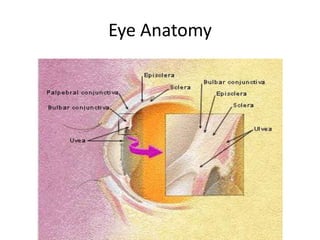
• Conjunctiva: thin, translucent, elastic tissue
layer with bulbar and palpebral portions
• Bulbar: lines the outer surface of the globe to
the limbus (junction of sclera and cornea)
• Palpebral: covers the inside of the eyelids
• Two layers: epithelium, substantia propria
Eye Anatomy
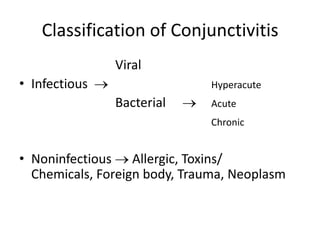
Classification of Conjunctivitis
Viral
• Infectious Hyperacute
Bacterial Acute
Chronic
• Noninfectious Allergic, Toxins/
Chemicals, Foreign body, Trauma, Neoplasm
Etiological classification
• 1. Infective conjunctivitis:
bacterial, chlamydial, viral,fungal, rickettsial, spiro
chaetal, protozoal, parasitic etc.
• 2. Allergic conjunctivitis.
• 3. Irritative conjunctivitis.
• 4. Keratoconjunctivitis associated with diseases of
skin and mucous membrane.
• 5. Traumatic conjunctivitis.
• 6. Keratoconjunctivitis of unknown etiology.
eg: Trachoma..
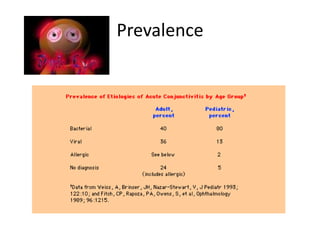
Prevalence
Viral Conjunctivitis
• Most common viral cause is adenovirus (enterovirus,
HSV)
• Occurs in community epidemics (schools,
workplaces, physicians’ offices)
• Usual modes of transmission: contaminated fingers,
medical instruments, swimming pool water
Viral infections of conjunctiva include:
• Adenovirus conjunctivitis
• Herpes simplex keratoconjunctivitis
• Herpes zoster conjunctivitis
• Pox virus conjunctivitis
• Myxovirus conjunctivitis
• Paramyxovirus conjunctivitis
• ARBOR virus (ARthropod-BOrne virus)
conjunctivitis
Clinical presentations.
• Acute viral conjunctivitis may
present in three clinical forms:
• 1. Acute serous conjunctivitis
• 2. Acute haemorrhagic conjunctivitis
• 3. Acute follicular conjunctivitis
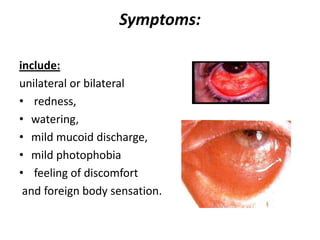
Symptoms:
include:
unilateral or bilateral
• redness,
• watering,
• mild mucoid discharge,
• mild photophobia
• feeling of discomfort
and foreign body sensation.
• May be part of viral prodrome:
• tender preauricular node
• adenopathy,
• fever,
• pharyngitis,
• cough,
• rhinorrhea
ACUTE SEROUS CONJUNCTIVITIS
• Etiology. It is typically caused by a mild grade viral
infection which does not give rise to follicular response.
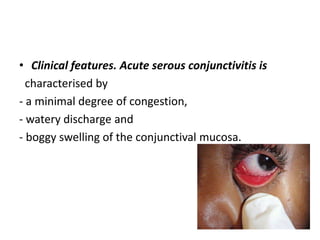
• Clinical features. Acute serous conjunctivitis is
characterised by
- a minimal degree of congestion,
- watery discharge and
- boggy swelling of the conjunctival mucosa.
• Treatment. Usually it is self-limiting and does not
need any treatment.
• But to avoid secondary bacterial infection,
--broad spectrum antibiotic eye drops may be used three
times a day for about 7 days.
ACUTE HAEMORRHAGIC CONJUNCTIVITIS
• It is an acute inflammation of conjunctiva
characterised by
• multiple conjunctival haemorrhages,
• conjunctival hyperaemia and
• mild follicular hyperplasia.
• Etiology. The disease is caused by picornaviruses
• Symptoms: include
• pain,
• redness,
• watering,
• mild photophobia
• transient blurring of vision and
• Lid swelling.
• Signs:
• conjunctival congestion,
• chemosis,
• multiple haemorrhages in bulbar conjunctiva,
• mild follicular hyperplasia,
• lid oedema and
• pre-auricular lymphadenopathy.
• Corneal involvement may occur in the form of
-fine epithelial keratitis.
Treatment
• very infectious and poses major potential problems of
cross-infection. Therefore,
• prophylactic measures are very important.
• No specific effective curative treatment is known.
However,
• broad spectrum antibiotic eye drops may be used to
prevent secondary bacterial infections.
• Usually the disease has a self-limiting course of 5-7
days.
FOLLICULAR CONJUNCTIVITIS
• Types
• 1. Acute follicular conjunctivitis.
• 2. Chronic follicular conjunctivitis.
• 3. Specific type of conjunctivitis with follicle formation
e.g., trachoma
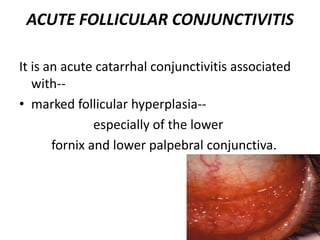
ACUTE FOLLICULAR CONJUNCTIVITIS
It is an acute catarrhal conjunctivitis associated
with--
• marked follicular hyperplasia--
especially of the lower
fornix and lower palpebral conjunctiva.
Symptoms
--- similar to acute catarrhal conjunctivitis
include:
• Burning and grittiness in the eyes, especially
in the evening.
• Feeling of heat and dryness on the lid
margins.
• Difficulty in keeping the eyes open.
• Feeling of sleepiness and tiredness in the eyes
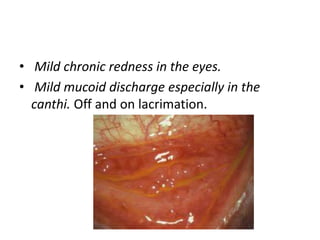
• Mild chronic redness in the eyes.
• Mild mucoid discharge especially in the
canthi. Off and on lacrimation.
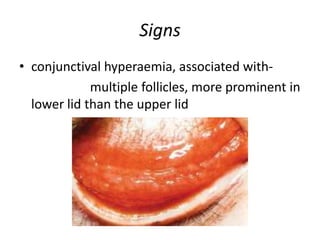
Signs
• conjunctival hyperaemia, associated with-
multiple follicles, more prominent in
lower lid than the upper lid
Treatment
• Primary herpetic infection is usually
selflimiting.
• The topical antiviral drugs control the
infection effectively and prevent recurrences
BACTERIAL CONJUNCTIVITIS
• Etiology:
- Predisposing factors
- Causative organisms
- Acording to Mode of infection
Pathology
Vascular response
Cellular response
Conjunctival tissue repsonse
Conjunctival discharge
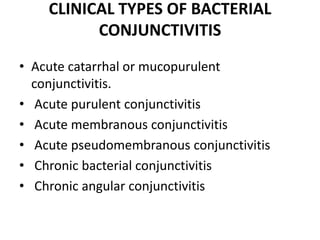
CLINICAL TYPES OF BACTERIAL
CONJUNCTIVITIS
• Acute catarrhal or mucopurulent
conjunctivitis.
• Acute purulent conjunctivitis
• Acute membranous conjunctivitis
• Acute pseudomembranous conjunctivitis
• Chronic bacterial conjunctivitis
• Chronic angular conjunctivitis
ACUTE MUCOPURULENT
CONJUNCTIVITIS
• Common causative bacteria are:
Staphylococcus aureus,
Koch-Weeks bacillus,
Pneumococcus and
Streptococcus.
Symptoms
• Discomfort and foreign body
• Mild photophobia.
• Mucopurulent discharge from the eyes.
• Sticking together of lid margins
• Slight blurring of vision due to mucous flakes
• may complain of coloured halos.
Signs
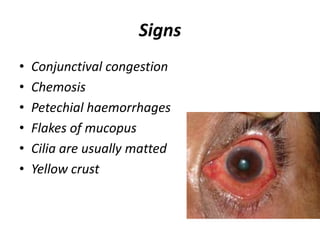
• Conjunctival congestion
• Chemosis
• Petechial haemorrhages
• Flakes of mucopus
• Cilia are usually matted
• Yellow crust
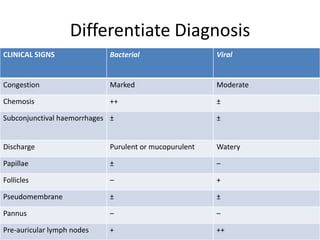
Differentiate Diagnosis
CLINICAL SIGNS Bacterial Viral
Congestion Marked Moderate
Chemosis ++ ±
Subconjunctival haemorrhages ± ±
Discharge Purulent or mucopurulent Watery
Papillae ± –
Follicles – +
Pseudomembrane ± ±
Pannus – –
Pre-auricular lymph nodes + ++
Complications
Occasionally the disease may be complicated
by
• marginal corneal ulcer,
• superficial keratitis,
• blepharitis or dacryocystitis
Treatment
• Topical antibiotics- broad specturm antibiotics
• Irrigation of conjunctival sac
• Dark goggles
• No steroids should be applied
• No bandage
• Anti-inflammatory and analgesic drugs
ACUTE PURULENT CONJUNCTIVITIS
Etiology:
-causative organism
Clinical picture:
1 Stage of infiltraton
2 Stage of blenorrhoea
3 Stage of slow healing
Stage of infiltraton
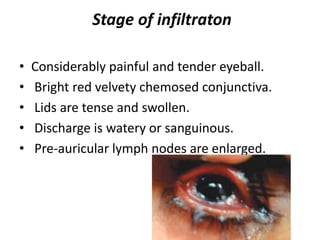
• Considerably painful and tender eyeball.
• Bright red velvety chemosed conjunctiva.
• Lids are tense and swollen.
• Discharge is watery or sanguinous.
• Pre-auricular lymph nodes are enlarged.
Stage of blenorrhoea
• Frankly purulent, copious, thick discharge
trickling down the cheeks.
• Other symptoms are increased but tension in
the lids is decreased
Complications
• 1. Corneal involvement
• 2. Iridocyclitis
• 3. Systemic complications—
- gonorrhoea arthritis
- endocarditis
- septicaemia
Treatment
• Systemic therapy:
• Norfloxacin 1.2 gm orally qid for 5 days
• Cefoxitim 1.0 gm or cefotaxime 500 mg. IV qid
• or ceftriaxone 1.0 gm IM qid, all for 5 days; or
• Spectinomycin 2.0 gm IM for 3 days
• Topical antibiotic therapy
• ofloxacin, ciprofloxacin or tobramycin eye drops
• bacitracin or
• erythromycin eye ointment
• Irrigation of the eyes
• Topical atropine 1 per cent
• Patient and the sexual partner should be
referred for evaluation of other sexually
transmitted diseases
OPHTHALMIA NEONATORUM
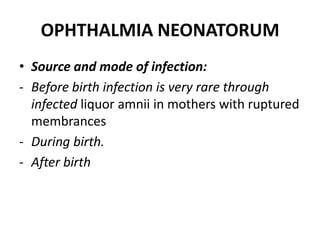
• Source and mode of infection:
- Before birth infection is very rare through
infected liquor amnii in mothers with ruptured
membrances
- During birth.
- After birth
Causative agents
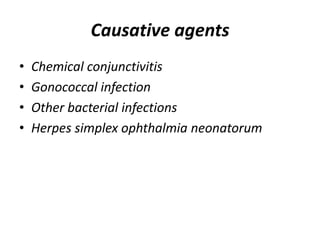
• Chemical conjunctivitis
• Gonococcal infection
• Other bacterial infections
• Herpes simplex ophthalmia neonatorum
Symptoms and signs
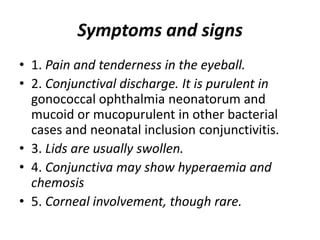
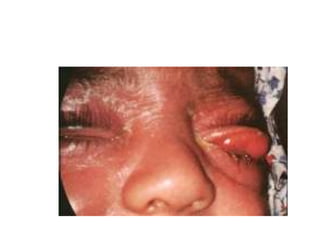
• 1. Pain and tenderness in the eyeball.
• 2. Conjunctival discharge. It is purulent in
gonococcal ophthalmia neonatorum and
mucoid or mucopurulent in other bacterial
cases and neonatal inclusion conjunctivitis.
• 3. Lids are usually swollen.
• 4. Conjunctiva may show hyperaemia and
chemosis
• 5. Corneal involvement, though rare.
Complications
• may develop corneal ulceration,
• Which may perforate rapidly resulting in
corneal opacification or staphyloma
formation.
Treatment
• A. Prophylaxis needs antenatal, natal and
postnatal care.
• Curative treatment:
• Chemical ophthalmia neonatorum is a self-
limiting condition, and does not require any
treatment.
• Topical therapy
- Saline lavage
-Bacitracin eye ointment 4 times/day
• However in cases with proved penicillin
susceptibility, penicillin drops 5000 to 10000
units per ml should be instilled every minute
for half an hour, every five minutes for next
half an hour and then half hourly till the
infection is controlled.
• Systemic therapy:
• Ceftriaxone 75-100 mg/kg/day IV or IM, QID.
• Cefotaxime 100-150 mg/kg/day IV or IM, 12
hourly.
• Ciprofloxacin 10-20 mg/kg/day or Norfloxacin
10 mg/kg/day.

Viral and bacterial conjunctivitis

  • 1.
    Viral & BacterialConjunctivitis Sourov Roy 3rd Batch, B.Optom, ICO,CU
  • 2.
    Definition • Conjunctivitis: inflammationof the conjunctiva • Conjunctiva: thin, translucent, elastic tissue layer with bulbar and palpebral portions • Bulbar: lines the outer surface of the globe to the limbus (junction of sclera and cornea) • Palpebral: covers the inside of the eyelids • Two layers: epithelium, substantia propria
  • 3.
  • 4.
    Classification of Conjunctivitis Viral •Infectious Hyperacute Bacterial Acute Chronic • Noninfectious Allergic, Toxins/ Chemicals, Foreign body, Trauma, Neoplasm
  • 5.
    Etiological classification • 1.Infective conjunctivitis: bacterial, chlamydial, viral,fungal, rickettsial, spiro chaetal, protozoal, parasitic etc. • 2. Allergic conjunctivitis. • 3. Irritative conjunctivitis. • 4. Keratoconjunctivitis associated with diseases of skin and mucous membrane. • 5. Traumatic conjunctivitis. • 6. Keratoconjunctivitis of unknown etiology. eg: Trachoma..
  • 6.
  • 7.
    Viral Conjunctivitis • Mostcommon viral cause is adenovirus (enterovirus, HSV) • Occurs in community epidemics (schools, workplaces, physicians’ offices) • Usual modes of transmission: contaminated fingers, medical instruments, swimming pool water
  • 8.
    Viral infections ofconjunctiva include: • Adenovirus conjunctivitis • Herpes simplex keratoconjunctivitis • Herpes zoster conjunctivitis • Pox virus conjunctivitis • Myxovirus conjunctivitis • Paramyxovirus conjunctivitis • ARBOR virus (ARthropod-BOrne virus) conjunctivitis
  • 9.
    Clinical presentations. • Acuteviral conjunctivitis may present in three clinical forms: • 1. Acute serous conjunctivitis • 2. Acute haemorrhagic conjunctivitis • 3. Acute follicular conjunctivitis
  • 10.
    Symptoms: include: unilateral or bilateral •redness, • watering, • mild mucoid discharge, • mild photophobia • feeling of discomfort and foreign body sensation.
  • 11.
    • May bepart of viral prodrome: • tender preauricular node • adenopathy, • fever, • pharyngitis, • cough, • rhinorrhea
  • 12.
    ACUTE SEROUS CONJUNCTIVITIS •Etiology. It is typically caused by a mild grade viral infection which does not give rise to follicular response.
  • 13.
    • Clinical features.Acute serous conjunctivitis is characterised by - a minimal degree of congestion, - watery discharge and - boggy swelling of the conjunctival mucosa.
  • 14.
    • Treatment. Usuallyit is self-limiting and does not need any treatment. • But to avoid secondary bacterial infection, --broad spectrum antibiotic eye drops may be used three times a day for about 7 days.
  • 15.
    ACUTE HAEMORRHAGIC CONJUNCTIVITIS •It is an acute inflammation of conjunctiva characterised by • multiple conjunctival haemorrhages, • conjunctival hyperaemia and • mild follicular hyperplasia.
  • 16.
    • Etiology. Thedisease is caused by picornaviruses
  • 17.
    • Symptoms: include •pain, • redness, • watering, • mild photophobia • transient blurring of vision and • Lid swelling.
  • 18.
    • Signs: • conjunctivalcongestion, • chemosis, • multiple haemorrhages in bulbar conjunctiva, • mild follicular hyperplasia, • lid oedema and • pre-auricular lymphadenopathy.
  • 19.
    • Corneal involvementmay occur in the form of -fine epithelial keratitis.
  • 20.
    Treatment • very infectiousand poses major potential problems of cross-infection. Therefore, • prophylactic measures are very important. • No specific effective curative treatment is known. However, • broad spectrum antibiotic eye drops may be used to prevent secondary bacterial infections. • Usually the disease has a self-limiting course of 5-7 days.
  • 21.
    FOLLICULAR CONJUNCTIVITIS • Types •1. Acute follicular conjunctivitis. • 2. Chronic follicular conjunctivitis. • 3. Specific type of conjunctivitis with follicle formation e.g., trachoma
  • 22.
    ACUTE FOLLICULAR CONJUNCTIVITIS Itis an acute catarrhal conjunctivitis associated with-- • marked follicular hyperplasia-- especially of the lower fornix and lower palpebral conjunctiva.
  • 23.
    Symptoms --- similar toacute catarrhal conjunctivitis include: • Burning and grittiness in the eyes, especially in the evening. • Feeling of heat and dryness on the lid margins. • Difficulty in keeping the eyes open. • Feeling of sleepiness and tiredness in the eyes
  • 24.
    • Mild chronicredness in the eyes. • Mild mucoid discharge especially in the canthi. Off and on lacrimation.
  • 25.
    Signs • conjunctival hyperaemia,associated with- multiple follicles, more prominent in lower lid than the upper lid
  • 26.
    Treatment • Primary herpeticinfection is usually selflimiting. • The topical antiviral drugs control the infection effectively and prevent recurrences
  • 27.
    BACTERIAL CONJUNCTIVITIS • Etiology: -Predisposing factors - Causative organisms - Acording to Mode of infection
  • 28.
    Pathology Vascular response Cellular response Conjunctivaltissue repsonse Conjunctival discharge
  • 29.
    CLINICAL TYPES OFBACTERIAL CONJUNCTIVITIS • Acute catarrhal or mucopurulent conjunctivitis. • Acute purulent conjunctivitis • Acute membranous conjunctivitis • Acute pseudomembranous conjunctivitis • Chronic bacterial conjunctivitis • Chronic angular conjunctivitis
  • 30.
    ACUTE MUCOPURULENT CONJUNCTIVITIS • Commoncausative bacteria are: Staphylococcus aureus, Koch-Weeks bacillus, Pneumococcus and Streptococcus.
  • 31.
    Symptoms • Discomfort andforeign body • Mild photophobia. • Mucopurulent discharge from the eyes. • Sticking together of lid margins • Slight blurring of vision due to mucous flakes • may complain of coloured halos.
  • 32.
    Signs • Conjunctival congestion •Chemosis • Petechial haemorrhages • Flakes of mucopus • Cilia are usually matted • Yellow crust
  • 33.
    Differentiate Diagnosis CLINICAL SIGNSBacterial Viral Congestion Marked Moderate Chemosis ++ ± Subconjunctival haemorrhages ± ± Discharge Purulent or mucopurulent Watery Papillae ± – Follicles – + Pseudomembrane ± ± Pannus – – Pre-auricular lymph nodes + ++
  • 34.
    Complications Occasionally the diseasemay be complicated by • marginal corneal ulcer, • superficial keratitis, • blepharitis or dacryocystitis
  • 35.
    Treatment • Topical antibiotics-broad specturm antibiotics • Irrigation of conjunctival sac • Dark goggles • No steroids should be applied • No bandage • Anti-inflammatory and analgesic drugs
  • 36.
    ACUTE PURULENT CONJUNCTIVITIS Etiology: -causativeorganism Clinical picture: 1 Stage of infiltraton 2 Stage of blenorrhoea 3 Stage of slow healing
  • 37.
    Stage of infiltraton •Considerably painful and tender eyeball. • Bright red velvety chemosed conjunctiva. • Lids are tense and swollen. • Discharge is watery or sanguinous. • Pre-auricular lymph nodes are enlarged.
  • 38.
    Stage of blenorrhoea •Frankly purulent, copious, thick discharge trickling down the cheeks. • Other symptoms are increased but tension in the lids is decreased
  • 39.
    Complications • 1. Cornealinvolvement • 2. Iridocyclitis • 3. Systemic complications— - gonorrhoea arthritis - endocarditis - septicaemia
  • 40.
    Treatment • Systemic therapy: •Norfloxacin 1.2 gm orally qid for 5 days • Cefoxitim 1.0 gm or cefotaxime 500 mg. IV qid • or ceftriaxone 1.0 gm IM qid, all for 5 days; or • Spectinomycin 2.0 gm IM for 3 days • Topical antibiotic therapy • ofloxacin, ciprofloxacin or tobramycin eye drops • bacitracin or • erythromycin eye ointment
  • 41.
    • Irrigation ofthe eyes • Topical atropine 1 per cent • Patient and the sexual partner should be referred for evaluation of other sexually transmitted diseases
  • 42.
    OPHTHALMIA NEONATORUM • Sourceand mode of infection: - Before birth infection is very rare through infected liquor amnii in mothers with ruptured membrances - During birth. - After birth
  • 43.
    Causative agents • Chemicalconjunctivitis • Gonococcal infection • Other bacterial infections • Herpes simplex ophthalmia neonatorum
  • 44.
    Symptoms and signs •1. Pain and tenderness in the eyeball. • 2. Conjunctival discharge. It is purulent in gonococcal ophthalmia neonatorum and mucoid or mucopurulent in other bacterial cases and neonatal inclusion conjunctivitis. • 3. Lids are usually swollen. • 4. Conjunctiva may show hyperaemia and chemosis • 5. Corneal involvement, though rare.
  • 46.
    Complications • may developcorneal ulceration, • Which may perforate rapidly resulting in corneal opacification or staphyloma formation.
  • 47.
    Treatment • A. Prophylaxisneeds antenatal, natal and postnatal care. • Curative treatment: • Chemical ophthalmia neonatorum is a self- limiting condition, and does not require any treatment.
  • 48.
    • Topical therapy -Saline lavage -Bacitracin eye ointment 4 times/day • However in cases with proved penicillin susceptibility, penicillin drops 5000 to 10000 units per ml should be instilled every minute for half an hour, every five minutes for next half an hour and then half hourly till the infection is controlled.
  • 49.
    • Systemic therapy: •Ceftriaxone 75-100 mg/kg/day IV or IM, QID. • Cefotaxime 100-150 mg/kg/day IV or IM, 12 hourly. • Ciprofloxacin 10-20 mg/kg/day or Norfloxacin 10 mg/kg/day.