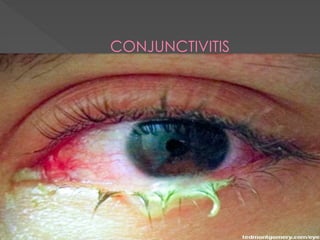
CONJUNCTIVITIS
Definition
 Conjunctivitis: inflammation of the
conjunctiva
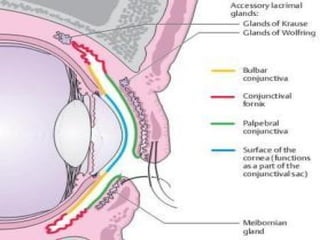
 Conjunctiva: thin, translucent, elastic tissue
layer with bulbar and palpebral portions
 Bulbar: lines the outer surface of the globe
to the limbus (junction of sclera and cornea)
 Palpebral: covers the inside of the eyelids
 Fornices: where bulbar meets palpebral.
Classification of Conjunctivitis
Viral
 Infectious Bacterial
 Noninfectious 
 Allergic, Toxins/ Chemicals, Foreign
body, Trauma,
Viral Conjunctivitis
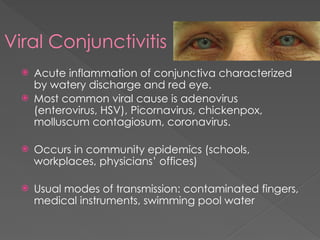
 Acute inflammation of conjunctiva characterized
by watery discharge and red eye.
 Most common viral cause is adenovirus
(enterovirus, HSV), Picornavirus, chickenpox,
molluscum contagiosum, coronavirus.
 Occurs in community epidemics (schools,
workplaces, physicians’ offices)
 Usual modes of transmission: contaminated fingers,
medical instruments, swimming pool water
• Viral conjunctivitis is highly contagious, usually for 10-12
days from onset as long as the eyes are red.
• Patients should avoid touching their eyes, shaking hands,
and sharing towels, among other activities.
• Transmission may occur through accidental inoculation of
viral particles from the patient's hands or by contact with
infected upper respiratory droplets, fomites (clothing,
bedding), or contaminated swimming pools.
• The infection usually resolves spontaneously within 2-4
weeks.
Viral Conjunctivitis
 Presentation: unilateral or bilateral, acutely red
eye, watery or mucoserous discharge, chemosis,
tender preauricular node, follicles, burning/
sanding/gritty feeling in eye(s), rarely
photophobia
 May be part of: lymph adenopathy (refers
to lymph nodes which are abnormal in size,
number or consistency and for swollen or
enlarged lymph nodes). Patient may also have,
fever, pharyngitis, cough, rhinorrhea (runny nose)
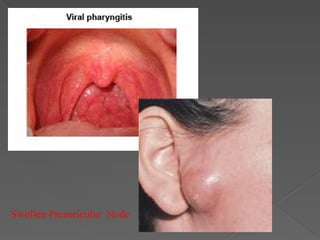
Swollen Preauricular Node
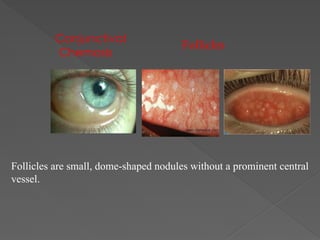
Conjunctival
Chemosis
Follicles
Follicles are small, dome-shaped nodules without a prominent central
vessel.
Typical appearance of Viral Conjunctivitis
Complications
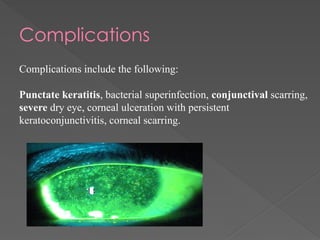
Complications include the following:
Punctate keratitis, bacterial superinfection, conjunctival scarring,
severe dry eye, corneal ulceration with persistent
keratoconjunctivitis, corneal scarring.
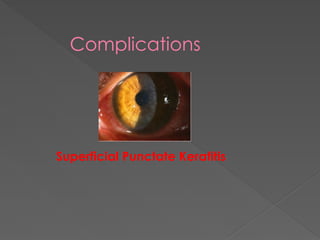
Complications
Superficial Punctate Keratitis
Molluscum contagiosum
 MC is common
infection of skin
 Poxvirus
 The viral particle are
released from eyelid
lesion into the tear
film that cause
follicular
conjunctivitis
 Clinical FEATURES
MANAGEMNT
 Shave excision
 Cryotherapy
 Cauterization
Treatment of Viral
Conjunctivitis
 Topical antibiotics necessary if secondary
bacterial infection occurs.
 Reassurance that the symptoms may get
worse for 3-5d before getting better and
persist for 2-3 weeks
 Some relief from cold compresses and
topical antihistamines/decongestants
 Do not use topical corticosteroids due to risk
of sight-threatening complications (scarring,
corneal melting, perforation), especially if
etiology is herpes simplex virus
Acute Bacterial Conjunctivitis
 Common causes in neonates (ophthalmia
neonatorum): Chlamydia trachomatis, Neisseria
gonorrhoeae
 In children: Haemophilus influenzae,
Streptococcus pneumoniae
 In adults: Staphylococcus aureus
Ophthalmia Neonatorum Bacterial Conjunctivitis in Children
Severe Bacterial
Conjunctivitis
Acute Bacterial Conjunctivitis
 Presentation: Unilateral or bilateral, red eye,
mucopurulent or purulent discharge
continuously throughout the day, burning,
irritation, mild chemosis
 Neonates: symptoms appear 5-14days after
birth (inclusion conjunctivitis of the newborn)
 Highly contagious: spread by direct contact or
by contaminated objects
Signs and Symptoms
 Follicles on the inflamed conjunctiva
 Discharge: More purulent than in viral conjunctivitis, with more
mattering (generally white or yellow mucous discharge [green in
some cases]) of the eyelid margins and greater associated
difficulty opening the eyelids following sleep; patients waking up
with their eyes “glued” shut.
 Enlarged preauricular lymph node: Unusual in bacterial
conjunctivitis but found in severe conjunctivitis caused by N
gonorrhoeae
 Eyelid edema: Often present in bacterial conjunctivitis, but mild
in most cases; severe eyelid edema in the presence of purulent
discharge raises the suspicion of N gonorrhoeae infection
Eyelid Oedema Follicles
Chronic Bacterial
Conjunctivitis
 Most common etiology: Staphylococcus species
 More common in adults and patients with acne
rosacea or facial seborrhea
 Presentation varies: redness, itching, burning,
foreign-body sensation, flaky debris, blepharitis
(common), eyelash loss
 Concurrently seen styes and chalazia of the lid
margin from chronic inflammation of the
meibomian glands.
Acne Rosacea Seborrhoea
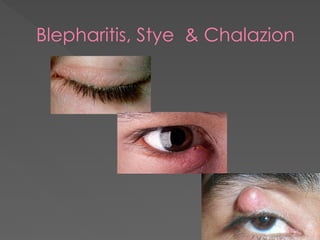
Blepharitis, Stye & Chalazion
Membranous conjunctivitis
 Acute inflammation of the conjunctiva,
and membrane formation on the
conjunctiva.
 Cause: corynebacterium diphtheria.
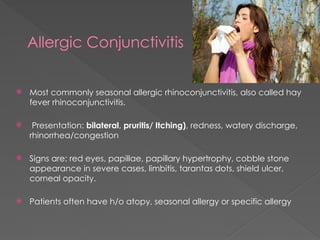
Allergic Conjunctivitis
 Most commonly seasonal allergic rhinoconjunctivitis, also called hay
fever rhinoconjunctivitis.
 Presentation: bilateral, pruritis/ Itching), redness, watery discharge,
rhinorrhea/congestion
 Signs are: red eyes, papillae, papillary hypertrophy, cobble stone
appearance in severe cases, limbitis, tarantas dots, shield ulcer,
corneal opacity.
 Patients often have h/o atopy, seasonal allergy or specific allergy
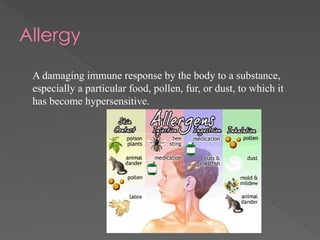
Allergy
A damaging immune response by the body to a substance,
especially a particular food, pollen, fur, or dust, to which it
has become hypersensitive.
Allergic Conjunctivits
Limbal signs include thickening and opacification of the limbal
conjunctiva as well as gelatinous appearing and sometime confluent
limbal papillae. Peri-limbal Horner-Trantas dots are focal white
limbal dots consisting of degenerated epithelial cells and eosinophils
Discharge
Discharge Associated with Conjunctivitis
Etiology Serous Mucoid Mucopurulent Purulent
Viral
Chlamydial
Bacterial
Allergic
Toxic
+
-
-
+
+
-
+
-
+
+
-
+
+
-
+
-
-
+
-
-
+=Present; ­=absent.
Adapted with permission from Jackson WB. Differentiating conjunctivitis of diverse origins. Surv Ophthalmol
1993;38(Suppl):91-104
“Pink Eye” Differential
Cultures
 Not necessary for initial diagnosis and
therapy of acute conjunctivitis
 When to culture:
1. Neonates
2. Hyperacute purulent conjunctivitis
(immediate Gram staining)
3. Chronic or recurrent conjunctivitis
Treatment
 Viral, allergic, and nonspecific
conjunctivitis are self-limited
 Bacterial conjunctivitis is also likely to be
self-limited but treatment shortens the
course, reduces person-to-person
spread, and lowers the risk of sight-
threatening complications
Treatment of Bacterial
Conjunctivitis
 Most bacterial conjunctivitis are self-limiting, although topical antibiotics are
recommended because they can shorten the duration of the disease and
prevent the spread of infection.
 Broad-spectrum antibiotics are generally used empirically as first-line therapy
for bacterial conjunctivitis. Topical as opposed to oral antibiotics is
recommended to deliver high levels of the drug directly to the site of
infection, exceeding what is normally achieved in body tissues by oral routes.
Therefore, the antibiotic spectrum of the individual drug is enhanced.
 For severe conjunctivitis marked by purulent discharge and eye
inflammation, cultures are needed to guide the choice of antibiotic. Fortified
antibiotics such as combination aminoglycosides and cephalosporins have a
similar efficacy profile to fluoroquinolones. Resistance to early-generation
fluoroquinolones, however, has been increasing. Oral antibiotics are
recommended for gonococcal and chlamydial infections.
Treatment of Allergic
Conjunctivitis
 Self-limited
 Allergen avoidance, cold compresses,
topical antihistamines/vasoconstrictors
(do not use for greater than 2 weeks),
artificial tears, topical NSAIDS (low
efficacy).
 Prophylaxis (prevention): oral
antihistamines (onset of action=days),
mast cell stabilizers (onset of action=5-14d)

Conjunctivitis.pptx . . . . . . . . . . . .

  • 1.
  • 2.
    Definition  Conjunctivitis: inflammationof the conjunctiva  Conjunctiva: thin, translucent, elastic tissue layer with bulbar and palpebral portions  Bulbar: lines the outer surface of the globe to the limbus (junction of sclera and cornea)  Palpebral: covers the inside of the eyelids  Fornices: where bulbar meets palpebral.
  • 5.
    Classification of Conjunctivitis Viral Infectious Bacterial  Noninfectious   Allergic, Toxins/ Chemicals, Foreign body, Trauma,
  • 6.
    Viral Conjunctivitis  Acuteinflammation of conjunctiva characterized by watery discharge and red eye.  Most common viral cause is adenovirus (enterovirus, HSV), Picornavirus, chickenpox, molluscum contagiosum, coronavirus.  Occurs in community epidemics (schools, workplaces, physicians’ offices)  Usual modes of transmission: contaminated fingers, medical instruments, swimming pool water
  • 7.
    • Viral conjunctivitisis highly contagious, usually for 10-12 days from onset as long as the eyes are red. • Patients should avoid touching their eyes, shaking hands, and sharing towels, among other activities. • Transmission may occur through accidental inoculation of viral particles from the patient's hands or by contact with infected upper respiratory droplets, fomites (clothing, bedding), or contaminated swimming pools. • The infection usually resolves spontaneously within 2-4 weeks.
  • 9.
    Viral Conjunctivitis  Presentation:unilateral or bilateral, acutely red eye, watery or mucoserous discharge, chemosis, tender preauricular node, follicles, burning/ sanding/gritty feeling in eye(s), rarely photophobia  May be part of: lymph adenopathy (refers to lymph nodes which are abnormal in size, number or consistency and for swollen or enlarged lymph nodes). Patient may also have, fever, pharyngitis, cough, rhinorrhea (runny nose)
  • 10.
  • 11.
    Conjunctival Chemosis Follicles Follicles are small,dome-shaped nodules without a prominent central vessel.
  • 12.
    Typical appearance ofViral Conjunctivitis
  • 13.
    Complications Complications include thefollowing: Punctate keratitis, bacterial superinfection, conjunctival scarring, severe dry eye, corneal ulceration with persistent keratoconjunctivitis, corneal scarring.
  • 14.
  • 15.
    Molluscum contagiosum  MCis common infection of skin  Poxvirus  The viral particle are released from eyelid lesion into the tear film that cause follicular conjunctivitis  Clinical FEATURES
  • 16.
    MANAGEMNT  Shave excision Cryotherapy  Cauterization
  • 17.
    Treatment of Viral Conjunctivitis Topical antibiotics necessary if secondary bacterial infection occurs.  Reassurance that the symptoms may get worse for 3-5d before getting better and persist for 2-3 weeks  Some relief from cold compresses and topical antihistamines/decongestants  Do not use topical corticosteroids due to risk of sight-threatening complications (scarring, corneal melting, perforation), especially if etiology is herpes simplex virus
  • 18.
    Acute Bacterial Conjunctivitis Common causes in neonates (ophthalmia neonatorum): Chlamydia trachomatis, Neisseria gonorrhoeae  In children: Haemophilus influenzae, Streptococcus pneumoniae  In adults: Staphylococcus aureus
  • 19.
    Ophthalmia Neonatorum BacterialConjunctivitis in Children Severe Bacterial Conjunctivitis
  • 20.
    Acute Bacterial Conjunctivitis Presentation: Unilateral or bilateral, red eye, mucopurulent or purulent discharge continuously throughout the day, burning, irritation, mild chemosis  Neonates: symptoms appear 5-14days after birth (inclusion conjunctivitis of the newborn)  Highly contagious: spread by direct contact or by contaminated objects
  • 21.
    Signs and Symptoms Follicles on the inflamed conjunctiva  Discharge: More purulent than in viral conjunctivitis, with more mattering (generally white or yellow mucous discharge [green in some cases]) of the eyelid margins and greater associated difficulty opening the eyelids following sleep; patients waking up with their eyes “glued” shut.  Enlarged preauricular lymph node: Unusual in bacterial conjunctivitis but found in severe conjunctivitis caused by N gonorrhoeae  Eyelid edema: Often present in bacterial conjunctivitis, but mild in most cases; severe eyelid edema in the presence of purulent discharge raises the suspicion of N gonorrhoeae infection
  • 22.
  • 23.
    Chronic Bacterial Conjunctivitis  Mostcommon etiology: Staphylococcus species  More common in adults and patients with acne rosacea or facial seborrhea  Presentation varies: redness, itching, burning, foreign-body sensation, flaky debris, blepharitis (common), eyelash loss  Concurrently seen styes and chalazia of the lid margin from chronic inflammation of the meibomian glands.
  • 24.
  • 25.
  • 26.
    Membranous conjunctivitis  Acuteinflammation of the conjunctiva, and membrane formation on the conjunctiva.  Cause: corynebacterium diphtheria.
  • 27.
    Allergic Conjunctivitis  Mostcommonly seasonal allergic rhinoconjunctivitis, also called hay fever rhinoconjunctivitis.  Presentation: bilateral, pruritis/ Itching), redness, watery discharge, rhinorrhea/congestion  Signs are: red eyes, papillae, papillary hypertrophy, cobble stone appearance in severe cases, limbitis, tarantas dots, shield ulcer, corneal opacity.  Patients often have h/o atopy, seasonal allergy or specific allergy
  • 28.
    Allergy A damaging immuneresponse by the body to a substance, especially a particular food, pollen, fur, or dust, to which it has become hypersensitive.
  • 29.
  • 32.
    Limbal signs includethickening and opacification of the limbal conjunctiva as well as gelatinous appearing and sometime confluent limbal papillae. Peri-limbal Horner-Trantas dots are focal white limbal dots consisting of degenerated epithelial cells and eosinophils
  • 33.
    Discharge Discharge Associated withConjunctivitis Etiology Serous Mucoid Mucopurulent Purulent Viral Chlamydial Bacterial Allergic Toxic + - - + + - + - + + - + + - + - - + - - +=Present; ­=absent. Adapted with permission from Jackson WB. Differentiating conjunctivitis of diverse origins. Surv Ophthalmol 1993;38(Suppl):91-104
  • 34.
  • 35.
    Cultures  Not necessaryfor initial diagnosis and therapy of acute conjunctivitis  When to culture: 1. Neonates 2. Hyperacute purulent conjunctivitis (immediate Gram staining) 3. Chronic or recurrent conjunctivitis
  • 36.
    Treatment  Viral, allergic,and nonspecific conjunctivitis are self-limited  Bacterial conjunctivitis is also likely to be self-limited but treatment shortens the course, reduces person-to-person spread, and lowers the risk of sight- threatening complications
  • 37.
    Treatment of Bacterial Conjunctivitis Most bacterial conjunctivitis are self-limiting, although topical antibiotics are recommended because they can shorten the duration of the disease and prevent the spread of infection.  Broad-spectrum antibiotics are generally used empirically as first-line therapy for bacterial conjunctivitis. Topical as opposed to oral antibiotics is recommended to deliver high levels of the drug directly to the site of infection, exceeding what is normally achieved in body tissues by oral routes. Therefore, the antibiotic spectrum of the individual drug is enhanced.  For severe conjunctivitis marked by purulent discharge and eye inflammation, cultures are needed to guide the choice of antibiotic. Fortified antibiotics such as combination aminoglycosides and cephalosporins have a similar efficacy profile to fluoroquinolones. Resistance to early-generation fluoroquinolones, however, has been increasing. Oral antibiotics are recommended for gonococcal and chlamydial infections.
  • 38.
    Treatment of Allergic Conjunctivitis Self-limited  Allergen avoidance, cold compresses, topical antihistamines/vasoconstrictors (do not use for greater than 2 weeks), artificial tears, topical NSAIDS (low efficacy).  Prophylaxis (prevention): oral antihistamines (onset of action=days), mast cell stabilizers (onset of action=5-14d)