Confrontation fields test
By
Dr. Alshymaa Moustafa
Ophthalmology specialist
Visualfield
 It contains :
1. Centeral or foveal which is measured by visual acuity
test, contrast senstivity and macular function tests
.and concerned with Resolution, forms.
2. Peripheral or Extrafoveal which is concerned with
Peripheral sensitivity , motion and light detection.
 Normal visual field is reversed inverted map of
corresponding retinal points .
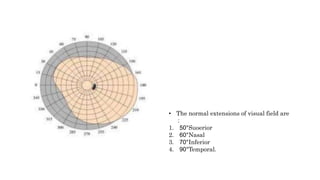
• The normal extensions of visual field are
:
1. °
50 Suoerior
2. °
60 Nasal
3. °
70 Inferior
4. °
90 Temporal.
Perimetery
 It is making of visual field using stimulus.
 The stimulus may be
1. Moving (kinetic) determine the visual threshold
along edge of visual field.
2. Static in which the static object has different level of
brightness.
Confrontation
fieldstest
 It is used as screening for moderate to sever visual
field defects.
 It is un reliable to identify Mild visual field defects.
 Note
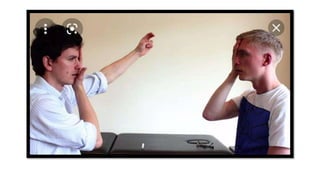
1. Face to face position.
2. Start with better eye.
3. Avoid confusion by using 1,2,5 fingers.
4. If the patient can’t count fingers, use hand motion , if
can’t use light projection.
5. Young child use finger mimicking procedure.
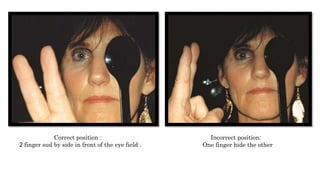
Correct position :
2 finger sud by side in front of the eye field .
Incorrect position:
One finger hide the other
Clinical protocol
Test steps:
Teststeps
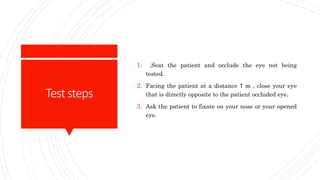
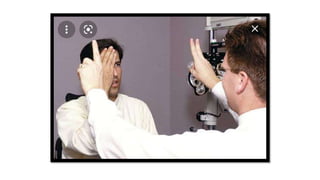
1. .Seat the patient and occlude the eye not being
tested.
2. Facing the patient at a distance 1 m , close your eye
that is directly opposite to the patient occluded eye.
3. Ask the patient to fixate on your nose or your opened
eye.
Checkfor
scotoma
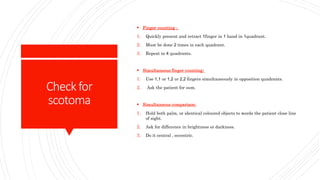
 Finger counting :
1. Quickly present and retract 1finger in 1 hand in 1quadrant.
2. Must be done 2 times in each quadrant.
3. Repeat in 4 quadrants.
 Simultaneous finger counting;
1. Use 1,1 or 1,2 or 2,2 fingers simultaneously in opposition quadrants.
2. Ask the patient for sum.
 Simultaneous comparison:
1. Hold both palm, or identical coloured objects to words the patient close line
of sight.
2. Ask for difference in brightness or darkness.
3. Do it central , eccentric.
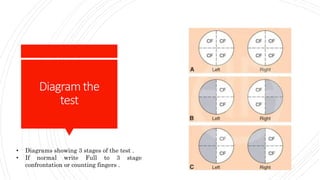
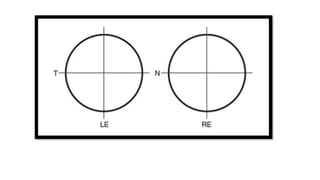
Diagramthe
test
• Diagrams showing 3 stages of the test .
• If normal write Full to 3 stage
confrontation or counting fingers .
Thanks

Confrontation test

  • 1.
    Confrontation fields test By Dr.Alshymaa Moustafa Ophthalmology specialist
  • 2.
    Visualfield  It contains: 1. Centeral or foveal which is measured by visual acuity test, contrast senstivity and macular function tests .and concerned with Resolution, forms. 2. Peripheral or Extrafoveal which is concerned with Peripheral sensitivity , motion and light detection.  Normal visual field is reversed inverted map of corresponding retinal points .
  • 3.
    • The normalextensions of visual field are : 1. ° 50 Suoerior 2. ° 60 Nasal 3. ° 70 Inferior 4. ° 90 Temporal.
  • 4.
    Perimetery  It ismaking of visual field using stimulus.  The stimulus may be 1. Moving (kinetic) determine the visual threshold along edge of visual field. 2. Static in which the static object has different level of brightness.
  • 5.
    Confrontation fieldstest  It isused as screening for moderate to sever visual field defects.  It is un reliable to identify Mild visual field defects.  Note 1. Face to face position. 2. Start with better eye. 3. Avoid confusion by using 1,2,5 fingers. 4. If the patient can’t count fingers, use hand motion , if can’t use light projection. 5. Young child use finger mimicking procedure.
  • 6.
    Correct position : 2finger sud by side in front of the eye field . Incorrect position: One finger hide the other
  • 7.
  • 8.
    Teststeps 1. .Seat thepatient and occlude the eye not being tested. 2. Facing the patient at a distance 1 m , close your eye that is directly opposite to the patient occluded eye. 3. Ask the patient to fixate on your nose or your opened eye.
  • 9.
    Checkfor scotoma  Finger counting: 1. Quickly present and retract 1finger in 1 hand in 1quadrant. 2. Must be done 2 times in each quadrant. 3. Repeat in 4 quadrants.  Simultaneous finger counting; 1. Use 1,1 or 1,2 or 2,2 fingers simultaneously in opposition quadrants. 2. Ask the patient for sum.  Simultaneous comparison: 1. Hold both palm, or identical coloured objects to words the patient close line of sight. 2. Ask for difference in brightness or darkness. 3. Do it central , eccentric.
  • 13.
    Diagramthe test • Diagrams showing3 stages of the test . • If normal write Full to 3 stage confrontation or counting fingers .
  • 15.