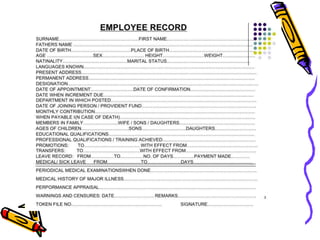
Records
• Record means preservation of
information in files and documents.
• A record is a piece of writing or a
chart which provides ready
information and which preserves
evidence for future reference or use.
• Records are generally prepared from
reports and they are meant for long-
term use.
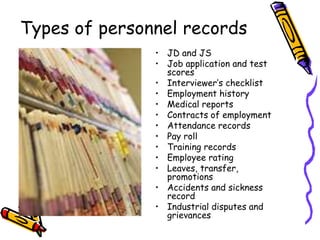
Types of personnel records
• JD and JS
• Job application and test
scores
• Interviewer’s checklist
• Employment history
• Medical reports
• Contracts of employment
• Attendance records
• Pay roll
• Training records
• Employee rating
• Leaves, transfer,
promotions
• Accidents and sickness
record
• Industrial disputes and
grievances
Purpose of record keeping
• To keep an orderly account
of progress
• To enable the making of
comparison
• To facilitate the detection
of errors and frauds
• To meet legal requirements
• To supply information
required for taking
personnel decisions
• To provide a basis for the
formulation, evaluation and
modification of personnel
policies and programme
Significance of
Personnel Records
• Personnel records and reports help
management in obtaining the requisite
information regarding the use of
human resources in various
departments or divisions.
• Personnel records play a significant
role in performing various personnel
functions including audit and research.
• They are specially needed to:
i. supply the information required by the
management and trade unions to
review the effectiveness of personnel
policies and practices and develop
them.
ii. supply the information required by
various agencies on the accidents,
employment position, strikes,
absenteeism, turnover, etc.
iii. provide the information about
manpower inventory for manpower
planning and succession planning.
iv. Conduct research in personnel and
industrial relations areas.
v. Identify training and development
needs.
vi. Revise pay scales and benefits
from time to time.
Essentials of a good
record
1. Simple: Record-keeping must be
simple. It should, at the same time,
meet the requirements of the
organisation.
2. Accurate: Records should be error-
free. They must be built around
facts as far as possible.
3. Economical: It should not cost a
fortune to maintain records. The cost
of maintaining records must not be
high.
4. Useful: Records must provide
information which could be put to use.
They must facilitate managerial
decision making. To this end they must
be reviewed and kept up-to-date.
Reports
• Personnel report is a statement
describing an event, situation and
happening in a clear manner.
• It provides both qualitative and
quantitative information as to what
happened and what is happening.
Essentials of a good
report
1. Conformity: Reports must conform
to organisational objectives.
2. Unbiased: Reports must be
objective and prepared without
prejudice or bias. They must be built
around facts as far as possible.
3. Data based: Reports must be
built around facts. They must not
only present facts but interpret
them in a meaningful manner.
4. Clarity and Simplicity: The report
must be clearly worded so that
people could use it easily. To make
it simple, some illustrative points
could also be used.
• 5. Timely: Reports must be submitted
keeping the time limits in mind. So
that proper action may be taken on it.
Personnel Audits
• It involved examination and
verification of accounts and
records
• It involves a formal,
systematic and in-depth
analysis, investigation and
comparison of personnel
policies and procedures.
Objectives of Personnel
Audit
1. To review the whole organisational
system of human resource practices,
i.e., acquiring, developing, allocating
and utilizing human resources in the
organisation.
2. To evaluate the effectiveness of
various personnel policies and
practices.
• 3.
3. To identify shortcomings in the
implementation of human resource
practices in the organisation.
4. To modify the existing human
resource practices to meet the
challenges of personnel/human
resource management.
Importance of Personnel
Audit
• Essential for Organization success.
• It Provides Required Feedback.
• Managing Rising Labor Costs.
• Increasing Opportunities
for Competitive Advantage of HRM.
• It can avoid Government intervention
• It protects Employees interests

Personnel Records.ppt

  • 2.
    Records • Record meanspreservation of information in files and documents. • A record is a piece of writing or a chart which provides ready information and which preserves evidence for future reference or use. • Records are generally prepared from reports and they are meant for long- term use.
  • 3.
    Types of personnelrecords • JD and JS • Job application and test scores • Interviewer’s checklist • Employment history • Medical reports • Contracts of employment • Attendance records • Pay roll • Training records • Employee rating • Leaves, transfer, promotions • Accidents and sickness record • Industrial disputes and grievances
  • 4.
    Purpose of recordkeeping • To keep an orderly account of progress • To enable the making of comparison • To facilitate the detection of errors and frauds • To meet legal requirements • To supply information required for taking personnel decisions • To provide a basis for the formulation, evaluation and modification of personnel policies and programme
  • 6.
    Significance of Personnel Records •Personnel records and reports help management in obtaining the requisite information regarding the use of human resources in various departments or divisions.
  • 7.
    • Personnel recordsplay a significant role in performing various personnel functions including audit and research. • They are specially needed to: i. supply the information required by the management and trade unions to review the effectiveness of personnel policies and practices and develop them.
  • 8.
    ii. supply theinformation required by various agencies on the accidents, employment position, strikes, absenteeism, turnover, etc. iii. provide the information about manpower inventory for manpower planning and succession planning.
  • 9.
    iv. Conduct researchin personnel and industrial relations areas. v. Identify training and development needs. vi. Revise pay scales and benefits from time to time.
  • 10.
    Essentials of agood record 1. Simple: Record-keeping must be simple. It should, at the same time, meet the requirements of the organisation. 2. Accurate: Records should be error- free. They must be built around facts as far as possible.
  • 11.
    3. Economical: Itshould not cost a fortune to maintain records. The cost of maintaining records must not be high. 4. Useful: Records must provide information which could be put to use. They must facilitate managerial decision making. To this end they must be reviewed and kept up-to-date.
  • 12.
    Reports • Personnel reportis a statement describing an event, situation and happening in a clear manner. • It provides both qualitative and quantitative information as to what happened and what is happening.
  • 13.
    Essentials of agood report 1. Conformity: Reports must conform to organisational objectives. 2. Unbiased: Reports must be objective and prepared without prejudice or bias. They must be built around facts as far as possible.
  • 14.
    3. Data based:Reports must be built around facts. They must not only present facts but interpret them in a meaningful manner. 4. Clarity and Simplicity: The report must be clearly worded so that people could use it easily. To make it simple, some illustrative points could also be used.
  • 15.
    • 5. Timely:Reports must be submitted keeping the time limits in mind. So that proper action may be taken on it.
  • 16.
    Personnel Audits • Itinvolved examination and verification of accounts and records • It involves a formal, systematic and in-depth analysis, investigation and comparison of personnel policies and procedures.
  • 17.
    Objectives of Personnel Audit 1.To review the whole organisational system of human resource practices, i.e., acquiring, developing, allocating and utilizing human resources in the organisation. 2. To evaluate the effectiveness of various personnel policies and practices. • 3.
  • 18.
    3. To identifyshortcomings in the implementation of human resource practices in the organisation. 4. To modify the existing human resource practices to meet the challenges of personnel/human resource management.
  • 19.
    Importance of Personnel Audit •Essential for Organization success. • It Provides Required Feedback. • Managing Rising Labor Costs. • Increasing Opportunities for Competitive Advantage of HRM. • It can avoid Government intervention • It protects Employees interests