Decision
Making
In an organization decisions are routinely taken in operations,
marketing, maintenance, R & D, transportation, finance, human
resource etc.
Decision making is the cognitive process leading to the
selection of a course of action among alternatives.
Every decision making process produces a final choice. It can
be an action or an opinion.
Prakhyath Rai, Asst. Professor, Department of ISE, SCEM, Mangaluru-575007 1
Characteristics of
Decision Making
Prakhyath Rai, Asst. Professor, Department of ISE, SCEM, Mangaluru-575007 2
 Decision making is goal oriented
 Decision making involves alternatives
 Decision making is an analytical intellectual process
 Decision making is a continuous activity
 Decision making is an all pervasive function
 Decision making is situational and dynamic.
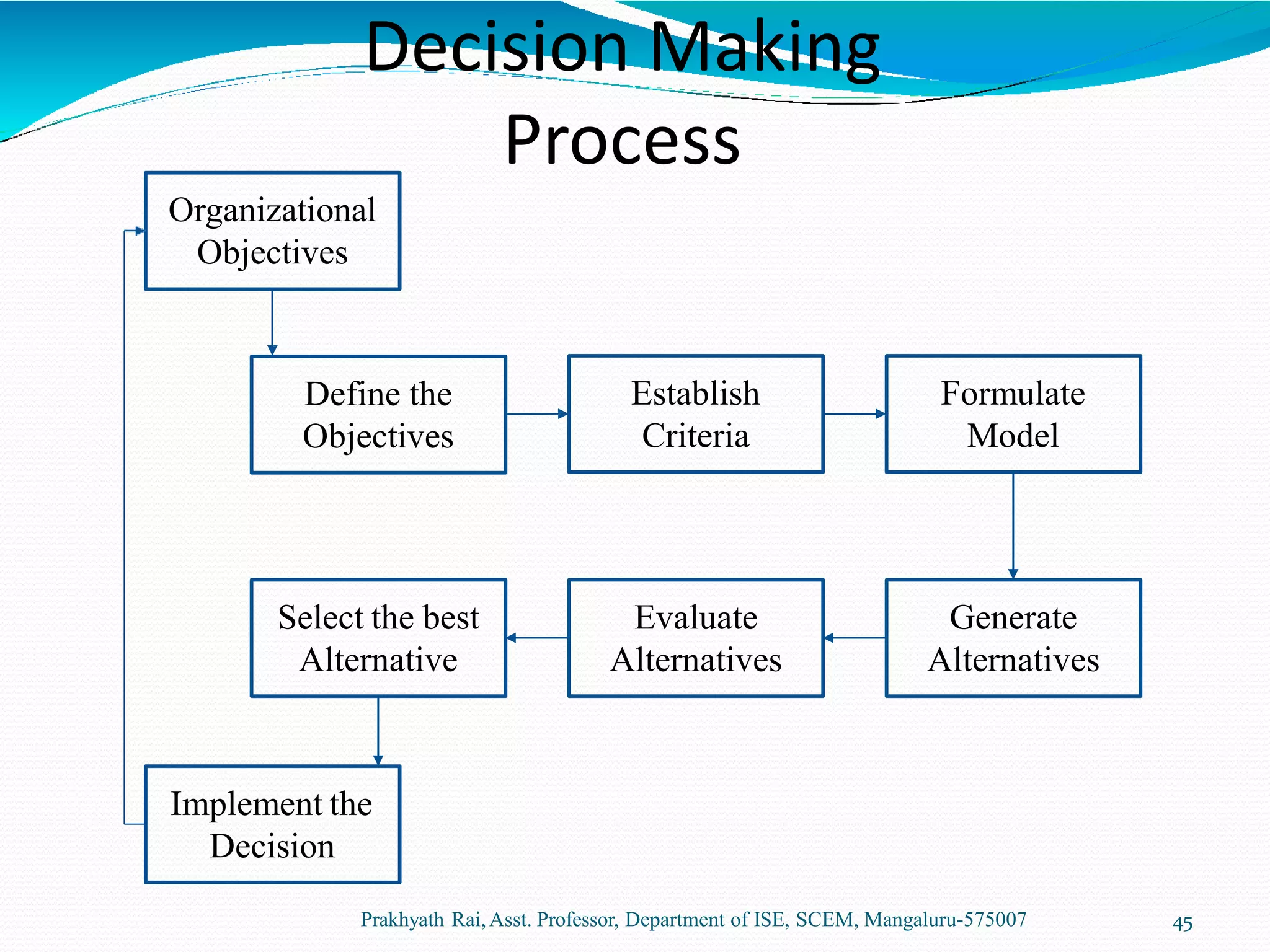
Decision Making
Process
Prakhyath Rai,Asst. Professor, Department of ISE, SCEM, Mangaluru-575007 45
Organizational
Objectives
Define the
Objectives
Establish
Criteria
Formulate
Model
Select the best
Alternative
Generate
Alternatives
Evaluate
Alternatives
Implement the
Decision
Decision Making
Process
Prakhyath Rai,Asst. Professor, Department of ISE, SCEM, Mangaluru-575007 4
 To define the problem and parameters influencing it
 To establish criteria for decision making
 To formulate a model considering all decision variables
Physical model – architects idea of a building
 Computer Model – CAD model of cars and machines
Mathematical Models – Forecasting model, simplex
model, transportation model etc.
Verbal Models – Words and description
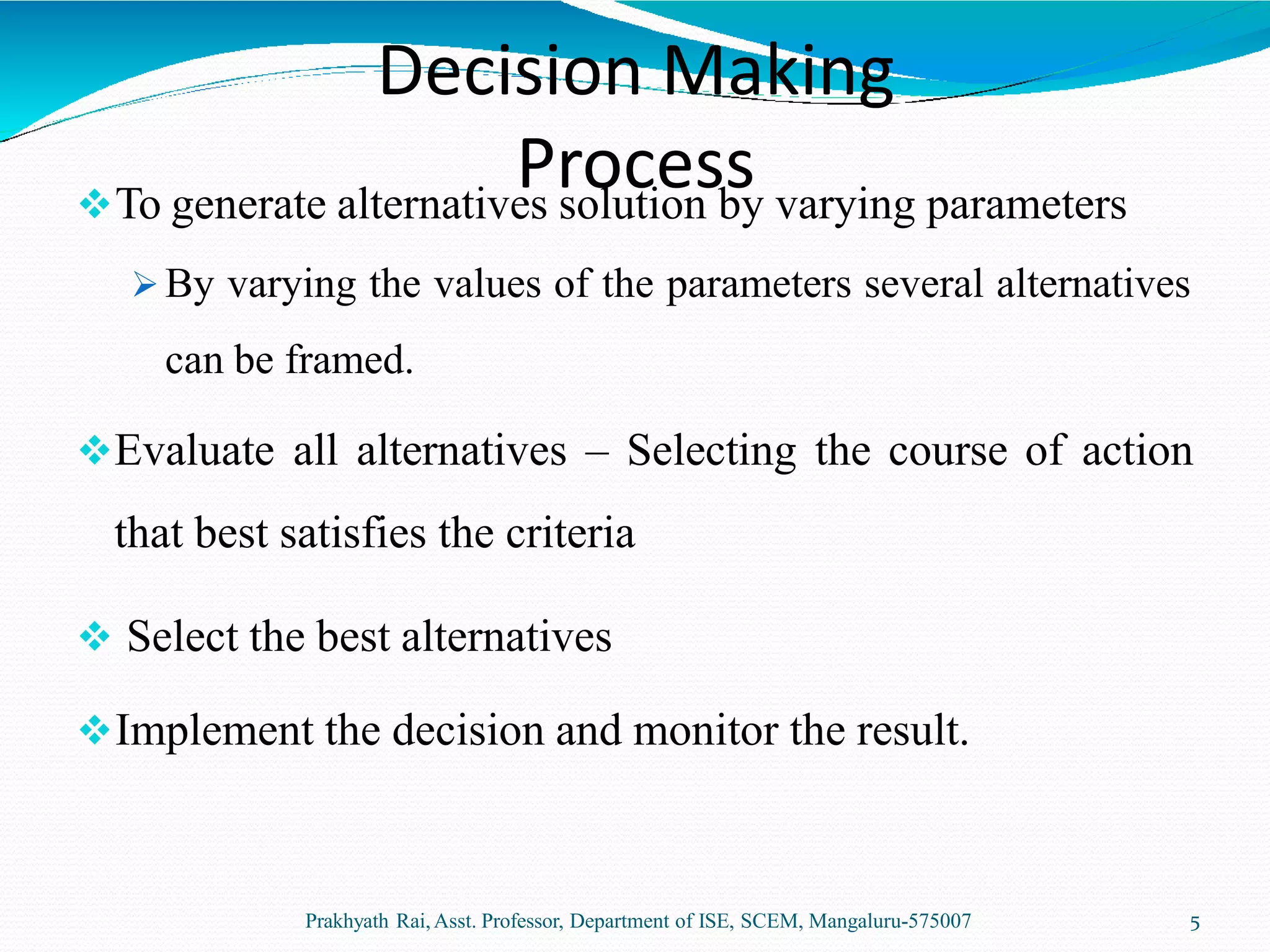
To generate alternatives solution by varying parameters
 By varying the values of the parameters several alternatives
can be framed.
Evaluate all alternatives – Selecting the course of action
that best satisfies the criteria
 Select the best alternatives
Implement the decision and monitor the result.
Prakhyath Rai,Asst. Professor, Department of ISE, SCEM, Mangaluru-575007 5
Decision Making
Process
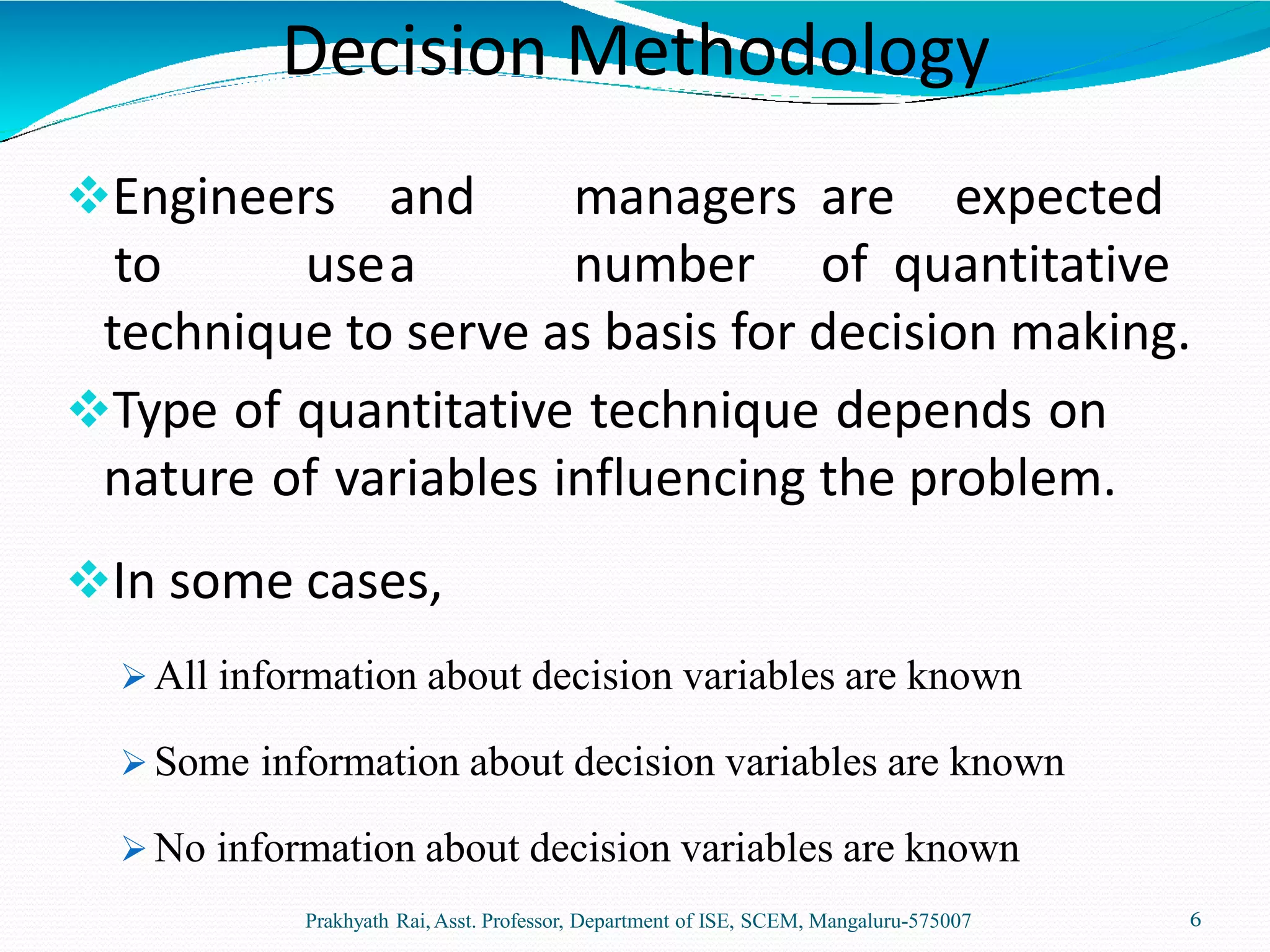
Engineers and managers are expected
to usea number of quantitative
technique to serve as basis for decision making.
Type of quantitative technique depends on
nature of variables influencing the problem.
In some cases,
 All information about decision variables are known
 Some information about decision variables are known
 No information about decision variables are known
Prakhyath Rai,Asst. Professor, Department of ISE, SCEM, Mangaluru-575007 6
Decision Methodology
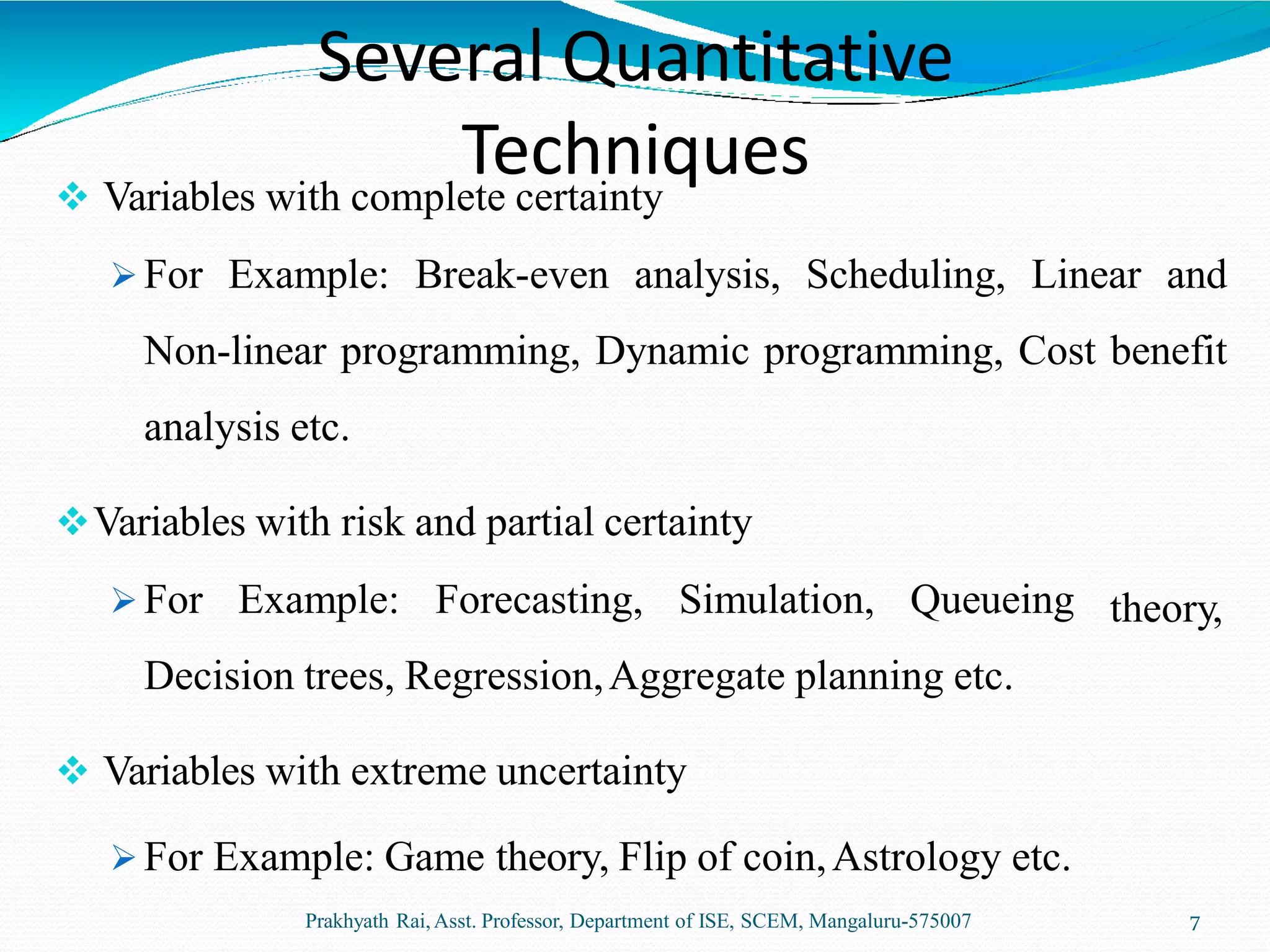
 Variables with complete certainty
 For Example: Break-even analysis, Scheduling, Linear and
Non-linear programming, Dynamic programming, Cost benefit
analysis etc.
Prakhyath Rai,Asst. Professor, Department of ISE, SCEM, Mangaluru-575007 7
theory,
Variables with risk and partial certainty
 For Example: Forecasting, Simulation, Queueing
Decision trees, Regression,Aggregate planning etc.
 Variables with extreme uncertainty
 For Example: Game theory, Flip of coin,Astrology etc.
Several Quantitative
Techniques

Decision making.pptx

  • 1.
    Decision Making In an organizationdecisions are routinely taken in operations, marketing, maintenance, R & D, transportation, finance, human resource etc. Decision making is the cognitive process leading to the selection of a course of action among alternatives. Every decision making process produces a final choice. It can be an action or an opinion. Prakhyath Rai, Asst. Professor, Department of ISE, SCEM, Mangaluru-575007 1
  • 2.
    Characteristics of Decision Making PrakhyathRai, Asst. Professor, Department of ISE, SCEM, Mangaluru-575007 2  Decision making is goal oriented  Decision making involves alternatives  Decision making is an analytical intellectual process  Decision making is a continuous activity  Decision making is an all pervasive function  Decision making is situational and dynamic.
  • 3.
    Decision Making Process Prakhyath Rai,Asst.Professor, Department of ISE, SCEM, Mangaluru-575007 45 Organizational Objectives Define the Objectives Establish Criteria Formulate Model Select the best Alternative Generate Alternatives Evaluate Alternatives Implement the Decision
  • 4.
    Decision Making Process Prakhyath Rai,Asst.Professor, Department of ISE, SCEM, Mangaluru-575007 4  To define the problem and parameters influencing it  To establish criteria for decision making  To formulate a model considering all decision variables Physical model – architects idea of a building  Computer Model – CAD model of cars and machines Mathematical Models – Forecasting model, simplex model, transportation model etc. Verbal Models – Words and description
  • 5.
    To generate alternativessolution by varying parameters  By varying the values of the parameters several alternatives can be framed. Evaluate all alternatives – Selecting the course of action that best satisfies the criteria  Select the best alternatives Implement the decision and monitor the result. Prakhyath Rai,Asst. Professor, Department of ISE, SCEM, Mangaluru-575007 5 Decision Making Process
  • 6.
    Engineers and managersare expected to usea number of quantitative technique to serve as basis for decision making. Type of quantitative technique depends on nature of variables influencing the problem. In some cases,  All information about decision variables are known  Some information about decision variables are known  No information about decision variables are known Prakhyath Rai,Asst. Professor, Department of ISE, SCEM, Mangaluru-575007 6 Decision Methodology
  • 7.
     Variables withcomplete certainty  For Example: Break-even analysis, Scheduling, Linear and Non-linear programming, Dynamic programming, Cost benefit analysis etc. Prakhyath Rai,Asst. Professor, Department of ISE, SCEM, Mangaluru-575007 7 theory, Variables with risk and partial certainty  For Example: Forecasting, Simulation, Queueing Decision trees, Regression,Aggregate planning etc.  Variables with extreme uncertainty  For Example: Game theory, Flip of coin,Astrology etc. Several Quantitative Techniques