
Why Do We Study OB?
• To learn about yourself and how to deal with others?
• You are part of an organization now, and will continue to be a
part of various organizations…
• Organizations are increasingly expecting individuals to be
able to work in teams, at least some of the time
• Some of you may want to be managers or entrepreneurs
WHAT IS AN ORGANIZATION?
• An organization is a collection of people who
work together to achieve a wide variety of
goals.
• Organizations exist to provide goods and
services that people want.
• These goods and services are the products of
the behaviors of workers.
Jayant Isaac,Asso.Profesor
Organization
 Organization - collection of people, work together to
achieve
-Individual goals*
-Organizational goals*
Jayant Isaac,Asso.Profesor
*Goals: An observable and
measurable end result having one or
more objectives to be achieved within
a more or less fixed timeframe.
MANAGEMENT FUNCTIONS
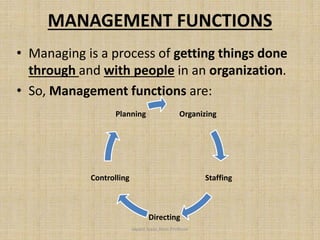
• Managing is a process of getting things done
through and with people in an organization.
• So, Management functions are:
Organizing
Staffing
Directing
Controlling
Planning
Jayant Isaac,Asso.Profesor
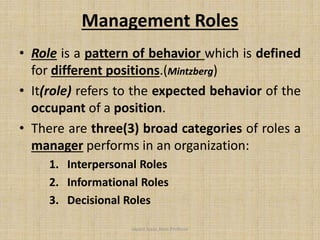
Management Roles
• Role is a pattern of behavior which is defined
for different positions.(Mintzberg)
• It(role) refers to the expected behavior of the
occupant of a position.
• There are three(3) broad categories of roles a
manager performs in an organization:
1. Interpersonal Roles
2. Informational Roles
3. Decisional Roles
Jayant Isaac,Asso.Profesor
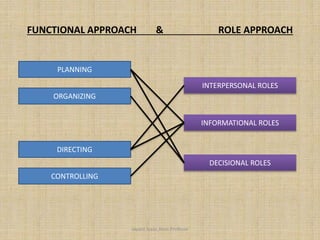
FUNCTIONAL APPROACH & ROLE APPROACH
PLANNING
ORGANIZING
DIRECTING
CONTROLLING
INTERPERSONAL ROLES
INFORMATIONAL ROLES
DECISIONAL ROLES
Jayant Isaac,Asso.Profesor
Organisational Behaviour -Meaning
• Organizational behavior (OB) is a field of study
that investigates the impact that individuals,
groups, and structure have on behavior
within an organization, and then applies that
knowledge to make organizations work more
effectively.
• Specifically, OB focuses on how to improve
productivity, reduce absenteeism and
turnover, and increase employee citizenship
and job satisfaction.
Jayant Isaac,Asso.Profesor
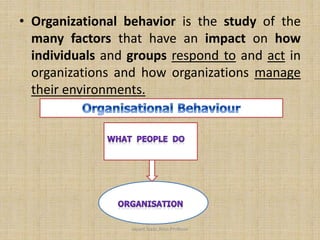
• Organizational behavior is the study of the
many factors that have an impact on how
individuals and groups respond to and act in
organizations and how organizations manage
their environments.
Jayant Isaac,Asso.Profesor
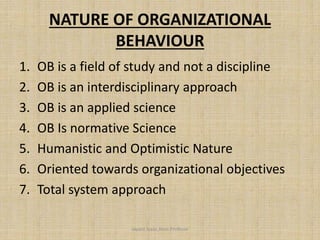
NATURE OF ORGANIZATIONAL
BEHAVIOUR
1. OB is a field of study and not a discipline
2. OB is an interdisciplinary approach
3. OB is an applied science
4. OB Is normative Science
5. Humanistic and Optimistic Nature
6. Oriented towards organizational objectives
7. Total system approach
Jayant Isaac,Asso.Profesor
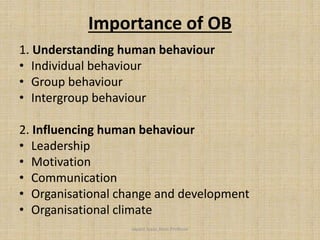
Importance of OB
1. Understanding human behaviour
• Individual behaviour
• Group behaviour
• Intergroup behaviour
2. Influencing human behaviour
• Leadership
• Motivation
• Communication
• Organisational change and development
• Organisational climate
Jayant Isaac,Asso.Profesor
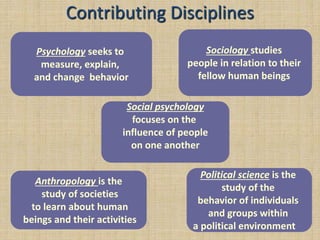
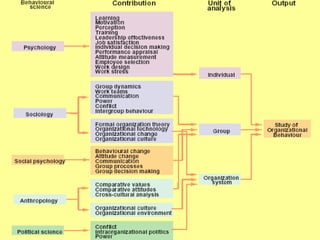
Psychology seeks to
measure, explain,
and change behavior
Sociology studies
people in relation to their
fellow human beings
Social psychology
focuses on the
influence of people
on one another
Anthropology is the
study of societies
to learn about human
beings and their activities
Political science is the
study of the
behavior of individuals
and groups within
a political environment
Contributing Disciplines
Historical Development of OB &
Theories of Organisation
• Classical Theory
– Max Weber’s Ideal Bureaucracy
– Taylor’s Theory
– Fayol, Gulik and Urwick
• Neo-Classical Theory
– Hawthorne experiments and human relations
• Modern Organisational Theory
– Social systems approach
– Human Behavior approach
– Systems and contingency approach
Jayant Isaac,Asso.Profesor
THEORIES OF OB
1. Scientific Management
2. Fayol’s Administrative management
3. Bureaucracy
4. Hawthorne experiments and human relations
5. Social systems approach
6. Human Behavior approach
7. Systems and contingency approach
Jayant Isaac,Asso.Profesor
(1)Scientific Management(beg. of 20th Century)
• Introduced by Frederic Winslow Taylor in USA.
• “Scientific management is concerned with
knowing exactly what you want men to do
and then see in that they do it in the best and
cheapest way.”
• It described management as a science with
employers having specific but different
responsibilities.
• It encouraged the scientific selection, training,
and development of workers and the equal
division of work between workers and
management. Jayant Isaac,Asso.Profesor
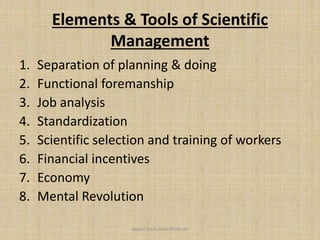
Elements & Tools of Scientific
Management
1. Separation of planning & doing
2. Functional foremanship
3. Job analysis
4. Standardization
5. Scientific selection and training of workers
6. Financial incentives
7. Economy
8. Mental Revolution
Jayant Isaac,Asso.Profesor
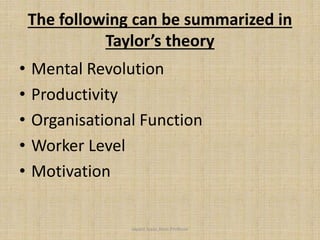
The following can be summarized in
Taylor’s theory
• Mental Revolution
• Productivity
• Organisational Function
• Worker Level
• Motivation
Jayant Isaac,Asso.Profesor
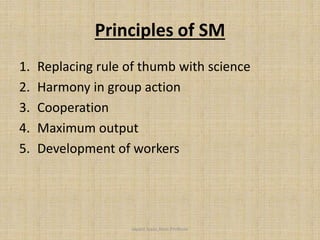
Principles of SM
1. Replacing rule of thumb with science
2. Harmony in group action
3. Cooperation
4. Maximum output
5. Development of workers
Jayant Isaac,Asso.Profesor
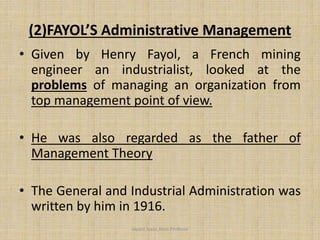
(2)FAYOL’S Administrative Management
• Given by Henry Fayol, a French mining
engineer an industrialist, looked at the
problems of managing an organization from
top management point of view.
• He was also regarded as the father of
Management Theory
• The General and Industrial Administration was
written by him in 1916.
Jayant Isaac,Asso.Profesor
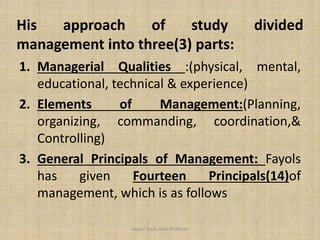
1. Managerial Qualities :(physical, mental,
educational, technical & experience)
2. Elements of Management:(Planning,
organizing, commanding, coordination,&
Controlling)
3. General Principals of Management: Fayols
has given Fourteen Principals(14)of
management, which is as follows
Jayant Isaac,Asso.Profesor
His approach of study divided
management into three(3) parts:
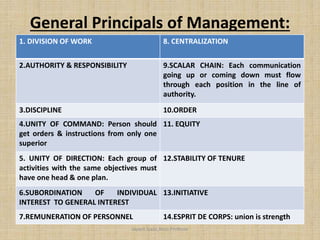
General Principals of Management:
1. DIVISION OF WORK 8. CENTRALIZATION
2.AUTHORITY & RESPONSIBILITY 9.SCALAR CHAIN: Each communication
going up or coming down must flow
through each position in the line of
authority.
3.DISCIPLINE 10.ORDER
4.UNITY OF COMMAND: Person should
get orders & instructions from only one
superior
11. EQUITY
5. UNITY OF DIRECTION: Each group of
activities with the same objectives must
have one head & one plan.
12.STABILITY OF TENURE
6.SUBORDINATION OF INDIVIDUAL
INTEREST TO GENERAL INTEREST
13.INITIATIVE
7.REMUNERATION OF PERSONNEL 14.ESPRIT DE CORPS: union is strength
Jayant Isaac,Asso.Profesor
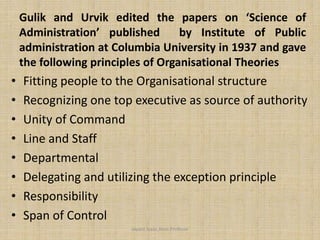
Gulik and Urvik edited the papers on ‘Science of
Administration’ published by Institute of Public
administration at Columbia University in 1937 and gave
the following principles of Organisational Theories
• Fitting people to the Organisational structure
• Recognizing one top executive as source of authority
• Unity of Command
• Line and Staff
• Departmental
• Delegating and utilizing the exception principle
• Responsibility
• Span of Control
Jayant Isaac,Asso.Profesor
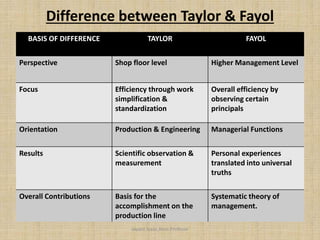
Difference between Taylor & Fayol
BASIS OF DIFFERENCE TAYLOR FAYOL
Perspective Shop floor level Higher Management Level
Focus Efficiency through work
simplification &
standardization
Overall efficiency by
observing certain
principals
Orientation Production & Engineering Managerial Functions
Results Scientific observation &
measurement
Personal experiences
translated into universal
truths
Overall Contributions Basis for the
accomplishment on the
production line
Systematic theory of
management.
Jayant Isaac,Asso.Profesor
Span of Control
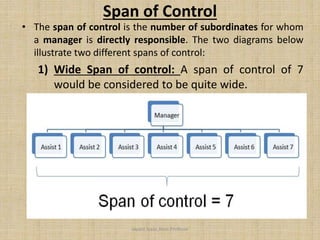
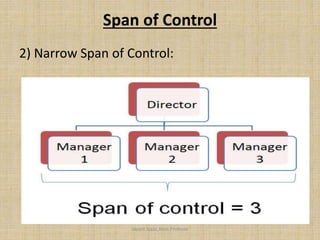
• The span of control is the number of subordinates for whom
a manager is directly responsible. The two diagrams below
illustrate two different spans of control:
1) Wide Span of control: A span of control of 7
would be considered to be quite wide.
Jayant Isaac,Asso.Profesor
Span of Control
2) Narrow Span of Control:
Jayant Isaac,Asso.Profesor
Is there an ideal span of control?
• The answer is generally NO – a suitable span of
control will depend upon a number of factors:
– The experience and personality of the manager
– The nature of the business. If being a line manager
requires a great deal of close supervision, then a
narrower span might be appropriate
– The skills and attitudes of the employees. Highly
skilled, professional employees might flourish in a
business adopting wide spans of control.
– The tradition and culture of the organisation. A
business with a tradition of democratic management
and empowered workers may operate wider spans of
control
Jayant Isaac,Asso.Profesor
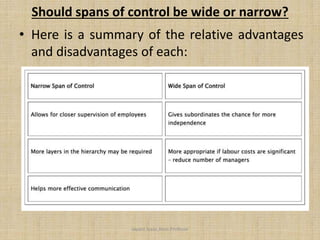
Should spans of control be wide or narrow?
• Here is a summary of the relative advantages
and disadvantages of each:
Jayant Isaac,Asso.Profesor
(3)BUREAUCRACY
• The term "bureaucracy" was created from words:
‘bureau’ means “desk or office” and “cracy or
kratos” which means– rule or political power
• Bureaucracy is an administrative system designed to
accomplish large-scale administrative task by
systematically coordinating the work of many
individuals.
• Given by Max Weber(1864-1920), and he observed
three types of power in the organizations:
1. Traditional
2. Charismatic (attractive or magnetic)
3. Bureaucratic
Jayant Isaac,Asso.Profesor
Features of Bureaucracy
• Ten (10) features of Bureaucracy are:
1. Administrative Class
2. Hierarchy
3. Promotion
4. Expert training
5. Selection based on technical competence
6. Division of Work
7. Official Rules
8. Interpersonal Relationships
9. Official Records
10.Specialization
Jayant Isaac,Asso.Profesor
4.HAWTHORNE EXPERIMENTS AND
HUMAN RELATIONS
• It is based on the approach of “ human relations
approach of management.”
• In this Organizational situations should be viewed in
social terms as well as in economic and technical
terms.
• The social process of group behavior can be
understood in terms of clinical approach.
• This approach was basically headed by Elton Mayo
(psychologist) and conducted analysis in Hawthorne
plant of Western Electric Company Chicago in the
year 1924
Jayant Isaac,Asso.Profesor
Phases of the Experiment
• ILLUMINATION Experiments
• Relay Assembly & Test Room Experiments
• Mass Interviewing Programme
• Bank wiring observation room experiments
Jayant Isaac,Asso.Profesor
5.Social System Approach
• This approach was introduced by Vilfredo
Pareto.His ideas were later developed by
Chester Barnard.
• As per this approach an organization is
essentially a cultural system composed of
people who work in cooperation.
Jayant Isaac,Asso.Profesor
6.HUMAN BEHAVIOUR APPROACH
• It is an outcome of the thoughts developed by
the behavioral scientist who looked at the
organization as collectively of people for
certain specified objectives.
• The approach emphasizes human resources in
an organization more as compared to
physical and financial resources.
Jayant Isaac,Asso.Profesor
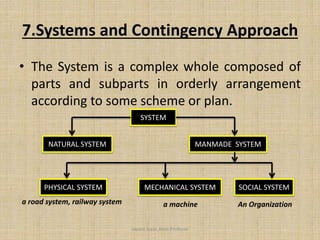
7.Systems and Contingency Approach
• The System is a complex whole composed of
parts and subparts in orderly arrangement
according to some scheme or plan.
SYSTEM
NATURAL SYSTEM MANMADE SYSTEM
PHYSICAL SYSTEM MECHANICAL SYSTEM SOCIAL SYSTEM
a road system, railway system a machine An Organization
Jayant Isaac,Asso.Profesor
• Contingency Approach may be treated as an
extension of systems approach.
• The basic idea for this approach is that there
cannot be a particular action of managing
human behavior which will be suitable for all
situations.
• This is the reason why a particular action of
managing human behavior becomes
successful in one organization but fails in
other organization.
Jayant Isaac,Asso.Profesor
MODELS IN OB
• Models are developed in different fields to
guide activities in those fields.
• Every organization develops a particular
model in which behavior of the people takes
place.
• “Davis” has described four(4) OB models
which are as follows:
1. Autocratic
2. Custodial
3. Supportive
4. Collegial
Jayant Isaac,Asso.Profesor
THE AUTOCRATIC MODEL
• The autocratic model is based on power. Under this
model, the person who holds power has the authority
to demand work from workers.
• This model was widely popular during the Industrial
Revolution.
• It is based on the assumption that work can only be
extracted by means of pushing, directing, and
persuading the employees.
Jayant Isaac,Asso.Profesor
THE AUTOCRATIC MODEL
• This model empowers managers with authority which
might be used for unfair practices such as suspending
the employees for not obeying the orders, giving low
pay, etc.
• Such a work environment motivates very few
employees to exhibit higher productivity.
• However, the autocratic model works well under
certain conditions, particularly in times of an
organizational crisis.
Jayant Isaac,Asso.Profesor
THE CUSTODIAL MODEL
• In the custodial model, the emphasis is laid on
providing job security to the employees. It has been
observed that employees generally prefer jobs that
promise job security.
• Therefore, employers offer fringe benefits to
strengthen the employee’s confidence in job security.
• While this helps in retaining the employees,
knowing that they are going to get incentives
irrespective of their job performance might cause
the employees to be more laid back in their
approach toward work.
Jayant Isaac,Asso.Profesor
THE SUPPORTIVE MODEL
• The supportive model emphasizes leadership rather than
power or money.
• Under this approach, leaders promote an environment for the
employees to grow while they help in achieving the
organization’s objectives.
• Also the support extended by the management motivates the
employees to work. The employees are self motivated to
enhance their performance and are not compelled to do so.
• This model might not be effective for employees whose lower
level needs are not satisfied.
• Nevertheless, the supportive model enhances the
relationships between the employee and the employer.Jayant Isaac,Asso.Profesor
THE COLLEGIAL MODEL
• In the collegial model, employees are self-
disciplined, self-satisfied, and have specific goals
which motivate them to improve their
performance.
• In this approach, the superior acts more like a leader
who leads the way and motivates employees that to
perform at their best.
• The term ‘collegial’ refers to a group of persons
working for a common purpose. This approach is an
extension of the supportive model.
Jayant Isaac,Asso.Profesor
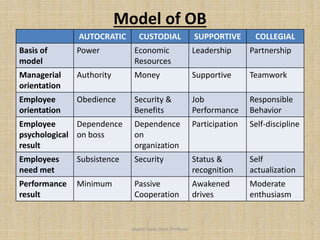
Model of OB
AUTOCRATIC CUSTODIAL SUPPORTIVE COLLEGIAL
Basis of
model
Power Economic
Resources
Leadership Partnership
Managerial
orientation
Authority Money Supportive Teamwork
Employee
orientation
Obedience Security &
Benefits
Job
Performance
Responsible
Behavior
Employee
psychological
result
Dependence
on boss
Dependence
on
organization
Participation Self-discipline
Employees
need met
Subsistence Security Status &
recognition
Self
actualization
Performance
result
Minimum Passive
Cooperation
Awakened
drives
Moderate
enthusiasm
Jayant Isaac,Asso.Profesor
S-O-B-C Model
• The OB model based on the social learning
approach is termed as the SOBC model, where
“S” stands for stimulus, “O” for organism, “B”
for behavior, and “C” for consequence.
• The S-O-B-C model gives the basic framework
rather than a complete explanation of OB.
Jayant Isaac,Asso.Profesor
A Model of Organizational Behavior
• S – Stimulus: is an environmental variable that
depicts the environmental situation, both
contextual and organizational.
• O – Organism: is a cognitive variable that understands
organizational participants which link the environmental
situation and the resulting organizational behavior.
• B – Represents the organizational behavior.
• C – Consequence: is an environmental variable that depicts
organizational and group dynamics and the consequences
of previous interactions between environmental, personal
and behavioral variables.
Jayant Isaac,Asso.Profesor
Organization as a Social System,
Socio technical System
• Social System Approach
• Systems and Contingency Approach
Jayant Isaac,Asso.Profesor
Factors Influencing OB
• There are many factors here, but they can be
broadly categorized into 4 groups:
– The individual
– The group
– The organization
– The environment
Jayant Isaac,Asso.Profesor
Environmental factors and its
Constraints over organization &
management performance
Jayant Isaac,Asso.Profesor
Environmental Factors
Many factors can be included in the category of
environment factors – Social , Economic ,
Cultural , Geographical , Technological ,
Political Legal and Ecological factors ; in
addition to government policies , labour factors
, competitive market conditions , locational
factors , emerging globalization and so on.
Although there are many factors , the most
important of the factors are socio- economic ,
technological , suppliers and government.
Social Factors
o There are many social factors which affect the
policy and strategy of corporate management.
Culture , values , tastes and preferences ,
social integration, and disintegration and so
on must be part of the agenda of every
business organization.
o While social institutions are closely linked with
business organizations, business itself is a
social institution.
Economic Factors
• Economic factors such as per capita income ,
national income , resource mobilization ,
exploitation of natural resources ,
infrastructure development , capital formation
,employment generation, industrial
development and so on, influence the
business environment.
Cultural Factors
• The cultural factors of a business environment
should also be taken into consideration while
scanning the environment and during the policy
formulation.
• Managers and policymakers in global business
can not be disregard cultural variables like social
and religious practices , education, knowledge ,
rural community norms and beliefs and so on
with special reference to India.
Geographical Factors
• In a global business environment , geographical
locations , seasonal variations , climatic
conditions and so on , considerably affect the
tastes and preferences of customers and also
prospects and the labor forces.
• The policies of the government regarding
industrial locations are considerably influenced
by the pace of development in various
geographical locations.
Political Factors
• The philosophy and approach of the political
party in power substantially influences the
business environment. For example , the
communist –ruled state of West Bengal had
the largest number of industrial disputes.
Legal Factors
• Every aspect of the business is regulated by a law
in India. Hence , the legal environment plays a
very vital role in the business.
• Laws relating to industrial licensing,company
information, factory administration, Industrial
disputes , payment of wages , trade unionism ,
monopoly control , foreign exchange regulations ,
shops and establishments and so on are examples
of what forms the legal business environment in
India.
Ecological Factors
• Ecology deals with the study of the environment , biotic
factors (plants, animals , and micro organisms ) abiotic
factors (water , air , sunlight, soil,) and their interactions
with each other. Industrial activities , automobiles ,
emission of fumes or smoke and influents and so on ,
result in an environmental degradation.
• Hence , environmental protection and preservation must
be the responsibility of every organization. Pollution free
industrial activity is , therefore , considered to be a
necessary condition of industrial organizations.
The Government Policies
• The government policies provide the basic
environment of the business. For instance , the
government’s policy to open up the Indian economy to
integrate it with the global economy has resulted in
liberalization.
• Industrial policy resolutions , and licensing policies ,
trade policies , labor policies , locational policies ,
export-import policies , foreign exchange policies ,
monetary policies, taxation policies and so on , pave
the way for business environment.
Labor Policies
• Although labor within the organization constitutes its
internal environment, general labor policies and
climate may from a part of the external environment.
• If militant trade unionism is widespread in a particular
industrial location , Such militancy would become the
labor climate and would make external element.
• At the same time , a specific organizations may have a
committed labor forces , which could be the strength
of the internal environment of the organization.
Understanding Organisational Behaviour

Understanding Organisational Behaviour

  • 2.
    Why Do WeStudy OB? • To learn about yourself and how to deal with others? • You are part of an organization now, and will continue to be a part of various organizations… • Organizations are increasingly expecting individuals to be able to work in teams, at least some of the time • Some of you may want to be managers or entrepreneurs
  • 3.
    WHAT IS ANORGANIZATION? • An organization is a collection of people who work together to achieve a wide variety of goals. • Organizations exist to provide goods and services that people want. • These goods and services are the products of the behaviors of workers. Jayant Isaac,Asso.Profesor
  • 4.
    Organization  Organization -collection of people, work together to achieve -Individual goals* -Organizational goals* Jayant Isaac,Asso.Profesor *Goals: An observable and measurable end result having one or more objectives to be achieved within a more or less fixed timeframe.
  • 5.
    MANAGEMENT FUNCTIONS • Managingis a process of getting things done through and with people in an organization. • So, Management functions are: Organizing Staffing Directing Controlling Planning Jayant Isaac,Asso.Profesor
  • 6.
    Management Roles • Roleis a pattern of behavior which is defined for different positions.(Mintzberg) • It(role) refers to the expected behavior of the occupant of a position. • There are three(3) broad categories of roles a manager performs in an organization: 1. Interpersonal Roles 2. Informational Roles 3. Decisional Roles Jayant Isaac,Asso.Profesor
  • 7.
    FUNCTIONAL APPROACH &ROLE APPROACH PLANNING ORGANIZING DIRECTING CONTROLLING INTERPERSONAL ROLES INFORMATIONAL ROLES DECISIONAL ROLES Jayant Isaac,Asso.Profesor
  • 8.
    Organisational Behaviour -Meaning •Organizational behavior (OB) is a field of study that investigates the impact that individuals, groups, and structure have on behavior within an organization, and then applies that knowledge to make organizations work more effectively. • Specifically, OB focuses on how to improve productivity, reduce absenteeism and turnover, and increase employee citizenship and job satisfaction. Jayant Isaac,Asso.Profesor
  • 9.
    • Organizational behavioris the study of the many factors that have an impact on how individuals and groups respond to and act in organizations and how organizations manage their environments. Jayant Isaac,Asso.Profesor
  • 10.
    NATURE OF ORGANIZATIONAL BEHAVIOUR 1.OB is a field of study and not a discipline 2. OB is an interdisciplinary approach 3. OB is an applied science 4. OB Is normative Science 5. Humanistic and Optimistic Nature 6. Oriented towards organizational objectives 7. Total system approach Jayant Isaac,Asso.Profesor
  • 11.
    Importance of OB 1.Understanding human behaviour • Individual behaviour • Group behaviour • Intergroup behaviour 2. Influencing human behaviour • Leadership • Motivation • Communication • Organisational change and development • Organisational climate Jayant Isaac,Asso.Profesor
  • 12.
    Psychology seeks to measure,explain, and change behavior Sociology studies people in relation to their fellow human beings Social psychology focuses on the influence of people on one another Anthropology is the study of societies to learn about human beings and their activities Political science is the study of the behavior of individuals and groups within a political environment Contributing Disciplines
  • 14.
    Historical Development ofOB & Theories of Organisation • Classical Theory – Max Weber’s Ideal Bureaucracy – Taylor’s Theory – Fayol, Gulik and Urwick • Neo-Classical Theory – Hawthorne experiments and human relations • Modern Organisational Theory – Social systems approach – Human Behavior approach – Systems and contingency approach Jayant Isaac,Asso.Profesor
  • 15.
    THEORIES OF OB 1.Scientific Management 2. Fayol’s Administrative management 3. Bureaucracy 4. Hawthorne experiments and human relations 5. Social systems approach 6. Human Behavior approach 7. Systems and contingency approach Jayant Isaac,Asso.Profesor
  • 16.
    (1)Scientific Management(beg. of20th Century) • Introduced by Frederic Winslow Taylor in USA. • “Scientific management is concerned with knowing exactly what you want men to do and then see in that they do it in the best and cheapest way.” • It described management as a science with employers having specific but different responsibilities. • It encouraged the scientific selection, training, and development of workers and the equal division of work between workers and management. Jayant Isaac,Asso.Profesor
  • 17.
    Elements & Toolsof Scientific Management 1. Separation of planning & doing 2. Functional foremanship 3. Job analysis 4. Standardization 5. Scientific selection and training of workers 6. Financial incentives 7. Economy 8. Mental Revolution Jayant Isaac,Asso.Profesor
  • 18.
    The following canbe summarized in Taylor’s theory • Mental Revolution • Productivity • Organisational Function • Worker Level • Motivation Jayant Isaac,Asso.Profesor
  • 19.
    Principles of SM 1.Replacing rule of thumb with science 2. Harmony in group action 3. Cooperation 4. Maximum output 5. Development of workers Jayant Isaac,Asso.Profesor
  • 20.
    (2)FAYOL’S Administrative Management •Given by Henry Fayol, a French mining engineer an industrialist, looked at the problems of managing an organization from top management point of view. • He was also regarded as the father of Management Theory • The General and Industrial Administration was written by him in 1916. Jayant Isaac,Asso.Profesor
  • 21.
    1. Managerial Qualities:(physical, mental, educational, technical & experience) 2. Elements of Management:(Planning, organizing, commanding, coordination,& Controlling) 3. General Principals of Management: Fayols has given Fourteen Principals(14)of management, which is as follows Jayant Isaac,Asso.Profesor His approach of study divided management into three(3) parts:
  • 22.
    General Principals ofManagement: 1. DIVISION OF WORK 8. CENTRALIZATION 2.AUTHORITY & RESPONSIBILITY 9.SCALAR CHAIN: Each communication going up or coming down must flow through each position in the line of authority. 3.DISCIPLINE 10.ORDER 4.UNITY OF COMMAND: Person should get orders & instructions from only one superior 11. EQUITY 5. UNITY OF DIRECTION: Each group of activities with the same objectives must have one head & one plan. 12.STABILITY OF TENURE 6.SUBORDINATION OF INDIVIDUAL INTEREST TO GENERAL INTEREST 13.INITIATIVE 7.REMUNERATION OF PERSONNEL 14.ESPRIT DE CORPS: union is strength Jayant Isaac,Asso.Profesor
  • 23.
    Gulik and Urvikedited the papers on ‘Science of Administration’ published by Institute of Public administration at Columbia University in 1937 and gave the following principles of Organisational Theories • Fitting people to the Organisational structure • Recognizing one top executive as source of authority • Unity of Command • Line and Staff • Departmental • Delegating and utilizing the exception principle • Responsibility • Span of Control Jayant Isaac,Asso.Profesor
  • 24.
    Difference between Taylor& Fayol BASIS OF DIFFERENCE TAYLOR FAYOL Perspective Shop floor level Higher Management Level Focus Efficiency through work simplification & standardization Overall efficiency by observing certain principals Orientation Production & Engineering Managerial Functions Results Scientific observation & measurement Personal experiences translated into universal truths Overall Contributions Basis for the accomplishment on the production line Systematic theory of management. Jayant Isaac,Asso.Profesor
  • 25.
    Span of Control •The span of control is the number of subordinates for whom a manager is directly responsible. The two diagrams below illustrate two different spans of control: 1) Wide Span of control: A span of control of 7 would be considered to be quite wide. Jayant Isaac,Asso.Profesor
  • 26.
    Span of Control 2)Narrow Span of Control: Jayant Isaac,Asso.Profesor
  • 27.
    Is there anideal span of control? • The answer is generally NO – a suitable span of control will depend upon a number of factors: – The experience and personality of the manager – The nature of the business. If being a line manager requires a great deal of close supervision, then a narrower span might be appropriate – The skills and attitudes of the employees. Highly skilled, professional employees might flourish in a business adopting wide spans of control. – The tradition and culture of the organisation. A business with a tradition of democratic management and empowered workers may operate wider spans of control Jayant Isaac,Asso.Profesor
  • 28.
    Should spans ofcontrol be wide or narrow? • Here is a summary of the relative advantages and disadvantages of each: Jayant Isaac,Asso.Profesor
  • 29.
    (3)BUREAUCRACY • The term"bureaucracy" was created from words: ‘bureau’ means “desk or office” and “cracy or kratos” which means– rule or political power • Bureaucracy is an administrative system designed to accomplish large-scale administrative task by systematically coordinating the work of many individuals. • Given by Max Weber(1864-1920), and he observed three types of power in the organizations: 1. Traditional 2. Charismatic (attractive or magnetic) 3. Bureaucratic Jayant Isaac,Asso.Profesor
  • 30.
    Features of Bureaucracy •Ten (10) features of Bureaucracy are: 1. Administrative Class 2. Hierarchy 3. Promotion 4. Expert training 5. Selection based on technical competence 6. Division of Work 7. Official Rules 8. Interpersonal Relationships 9. Official Records 10.Specialization Jayant Isaac,Asso.Profesor
  • 31.
    4.HAWTHORNE EXPERIMENTS AND HUMANRELATIONS • It is based on the approach of “ human relations approach of management.” • In this Organizational situations should be viewed in social terms as well as in economic and technical terms. • The social process of group behavior can be understood in terms of clinical approach. • This approach was basically headed by Elton Mayo (psychologist) and conducted analysis in Hawthorne plant of Western Electric Company Chicago in the year 1924 Jayant Isaac,Asso.Profesor
  • 32.
    Phases of theExperiment • ILLUMINATION Experiments • Relay Assembly & Test Room Experiments • Mass Interviewing Programme • Bank wiring observation room experiments Jayant Isaac,Asso.Profesor
  • 33.
    5.Social System Approach •This approach was introduced by Vilfredo Pareto.His ideas were later developed by Chester Barnard. • As per this approach an organization is essentially a cultural system composed of people who work in cooperation. Jayant Isaac,Asso.Profesor
  • 34.
    6.HUMAN BEHAVIOUR APPROACH •It is an outcome of the thoughts developed by the behavioral scientist who looked at the organization as collectively of people for certain specified objectives. • The approach emphasizes human resources in an organization more as compared to physical and financial resources. Jayant Isaac,Asso.Profesor
  • 35.
    7.Systems and ContingencyApproach • The System is a complex whole composed of parts and subparts in orderly arrangement according to some scheme or plan. SYSTEM NATURAL SYSTEM MANMADE SYSTEM PHYSICAL SYSTEM MECHANICAL SYSTEM SOCIAL SYSTEM a road system, railway system a machine An Organization Jayant Isaac,Asso.Profesor
  • 36.
    • Contingency Approachmay be treated as an extension of systems approach. • The basic idea for this approach is that there cannot be a particular action of managing human behavior which will be suitable for all situations. • This is the reason why a particular action of managing human behavior becomes successful in one organization but fails in other organization. Jayant Isaac,Asso.Profesor
  • 37.
    MODELS IN OB •Models are developed in different fields to guide activities in those fields. • Every organization develops a particular model in which behavior of the people takes place. • “Davis” has described four(4) OB models which are as follows: 1. Autocratic 2. Custodial 3. Supportive 4. Collegial Jayant Isaac,Asso.Profesor
  • 38.
    THE AUTOCRATIC MODEL •The autocratic model is based on power. Under this model, the person who holds power has the authority to demand work from workers. • This model was widely popular during the Industrial Revolution. • It is based on the assumption that work can only be extracted by means of pushing, directing, and persuading the employees. Jayant Isaac,Asso.Profesor
  • 39.
    THE AUTOCRATIC MODEL •This model empowers managers with authority which might be used for unfair practices such as suspending the employees for not obeying the orders, giving low pay, etc. • Such a work environment motivates very few employees to exhibit higher productivity. • However, the autocratic model works well under certain conditions, particularly in times of an organizational crisis. Jayant Isaac,Asso.Profesor
  • 40.
    THE CUSTODIAL MODEL •In the custodial model, the emphasis is laid on providing job security to the employees. It has been observed that employees generally prefer jobs that promise job security. • Therefore, employers offer fringe benefits to strengthen the employee’s confidence in job security. • While this helps in retaining the employees, knowing that they are going to get incentives irrespective of their job performance might cause the employees to be more laid back in their approach toward work. Jayant Isaac,Asso.Profesor
  • 41.
    THE SUPPORTIVE MODEL •The supportive model emphasizes leadership rather than power or money. • Under this approach, leaders promote an environment for the employees to grow while they help in achieving the organization’s objectives. • Also the support extended by the management motivates the employees to work. The employees are self motivated to enhance their performance and are not compelled to do so. • This model might not be effective for employees whose lower level needs are not satisfied. • Nevertheless, the supportive model enhances the relationships between the employee and the employer.Jayant Isaac,Asso.Profesor
  • 42.
    THE COLLEGIAL MODEL •In the collegial model, employees are self- disciplined, self-satisfied, and have specific goals which motivate them to improve their performance. • In this approach, the superior acts more like a leader who leads the way and motivates employees that to perform at their best. • The term ‘collegial’ refers to a group of persons working for a common purpose. This approach is an extension of the supportive model. Jayant Isaac,Asso.Profesor
  • 43.
    Model of OB AUTOCRATICCUSTODIAL SUPPORTIVE COLLEGIAL Basis of model Power Economic Resources Leadership Partnership Managerial orientation Authority Money Supportive Teamwork Employee orientation Obedience Security & Benefits Job Performance Responsible Behavior Employee psychological result Dependence on boss Dependence on organization Participation Self-discipline Employees need met Subsistence Security Status & recognition Self actualization Performance result Minimum Passive Cooperation Awakened drives Moderate enthusiasm Jayant Isaac,Asso.Profesor
  • 44.
    S-O-B-C Model • TheOB model based on the social learning approach is termed as the SOBC model, where “S” stands for stimulus, “O” for organism, “B” for behavior, and “C” for consequence. • The S-O-B-C model gives the basic framework rather than a complete explanation of OB. Jayant Isaac,Asso.Profesor
  • 45.
    A Model ofOrganizational Behavior • S – Stimulus: is an environmental variable that depicts the environmental situation, both contextual and organizational. • O – Organism: is a cognitive variable that understands organizational participants which link the environmental situation and the resulting organizational behavior. • B – Represents the organizational behavior. • C – Consequence: is an environmental variable that depicts organizational and group dynamics and the consequences of previous interactions between environmental, personal and behavioral variables. Jayant Isaac,Asso.Profesor
  • 46.
    Organization as aSocial System, Socio technical System • Social System Approach • Systems and Contingency Approach Jayant Isaac,Asso.Profesor
  • 47.
    Factors Influencing OB •There are many factors here, but they can be broadly categorized into 4 groups: – The individual – The group – The organization – The environment Jayant Isaac,Asso.Profesor
  • 48.
    Environmental factors andits Constraints over organization & management performance Jayant Isaac,Asso.Profesor
  • 49.
    Environmental Factors Many factorscan be included in the category of environment factors – Social , Economic , Cultural , Geographical , Technological , Political Legal and Ecological factors ; in addition to government policies , labour factors , competitive market conditions , locational factors , emerging globalization and so on. Although there are many factors , the most important of the factors are socio- economic , technological , suppliers and government.
  • 50.
    Social Factors o Thereare many social factors which affect the policy and strategy of corporate management. Culture , values , tastes and preferences , social integration, and disintegration and so on must be part of the agenda of every business organization. o While social institutions are closely linked with business organizations, business itself is a social institution.
  • 51.
    Economic Factors • Economicfactors such as per capita income , national income , resource mobilization , exploitation of natural resources , infrastructure development , capital formation ,employment generation, industrial development and so on, influence the business environment.
  • 52.
    Cultural Factors • Thecultural factors of a business environment should also be taken into consideration while scanning the environment and during the policy formulation. • Managers and policymakers in global business can not be disregard cultural variables like social and religious practices , education, knowledge , rural community norms and beliefs and so on with special reference to India.
  • 53.
    Geographical Factors • Ina global business environment , geographical locations , seasonal variations , climatic conditions and so on , considerably affect the tastes and preferences of customers and also prospects and the labor forces. • The policies of the government regarding industrial locations are considerably influenced by the pace of development in various geographical locations.
  • 54.
    Political Factors • Thephilosophy and approach of the political party in power substantially influences the business environment. For example , the communist –ruled state of West Bengal had the largest number of industrial disputes.
  • 55.
    Legal Factors • Everyaspect of the business is regulated by a law in India. Hence , the legal environment plays a very vital role in the business. • Laws relating to industrial licensing,company information, factory administration, Industrial disputes , payment of wages , trade unionism , monopoly control , foreign exchange regulations , shops and establishments and so on are examples of what forms the legal business environment in India.
  • 56.
    Ecological Factors • Ecologydeals with the study of the environment , biotic factors (plants, animals , and micro organisms ) abiotic factors (water , air , sunlight, soil,) and their interactions with each other. Industrial activities , automobiles , emission of fumes or smoke and influents and so on , result in an environmental degradation. • Hence , environmental protection and preservation must be the responsibility of every organization. Pollution free industrial activity is , therefore , considered to be a necessary condition of industrial organizations.
  • 57.
    The Government Policies •The government policies provide the basic environment of the business. For instance , the government’s policy to open up the Indian economy to integrate it with the global economy has resulted in liberalization. • Industrial policy resolutions , and licensing policies , trade policies , labor policies , locational policies , export-import policies , foreign exchange policies , monetary policies, taxation policies and so on , pave the way for business environment.
  • 58.
    Labor Policies • Althoughlabor within the organization constitutes its internal environment, general labor policies and climate may from a part of the external environment. • If militant trade unionism is widespread in a particular industrial location , Such militancy would become the labor climate and would make external element. • At the same time , a specific organizations may have a committed labor forces , which could be the strength of the internal environment of the organization.