Quantitative Applications
In a quantitative analysis, the height or area of an analyte’s
chromatographic peak is used to determine its concentration
Although peak height is easy to measure, its utility is limited by the
inverse relationship between the height and width of a
chromatographic peak
Unless chromatographic conditions are carefully controlled to
maintain a constant column efficiency, variations in peak height may
decrease the accuracy and precision of the quantitative analysis
A better choice is to measure the area under the chromatographic
peak with an integrating recorder. Since peak area is directly
proportional to the amount of analyte that was injected, changes in
column efficiency will not affect the accuracy or precision of the
analysis
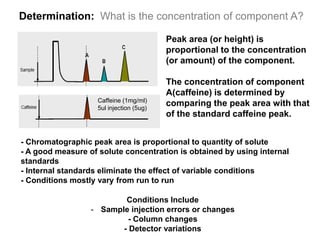
Determination: What is the concentration of component A?
Peak area (or height) is
proportional to the concentration
(or amount) of the component.
The concentration of component
A(caffeine) is determined by
comparing the peak area with that
of the standard caffeine peak.
Caffeine (1mg/ml)
5ul injection (5ug)
- Chromatographic peak area is proportional to quantity of solute
- A good measure of solute concentration is obtained by using internal
standards
- Internal standards eliminate the effect of variable conditions
- Conditions mostly vary from run to run
Conditions Include
- Sample injection errors or changes
- Column changes
- Detector variations
Calibration curves are usually constructed by analyzing a series
of external standards and plotting the detector’s signal as a
function of their known concentrations
As long as the injection volume is identical for every standard
and sample, calibration curves prepared in this fashion give
both accurate and precise results
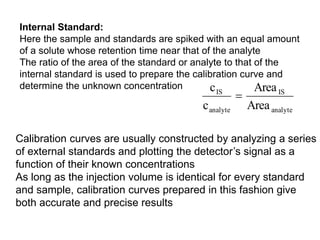
Internal Standard:
Here the sample and standards are spiked with an equal amount
of a solute whose retention time near that of the analyte
The ratio of the area of the standard or analyte to that of the
internal standard is used to prepare the calibration curve and
determine the unknown concentration
analyte
IS
analyte
IS
Area
Area
c
c

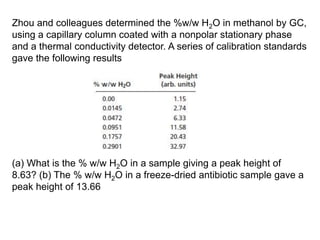
Zhou and colleagues determined the %w/w H2O in methanol by GC,
using a capillary column coated with a nonpolar stationary phase
and a thermal conductivity detector. A series of calibration standards
gave the following results
(a) What is the % w/w H2O in a sample giving a peak height of
8.63? (b) The % w/w H2O in a freeze-dried antibiotic sample gave a
peak height of 13.66
Classification of chromatography
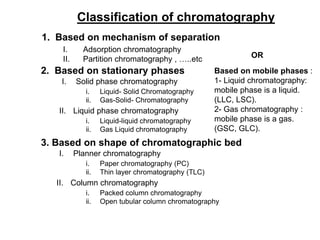
1. Based on mechanism of separation
I. Adsorption chromatography
II. Partition chromatography , …..etc
2. Based on stationary phases
I. Solid phase chromatography
i. Liquid- Solid Chromatography
ii. Gas-Solid- Chromatography
II. Liquid phase chromatography
i. Liquid-liquid chromatography
ii. Gas Liquid chromatography
3. Based on shape of chromatographic bed
I. Planner chromatography
i. Paper chromatography (PC)
ii. Thin layer chromatography (TLC)
II. Column chromatography
i. Packed column chromatography
ii. Open tubular column chromatography
Based on mobile phases :
1- Liquid chromatography:
mobile phase is a liquid.
(LLC, LSC).
2- Gas chromatography :
mobile phase is a gas.
(GSC, GLC).
OR
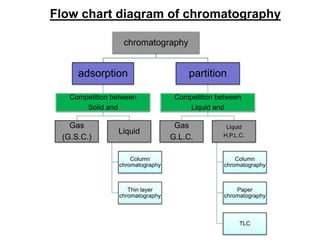
Flow chart diagram of chromatography
chromatography
adsorption
Competition between
Solid and
Gas
(G.S.C.)
Liquid
Column
chromatography
Thin layer
chromatography
partition
Competition between
Liquid and
Gas
G.L.C.
Liquid
H.P.L.C.
Column
chromatography
Paper
chromatography
TLC
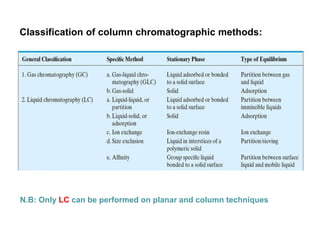
N.B: Only LC can be performed on planar and column techniques
Classification of column chromatographic methods:
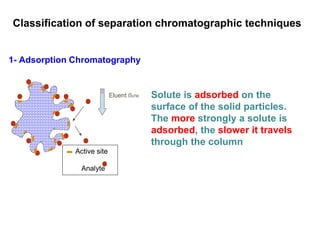
1- Adsorption Chromatography
Eluent flow
Active site
Analyte
Classification of separation chromatographic techniques
Solute is adsorbed on the
surface of the solid particles.
The more strongly a solute is
adsorbed, the slower it travels
through the column
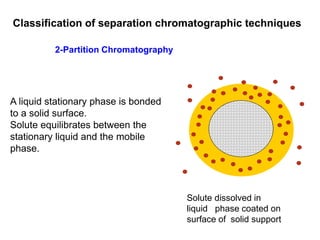
2-Partition Chromatography
Solute dissolved in
liquid phase coated on
surface of solid support
A liquid stationary phase is bonded
to a solid surface.
Solute equilibrates between the
stationary liquid and the mobile
phase.
Classification of separation chromatographic techniques
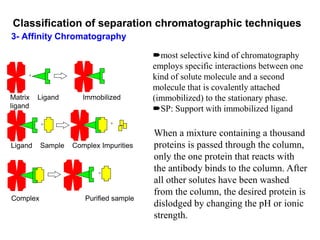
3- Affinity Chromatography
+
+ +
+
Matrix Ligand Immobilized
ligand
Ligand Sample Complex Impurities
Complex Purified sample
most selective kind of chromatography
employs specific interactions between one
kind of solute molecule and a second
molecule that is covalently attached
(immobilized) to the stationary phase.
SP: Support with immobilized ligand
When a mixture containing a thousand
proteins is passed through the column,
only the one protein that reacts with
the antibody binds to the column. After
all other solutes have been washed
from the column, the desired protein is
dislodged by changing the pH or ionic
strength.
Classification of separation chromatographic techniques
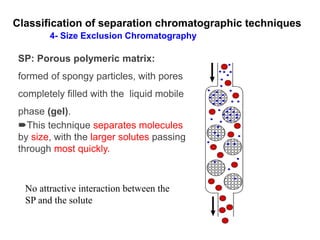
4- Size Exclusion Chromatography
SP: Porous polymeric matrix:
formed of spongy particles, with pores
completely filled with the liquid mobile
phase (gel).
This technique separates molecules
by size, with the larger solutes passing
through most quickly.
No attractive interaction between the
SP and the solute
Classification of separation chromatographic techniques
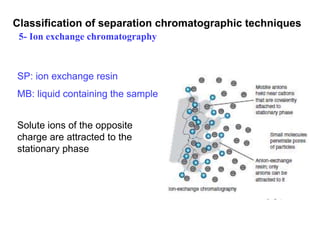
5- Ion exchange chromatography
SP: ion exchange resin
MB: liquid containing the sample
Solute ions of the opposite
charge are attracted to the
stationary phase
Classification of separation chromatographic techniques
How Does Chromatography Work?
• In all chromatographic separations, the sample is transported
in a mobile Phase
• The mobile phase is then forced through a stationary phase
(SP) held in a column or on a solid surface.
• Therefore, separation of sample into their components is based
on interaction between the components and the SP.
• Samples that interact greatly with SP, then appear to move
more slowly.
• Samples that interact weakly, then appear to move more
quickly. Consequence: separate bands, or zones are obtained
(usefull for qualitative and quantitative purpose)
1- Thin layer chromatography (TLC)
is a method for identifying substances and testing the purity of
compounds.
TLC is a useful technique because it is relatively quick and
requires small quantities of material.
Separations in TLC involve distributing a mixture of two or more
substances between a stationary phase and a mobile phase.
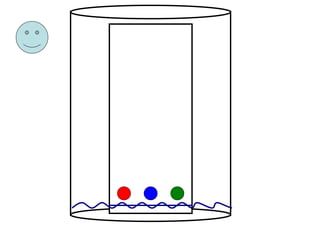
The stationary phase:
is a thin layer of adsorbent (usually silica gel or alumina) coated
on a plate.
The mobile phase:
is a developing liquid which travels up the stationary phase,
carrying the samples with it.
Components of the samples will separate on the stationary phase
according to
how much they adsorb on the stationary phase versus how much
they dissolve in the mobile phase.
Interpreting the Data
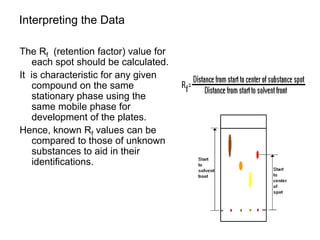
The Rf (retention factor) value for
each spot should be calculated.
It is characteristic for any given
compound on the same
stationary phase using the
same mobile phase for
development of the plates.
Hence, known Rf values can be
compared to those of unknown
substances to aid in their
identifications.
(Note: Rf values often depend on the temperature and the solvent
used in the TLC experiment.
the most effective way to identify a compound is to spot known
substances next to unknown substances on the same plate.)
In addition, the purity of a sample may be estimated from the
chromatogram.
An impure sample will often develop as two or more spots, while a
pure sample will show only one spot
2- Paper Chromatography
A method of partition chromatography using filter paper strips as
carrier or inert support.
The factor governing separation of mixtures of solutes on filter
paper is the partition between two immiscible phases.
One is usually water adsorbed on cellulose fibers in the paper
(stationary phase).
The second is the organic solvent flows past the sample on the
paper (stationary phase).
Partition occurs between the mobile phase and the stationary
aqueous phase bound by the cellulose.
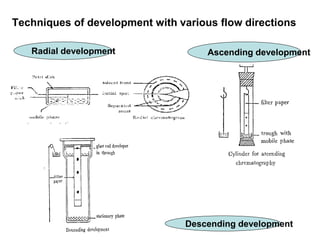
Techniques of development with various flow directions
Ascending development
Descending development
Radial development
3- Columnar Chromatography (CC)
This includes chromatographic methods in which:
The stationary phase is packed into a column.
The mobile phase is a moving liquid or gas.
According to the mechanism of separation of solutes, five major
types of CC are distinguished. Usually, one mechanism
predominates but does not exclude the others
Open Column Chromatography
Traditional column
chromatography is
characterized by addition of
mobile phase under
atmospheric pressure and the
stationary phase is packed in
a glass column.
Elution
- The process of passing a liquid
or gas through a column
Eluent
- Fluid entering the column
Eluate (effluent)
- Fluid exiting the column
eluent
Eluate (effluent)
A
B
Elution
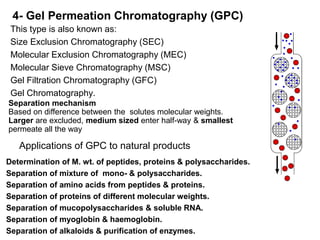
4- Gel Permeation Chromatography (GPC)
This type is also known as:
Size Exclusion Chromatography (SEC)
Molecular Exclusion Chromatography (MEC)
Molecular Sieve Chromatography (MSC)
Gel Filtration Chromatography (GFC)
Gel Chromatography.
Separation mechanism
Based on difference between the solutes molecular weights.
Larger are excluded, medium sized enter half-way & smallest
permeate all the way
Applications of GPC to natural products
Determination of M. wt. of peptides, proteins & polysaccharides.
Separation of mixture of mono- & polysaccharides.
Separation of amino acids from peptides & proteins.
Separation of proteins of different molecular weights.
Separation of mucopolysaccharides & soluble RNA.
Separation of myoglobin & haemoglobin.
Separation of alkaloids & purification of enzymes.
5- Ion Exchange Chromatography
Principle
Process by which ions of an electrolyte solution are brought into contact
with an ion exchange resin.
The ion exchange resin is an insoluble polymer consisting of a "matrix" that
carries fixed charges (not exchangeable) and mobile active ions
"counter ions" which are loosely attached to the matrix.
Cation Exchangers:
Active ions (counter ions) are
cations.
The polar groups attached to
the matrix are acidic
Anion Exchangers
Active ions (counter ions) are
anions.
The polar groups attached to the
matrix are tertiary or quaternary
ammonium groups (basic).
Applications of Ion Exchange Chromatography
1- Water softening:
Removal of Ca2+, Mg2+ & other multivalent ions causing hardness
of water by filtration through a layer of strong cation resin.
2-Water demineralization:
Removal of cations & anions dissolved in water. Usually carried by
the two step technique in which two columns are used in
sequence.
3- Neutralization:
Cationic exchanger in [H+] can be used to neutralize alkali hydroxide
& anionic exchanger in [OH-] form to neutralize the acidity.
4- Separation of electrolytes from non-electrolytes.
5- Separation of carbohydrates & their derivatives:

Chromatography الشيت الثاني.ppt

  • 1.
    Quantitative Applications In aquantitative analysis, the height or area of an analyte’s chromatographic peak is used to determine its concentration Although peak height is easy to measure, its utility is limited by the inverse relationship between the height and width of a chromatographic peak Unless chromatographic conditions are carefully controlled to maintain a constant column efficiency, variations in peak height may decrease the accuracy and precision of the quantitative analysis A better choice is to measure the area under the chromatographic peak with an integrating recorder. Since peak area is directly proportional to the amount of analyte that was injected, changes in column efficiency will not affect the accuracy or precision of the analysis
  • 2.
    Determination: What isthe concentration of component A? Peak area (or height) is proportional to the concentration (or amount) of the component. The concentration of component A(caffeine) is determined by comparing the peak area with that of the standard caffeine peak. Caffeine (1mg/ml) 5ul injection (5ug) - Chromatographic peak area is proportional to quantity of solute - A good measure of solute concentration is obtained by using internal standards - Internal standards eliminate the effect of variable conditions - Conditions mostly vary from run to run Conditions Include - Sample injection errors or changes - Column changes - Detector variations
  • 3.
    Calibration curves areusually constructed by analyzing a series of external standards and plotting the detector’s signal as a function of their known concentrations As long as the injection volume is identical for every standard and sample, calibration curves prepared in this fashion give both accurate and precise results Internal Standard: Here the sample and standards are spiked with an equal amount of a solute whose retention time near that of the analyte The ratio of the area of the standard or analyte to that of the internal standard is used to prepare the calibration curve and determine the unknown concentration analyte IS analyte IS Area Area c c 
  • 4.
    Zhou and colleaguesdetermined the %w/w H2O in methanol by GC, using a capillary column coated with a nonpolar stationary phase and a thermal conductivity detector. A series of calibration standards gave the following results (a) What is the % w/w H2O in a sample giving a peak height of 8.63? (b) The % w/w H2O in a freeze-dried antibiotic sample gave a peak height of 13.66
  • 5.
    Classification of chromatography 1.Based on mechanism of separation I. Adsorption chromatography II. Partition chromatography , …..etc 2. Based on stationary phases I. Solid phase chromatography i. Liquid- Solid Chromatography ii. Gas-Solid- Chromatography II. Liquid phase chromatography i. Liquid-liquid chromatography ii. Gas Liquid chromatography 3. Based on shape of chromatographic bed I. Planner chromatography i. Paper chromatography (PC) ii. Thin layer chromatography (TLC) II. Column chromatography i. Packed column chromatography ii. Open tubular column chromatography Based on mobile phases : 1- Liquid chromatography: mobile phase is a liquid. (LLC, LSC). 2- Gas chromatography : mobile phase is a gas. (GSC, GLC). OR
  • 6.
    Flow chart diagramof chromatography chromatography adsorption Competition between Solid and Gas (G.S.C.) Liquid Column chromatography Thin layer chromatography partition Competition between Liquid and Gas G.L.C. Liquid H.P.L.C. Column chromatography Paper chromatography TLC
  • 7.
    N.B: Only LCcan be performed on planar and column techniques Classification of column chromatographic methods:
  • 8.
    1- Adsorption Chromatography Eluentflow Active site Analyte Classification of separation chromatographic techniques Solute is adsorbed on the surface of the solid particles. The more strongly a solute is adsorbed, the slower it travels through the column
  • 9.
    2-Partition Chromatography Solute dissolvedin liquid phase coated on surface of solid support A liquid stationary phase is bonded to a solid surface. Solute equilibrates between the stationary liquid and the mobile phase. Classification of separation chromatographic techniques
  • 10.
    3- Affinity Chromatography + ++ + Matrix Ligand Immobilized ligand Ligand Sample Complex Impurities Complex Purified sample most selective kind of chromatography employs specific interactions between one kind of solute molecule and a second molecule that is covalently attached (immobilized) to the stationary phase. SP: Support with immobilized ligand When a mixture containing a thousand proteins is passed through the column, only the one protein that reacts with the antibody binds to the column. After all other solutes have been washed from the column, the desired protein is dislodged by changing the pH or ionic strength. Classification of separation chromatographic techniques
  • 11.
    4- Size ExclusionChromatography SP: Porous polymeric matrix: formed of spongy particles, with pores completely filled with the liquid mobile phase (gel). This technique separates molecules by size, with the larger solutes passing through most quickly. No attractive interaction between the SP and the solute Classification of separation chromatographic techniques
  • 12.
    5- Ion exchangechromatography SP: ion exchange resin MB: liquid containing the sample Solute ions of the opposite charge are attracted to the stationary phase Classification of separation chromatographic techniques
  • 13.
    How Does ChromatographyWork? • In all chromatographic separations, the sample is transported in a mobile Phase • The mobile phase is then forced through a stationary phase (SP) held in a column or on a solid surface. • Therefore, separation of sample into their components is based on interaction between the components and the SP. • Samples that interact greatly with SP, then appear to move more slowly. • Samples that interact weakly, then appear to move more quickly. Consequence: separate bands, or zones are obtained (usefull for qualitative and quantitative purpose)
  • 14.
    1- Thin layerchromatography (TLC) is a method for identifying substances and testing the purity of compounds. TLC is a useful technique because it is relatively quick and requires small quantities of material. Separations in TLC involve distributing a mixture of two or more substances between a stationary phase and a mobile phase. The stationary phase: is a thin layer of adsorbent (usually silica gel or alumina) coated on a plate. The mobile phase: is a developing liquid which travels up the stationary phase, carrying the samples with it. Components of the samples will separate on the stationary phase according to how much they adsorb on the stationary phase versus how much they dissolve in the mobile phase.
  • 16.
    Interpreting the Data TheRf (retention factor) value for each spot should be calculated. It is characteristic for any given compound on the same stationary phase using the same mobile phase for development of the plates. Hence, known Rf values can be compared to those of unknown substances to aid in their identifications.
  • 17.
    (Note: Rf valuesoften depend on the temperature and the solvent used in the TLC experiment. the most effective way to identify a compound is to spot known substances next to unknown substances on the same plate.) In addition, the purity of a sample may be estimated from the chromatogram. An impure sample will often develop as two or more spots, while a pure sample will show only one spot
  • 18.
    2- Paper Chromatography Amethod of partition chromatography using filter paper strips as carrier or inert support. The factor governing separation of mixtures of solutes on filter paper is the partition between two immiscible phases. One is usually water adsorbed on cellulose fibers in the paper (stationary phase). The second is the organic solvent flows past the sample on the paper (stationary phase). Partition occurs between the mobile phase and the stationary aqueous phase bound by the cellulose.
  • 19.
    Techniques of developmentwith various flow directions Ascending development Descending development Radial development
  • 20.
    3- Columnar Chromatography(CC) This includes chromatographic methods in which: The stationary phase is packed into a column. The mobile phase is a moving liquid or gas. According to the mechanism of separation of solutes, five major types of CC are distinguished. Usually, one mechanism predominates but does not exclude the others Open Column Chromatography Traditional column chromatography is characterized by addition of mobile phase under atmospheric pressure and the stationary phase is packed in a glass column.
  • 21.
    Elution - The processof passing a liquid or gas through a column Eluent - Fluid entering the column Eluate (effluent) - Fluid exiting the column eluent Eluate (effluent) A B Elution
  • 22.
    4- Gel PermeationChromatography (GPC) This type is also known as: Size Exclusion Chromatography (SEC) Molecular Exclusion Chromatography (MEC) Molecular Sieve Chromatography (MSC) Gel Filtration Chromatography (GFC) Gel Chromatography. Separation mechanism Based on difference between the solutes molecular weights. Larger are excluded, medium sized enter half-way & smallest permeate all the way Applications of GPC to natural products Determination of M. wt. of peptides, proteins & polysaccharides. Separation of mixture of mono- & polysaccharides. Separation of amino acids from peptides & proteins. Separation of proteins of different molecular weights. Separation of mucopolysaccharides & soluble RNA. Separation of myoglobin & haemoglobin. Separation of alkaloids & purification of enzymes.
  • 23.
    5- Ion ExchangeChromatography Principle Process by which ions of an electrolyte solution are brought into contact with an ion exchange resin. The ion exchange resin is an insoluble polymer consisting of a "matrix" that carries fixed charges (not exchangeable) and mobile active ions "counter ions" which are loosely attached to the matrix. Cation Exchangers: Active ions (counter ions) are cations. The polar groups attached to the matrix are acidic Anion Exchangers Active ions (counter ions) are anions. The polar groups attached to the matrix are tertiary or quaternary ammonium groups (basic).
  • 24.
    Applications of IonExchange Chromatography 1- Water softening: Removal of Ca2+, Mg2+ & other multivalent ions causing hardness of water by filtration through a layer of strong cation resin. 2-Water demineralization: Removal of cations & anions dissolved in water. Usually carried by the two step technique in which two columns are used in sequence. 3- Neutralization: Cationic exchanger in [H+] can be used to neutralize alkali hydroxide & anionic exchanger in [OH-] form to neutralize the acidity. 4- Separation of electrolytes from non-electrolytes. 5- Separation of carbohydrates & their derivatives: