©The McGraw-Hill Companies, Inc. 2008
McGraw-Hill/Irwin
A Survey of Probability Concepts
Chapter 5
2
GOALS
 Define probability.
 Describe the classical, empirical, and subjective
approaches to probability.
 Explain the terms experiment, event, outcome,
permutations, and combinations.
 Define the terms conditional probability and joint
probability.
 Calculate probabilities using the rules of addition
and rules of multiplication.
 Apply a tree diagram to organize and compute
probabilities.
 Calculate a probability using Bayes’ theorem.
3
Definitions
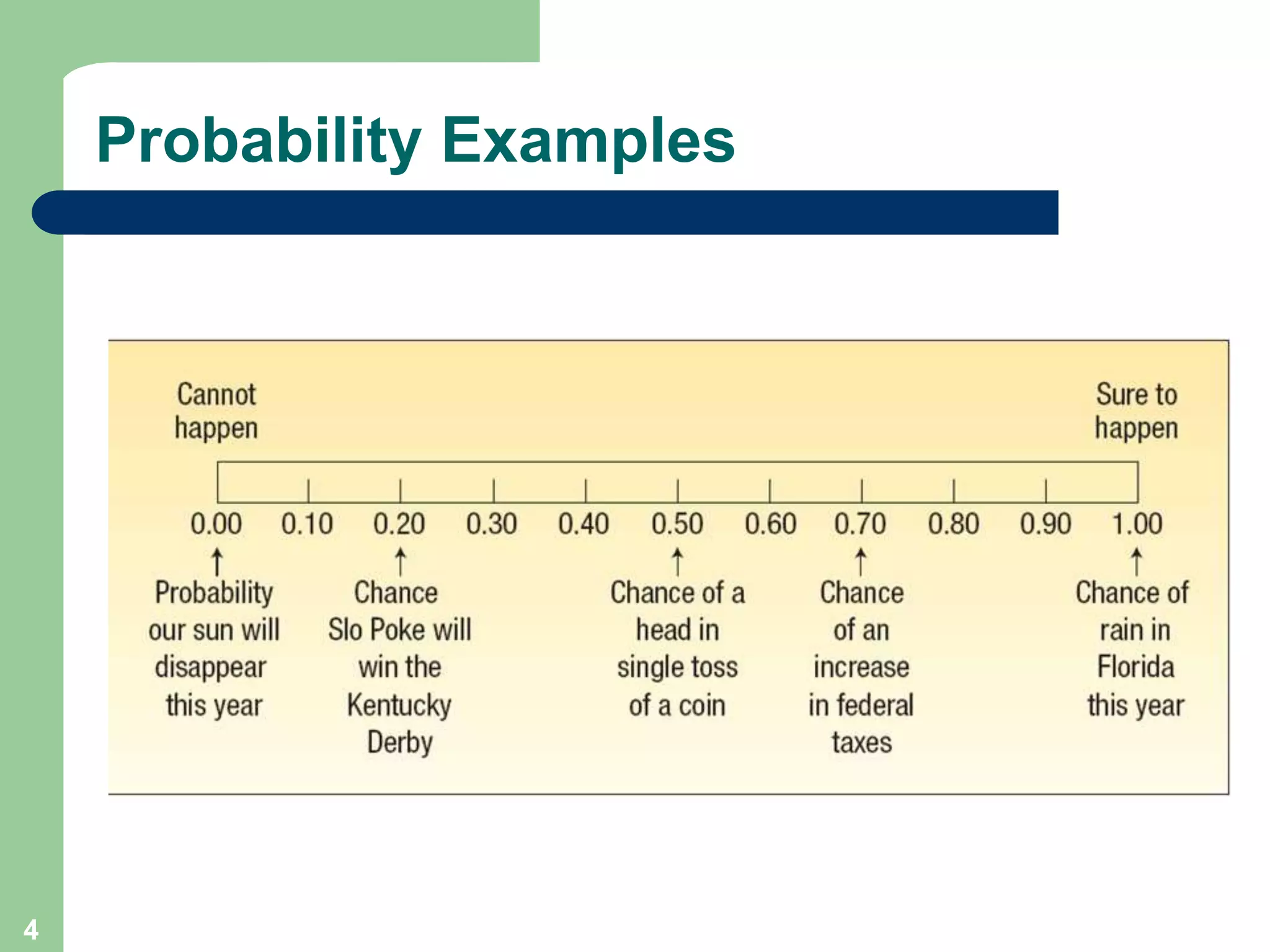
A probability is a measure of the likelihood
that an event in the future will happen. It
it can only assume a value between 0 and 1.
 A value near zero means the event is not
likely to happen. A value near one means it is
likely.
 There are three ways of assigning probability:
– classical,
– empirical, and
– subjective.
4
Probability Examples
5
Definitions continued
 An experiment is the observation of
some activity or the act of taking
some measurement.
 An outcome is the particular result
of an experiment.
 An event is the collection of one or
more outcomes of an experiment.
6
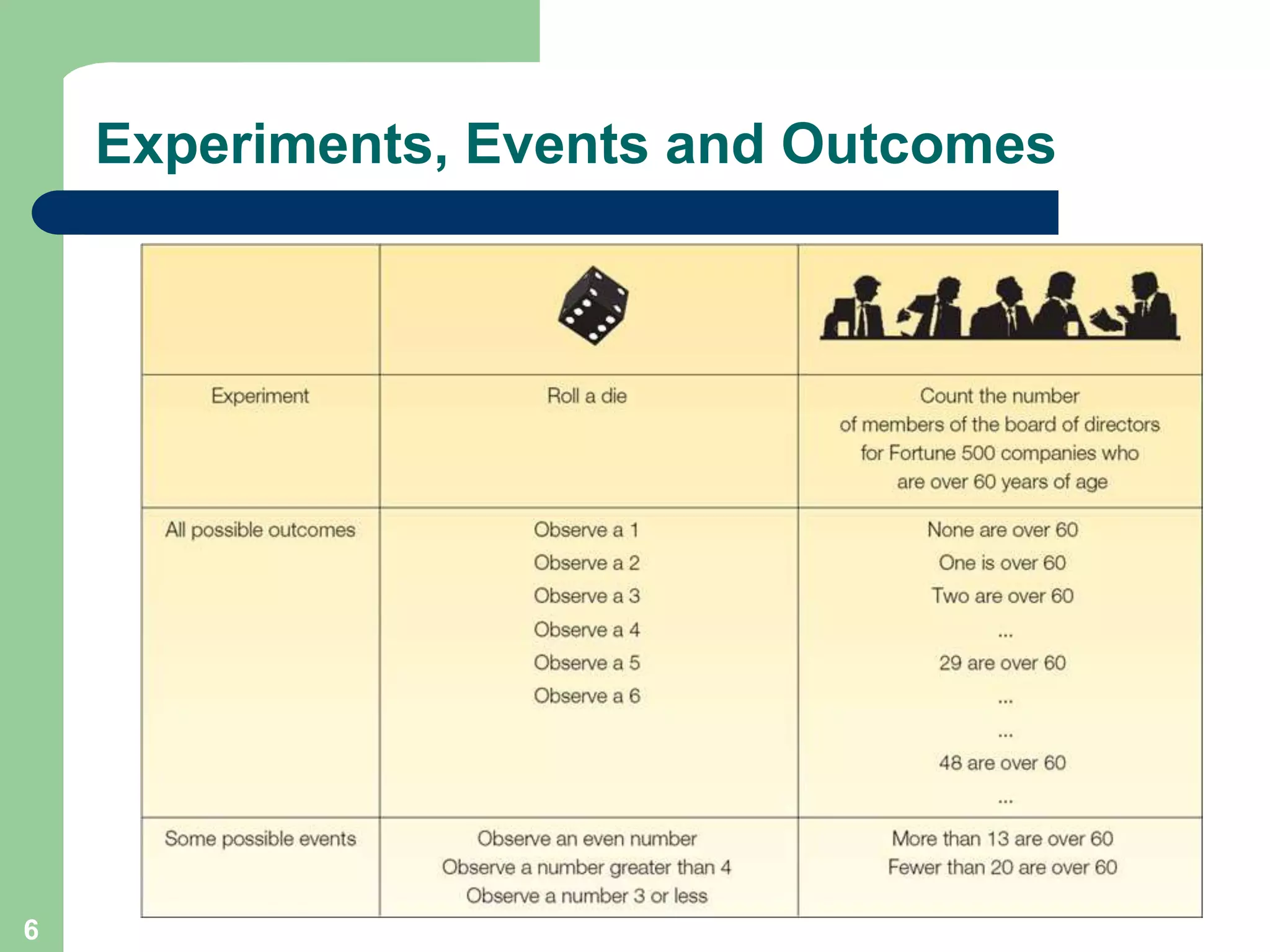
Experiments, Events and Outcomes
7
Assigning Probabilities
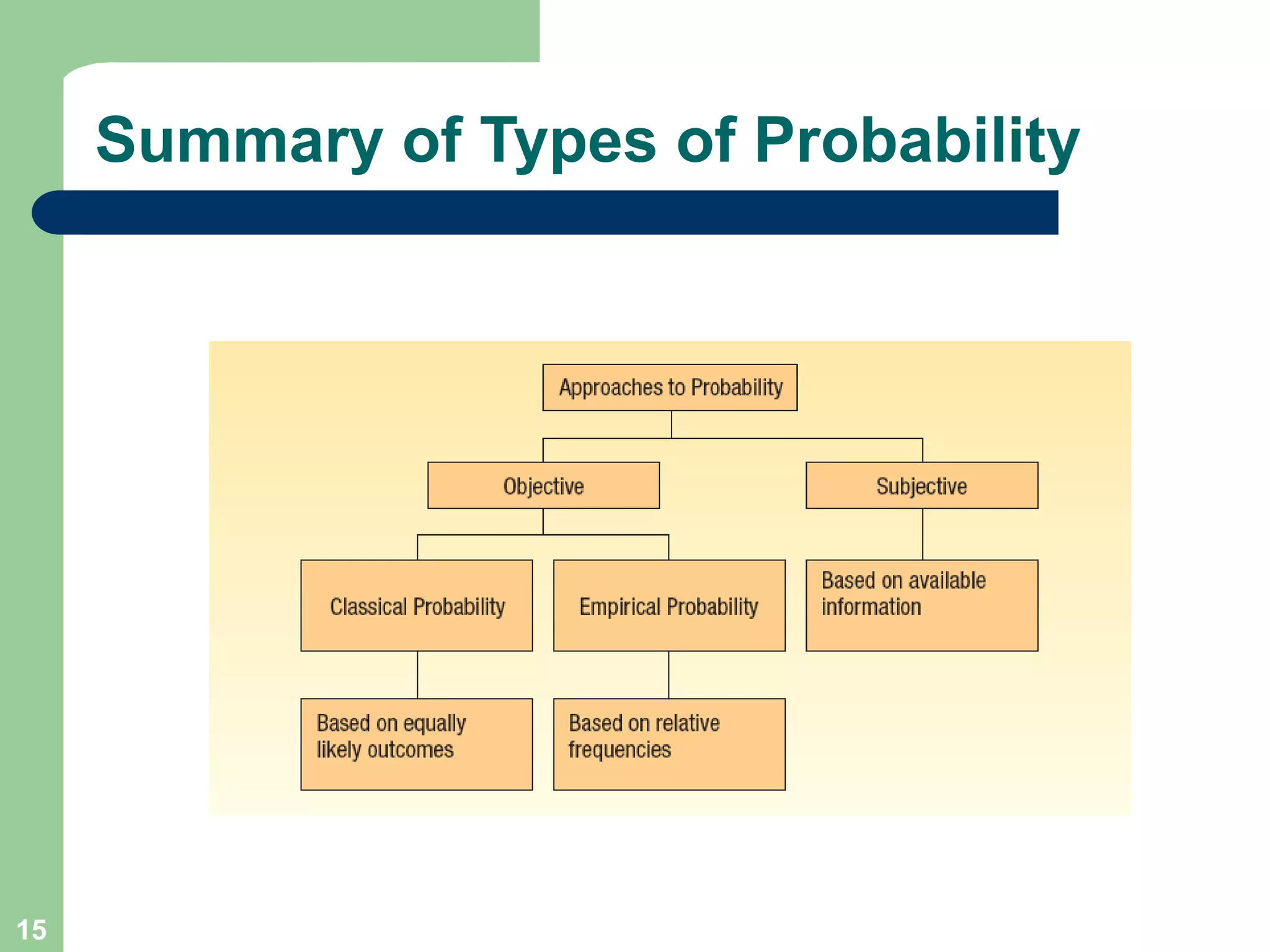
Three approaches to assigning
probabilities
– Classical
– Empirical
– Subjective
8
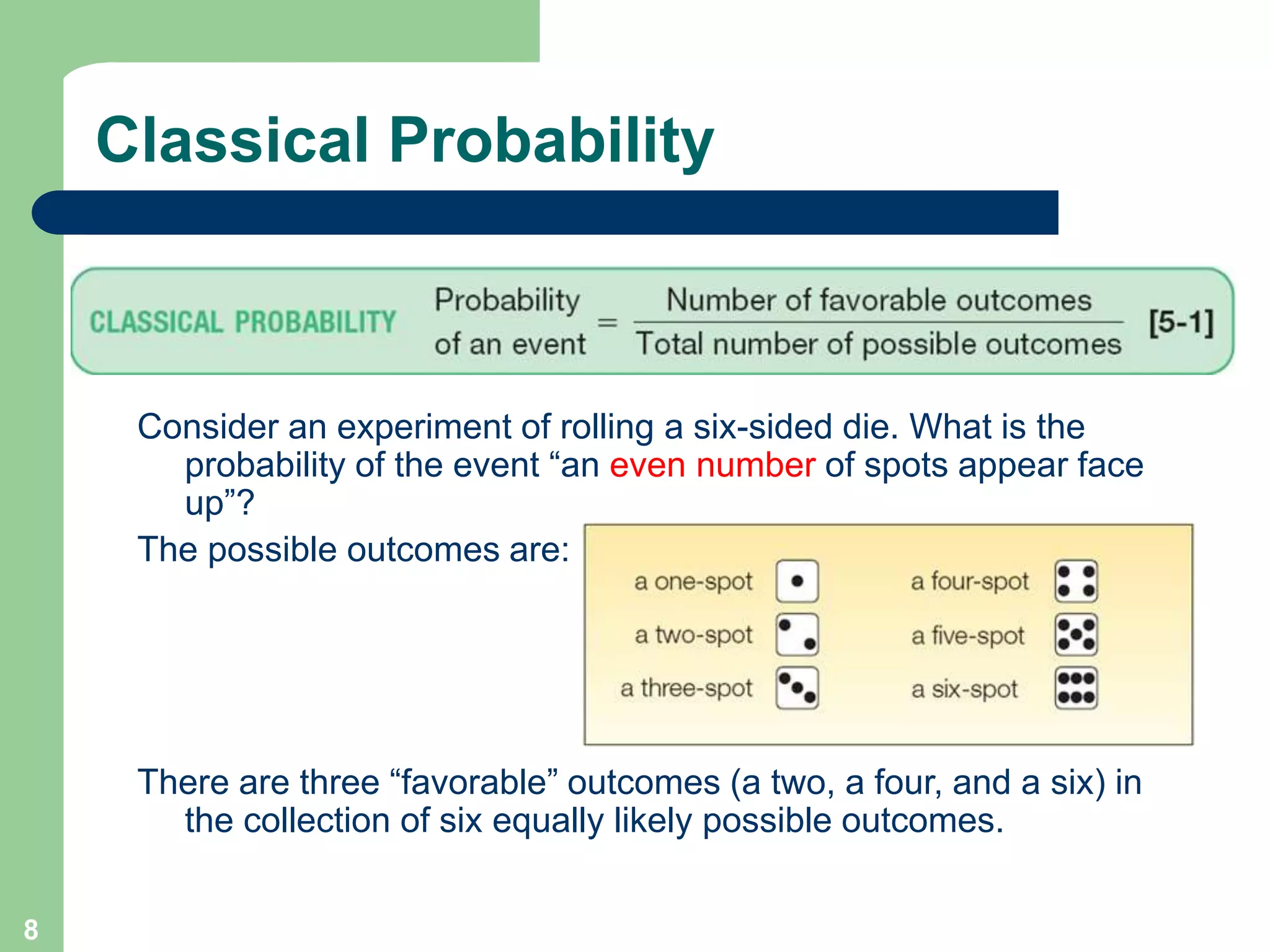
Classical Probability
Consider an experiment of rolling a six-sided die. What is the
probability of the event “an even number of spots appear face
up”?
The possible outcomes are:
There are three “favorable” outcomes (a two, a four, and a six) in
the collection of six equally likely possible outcomes.
9
Mutually Exclusive Events
 Events are mutually exclusive if the
occurrence of any one event means
that none of the others can occur at
the same time.
 Events are independent if the
occurrence of one event does not
affect the occurrence of another.
10
Collectively Exhaustive Events
 Events are collectively exhaustive
if at least one of the events must
occur when an experiment is
conducted.
11
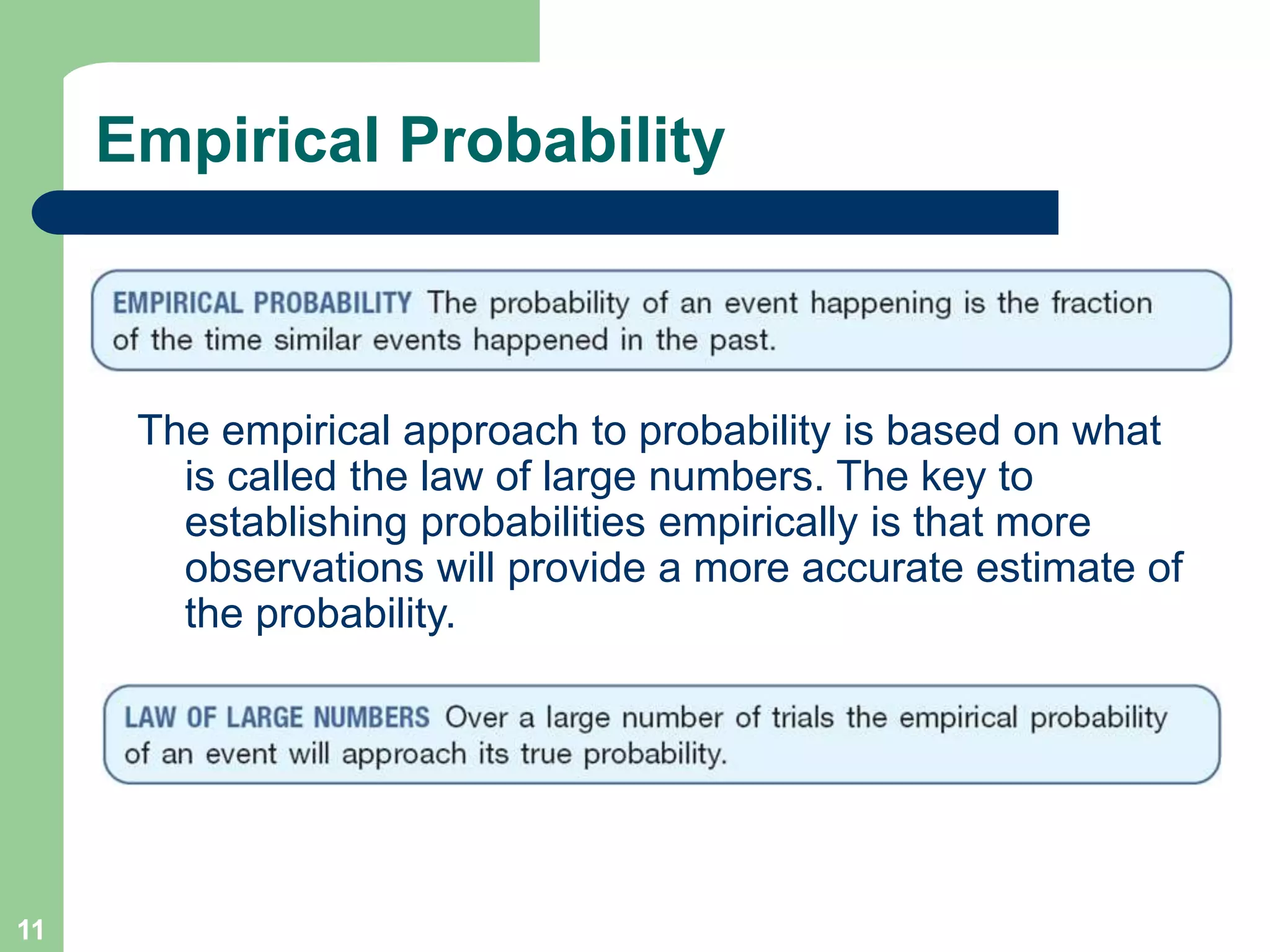
Empirical Probability
The empirical approach to probability is based on what
is called the law of large numbers. The key to
establishing probabilities empirically is that more
observations will provide a more accurate estimate of
the probability.
12
Law of Large Numbers
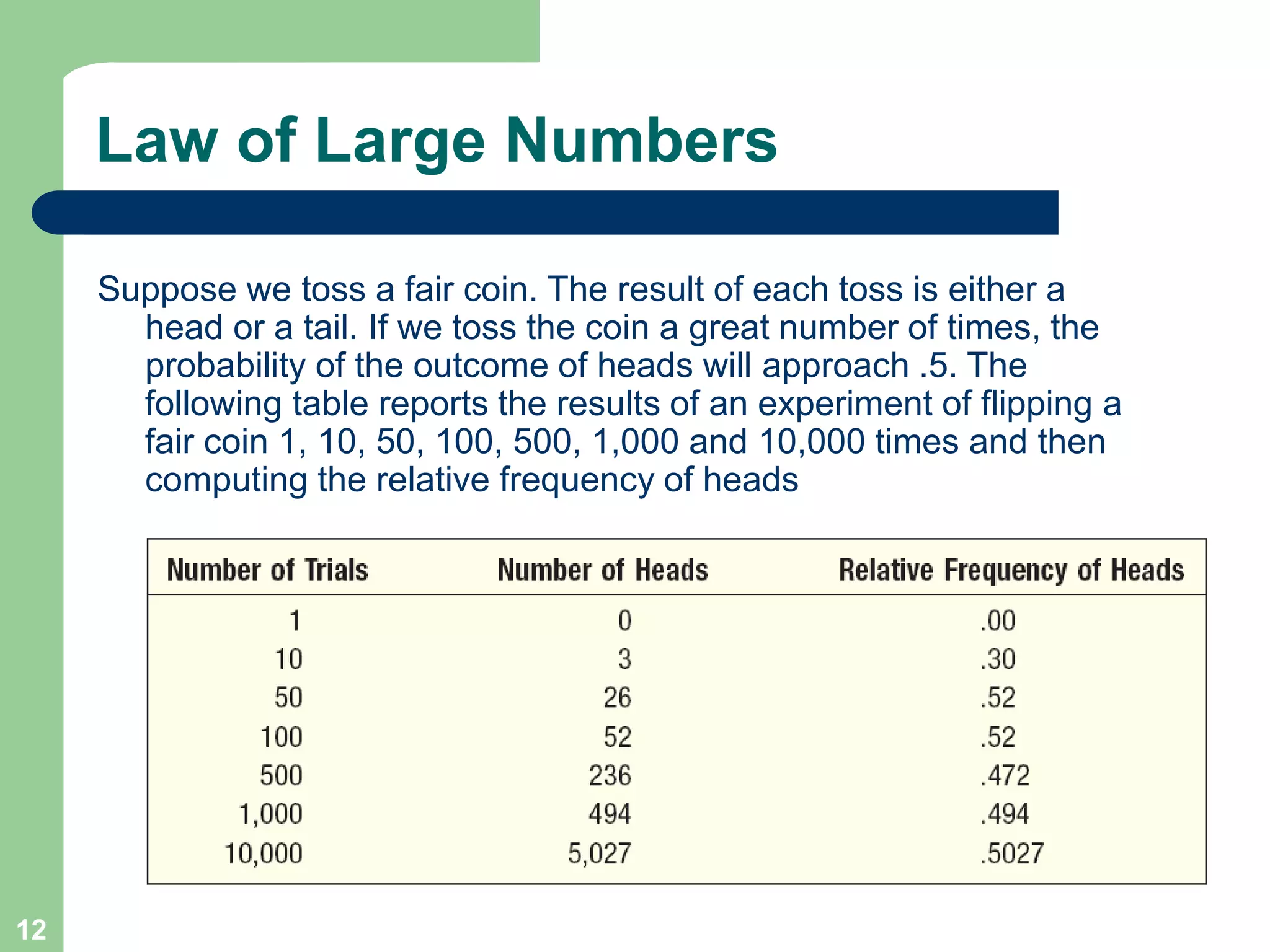
Suppose we toss a fair coin. The result of each toss is either a
head or a tail. If we toss the coin a great number of times, the
probability of the outcome of heads will approach .5. The
following table reports the results of an experiment of flipping a
fair coin 1, 10, 50, 100, 500, 1,000 and 10,000 times and then
computing the relative frequency of heads
13
Empirical Probability - Example
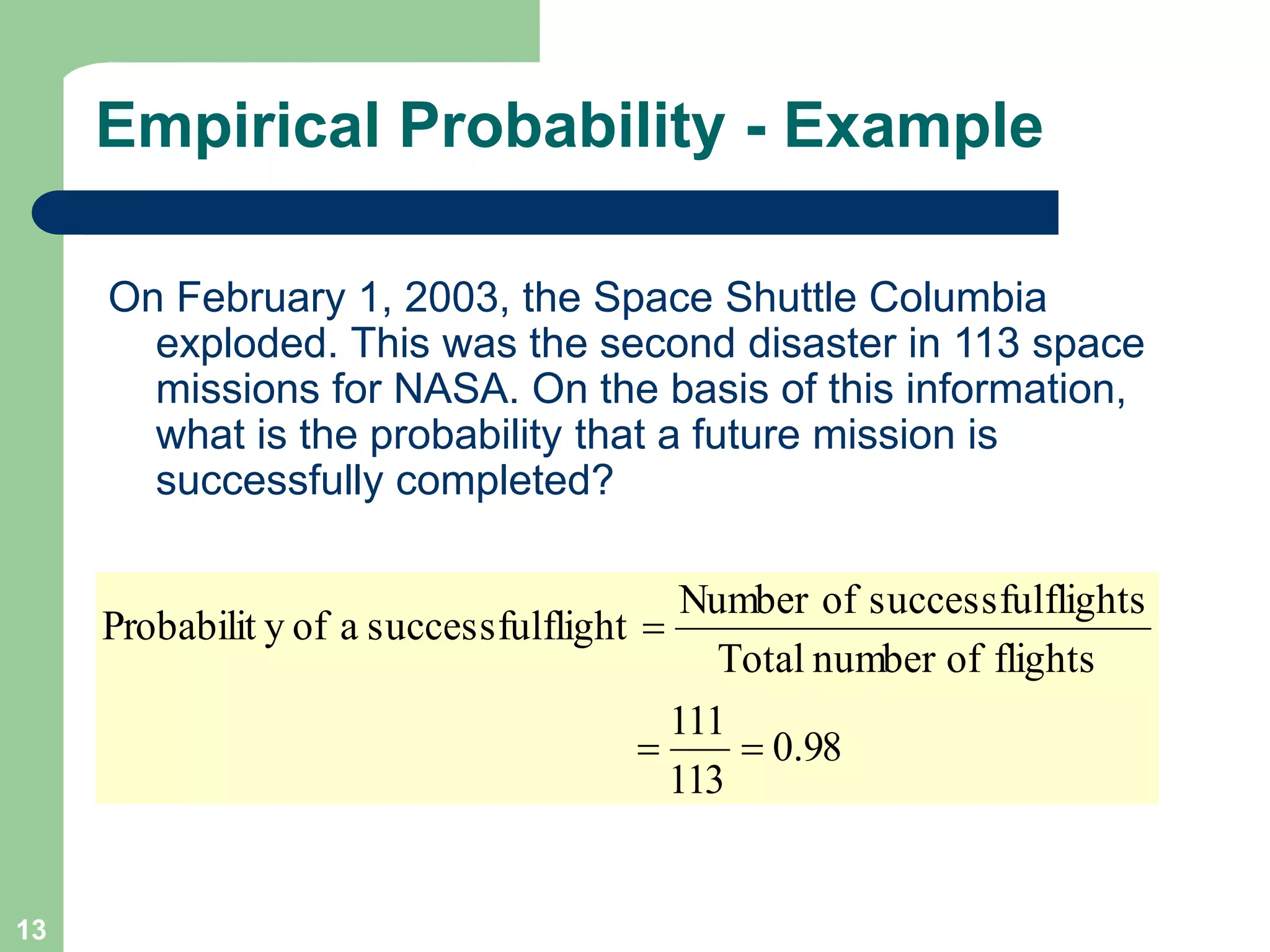
On February 1, 2003, the Space Shuttle Columbia
exploded. This was the second disaster in 113 space
missions for NASA. On the basis of this information,
what is the probability that a future mission is
successfully completed?
98
.
0
113
111
flights
of
number
Total
flights
successful
of
Number
flight
successful
a
of
y
Probabilit



14
Subjective Probability - Example
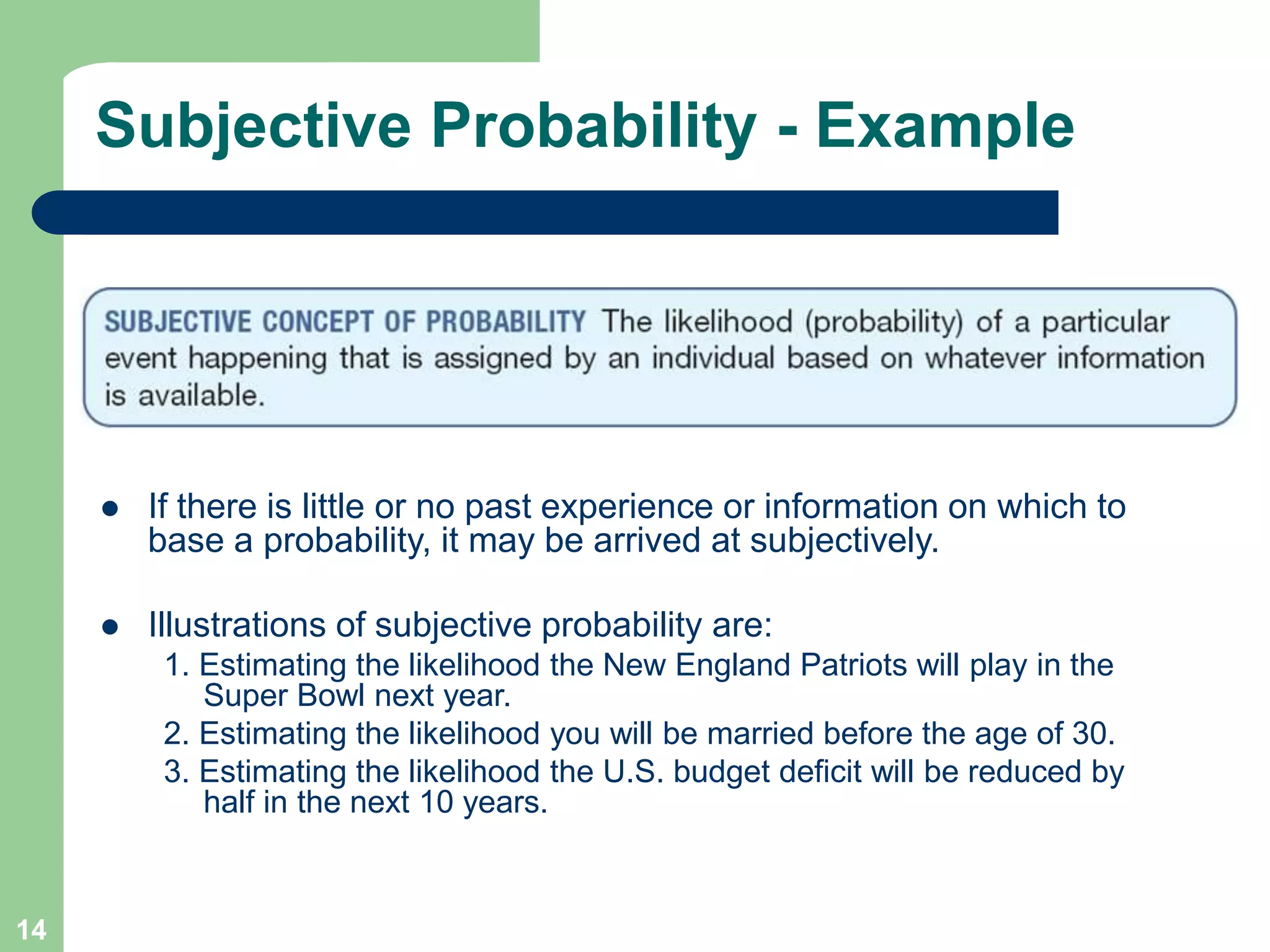
 If there is little or no past experience or information on which to
base a probability, it may be arrived at subjectively.
 Illustrations of subjective probability are:
1. Estimating the likelihood the New England Patriots will play in the
Super Bowl next year.
2. Estimating the likelihood you will be married before the age of 30.
3. Estimating the likelihood the U.S. budget deficit will be reduced by
half in the next 10 years.
15
Summary of Types of Probability
16
Rules for Computing Probabilities
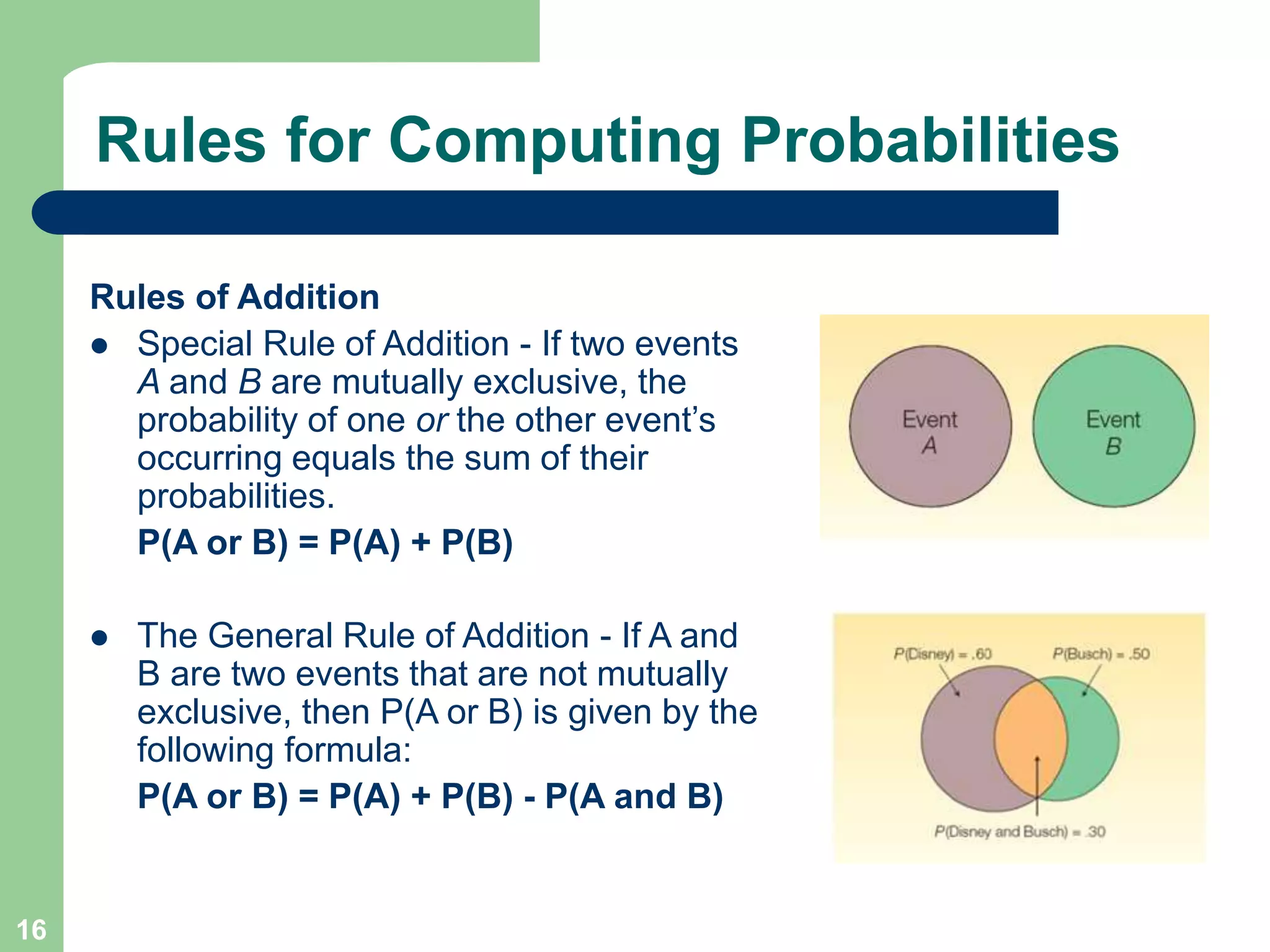
Rules of Addition
 Special Rule of Addition - If two events
A and B are mutually exclusive, the
probability of one or the other event’s
occurring equals the sum of their
probabilities.
P(A or B) = P(A) + P(B)
 The General Rule of Addition - If A and
B are two events that are not mutually
exclusive, then P(A or B) is given by the
following formula:
P(A or B) = P(A) + P(B) - P(A and B)
17
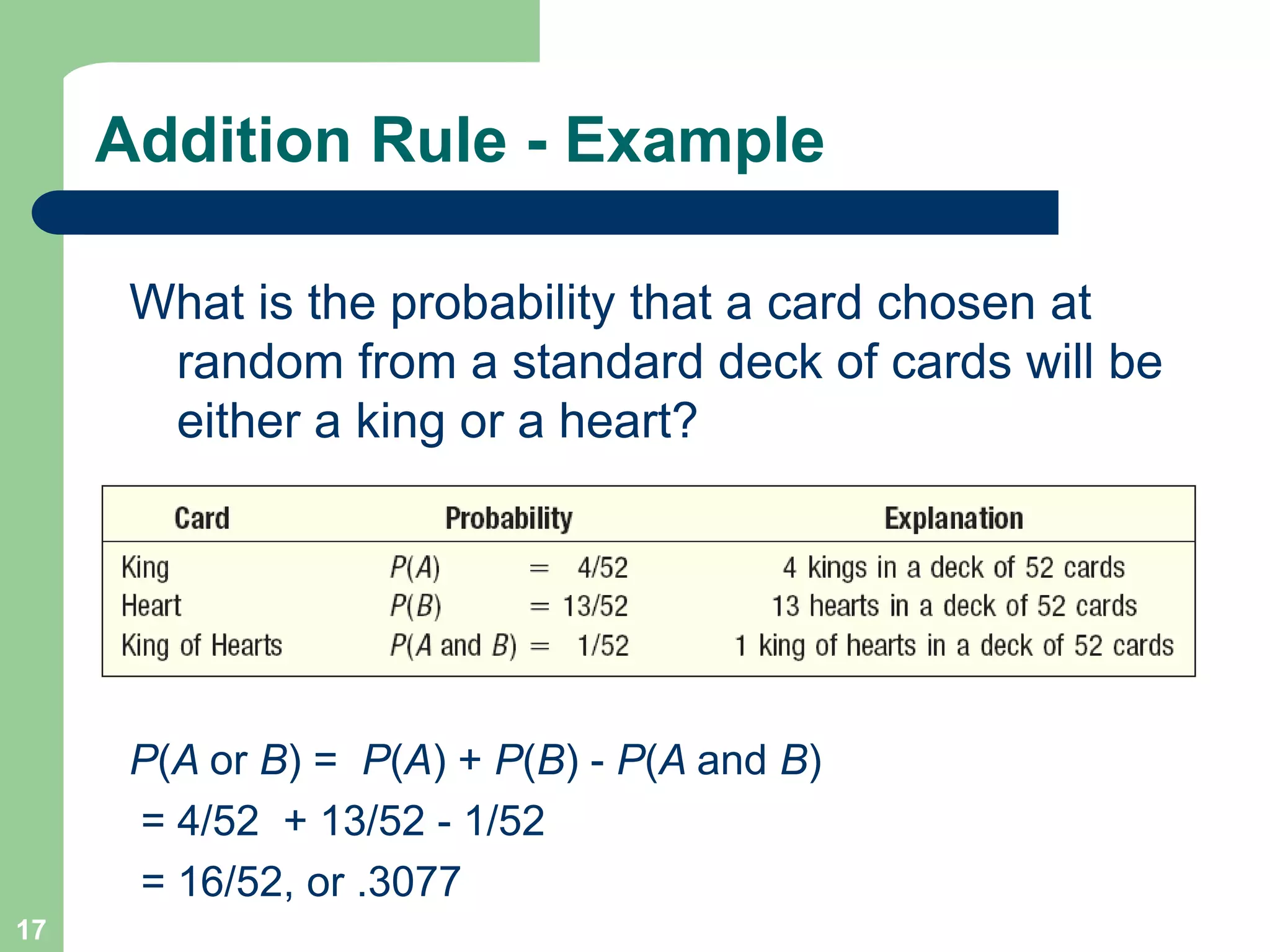
Addition Rule - Example
What is the probability that a card chosen at
random from a standard deck of cards will be
either a king or a heart?
P(A or B) = P(A) + P(B) - P(A and B)
= 4/52 + 13/52 - 1/52
= 16/52, or .3077
18
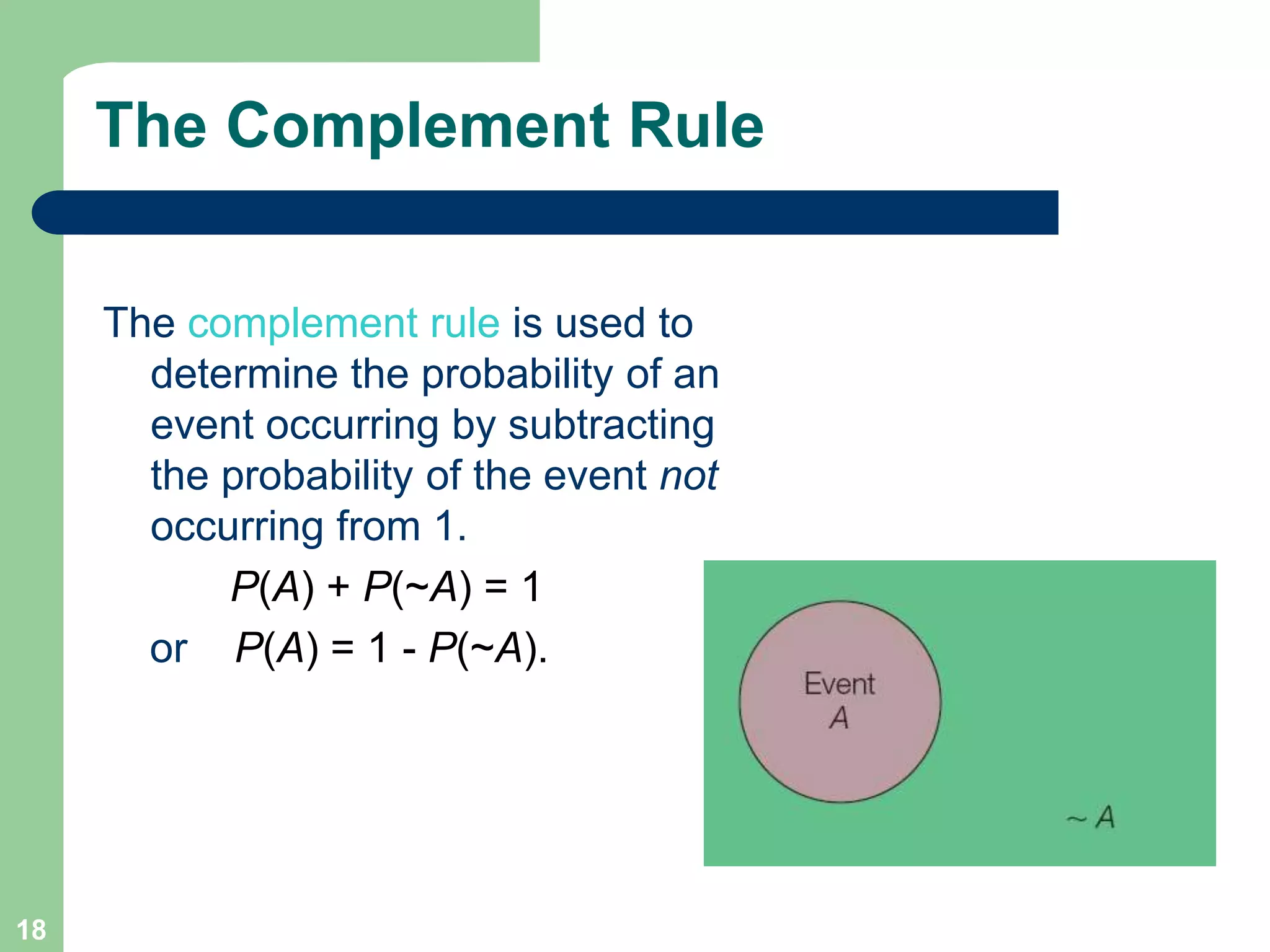
The Complement Rule
The complement rule is used to
determine the probability of an
event occurring by subtracting
the probability of the event not
occurring from 1.
P(A) + P(~A) = 1
or P(A) = 1 - P(~A).
19
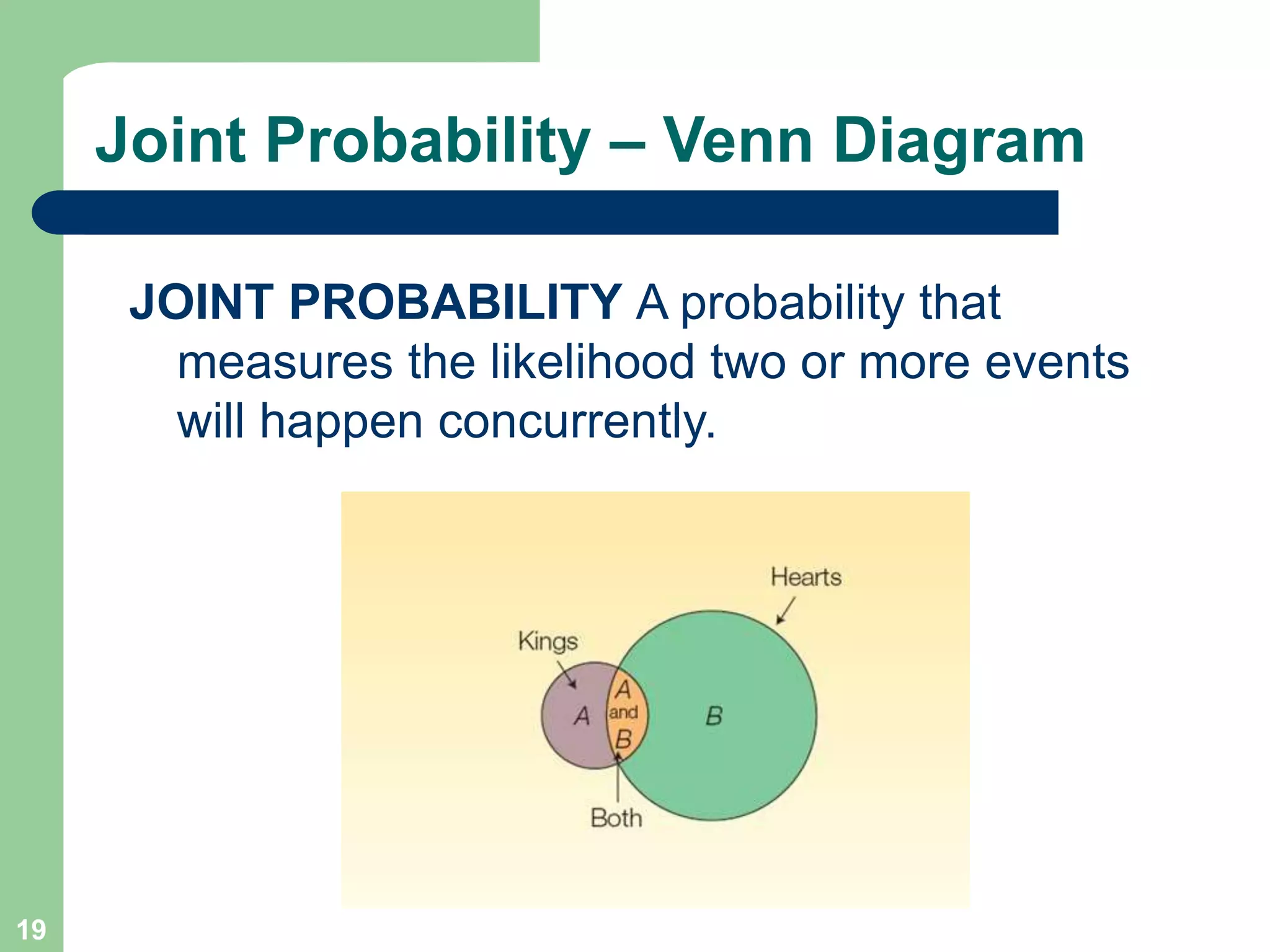
Joint Probability – Venn Diagram
JOINT PROBABILITY A probability that
measures the likelihood two or more events
will happen concurrently.
20
Special Rule of Multiplication
 The special rule of multiplication
requires that two events A and B are
independent.
 Two events A and B are independent if the
occurrence of one has no effect on the
probability of the occurrence of the other.
 This rule is written: P(A and B) = P(A)P(B)
21
Multiplication Rule-Example
A survey by the American Automobile association
(AAA) revealed 60 percent of its members made
airline reservations last year. Two members are
selected at random. What is the probability both
made airline reservations last year?
Solution:
The probability the first member made an airline reservation last year is
.60, written as P(R1) = .60
The probability that the second member selected made a reservation is
also .60, so P(R2) = .60.
Since the number of AAA members is very large, you may assume that
R1 and R2 are independent.
P(R1 and R2) = P(R1)P(R2) = (.60)(.60) = .36
22
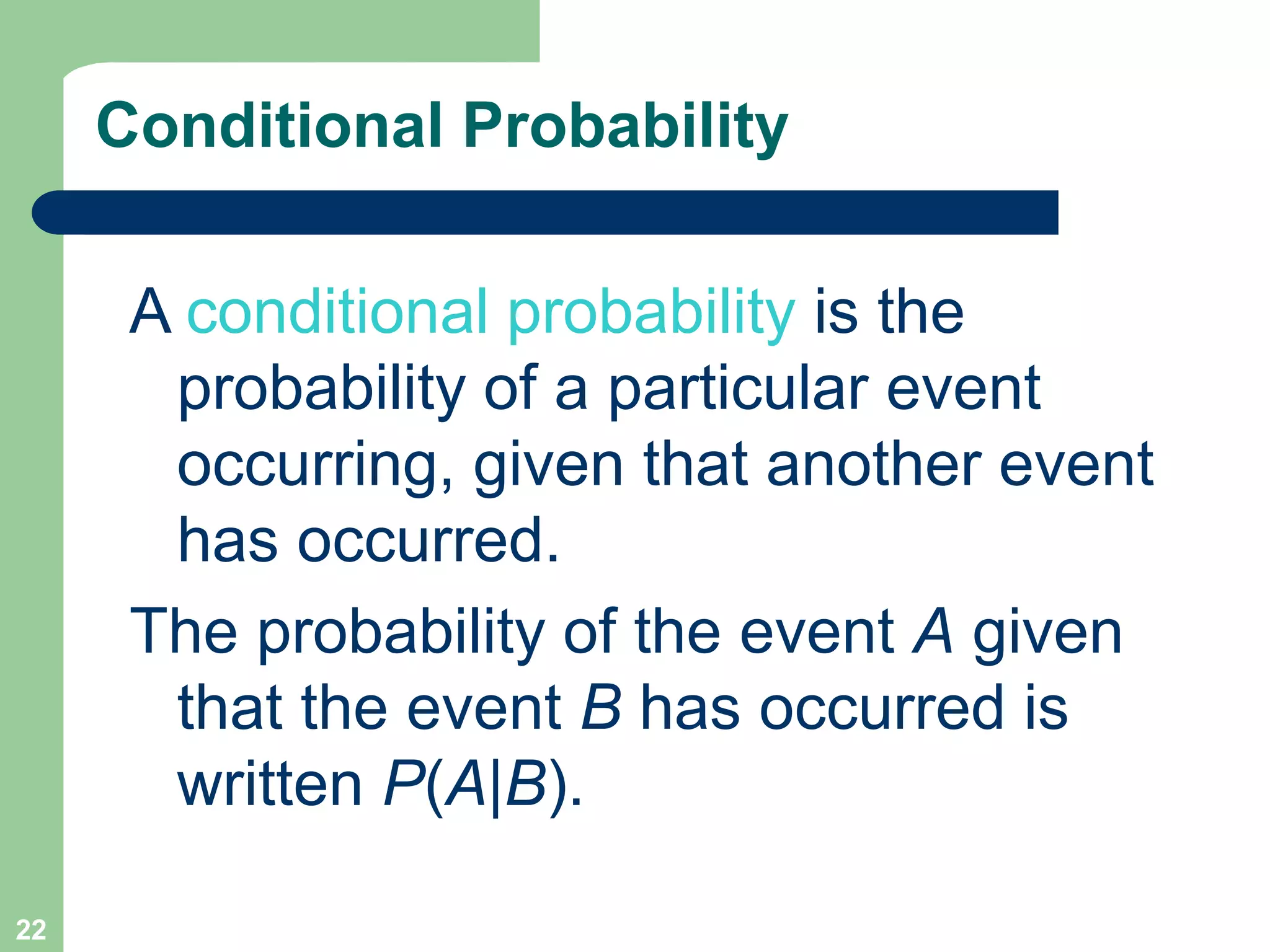
Conditional Probability
A conditional probability is the
probability of a particular event
occurring, given that another event
has occurred.
The probability of the event A given
that the event B has occurred is
written P(A|B).
23
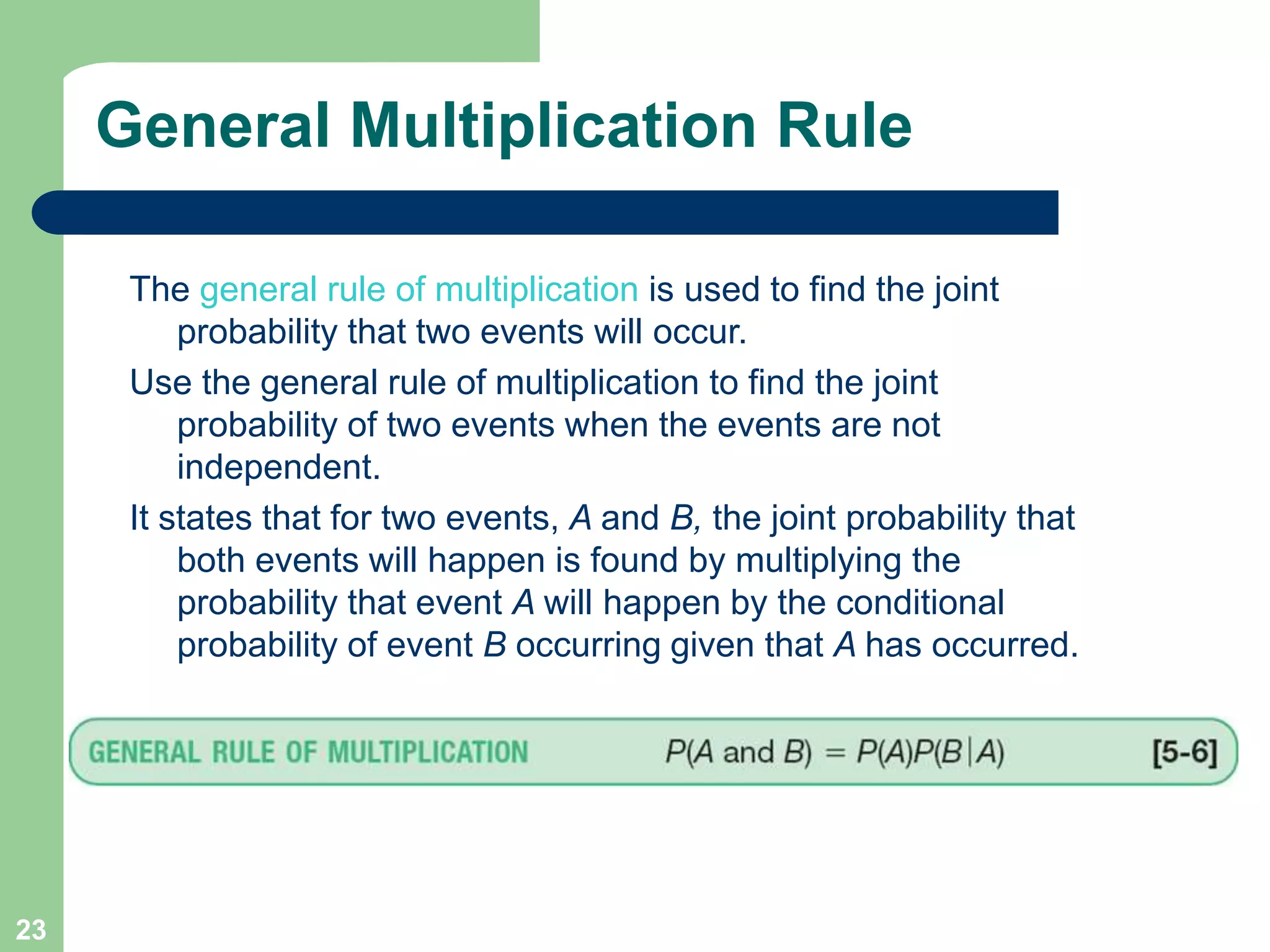
General Multiplication Rule
The general rule of multiplication is used to find the joint
probability that two events will occur.
Use the general rule of multiplication to find the joint
probability of two events when the events are not
independent.
It states that for two events, A and B, the joint probability that
both events will happen is found by multiplying the
probability that event A will happen by the conditional
probability of event B occurring given that A has occurred.
24
General Multiplication Rule - Example
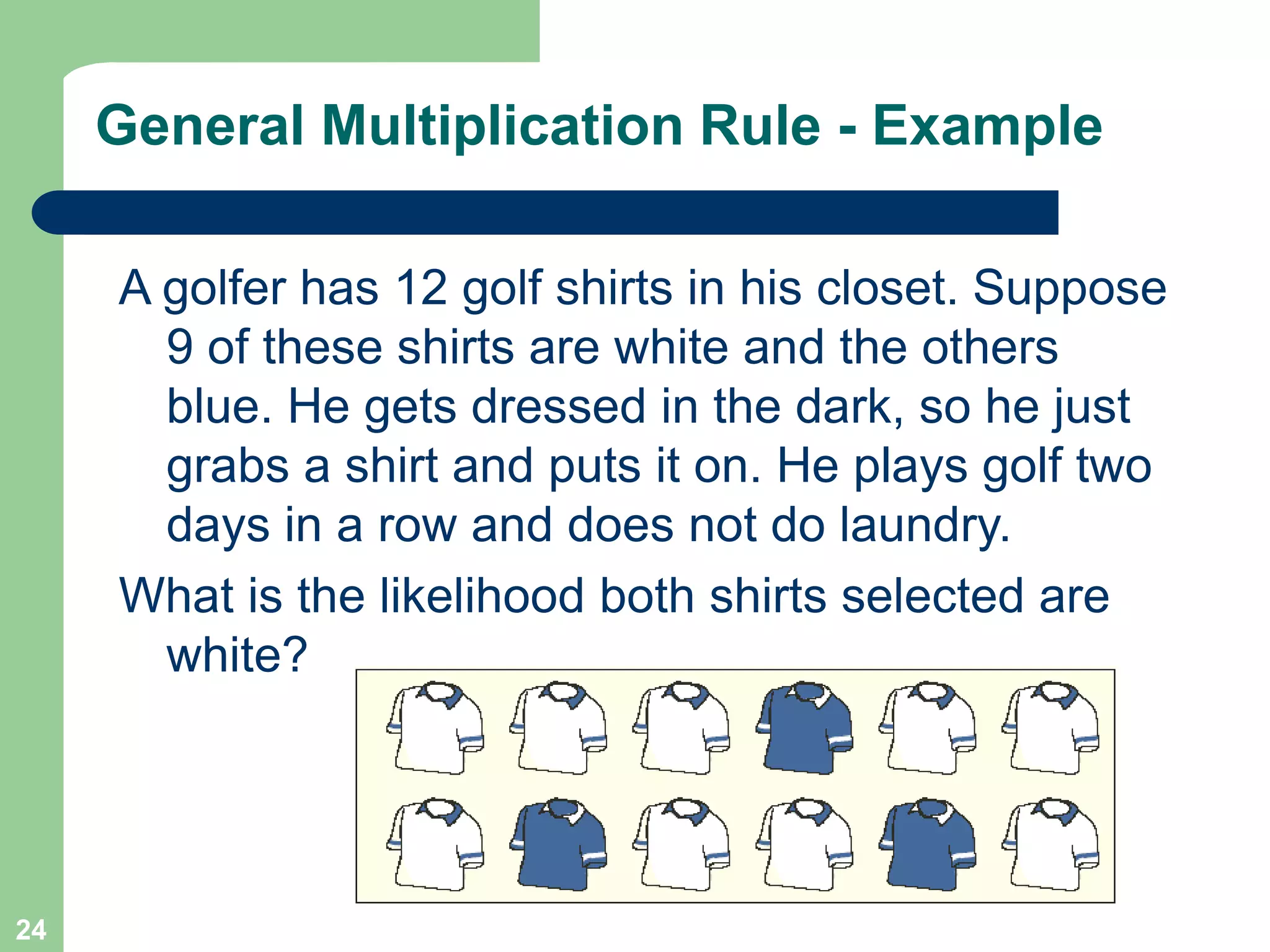
A golfer has 12 golf shirts in his closet. Suppose
9 of these shirts are white and the others
blue. He gets dressed in the dark, so he just
grabs a shirt and puts it on. He plays golf two
days in a row and does not do laundry.
What is the likelihood both shirts selected are
white?
25
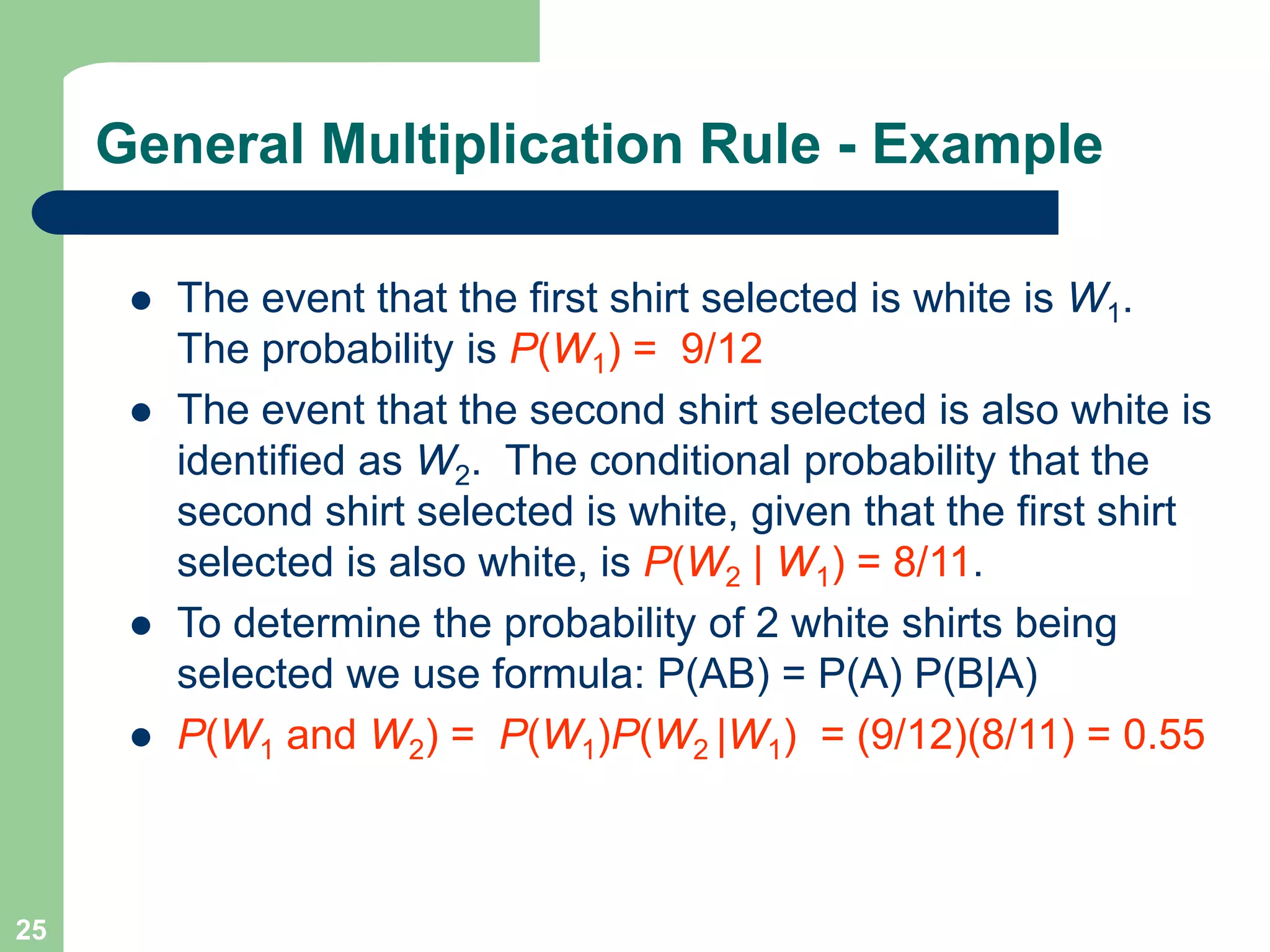
 The event that the first shirt selected is white is W1.
The probability is P(W1) = 9/12
 The event that the second shirt selected is also white is
identified as W2. The conditional probability that the
second shirt selected is white, given that the first shirt
selected is also white, is P(W2 | W1) = 8/11.
 To determine the probability of 2 white shirts being
selected we use formula: P(AB) = P(A) P(B|A)
 P(W1 and W2) = P(W1)P(W2 |W1) = (9/12)(8/11) = 0.55
General Multiplication Rule - Example
26
Contingency Tables
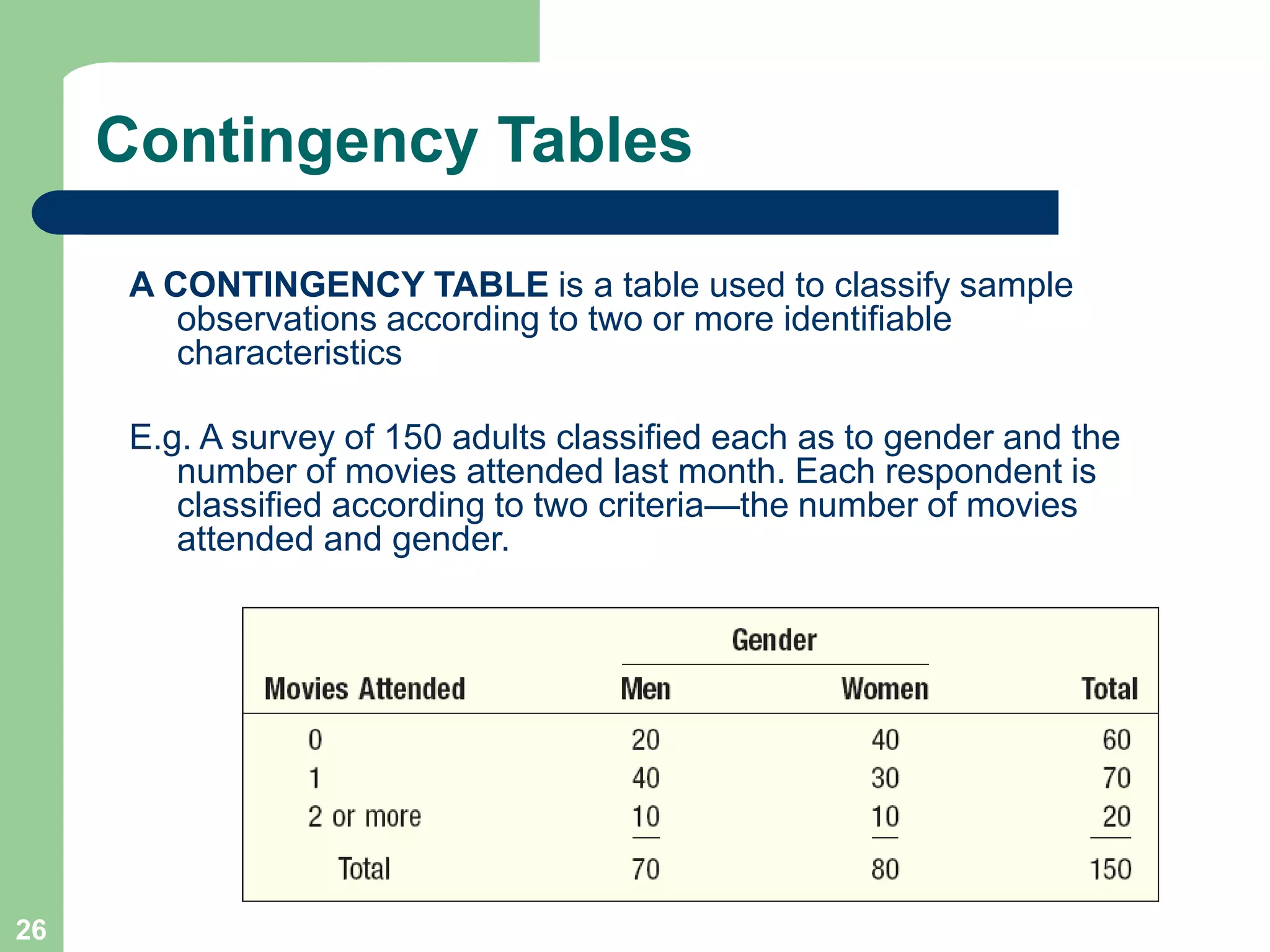
A CONTINGENCY TABLE is a table used to classify sample
observations according to two or more identifiable
characteristics
E.g. A survey of 150 adults classified each as to gender and the
number of movies attended last month. Each respondent is
classified according to two criteria—the number of movies
attended and gender.
27
Contingency Tables - Example
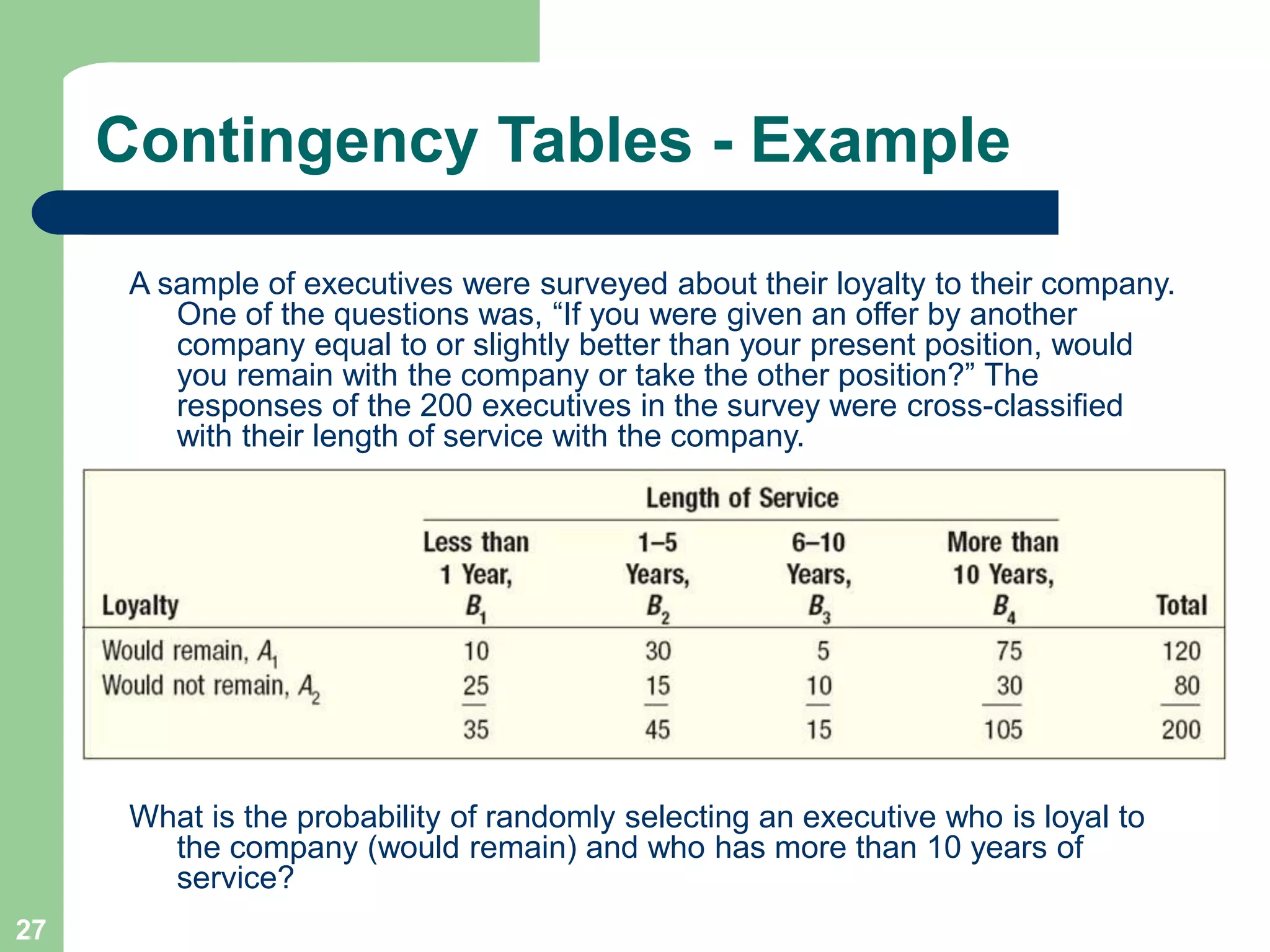
A sample of executives were surveyed about their loyalty to their company.
One of the questions was, “If you were given an offer by another
company equal to or slightly better than your present position, would
you remain with the company or take the other position?” The
responses of the 200 executives in the survey were cross-classified
with their length of service with the company.
What is the probability of randomly selecting an executive who is loyal to
the company (would remain) and who has more than 10 years of
service?
28
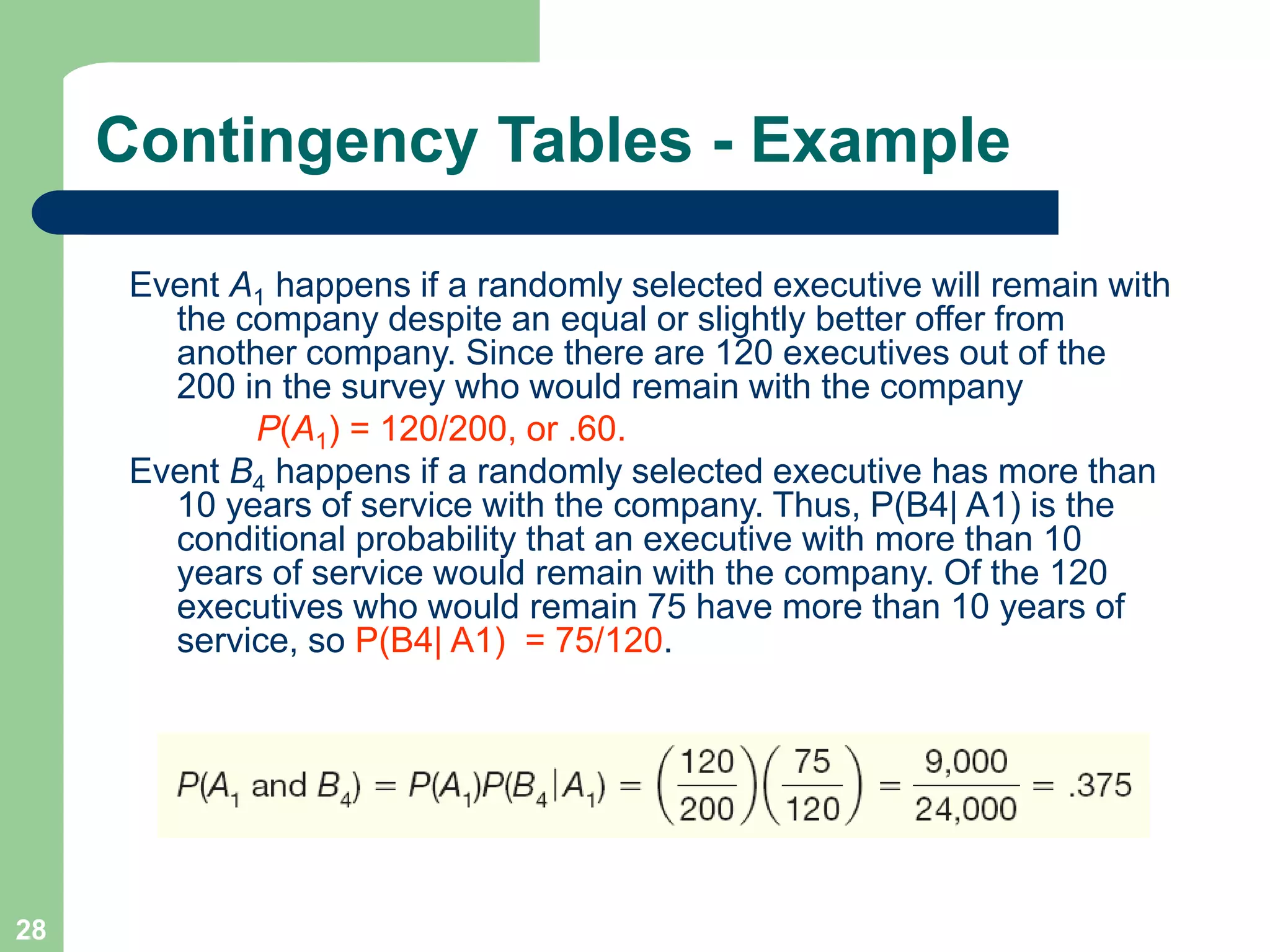
Event A1 happens if a randomly selected executive will remain with
the company despite an equal or slightly better offer from
another company. Since there are 120 executives out of the
200 in the survey who would remain with the company
P(A1) = 120/200, or .60.
Event B4 happens if a randomly selected executive has more than
10 years of service with the company. Thus, P(B4| A1) is the
conditional probability that an executive with more than 10
years of service would remain with the company. Of the 120
executives who would remain 75 have more than 10 years of
service, so P(B4| A1) = 75/120.
Contingency Tables - Example
29
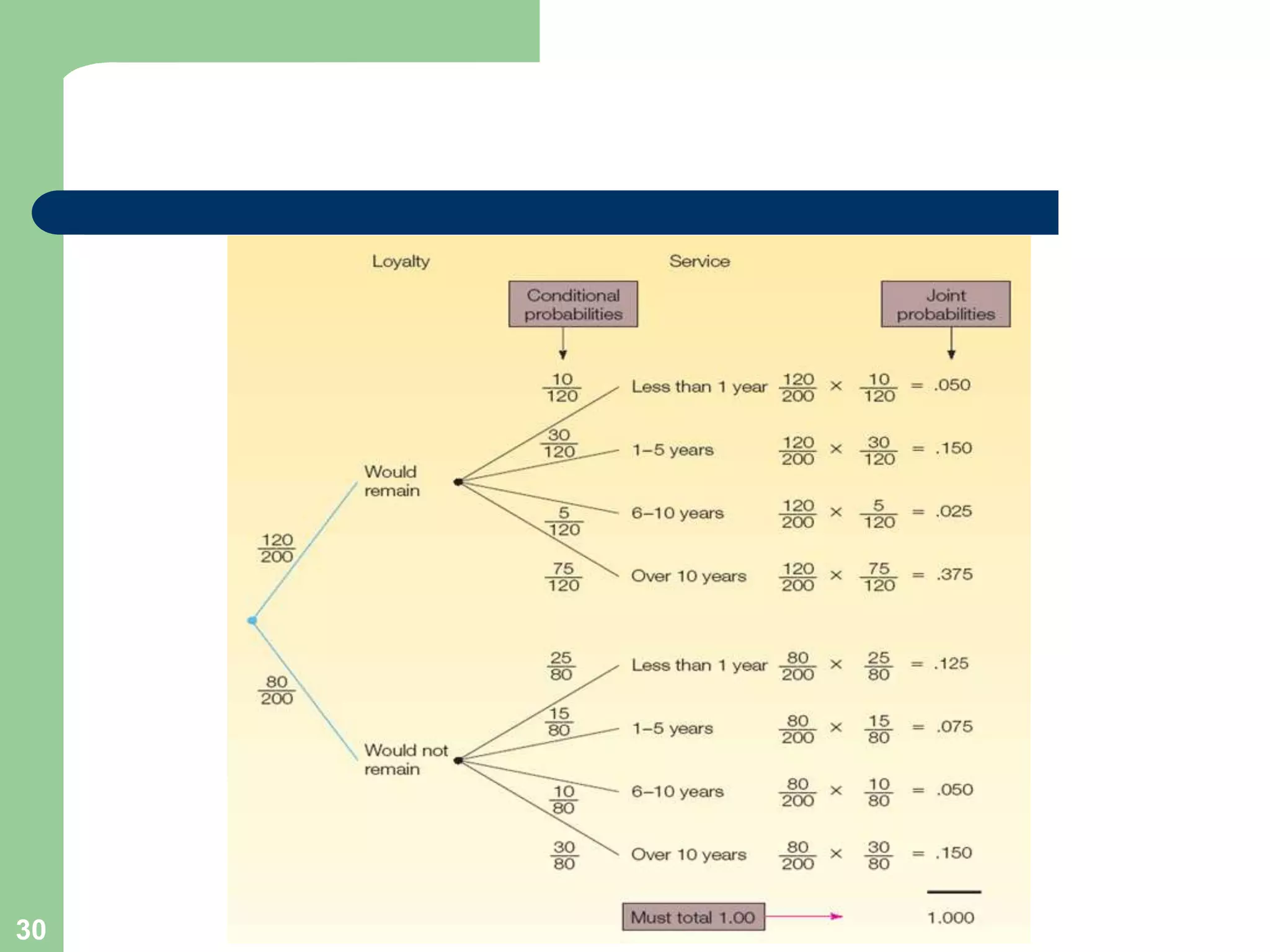
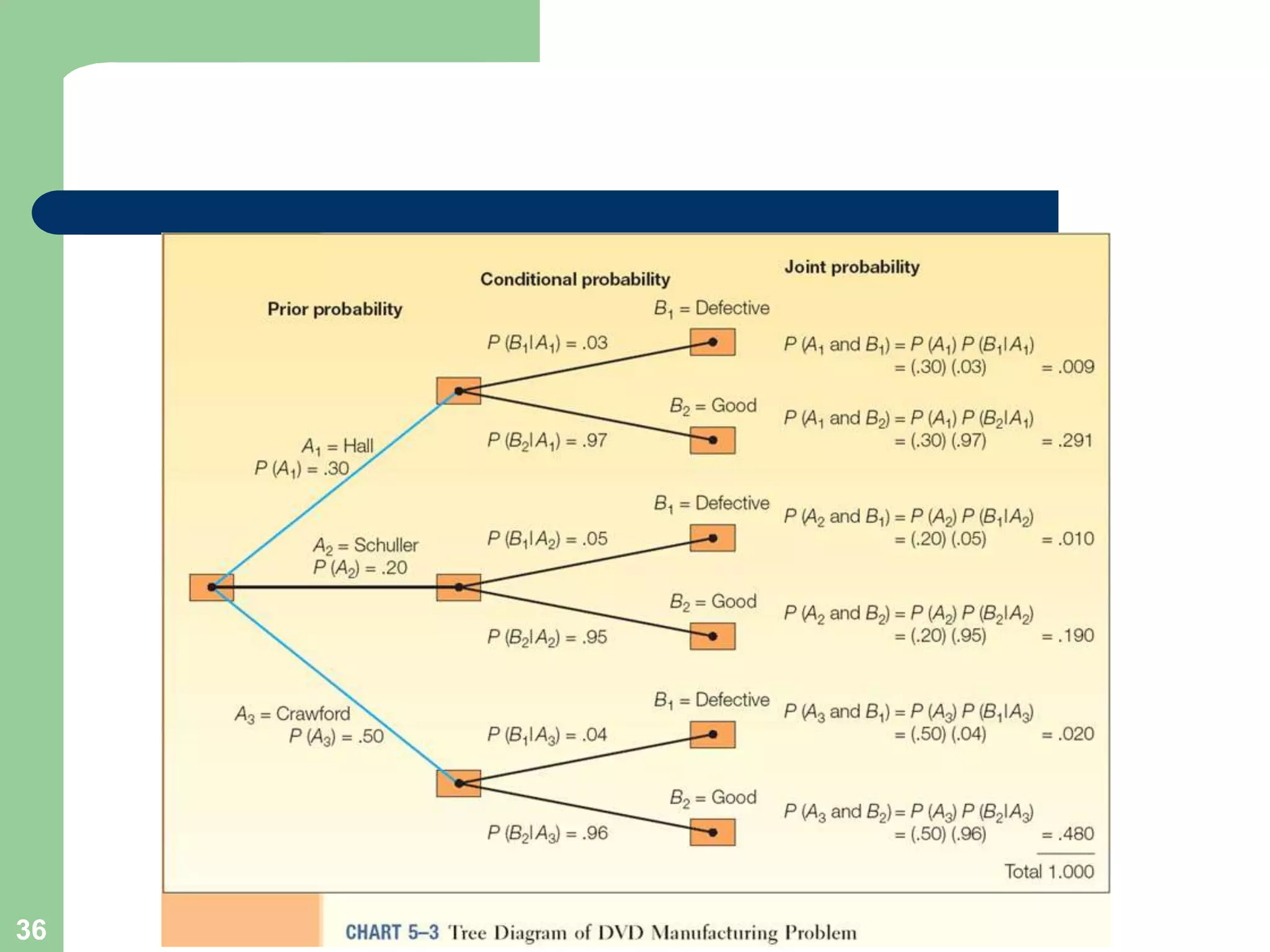
Tree Diagrams
A tree diagram is useful for portraying
conditional and joint probabilities. It is
particularly useful for analyzing business
decisions involving several stages.
A tree diagram is a graph that is helpful in
organizing calculations that involve several
stages. Each segment in the tree is one stage of
the problem. The branches of a tree diagram are
weighted by probabilities.
30
31
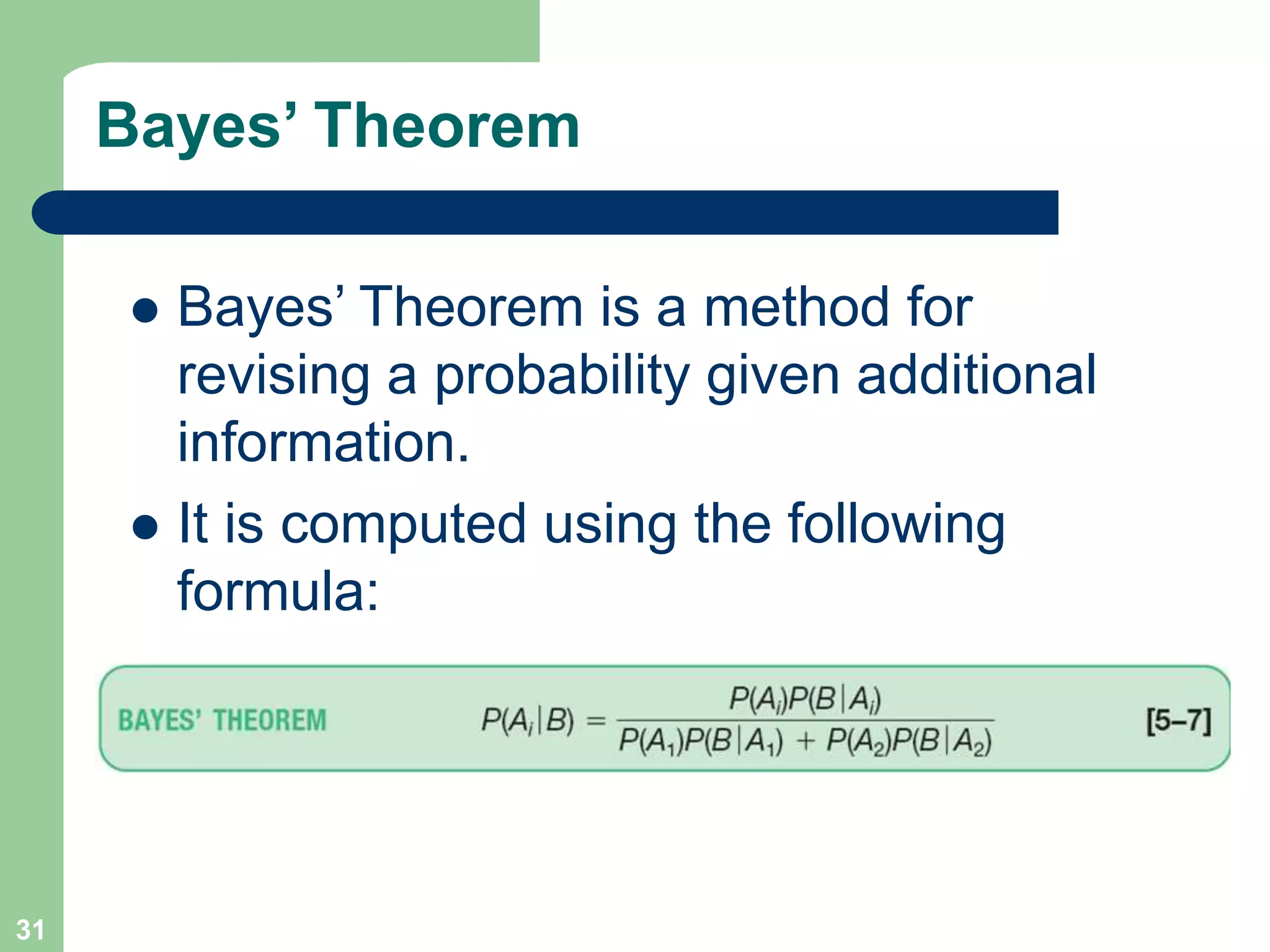
Bayes’ Theorem
 Bayes’ Theorem is a method for
revising a probability given additional
information.
 It is computed using the following
formula:
32
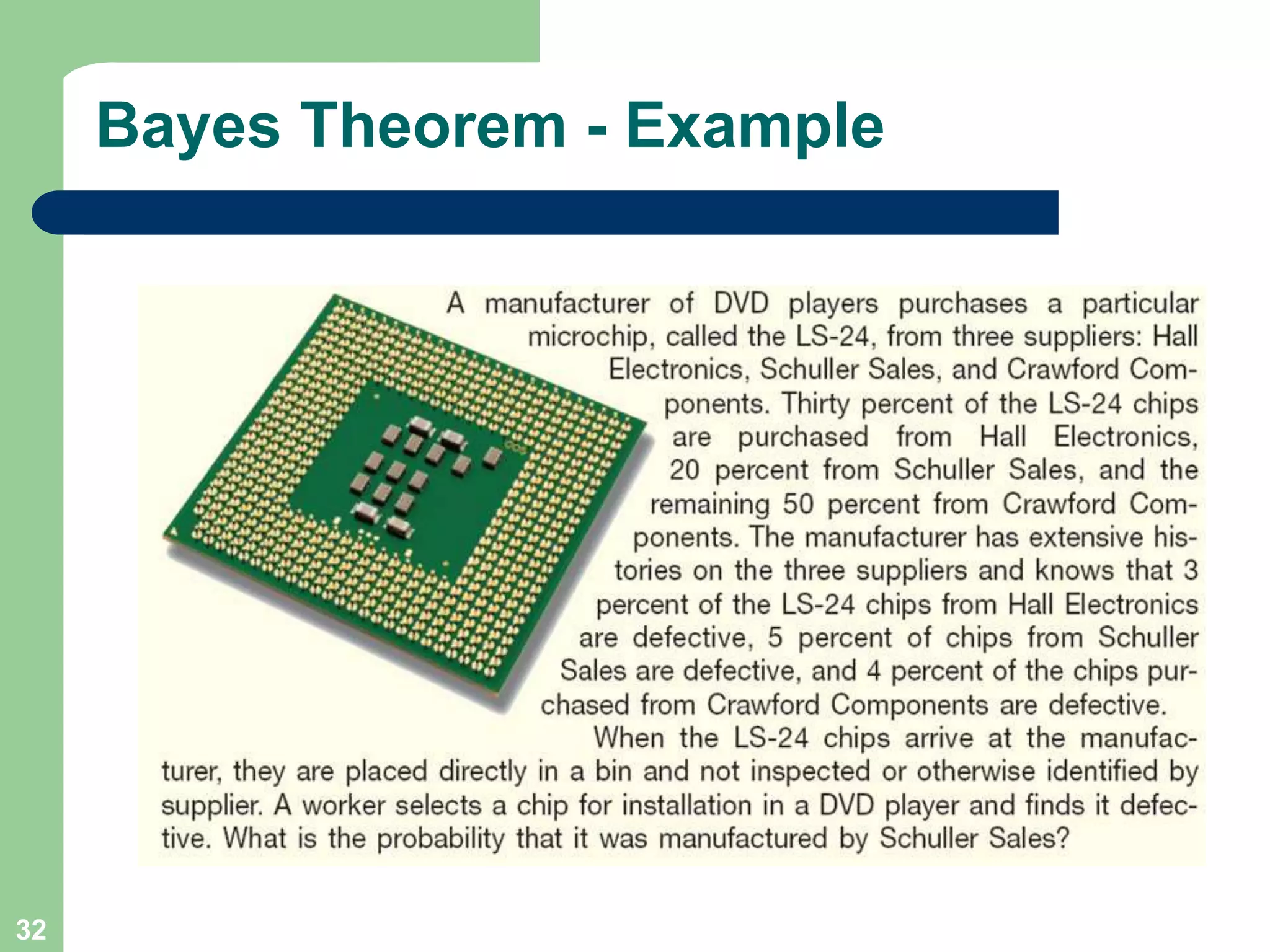
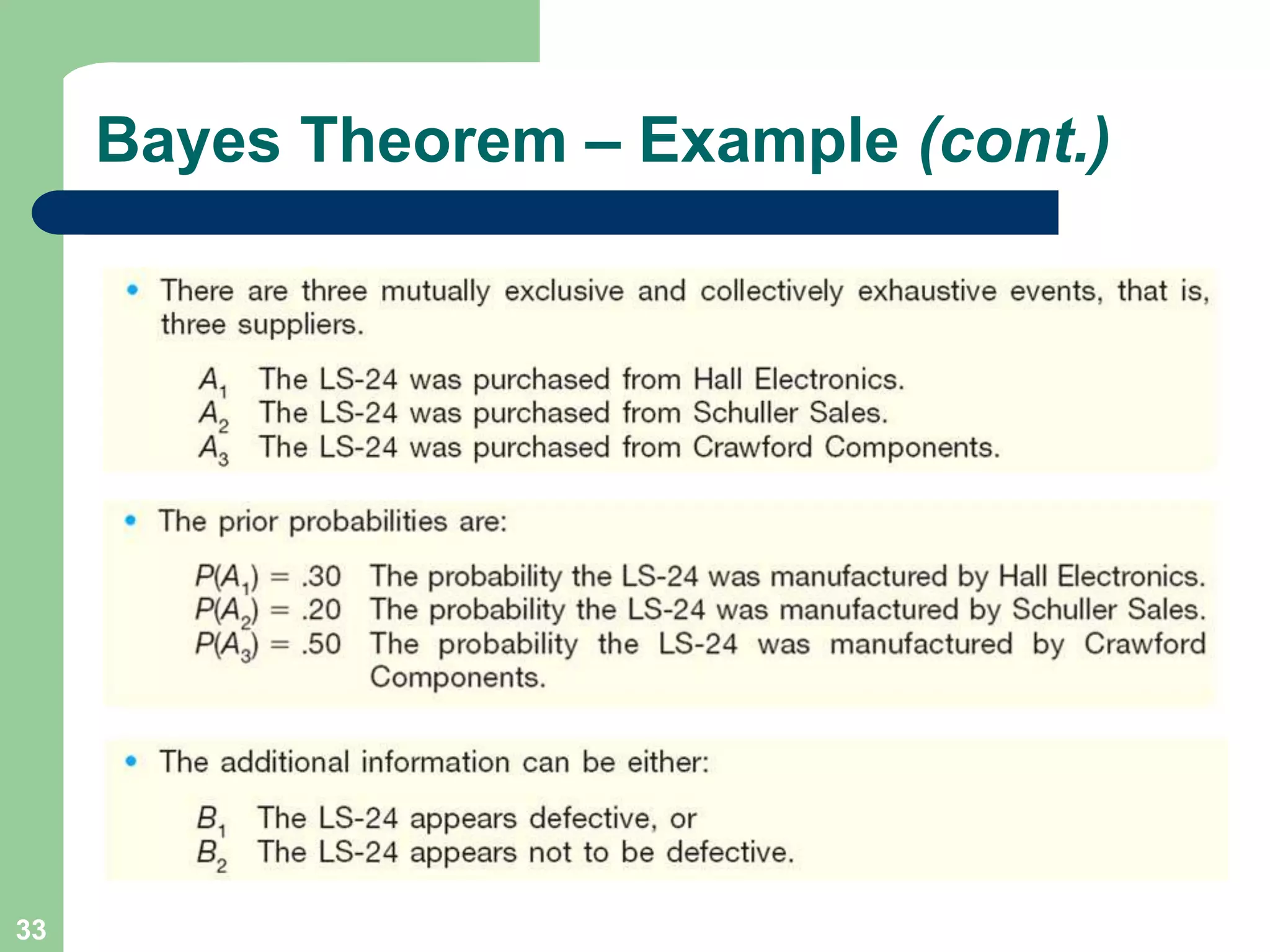
Bayes Theorem - Example
33
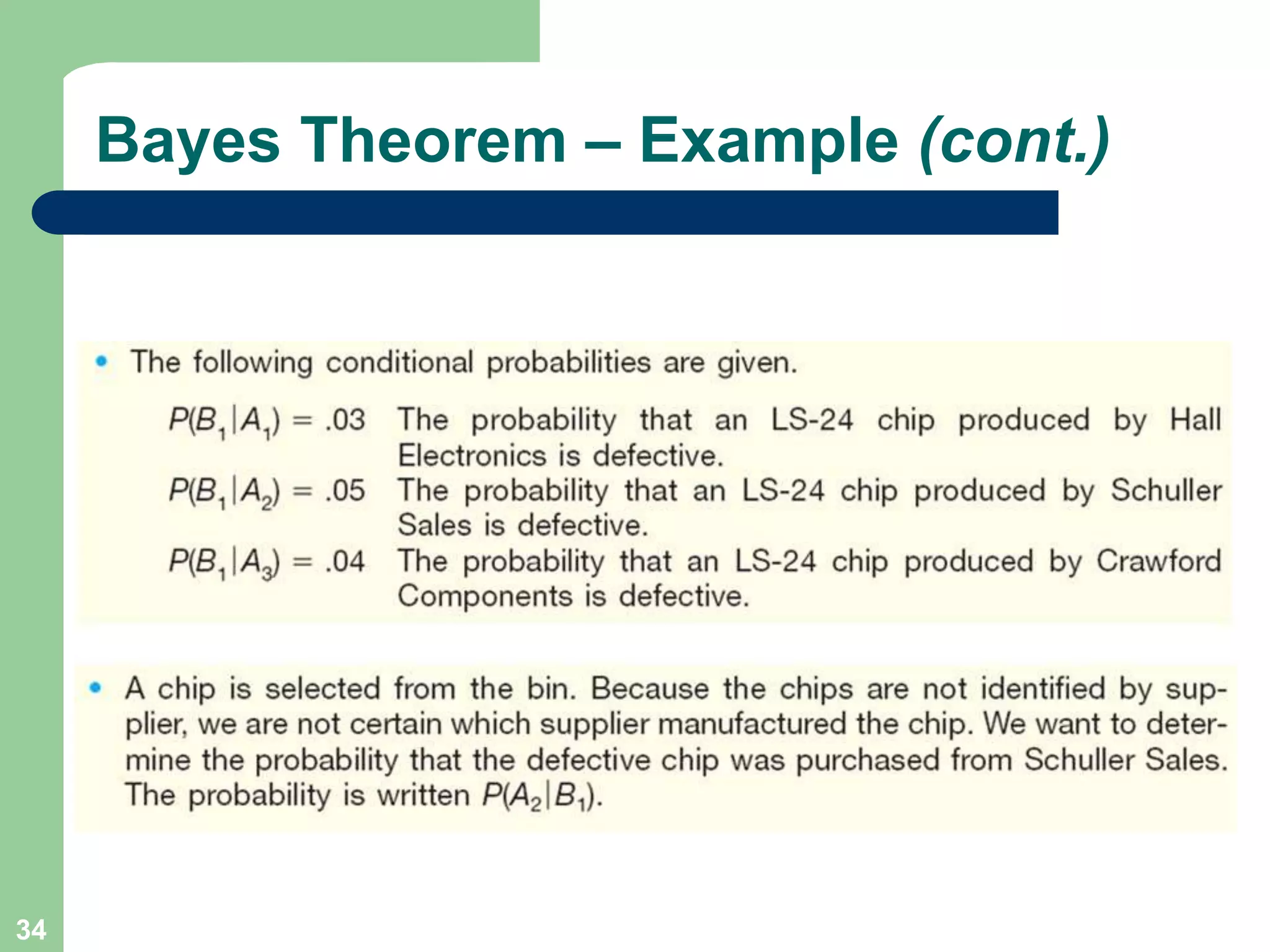
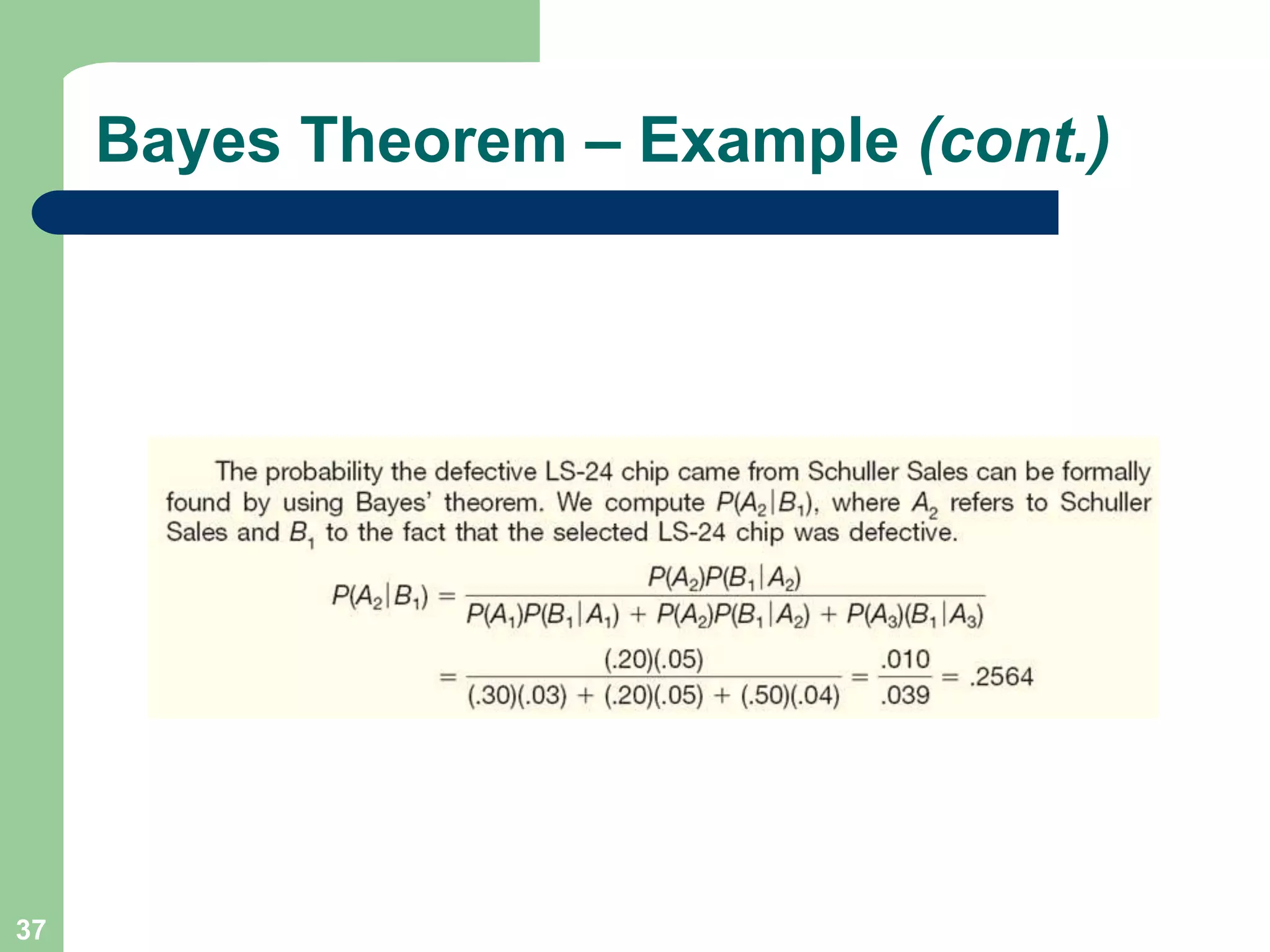
Bayes Theorem – Example (cont.)
34
Bayes Theorem – Example (cont.)
35
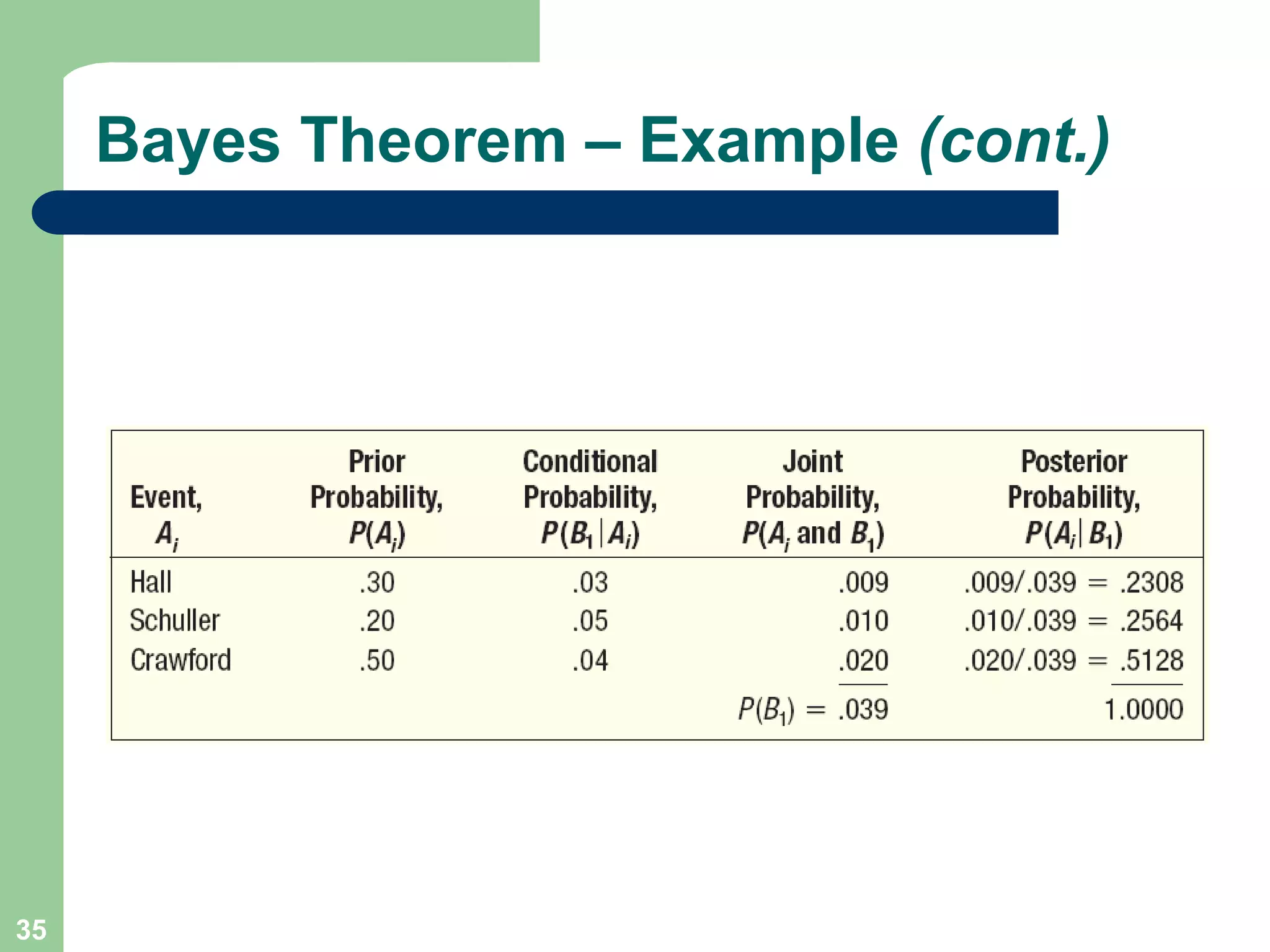
Bayes Theorem – Example (cont.)
36
37
Bayes Theorem – Example (cont.)
38
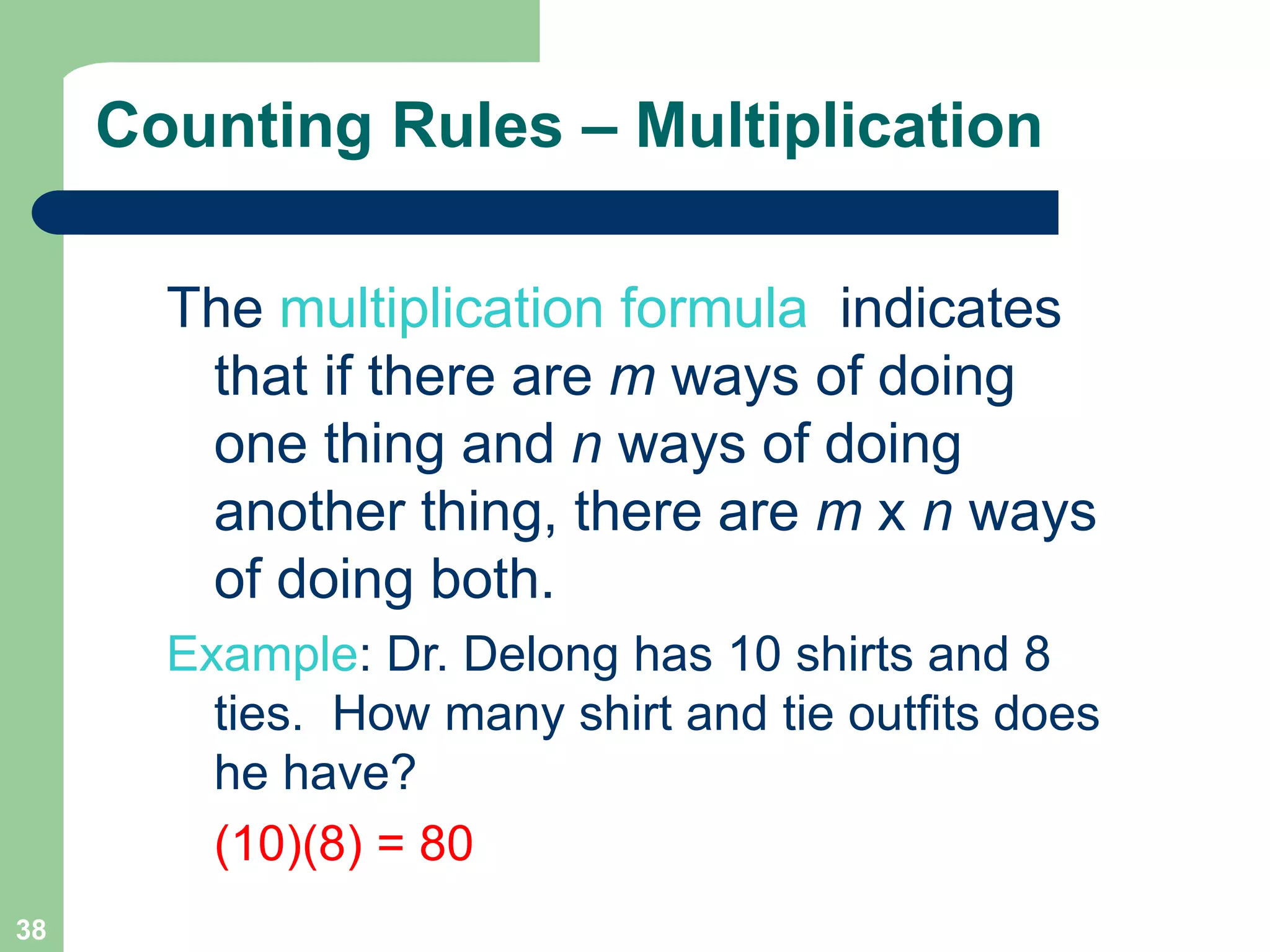
Counting Rules – Multiplication
The multiplication formula indicates
that if there are m ways of doing
one thing and n ways of doing
another thing, there are m x n ways
of doing both.
Example: Dr. Delong has 10 shirts and 8
ties. How many shirt and tie outfits does
he have?
(10)(8) = 80
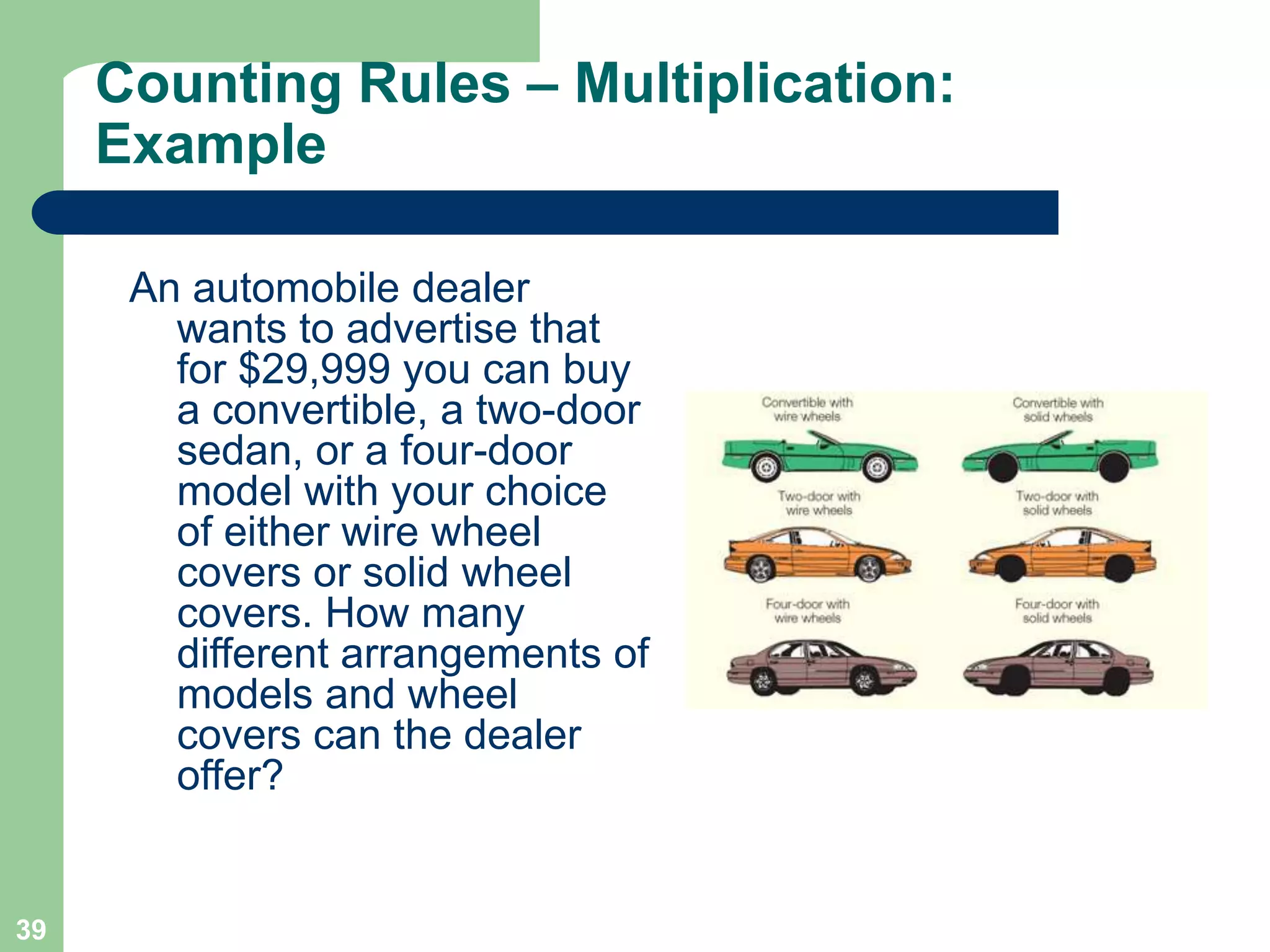
39
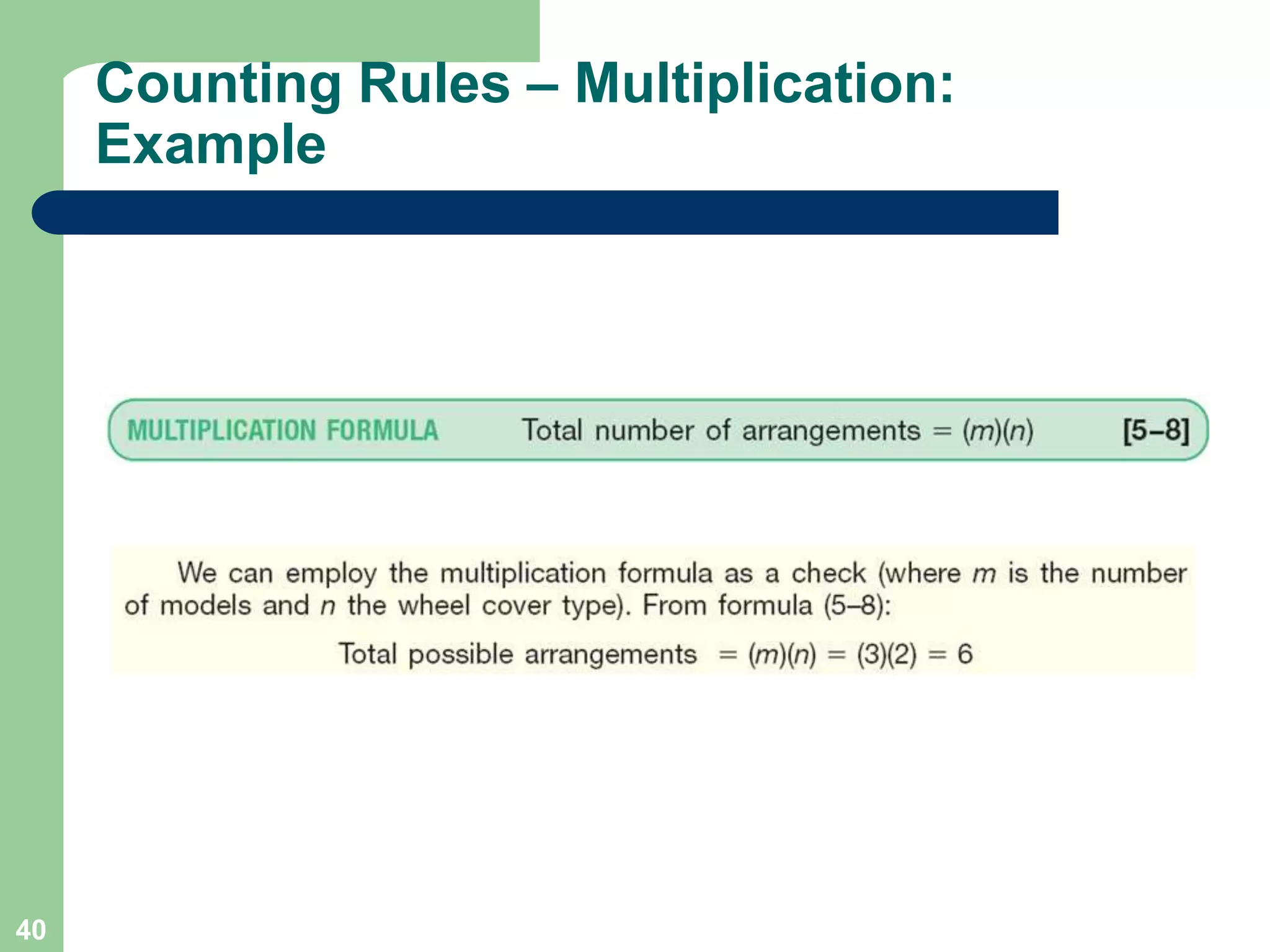
An automobile dealer
wants to advertise that
for $29,999 you can buy
a convertible, a two-door
sedan, or a four-door
model with your choice
of either wire wheel
covers or solid wheel
covers. How many
different arrangements of
models and wheel
covers can the dealer
offer?
Counting Rules – Multiplication:
Example
40
Counting Rules – Multiplication:
Example
41
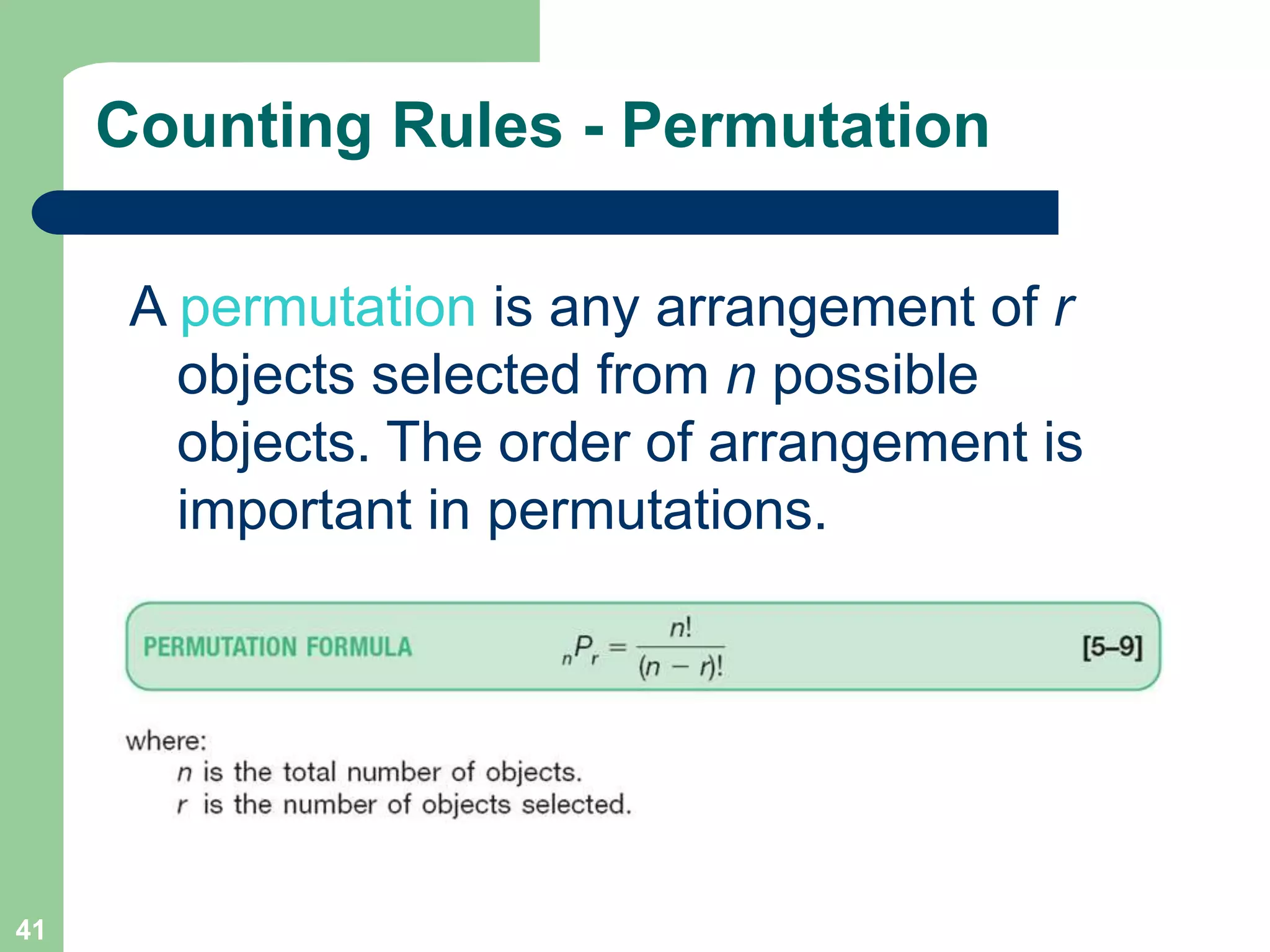
Counting Rules - Permutation
A permutation is any arrangement of r
objects selected from n possible
objects. The order of arrangement is
important in permutations.
42
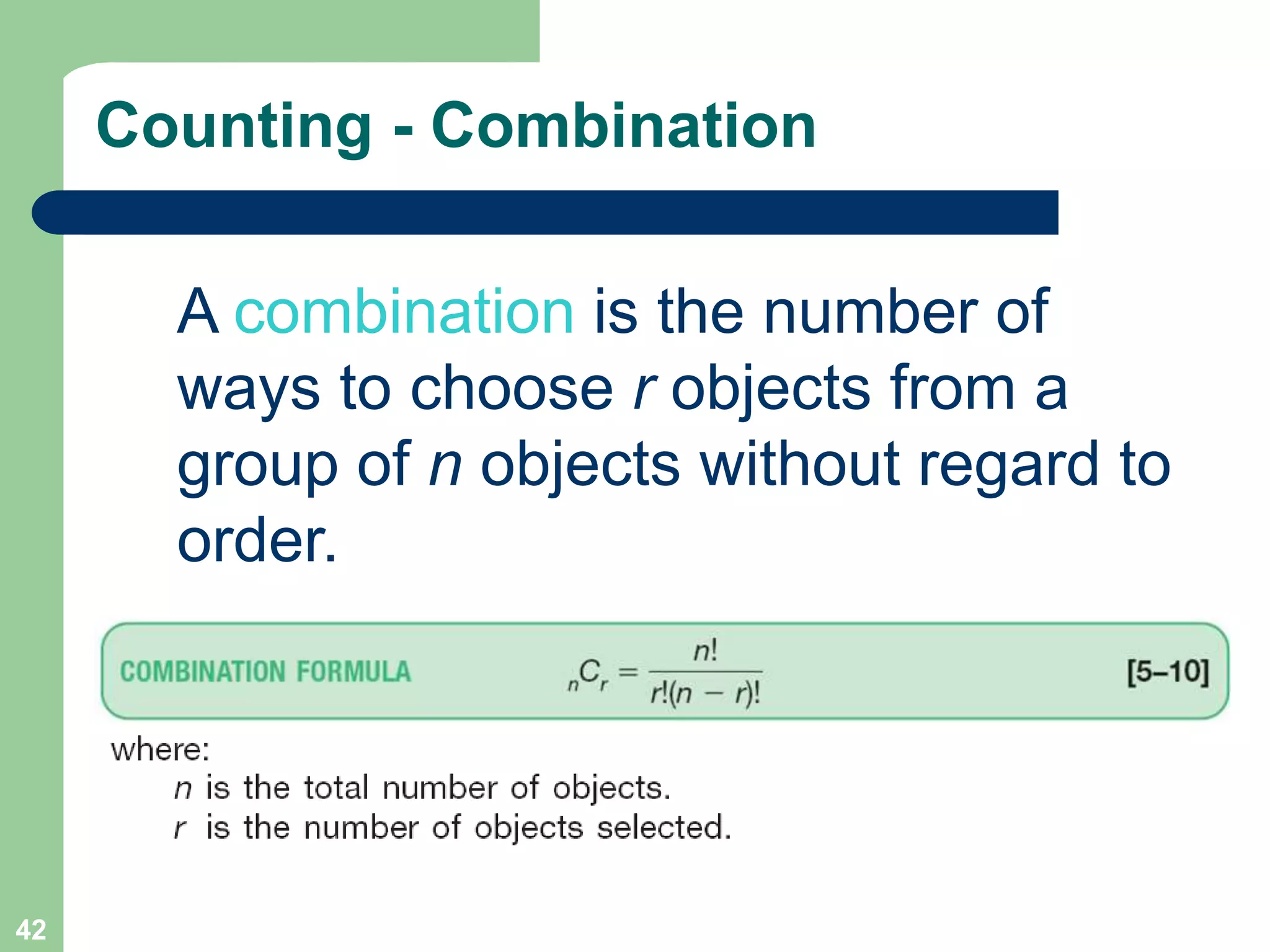
Counting - Combination
A combination is the number of
ways to choose r objects from a
group of n objects without regard to
order.
43
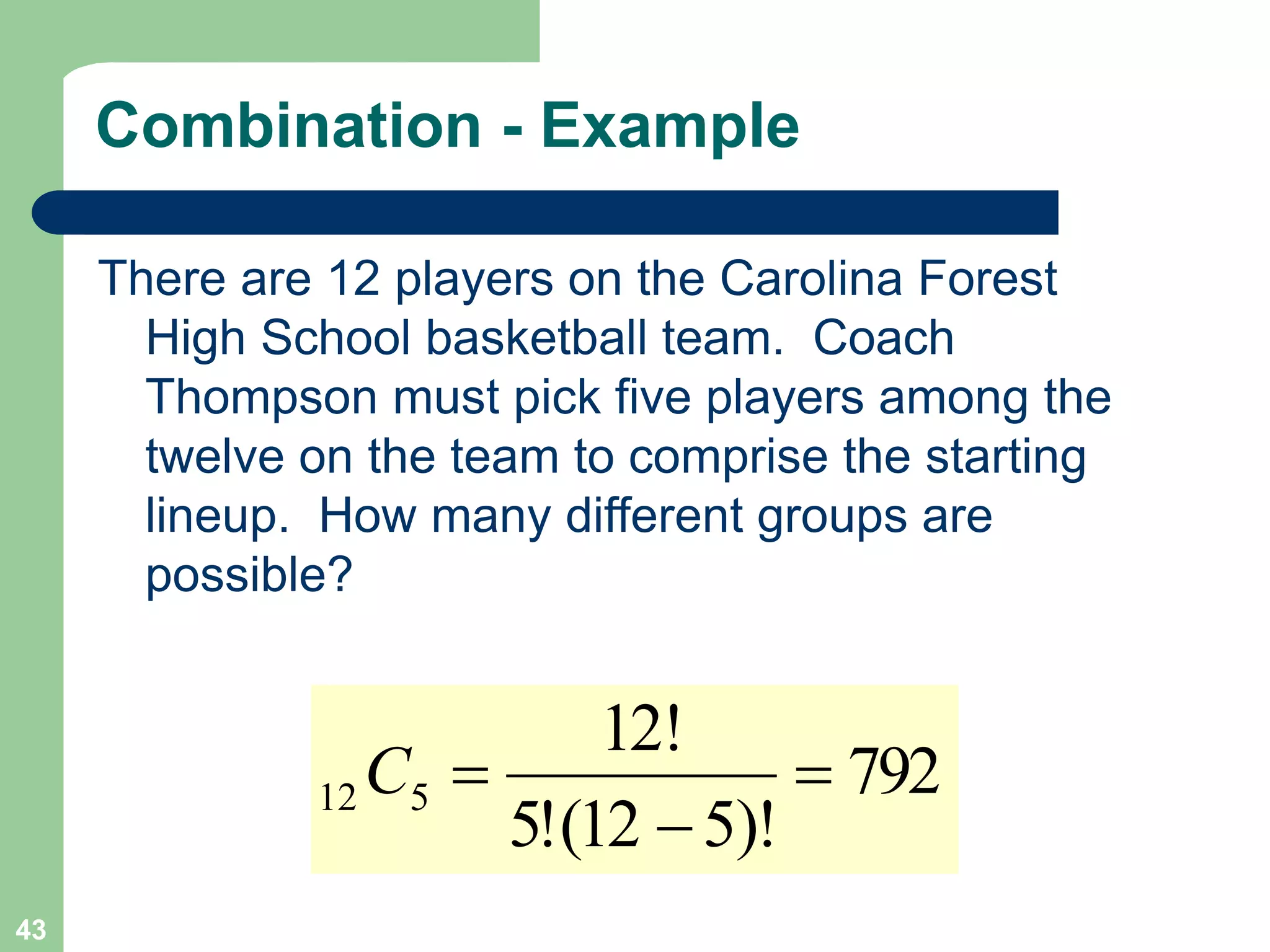
Combination - Example
There are 12 players on the Carolina Forest
High School basketball team. Coach
Thompson must pick five players among the
twelve on the team to comprise the starting
lineup. How many different groups are
possible?
792
)!
5
12
(
!
5
!
12
5
12 


C
44
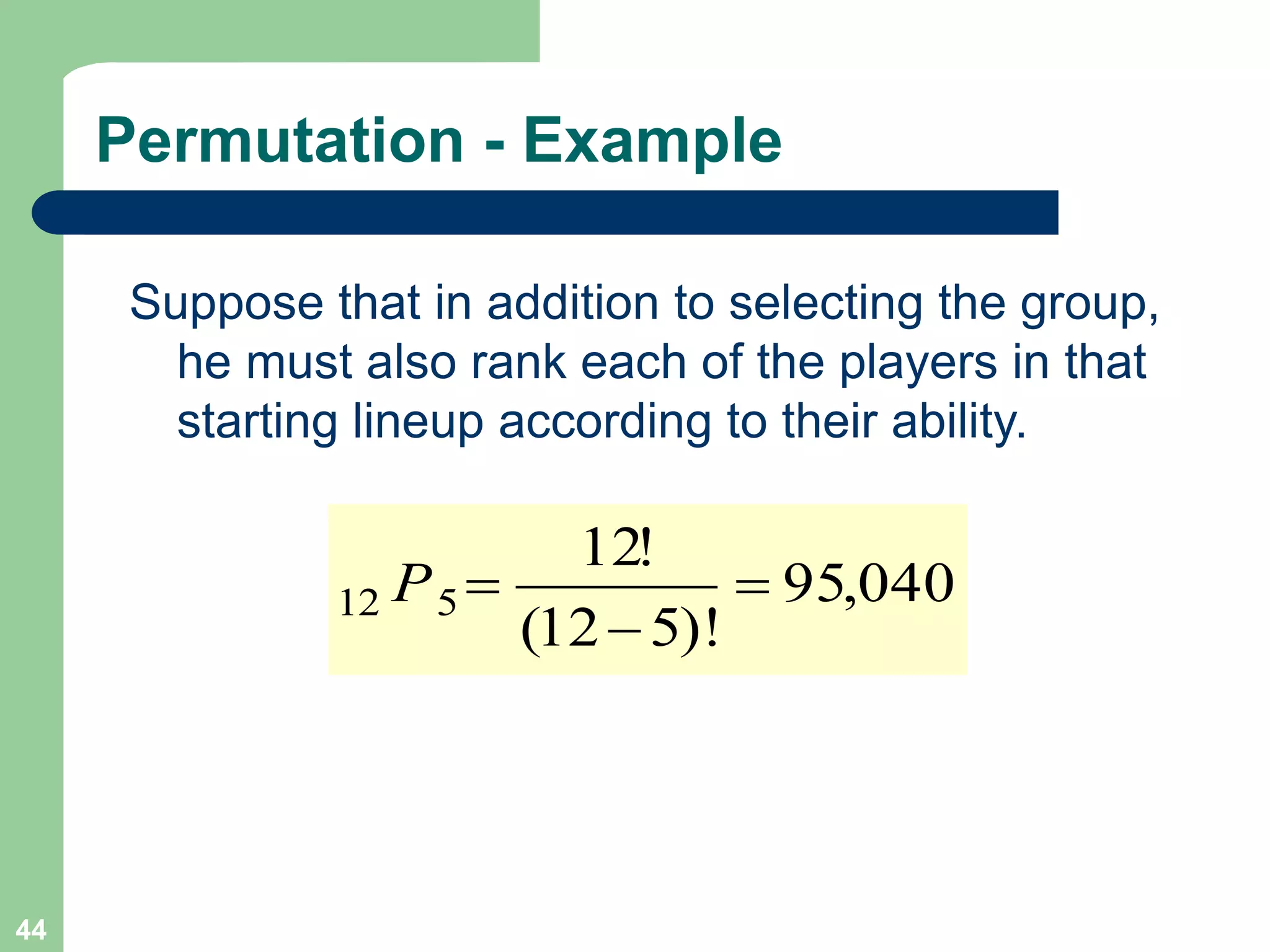
Permutation - Example
Suppose that in addition to selecting the group,
he must also rank each of the players in that
starting lineup according to their ability.
040
,
95
)!
5
12
(
!
12
5
12 


P
45
End of Chapter 5

Lesson 5.ppt

  • 1.
    ©The McGraw-Hill Companies,Inc. 2008 McGraw-Hill/Irwin A Survey of Probability Concepts Chapter 5
  • 2.
    2 GOALS  Define probability. Describe the classical, empirical, and subjective approaches to probability.  Explain the terms experiment, event, outcome, permutations, and combinations.  Define the terms conditional probability and joint probability.  Calculate probabilities using the rules of addition and rules of multiplication.  Apply a tree diagram to organize and compute probabilities.  Calculate a probability using Bayes’ theorem.
  • 3.
    3 Definitions A probability isa measure of the likelihood that an event in the future will happen. It it can only assume a value between 0 and 1.  A value near zero means the event is not likely to happen. A value near one means it is likely.  There are three ways of assigning probability: – classical, – empirical, and – subjective.
  • 4.
  • 5.
    5 Definitions continued  Anexperiment is the observation of some activity or the act of taking some measurement.  An outcome is the particular result of an experiment.  An event is the collection of one or more outcomes of an experiment.
  • 6.
  • 7.
    7 Assigning Probabilities Three approachesto assigning probabilities – Classical – Empirical – Subjective
  • 8.
    8 Classical Probability Consider anexperiment of rolling a six-sided die. What is the probability of the event “an even number of spots appear face up”? The possible outcomes are: There are three “favorable” outcomes (a two, a four, and a six) in the collection of six equally likely possible outcomes.
  • 9.
    9 Mutually Exclusive Events Events are mutually exclusive if the occurrence of any one event means that none of the others can occur at the same time.  Events are independent if the occurrence of one event does not affect the occurrence of another.
  • 10.
    10 Collectively Exhaustive Events Events are collectively exhaustive if at least one of the events must occur when an experiment is conducted.
  • 11.
    11 Empirical Probability The empiricalapproach to probability is based on what is called the law of large numbers. The key to establishing probabilities empirically is that more observations will provide a more accurate estimate of the probability.
  • 12.
    12 Law of LargeNumbers Suppose we toss a fair coin. The result of each toss is either a head or a tail. If we toss the coin a great number of times, the probability of the outcome of heads will approach .5. The following table reports the results of an experiment of flipping a fair coin 1, 10, 50, 100, 500, 1,000 and 10,000 times and then computing the relative frequency of heads
  • 13.
    13 Empirical Probability -Example On February 1, 2003, the Space Shuttle Columbia exploded. This was the second disaster in 113 space missions for NASA. On the basis of this information, what is the probability that a future mission is successfully completed? 98 . 0 113 111 flights of number Total flights successful of Number flight successful a of y Probabilit   
  • 14.
    14 Subjective Probability -Example  If there is little or no past experience or information on which to base a probability, it may be arrived at subjectively.  Illustrations of subjective probability are: 1. Estimating the likelihood the New England Patriots will play in the Super Bowl next year. 2. Estimating the likelihood you will be married before the age of 30. 3. Estimating the likelihood the U.S. budget deficit will be reduced by half in the next 10 years.
  • 15.
    15 Summary of Typesof Probability
  • 16.
    16 Rules for ComputingProbabilities Rules of Addition  Special Rule of Addition - If two events A and B are mutually exclusive, the probability of one or the other event’s occurring equals the sum of their probabilities. P(A or B) = P(A) + P(B)  The General Rule of Addition - If A and B are two events that are not mutually exclusive, then P(A or B) is given by the following formula: P(A or B) = P(A) + P(B) - P(A and B)
  • 17.
    17 Addition Rule -Example What is the probability that a card chosen at random from a standard deck of cards will be either a king or a heart? P(A or B) = P(A) + P(B) - P(A and B) = 4/52 + 13/52 - 1/52 = 16/52, or .3077
  • 18.
    18 The Complement Rule Thecomplement rule is used to determine the probability of an event occurring by subtracting the probability of the event not occurring from 1. P(A) + P(~A) = 1 or P(A) = 1 - P(~A).
  • 19.
    19 Joint Probability –Venn Diagram JOINT PROBABILITY A probability that measures the likelihood two or more events will happen concurrently.
  • 20.
    20 Special Rule ofMultiplication  The special rule of multiplication requires that two events A and B are independent.  Two events A and B are independent if the occurrence of one has no effect on the probability of the occurrence of the other.  This rule is written: P(A and B) = P(A)P(B)
  • 21.
    21 Multiplication Rule-Example A surveyby the American Automobile association (AAA) revealed 60 percent of its members made airline reservations last year. Two members are selected at random. What is the probability both made airline reservations last year? Solution: The probability the first member made an airline reservation last year is .60, written as P(R1) = .60 The probability that the second member selected made a reservation is also .60, so P(R2) = .60. Since the number of AAA members is very large, you may assume that R1 and R2 are independent. P(R1 and R2) = P(R1)P(R2) = (.60)(.60) = .36
  • 22.
    22 Conditional Probability A conditionalprobability is the probability of a particular event occurring, given that another event has occurred. The probability of the event A given that the event B has occurred is written P(A|B).
  • 23.
    23 General Multiplication Rule Thegeneral rule of multiplication is used to find the joint probability that two events will occur. Use the general rule of multiplication to find the joint probability of two events when the events are not independent. It states that for two events, A and B, the joint probability that both events will happen is found by multiplying the probability that event A will happen by the conditional probability of event B occurring given that A has occurred.
  • 24.
    24 General Multiplication Rule- Example A golfer has 12 golf shirts in his closet. Suppose 9 of these shirts are white and the others blue. He gets dressed in the dark, so he just grabs a shirt and puts it on. He plays golf two days in a row and does not do laundry. What is the likelihood both shirts selected are white?
  • 25.
    25  The eventthat the first shirt selected is white is W1. The probability is P(W1) = 9/12  The event that the second shirt selected is also white is identified as W2. The conditional probability that the second shirt selected is white, given that the first shirt selected is also white, is P(W2 | W1) = 8/11.  To determine the probability of 2 white shirts being selected we use formula: P(AB) = P(A) P(B|A)  P(W1 and W2) = P(W1)P(W2 |W1) = (9/12)(8/11) = 0.55 General Multiplication Rule - Example
  • 26.
    26 Contingency Tables A CONTINGENCYTABLE is a table used to classify sample observations according to two or more identifiable characteristics E.g. A survey of 150 adults classified each as to gender and the number of movies attended last month. Each respondent is classified according to two criteria—the number of movies attended and gender.
  • 27.
    27 Contingency Tables -Example A sample of executives were surveyed about their loyalty to their company. One of the questions was, “If you were given an offer by another company equal to or slightly better than your present position, would you remain with the company or take the other position?” The responses of the 200 executives in the survey were cross-classified with their length of service with the company. What is the probability of randomly selecting an executive who is loyal to the company (would remain) and who has more than 10 years of service?
  • 28.
    28 Event A1 happensif a randomly selected executive will remain with the company despite an equal or slightly better offer from another company. Since there are 120 executives out of the 200 in the survey who would remain with the company P(A1) = 120/200, or .60. Event B4 happens if a randomly selected executive has more than 10 years of service with the company. Thus, P(B4| A1) is the conditional probability that an executive with more than 10 years of service would remain with the company. Of the 120 executives who would remain 75 have more than 10 years of service, so P(B4| A1) = 75/120. Contingency Tables - Example
  • 29.
    29 Tree Diagrams A treediagram is useful for portraying conditional and joint probabilities. It is particularly useful for analyzing business decisions involving several stages. A tree diagram is a graph that is helpful in organizing calculations that involve several stages. Each segment in the tree is one stage of the problem. The branches of a tree diagram are weighted by probabilities.
  • 30.
  • 31.
    31 Bayes’ Theorem  Bayes’Theorem is a method for revising a probability given additional information.  It is computed using the following formula:
  • 32.
  • 33.
    33 Bayes Theorem –Example (cont.)
  • 34.
    34 Bayes Theorem –Example (cont.)
  • 35.
    35 Bayes Theorem –Example (cont.)
  • 36.
  • 37.
    37 Bayes Theorem –Example (cont.)
  • 38.
    38 Counting Rules –Multiplication The multiplication formula indicates that if there are m ways of doing one thing and n ways of doing another thing, there are m x n ways of doing both. Example: Dr. Delong has 10 shirts and 8 ties. How many shirt and tie outfits does he have? (10)(8) = 80
  • 39.
    39 An automobile dealer wantsto advertise that for $29,999 you can buy a convertible, a two-door sedan, or a four-door model with your choice of either wire wheel covers or solid wheel covers. How many different arrangements of models and wheel covers can the dealer offer? Counting Rules – Multiplication: Example
  • 40.
    40 Counting Rules –Multiplication: Example
  • 41.
    41 Counting Rules -Permutation A permutation is any arrangement of r objects selected from n possible objects. The order of arrangement is important in permutations.
  • 42.
    42 Counting - Combination Acombination is the number of ways to choose r objects from a group of n objects without regard to order.
  • 43.
    43 Combination - Example Thereare 12 players on the Carolina Forest High School basketball team. Coach Thompson must pick five players among the twelve on the team to comprise the starting lineup. How many different groups are possible? 792 )! 5 12 ( ! 5 ! 12 5 12    C
  • 44.
    44 Permutation - Example Supposethat in addition to selecting the group, he must also rank each of the players in that starting lineup according to their ability. 040 , 95 )! 5 12 ( ! 12 5 12    P
  • 45.