Concurrency Control
Outline
• Lock-Based Protocols
• Timestamp-Based Protocols
• Deadlock Handling
Lock-Based Protocols
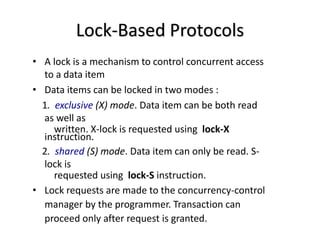
• A lock is a mechanism to control concurrent access
to a data item
• Data items can be locked in two modes :
1. exclusive (X) mode. Data item can be both read
as well as
written. X-lock is requested using lock-X
instruction.
2. shared (S) mode. Data item can only be read. S-
lock is
requested using lock-S instruction.
• Lock requests are made to the concurrency-control
manager by the programmer. Transaction can
proceed only after request is granted.
Lock-Based Protocols (Cont.)
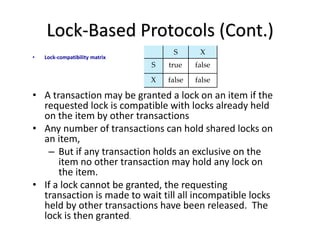
• Lock-compatibility matrix
• A transaction may be granted a lock on an item if the
requested lock is compatible with locks already held
on the item by other transactions
• Any number of transactions can hold shared locks on
an item,
– But if any transaction holds an exclusive on the
item no other transaction may hold any lock on
the item.
• If a lock cannot be granted, the requesting
transaction is made to wait till all incompatible locks
held by other transactions have been released. The
lock is then granted.
Lock-Based Protocols (Cont.)
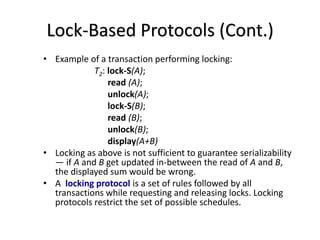
• Example of a transaction performing locking:
T2: lock-S(A);
read (A);
unlock(A);
lock-S(B);
read (B);
unlock(B);
display(A+B)
• Locking as above is not sufficient to guarantee serializability
— if A and B get updated in-between the read of A and B,
the displayed sum would be wrong.
• A locking protocol is a set of rules followed by all
transactions while requesting and releasing locks. Locking
protocols restrict the set of possible schedules.
The Two-Phase Locking Protocol
• This protocol ensures conflict-serializable
schedules.
• Phase 1: Growing Phase
– Transaction may obtain locks
– Transaction may not release locks
• Phase 2: Shrinking Phase
– Transaction may release locks
– Transaction may not obtain locks
• The protocol assures serializability. It can be
proved that the transactions can be serialized
in the order of their lock points (i.e., the point
where a transaction acquired its final lock).
Lock Conversions
• Two-phase locking with lock conversions:
– First Phase:
– can acquire a lock-S on item
– can acquire a lock-X on item
– can convert a lock-S to a lock-X (upgrade)
– Second Phase:
– can release a lock-S
– can release a lock-X
– can convert a lock-X to a lock-S (downgrade)
• This protocol assures serializability. But still
relies on the programmer to insert the
various locking instructions.
Deadlocks• Consider the partial schedule
• Neither T3 nor T4 can make progress — executing lock-S(B)
causes T4 to wait for T3 to release its lock on B, while executing
lock-X(A) causes T3 to wait for T4 to release its lock on A.
• Such a situation is called a deadlock.
– To handle a deadlock one of T3 or T4 must be rolled back
and its locks released.
Deadlocks (Cont.)
• Two-phase locking does not ensure freedom from
deadlocks.
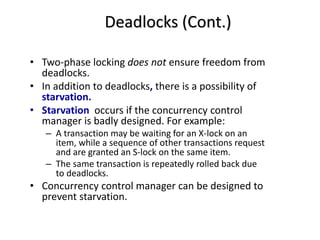
• In addition to deadlocks, there is a possibility of
starvation.
• Starvation occurs if the concurrency control
manager is badly designed. For example:
– A transaction may be waiting for an X-lock on an
item, while a sequence of other transactions request
and are granted an S-lock on the same item.
– The same transaction is repeatedly rolled back due
to deadlocks.
• Concurrency control manager can be designed to
prevent starvation.
Deadlocks (Cont.)
• The potential for deadlock exists in most locking
protocols. Deadlocks are a necessary evil.
• When a deadlock occurs there is a possibility of
cascading roll-backs.
• Cascading roll-back is possible under two-phase
locking. To avoid this, follow a modified
protocol called strict two-phase locking -- a
transaction must hold all its exclusive locks till it
commits/aborts.
• Rigorous two-phase locking is even stricter.
Here, all locks are held till commit/abort. In this
protocol transactions can be serialized in the
order in which they commit.
Implementation of Locking
• A lock manager can be implemented as a separate process to
which transactions send lock and unlock requests
• The lock manager replies to a lock request by sending a lock
grant messages (or a message asking the transaction to roll
back, in case of a deadlock)
• The requesting transaction waits until its request is answered
• The lock manager maintains a data-structure called a lock
table to record granted locks and pending requests
• The lock table is usually implemented as an in-memory hash
table indexed on the name of the data item being locked
Deadlock Handling
• System is deadlocked if there is a set of
transactions such that every transaction in the
set is waiting for another transaction in the
set.
• Deadlock prevention protocols ensure that
the system will never enter into a deadlock
state. Some prevention strategies :
– Require that each transaction locks all its data
items before it begins execution (pre declaration).
– Impose partial ordering of all data items and
require that a transaction can lock data items only
in the order specified by the partial order.
More Deadlock Prevention Strategies
• Following schemes use transaction timestamps for
the sake of deadlock prevention alone.
• wait-die scheme — non-preemptive
– older transaction may wait for younger one to release
data item. (older means smaller timestamp) Younger
transactions never wait for older ones; they are rolled
back instead.
– a transaction may die several times before acquiring
needed data item
• wound-wait scheme — preemptive
– older transaction wounds (forces rollback) of younger
transaction instead of waiting for it. Younger
transactions may wait for older ones.
– may be fewer rollbacks than wait-die scheme.
Deadlock prevention (Cont.)
• Both in wait-die and in wound-wait schemes, a rolled
back transactions is restarted with its original
timestamp. Older transactions thus have precedence
over newer ones, and starvation is hence avoided.
• Timeout-Based Schemes:
– a transaction waits for a lock only for a specified amount of
time. If the lock has not been granted within that time, the
transaction is rolled back and restarted,
– Thus, deadlocks are not possible
– simple to implement; but starvation is possible. Also
difficult to determine good value of the timeout interval.
Deadlock Detection
• Deadlocks can be described as a wait-for graph, which
consists of a pair G = (V,E),
– V is a set of vertices (all the transactions in the system)
– E is a set of edges; each element is an ordered pair Ti Tj.
• If Ti  Tj is in E, then there is a directed edge from Ti to Tj,
implying that Ti is waiting for Tj to release a data item.
• When Ti requests a data item currently being held by Tj,
then the edge Ti  Tj is inserted in the wait-for graph. This
edge is removed only when Tj is no longer holding a data
item needed by Ti.
• The system is in a deadlock state if and only if the wait-for
graph has a cycle. Must invoke a deadlock-detection
algorithm periodically to look for cycles.
Deadlock Detection (Cont.)
Wait-for graph without a cycle Wait-for graph with a cycle
Deadlock Recovery
• When deadlock is detected :
– Some transaction will have to rolled back (made
a victim) to break deadlock. Select that
transaction as victim that will incur minimum
cost.
– Rollback -- determine how far to roll back
transaction
• Total rollback: Abort the transaction and then restart
it.
• More effective to roll back transaction only as far as
necessary to break deadlock.
– Starvation happens if same transaction is always
chosen as victim. Include the number of
rollbacks in the cost factor to avoid starvation
Timestamp-Based Protocols
• Each transaction is issued a timestamp when it enters the
system. If an old transaction Ti has time-stamp TS(Ti), a new
transaction Tj is assigned time-stamp TS(Tj) such that TS(Ti)
<TS(Tj).
• The protocol manages concurrent execution such that the
time-stamps determine the serializability order.
• In order to assure such behavior, the protocol maintains for
each data Q two timestamp values:
– W-timestamp(Q) is the largest time-stamp of any transaction
that executed write(Q) successfully.
– R-timestamp(Q) is the largest time-stamp of any transaction that
executed read(Q) successfully.
Timestamp-Based Protocols (Cont.)
• The timestamp ordering protocol ensures that
any conflicting read and write operations are
executed in timestamp order.
• Suppose a transaction Ti issues a read(Q)
1. If TS(Ti)  W-timestamp(Q), then Ti needs to read a
value of Q that was already overwritten.
 Hence, the read operation is rejected, and Ti is rolled
back.
2. If TS(Ti) >W-timestamp(Q), then the read operation
is executed, and R-timestamp(Q) is set to max(R-
timestamp(Q), TS(Ti)).
Timestamp-Based Protocols (Cont.)
• Suppose that transaction Ti issues write(Q).
1. If TS(Ti) < R-timestamp(Q), then the value of Q that Ti
is producing was needed previously, and the system
assumed that that value would never be produced.
 Hence, the write operation is rejected, and Ti is rolled back.
2. If TS(Ti) < W-timestamp(Q), then Ti is attempting to
write an obsolete value of Q.
 Hence, this write operation is rejected, and Ti is rolled back.
3. Otherwise, the write operation is executed, and W-
timestamp(Q) is set to TS(Ti).
Correctness of Timestamp-Ordering Protocol
• The timestamp-ordering protocol guarantees
serializability since all the arcs in the precedence
graph are of the form:
Thus, there will be no cycles in the precedence
graph
• Timestamp protocol ensures freedom from
deadlock as no transaction ever waits.
• But the schedule may not be cascade-free, and
may not even be recoverable.
Recoverability and Cascade Freedom
• Problem with timestamp-ordering protocol:
– Suppose Ti aborts, but Tj has read a data item written by Ti
– Then Tj must abort; if Tj had been allowed to commit earlier, the
schedule is not recoverable.
– Further, any transaction that has read a data item written by Tj
must abort
– This can lead to cascading rollback --- that is, a chain of rollbacks
• Solution 1:
– A transaction is structured such that its writes are all performed
at the end of its processing
– All writes of a transaction form an atomic action; no transaction
may execute while a transaction is being written
– A transaction that aborts is restarted with a new timestamp
• Solution 2: Limited form of locking: wait for data to be
committed before reading it
• Solution 3: Use commit dependencies to ensure recoverability
Thomas’ Write Rule
• Modified version of the timestamp-ordering protocol in which
obsolete write operations may be ignored under certain
circumstances.
• When Ti attempts to write data item Q, if TS(Ti) < W-timestamp(Q),
then Ti is attempting to write an obsolete value of {Q}.
– Rather than rolling back Ti as the timestamp ordering protocol would
have done, this {write} operation can be ignored.
• Otherwise this protocol is the same as the timestamp ordering
protocol.
• Thomas' Write Rule allows greater potential concurrency.
– Allows some view-serializable schedules that are not conflict-
serializable.

Concurrency control

  • 1.
  • 2.
    Outline • Lock-Based Protocols •Timestamp-Based Protocols • Deadlock Handling
  • 3.
    Lock-Based Protocols • Alock is a mechanism to control concurrent access to a data item • Data items can be locked in two modes : 1. exclusive (X) mode. Data item can be both read as well as written. X-lock is requested using lock-X instruction. 2. shared (S) mode. Data item can only be read. S- lock is requested using lock-S instruction. • Lock requests are made to the concurrency-control manager by the programmer. Transaction can proceed only after request is granted.
  • 4.
    Lock-Based Protocols (Cont.) •Lock-compatibility matrix • A transaction may be granted a lock on an item if the requested lock is compatible with locks already held on the item by other transactions • Any number of transactions can hold shared locks on an item, – But if any transaction holds an exclusive on the item no other transaction may hold any lock on the item. • If a lock cannot be granted, the requesting transaction is made to wait till all incompatible locks held by other transactions have been released. The lock is then granted.
  • 5.
    Lock-Based Protocols (Cont.) •Example of a transaction performing locking: T2: lock-S(A); read (A); unlock(A); lock-S(B); read (B); unlock(B); display(A+B) • Locking as above is not sufficient to guarantee serializability — if A and B get updated in-between the read of A and B, the displayed sum would be wrong. • A locking protocol is a set of rules followed by all transactions while requesting and releasing locks. Locking protocols restrict the set of possible schedules.
  • 6.
    The Two-Phase LockingProtocol • This protocol ensures conflict-serializable schedules. • Phase 1: Growing Phase – Transaction may obtain locks – Transaction may not release locks • Phase 2: Shrinking Phase – Transaction may release locks – Transaction may not obtain locks • The protocol assures serializability. It can be proved that the transactions can be serialized in the order of their lock points (i.e., the point where a transaction acquired its final lock).
  • 7.
    Lock Conversions • Two-phaselocking with lock conversions: – First Phase: – can acquire a lock-S on item – can acquire a lock-X on item – can convert a lock-S to a lock-X (upgrade) – Second Phase: – can release a lock-S – can release a lock-X – can convert a lock-X to a lock-S (downgrade) • This protocol assures serializability. But still relies on the programmer to insert the various locking instructions.
  • 8.
    Deadlocks• Consider thepartial schedule • Neither T3 nor T4 can make progress — executing lock-S(B) causes T4 to wait for T3 to release its lock on B, while executing lock-X(A) causes T3 to wait for T4 to release its lock on A. • Such a situation is called a deadlock. – To handle a deadlock one of T3 or T4 must be rolled back and its locks released.
  • 9.
    Deadlocks (Cont.) • Two-phaselocking does not ensure freedom from deadlocks. • In addition to deadlocks, there is a possibility of starvation. • Starvation occurs if the concurrency control manager is badly designed. For example: – A transaction may be waiting for an X-lock on an item, while a sequence of other transactions request and are granted an S-lock on the same item. – The same transaction is repeatedly rolled back due to deadlocks. • Concurrency control manager can be designed to prevent starvation.
  • 10.
    Deadlocks (Cont.) • Thepotential for deadlock exists in most locking protocols. Deadlocks are a necessary evil. • When a deadlock occurs there is a possibility of cascading roll-backs. • Cascading roll-back is possible under two-phase locking. To avoid this, follow a modified protocol called strict two-phase locking -- a transaction must hold all its exclusive locks till it commits/aborts. • Rigorous two-phase locking is even stricter. Here, all locks are held till commit/abort. In this protocol transactions can be serialized in the order in which they commit.
  • 11.
    Implementation of Locking •A lock manager can be implemented as a separate process to which transactions send lock and unlock requests • The lock manager replies to a lock request by sending a lock grant messages (or a message asking the transaction to roll back, in case of a deadlock) • The requesting transaction waits until its request is answered • The lock manager maintains a data-structure called a lock table to record granted locks and pending requests • The lock table is usually implemented as an in-memory hash table indexed on the name of the data item being locked
  • 12.
    Deadlock Handling • Systemis deadlocked if there is a set of transactions such that every transaction in the set is waiting for another transaction in the set. • Deadlock prevention protocols ensure that the system will never enter into a deadlock state. Some prevention strategies : – Require that each transaction locks all its data items before it begins execution (pre declaration). – Impose partial ordering of all data items and require that a transaction can lock data items only in the order specified by the partial order.
  • 13.
    More Deadlock PreventionStrategies • Following schemes use transaction timestamps for the sake of deadlock prevention alone. • wait-die scheme — non-preemptive – older transaction may wait for younger one to release data item. (older means smaller timestamp) Younger transactions never wait for older ones; they are rolled back instead. – a transaction may die several times before acquiring needed data item • wound-wait scheme — preemptive – older transaction wounds (forces rollback) of younger transaction instead of waiting for it. Younger transactions may wait for older ones. – may be fewer rollbacks than wait-die scheme.
  • 14.
    Deadlock prevention (Cont.) •Both in wait-die and in wound-wait schemes, a rolled back transactions is restarted with its original timestamp. Older transactions thus have precedence over newer ones, and starvation is hence avoided. • Timeout-Based Schemes: – a transaction waits for a lock only for a specified amount of time. If the lock has not been granted within that time, the transaction is rolled back and restarted, – Thus, deadlocks are not possible – simple to implement; but starvation is possible. Also difficult to determine good value of the timeout interval.
  • 15.
    Deadlock Detection • Deadlockscan be described as a wait-for graph, which consists of a pair G = (V,E), – V is a set of vertices (all the transactions in the system) – E is a set of edges; each element is an ordered pair Ti Tj. • If Ti  Tj is in E, then there is a directed edge from Ti to Tj, implying that Ti is waiting for Tj to release a data item. • When Ti requests a data item currently being held by Tj, then the edge Ti  Tj is inserted in the wait-for graph. This edge is removed only when Tj is no longer holding a data item needed by Ti. • The system is in a deadlock state if and only if the wait-for graph has a cycle. Must invoke a deadlock-detection algorithm periodically to look for cycles.
  • 16.
    Deadlock Detection (Cont.) Wait-forgraph without a cycle Wait-for graph with a cycle
  • 17.
    Deadlock Recovery • Whendeadlock is detected : – Some transaction will have to rolled back (made a victim) to break deadlock. Select that transaction as victim that will incur minimum cost. – Rollback -- determine how far to roll back transaction • Total rollback: Abort the transaction and then restart it. • More effective to roll back transaction only as far as necessary to break deadlock. – Starvation happens if same transaction is always chosen as victim. Include the number of rollbacks in the cost factor to avoid starvation
  • 18.
    Timestamp-Based Protocols • Eachtransaction is issued a timestamp when it enters the system. If an old transaction Ti has time-stamp TS(Ti), a new transaction Tj is assigned time-stamp TS(Tj) such that TS(Ti) <TS(Tj). • The protocol manages concurrent execution such that the time-stamps determine the serializability order. • In order to assure such behavior, the protocol maintains for each data Q two timestamp values: – W-timestamp(Q) is the largest time-stamp of any transaction that executed write(Q) successfully. – R-timestamp(Q) is the largest time-stamp of any transaction that executed read(Q) successfully.
  • 19.
    Timestamp-Based Protocols (Cont.) •The timestamp ordering protocol ensures that any conflicting read and write operations are executed in timestamp order. • Suppose a transaction Ti issues a read(Q) 1. If TS(Ti)  W-timestamp(Q), then Ti needs to read a value of Q that was already overwritten.  Hence, the read operation is rejected, and Ti is rolled back. 2. If TS(Ti) >W-timestamp(Q), then the read operation is executed, and R-timestamp(Q) is set to max(R- timestamp(Q), TS(Ti)).
  • 20.
    Timestamp-Based Protocols (Cont.) •Suppose that transaction Ti issues write(Q). 1. If TS(Ti) < R-timestamp(Q), then the value of Q that Ti is producing was needed previously, and the system assumed that that value would never be produced.  Hence, the write operation is rejected, and Ti is rolled back. 2. If TS(Ti) < W-timestamp(Q), then Ti is attempting to write an obsolete value of Q.  Hence, this write operation is rejected, and Ti is rolled back. 3. Otherwise, the write operation is executed, and W- timestamp(Q) is set to TS(Ti).
  • 21.
    Correctness of Timestamp-OrderingProtocol • The timestamp-ordering protocol guarantees serializability since all the arcs in the precedence graph are of the form: Thus, there will be no cycles in the precedence graph • Timestamp protocol ensures freedom from deadlock as no transaction ever waits. • But the schedule may not be cascade-free, and may not even be recoverable.
  • 22.
    Recoverability and CascadeFreedom • Problem with timestamp-ordering protocol: – Suppose Ti aborts, but Tj has read a data item written by Ti – Then Tj must abort; if Tj had been allowed to commit earlier, the schedule is not recoverable. – Further, any transaction that has read a data item written by Tj must abort – This can lead to cascading rollback --- that is, a chain of rollbacks • Solution 1: – A transaction is structured such that its writes are all performed at the end of its processing – All writes of a transaction form an atomic action; no transaction may execute while a transaction is being written – A transaction that aborts is restarted with a new timestamp • Solution 2: Limited form of locking: wait for data to be committed before reading it • Solution 3: Use commit dependencies to ensure recoverability
  • 23.
    Thomas’ Write Rule •Modified version of the timestamp-ordering protocol in which obsolete write operations may be ignored under certain circumstances. • When Ti attempts to write data item Q, if TS(Ti) < W-timestamp(Q), then Ti is attempting to write an obsolete value of {Q}. – Rather than rolling back Ti as the timestamp ordering protocol would have done, this {write} operation can be ignored. • Otherwise this protocol is the same as the timestamp ordering protocol. • Thomas' Write Rule allows greater potential concurrency. – Allows some view-serializable schedules that are not conflict- serializable.