Treebank Annotation 
By – 
Mohit Jasapara – 2012EEB1059 
Aashish Kholiya – 2012MEB1083 
1
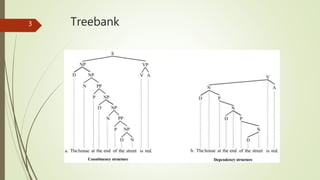
Treebank 
 The termtreebank was coined by linguist Geoffrey Leech in the 1980s because 
both syntactic and semantic structure are commonly represented compositionally 
as a tree structure. 
 In linguistics , a treebank is a parsed text corpus that annotates syntactic or 
semantic sentence structure. 
 In simple words, treebanks are collections of manually checked syntactic analyses 
of sentences. 
2
3 Treebank
Construction 
 Treebanks are often created on top of a corpus that has already been annotated 
with part-of-speech tags. 
 treebanks are sometimes enhanced with semantic or other linguistic information. 
 Treebanks can be created completely manually, where linguists annotate each 
sentence with syntactic structure, or semi-automatically, where a parser assigns 
some syntactic structure which linguists then check and, if necessary, correct 
4
Construction 
 In practice, fully checking and completing the parsing of natural language corpora 
is a labour-intensive project that can take teams of graduate linguists several years. 
 The level of annotation detail and the breadth of the linguistic sample determine 
the difficulty of the task and the length of time required to build a treebank. 
5
Construction 
 Some treebanks follow a specific linguistic theory in their syntactic annotation 
(e.g. the BulTreeBank follows HPSG) but most try to be less theory-specific. 
However, two main groups can be distinguished: 
treebanks that annotate phrase structure (for example the Penn Treebank or ICE-GB) 
and 
those that annotate dependency structure (for example the Prague Dependency 
Treebank or the Quranic Arabic Dependency Treebank). 
6
Construction 
 It is important to clarify the distinction between the formal representation and the 
file format used to store the annotated data. 
 Treebanks are necessarily constructed according to a particular grammar. The same 
grammar may be implemented by different file formats. 
7
Construction 
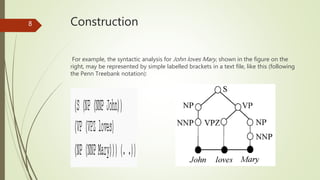
For example, the syntactic analysis for John loves Mary, shown in the figure on the 
right, may be represented by simple labelled brackets in a text file, like this (following 
the Penn Treebank notation): 
8
Construction 
 This type of representation is popular because it is light on resources, and the tree 
structure is relatively easy to read without software tools. However as corpora 
become increasingly complex, other file formats may be preferred. Alternatives 
include treebank-specific XML schemes, numbered indentation and various types 
of standoff notation. 
9
Applications 
Computational perspective 
 From a computational perspective, Treebank have been used to engineer state-of-the- 
art natural language processing systems such as part-of-speech 
taggers, parsers, semantic analyzers and machine translation systems. 
 Most computational systems utilize gold-standard Treebank data. 
 However, an automatically parsed corpus that is not corrected by human linguists 
can still be useful. 
10
Applications 
 It can provide evidence of rule frequency for a parser. 
 A parser may be improved by applying it to large amounts of text and gathering 
rule frequencies. 
 However, it should be obvious that only by a process of correcting and completing 
a corpus by hand is it possible then to identify rules absent from the parser 
knowledge base. In addition, frequencies are likely to be more accurate. 
11
Applications 
Corpus linguistics 
 In corpus linguistics, Treebank are used to study syntactic phenomena 
for example, diachronic corpora can be used to study the time course of syntactic 
change. 
 Once parsed, a corpus will contain frequency evidence showing how common 
different grammatical structures are in use. 
 Treebank also provide evidence of coverage and support the discovery of new, 
unanticipated, grammatical phenomena. 
. 
12
Applications 
 Interaction research is particularly fruitful as further layers of annotation, e.g. 
semantic, pragmatic, are added to a corpus. 
 It is then possible to evaluate the impact of non-syntactic phenomena on 
grammatical choices 
13
Applications 
Theoretical linguistics and Psycholinguistics 
 Another use of Treebank in theoretical linguistics and psycholinguistics is 
interaction evidence. 
 A completed Treebank can help linguists carry out experiments as to how the 
decision to use one grammatical construction tends to influence the decision to 
form others, and to try to understand how speakers and writers make decisions as 
they form sentences. 
14
Penn Treebank Project 
 The Penn Treebank Project annotates naturally-occurring text for linguistic 
structure. 
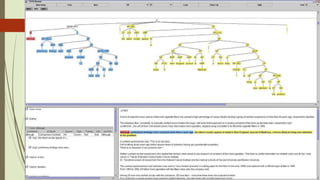
 Most notably, it produces skeletal parses showing rough syntactic and semantic 
information -- a bank of linguistic trees . 
 It also annotate text with part-of-speech tags, and for the Switchboard corpus of 
telephone conversations, dysfluency annotation. 
 It is located in the LINC Laboratory of the Computer and Information Science 
Department at the University of Pennsylvania. 
15
Penn Treebank Project 
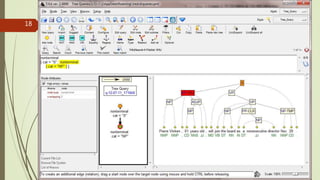
 The Linguistic Data Consortium(LDC) provides tools and formats for creating and 
managing linguistic annotations. 
 `Linguistic annotation‘ covers any descriptive or analytic notations applied to raw 
language data. 
 The Penn Treebank is a human-annotated and partially `skeletally' parsed corpus 
consisting of over 4.5 million words of American English. 
 It includes the Brown Corpus (retagged) and the Wall Street Journal Corpus, as well 
as Department of Energy abstracts, Dow Jones Newswire stories, Department of 
Agriculture bulletins, Library of America texts, MUC-3 messages, IBM Manual 
sentences, WBUR radio transcripts, and ATIS sentences. 
16
17
18
References 
 http://en.wikipedia.org/wiki/Treebank 
 http://www.cis.upenn.edu/~treebank/ 
 https://catalog.ldc.upenn.edu/LDC97S62 
 http://mshang.ca/syntree/ 
 http://faculty.washington.edu/fxia/LAWVI/workshop_presentation_slides/special_se 
ssion/pml/ 
 http://www.seas.upenn.edu/~pdtb/tools.shtml 
19
20

Treebank annotation

  • 1.
    Treebank Annotation By– Mohit Jasapara – 2012EEB1059 Aashish Kholiya – 2012MEB1083 1
  • 2.
    Treebank  Thetermtreebank was coined by linguist Geoffrey Leech in the 1980s because both syntactic and semantic structure are commonly represented compositionally as a tree structure.  In linguistics , a treebank is a parsed text corpus that annotates syntactic or semantic sentence structure.  In simple words, treebanks are collections of manually checked syntactic analyses of sentences. 2
  • 3.
  • 4.
    Construction  Treebanksare often created on top of a corpus that has already been annotated with part-of-speech tags.  treebanks are sometimes enhanced with semantic or other linguistic information.  Treebanks can be created completely manually, where linguists annotate each sentence with syntactic structure, or semi-automatically, where a parser assigns some syntactic structure which linguists then check and, if necessary, correct 4
  • 5.
    Construction  Inpractice, fully checking and completing the parsing of natural language corpora is a labour-intensive project that can take teams of graduate linguists several years.  The level of annotation detail and the breadth of the linguistic sample determine the difficulty of the task and the length of time required to build a treebank. 5
  • 6.
    Construction  Sometreebanks follow a specific linguistic theory in their syntactic annotation (e.g. the BulTreeBank follows HPSG) but most try to be less theory-specific. However, two main groups can be distinguished: treebanks that annotate phrase structure (for example the Penn Treebank or ICE-GB) and those that annotate dependency structure (for example the Prague Dependency Treebank or the Quranic Arabic Dependency Treebank). 6
  • 7.
    Construction  Itis important to clarify the distinction between the formal representation and the file format used to store the annotated data.  Treebanks are necessarily constructed according to a particular grammar. The same grammar may be implemented by different file formats. 7
  • 8.
    Construction For example,the syntactic analysis for John loves Mary, shown in the figure on the right, may be represented by simple labelled brackets in a text file, like this (following the Penn Treebank notation): 8
  • 9.
    Construction  Thistype of representation is popular because it is light on resources, and the tree structure is relatively easy to read without software tools. However as corpora become increasingly complex, other file formats may be preferred. Alternatives include treebank-specific XML schemes, numbered indentation and various types of standoff notation. 9
  • 10.
    Applications Computational perspective  From a computational perspective, Treebank have been used to engineer state-of-the- art natural language processing systems such as part-of-speech taggers, parsers, semantic analyzers and machine translation systems.  Most computational systems utilize gold-standard Treebank data.  However, an automatically parsed corpus that is not corrected by human linguists can still be useful. 10
  • 11.
    Applications  Itcan provide evidence of rule frequency for a parser.  A parser may be improved by applying it to large amounts of text and gathering rule frequencies.  However, it should be obvious that only by a process of correcting and completing a corpus by hand is it possible then to identify rules absent from the parser knowledge base. In addition, frequencies are likely to be more accurate. 11
  • 12.
    Applications Corpus linguistics  In corpus linguistics, Treebank are used to study syntactic phenomena for example, diachronic corpora can be used to study the time course of syntactic change.  Once parsed, a corpus will contain frequency evidence showing how common different grammatical structures are in use.  Treebank also provide evidence of coverage and support the discovery of new, unanticipated, grammatical phenomena. . 12
  • 13.
    Applications  Interactionresearch is particularly fruitful as further layers of annotation, e.g. semantic, pragmatic, are added to a corpus.  It is then possible to evaluate the impact of non-syntactic phenomena on grammatical choices 13
  • 14.
    Applications Theoretical linguisticsand Psycholinguistics  Another use of Treebank in theoretical linguistics and psycholinguistics is interaction evidence.  A completed Treebank can help linguists carry out experiments as to how the decision to use one grammatical construction tends to influence the decision to form others, and to try to understand how speakers and writers make decisions as they form sentences. 14
  • 15.
    Penn Treebank Project  The Penn Treebank Project annotates naturally-occurring text for linguistic structure.  Most notably, it produces skeletal parses showing rough syntactic and semantic information -- a bank of linguistic trees .  It also annotate text with part-of-speech tags, and for the Switchboard corpus of telephone conversations, dysfluency annotation.  It is located in the LINC Laboratory of the Computer and Information Science Department at the University of Pennsylvania. 15
  • 16.
    Penn Treebank Project  The Linguistic Data Consortium(LDC) provides tools and formats for creating and managing linguistic annotations.  `Linguistic annotation‘ covers any descriptive or analytic notations applied to raw language data.  The Penn Treebank is a human-annotated and partially `skeletally' parsed corpus consisting of over 4.5 million words of American English.  It includes the Brown Corpus (retagged) and the Wall Street Journal Corpus, as well as Department of Energy abstracts, Dow Jones Newswire stories, Department of Agriculture bulletins, Library of America texts, MUC-3 messages, IBM Manual sentences, WBUR radio transcripts, and ATIS sentences. 16
  • 17.
  • 18.
  • 19.
    References  http://en.wikipedia.org/wiki/Treebank  http://www.cis.upenn.edu/~treebank/  https://catalog.ldc.upenn.edu/LDC97S62  http://mshang.ca/syntree/  http://faculty.washington.edu/fxia/LAWVI/workshop_presentation_slides/special_se ssion/pml/  http://www.seas.upenn.edu/~pdtb/tools.shtml 19
  • 20.