By
B.Sakthibala
I M.sc(cs)
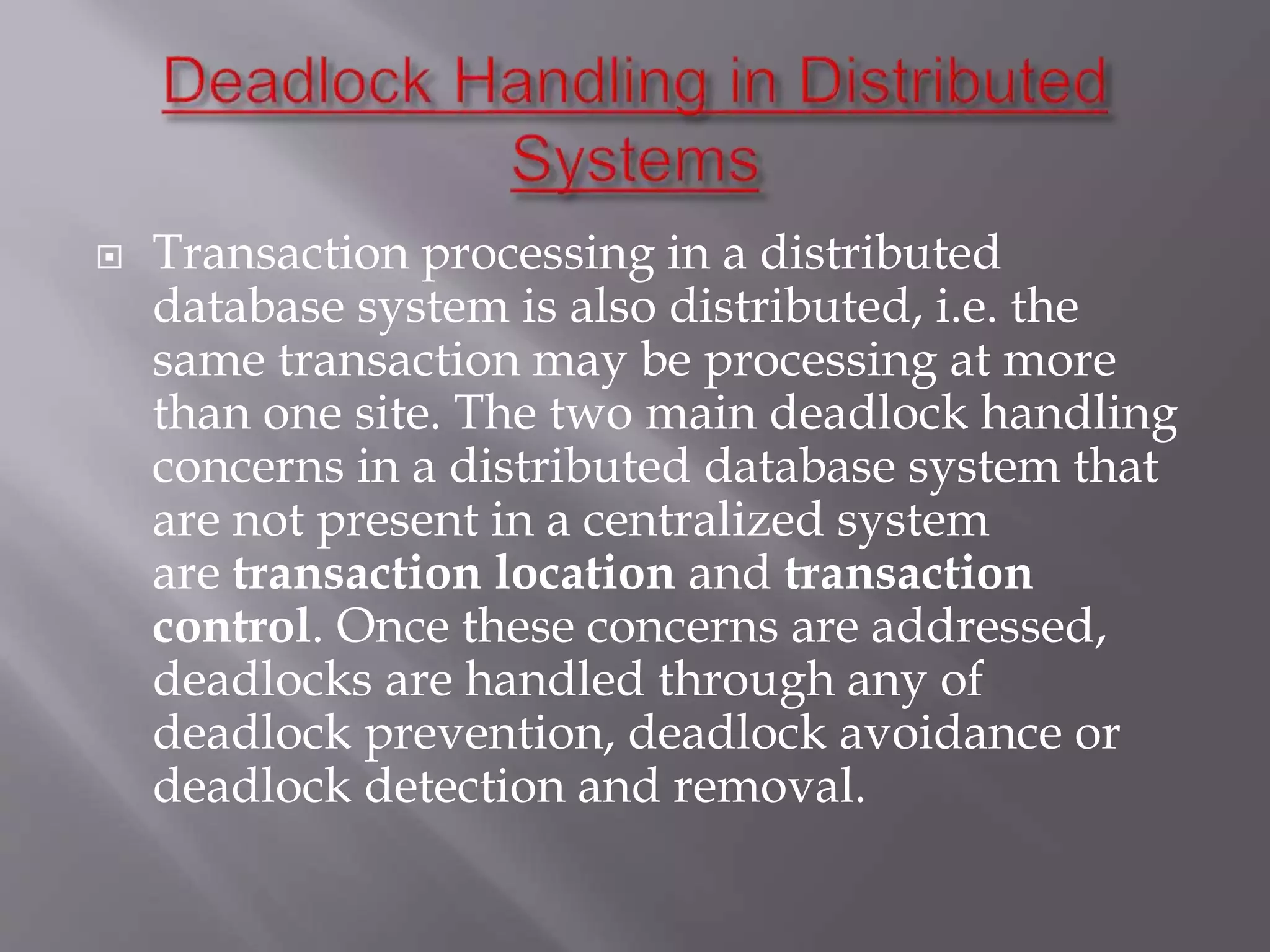
 Deadlock occurs when two or more
transactions are waiting to access the data
locked by the other transaction.
 Neither transaction can continue because each
is waiting for a lock it cannot obtain until the
other completes.
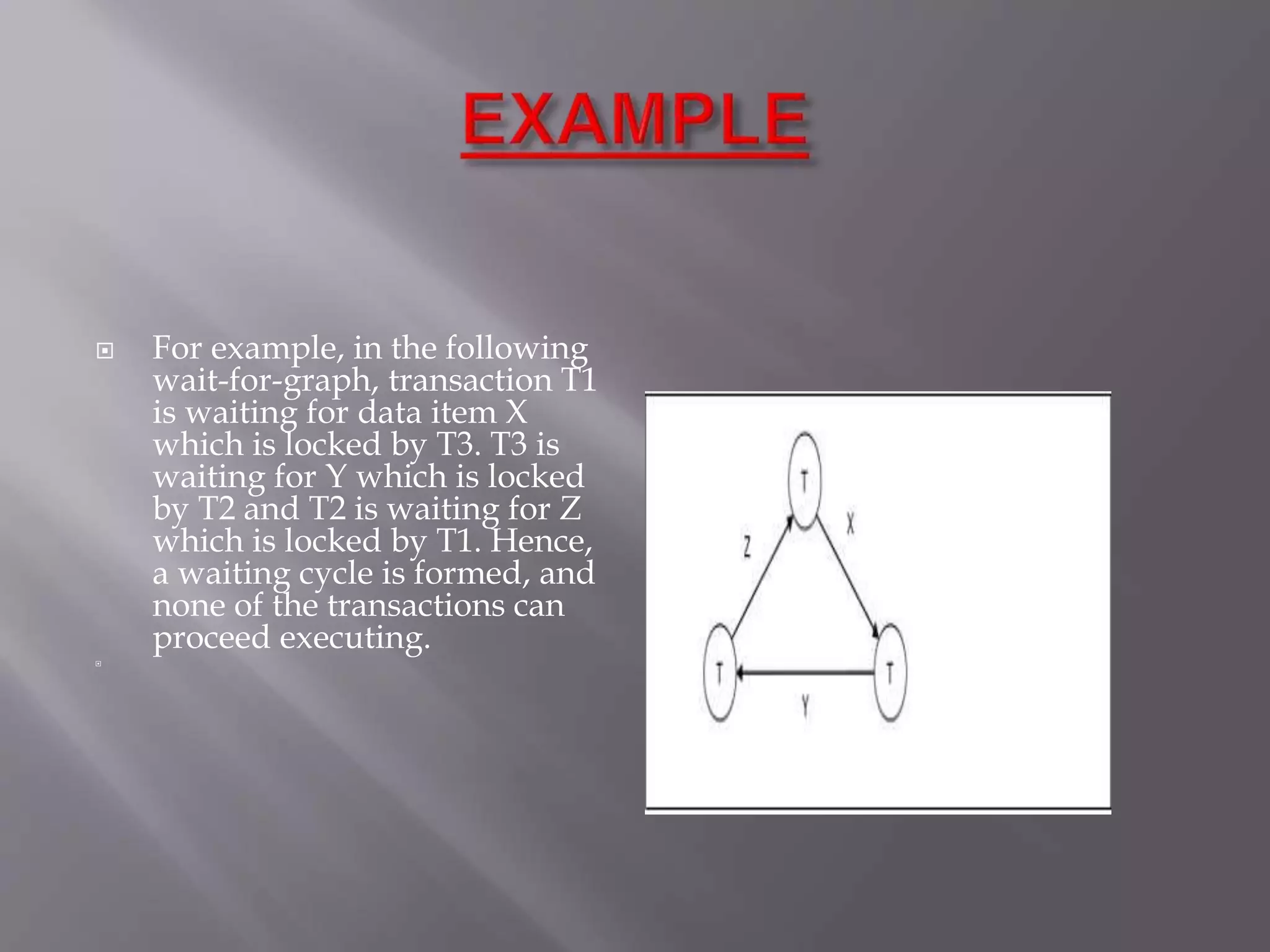
 For example, in the following
wait-for-graph, transaction T1
is waiting for data item X
which is locked by T3. T3 is
waiting for Y which is locked
by T2 and T2 is waiting for Z
which is locked by T1. Hence,
a waiting cycle is formed, and
none of the transactions can
proceed executing.

 There are three classical approaches for
deadlock handling, namely āˆ’
 Deadlock prevention.
 Deadlock avoidance.
 Deadlock detection and removal.
 All of the three approaches can be incorporated
in both a centralized and a distributed database
system
 The deadlock prevention approach does not allow
any transaction to acquire locks that will lead to
deadlocks. The convention is that when more than
one transactions request for locking the same data
item, only one of them is granted the lock.
 One of the most popular deadlock prevention
methods is pre-acquisition of all the locks. In this
method, a transaction acquires all the locks before
starting to execute and retains the locks for the
entire duration of transaction
 The deadlock avoidance approach handles deadlocks before they
occur. It analyzes the transactions and the locks to determine
whether or not waiting leads to a deadlock.
 There are two algorithms for this purpose, namely wait-
die and wound-wait. Let us assume that there are two
transactions, T1 and T2, where T1 tries to lock a data item which is
already locked by T2. The algorithms are as follows āˆ’
 Wait-Die āˆ’ If T1 is older than T2, T1 is allowed to wait. Otherwise,
if T1 is younger than T2, T1 is aborted and later restarted.
 Wound-Wait āˆ’ If T1 is older than T2, T2 is aborted and later
restarted. Otherwise, if T1 is younger than T2, T1 is allowed to
wait.
 Wait-Die āˆ’ If T1 is older than T2, T1 is allowed
to wait. Otherwise, if T1 is younger than T2, T1
is aborted and later restarted.
 Wound-Wait āˆ’ If T1 is older than T2, T2 is
aborted and later restarted. Otherwise, if T1 is
younger than T2, T1 is allowed to wait
 The deadlock detection and removal approach
runs a deadlock detection algorithm
periodically and removes deadlock in case
there is one. It does not check for deadlock
when a transaction places a request for a lock.
When a transaction requests a lock, the lock
manager checks whether it is available. If it is
available, the transaction is allowed to lock the
data item; otherwise the transaction is allowed
to wait
 Choose the youngest transaction.
 Choose the transaction with fewest data items.
 Choose the transaction that has performed least
number of updates.
 Choose the transaction having least restart
overhead.
 Choose the transaction which is common to two or
more cycles.
 This approach is primarily suited for systems
having transactions low and where fast response to
lock requests is needed.
 Transaction processing in a distributed
database system is also distributed, i.e. the
same transaction may be processing at more
than one site. The two main deadlock handling
concerns in a distributed database system that
are not present in a centralized system
are transaction location and transaction
control. Once these concerns are addressed,
deadlocks are handled through any of
deadlock prevention, deadlock avoidance or
deadlock detection and removal.
 Transactions in a distributed database system
are processed in multiple sites and use data
items in multiple sites. The amount of data
processing is not uniformly distributed among
these sites. The time period of processing also
varies. Thus the same transaction may be active
at some sites and inactive at others. When two
conflicting transactions are located in a site, it
may happen that one of them is in inactive
state. This condition does not arise in a
centralized system
 This concern is called transaction location issue:
 This concern may be addressed by Daisy Chain
model. In this model, a transaction carries certain
details when it moves from one site to another.
Some of the details are the list of tables required,
the list of sites required, the list of visited tables
and sites, the list of tables and sites that are yet to
be visited and the list of acquired locks with types.
After a transaction terminates by either commit or
abort, the information should be sent to all the
concerned sites.
 Transaction control is concerned with
designating and controlling the sites required
for processing a transaction in a distributed
database system. There are many options
regarding the choice of where to process the
transaction and how to designate the center of
control.
 One server may be selected as the center of
control.
 The center of control may travel from one
server to another.
 The responsibility of controlling may be shared
by a number of servers.
 The site where the transaction enters is
designated as the controlling site. The
controlling site sends messages to the sites
where the data items are located to lock the
items. Then it waits for confirmation. When all
the sites have confirmed that they have locked
the data items, transaction starts. If any site or
communication link fails, the transaction has to
wait until they have been repaired.
 Though the implementation is simple, this approach has
some drawbacks āˆ’
 Pre-acquisition of locks requires a long time for
communication delays. This increases the time required for
transaction.
 In case of site or link failure, a transaction has to wait for a
long time so that the sites recover. Meanwhile, in the
running sites, the items are locked. This may prevent other
transactions from executing.
 If the controlling site fails, it cannot communicate with the
other sites. These sites continue to keep the locked data
items in their locked state, thus resulting in blocking.

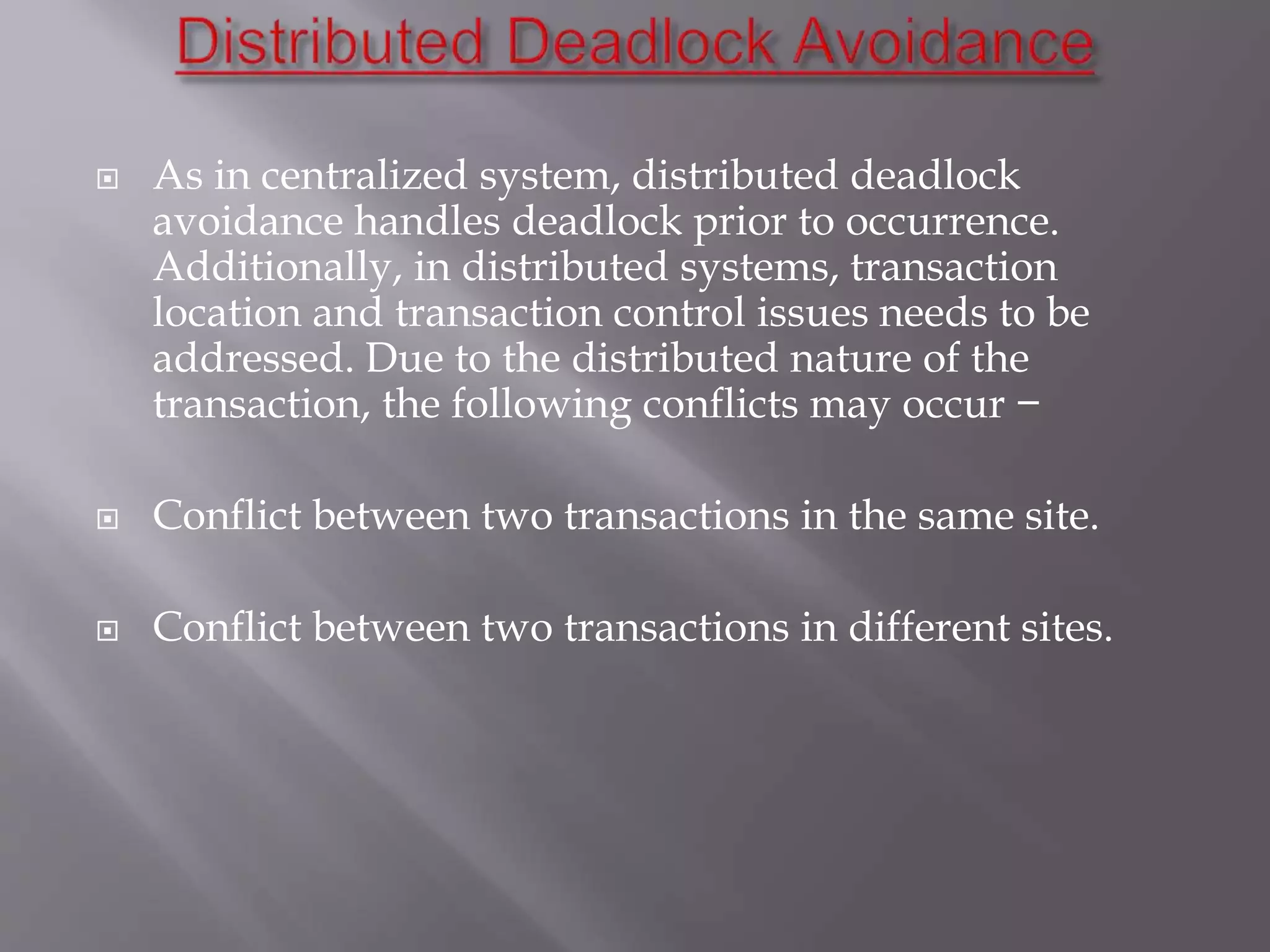
 As in centralized system, distributed deadlock
avoidance handles deadlock prior to occurrence.
Additionally, in distributed systems, transaction
location and transaction control issues needs to be
addressed. Due to the distributed nature of the
transaction, the following conflicts may occur āˆ’
 Conflict between two transactions in the same site.
 Conflict between two transactions in different sites.
 In case of conflict, one of the transactions may
be aborted or allowed to wait as per distributed
wait-die or distributed wound-wait algorithms.
 Let us assume that there are two transactions,
T1 and T2. T1 arrives at Site P and tries to lock
a data item which is already locked by T2 at
that site. Hence, there is a conflict at Site P. The
algorithms are as follows āˆ’

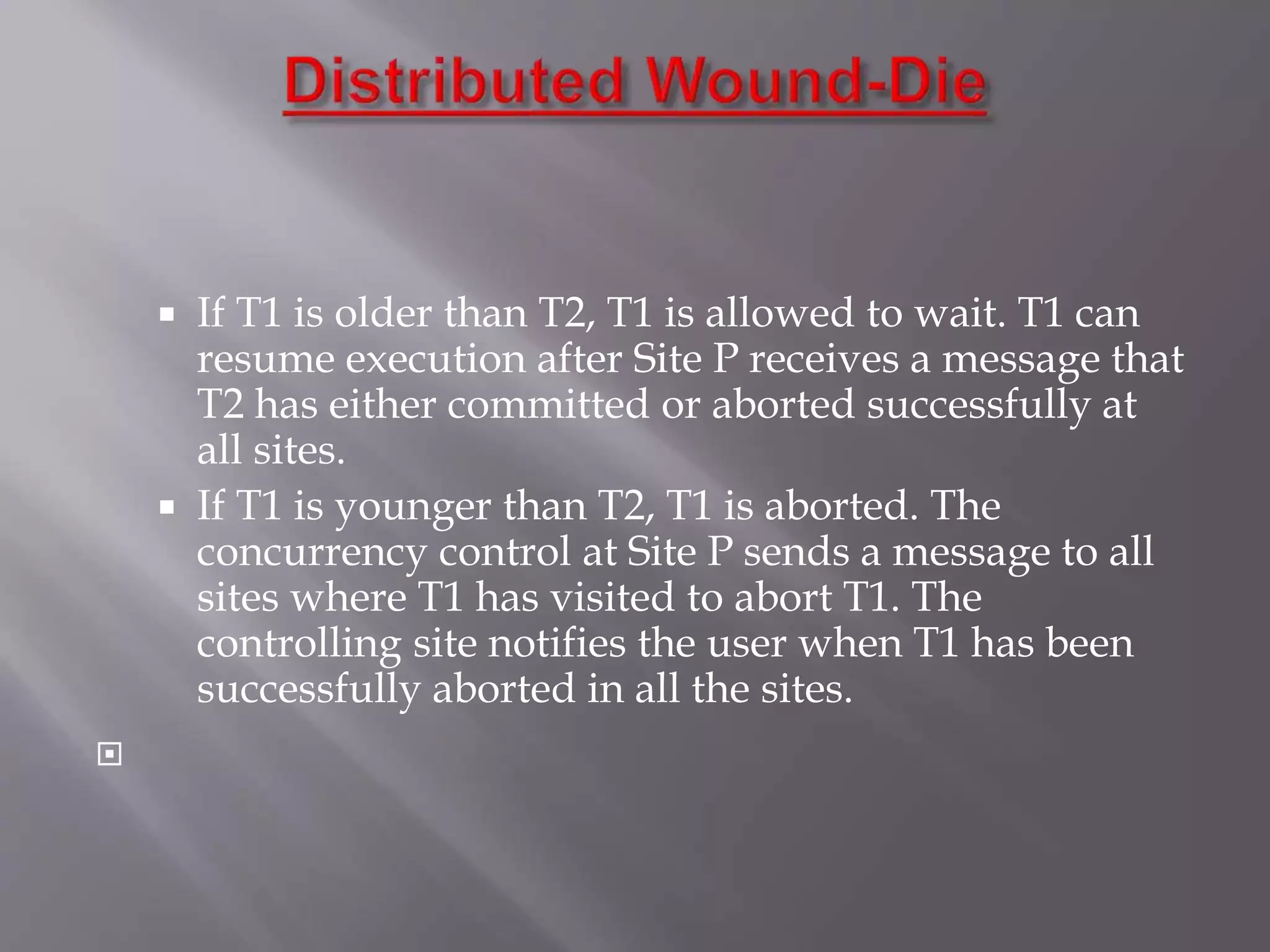
ļ‚” If T1 is older than T2, T1 is allowed to wait. T1 can
resume execution after Site P receives a message that
T2 has either committed or aborted successfully at
all sites.
ļ‚” If T1 is younger than T2, T1 is aborted. The
concurrency control at Site P sends a message to all
sites where T1 has visited to abort T1. The
controlling site notifies the user when T1 has been
successfully aborted in all the sites.

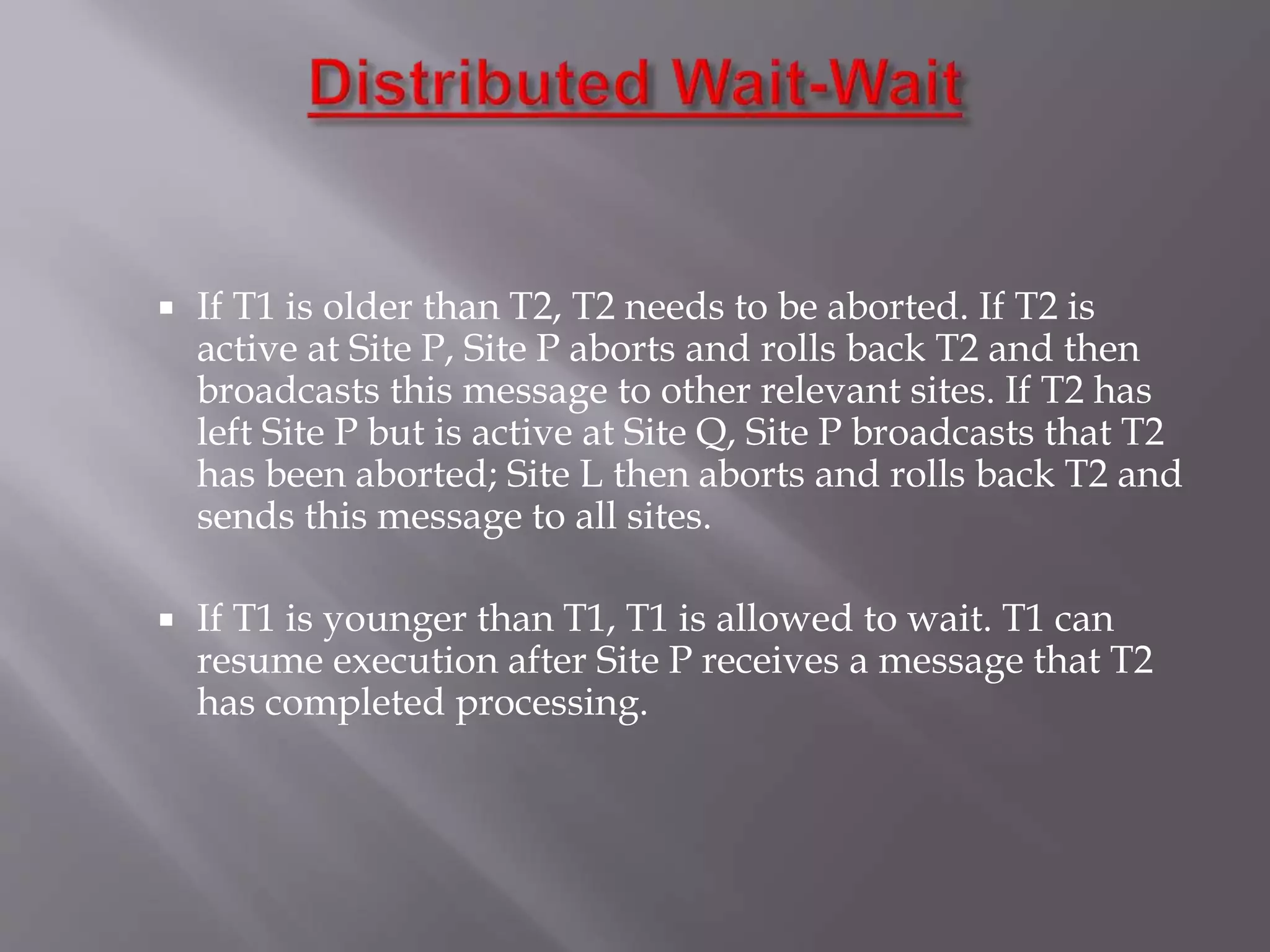
ļ‚” If T1 is older than T2, T2 needs to be aborted. If T2 is
active at Site P, Site P aborts and rolls back T2 and then
broadcasts this message to other relevant sites. If T2 has
left Site P but is active at Site Q, Site P broadcasts that T2
has been aborted; Site L then aborts and rolls back T2 and
sends this message to all sites.
ļ‚” If T1 is younger than T1, T1 is allowed to wait. T1 can
resume execution after Site P receives a message that T2
has completed processing.
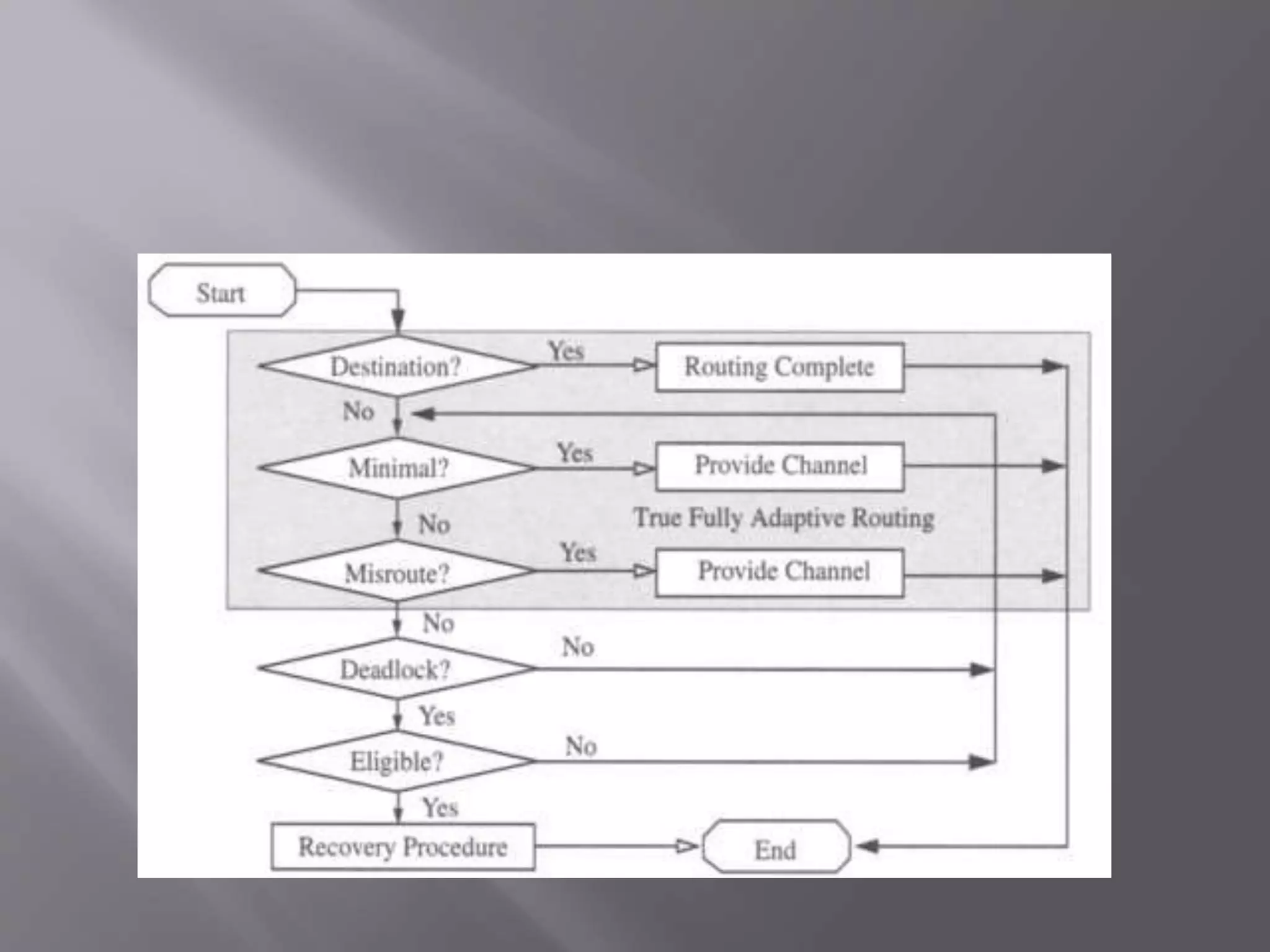
 Just like centralized deadlock detection approach,
deadlocks are allowed to occur and are removed if
detected. The system does not perform any checks
when a transaction places a lock request.
 For implementation, global wait-for-graphs are
created. Existence of a cycle in the global wait-for-
graph indicates deadlocks. However, it is difficult
to spot deadlocks since transaction waits for
resources across the network.
 Another tool used for deadlock handling is a
deadlock detector. In a centralized system,
there is one deadlock detector. In a distributed
system, there can be more than one deadlock
detectors. A deadlock detector can find
deadlocks for the sites under its control.
 There are three alternatives for deadlock
detection in a distributed system, namely.
 Centralized Deadlock Detector āˆ’ One site is
designated as the central deadlock detector.
 Hierarchical Deadlock Detector āˆ’ A number
of deadlock detectors are arranged in
hierarchy.
 Distributed Deadlock Detector āˆ’ All the sites
participate in detecting deadlocks and
removing them.
 THANKING YOU

Rdbms

  • 1.
  • 2.
     Deadlock occurswhen two or more transactions are waiting to access the data locked by the other transaction.  Neither transaction can continue because each is waiting for a lock it cannot obtain until the other completes.
  • 3.
     For example,in the following wait-for-graph, transaction T1 is waiting for data item X which is locked by T3. T3 is waiting for Y which is locked by T2 and T2 is waiting for Z which is locked by T1. Hence, a waiting cycle is formed, and none of the transactions can proceed executing. 
  • 5.
     There arethree classical approaches for deadlock handling, namely āˆ’  Deadlock prevention.  Deadlock avoidance.  Deadlock detection and removal.  All of the three approaches can be incorporated in both a centralized and a distributed database system
  • 6.
     The deadlockprevention approach does not allow any transaction to acquire locks that will lead to deadlocks. The convention is that when more than one transactions request for locking the same data item, only one of them is granted the lock.  One of the most popular deadlock prevention methods is pre-acquisition of all the locks. In this method, a transaction acquires all the locks before starting to execute and retains the locks for the entire duration of transaction
  • 7.
     The deadlockavoidance approach handles deadlocks before they occur. It analyzes the transactions and the locks to determine whether or not waiting leads to a deadlock.  There are two algorithms for this purpose, namely wait- die and wound-wait. Let us assume that there are two transactions, T1 and T2, where T1 tries to lock a data item which is already locked by T2. The algorithms are as follows āˆ’  Wait-Die āˆ’ If T1 is older than T2, T1 is allowed to wait. Otherwise, if T1 is younger than T2, T1 is aborted and later restarted.  Wound-Wait āˆ’ If T1 is older than T2, T2 is aborted and later restarted. Otherwise, if T1 is younger than T2, T1 is allowed to wait.
  • 8.
     Wait-Die āˆ’If T1 is older than T2, T1 is allowed to wait. Otherwise, if T1 is younger than T2, T1 is aborted and later restarted.  Wound-Wait āˆ’ If T1 is older than T2, T2 is aborted and later restarted. Otherwise, if T1 is younger than T2, T1 is allowed to wait
  • 9.
     The deadlockdetection and removal approach runs a deadlock detection algorithm periodically and removes deadlock in case there is one. It does not check for deadlock when a transaction places a request for a lock. When a transaction requests a lock, the lock manager checks whether it is available. If it is available, the transaction is allowed to lock the data item; otherwise the transaction is allowed to wait
  • 10.
     Choose theyoungest transaction.  Choose the transaction with fewest data items.  Choose the transaction that has performed least number of updates.  Choose the transaction having least restart overhead.  Choose the transaction which is common to two or more cycles.  This approach is primarily suited for systems having transactions low and where fast response to lock requests is needed.
  • 12.
     Transaction processingin a distributed database system is also distributed, i.e. the same transaction may be processing at more than one site. The two main deadlock handling concerns in a distributed database system that are not present in a centralized system are transaction location and transaction control. Once these concerns are addressed, deadlocks are handled through any of deadlock prevention, deadlock avoidance or deadlock detection and removal.
  • 13.
     Transactions ina distributed database system are processed in multiple sites and use data items in multiple sites. The amount of data processing is not uniformly distributed among these sites. The time period of processing also varies. Thus the same transaction may be active at some sites and inactive at others. When two conflicting transactions are located in a site, it may happen that one of them is in inactive state. This condition does not arise in a centralized system
  • 14.
     This concernis called transaction location issue:  This concern may be addressed by Daisy Chain model. In this model, a transaction carries certain details when it moves from one site to another. Some of the details are the list of tables required, the list of sites required, the list of visited tables and sites, the list of tables and sites that are yet to be visited and the list of acquired locks with types. After a transaction terminates by either commit or abort, the information should be sent to all the concerned sites.
  • 15.
     Transaction controlis concerned with designating and controlling the sites required for processing a transaction in a distributed database system. There are many options regarding the choice of where to process the transaction and how to designate the center of control.
  • 16.
     One servermay be selected as the center of control.  The center of control may travel from one server to another.  The responsibility of controlling may be shared by a number of servers.
  • 17.
     The sitewhere the transaction enters is designated as the controlling site. The controlling site sends messages to the sites where the data items are located to lock the items. Then it waits for confirmation. When all the sites have confirmed that they have locked the data items, transaction starts. If any site or communication link fails, the transaction has to wait until they have been repaired.
  • 18.
     Though theimplementation is simple, this approach has some drawbacks āˆ’  Pre-acquisition of locks requires a long time for communication delays. This increases the time required for transaction.  In case of site or link failure, a transaction has to wait for a long time so that the sites recover. Meanwhile, in the running sites, the items are locked. This may prevent other transactions from executing.  If the controlling site fails, it cannot communicate with the other sites. These sites continue to keep the locked data items in their locked state, thus resulting in blocking. 
  • 19.
     As incentralized system, distributed deadlock avoidance handles deadlock prior to occurrence. Additionally, in distributed systems, transaction location and transaction control issues needs to be addressed. Due to the distributed nature of the transaction, the following conflicts may occur āˆ’  Conflict between two transactions in the same site.  Conflict between two transactions in different sites.
  • 20.
     In caseof conflict, one of the transactions may be aborted or allowed to wait as per distributed wait-die or distributed wound-wait algorithms.  Let us assume that there are two transactions, T1 and T2. T1 arrives at Site P and tries to lock a data item which is already locked by T2 at that site. Hence, there is a conflict at Site P. The algorithms are as follows āˆ’ 
  • 21.
    ļ‚” If T1is older than T2, T1 is allowed to wait. T1 can resume execution after Site P receives a message that T2 has either committed or aborted successfully at all sites. ļ‚” If T1 is younger than T2, T1 is aborted. The concurrency control at Site P sends a message to all sites where T1 has visited to abort T1. The controlling site notifies the user when T1 has been successfully aborted in all the sites. 
  • 22.
    ļ‚” If T1is older than T2, T2 needs to be aborted. If T2 is active at Site P, Site P aborts and rolls back T2 and then broadcasts this message to other relevant sites. If T2 has left Site P but is active at Site Q, Site P broadcasts that T2 has been aborted; Site L then aborts and rolls back T2 and sends this message to all sites. ļ‚” If T1 is younger than T1, T1 is allowed to wait. T1 can resume execution after Site P receives a message that T2 has completed processing.
  • 23.
     Just likecentralized deadlock detection approach, deadlocks are allowed to occur and are removed if detected. The system does not perform any checks when a transaction places a lock request.  For implementation, global wait-for-graphs are created. Existence of a cycle in the global wait-for- graph indicates deadlocks. However, it is difficult to spot deadlocks since transaction waits for resources across the network.
  • 24.
     Another toolused for deadlock handling is a deadlock detector. In a centralized system, there is one deadlock detector. In a distributed system, there can be more than one deadlock detectors. A deadlock detector can find deadlocks for the sites under its control.  There are three alternatives for deadlock detection in a distributed system, namely.
  • 25.
     Centralized DeadlockDetector āˆ’ One site is designated as the central deadlock detector.  Hierarchical Deadlock Detector āˆ’ A number of deadlock detectors are arranged in hierarchy.  Distributed Deadlock Detector āˆ’ All the sites participate in detecting deadlocks and removing them.
  • 27.