By
B.Kohila MSc(IT),
Nadar saraswathi college of
arts and science,
Theni
IPV4
ADDRESSING
IPV4 ADDRESSES
IPv4 address is a 32-bit address that
uniquely and universally defines the
connection of a device to the internet.
Ipv4 addresses are unique.
Continue……
Two devices on the internet can never
have the same address at the same time.
The IPv4 address are universal in the
sense that the addressing system must be
accepted by any host that wants to be
connected to the internet.
IPv4 Addressing
A core function of IP is to provide logical addressing for
hosts.
An IP address provides a Hierarchical structure to both
uniquely identify a host, and what network that host
exists on.
An IP address is most often represented in decimal, in
the following format:158.80.164.3
An IP address is comprised of four octets ,separated
by periods : First Octet Second Octet Third Octet
Fourth Octet 158 80 164 3
Each octet is an 8-bit number, resulting in a 32-bit
IP address. The smallest possible value of an octet is
0, or 00000000 in binary. The largest possible value
of an octet is 255, or 11111111 in binary.
The above IP address represented in binary would
look as follows: First Octet Second Octet Third
Octet Fourth Octet 10011110 01010000 10100100
00000011
Binary to Decimal Conversion:
Converting from binary back to decimal I seven
simpler.
Apply the binary number to the conversion table,
and
then add up anycolumns with binary bits set to 1.
For
example, consider the binary number of 11110001:
 Decimal 128 64 32 16 8 4 2 1
 Binary 1 1 1 1 0 0 0 1
 By adding 128 + 64 + 32 + 16+ 1, it can be
 determined that 11110001 equals 241.
The Subnet Mask(continued)
Hosts on the same logical network will have
dentical network addresses, and can communicate
freely. For example, the following two hosts are on
the same network:
 Host A: 158.80.164.100 255.255.0.0
 Host B: 158.80.164.101 255.255.0.0
Both share the same network address(158.80),
which is determined by the255.255.0.0 subnet
mask.
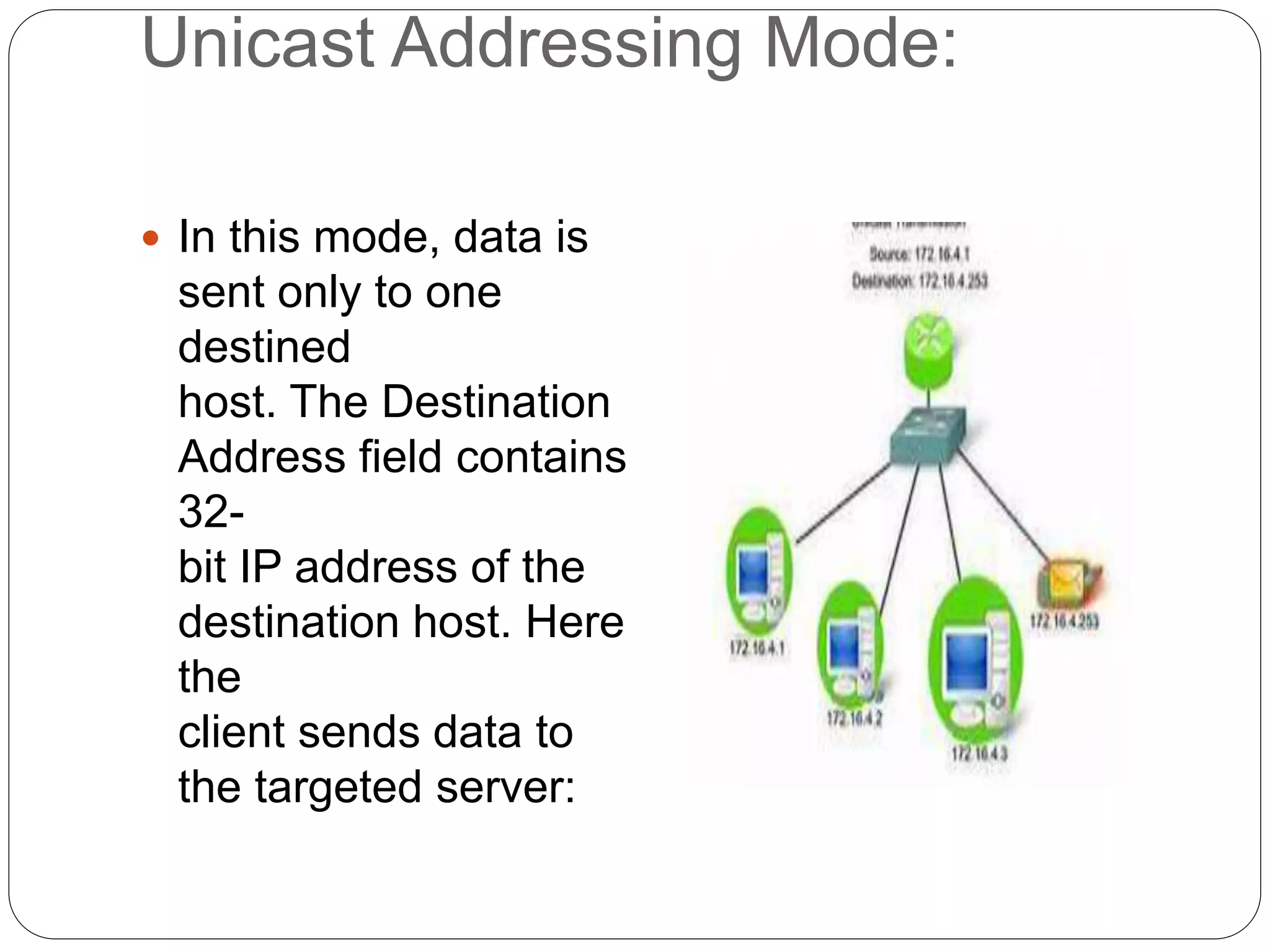
Unicast Addressing Mode:
 In this mode, data is
sent only to one
destined
host. The Destination
Address field contains
32-
bit IP address of the
destination host. Here
the
client sends data to
the targeted server:
Broadcast Addressing Mode:
In this mode, the packet is addressed to all the
hosts in a network segment. The Destination
Address field contains a special broadcast address,
i.e. 255.255.255.255.
When a host sees this packet on the
network, it is bound to process it. Here
the client sends a packet, which is
entertained by all the Servers:
Multicast Addressing Mode:
This mode is a mix of the previous two modes,
i.e. the packet sent is neither destined to a
Single host nor all the hosts on the segment. In
this packet, the Destination Address contains a
special address which starts with 224.x.x.x and
can be entertained
conclusion
Every network has one IP address reserved for
The Network Number which represents the
network and one IP address reserved for
the Broadcast Address, which represents all the
hosts in that network.

Ipv4

  • 1.
    By B.Kohila MSc(IT), Nadar saraswathicollege of arts and science, Theni IPV4 ADDRESSING
  • 2.
    IPV4 ADDRESSES IPv4 addressis a 32-bit address that uniquely and universally defines the connection of a device to the internet. Ipv4 addresses are unique.
  • 3.
    Continue…… Two devices onthe internet can never have the same address at the same time. The IPv4 address are universal in the sense that the addressing system must be accepted by any host that wants to be connected to the internet.
  • 4.
    IPv4 Addressing A corefunction of IP is to provide logical addressing for hosts. An IP address provides a Hierarchical structure to both uniquely identify a host, and what network that host exists on. An IP address is most often represented in decimal, in the following format:158.80.164.3
  • 5.
    An IP addressis comprised of four octets ,separated by periods : First Octet Second Octet Third Octet Fourth Octet 158 80 164 3 Each octet is an 8-bit number, resulting in a 32-bit IP address. The smallest possible value of an octet is 0, or 00000000 in binary. The largest possible value of an octet is 255, or 11111111 in binary. The above IP address represented in binary would look as follows: First Octet Second Octet Third Octet Fourth Octet 10011110 01010000 10100100 00000011
  • 6.
    Binary to DecimalConversion: Converting from binary back to decimal I seven simpler. Apply the binary number to the conversion table, and then add up anycolumns with binary bits set to 1. For example, consider the binary number of 11110001:  Decimal 128 64 32 16 8 4 2 1  Binary 1 1 1 1 0 0 0 1  By adding 128 + 64 + 32 + 16+ 1, it can be  determined that 11110001 equals 241.
  • 7.
    The Subnet Mask(continued) Hostson the same logical network will have dentical network addresses, and can communicate freely. For example, the following two hosts are on the same network:  Host A: 158.80.164.100 255.255.0.0  Host B: 158.80.164.101 255.255.0.0 Both share the same network address(158.80), which is determined by the255.255.0.0 subnet mask.
  • 9.
    Unicast Addressing Mode: In this mode, data is sent only to one destined host. The Destination Address field contains 32- bit IP address of the destination host. Here the client sends data to the targeted server:
  • 10.
    Broadcast Addressing Mode: Inthis mode, the packet is addressed to all the hosts in a network segment. The Destination Address field contains a special broadcast address, i.e. 255.255.255.255. When a host sees this packet on the network, it is bound to process it. Here the client sends a packet, which is entertained by all the Servers:
  • 11.
    Multicast Addressing Mode: Thismode is a mix of the previous two modes, i.e. the packet sent is neither destined to a Single host nor all the hosts on the segment. In this packet, the Destination Address contains a special address which starts with 224.x.x.x and can be entertained
  • 12.
    conclusion Every network hasone IP address reserved for The Network Number which represents the network and one IP address reserved for the Broadcast Address, which represents all the hosts in that network.