SUBASHREE D
ASSISTANT PROFESSOR
SRMIST
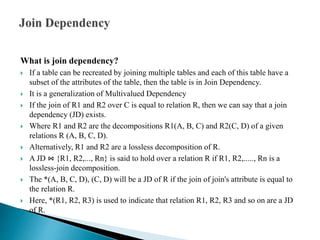
What is join dependency?
 If a table can be recreated by joining multiple tables and each of this table have a
subset of the attributes of the table, then the table is in Join Dependency.
 It is a generalization of Multivalued Dependency
 If the join of R1 and R2 over C is equal to relation R, then we can say that a join
dependency (JD) exists.
 Where R1 and R2 are the decompositions R1(A, B, C) and R2(C, D) of a given
relations R (A, B, C, D).
 Alternatively, R1 and R2 are a lossless decomposition of R.
 A JD ⋈ {R1, R2,..., Rn} is said to hold over a relation R if R1, R2,....., Rn is a
lossless-join decomposition.
 The *(A, B, C, D), (C, D) will be a JD of R if the join of join's attribute is equal to
the relation R.
 Here, *(R1, R2, R3) is used to indicate that relation R1, R2, R3 and so on are a JD
of R.
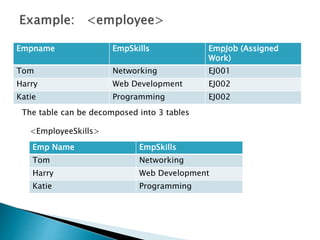
Empname EmpSkills EmpJob (Assigned
Work)
Tom Networking EJ001
Harry Web Development EJ002
Katie Programming EJ002
Emp Name EmpSkills
Tom Networking
Harry Web Development
Katie Programming
The table can be decomposed into 3 tables
<EmployeeSkills>
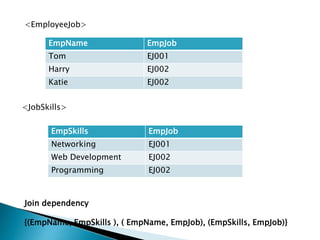
EmpName EmpJob
Tom EJ001
Harry EJ002
Katie EJ002
<EmployeeJob>
<JobSkills>
EmpSkills EmpJob
Networking EJ001
Web Development EJ002
Programming EJ002
Join dependency
{(EmpName, EmpSkills ), ( EmpName, EmpJob), (EmpSkills, EmpJob)}
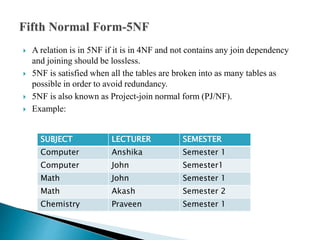
 A relation is in 5NF if it is in 4NF and not contains any join dependency
and joining should be lossless.
 5NF is satisfied when all the tables are broken into as many tables as
possible in order to avoid redundancy.
 5NF is also known as Project-join normal form (PJ/NF).
 Example:
SUBJECT LECTURER SEMESTER
Computer Anshika Semester 1
Computer John Semester1
Math John Semester 1
Math Akash Semester 2
Chemistry Praveen Semester 1
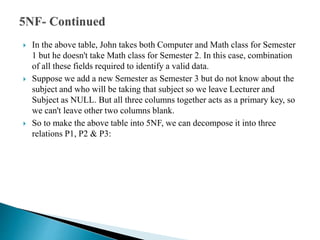
 In the above table, John takes both Computer and Math class for Semester
1 but he doesn't take Math class for Semester 2. In this case, combination
of all these fields required to identify a valid data.
 Suppose we add a new Semester as Semester 3 but do not know about the
subject and who will be taking that subject so we leave Lecturer and
Subject as NULL. But all three columns together acts as a primary key, so
we can't leave other two columns blank.
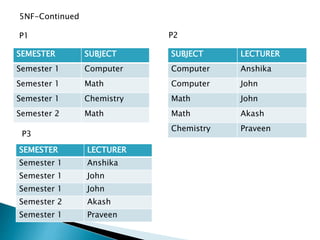
 So to make the above table into 5NF, we can decompose it into three
relations P1, P2 & P3:
SEMESTER SUBJECT
Semester 1 Computer
Semester 1 Math
Semester 1 Chemistry
Semester 2 Math
5NF-Continued
P1
SUBJECT LECTURER
Computer Anshika
Computer John
Math John
Math Akash
Chemistry Praveen
P2
P3
SEMESTER LECTURER
Semester 1 Anshika
Semester 1 John
Semester 1 John
Semester 2 Akash
Semester 1 Praveen
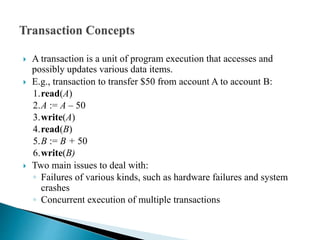
 A transaction is a unit of program execution that accesses and
possibly updates various data items.
 E.g., transaction to transfer $50 from account A to account B:
1.read(A)
2.A := A – 50
3.write(A)
4.read(B)
5.B := B + 50
6.write(B)
 Two main issues to deal with:
◦ Failures of various kinds, such as hardware failures and system
crashes
◦ Concurrent execution of multiple transactions
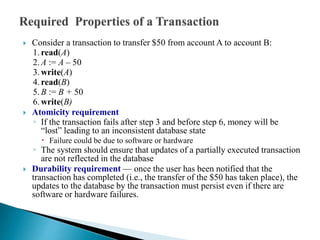
 Consider a transaction to transfer $50 from account A to account B:
1.read(A)
2.A := A – 50
3.write(A)
4.read(B)
5.B := B + 50
6.write(B)
 Atomicity requirement
◦ If the transaction fails after step 3 and before step 6, money will be
“lost” leading to an inconsistent database state
 Failure could be due to software or hardware
◦ The system should ensure that updates of a partially executed transaction
are not reflected in the database
 Durability requirement — once the user has been notified that the
transaction has completed (i.e., the transfer of the $50 has taken place), the
updates to the database by the transaction must persist even if there are
software or hardware failures.
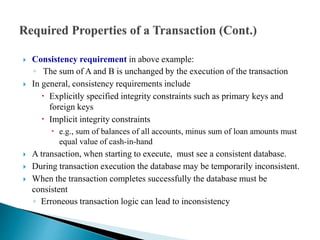
 Consistency requirement in above example:
◦ The sum of A and B is unchanged by the execution of the transaction
 In general, consistency requirements include
 Explicitly specified integrity constraints such as primary keys and
foreign keys
 Implicit integrity constraints
 e.g., sum of balances of all accounts, minus sum of loan amounts must
equal value of cash-in-hand
 A transaction, when starting to execute, must see a consistent database.
 During transaction execution the database may be temporarily inconsistent.
 When the transaction completes successfully the database must be
consistent
◦ Erroneous transaction logic can lead to inconsistency
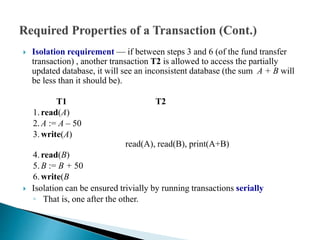
 Isolation requirement — if between steps 3 and 6 (of the fund transfer
transaction) , another transaction T2 is allowed to access the partially
updated database, it will see an inconsistent database (the sum A + B will
be less than it should be).
T1 T2
1.read(A)
2.A := A – 50
3.write(A)
read(A), read(B), print(A+B)
4.read(B)
5.B := B + 50
6.write(B
 Isolation can be ensured trivially by running transactions serially
◦ That is, one after the other.
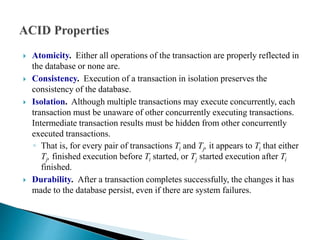
 Atomicity. Either all operations of the transaction are properly reflected in
the database or none are.
 Consistency. Execution of a transaction in isolation preserves the
consistency of the database.
 Isolation. Although multiple transactions may execute concurrently, each
transaction must be unaware of other concurrently executing transactions.
Intermediate transaction results must be hidden from other concurrently
executed transactions.
◦ That is, for every pair of transactions Ti and Tj, it appears to Ti that either
Tj, finished execution before Ti started, or Tj started execution after Ti
finished.
 Durability. After a transaction completes successfully, the changes it has
made to the database persist, even if there are system failures.
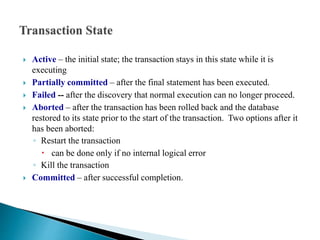
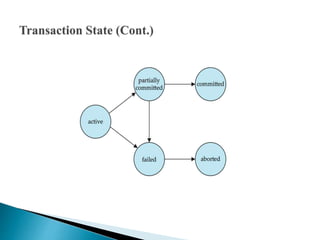
 Active – the initial state; the transaction stays in this state while it is
executing
 Partially committed – after the final statement has been executed.
 Failed -- after the discovery that normal execution can no longer proceed.
 Aborted – after the transaction has been rolled back and the database
restored to its state prior to the start of the transaction. Two options after it
has been aborted:
◦ Restart the transaction
 can be done only if no internal logical error
◦ Kill the transaction
 Committed – after successful completion.
 Multiple transactions are allowed to run concurrently in the system.
Advantages are:
◦ Increased processor and disk utilization, leading to better transaction
throughput
 E.g. one transaction can be using the CPU while another is reading
from or writing to the disk
◦ Reduced average response time for transactions: short transactions
need not wait behind long ones.
 Concurrency control schemes – mechanisms to achieve isolation
◦ That is, to control the interaction among the concurrent transactions in
order to prevent them from destroying the consistency of the database
 Schedule – a sequences of instructions that specify the chronological order
in which instructions of concurrent transactions are executed
◦ A schedule for a set of transactions must consist of all instructions of
those transactions
◦ Must preserve the order in which the instructions appear in each
individual transaction.
 A transaction that successfully completes its execution will have a commit
instructions as the last statement
◦ By default transaction assumed to execute commit instruction as its last
step
 A transaction that fails to successfully complete its execution will have an
abort instruction as the last statement
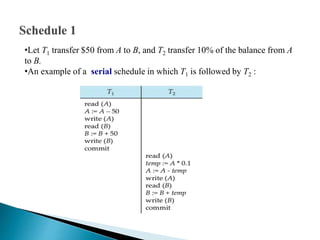
•Let T1 transfer $50 from A to B, and T2 transfer 10% of the balance from A
to B.
•An example of a serial schedule in which T1 is followed by T2 :
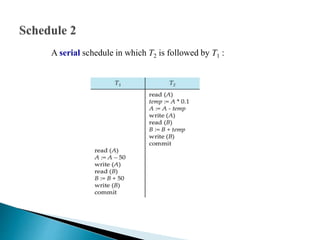
A serial schedule in which T2 is followed by T1 :
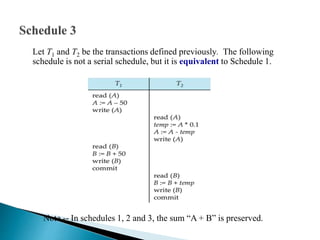
Let T1 and T2 be the transactions defined previously. The following
schedule is not a serial schedule, but it is equivalent to Schedule 1.
Note -- In schedules 1, 2 and 3, the sum “A + B” is preserved.
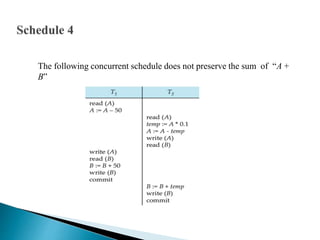
The following concurrent schedule does not preserve the sum of “A +
B”

Join dependency

  • 1.
  • 2.
    What is joindependency?  If a table can be recreated by joining multiple tables and each of this table have a subset of the attributes of the table, then the table is in Join Dependency.  It is a generalization of Multivalued Dependency  If the join of R1 and R2 over C is equal to relation R, then we can say that a join dependency (JD) exists.  Where R1 and R2 are the decompositions R1(A, B, C) and R2(C, D) of a given relations R (A, B, C, D).  Alternatively, R1 and R2 are a lossless decomposition of R.  A JD ⋈ {R1, R2,..., Rn} is said to hold over a relation R if R1, R2,....., Rn is a lossless-join decomposition.  The *(A, B, C, D), (C, D) will be a JD of R if the join of join's attribute is equal to the relation R.  Here, *(R1, R2, R3) is used to indicate that relation R1, R2, R3 and so on are a JD of R.
  • 3.
    Empname EmpSkills EmpJob(Assigned Work) Tom Networking EJ001 Harry Web Development EJ002 Katie Programming EJ002 Emp Name EmpSkills Tom Networking Harry Web Development Katie Programming The table can be decomposed into 3 tables <EmployeeSkills>
  • 4.
    EmpName EmpJob Tom EJ001 HarryEJ002 Katie EJ002 <EmployeeJob> <JobSkills> EmpSkills EmpJob Networking EJ001 Web Development EJ002 Programming EJ002 Join dependency {(EmpName, EmpSkills ), ( EmpName, EmpJob), (EmpSkills, EmpJob)}
  • 5.
     A relationis in 5NF if it is in 4NF and not contains any join dependency and joining should be lossless.  5NF is satisfied when all the tables are broken into as many tables as possible in order to avoid redundancy.  5NF is also known as Project-join normal form (PJ/NF).  Example: SUBJECT LECTURER SEMESTER Computer Anshika Semester 1 Computer John Semester1 Math John Semester 1 Math Akash Semester 2 Chemistry Praveen Semester 1
  • 6.
     In theabove table, John takes both Computer and Math class for Semester 1 but he doesn't take Math class for Semester 2. In this case, combination of all these fields required to identify a valid data.  Suppose we add a new Semester as Semester 3 but do not know about the subject and who will be taking that subject so we leave Lecturer and Subject as NULL. But all three columns together acts as a primary key, so we can't leave other two columns blank.  So to make the above table into 5NF, we can decompose it into three relations P1, P2 & P3:
  • 7.
    SEMESTER SUBJECT Semester 1Computer Semester 1 Math Semester 1 Chemistry Semester 2 Math 5NF-Continued P1 SUBJECT LECTURER Computer Anshika Computer John Math John Math Akash Chemistry Praveen P2 P3 SEMESTER LECTURER Semester 1 Anshika Semester 1 John Semester 1 John Semester 2 Akash Semester 1 Praveen
  • 8.
     A transactionis a unit of program execution that accesses and possibly updates various data items.  E.g., transaction to transfer $50 from account A to account B: 1.read(A) 2.A := A – 50 3.write(A) 4.read(B) 5.B := B + 50 6.write(B)  Two main issues to deal with: ◦ Failures of various kinds, such as hardware failures and system crashes ◦ Concurrent execution of multiple transactions
  • 9.
     Consider atransaction to transfer $50 from account A to account B: 1.read(A) 2.A := A – 50 3.write(A) 4.read(B) 5.B := B + 50 6.write(B)  Atomicity requirement ◦ If the transaction fails after step 3 and before step 6, money will be “lost” leading to an inconsistent database state  Failure could be due to software or hardware ◦ The system should ensure that updates of a partially executed transaction are not reflected in the database  Durability requirement — once the user has been notified that the transaction has completed (i.e., the transfer of the $50 has taken place), the updates to the database by the transaction must persist even if there are software or hardware failures.
  • 10.
     Consistency requirementin above example: ◦ The sum of A and B is unchanged by the execution of the transaction  In general, consistency requirements include  Explicitly specified integrity constraints such as primary keys and foreign keys  Implicit integrity constraints  e.g., sum of balances of all accounts, minus sum of loan amounts must equal value of cash-in-hand  A transaction, when starting to execute, must see a consistent database.  During transaction execution the database may be temporarily inconsistent.  When the transaction completes successfully the database must be consistent ◦ Erroneous transaction logic can lead to inconsistency
  • 11.
     Isolation requirement— if between steps 3 and 6 (of the fund transfer transaction) , another transaction T2 is allowed to access the partially updated database, it will see an inconsistent database (the sum A + B will be less than it should be). T1 T2 1.read(A) 2.A := A – 50 3.write(A) read(A), read(B), print(A+B) 4.read(B) 5.B := B + 50 6.write(B  Isolation can be ensured trivially by running transactions serially ◦ That is, one after the other.
  • 12.
     Atomicity. Eitherall operations of the transaction are properly reflected in the database or none are.  Consistency. Execution of a transaction in isolation preserves the consistency of the database.  Isolation. Although multiple transactions may execute concurrently, each transaction must be unaware of other concurrently executing transactions. Intermediate transaction results must be hidden from other concurrently executed transactions. ◦ That is, for every pair of transactions Ti and Tj, it appears to Ti that either Tj, finished execution before Ti started, or Tj started execution after Ti finished.  Durability. After a transaction completes successfully, the changes it has made to the database persist, even if there are system failures.
  • 13.
     Active –the initial state; the transaction stays in this state while it is executing  Partially committed – after the final statement has been executed.  Failed -- after the discovery that normal execution can no longer proceed.  Aborted – after the transaction has been rolled back and the database restored to its state prior to the start of the transaction. Two options after it has been aborted: ◦ Restart the transaction  can be done only if no internal logical error ◦ Kill the transaction  Committed – after successful completion.
  • 15.
     Multiple transactionsare allowed to run concurrently in the system. Advantages are: ◦ Increased processor and disk utilization, leading to better transaction throughput  E.g. one transaction can be using the CPU while another is reading from or writing to the disk ◦ Reduced average response time for transactions: short transactions need not wait behind long ones.  Concurrency control schemes – mechanisms to achieve isolation ◦ That is, to control the interaction among the concurrent transactions in order to prevent them from destroying the consistency of the database
  • 16.
     Schedule –a sequences of instructions that specify the chronological order in which instructions of concurrent transactions are executed ◦ A schedule for a set of transactions must consist of all instructions of those transactions ◦ Must preserve the order in which the instructions appear in each individual transaction.  A transaction that successfully completes its execution will have a commit instructions as the last statement ◦ By default transaction assumed to execute commit instruction as its last step  A transaction that fails to successfully complete its execution will have an abort instruction as the last statement
  • 17.
    •Let T1 transfer$50 from A to B, and T2 transfer 10% of the balance from A to B. •An example of a serial schedule in which T1 is followed by T2 :
  • 18.
    A serial schedulein which T2 is followed by T1 :
  • 19.
    Let T1 andT2 be the transactions defined previously. The following schedule is not a serial schedule, but it is equivalent to Schedule 1. Note -- In schedules 1, 2 and 3, the sum “A + B” is preserved.
  • 20.
    The following concurrentschedule does not preserve the sum of “A + B”